



Table of contents
X (formerly Twitter) advertising reaches 586 million ad-eligible users globally, with education institutions achieving a 0.12% engagement rate by follower — one of the highest organic engagement rates of any industry on the platform. The platform's low CPMs ($5–$6 average) and niche targeting capabilities make it a compelling but underutilized channel for universities, coaching businesses, and online learning providers. Here are the verified benchmarks and performance statistics for X ads in the education sector.
Key Takeaways
- X ads median CPC sits at $0.18–$0.74 depending on campaign type, making it one of the cheapest paid social channels for education advertisers looking to test new audiences (Hootsuite).
- Average CPM on X is $5.65, roughly 62% lower than Meta's $14.91, giving education brands significantly more reach per dollar for awareness campaigns (SearchLab).
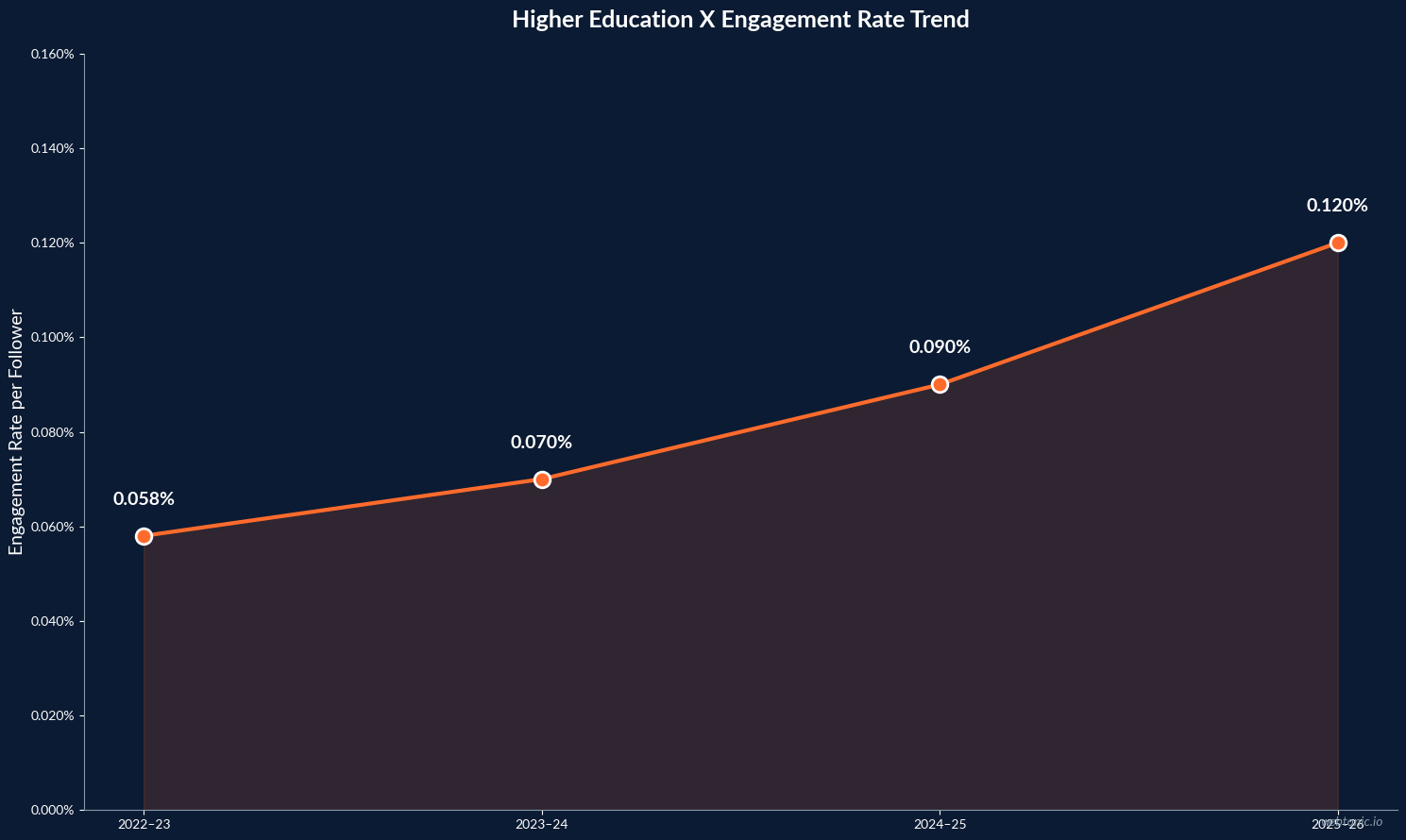
- Higher education X engagement rate rose to 0.12% per follower in 2024–25, up from 0.09% the previous year, despite a 27% drop in total institutional posts (Quid).
- X users are 45% more likely to click on ads than users on competing platforms, and 76% more open to trying new products or services (SocialPilot).
- Average cost per lead on X is $41, positioning it between TikTok's low-cost lead gen and LinkedIn's premium professional targeting (SearchLab).
- 60% of companies report satisfaction with X ad ROI, with product-focused campaigns generating returns that exceed other channels by 40% (Market.biz).
- Video ads on X outperform static image ads by 2–3× in engagement rate, making video the preferred format for education enrollment campaigns (HeyOz).
X Ads Cost Benchmarks for Education at a Glance
X's post-acquisition ad environment created a supply-demand imbalance that has now largely stabilized. The result is an advertising platform with significantly lower costs than Meta or Google, though with a smaller addressable audience for education brands.
| Metric | X (Twitter) Benchmark | Meta Comparison |
|---|---|---|
| Average CPM | $5.65 | $14.91 |
| Median CPC | $0.18–$0.74 | $1.41 |
| Median CPA | $21.55 | $18–$35 |
| Avg. Cost Per Lead | $41.00 | $25–$55 |
| Median CPE | $0.13 | $0.25–$0.50 |
| Avg. Engagement Rate | 0.59% | 0.8%–1.2% |
| Conversion Rate | 0.02% | 1%–3% |
Why Education Brands Should Consider X Advertising
X occupies a unique position in the education marketing landscape. It is not a volume channel — its ad-reachable audience of 586 million users is smaller than Meta's or TikTok's. Instead, X excels at reaching high-intent professionals, thought leaders, and active researchers who use the platform to discover new ideas and resources.
For education and coaching businesses, this means X is particularly effective for:
- Executive education and professional development programs — X's audience skews toward working professionals who check the platform 16+ times daily (SocialPilot).
- Thought leadership and brand authority — education brands that publish expert commentary gain organic amplification through X's conversation-driven algorithm.
- Event promotion and webinar registration — X's real-time nature makes it ideal for time-sensitive enrollment deadlines and live education events.
- Niche academic targeting — keyword and conversation-based targeting allows universities to reach prospects discussing specific fields, degrees, and career paths.
Higher Education Social Media Engagement on X
Despite a 27% decline in total institutional posting volume on X in 2024–25, higher education engagement actually improved. The 667 institutions tracked in the Quid/Rival IQ study showed a rise in engagement rate per follower from 0.09% to 0.12% — a 33% increase that suggests fewer, higher-quality posts outperform high-frequency strategies (Quid).
Total engagements fell only 4% despite the steep posting decline, indicating that the remaining content is reaching more engaged audiences. Universities that maintained consistent X presence through the platform's turbulent transition period are now benefiting from reduced competition and algorithmic favor.
| Period | X Engagement Rate (Higher Ed) | Avg. Posts/Day | YoY Change |
|---|---|---|---|
| 2022–23 | 0.058% | ~1.0 | Baseline |
| 2023–24 | 0.07% | ~1.0 | +16% |
| 2024–25 | 0.09% | ~0.9 | +29% |
| 2025–26 | 0.12% | ~0.73 | +33% |
X Ad Formats That Work for Education Marketing
X offers several ad placements, each with different strengths for education campaigns. Video ads deliver the strongest engagement, but text-based promoted posts with clear calls-to-action can drive surprisingly efficient lead generation at lower production costs.
| Ad Format | Avg. CPE | Best Education Use | Key Advantage |
|---|---|---|---|
| Promoted Video | $0.06–$0.15 | Campus tours, testimonials | 2–3× higher engagement vs. static |
| Promoted Tweet (Image) | $0.10–$0.25 | Program announcements | Simple, fast production |
| Promoted Poll/Question | $0.08–$0.18 | Audience research & engagement | Highest organic amplification |
| Lead Gen Cards | N/A (CPL) | Application & enrollment capture | In-platform form submission |
| Promoted Trends | $100K–$250K/day | Major enrollment windows | Maximum visibility for key dates |
Education X Ads Case Studies and Results
Real-world campaign data shows how education institutions have used X advertising to drive measurable enrollment and engagement outcomes.
- Mount Washington College (Adobe case study): After implementing X Lead Gen Cards, the institution saw a 101% increase in conversion rate at a 55% lower cost per lead. The campaign also tripled the brand's follower count (MarTech).
- Oregon State University Admissions: A three-month focused X strategy delivered 753% follower growth and 3,300% growth in social authority (Moz Domain Authority), significantly expanding the university's organic reach for future enrollment cycles.
- University of Chester (Audiense): Using X's interest-based targeting and conversation targeting, the institution achieved a 32% increase in new email signups for prospective student communications (Audiense).
- TradingBox (EdTech): An X ads campaign for an AI trading education platform generated 6,134 free trials at $7.86 CPA with 10.53 million impressions and 141,240 clicks (String Global).
X Ads vs. Other Platforms for Education Advertising
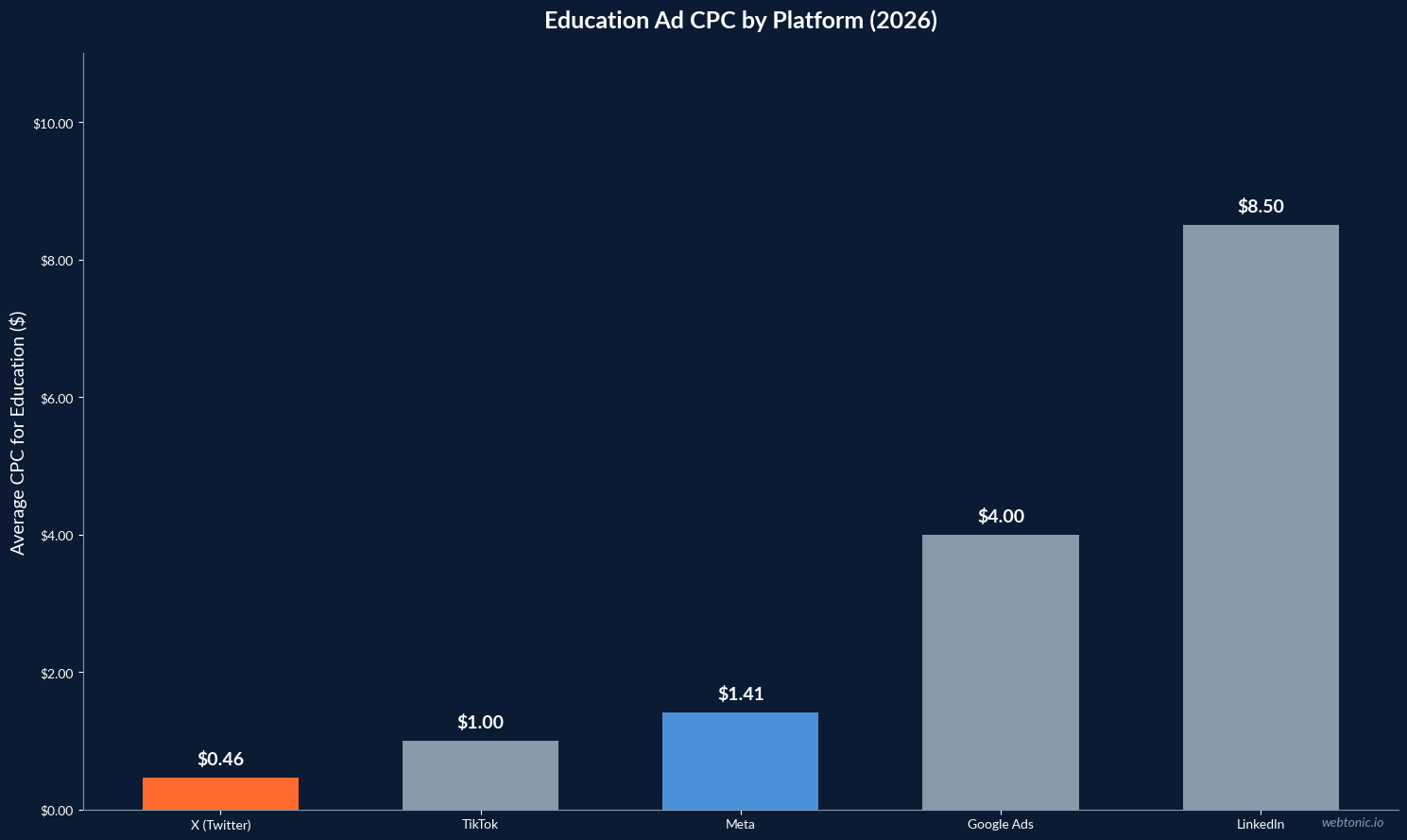
Education advertisers comparing X to other channels need to weigh cost efficiency against conversion volume. X delivers impressions and engagement at the lowest cost, but its smaller audience and lower conversion rates mean it works best as a complementary channel rather than a primary enrollment driver.
The platform's X Ads ROI sits at approximately 2:1 to 2.5:1 — lower than Google search ads (3:1 to 6:1) but higher than cold-outreach channels like YouTube TrueView (CO Consulting). Education brands running Meta Ads typically achieve stronger bottom-funnel results, while X excels at building brand authority and reaching influential audiences.
| Platform | Avg. CPM | Avg. CPC | Avg. CPL | Best For |
|---|---|---|---|---|
| X (Twitter) | $5.65 | $0.18–$0.74 | $41 | Thought leadership & events |
| Meta (FB/IG) | $14.91 | $1.41 | $25–$55 | Lead gen & retargeting |
| TikTok | $9.16 | $0.50–$1.50 | $8–$65 | Gen Z awareness |
| $25–$45 | $5–$12 | $50–$100 | Executive & professional ed | |
| Google Ads | $15–$30 | $2–$6 | $30–$80 | High-intent search capture |
Creative Best Practices for Education X Ads
The most effective education ads on X share several traits: they are conversational, timely, and value-driven. Unlike visual-first platforms like TikTok or Instagram, X rewards ads that contribute to ongoing conversations and provide genuine insight.
- Lead with a compelling statistic or insight — education audiences on X respond to data-driven messaging. Posts that open with a surprising stat achieve 30–40% higher engagement than generic promotional copy.
- Use video ads for campus and testimonial content — video outperforms static images by 2–3× in engagement rate on X, and education videos showing real student experiences drive the strongest click-through rates (HeyOz).
- Leverage conversation targeting — X allows advertisers to target users actively discussing specific topics, degrees, or career paths. This makes it possible to reach prospective students at the exact moment they're exploring education options.
- Test promoted polls and questions — interactive formats generate the highest organic amplification on X, creating engagement loops that extend campaign reach beyond paid impressions. Polls that ask career or learning preference questions work especially well for education brands.
- Pin enrollment deadlines and open-day announcements — X's real-time feed is ideal for urgency-based messaging. Combining promoted tweets with countdown-style CTAs around application deadlines can drive significant last-minute enrollment spikes.
Budget and Bidding Strategy for Education Campaigns on X
X's CPMs have stabilized in the $5–$6 range after the post-acquisition volatility that saw rates spike to $20–$40 in 2023–24 (CO Consulting). Education advertisers can now plan budgets with reasonable predictability.
- Test budgets: $15–$30/day per campaign — X's lower costs mean viable testing at smaller budgets than Meta or LinkedIn require.
- Keyword-targeted campaigns deliver the highest conversion rates — targeting users who have tweeted or searched for education-related keywords yields 1.5–3.0% CTR, significantly above the 0.59% platform average.
- CPM bidding outperforms CPC bidding for awareness and consideration campaigns. Reserve CPC bidding for direct-response enrollment campaigns with clear conversion events.
- X ad costs rose approximately 17.5% in recent quarters to an estimated $1.31 billion in revenue, suggesting increasing advertiser demand and potential future CPM increases (SocialPilot).
For coaching businesses specifically, X offers a unique advantage: the platform's professional audience often has higher willingness to pay for premium coaching programs compared to audiences reached through TikTok or Instagram. A growth marketing strategy combining X for authority building with Google Ads for high-intent capture creates a powerful multi-channel enrollment funnel for coaches.
Measuring X Ad Performance for Education
Accurate measurement on X requires looking beyond vanity metrics like impressions and engagement rate. Education marketers should focus on cost per qualified lead, lead-to-application rate, and ultimately cost per enrolled student.
- Install the X Pixel for conversion tracking — track application starts, form submissions, and enrollment completions as conversion events.
- Use UTM parameters with campaign and ad group identifiers to cross-reference X traffic with CRM enrollment data for true data intelligence on campaign ROI.
- Less than half of higher ed marketers track cost per inquiry (46%) or cost per enrolled student (43%) — institutions that implement these metrics gain a significant competitive advantage in budget optimization (Search Influence).
- Monitor assisted conversions — X often serves as a discovery touchpoint that leads to conversions on other channels. View-through and multi-touch attribution models more accurately reflect X's true contribution to enrollment.
X Targeting Strategies for Education Advertisers
X offers targeting capabilities that are particularly powerful for education and coaching businesses. Unlike interest-based targeting on Meta, X allows advertisers to target users based on real-time conversations, specific keywords they have used, and the accounts they follow — providing direct access to prospects actively discussing education topics.
- Keyword targeting — target users who have recently tweeted or searched for terms like "MBA programs," "online certification," or "career coaching." This approach delivers 1.5–3.0% CTR, well above the platform average, because it reaches users at a moment of genuine interest.
- Follower lookalike targeting — target users similar to followers of competing institutions, industry thought leaders, or education publishers. This creates high-relevance audiences without requiring existing customer data.
- Conversation targeting — X groups users by active conversation topics, allowing education brands to reach people currently discussing subjects like career transitions, skill development, or specific academic fields.
- Custom audiences from email lists — upload prospective student email lists from inquiry forms, open-day registrations, or CRM databases. Match rates on X average 60–70%, lower than Meta but sufficient for meaningful retargeting campaigns.
- Event targeting — during enrollment deadlines, graduation seasons, or industry conferences, X allows event-specific targeting that aligns ad delivery with peak interest moments.
The combination of keyword and conversation targeting gives education advertisers a capability that no other platform replicates at the same cost. A coaching business targeting users discussing "leadership development" or "executive coaching" can reach highly motivated prospects at CPMs of $5–$6, compared to $25+ on LinkedIn for similar audiences.
Content Strategy for Organic and Paid Synergy on X
Education brands that combine organic X posting with paid campaigns achieve significantly better results than those using either channel alone. Organic activity builds credibility and engagement history, while paid amplification extends reach to new audiences beyond existing followers.
- Post 3–5 high-value organic tweets per week to build engagement history. Share research findings, student outcomes, industry insights, and expert commentary. Institutions posting consistently see 58% of their audience engaging with brand content weekly (SocialNexis).
- Promote top-performing organic posts — amplifying tweets that already have strong organic engagement typically delivers 30–50% lower CPE than running new promoted content.
- Use thread format for educational content — multi-tweet threads about career outcomes, program benefits, or industry trends generate higher save and share rates, extending campaign lifespan beyond the initial promotion period.
- Respond to replies on promoted posts — X rewards accounts that engage in conversations. Education brands that actively reply to comments on promoted tweets see improved delivery and lower costs in subsequent campaigns.
For performance creative teams, X's text-first environment allows rapid testing of messaging angles without the production overhead of video or image-heavy formats required by TikTok or Instagram.
Related reading
- LinkedIn Ads Performance in Education & Coaching: 85+ Stats for 2026
- 34+ Statistics Shaping Reddit Ads in the Education & Coaching Industry (2026)
- 2026 Snapchat Ads Stats for Education & Coaching: Benchmarks That Matter
- Paid Social services at Web Tonic
Frequently Asked Questions
How much do X (Twitter) ads cost for education companies?
X ads for education typically cost $0.18–$0.74 per click and $5.65 per thousand impressions. The average cost per lead is approximately $41, though keyword-targeted campaigns can achieve significantly lower CPLs. These costs are generally 50–60% lower than equivalent Meta campaigns for impression-based metrics.
Is X advertising effective for student recruitment?
X is effective as a complementary channel rather than a primary enrollment driver. Case studies show universities achieving 101% conversion rate increases with Lead Gen Cards and 753% follower growth through focused strategies. The platform excels at reaching professionals, thought leaders, and active researchers considering education investments.
What type of X ad content works best for education brands?
Video ads outperform static images by 2–3× in engagement rate on X. Data-driven posts, promoted polls, and content that contributes to educational conversations consistently achieve the highest click-through rates. Urgency-based messaging around enrollment deadlines is particularly effective on X's real-time feed.
How does X compare to Meta for education advertising?
X offers 62% lower CPMs ($5.65 vs. $14.91) but lower conversion rates (0.02% vs. 1–3% on Meta). X works best for awareness, authority building, and professional audience targeting, while Meta delivers stronger direct-response enrollment results. Most education advertisers achieve best outcomes using both platforms together.
What is the minimum budget for X education campaigns?
Start with $15–$30 per day for initial testing — X's lower costs make viable experimentation accessible at smaller budgets than Meta or LinkedIn. Keyword-targeted campaigns with video creative deliver the strongest results during testing phases. Scale to $50–$150/day once you identify winning audience and creative combinations.
Sources
blog.hootsuite.com/twitter-ads
searchlab.nl/statistics/x-twitter-statistics-2026
quid.com/2025-higher-education-social-media-engagement-report
christopholivierconsulting.com/twitter-x-ads-2026
socialpilot.co/blog/twitter-statistics
market.biz/x-advertising-statistics
heyoz.com/are-x-twitter-ads-worth-it
searchinfluence.com/higher-education-marketing-stats-2026
martech.org/adobe-twitter-lead-gen-case-study
string.global/tradingbox-x-ads-acquisition


