Table of contents

WooCommerce runs on more of the open web (8.2% of all sites per W3Techs), while Shopify runs 32% GMV growth and a fifth straight quarter above 30% by its own Q2 2026 results. Neither statistic settles the argument alone — this page puts the 2026 share, growth and real cost numbers for both platforms side by side.
Key Takeaways
- WooCommerce runs on 8.2% of all websites (W3Techs, July 2026).
- That is 11.7% of sites with a known content management system.
- Shopify runs on 5.3% of all websites, 7.6% of CMS-identified sites.
- Shopify's Q2 2026 GMV hit USD 115.6 billion, up 32% year over year.
- Shopify Q2 2026 revenue reached USD 3.58 billion, up 34%.
- That marks Shopify's fifth consecutive quarter above 30% GMV growth.
- Shop Pay GMV grew 53% in the same quarter.
- Shopify Payments penetration reached 68% of global GMV.
- Shopify's Basic plan starts at USD 39/month (USD 29 billed yearly).
- Shopify card processing runs 2.9% + 30 cents down to 2.5% + 30 cents.
- WooCommerce is free software; hosting and infrastructure are unbundled.
- WooPayments charges 2.90% + USD 0.30 for US online card transactions.
- Realistic WooCommerce total cost of ownership runs USD 500-3,000+ a year.
- Managed WooCommerce hosting alone runs USD 25-200 a month.
- Shopify's Advanced plan drops transaction fees to 2.5% + 30 cents.
- Both platforms sit well ahead of Wix eCommerce (1.48% share).
Market share: two different ways to measure "biggest"
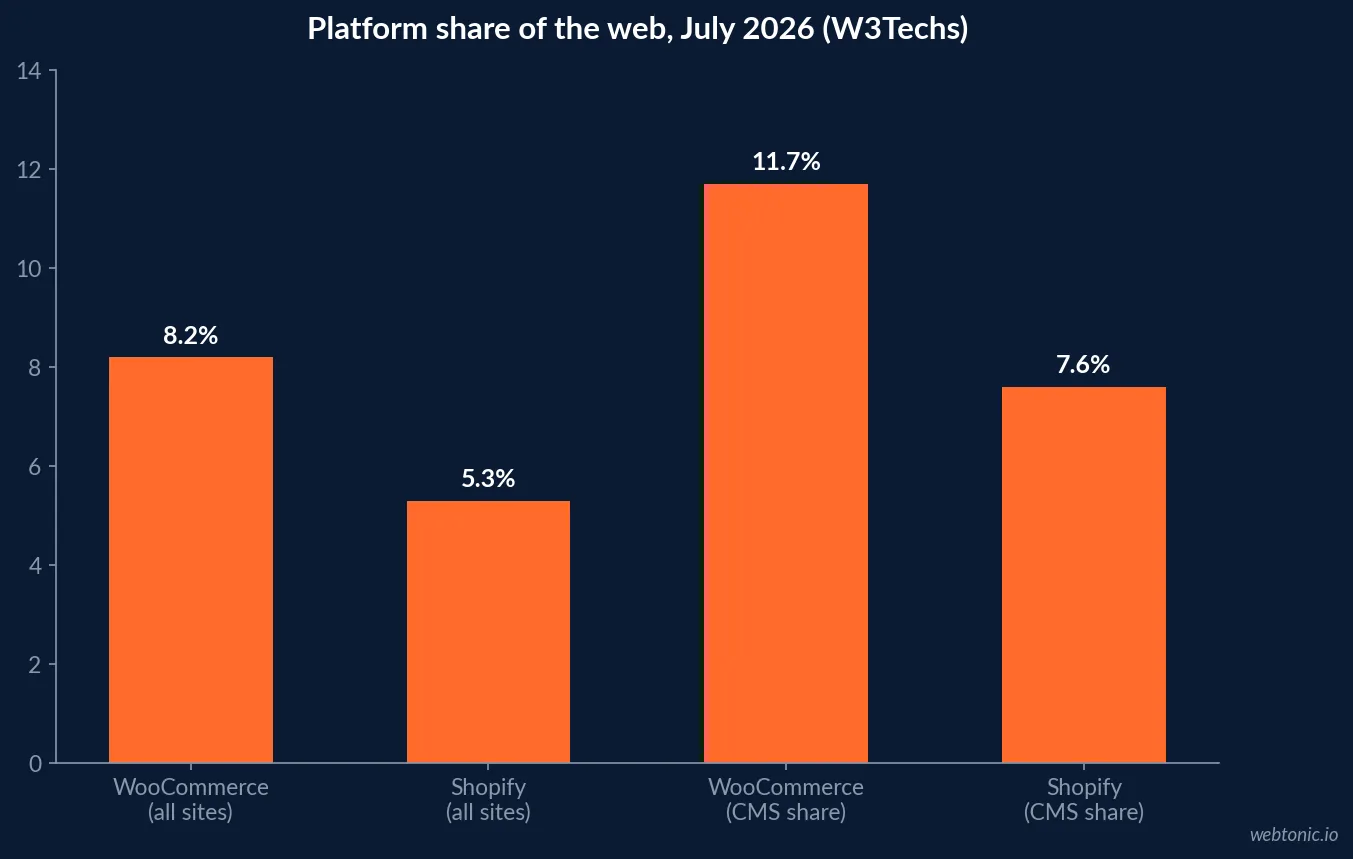
W3Techs reports WooCommerce used by 8.2% of all websites it tracks, a content management system market share of 11.7%, against Shopify at 5.3% of all websites and 7.6% of CMS-identified sites, as of July 2026. WooCommerce's advantage comes from being free plugin software installable on any of the millions of existing WordPress sites; Shopify's number reflects sites built specifically as paid, transacting stores from day one.
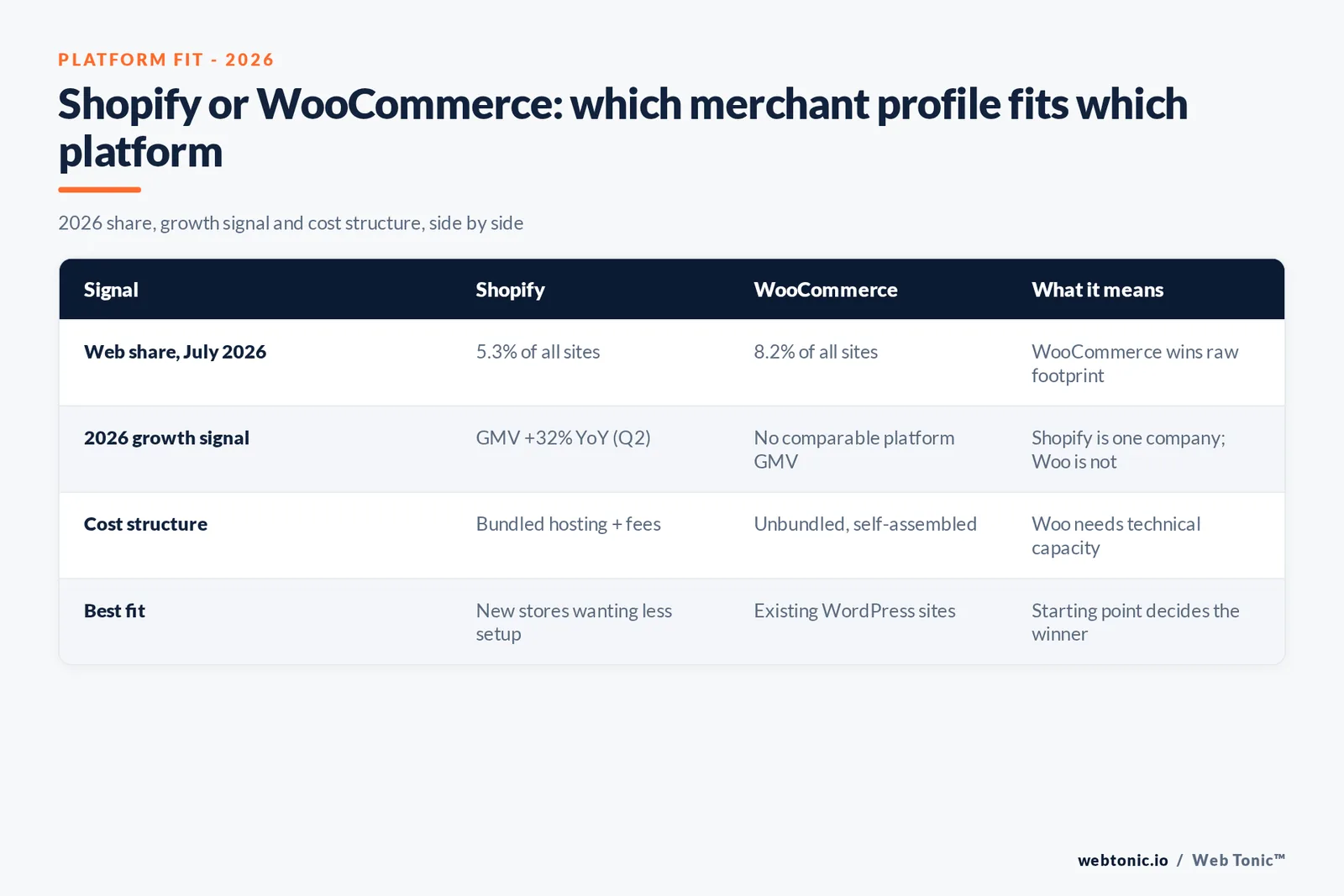
Read the wrong way, either number can be made to sound decisive. Read together, they describe two different products serving two different starting points: WooCommerce extends an existing site, Shopify launches a new one built to sell.
| Platform | Share of all websites | Share of CMS-identified sites | Source |
|---|---|---|---|
| WooCommerce | 8.2% | 11.7% | W3Techs, Jul 2026 |
| Shopify | 5.3% | 7.6% | W3Techs, Jul 2026 |
| WordPress (host CMS for WooCommerce) | 40.3% | 58.8% | W3Techs, Sep 2026 |
| Wix eCommerce | n/a | ~1.48% | GravityKit analysis, Jul 2026 |
Shopify's own growth numbers
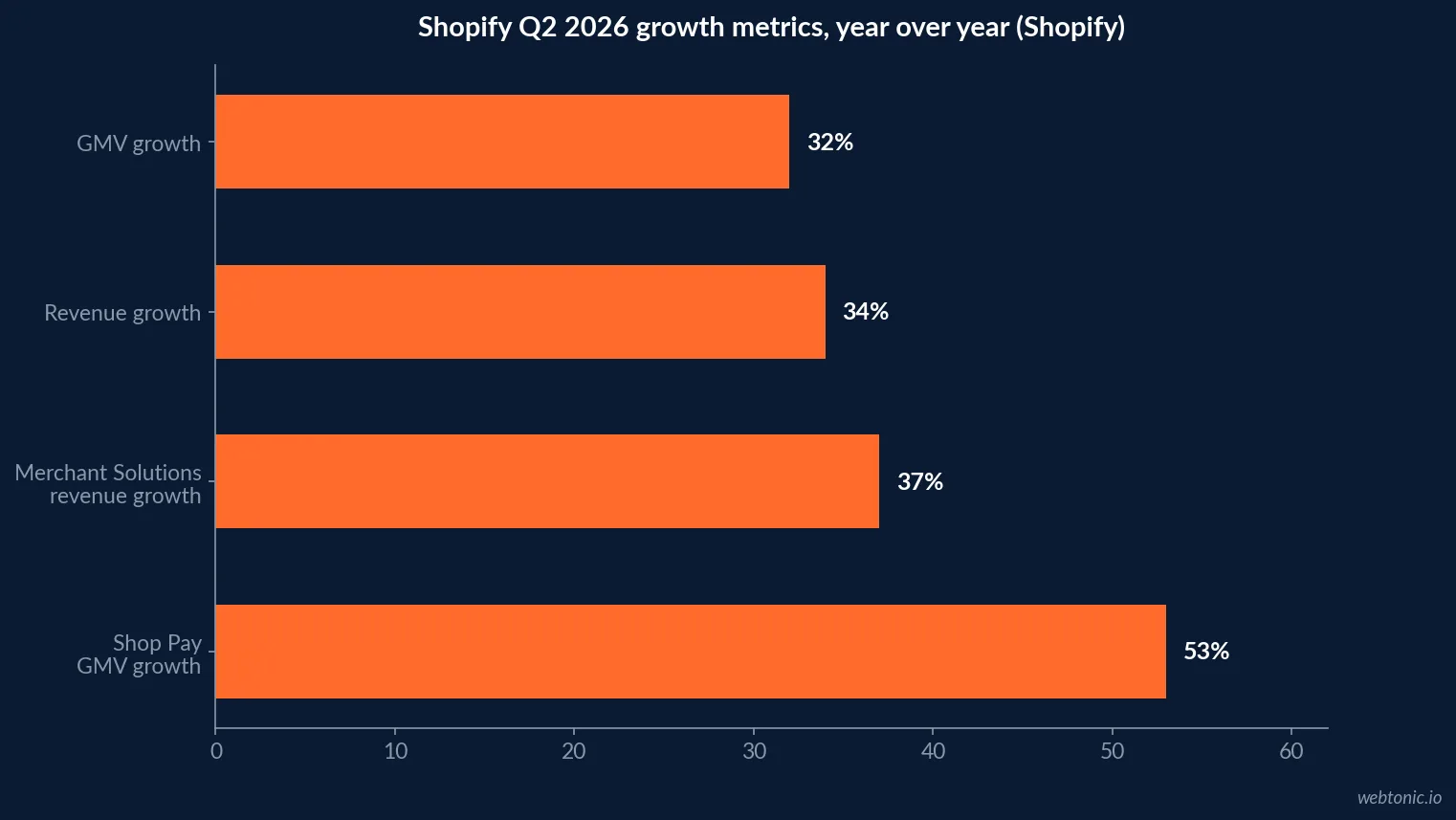
Shopify's Q2 2026 results reported Gross Merchandise Volume of USD 115.6 billion, up 32% year over year, and revenue of USD 3.58 billion, up 34% — its fifth consecutive quarter of GMV growth above 30%. Shop Pay GMV grew 53%, and Shopify Payments penetration reached 68% of global GMV, three points higher than a year earlier.
WooCommerce, as free open-source software distributed under Automattic's stewardship rather than a single revenue-reporting company, does not publish a comparable platform-wide GMV figure — a structural fact worth naming before comparing the two on "growth" as if they were the same kind of business.
| Shopify Q2 2026 metric | Value | YoY change | Source |
|---|---|---|---|
| GMV | USD 115.6 billion | +32% | Shopify Q2 2026 results |
| Revenue | USD 3.58 billion | +34% | Shopify Q2 2026 results |
| Merchant Solutions revenue | n/a | +37% | Shopify Q2 2026 results |
| Shop Pay GMV | n/a | +53% | Shopify Q2 2026 results |
| Shopify Payments penetration | 68% of global GMV | +3 pts | Shopify Q2 2026 results |
What each platform actually costs once the whole stack is priced
Shopify's pricing page lists the Basic plan at USD 39/month (USD 29 billed yearly), Grow at USD 105/month, and Advanced at USD 399/month, each bundling hosting, uptime and security into the subscription. Card processing runs 2.9% + 30 cents on Basic, improving to 2.5% + 30 cents on Advanced, plus an added surcharge for merchants who route payments through a non-Shopify gateway.
WooCommerce's own cost guide is explicit that hosting and infrastructure are unbundled from the free plugin, meaning a merchant assembles hosting, theme, extensions and a payment gateway separately. WooPayments charges 2.90% + USD 0.30 for US online card transactions with no platform-level penalty for choosing a different processor.
| Cost line | Shopify (bundled) | WooCommerce (unbundled) | Note |
|---|---|---|---|
| Entry monthly plan | USD 39 (USD 29/yr billed) | USD 0 (software is free) | WooCommerce needs separate hosting |
| Hosting | Included | ~USD 25-200/mo (managed) | Biggest hidden WooCommerce cost |
| Card processing | 2.9%+30c to 2.5%+30c | 2.90%+USD 0.30 (WooPayments) | Roughly comparable at entry tier |
| Realistic annual total | ~USD 470-4,800/yr (plan tier) | ~USD 500-3,000+/yr | Ranges overlap more than headlines suggest |
| Extensions/apps | Shopify App Store fees vary | Premium plugins USD 29-299/yr each | Both add up fast at scale |
The installed base behind the share numbers
WooCommerce's own listing on wordpress.org reports 7+ million active installations of the plugin itself, a figure that counts every store from a hobbyist testing a single product to a seven-figure operation. BuiltWith's detection data tracks Shopify separately by live, transacting storefronts rather than plugin installs, which is the core reason the two platforms' headline numbers are not measuring the same thing: one counts software installs, the other counts stores confirmed to be live and selling.
Neither number is wrong. They are simply answering different questions, and a platform decision based on the wrong one of the two is a decision based on the wrong evidence.
| What is being counted | WooCommerce figure | Shopify figure | Source |
|---|---|---|---|
| Software installs / accounts | 7+ million active installations | Not published this way | wordpress.org |
| Live, detected storefronts | Lower than install count | Millions of live stores tracked | BuiltWith |
| Share of all websites | 8.2% | 5.3% | W3Techs, Jul 2026 |
Where the real trade-off sits
The cost comparison is closer than either platform's marketing suggests once hosting, extensions and processing are all counted, which means the deciding factor for most merchants is not price but control versus convenience. WooCommerce hands over more configuration surface — and more responsibility for keeping that surface secure and fast. Shopify trades some of that control for a subscription that keeps checkout, uptime and PCI compliance someone else's problem.
For merchants already running WordPress for content, WooCommerce keeps everything in one ecosystem. For merchants launching a store with no existing WordPress investment, Shopify's bundled infrastructure removes an entire category of technical decisions before the first product is listed.
Switching costs: what a migration actually involves
Neither platform makes switching trivial, and the published pricing pages understate the real cost of a migration. Moving from WooCommerce to Shopify means exporting products, customers and order history, rebuilding any custom PHP functionality as a Shopify app or theme customization, and re-training staff on a fundamentally different admin. Moving the other direction means giving up Shopify's bundled hosting and taking on responsibility for uptime, backups and PCI compliance that Shopify previously handled invisibly.
Shopify's own plan structure assumes most stores stay on one plan tier for a year or more, and WooCommerce's cost guide is candid that a custom-built stack has real switching costs baked into every plugin and theme choice. The practical rule: budget a migration as a project with its own cost, not as a free byproduct of a platform decision.
| Migration direction | What has to be rebuilt | Typical hidden cost | Who it suits |
|---|---|---|---|
| WooCommerce to Shopify | Custom PHP logic, plugin-dependent features | Developer time re-platforming | Merchants outgrowing self-hosting |
| Shopify to WooCommerce | Hosting, security, backups, PCI setup | New hosting + dev retainer | Merchants wanting full control |
| Either direction | SEO redirects, historical order data | Traffic dip during cutover | Any merchant switching platforms |
What the trend lines suggest for 2027
Shopify's share of CMS-identified sites climbed from 6.7% to 7.8% over the trailing year tracked by W3Techs, a steady gain rather than a spike, while its GMV growth rate has held above 30% for five straight quarters. WooCommerce's headline share has been essentially flat over the same window, consistent with a mature, saturated installed base rather than a declining one. Neither trend line points to an imminent platform collapse on either side; both point to two durable, differently-shaped businesses.
The practical takeaway for a 2026 or 2027 platform decision is to price the full stack, not the headline plan cost, and to weight that against how much in-house technical capacity exists to manage an unbundled WooCommerce build. Our growth marketing team works across both ecosystems, and a scoping call is the fastest way to size the real total cost for a specific catalog and traffic level. Once the platform is settled, the harder question is usually the storefront's actual conversion path — our performance creative practice works across both ecosystems on that layer.
Frequently Asked Questions
Which platform has more market share in 2026, Shopify or WooCommerce?
It depends on the measure. W3Techs puts WooCommerce at 8.2% of all websites (11.7% of sites with a known content management system) versus Shopify at 5.3% of all websites (7.6% of CMS-identified sites) as of July 2026. WooCommerce wins on raw web footprint because it is free to install on any WordPress site; Shopify wins among stores built specifically to transact at scale, where its share of top-1-million ecommerce sites runs meaningfully higher.
Is Shopify actually growing faster than WooCommerce right now?
On revenue, clearly. Shopify's own Q2 2026 results reported GMV of USD 115.6 billion, up 32% year over year, and revenue of USD 3.58 billion, up 34%, marking a fifth consecutive quarter of GMV growth above 30%. WooCommerce does not report comparable platform-wide GMV because it is open-source software distributed for free, not a single company with a P&L, which is itself a structural difference worth weighing before comparing growth rates directly.
Is WooCommerce actually cheaper than Shopify once hosting and plugins are counted?
Not automatically. WooCommerce's own cost guide states plainly that hosting and infrastructure are unbundled from the software, so a merchant assembles their own stack, while Shopify bundles hosting, security and uptime into its monthly subscription starting at USD 39/month (USD 29 billed yearly). Third-party research puts realistic annual WooCommerce total cost of ownership, including hosting, premium extensions and payment processing, in the same USD 500-3,000+ range that a mid-tier Shopify plan lands in over a year — the sticker price gap narrows fast once the full stack is priced.
Which platform charges lower transaction fees?
Shopify's own pricing page lists card processing at 2.9% + 30 cents on the Basic plan, improving to 2.5% + 30 cents on the Advanced plan, plus an additional fee if a merchant uses a non-Shopify payment gateway. WooCommerce's own WooPayments charges 2.90% + USD 0.30 for US online card transactions with no platform-level surcharge for using a different processor, since it is not a closed payments ecosystem the way Shopify Payments is.
Should a growing brand switch from WooCommerce to Shopify, or the reverse?
The published data supports neither move as a default. WooCommerce's flexibility and lower CMS-wide cost floor suit merchants who already run WordPress and want full control of hosting and extensions. Shopify's bundled infrastructure and 30%-plus GMV growth suit merchants who want to scale checkout reliability without managing a server. The switching decision should be driven by store complexity and internal technical capacity, not by which platform has the bigger headline share number.
Sources
W3Techs - WooCommerce vs. Shopify usage statistics, July 2026
W3Techs - Usage statistics and market share of content management systems
Shopify - Q2 2026 financial results
Shopify - Pricing
WooCommerce - The total cost of running a store on WooCommerce
WordPress.org - WooCommerce plugin listing and active installations
BuiltWith - Shopify web technology usage trends