Table of contents
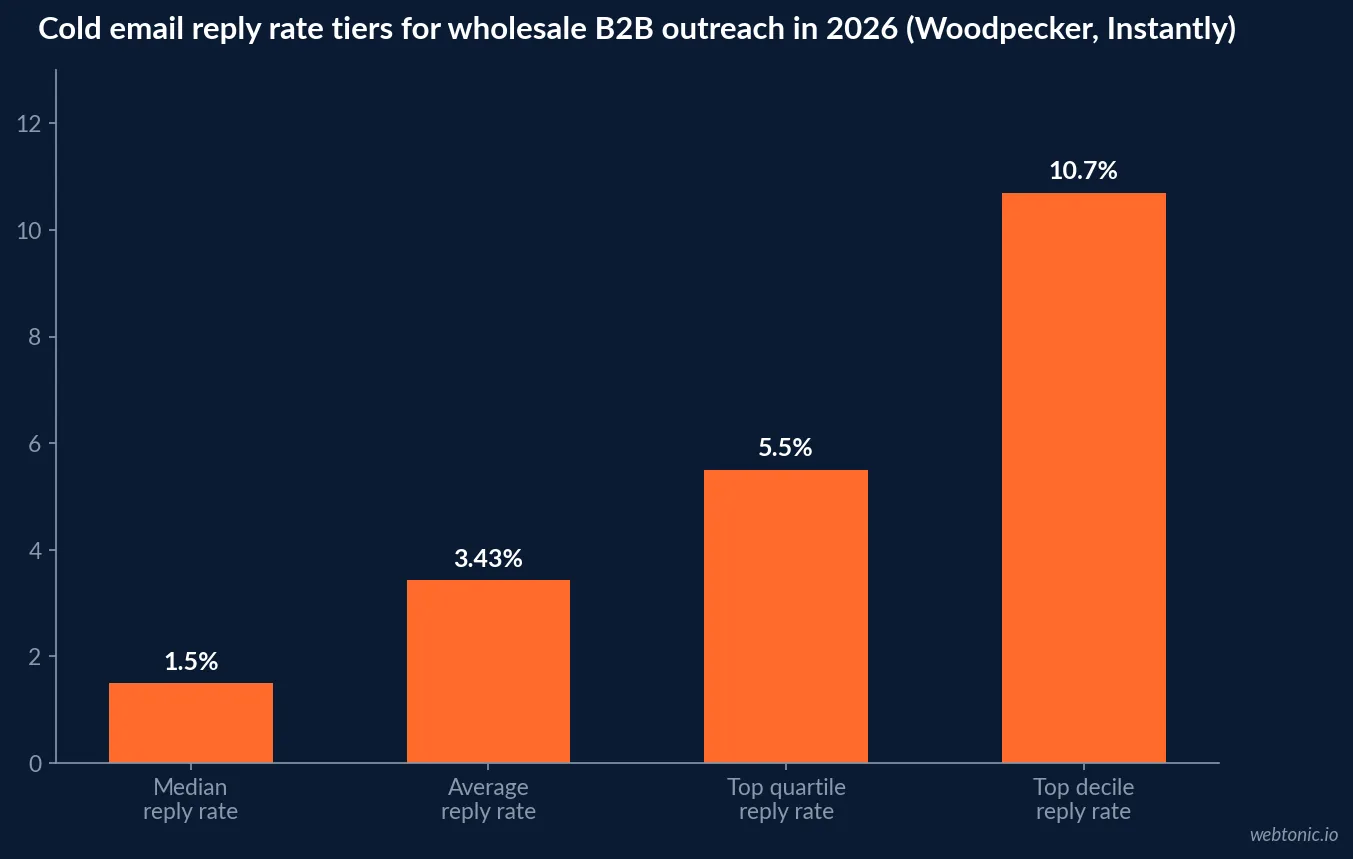
The median cold email reply rate across 56,614 campaigns tracked on one major platform is 1.5%, and a separate 2026 benchmark report puts the average at 3.43% with elite senders above 10%. The unit of analysis here is an e-commerce brand's B2B outbound motion - reaching wholesale buyers, retail stockists and suppliers - not marketing email to its own consumer list, which sits under a different set of rules entirely.
Key Takeaways
- Median cold email reply rate is 1.5% across 56,614 campaigns.
- Median cold email open rate is 26% across 37,000 campaigns.
- A separate 2026 benchmark puts the average reply rate at 3.43%.
- Top 25% of senders clear a 5.5% reply rate.
- Top 10% of senders clear a 10.7% reply rate.
- 58% of all replies come from the first email in a sequence.
- Remaining follow-ups still generate 42% of replies.
- Emails under 80 words perform best in the 2026 benchmark.
- 2-word subject lines get a 32% median open rate worldwide.
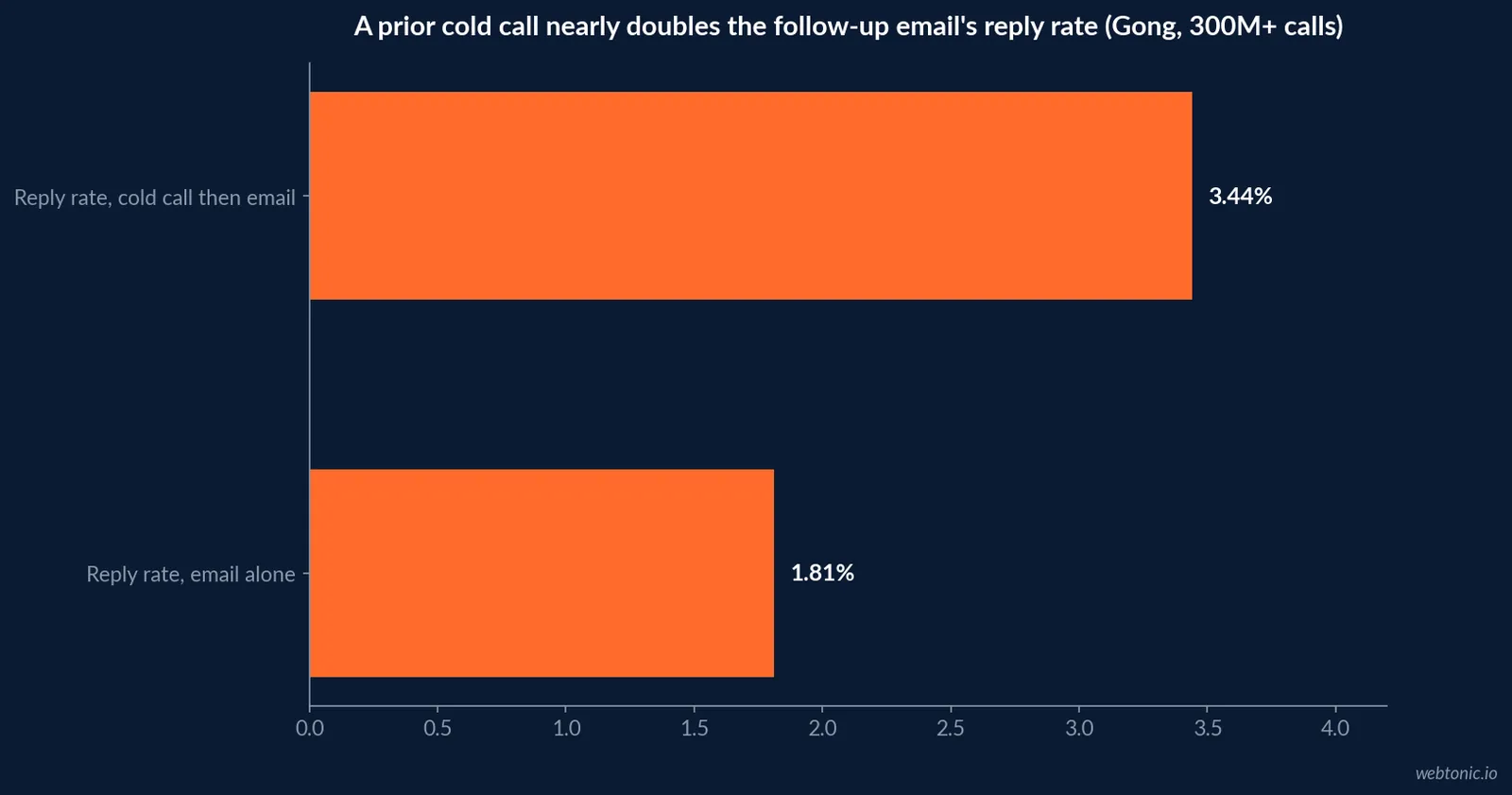
- A cold call nearly doubles the reply rate of a follow-up email, 3.44% vs 1.81%.
- Top 25% of sales reps land 4.3x more meetings than average.
- Top 10% of reps land 8.1x more meetings than average.
- C-level executives reply 30.2% less often than non-executives.
- InMails are 3x more likely accepted than a cold call, 6x more than email.
- A complete LinkedIn profile raises InMail acceptance by 87%.
- Google requires SPF, DKIM and DMARC for 5,000+ daily Gmail sends since Feb 1, 2024.
- Yahoo requires the same bulk-sender authentication stack via its Sender Hub.
- CAN-SPAM requires a working opt-out on every commercial email, honored within 10 days.
Where cold email fits an e-commerce brand's playbook
Consumer marketing email to an e-commerce brand's own list is opt-in and covered by CAN-SPAM, not cold outreach. The cold-email use case that actually applies to e-commerce is the B2B side of the same business: pitching a wholesale buyer, a boutique or big-box retail category manager, a distributor, or a supplier renegotiation - cold, unsolicited, first contact. That is a real B2B sales motion with the same reply-rate math as any other outbound program.
Woodpecker's platform benchmark tool, built from actual send data rather than a survey, puts the median open rate at 26% across 37,000 campaigns and the median reply rate at 1.5% across 56,614 campaigns - and flags reply rate as the number that actually matters, since open-rate tracking pixels are increasingly blocked by privacy features like Apple Mail Privacy Protection.
| Benchmark (2026) | Figure | Sample | Source |
|---|---|---|---|
| Median cold email open rate | 26% | 37,000 campaigns | Woodpecker platform data |
| Median cold email reply rate | 1.5% | 56,614 campaigns | Woodpecker platform data |
| Average cold email reply rate | 3.43% | Billions of tracked interactions | Instantly 2026 benchmark report |
| Top-quartile reply rate | 5.5%+ | Same dataset | Instantly 2026 benchmark report |
| Top-10% (elite) reply rate | 10.7%+ | Same dataset | Instantly 2026 benchmark report |
What actually moves the reply rate
Instantly's 2026 Cold Email Benchmark Report, drawn from billions of tracked cold email interactions, found that 58% of all replies come from the very first email in a sequence, with the remaining follow-up steps still contributing 42% of total replies - meaning a sequence that stops after one email leaves nearly half its replies uncollected. The same report found the best-performing campaigns keep messages under 80 words and refresh messaging with weekly A/B tests, and that Tuesday and Wednesday see the highest reply rates.
Subject line length matters more than most senders assume. Woodpecker's data across 9,000 campaigns shows worldwide 2-word subject lines get a 32% median open rate against 24% for 11-word subjects, while reply rate peaks slightly later, at 3 to 4 words.
| Sequence and copy lever | Benchmark figure | Source | Takeaway for a wholesale pitch |
|---|---|---|---|
| Share of replies from email 1 | 58% | Instantly 2026 benchmark report | First message still has to do the work |
| Share of replies from follow-ups | 42% | Instantly 2026 benchmark report | A single-email sequence forfeits nearly half the replies |
| Best-performing email length | Under 80 words | Instantly 2026 benchmark report | A buyer pitch should be shorter than a product pitch |
| 2-word subject line open rate (worldwide) | 32% | Woodpecker platform data | Short subjects outperform on open |
| Best reply-rate subject length | 3-4 words | Woodpecker platform data | Slightly longer than the open-rate optimum |
The rules that decide whether the email lands at all
Since February 1, 2024, Google's bulk sender guidelines require anyone sending 5,000 or more messages a day to Gmail accounts to authenticate with SPF and DKIM, publish a DMARC policy, and provide a one-click unsubscribe mechanism. Yahoo's Sender Hub imposes the equivalent requirement for its own bulk-sender threshold, including DMARC alignment with either the SPF or DKIM domain. Below the reply-rate question, this is the gate that decides whether the message reaches an inbox at all.
On top of the platform rules, the FTC's CAN-SPAM Act compliance guide requires every commercial email to carry accurate header and subject information, a clear commercial-message identifier, a valid postal address, and a working opt-out mechanism that must be honored within 10 business days. CAN-SPAM applies whether the recipient is a consumer or a wholesale buyer - it does not carve out B2B outreach.
Cold email versus the phone and versus LinkedIn
Gong's analysis of 300 million-plus cold calls found that making a cold call before a follow-up email nearly doubles that email's reply rate - 3.44% versus 1.81% for email alone, even when the call itself does not connect. Gong's separate 28-million-email analysis found the top 25% of reps land 4.3 times more meetings than average performers, and the top 10% land 8.1 times more. A third Gong dataset, covering more than a million executive sales cycles, found C-level executives reply 30.2% less often than non-executive contacts - relevant for e-commerce brands pitching a category buyer versus a founder.
LinkedIn's own prospecting data adds a third channel to the comparison: LinkedIn reports that InMails are 3 times more likely to be accepted than a cold call and 6 times more likely than a cold email, and that a complete sender profile raises InMail acceptance by 87%. That is an acceptance-rate figure specific to LinkedIn's own platform, not a revenue comparison, and it only applies to buyers who are reachable there - a meaningful share of independent retail buyers are not.
| Channel comparison (2026) | Figure | Source | Reading for wholesale outreach |
|---|---|---|---|
| Email reply rate lift from a prior cold call | 3.44% vs 1.81% (email alone) | Gong, 300M+ calls | Call-then-email beats email-only |
| Top-quartile rep meeting volume vs average | 4.3x more meetings | Gong, 28M+ emails | Rep skill compounds channel choice |
| Top-decile rep meeting volume vs average | 8.1x more meetings | Gong, 28M+ emails | The gap between good and great reps is large |
| C-level reply likelihood vs non-executive | 30.2% lower | Gong, 1M+ exec sales cycles | Target the buyer, not just the title |
| InMail acceptance vs cold call / cold email | 3x / 6x more likely accepted | LinkedIn own data | Best where the buyer is LinkedIn-active |
What happens when the list quality is wrong
Every benchmark above assumes a reasonably targeted list. Woodpecker's own analysis of subject-line data shows how much targeting swamps mechanics: median reply rates by subject length range from 0.25% to 1.48% depending on country and word count, a six-fold spread driven mostly by who is on the list, not what the subject line says. A wholesale buyer list scraped from a directory without checking product category fit will sit at the bottom of that range regardless of copywriting quality.
The same data source found the US market replies at lower rates than the rest of the world across almost every subject-length bin - a US buyer list should be budgeted against the lower end of published benchmarks, not the global median.
| List quality signal | Effect on reply rate | Source |
|---|---|---|
| Named buyer/category-manager contact vs generic inbox | Materially higher reply rate | Woodpecker platform data |
| US recipient vs rest-of-world recipient | Lower reply rate across most subject-length bins | Woodpecker platform data |
| Subject line 2-4 words vs 10+ words | Higher open and reply rate | Woodpecker platform data |
| Domain authenticated (SPF/DKIM/DMARC) vs not | Determines inbox placement before reply rate even applies | Google / Yahoo bulk sender rules |
What deliverability actually costs against paid channels
Woodpecker's own cost model, using its lowest sending tier, works out to roughly USD 36.25 a month to contact 500 people once fixed costs (a domain, a mailbox) are included. At a 1.5% to 1.9% reply rate and a typical 10% to 20% positive-reply share, that lands cost per acquired lead in the USD 18 to 40 range on Woodpecker's own worked example. WordStream's 2026 PPC benchmarks, drawn from more than 13,000 US-based campaigns, put the average Google Ads cost per lead at USD 66.69 across all industries. Cold email is not free - list building, verification and a sender's time all cost money the simple math skips - but the per-lead economics explain why B2B teams keep using it alongside paid search rather than instead of a wholesale outreach list built in-house.
| Channel | Reported cost per lead (2026) | Source |
|---|---|---|
| Cold email (Woodpecker worked example) | USD 18-40 | Woodpecker cost model, own platform pricing |
| Google Ads, all industries average | USD 66.69 | WordStream 2026 PPC Benchmarks (13,000+ campaigns) |
Deliverability signals to hold before scaling volume
Instantly's own reply-rate guide sets concrete deliverability floors: keep spam complaints under 0.3% and bounce rate under 2% before optimizing copy, since a domain that trips either threshold gets throttled by mailbox providers regardless of how good the message is. The same guide reports that adding a first follow-up increases total replies by 40% to 50%, and recommends 1 to 3 follow-ups over 7 to 14 days rather than a single send.
| Deliverability floor (2026) | Threshold | Source | Consequence of missing it |
|---|---|---|---|
| Spam complaint rate | Under 0.3% | Instantly reply-rate guide | Mailbox providers throttle or block the domain |
| Bounce rate | Under 2% | Instantly reply-rate guide | Signals a dirty or unverified list |
| First follow-up lift | +40-50% total replies | Instantly reply-rate guide | A single-send campaign leaves replies uncollected |
| Recommended follow-up cadence | 1-3 follow-ups over 7-14 days | Instantly reply-rate guide | Matches the 58%/42% first-touch split above |
Building the wholesale outreach program that survives the 2026 filters
Authenticate the sending domain before writing a single subject line - SPF, DKIM and a published DMARC policy are table stakes under both Google's and Yahoo's 2024 rules, not an optional upgrade. Keep the list to buyers and category managers you have a real reason to contact, cap daily volume per mailbox, and build a 3-to-5-step sequence rather than a single blast, since the data shows nearly half of all replies come after the first email. Where the buyer is reachable on the phone, call first: it roughly doubles the email reply rate that follows.
If your outbound program needs the deliverability and sequencing work done end to end, our growth marketing practice builds and audits exactly this kind of program, or read our breakdown of channel strategy fundamentals before allocating budget between outbound and paid acquisition, or talk to us about auditing an existing list.
Frequently Asked Questions
Do e-commerce brands actually use cold email, or is that a B2B SaaS tactic?
E-commerce brands use it, but on the B2B side of their own business: wholesale buyer outreach, retail partner and stockist prospecting, and supplier or 3PL negotiation, not marketing to their own consumer list, which is governed by opt-in and CAN-SPAM rules instead. Woodpecker's platform data across tens of thousands of campaigns shows a median reply rate of 1.5%, so wholesale cold outreach should be budgeted like any other B2B prospecting motion, not treated as a free channel.
What is a realistic cold email reply rate to expect in 2026?
Two vendor datasets converge on a similar range. Woodpecker's platform data (56,614 campaigns) puts the median reply rate at 1.5% and the median open rate at 26%. Instantly's 2026 benchmark report, drawn from billions of tracked interactions, puts the average reply rate at 3.43%, with the top 25% of senders clearing 5.5% and the top 10% clearing 10.7%. The gap between the two is mostly targeting and list quality, not the platform.
What changed with the 2024 Gmail and Yahoo sender rules?
Since February 1, 2024, Google requires any sender pushing 5,000 or more messages a day to Gmail accounts to authenticate with SPF and DKIM, publish a DMARC policy, and make one-click unsubscribe available; Yahoo's Sender Hub applies the same authentication and DMARC-alignment requirements for its own bulk-sender threshold. A wholesale outreach list that skips authentication now risks bulk filtering before a human buyer ever sees the message, regardless of how good the copy is.
Is cold email or cold calling more effective for reaching a buyer?
They compound rather than compete. Gong's analysis of 300 million-plus cold calls found that a cold call, even one that does not connect live, nearly doubles the email reply rate that follows it - 3.44% versus 1.81% for email alone. For e-commerce wholesale outreach, that argues for a phone-plus-email sequence over an email-only blast to a buyer list.
Does LinkedIn outperform cold email for reaching retail buyers?
LinkedIn's own data suggests its InMail format converts better per message: LinkedIn reports InMails are 3 times more likely to be accepted than a cold call and 6 times more likely than a cold email, and that a complete sender profile raises InMail acceptance by 87%. That is an acceptance-rate comparison, not a full revenue comparison, and it still requires the recipient to be reachable on LinkedIn - many wholesale buyers and store owners are not active users.
Sources
Woodpecker - Cold Email Benchmarks (platform data tool)
Instantly - Cold Email Benchmark Report 2026
Google Workspace Admin Help - Email sender guidelines
Yahoo Sender Hub - Sender Best Practices
Federal Trade Commission - CAN-SPAM Act Compliance Guide for Business
Gong - The hidden power of cold calling: insights from 300M calls
Gong - Do execs really reply to cold email?
LinkedIn Sales Solutions - What every InMail sent in 2022 told us
WordStream - Digital Benchmarks by Industry: PPC (2026)