Table of contents

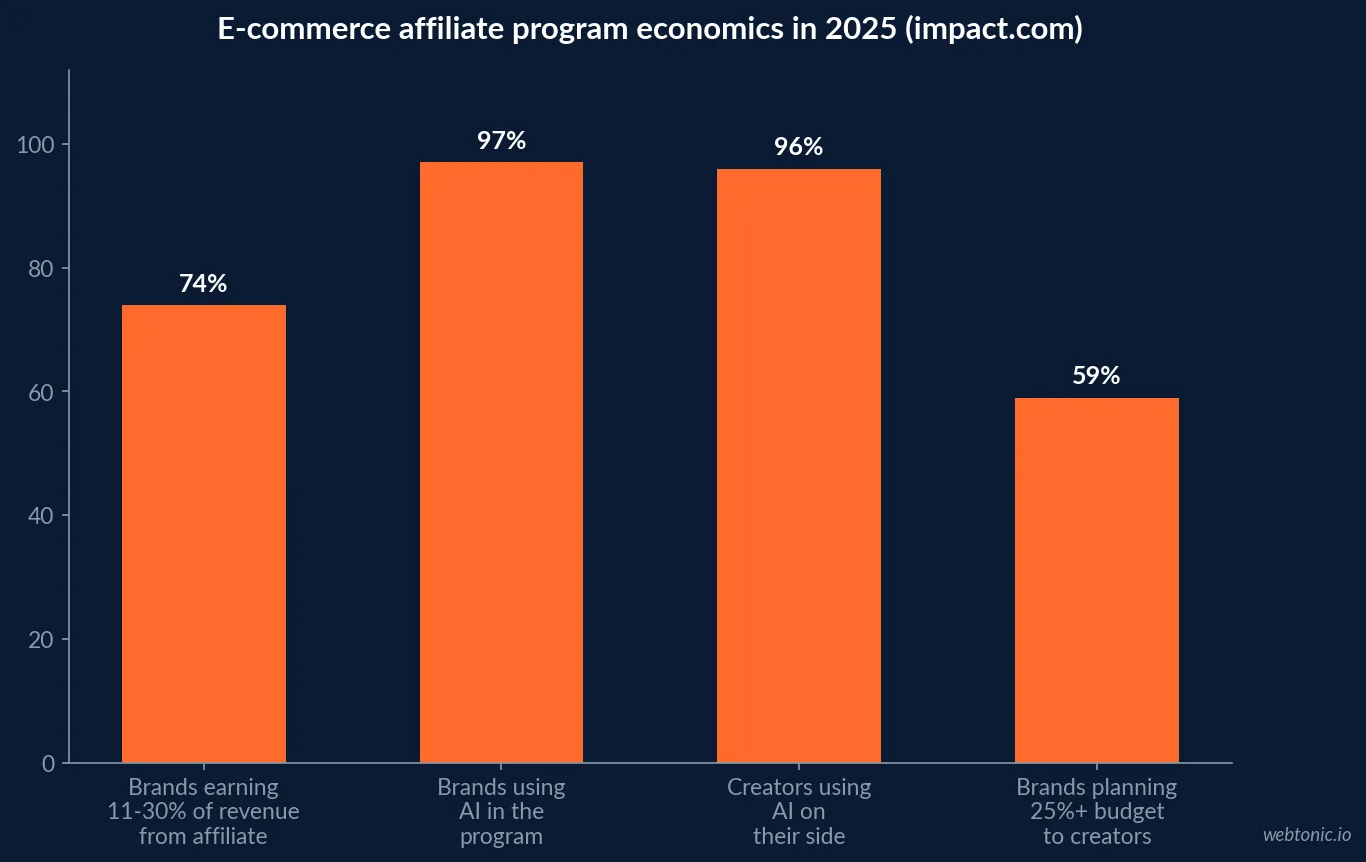
74% of e-commerce and DTC brands running an affiliate or partnership program report that it produces 11% to 30% of total company revenue, according to impact.com's 2025 research. The unit of analysis on this page is the program itself - what it pays, what it tracks, and what it must disclose - not a single campaign or a single influencer post.
Key Takeaways
- 74% of brands earn 11% to 30% of revenue from affiliate marketing.
- Well-known publisher commissions run 10% to 15% per sale.
- Premium placements push commissions up to 20%.
- Payouts are commonly held 30 to 60 days for returns.
- Split payouts, e.g. 80/20, protect non-last-click publishers.
- 97% of brands already use AI in their partnership programs.
- 96% of affiliates and creators report using AI too.
- 59% of brands plan to put 25%+ of affiliate budget into creators.
- 94% of brands are testing a move away from last-click attribution.
- 69% of B2B SaaS companies plan to increase partnership investment.
- Mid-market and enterprise firms see up to 35% of pipeline partner-influenced.
- 48% of aligned go-to-market teams report shortened sales cycles.
- FTC 16 CFR 255.5 requires clear disclosure of any paid affiliate link.
- Leading brands run 3 to 4 distinct partner types, not one.
- Subscription-program commissions differ structurally from one-time-sale rates.
- Only 42% of partnership programs use multi-touch attribution today.
- 18% of affiliate traffic industry-wide is flagged as invalid or fraudulent.
- 49% of senior leaders want AI specifically for partner and account targeting.
What the affiliate line item is actually worth
impact.com's State of Affiliate Marketing Research Report 2025 surveyed more than 1,500 marketers, publishers and creators across 8 countries and found 74% of brands generate 11% to 30% of total company revenue through affiliate and partner channels. The same report found leading brands run 3 to 4 distinct partner types - creators, publishers, affiliates and advocates - rather than concentrating spend on one relationship type.
That revenue share is why a program that is priced casually, on a single flat commission with no attribution audit, is easy to overpay for at scale.
| Program fact (2026) | Figure | Source | What it means for the P&L |
|---|---|---|---|
| Brands earning 11-30% of revenue from affiliate | 74% | impact.com 2025 report | A real revenue channel, not a side test |
| Brands running 3-4 partner types | Majority of leaders | impact.com 2025 report | Concentration risk if you run only one |
| Brands using AI in the program | 97% | impact.com 2025 report | Manual partner vetting is now the exception |
| Creators using AI on their side | 96% | impact.com 2025 report | Content velocity is no longer the bottleneck |
| Brands planning 25%+ of budget to creators | 59% | impact.com 2025 report | Creator payout terms need their own line |
Commission models: what actually gets paid
Shopify's own affiliate commission guide reports that well-known publishers typically earn 10% to 15% per sale on physical goods, with some brands paying up to 20% in exchange for premium visibility. Subscription-based brands, the guide notes, structure commissions differently because recurring margin behaves differently from a one-time sale, and payouts are commonly held for 30 to 60 days to account for returns before they are released.
Shopify's guide also documents split attribution in practice: on platforms like Impact, a content publisher that generates demand and a coupon site that takes the last click can each be paid a share of one commission - the example given is 80% to the content publisher and 20% to the last-click coupon site - specifically so last-click logic does not erase the publisher that did the actual selling.
| Commission model | Typical range or term | Source | Where it applies |
|---|---|---|---|
| Well-known publisher, physical goods | 10-15% per sale | Shopify affiliate guide | Standard e-commerce affiliate deal |
| Premium placement / high visibility | Up to 20% | Shopify affiliate guide | Homepage features, dedicated content |
| Split commission (content + last-click) | e.g. 80% / 20% | Shopify affiliate guide (Impact example) | Multi-touch buyer journeys |
| Payout hold for returns | 30-60 days | Shopify affiliate guide | Every category with a return window |
| Program with 3-4 active partner types | Majority of leading brands | impact.com 2025 report | Mature program structure |
What a network's own performance claims are worth
Affiliate networks compete partly on their own reported outcomes, and those figures are worth reading with the same care as any vendor benchmark. CJ's own advertiser page reports that advertisers who migrate to its platform see 30% more revenue in the first year and cites a 14:1 return on ad spend against what it calls a 12:1 channel average. Those are the network's own stated numbers, not an independent audit, and they describe migration outcomes for advertisers who already had an affiliate program running elsewhere - useful context, not a guarantee for a brand starting from zero.
Where the money is shifting: creators and AI
impact.com's 2025 report found 59% of brands plan to allocate at least 25% of their affiliate budget to creator partnerships, up from a channel historically dominated by coupon and content-review sites. On the tooling side, 97% of brands and 96% of creators report already using AI somewhere in the program - mostly for partner discovery, briefing and fraud screening, not for writing the endorsement itself, since the FTC's disclosure duty still runs to the human account behind the post.
The scale behind that shift is now measured separately: the IAB's own 2025 Creator Economy Ad Spend and Strategy Report projects U.S. creator ad spend at USD 37 billion in 2025, up 26% year over year - growth the IAB describes as nearly four times faster than digital ad spend overall. Affiliate commission to creators is one line inside that bigger number, not a separate budget most brands track distinctly yet.
Attribution: last-click is losing its default status
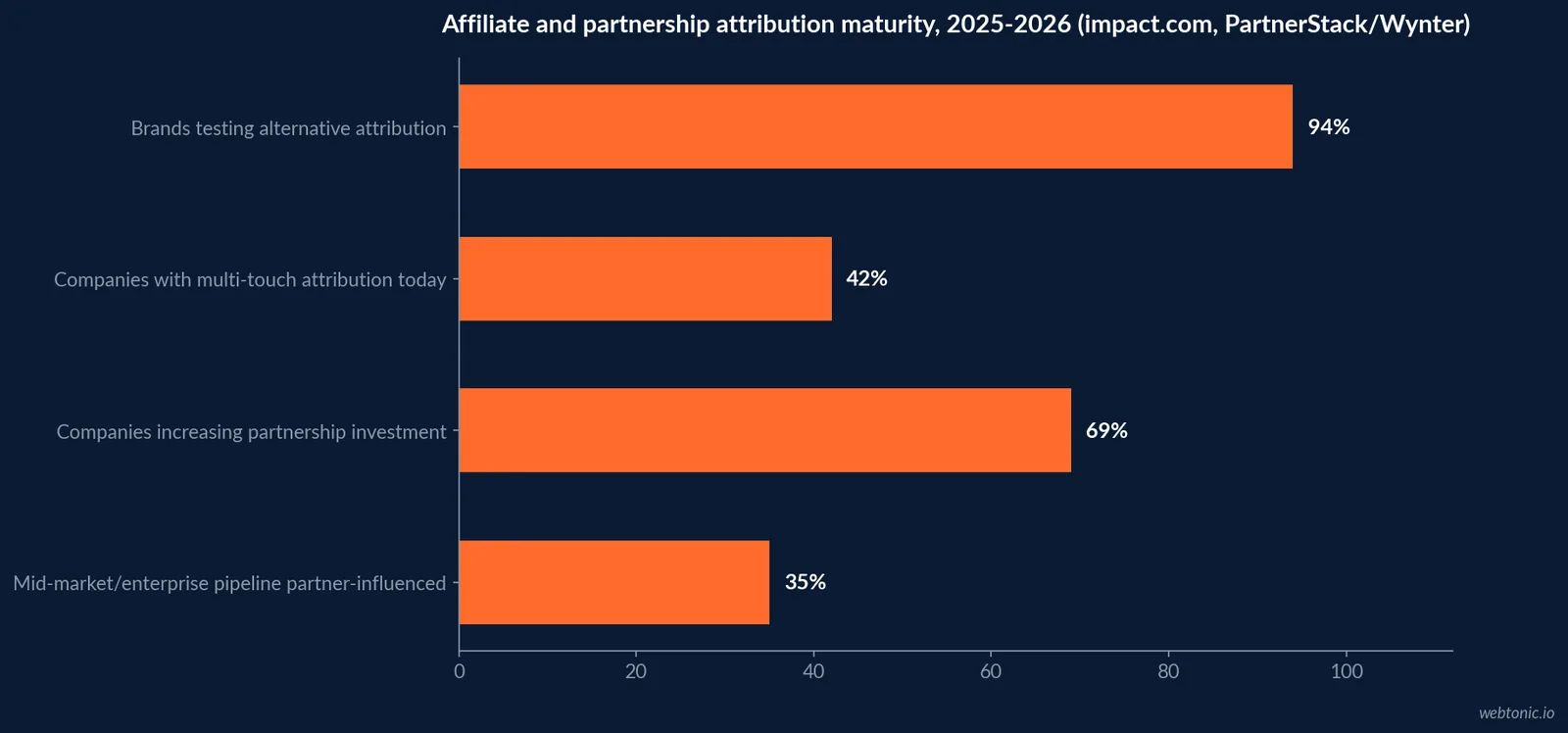
impact.com's 2025 research found 94% of brands are experimenting with or planning to adopt alternative attribution models within the next year, moving away from a pure last-click credit rule. On the B2B partnerships side, the PartnerStack and Wynter State of Partnerships in GTM 2026 report found only 42% of companies use multi-touch attribution across the funnel today, which the report calls a measurement gap that blocks optimization.
That gap matters for e-commerce specifically because affiliate and partner traffic is disproportionately mid-funnel: a shopper who clicked a review article on day one and a cashback extension on day seven both touched the sale, and a program that only pays the second one is paying for the wrong behavior.
| Attribution fact (2026) | Figure | Source | Program consequence |
|---|---|---|---|
| Brands testing alternative attribution | 94% | impact.com 2025 report | Last-click is being phased out as the default |
| Companies using multi-touch attribution today | 42% | PartnerStack/Wynter 2026 | Most programs still under-credit assist touches |
| Companies planning to increase partnership investment | 69% | PartnerStack/Wynter 2026 | Budget is growing faster than measurement maturity |
| Mid-market/enterprise pipeline that is partner-influenced | Up to 35% | PartnerStack/Wynter 2026 | Partner channel is material to pipeline, not incidental |
| Aligned GTM teams reporting shortened sales cycles | 48% | PartnerStack/Wynter 2026 | Attribution alignment compounds into speed |
The disclosure rule that applies to every affiliate link
Under 16 CFR 255.5, the FTC's Guides Concerning the Use of Endorsements and Testimonials, anyone with a "material connection" to a seller - and an ordinary affiliate commission counts - must disclose that connection clearly and conspicuously, near the endorsement itself, in language an average reader would actually notice. A disclosure buried in a bio page or an "about" footer does not satisfy the rule; it has to sit next to the specific link or recommendation.
For an e-commerce brand this is not just the creator's liability. Program terms, brand vetting of creator content, and even the affiliate network's own compliance sweep are all part of what regulators look at when a category gets investigated, which is why disclosure language belongs in the contract, not just the influencer's caption.
Fraud and program hygiene
Not every click a program pays for is a real one. Industry fraud-detection research cited across the affiliate press in 2026 puts invalid or fraudulent affiliate traffic at roughly 18% of total volume industry-wide - cookie stuffing, click-spamming and fake lead submission are the recurring patterns. A program that pays commission on raw click volume without a fraud filter is effectively subsidizing that share.
The practical fix most mature programs use is the same one search advertisers use: validate the conversion event (a real order, a real account, a real payment method) before commission is finalized, and hold the payout window long enough - the 30 to 60 day return window Shopify documents - to catch reversals before the affiliate is paid.
| Program hygiene item | Benchmark | Source | Action |
|---|---|---|---|
| Industry affiliate invalid-traffic share | ~18% flagged invalid/fraudulent | 2026 affiliate fraud research | Filter before commission is finalized |
| Return-driven payout hold | 30-60 days | Shopify affiliate guide | Match hold window to your own return policy |
| Disclosure standard | Clear and conspicuous, near the link | FTC 16 CFR 255.5 | Put disclosure language in the partner contract |
| Attribution model in use today | 42% multi-touch, rest largely last-click | PartnerStack/Wynter 2026 | Audit which touch actually gets paid |
| Partner types run by leading programs | 3-4 concurrently | impact.com 2025 report | Diversify beyond one coupon or review site |
Is the channel actually growing? A tracked-platform view
Program-level survey data says the channel matters; platform-tracked transaction data shows how it is trending month to month. Partnerize's own U.S. Retail Affiliate Marketing Sales Index, tracking roughly 700 retail brands across 10 categories, reported gross affiliate revenue down 3% year over year through January 2026 - but the components behind that number moved in different directions: clicks up 23%, conversion rate down 31%, and average order value up 14%. Total commission paid to publishers fell 2% in the same period, tracking revenue almost exactly.
That split matters for how a brand reads its own numbers: more traffic and a higher basket size are being offset by a much weaker conversion rate, which points at either lower-intent affiliate traffic or a checkout friction problem, not a demand problem.
| Partnerize Retail Sales Index metric (Jan 2026) | YoY change | Reading |
|---|---|---|
| Gross affiliate revenue | -3% | Modest overall decline |
| Clicks | +23% | Traffic is not the problem |
| Conversion rate | -31% | The real drag on revenue |
| Average order value | +14% | Basket size is compensating, not fixing it |
| Total commission paid to publishers | -2% | Payouts are tracking revenue closely |
Category spread: where affiliate revenue is rising and falling
The same Partnerize index breaks the January 2026 trend out by category, and the spread is wide enough that a single "affiliate is up/down" headline hides more than it tells a brand. Sports and Fitness rose 20% and Clothing and Apparel rose 19% year over year, while Gifts and Flowers fell 77% and Health and Beauty fell 50%. Home and Garden and Food and Drink each posted small single-digit gains.
| Retail category (Jan 2026, Partnerize index) | YoY revenue change |
|---|---|
| Sports & Fitness | +20% |
| Clothing & Apparel | +19% |
| Food & Drink | +2% |
| Home & Garden | +4% |
| Accessories & Jewelry | -24% |
| Computers & Electronics | -22% |
| Health & Beauty | -50% |
| Gifts & Flowers | -77% |
What to put in the partner contract
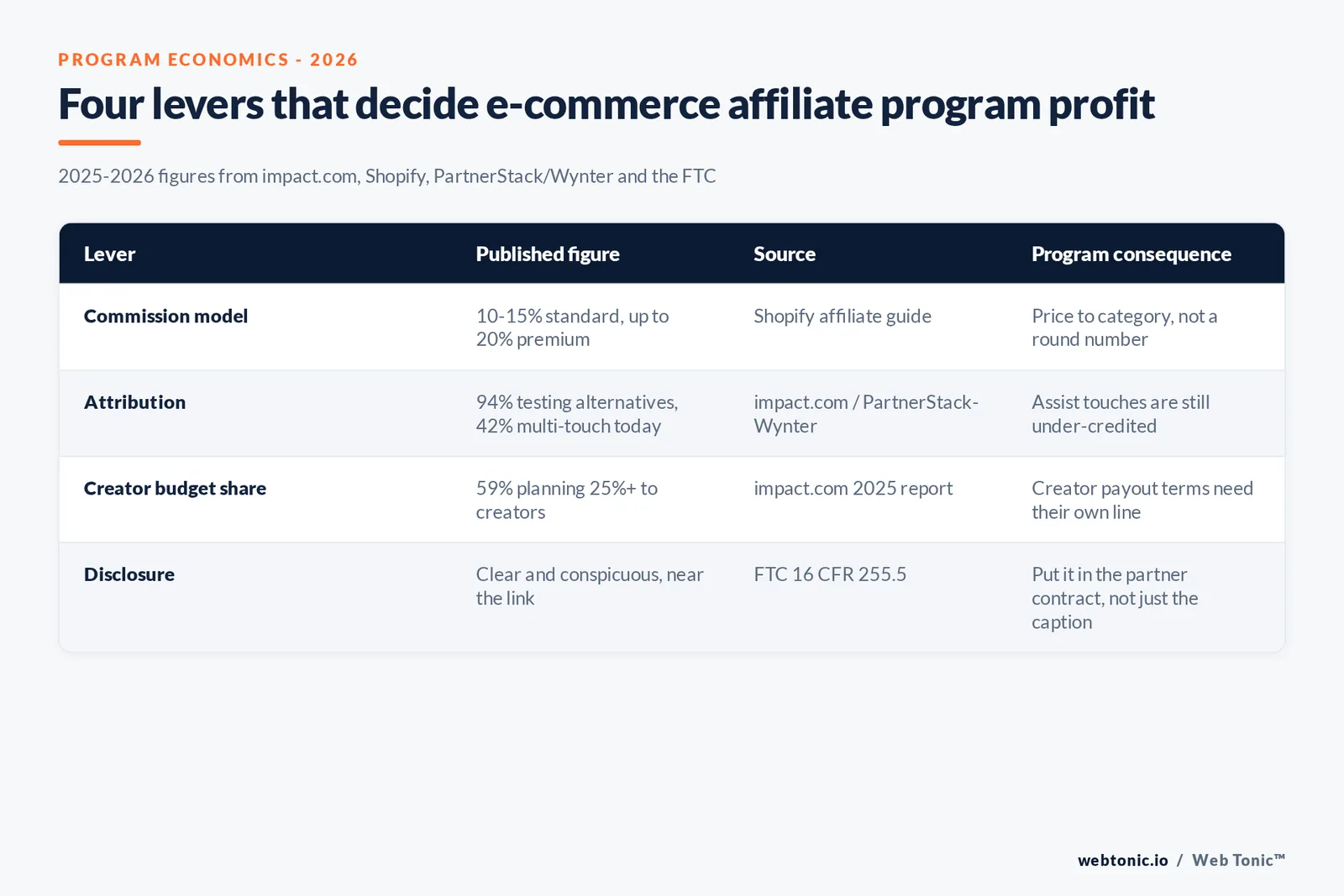
Four items belong in every e-commerce affiliate agreement before the first link goes live: the commission model and category-appropriate rate (10-15% is the standard opening point per Shopify's guide), the attribution model and how split credit is handled across touches, the payout hold window matched to the brand's own return policy, and disclosure language that mirrors the FTC's own guidance on affiliate disclosure rather than a generic "sponsored" tag. Programs that skip the attribution clause are the ones renegotiating it later, after a publisher disputes a de-duplicated sale.
| Contract item | What to specify | Why it is non-negotiable |
|---|---|---|
| Commission model | Rate by category, tiered if split credit applies | Prevents a flat rate from underpaying premium placements |
| Attribution model | Multi-touch or defined split, not silent last-click | 94% of brands are already moving off pure last-click |
| Payout hold window | Matched to the return policy (30-60 days typical) | Protects against paying commission on reversed orders |
| Disclosure language | Clear, conspicuous, next to the link per 16 CFR 255.5 | The brand is exposed even when the creator's caption is not |
How to read this if you run e-commerce affiliate spend
Price the commission to the category, not to a round number: 10-15% for a standard physical-goods program is a reasonable opening offer, premium placement negotiates up from there, and subscription products need a structurally different deal. Put a multi-touch attribution model in the contract before the first affiliate is onboarded, because retrofitting it after last-click has been the house rule for a year is a fight nobody wins cleanly. If you want the paid-channel side of the mix modeled against the affiliate line, our growth marketing practice and data and analytics team build that comparison, or talk to us directly about the program audit.
Frequently Asked Questions
How much of e-commerce revenue actually comes from affiliate and partner programs?
Impact.com's 2025 State of Affiliate Marketing research, surveying more than 1,500 marketers, publishers and creators across 8 countries, found that 74% of brands generate 11% to 30% of total company revenue through affiliate marketing. That is a real revenue line, not a rounding error, which is why the program's cost structure deserves the same scrutiny as a paid media channel.
What commission rate should an e-commerce brand expect to pay?
There is no single number because the model changes by product type. Shopify's own affiliate commission guide reports well-known publisher rates of 10% to 15% per sale for physical goods, up to 20% for high-visibility placements, and notes that subscription and digital-product brands typically pay a different structure entirely because the margin profile is different. Treat any single flat-rate quote as a starting offer, not a market rate.
Why do two affiliates sometimes split the commission on one sale?
Tiered attribution. Shopify's guide describes a real case where a content publisher drives the traffic and a coupon or cashback site takes the last click before checkout; tracking platforms like Impact can split the payout, for example 80% to the content publisher and 20% to the last-click coupon site, so the publisher that built demand is not zeroed out by a last-click rule.
What has to be disclosed when a creator or affiliate links to an e-commerce product?
Under the FTC's 16 CFR 255.5, anyone with a material connection to a seller - including an ordinary affiliate commission - must clearly and conspicuously disclose that connection near the endorsement, in a way an average reader would notice before clicking. The rule applies to blog posts, videos and social captions alike, and it is the brand's own program terms, not just the creator's caption, that gets checked when the FTC investigates a category.
Is the affiliate channel becoming more automated or more manual?
More automated on the brand side. Impact.com's 2025 report found 97% of brands and 96% of creators are already using AI somewhere in their partnership programs, mainly for partner discovery, content briefs and fraud screening, while attribution itself is moving away from last-click: 94% of brands say they are experimenting with or planning to adopt alternative attribution models within the next year.
Sources
impact.com - State of Affiliate Marketing Research Report 2025
Shopify - Affiliate Commission Guide: Structures and Industry Benchmarks
PartnerStack and Wynter - The State of Partnerships in GTM 2026
eCFR - 16 CFR 255.5, Disclosure of material connections
Federal Trade Commission - FTC's Endorsement Guides: What People Are Asking
Partnerize - U.S. Retail Affiliate Marketing Sales Index, January 2026
IAB - 2025 Creator Economy Ad Spend and Strategy Report
CJ - Advertiser platform performance claims