Table of contents
Key Takeaways
- 75% of companies have adopted multi-touch attribution in 2026, up from 58% in 2024, with teams reporting 14–36% CPA improvement (PipelineOn).
- 67% of home services companies struggle to understand which marketing channels work, making attribution the biggest measurement gap in the sector (Click-Vision).
- Phone calls generate 85% of restoration leads, making call tracking the most critical attribution tool (Marketing LTB).
- Companies using call tracking improve marketing ROI visibility by 61% (Marketing LTB).
- Restoration companies tracking marketing KPIs are 2× more likely to increase revenue year over year (Marketing LTB).
- Teams running multi-touch attribution report an average 19% ROI lift in the first year of implementation (AdBeacon).
Marketing Attribution Benchmarks for Disaster Restoration
| Attribution Metric | Industry Data | Source |
|---|---|---|
| MTA Adoption Rate (2026) | 75% of companies | PipelineOn / Improvado |
| CPA Improvement from MTA | 14–36% reduction | AdBeacon |
| Avg ROI Lift (Year 1 MTA) | 19% average | AdBeacon |
| Home Services Attribution Gap | 67% struggle with channel data | Click-Vision |
| Phone Calls as Lead Source | 85% of restoration leads | Marketing LTB |
| Call Tracking ROI Impact | +61% visibility improvement | Marketing LTB |
| KPI Tracking Revenue Impact | 2× more likely to grow YoY | Marketing LTB |
| Healthy Restoration ROAS | $8–$12 per dollar invested | Tygart Media |
| Restoration Cos. Using CRM + Tracking | ~20% (ahead of 80%) | Tygart Media |
| Basic Call Tracking Cost | ~$45/month (CallRail) | Tygart Media |
The Attribution Crisis in Disaster Restoration
Disaster restoration faces a uniquely difficult attribution challenge compared to other home service industries. 67% of home services companies struggle to understand which marketing channels actually drive results (Click-Vision). The problem is amplified in restoration by the emergency nature of the business — homeowners interact with multiple touchpoints over weeks or months through Google searches, review sites, social media, direct mail, and community recommendations, but the actual conversion happens in minutes when a crisis forces immediate action.
Every restoration company operates with at least four competing attribution systems that each claim credit differently: GA4 tracks website sessions, call tracking software captures inbound calls, the dispatch CRM records booked jobs and revenue, and the ad platforms report their own conversion data (Sheppard CG). Without deliberate integration across these systems, marketing teams end up either double-counting conversions or missing them entirely, leading to budget misallocation and wasted spend on underperforming channels while starving high-performing ones.
Spinutech's analysis highlights an especially damaging pattern: branded search receives disproportionate credit in most reporting environments, making demand-capture channels appear far more efficient than they really are (Spinutech). For restoration companies, this means organic brand-building investments such as truck wraps, community sponsorships, yard signs, and review management are systematically undervalued when using last-click attribution models.
Call Tracking: The Foundation of Restoration Attribution
Phone calls generate 85% of restoration leads (Marketing LTB), yet most restoration companies only track website form submissions. This creates a massive blind spot that causes marketing teams to misattribute credit and make poor budget decisions. Companies implementing call tracking improve marketing ROI visibility by 61%, and those that complete a full call tracking integration typically see a 43% decrease in cost per lead within 30 days because they can finally identify which channels produce actual phone calls, not just website visits.
Tygart Media's martech stack analysis identifies the minimum viable attribution setup for any restoration company: CallRail at approximately $45 per month connected to a CRM system. This combination alone puts a restoration company ahead of 80% of competitors in attribution capability (Tygart Media). The three essential systems that must work in coordination are CRM, call tracking, and GA4 analytics — everything else is optional until these three are connected and producing clean, reconciled data. The critical insight is that 86% of consumers do not answer calls from numbers they do not recognize (PipelineOn), which means follow-up call attribution and speed-to-lead metrics are essential components of any restoration attribution framework.
Multi-Touch Attribution Adoption and Impact
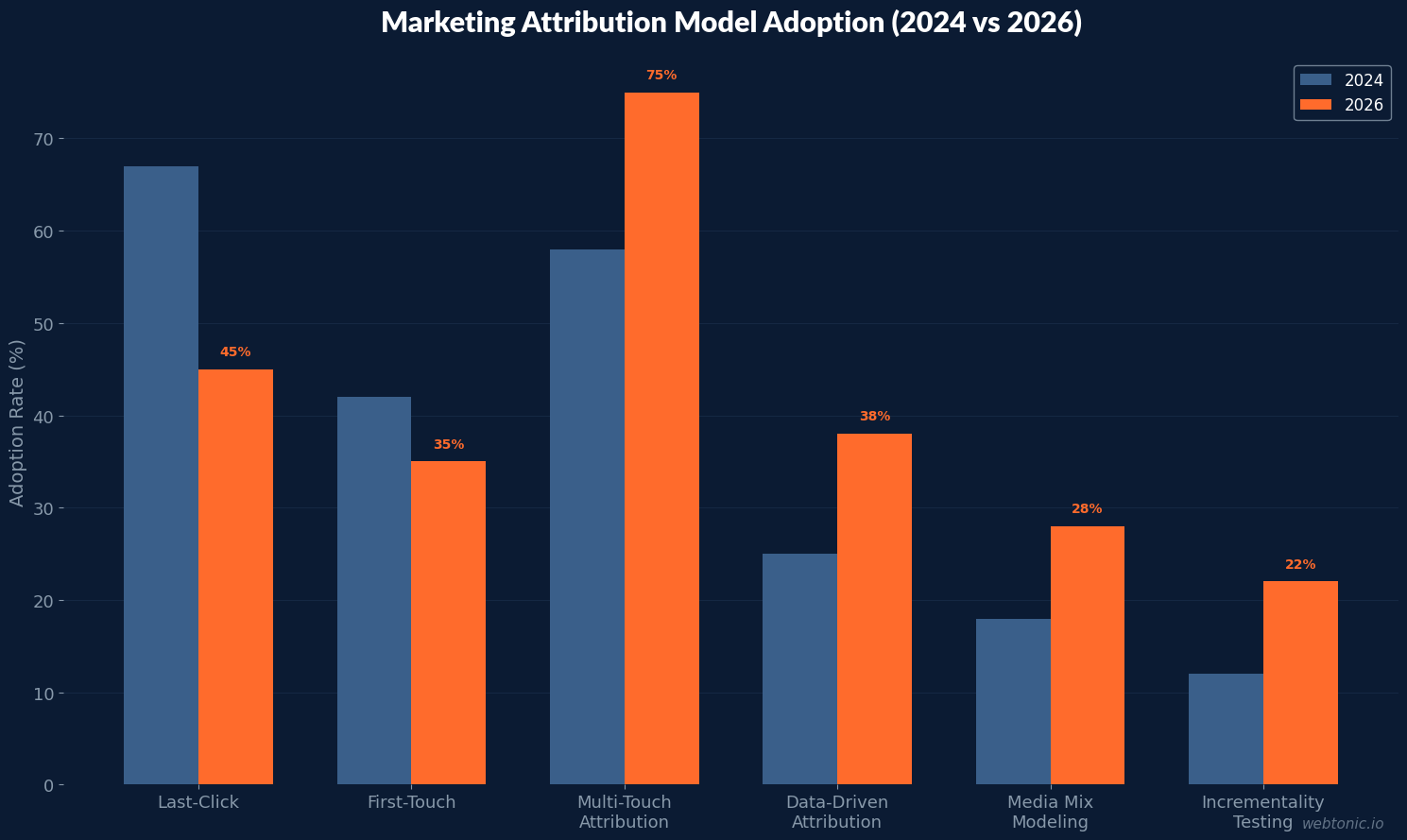
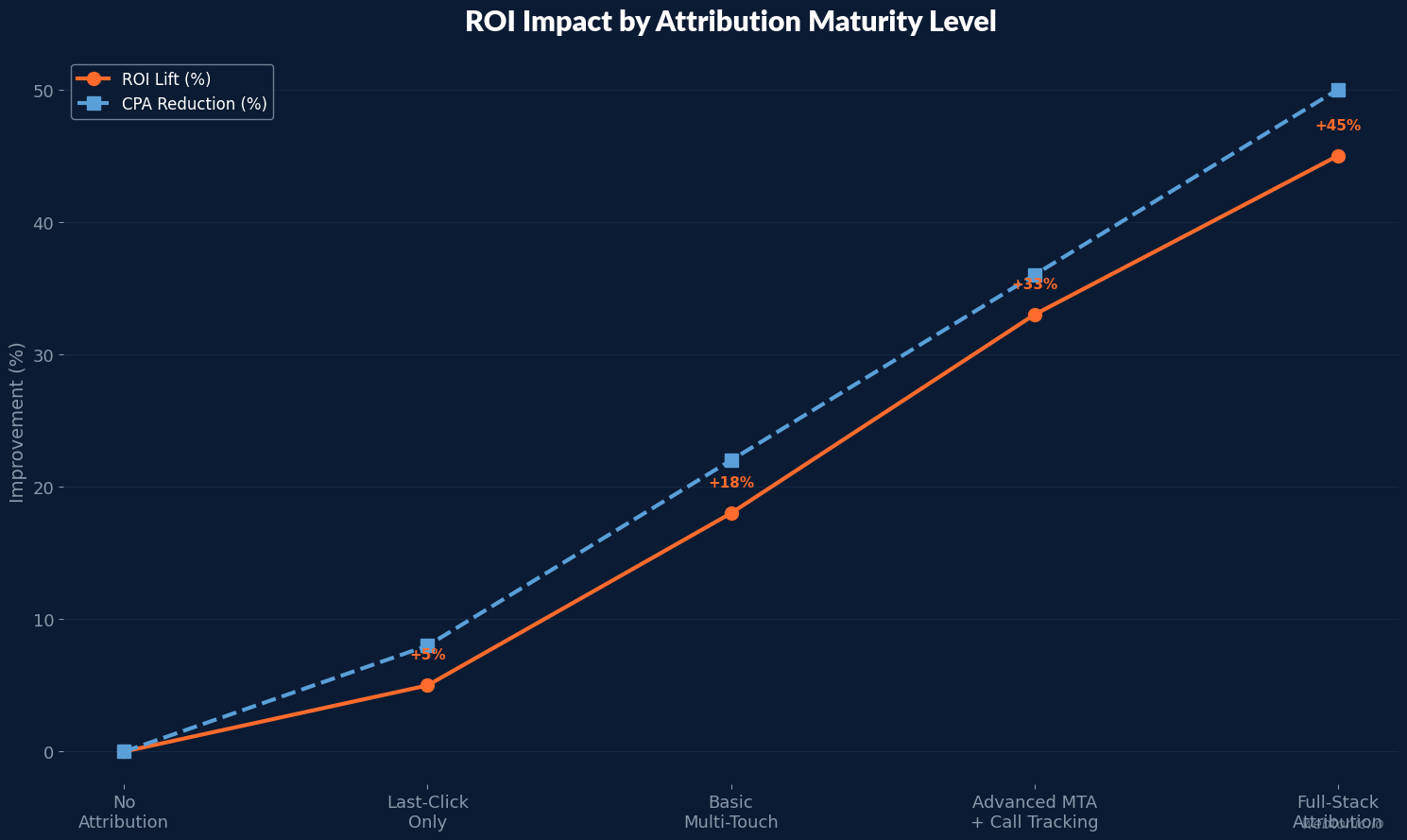
75% of companies have adopted multi-touch attribution in 2026, up significantly from 58% in 2024 (PipelineOn, citing Improvado's 2026 attribution report). The performance case for making the switch is concrete and well-documented: companies running MTA report 14–36% cost-per-acquisition improvement and approximately 19% average ROI lift in the first year of implementation (AdBeacon).
Despite these gains, 67% of B2B marketers still rely on last-touch reporting as their primary attribution model (MarqOps). The teams that have made the transition to multi-touch attribution report 18% average ROI lift, 22% better lead quality, and 15% lower customer acquisition cost. For restoration companies specifically, MTA is particularly valuable because the customer journey often spans weeks of latent awareness before a crisis triggers action within minutes, meaning the first and middle touchpoints deserve credit that last-click models entirely miss.
Attribution Models Compared for Restoration Marketing
| Model | How It Works | Best For Restoration | Key Limitation |
|---|---|---|---|
| Last-Click | 100% credit to final touchpoint | Emergency lead tracking | Ignores brand-building channels entirely |
| First-Touch | 100% credit to first interaction | Understanding awareness channels | Misses conversion-driving touchpoints |
| Linear MTA | Equal credit across all touchpoints | Fair channel comparison | Overvalues low-impact middle touches |
| Time-Decay | More credit to recent interactions | Emergency decision funnels | Undervalues initial awareness channels |
| Position-Based | 40% first, 40% last, 20% middle | Balanced residential + commercial | Arbitrary weight distribution |
| Data-Driven | ML-weighted by actual impact | Large-volume companies (50+ leads/mo) | Requires significant data volume |
For most restoration companies with fewer than 50 monthly leads, the position-based (U-shape) model provides the best balance between complexity and accuracy. It gives 40% credit to the first touchpoint that introduced the customer to your brand, 40% to the final touchpoint that triggered the emergency call, and distributes 20% across the middle interactions like review-reading, website revisits, and directory checks. This model appropriately values both brand-building investments and conversion-driving channels without requiring the massive data volumes that data-driven attribution demands.
Essential Attribution KPIs for Restoration Companies
- Cost Per Lead by Channel — Track CPL separately for Google Ads, LSAs, SEO, referrals, and social media. Restoration Google Ads CPL ranges from $150–$300+ while LSA median CPL sits at $85 for water damage restoration. Without channel-level CPL tracking, you cannot determine which channels deserve more budget and which are wasting money.
- Lead-to-Booked-Job Conversion Rate — Top-25% contractors close at rates 30–50% higher than median performers. Attribution must track beyond the initial lead capture to the actual booked job because a cheap lead that never converts is more expensive than a premium lead that closes reliably.
- Revenue Per Marketing Dollar (ROAS) — Benchmark $8–$12 return per dollar invested across all channels. Channels below $5 need optimization or reallocation; channels above $15 represent scaling opportunities that deserve additional budget.
- Average Ticket by Source — LSA and Google Ads jobs typically produce smaller tickets than referral or commercial jobs. Understanding this prevents over-investing in high-CPL channels that generate lower-revenue jobs and under-investing in channels that produce larger contracts.
- Response Time by Channel — 86% of consumers don't answer calls from numbers they don't recognize (PipelineOn), making callback attribution, speed-to-lead metrics, and local caller ID essential components of any restoration attribution framework.
Common Attribution Failures in Restoration Marketing
| Attribution Failure | Business Impact | Solution |
|---|---|---|
| Only tracking form submissions | Misses 85% of leads (phone calls) | Call tracking with keyword-level source attribution |
| Relying on last-click only | Branded search gets disproportionate credit | Adopt position-based or time-decay MTA |
| Disconnected CRM and ads data | Revenue can't be tied to specific channels | Connect CRM to call tracking and GA4 |
| Platform-reported conversions only | Double-counting across multiple channels | Use independent attribution (WhatConverts) |
| No offline tracking | Yard signs, wraps, and referrals invisible | 'How did you hear?' intake field + UTM discipline |
| Quarterly-only reporting | Slow reaction to channel degradation | Weekly attribution dashboards per channel |
The most damaging attribution failure for restoration companies is tracking only website form submissions while ignoring phone calls. Since phone calls generate 85% of restoration leads, a company relying on form-based attribution is making budget decisions based on only 15% of its actual lead volume. This typically results in over-investing in channels that drive website engagement (like display and social media) while under-investing in channels that produce the phone calls that actually book jobs (like LSAs and Google Ads). Implementing call tracking with source-level attribution corrects this imbalance and typically produces an immediate improvement in marketing efficiency.
Building a Restoration Attribution Stack
The recommended approach to building a restoration attribution stack follows a phased implementation that matches the company's data maturity level. Companies just starting with attribution should begin with the minimum viable stack of CallRail ($45/month) connected to a free CRM like HubSpot, which immediately provides call tracking with source attribution feeding into a central lead database. This baseline alone puts the company ahead of 80% of restoration competitors in attribution capability.
Phase two adds GA4 with goal conversion tracking and UTM parameter discipline across all marketing channels. Every ad, email, social post, and landing page should carry consistent UTM tags that allow GA4 to connect website behavior to the call tracking and CRM data from phase one. Phase three introduces independent multi-touch attribution through tools like WhatConverts or Triple Whale for companies spending $10,000+ per month on marketing. At this spend level, the cost of the attribution tool is easily justified by the 14–36% CPA improvement that proper MTA delivers. The final phase adds incrementality testing and media mix modeling for companies with the data volume to support these advanced methodologies.
Frequently Asked Questions
What is the most important attribution tool for restoration companies?
Call tracking is the single most important attribution tool because phone calls generate 85% of restoration leads. Companies using call tracking improve marketing ROI visibility by 61% and typically see a 43% decrease in cost per lead within 30 days. Start with CallRail at approximately $45 per month connected to your CRM for immediate attribution capability.
How much does marketing attribution improve ROI for restoration companies?
Companies running multi-touch attribution report 14–36% cost-per-acquisition improvement and approximately 19% average ROI lift in the first year of implementation. Restoration companies that track marketing KPIs are 2× more likely to increase revenue year over year compared to companies operating without any attribution framework.
What attribution model should a restoration company use?
For most restoration companies, a position-based (U-shape) model works best. It gives 40% credit to the first touchpoint (brand awareness), 40% to the last touchpoint (emergency conversion trigger), and distributes 20% across middle interactions. Companies with 50+ leads per month should consider data-driven attribution for ML-optimized credit distribution.
Why is attribution harder for restoration than other home services?
Restoration faces a unique challenge because brand awareness builds over weeks or months through truck sightings, reviews, and community presence, but the actual conversion happens in minutes during a water damage or fire emergency. This makes it extremely difficult to connect long-term brand investments with individual emergency calls. Additionally, 67% of home services companies struggle with basic channel attribution.
How many systems does a restoration company need for proper attribution?
At minimum, restoration companies need three connected systems: a CRM, call tracking with source attribution, and GA4 analytics. These three systems working together put a company ahead of 80% of competitors in attribution capability. Companies spending $10,000+ per month on marketing should add independent attribution tools like WhatConverts for multi-touch analysis.
Sources
https://pipelineon.com/blog/data-source-attribution-techniques/
https://click-vision.com/home-services-marketing-statistics
https://marketingltb.com/blog/statistics/restoration-marketing-statistics/
https://tygartmedia.com/the-restoration-companys-martech-stack-what-to-measure-what-to-connect-what-to-ignore/
https://www.adbeacon.com/the-case-against-staying-on-last-click/
https://www.sheppardcg.com/insights/marketing-attribution-home-services
https://www.spinutech.com/industries/home-services/the-attribution-problem-holding-back-home-services-brands/
https://pipelineon.com/blog/contractor-marketing-attribution-statistics/
https://www.marqops.com/blog/multi-touch-attribution-guide
https://amworldgroup.com/statistics/marketing-attribution-statistics