



Table of contents
Email returns $36–$44 for every dollar spent across home services — the highest-ROI channel available — yet most restoration contractors stop following up after one or two attempts. Here are the email marketing benchmarks, automation statistics, and lead nurturing data shaping how restoration companies convert and retain customers in 2026.
Key Takeaways
- 34.76% average open rate for Home & Maintenance emails, with a 1.57% click-through rate (Sendtric)
- $36–$44 ROI per dollar spent on email marketing across home services (PipelineOn)
- 75% of leads are not ready to buy immediately — they need follow-up nurture sequences (PipelineOn)
- 47% larger purchases from nurtured leads compared to non-nurtured leads (PipelineOn)
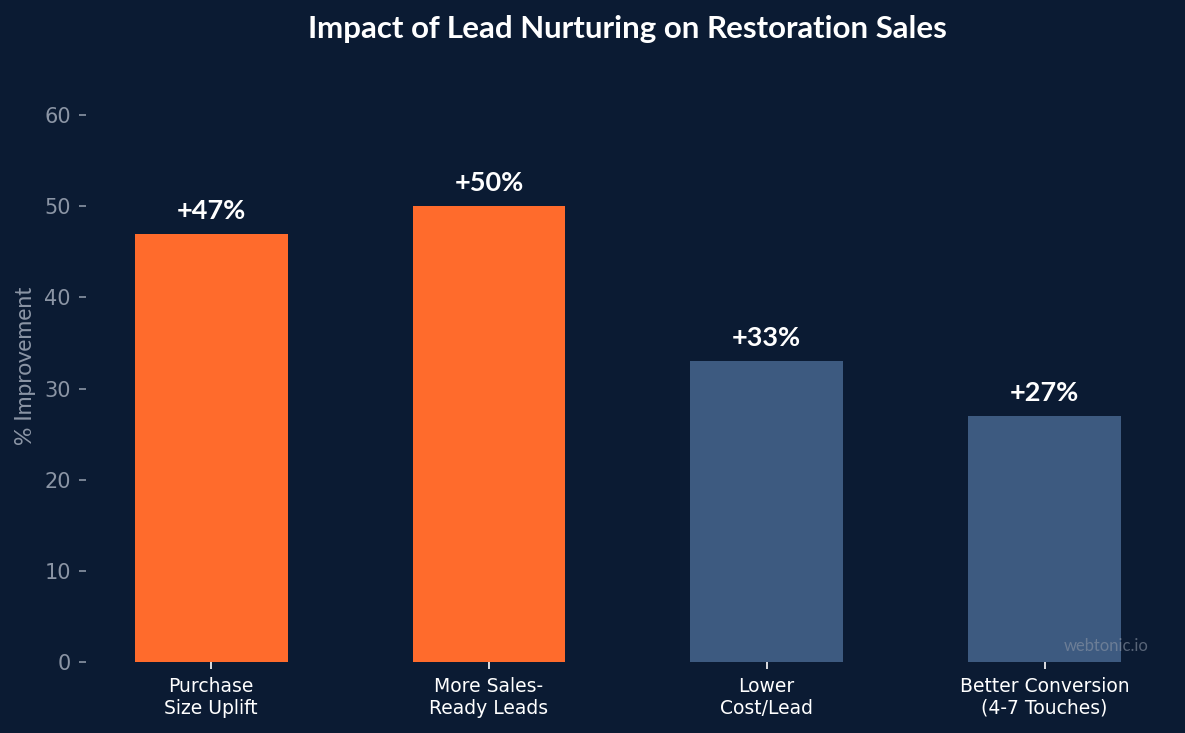
- 4–7 email touches convert 27% better than single outreach attempts (PipelineOn)
- 83% of restoration leads occur within 48 hours of property damage, making speed-to-inbox critical (Marketing LTB)
- Companies excelling at lead nurturing generate 50% more sales-ready leads at 33% lower cost
Email Marketing Benchmarks for Restoration at a Glance
| Metric | Industry Benchmark | Source |
|---|---|---|
| Open rate (Home & Maintenance) | 34.76% | Sendtric 2026 |
| Click-through rate | 1.57% | Sendtric 2026 |
| Overall avg. open rate (all industries) | 36.92% | Sendtric 2026 |
| Email ROI per dollar spent | $36–$44 | PipelineOn |
| Cold email reply rate (restoration) | 5–12% | Origami |
| Leads ready to buy immediately | 25% | PipelineOn |
| Nurtured lead purchase uplift | +47% vs. non-nurtured | PipelineOn |
| Optimal email touches | 4–7 per sequence | PipelineOn |
Open Rates and Engagement by Industry Context
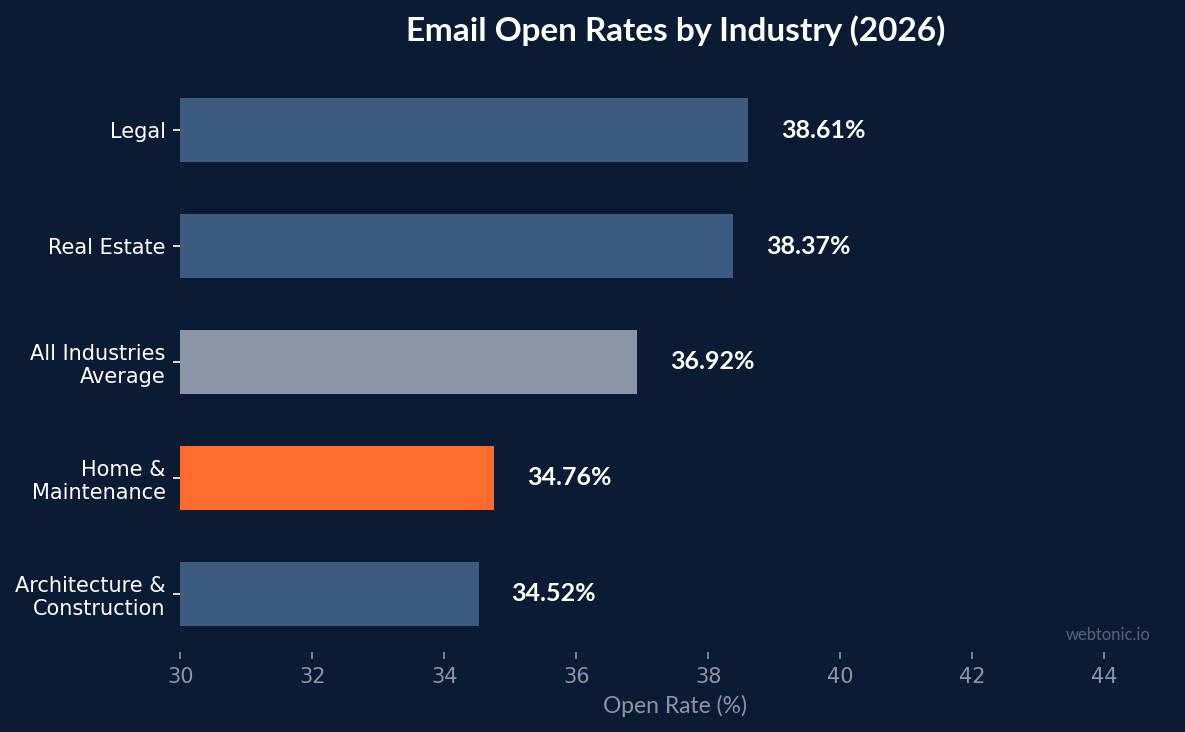
According to Sendtric's 2026 cross-platform analysis (aggregating data from MailChimp, Campaign Monitor, and other major platforms), Home & Maintenance emails average a 34.76% open rate with a 1.57% click-through rate. This falls slightly below the all-industry average of 36.92%, but the engagement quality is higher for emergency-driven services where recipients are actively seeking solutions.
| Industry | Open Rate | Click-Through Rate |
|---|---|---|
| Home & Maintenance | 34.76% | 1.57% |
| Architecture & Construction | 34.52% | 2.61% |
| Legal | 38.61% | 5.44% |
| Insurance (estimated) | 33–36% | 2.0–2.5% |
| Real Estate | 38.37% | 2.09% |
| Overall Average | 36.92% | 2.56% |
Top-performing email types across all industries are welcome emails and transactional messages, while high-volume repetitive emails with no real substance perform worst. For restoration companies, personalization depth, subject line strategy, and timing are the strongest predictors of open rates. Dynamic content elements like image personalization, countdown timers, and interactive widgets create a positive knock-on effect — higher engagement on one email increases the probability that future messages will be opened as well.
The construction-adjacent industries (Architecture & Construction at 34.52%, Real Estate at 38.37%) provide useful comparison points. Restoration companies often compete for the same property manager and commercial facility audiences, so understanding how adjacent verticals perform helps calibrate expectations. Legal sector emails achieve a notably high 5.44% click-through rate, suggesting that claim-related restoration content — which shares urgency characteristics with legal communications — could achieve similarly elevated engagement.
Lead Nurturing Performance for Restoration
The lead nurturing data from PipelineOn reveals why email automation is critical for restoration businesses: only 25% of new leads are ready to buy immediately. The other 75% are researching, comparing, or waiting for the right moment. Most contractors stop following up after one or two attempts — precisely when the majority of leads need continued engagement.
Companies that excel at lead nurturing generate 50% more sales-ready leads at 33% lower cost. They aren't generating more traffic; they're extracting more value from the same traffic through structured email sequences and growth marketing automation.
Email Sequence Optimization
Research shows that leads receiving 4–7 email touches convert 27% better than those receiving fewer attempts. Most restoration contractors stop at 1–2. The gap between industry best practice and typical contractor behavior represents the largest email marketing opportunity in the sector.
| Sequence Element | Best Practice | Impact |
|---|---|---|
| Number of touches | 4–7 per sequence | 27% higher conversion vs. fewer touches |
| Channel mix | Email → SMS → call → direct mail | Multichannel nurturing outperforms single-channel by 300% |
| Message length (cold email) | 50–100 words per touch | Higher reply rates than longer formats |
| Timing cadence | Day 1 → Day 3 → Day 7 | Balanced persistence without fatigue |
| Direct mail follow-up | Personalized postcard within 48 hours of high-intent visit | 4–5% response rate vs. 0.5–1% for cold mail |
| SMS integration | Add SMS to email sequences | 98% open rate on SMS vs. 20–25% on email |
Cold Email for Restoration Lead Generation
Water damage restoration cold email campaigns — targeting property managers, adjusters, and restoration company owners — typically achieve a 5–12% reply rate when lists are tightly segmented (Origami). The recommended 3-touch sequence structure keeps messages between 50–100 words each, speaking the language of restoration, insurance claims, and emergency response.
Segmentation matters significantly: emails to property managers should emphasize overflow partnerships and emergency call-out availability, while emails to insurance adjusters should pivot to faster claim closures and IICRC documentation. This segmentation approach aligns with how restoration companies use their data intelligence infrastructure to personalize outreach at scale.
Restoration cold email differs fundamentally from B2B software outreach. The service is local and need-based — the goal is overflow partnerships, emergency call-outs, and referral relationships, not booking product demos. Property managers receiving a tightly segmented message about emergency water damage availability with a follow-up story email respond at rates toward the higher end of the 12% benchmark. Adjusters receiving certification-forward content about cost-efficient restoration solutions engage when their current vendor list has gaps.
CRM and Automation in Restoration
The 12-month CRM touch calendar from Tygart Media outlines a structured approach to restoration email marketing, with touchpoints mapped to seasonal property risks and customer lifecycle stages. Key automation triggers include:
- Emergency follow-up — automated sequence within 24 hours of initial inquiry (83% of leads happen within 48 hours of damage)
- Seasonal preparedness — educational content mapped to weather patterns (hurricane prep, winter pipe protection, spring moisture alerts)
- Post-job nurturing — review requests, referral incentives, and annual inspection reminders
- Holiday safety content — "what to check before you leave" emails covering water shutoff, thermostat settings, and emergency contacts
- Insurance relationship maintenance — updates to adjusters and agents about capabilities and certifications
Companies using marketing automation reduce operational marketing costs by 55% (Marketing LTB). For restoration businesses where 70–80% of leads arrive by phone (Tygart Media), email automation bridges the gap between the initial call and ongoing customer relationship management.
Measuring Email Marketing ROI in Restoration
Beyond open rates and click-through rates, restoration companies should track three email-specific KPIs (PipelineOn):
- Nurture-to-close rate — what percentage of nurtured leads eventually book a job, compared to the overall lead-to-close rate
- Time to close — whether nurtured leads convert faster than non-nurtured ones (effective nurturing should shorten this cycle)
- Revenue per lead — are nurtured leads booking larger jobs? The 47% uplift benchmark isn't guaranteed but indicates the potential
The average sales cycle for major home service purchases runs 2–4 weeks for repairs and 2–3 months for replacements or installations. Email nurture sequences should match these timelines — emergency water damage emails need rapid-fire 48-hour sequences, while commercial relationship building requires monthly touchpoints sustained over quarters.
Market Context: Restoration Industry Scale
The global disaster restoration services market is valued at $45.2 billion in 2026 (Fortune Business Insights), with the U.S. property-restoration niche generating $7.2 billion across 62,582 firms (Proof). With 84% of customers searching online before contacting a restoration company, email marketing serves as the critical second-touch channel that converts initial awareness into booked jobs.
Seasonal Email Strategy and Insurance Relationships
Restoration email marketing performance varies significantly by season. Water damage claims peak during winter freeze cycles and spring thaw periods, while fire and storm damage follows hurricane and wildfire seasons. Companies that align their email calendar with these patterns see higher engagement — a pre-winter "pipe protection checklist" email performs markedly better in October than generic promotional content year-round.
Insurance relationships represent a unique email marketing opportunity. With insurance-funded projects accounting for 58.97% of all restoration spending globally (Fortune Business Insights), maintaining regular communication with adjusters, agents, and program managers is essential. Companies that build automated email workflows for these stakeholders report stronger referral pipelines and faster payment processing. Email sequences targeting insurance professionals should emphasize IICRC certifications, documentation standards, and claims processing speed rather than promotional pricing.
The 2026 Cleanfax survey reveals that insurance friction remains the industry's primary challenge — contractors describe delayed payments, reduced scopes, and pressure tactics. Companies with well-documented marketing processes and regular adjuster communication via email maintain stronger carrier relationships and experience fewer payment delays. Only 3% of contractors receive insurance payment within two weeks, making relationship maintenance through consistent email touchpoints a financial imperative.
For commercial restoration businesses pursuing larger accounts, drip campaigns targeting property managers, facility directors, and commercial real estate companies require longer nurture timelines of 3–6 months before conversion. These campaigns should integrate property-specific content — seasonal risk assessments, compliance updates, and emergency preparedness guides — that demonstrate ongoing value beyond the initial sales pitch. This approach aligns with the performance creative philosophy of delivering measurable results through sustained engagement.
Related reading
- Disaster Restoration Marketing Attribution Statistics (2026)
- Disaster Restoration Tracking & Analytics: Data-Driven Benchmarks for 2026
- Water Damage Email Marketing Stats (2026)
- Email Marketing services at Web Tonic
Frequently Asked Questions
What is a good email open rate for restoration companies?
The Home & Maintenance industry averages a 34.76% open rate in 2026, with a 1.57% click-through rate. Welcome emails and transactional messages perform highest. Emergency-related emails with urgent subject lines ("Your property assessment is ready") tend to outperform promotional content significantly.
How many follow-up emails should restoration companies send?
Research shows that 4–7 email touches convert 27% better than fewer attempts. Most contractors stop at 1–2, leaving significant revenue on the table. A 3-touch cold email sequence (Day 1, Day 3, Day 7) is the minimum effective cadence for new lead outreach.
What ROI does email marketing deliver for home services?
Email returns $36–$44 for every dollar spent across home services — the highest ROI of any marketing channel. Companies excelling at lead nurturing generate 50% more sales-ready leads at 33% lower cost. Nurtured leads also produce 47% larger purchases than non-nurtured contacts.
Should restoration companies use cold email campaigns?
Cold email targeting property managers and adjusters achieves a 5–12% reply rate when properly segmented. Messages should be 50–100 words, direct, and speak the language of insurance claims and emergency response. The goal is overflow partnerships, emergency call-outs, and referral relationships — not hard selling.
How does marketing automation help restoration businesses?
Companies using automation reduce marketing operational costs by 55%. For restoration businesses where 70–80% of leads arrive by phone, email automation bridges the gap between initial contact and ongoing relationship management. A structured 12-month CRM calendar with seasonal touchpoints maintains engagement without manual effort.
Sources
sendtric.com – Average Email Open Rates by Industry 2026
pipelineon.com – Lead Nurturing for Home Services
origami.chat – Water Damage Restoration Email Campaign
tygartmedia.com – 12-Month CRM Touch Calendar
marketingltb.com – Restoration Marketing Statistics 2026
tygartmedia.com – Restoration Martech Stack
fortunebusinessinsights.com – Disaster Recovery Market
proofco.ai – State of Restoration 2026


