Table of contents
No named study publishes a verifiable dermatology-specific TikTok ad cost, and this page will not invent one. What it does have is real data: Pew Research Center's 2026 figures on who actually uses the platform, TikTok's own policy on healthcare advertising, and peer-reviewed research on who is already posting dermatology content there. Together they answer the budget question a made-up CPC number cannot.
Key Takeaways
- 37% of US adults use TikTok in 2026, up from 21% in 2021 (Pew Research Center).
- 63% of adults under 30 use the platform, against 12% of those 65 and older.
- 68% of US teens aged 13 to 17 use TikTok, a top platform for that age group.
- 21% of teens say they are on TikTok "almost constantly."
- Black and Hispanic teens are more likely to be near-constant users than White teens.
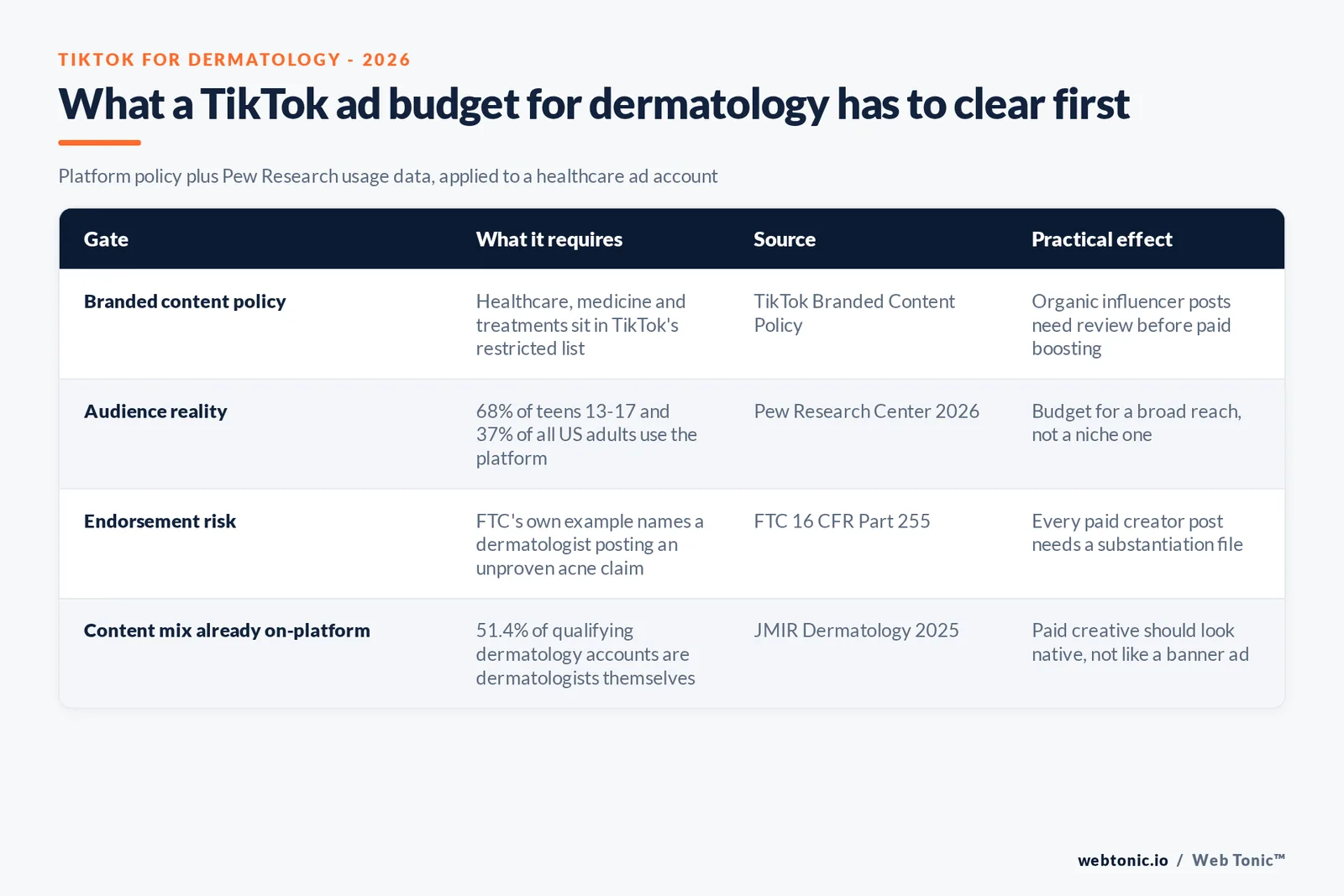
- TikTok's own policy lists healthcare and medicine under restricted branded content.
- 51.4% of qualifying dermatology accounts studied are run by dermatologists themselves.
- 17.1% are run by aestheticians and 11.4% by medical clinics, per the same study.
- Only 5.7% are run by medical spas, the smallest share of the four groups.
- The FTC's endorsement guides name a dermatologist scenario as a worked compliance example.
- No named, methodology-disclosed study prices dermatology TikTok CPC or CPM as of this page's research.
Why this page skips the CPC table
A search for "dermatology TikTok ads cost" surfaces several sites quoting specific CPC and CPM figures for "healthcare" TikTok ads. None of the ones reviewed for this page name a sample size, a date range, or a methodology that can be independently checked, several are aggregator sites republishing each other's numbers, and none isolate dermatology or plastic surgery from healthcare broadly. Rather than repeat an unverifiable figure, this page works from what is actually documented: the audience TikTok reaches, and the platform's own advertising policy for healthcare.
| What TikTok's own policy restricts | Category | Practical effect for a dermatology account |
|---|---|---|
| Branded content for medical treatments | Restricted / prohibited | Organic creator posts promoting a treatment face extra review |
| Telehealth and online pharmacy promotion | Restricted | Must meet third-party licensing standards (e.g. LegitScript, NABP) |
| Prescription-only drug promotion | Prohibited | Not permitted regardless of ad spend |
| Standard business ads for a licensed practice | Allowed with review | The practical path for most dermatology advertisers |
Who is actually on the platform: Pew Research's 2026 data
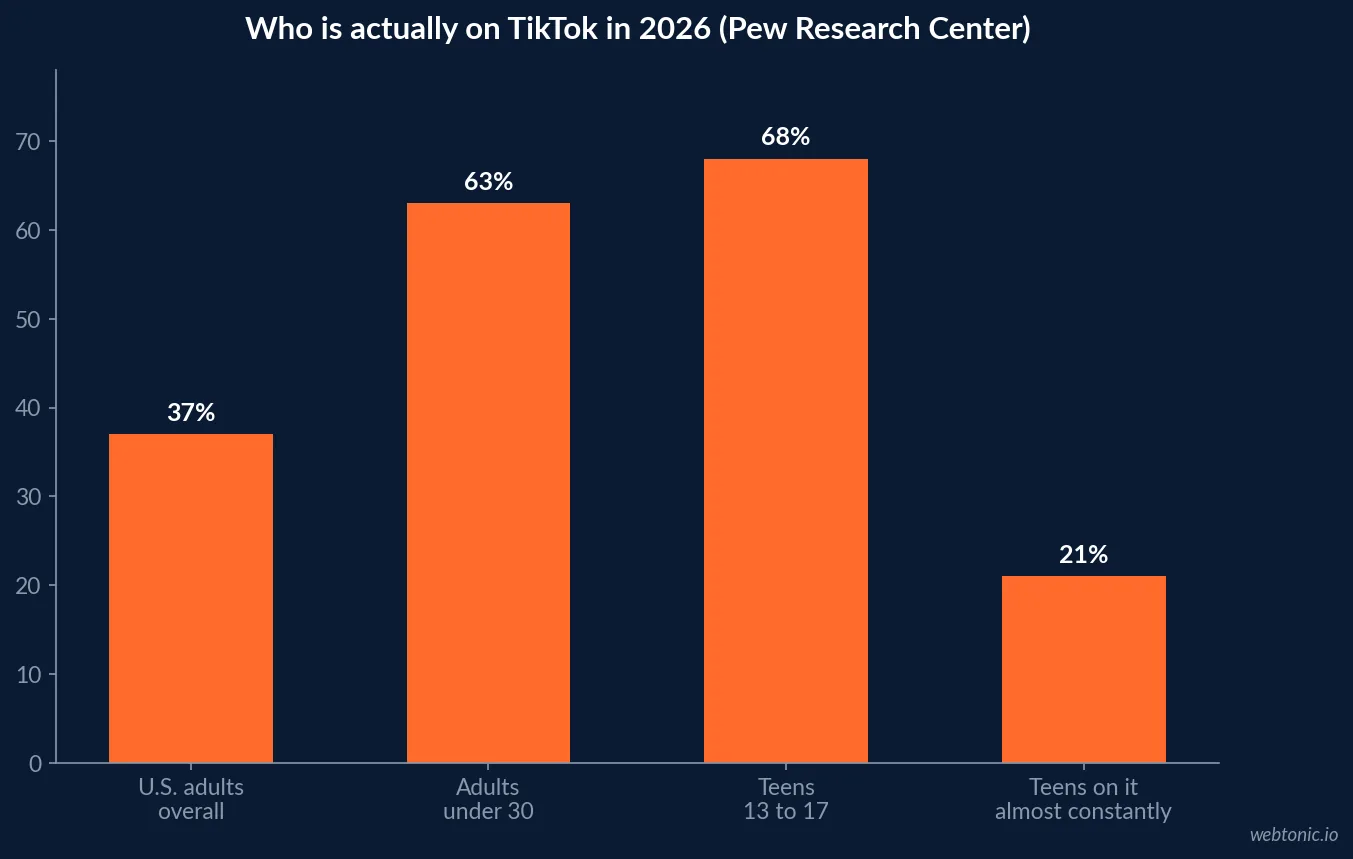
Pew Research Center's 2026 analysis finds 37% of US adults use TikTok, nearly double the 21% who did in 2021. Usage skews young: 63% of adults under 30 are on the platform against 44% of those 30-49, 30% of those 50-64, and 12% of those 65 and older.
For a dermatology audience specifically, teen usage matters most: acne, the single most common reason for a teen dermatology visit, sits inside a platform 68% of US teens aged 13 to 17 use, with 21% reporting they are on it "almost constantly," a share that is higher still among Black (37%) and Hispanic (34%) teens.
| Audience segment (Pew Research, 2026) | Share who use TikTok | Relevance to dermatology |
|---|---|---|
| All US adults | 37% | General brand and practice awareness reach |
| Adults under 30 | 63% | Acne, injectable and preventive-skincare audience |
| Adults 30-49 | 44% | Cosmetic dermatology and early anti-aging audience |
| Teens 13-17 | 68% | Acne treatment audience, requires parental-consent framing |
| Teens, almost-constant users | 21% | High-frequency exposure if content resonates |
Who is already posting: a peer-reviewed look at the feed
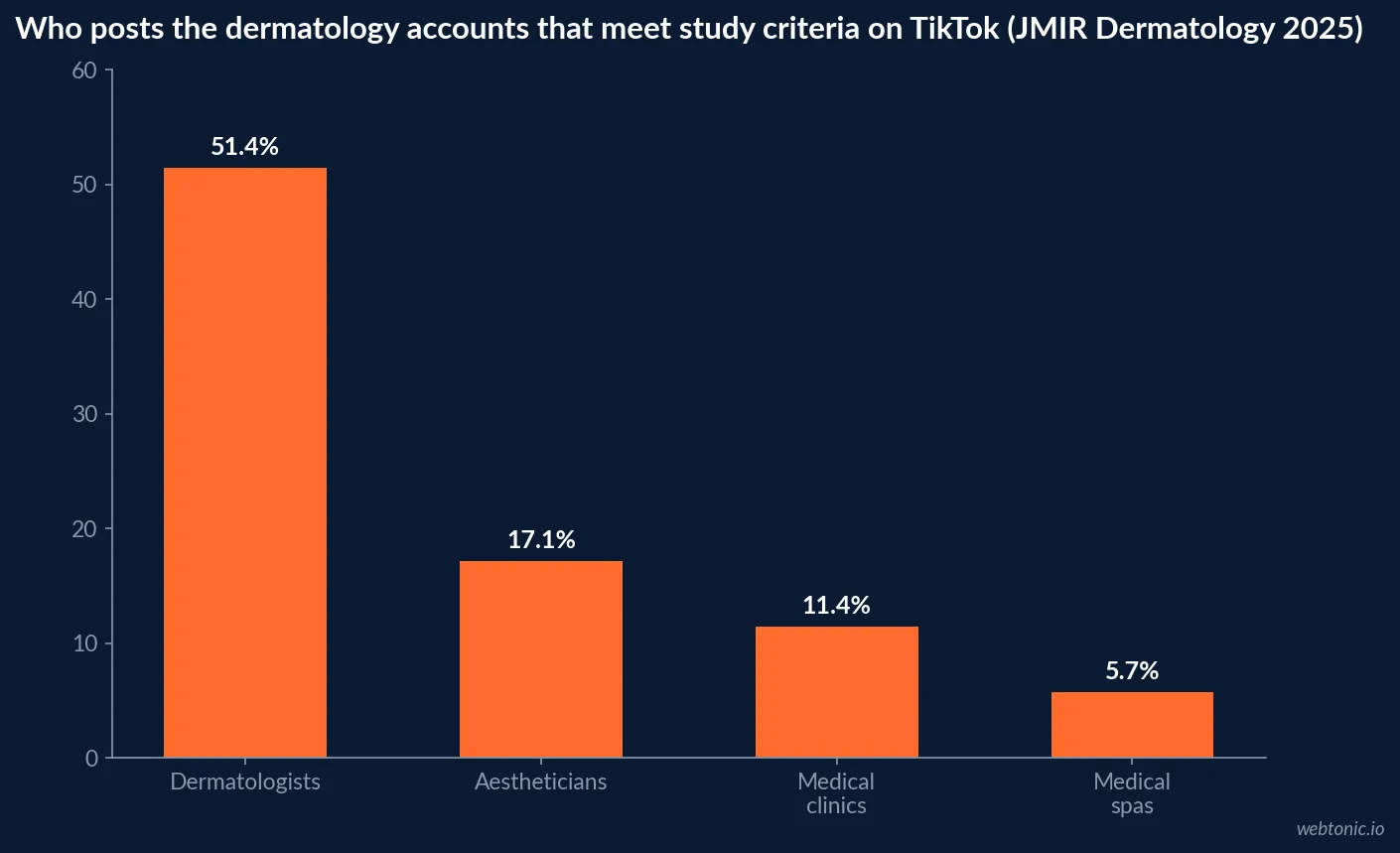
A 2025 study in JMIR Dermatology reviewing dermatology-related TikTok accounts found that, among the accounts meeting its inclusion criteria, 51.4% were run by dermatologists, 17.1% by aestheticians, 11.4% by medical clinics and 5.7% by medical spas. A separate 2024 study in the same journal, "Visibility of Board-Certified Dermatologists on TikTok," set out specifically to measure how visible board-certified physicians are against non-physician accounts covering the same topics.
The practical read for an advertiser: a paid dermatology ad is not entering an empty feed, it is competing against real board-certified dermatologists already publishing native-feeling content on the same hashtags a campaign would target. A media buyer who treats the format like a traditional display banner will be competing directly against creators who understand the platform's native pacing and editing conventions, and will likely lose that attention contest regardless of budget size.
The compliance layer that decides what a campaign can say
Beyond TikTok's platform policy, the FTC's endorsement guides, 16 CFR Part 255, use a dermatologist scenario directly: a dermatologist paid to promote a pharmaceutical company's acne treatment posts that it is "clinically proven" without having verified a flawed underlying study. The guide holds the dermatologist personally liable given their medical expertise, and the paying company liable too if the relationship is not disclosed. Any creator-partnership content boosted with paid TikTok spend needs that disclosure and a substantiation file behind every claim before launch.
| Campaign element | Rule that governs it | Action before launch |
|---|---|---|
| Paid post from a dermatologist creator | 16 CFR Part 255, expert endorsement | Disclose the paid relationship, verify claims |
| Before-and-after content | 16 CFR Part 255 examples | Use unaltered images, avoid implying typical results |
| Treatment or product claims | FTC Health Products Compliance Guidance | Keep substantiation on file for every claim made |
| Standard business ad (no influencer) | TikTok Ads Manager healthcare review | Expect manual ad review before approval |
A launch checklist that does not depend on an invented CPC
Because no verifiable cost benchmark exists for this pairing, the practical launch decision has to be sequenced around documentation rather than a target CPC. Before the first dollar of ad spend, a dermatology or plastic surgery advertiser should have on file: the practice's own licensing and NABP or LegitScript-style verification if any telehealth component is involved, a substantiation packet for every efficacy claim in the creative, a signed disclosure agreement with any creator partner, and a record of TikTok's ad review outcome for the specific creative used. None of that changes with spend level, so it should be built once and reused across every campaign in the account.
| Launch checklist item | Why it is required | Owner |
|---|---|---|
| Business/telehealth licensing verification | TikTok's Branded Content Policy restricts this category | Practice compliance lead |
| Claim substantiation file | FTC Health Products Compliance Guidance applies to every channel | Marketing / legal |
| Creator disclosure agreement | 16 CFR Part 255 requires disclosed material connections | Marketing |
| Ad review outcome on file | Confirms the specific creative cleared TikTok's healthcare review | Media buyer |
Why associations are moving onto the platform first
The American Academy of Dermatology's own "Your Dermatologist Knows" campaign, built to position board-certified dermatologists against non-physician clinicians in the public's mind, expanded onto TikTok within two years of launch, adding it to an existing social and traditional media mix rather than replacing anything. That is a signal worth reading closely: a national association with member-level scrutiny of every claim it makes chose to add TikTok specifically, rather than treat it as too risky a platform for dermatology messaging.
A practice-level account does not carry the AAD's scale, but the same logic applies: TikTok's restricted-but-not-prohibited healthcare ad policy is navigable, and the audience data above is the reason a national dermatology association judged the platform worth the compliance overhead.
| What the AAD's own move to TikTok signals | Detail |
|---|---|
| Timeline | Added within two years of the original campaign launch |
| Existing channel mix | Social plus traditional media, TikTok layered on top |
| Stated purpose | Position board-certified dermatologists as the trusted expert |
| Read-across for a practice | The platform is judged workable by the specialty's own association |
What this means for the budget conversation
Set the budget conversation around what is actually documented: an audience that is real and growing (37% of US adults, 68% of teens), a platform policy that restricts but does not forbid standard healthcare business advertising, a feed where board-certified dermatologists already compete for attention with organic content, and a compliance standard, the FTC's own dermatologist example, that applies specifically to this specialty. A CPC figure with no disclosed source should not be the number that decides the spend, and a media plan built only around an unverifiable cost target will misallocate budget the moment the real audience and policy data are factored back in.
For the paid social budget context beyond TikTok, see our breakdown of what paid social currently costs, our take on performance creative for regulated categories, or talk to us about a compliant creative brief for this specialty.
Frequently Asked Questions
What does a TikTok ad cost for a dermatology practice?
No named, methodology-disclosed study publishes a dermatology-specific TikTok CPC or CPM, and the widely circulated "healthcare TikTok ad benchmark" figures online do not name a verifiable sample or method, so this page does not repeat them. What is verifiable is the audience TikTok reaches and the platform's own restrictions on healthcare advertising, both covered below, which should shape the budget conversation more than an unsourced CPC figure would.
Can a dermatology practice actually run paid ads on TikTok?
Yes, but with real limits. TikTok's own Branded Content Policy lists healthcare, pharmaceuticals and medicine products, including medical treatments and telehealth providers, under prohibited or restricted branded content categories. A dermatology practice can run standard TikTok Ads Manager campaigns for its own business, but organic influencer or 'branded content' posts promoting specific treatments face tighter platform review than a typical consumer product.
Is the TikTok audience even relevant to a dermatology or plastic surgery practice?
Increasingly, yes. Pew Research Center's 2026 data puts TikTok use among all US adults at 37%, up from 21% in 2021, and at 63% among adults under 30. For dermatology specifically, that audience matters: 68% of US teens aged 13 to 17 report using the platform, and acne, the most common condition driving dermatology visits in that age group, is also one of the most-searched hashtag topics on the platform in academic content studies.
Who is actually posting the dermatology content already on TikTok?
A 2025 JMIR Dermatology study that reviewed accounts posting dermatology content on TikTok found that, among the accounts meeting its inclusion criteria, 51.4% were dermatologists themselves, 17.1% were aestheticians, 11.4% were medical clinics and 5.7% were medical spas. That means a paid dermatology ad is competing for attention against a feed where board-certified dermatologists already post native-feeling content, which should inform creative direction more than any recycled CPC figure.
What is the biggest compliance risk specific to TikTok ads for this specialty?
Endorsement liability. The FTC's endorsement guides, 16 CFR Part 255, use a dermatologist scenario directly: an expert who posts an unsubstantiated 'clinically proven' claim about a treatment is personally liable, and the paying company shares that liability if the relationship is not disclosed. A TikTok creator partnership promoting a treatment needs that same disclosure and substantiation file before a single dollar of paid boost goes behind it.
Sources
Pew Research Center - 8 Facts About Americans and TikTok, 2026
Pew Research Center - Teens, Social Media and AI Chatbots, 2025
TikTok - Branded Content Policy
American Academy of Dermatology - Your Dermatologist Knows campaign results
JMIR Dermatology - Information Regarding Dermatology as Seen on the Social Media Platform TikTok
JMIR Dermatology - Visibility of Board-Certified Dermatologists on TikTok
U.S. Government Publishing Office - 16 CFR Part 255, FTC Endorsement Guides