Table of contents

Meta's own 2026 category data shows Physicians & Surgeons earning the best lead-ad click-through rate of any of 14 tracked industries, then converting worse than average and paying more per lead than average. That gap - not a fabricated failure rate - is the real evidence behind claims that aesthetics brands misallocate Meta budget: the objective that earns attention and the destination that has to close it are being scored and bought as if they were the same problem.
Key Takeaways
- Physicians & Surgeons lead ads post a 4.18% click-through rate, the highest of 14 tracked categories.
- That category's all-industry average is 2.70%, so the gap is real, not noise.
- Physicians & Surgeons convert leads-objective clicks at 6.41%, below the 8.54% average.
- Cost per lead runs USD 32.14 against a USD 27.39 all-industry average.
- Beauty & Personal Care's traffic-objective CTR is 2.73%, the second highest tracked.
- The same category's lead-objective CTR is 1.35%, the lowest of any industry measured.
- Beauty & Personal Care's lead-objective CPL is USD 50.91, nearly double the average.
- 94% of consumers use rating and review sites before a cosmetic procedure booking.
- Nearly half of consumers say a provider's social presence affects their booking decision.
- 74% of consumers follow the social media of a provider they see or are considering.
- Dermatologists are named the top influencer in 12 of 15 tracked procedure categories.
- Traffic-objective CPC for Physicians & Surgeons is USD 0.61, near the USD 0.60 average.
- Leads-objective CPC for the same category is USD 1.68, below the USD 1.80 average.
- 1,585,878 cosmetic surgical procedures were performed in 2024 per ASPS.
- Facial plastic surgery volume is projected up 19% for 2025 per AAFPRS.
- Texas requires documented patient consent before a photo runs in a medical ad.
- California's before-and-after ad rule requires comparable lighting and a results-vary disclosure.
What "misallocation" means in this data, precisely
LocaliQ and WordStream track Meta (Facebook and Instagram) ad performance across 14 to 20 industry categories, split by campaign objective, from more than 1,000 live campaigns. Two categories cover most of dermatology and plastic surgery advertising: Physicians & Surgeons and Beauty & Personal Care. Neither is a perfect proxy - a Mohs surgery clinic and an injectables lounge buy ads under different labels - but both are close enough to show a pattern worth naming: each category is strongest at the objective it is least likely to be booked into.
Physicians & Surgeons: the best click, the weakest close
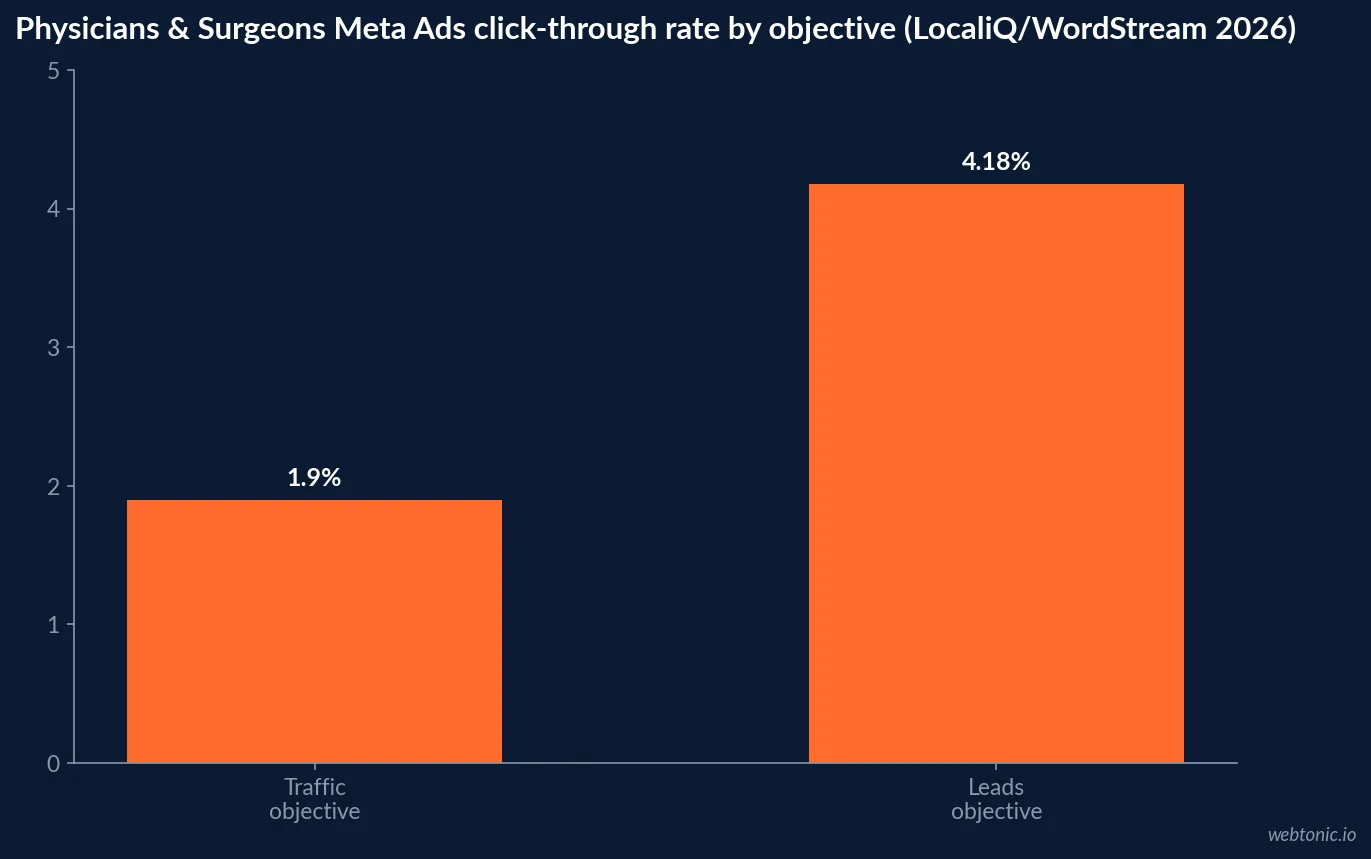
Traffic-objective Meta ads for Physicians & Surgeons post a 1.90% click-through rate, close to the 1.93% all-industry average, at a USD 0.61 cost per click against a USD 0.60 average - an unremarkable line. Move to the leads objective and the category jumps to 4.18%, the highest of every category LocaliQ/WordStream tracks, at a lower-than-average USD 1.68 cost per click. On engagement alone, Physicians & Surgeons is Meta's strongest performer for lead-form ads.
The close doesn't hold. Conversion rate on those same leads-objective ads is 6.41%, below the 8.54% average, and cost per lead lands at USD 32.14 against a USD 27.39 average. A category that wins the click and loses the form is telling advertisers something specific: the ad creative and targeting are doing their job; the landing page, intake form or phone answer is where the budget is actually being spent without return.
| Metric (2026) | Physicians & Surgeons | All-industry average | Source |
|---|---|---|---|
| Traffic-objective CTR | 1.90% | 1.93% | LocaliQ / WordStream |
| Traffic-objective CPC | USD 0.61 | USD 0.60 | LocaliQ / WordStream |
| Leads-objective CTR | 4.18% (highest tracked) | 2.70% | LocaliQ / WordStream |
| Leads-objective CPC | USD 1.68 | USD 1.80 | LocaliQ / WordStream |
| Leads-objective conversion rate | 6.41% | 8.54% | LocaliQ / WordStream |
| Leads-objective cost per lead | USD 32.14 | USD 27.39 | LocaliQ / WordStream |
Beauty & Personal Care: the opposite fault
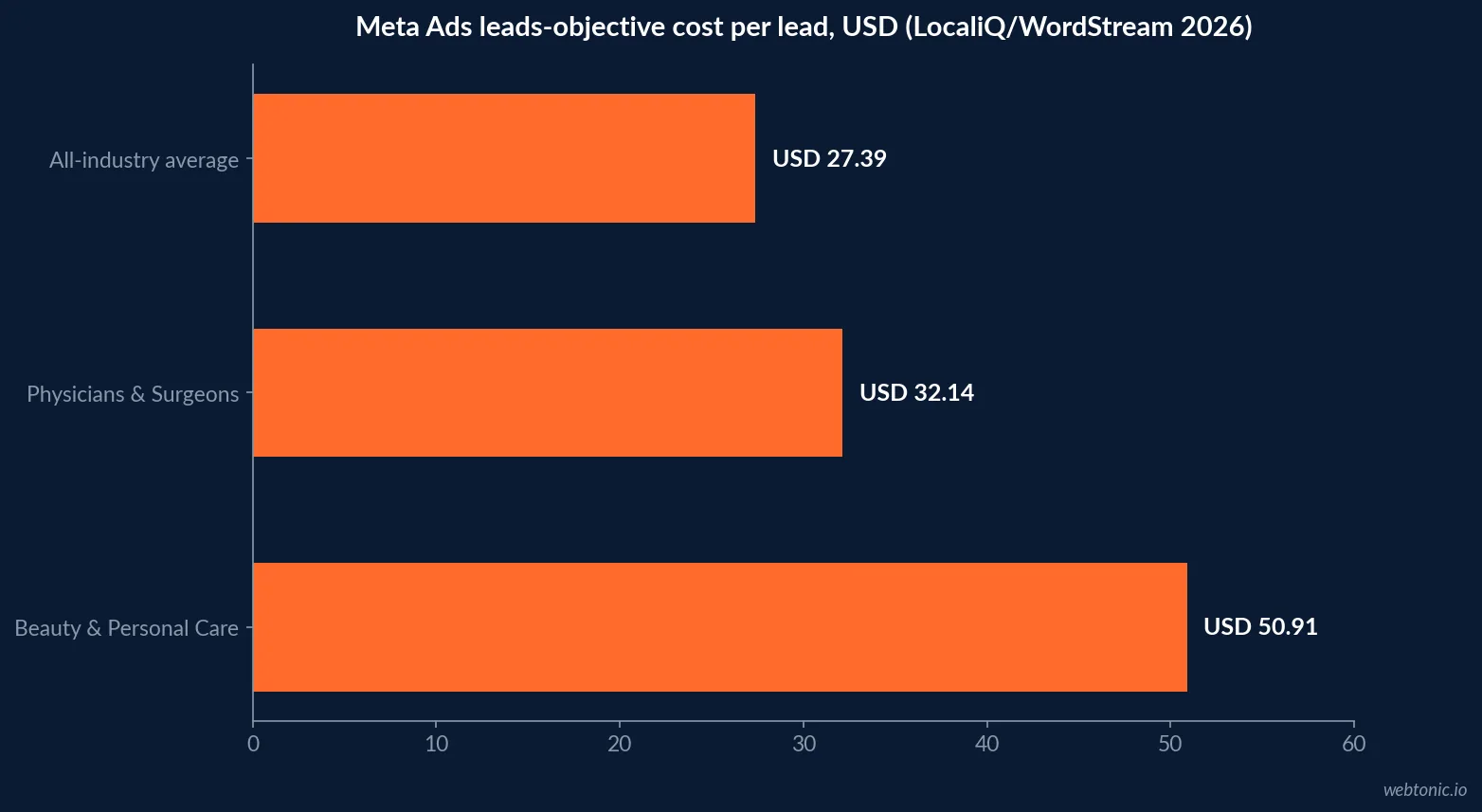
Beauty & Personal Care - the closer proxy for med-spa, injectable and skincare-adjacent dermatology offers - shows a mirrored problem. Its traffic-objective CTR is 2.73%, the second highest of any category behind Arts & Entertainment, meaning cold awareness content performs well. Its leads-objective CTR is 1.35%, the lowest of any tracked category, and its leads-objective cost per lead is USD 50.91, nearly double the all-industry average. A category that earns attention on interruption-style content converts poorly the moment it is asked to fill a form cold.
| Metric (2026) | Beauty & Personal Care | All-industry average | Source |
|---|---|---|---|
| Traffic-objective CTR | 2.73% (2nd highest tracked) | 1.93% | LocaliQ / WordStream |
| Traffic-objective CPC | USD 0.50 | USD 0.60 | LocaliQ / WordStream |
| Leads-objective CTR | 1.35% (lowest tracked) | 2.70% | LocaliQ / WordStream |
| Leads-objective CPC | USD 2.97 | USD 1.80 | LocaliQ / WordStream |
| Leads-objective cost per lead | USD 50.91 | USD 27.39 | LocaliQ / WordStream |
Why patients skip a cold click even when the ad is good
The 2025 American Society for Dermatologic Surgery (ASDS) Consumer Survey on Cosmetic Dermatologic Procedures, fielded among more than 3,500 consumers, found that 94% use rating and review websites before a cosmetic procedure decision, nearly half say a provider's social media presence affects whether they book, and 74% already follow the social media of a provider they see or are considering. Dermatologists were named the top influencer in 12 of 15 procedure categories the survey tracked.
That behavior explains the objective mismatch better than any single ad metric. A first-touch, cold leads campaign is competing with a research habit the target audience has already told researchers it follows - reviews, then the provider's own feed. An ad that sends a click straight to a form, skipping both, is fighting the funnel patients say they actually use.
| Patient research behavior (ASDS 2025) | Share | Relevance to Meta ad strategy |
|---|---|---|
| Use rating/review sites before booking | 94% | A leads ad with no visible proof is a harder sell |
| Say provider's social presence affects booking | ~50% | Organic feed strength changes paid CTR |
| Already follow the provider's social media | 74% | Retargeting a warm audience should outperform cold |
| Name dermatologists as the top influencer | 12 of 15 categories | Provider-led content outperforms brand-only |
What the fix looks like in campaign structure
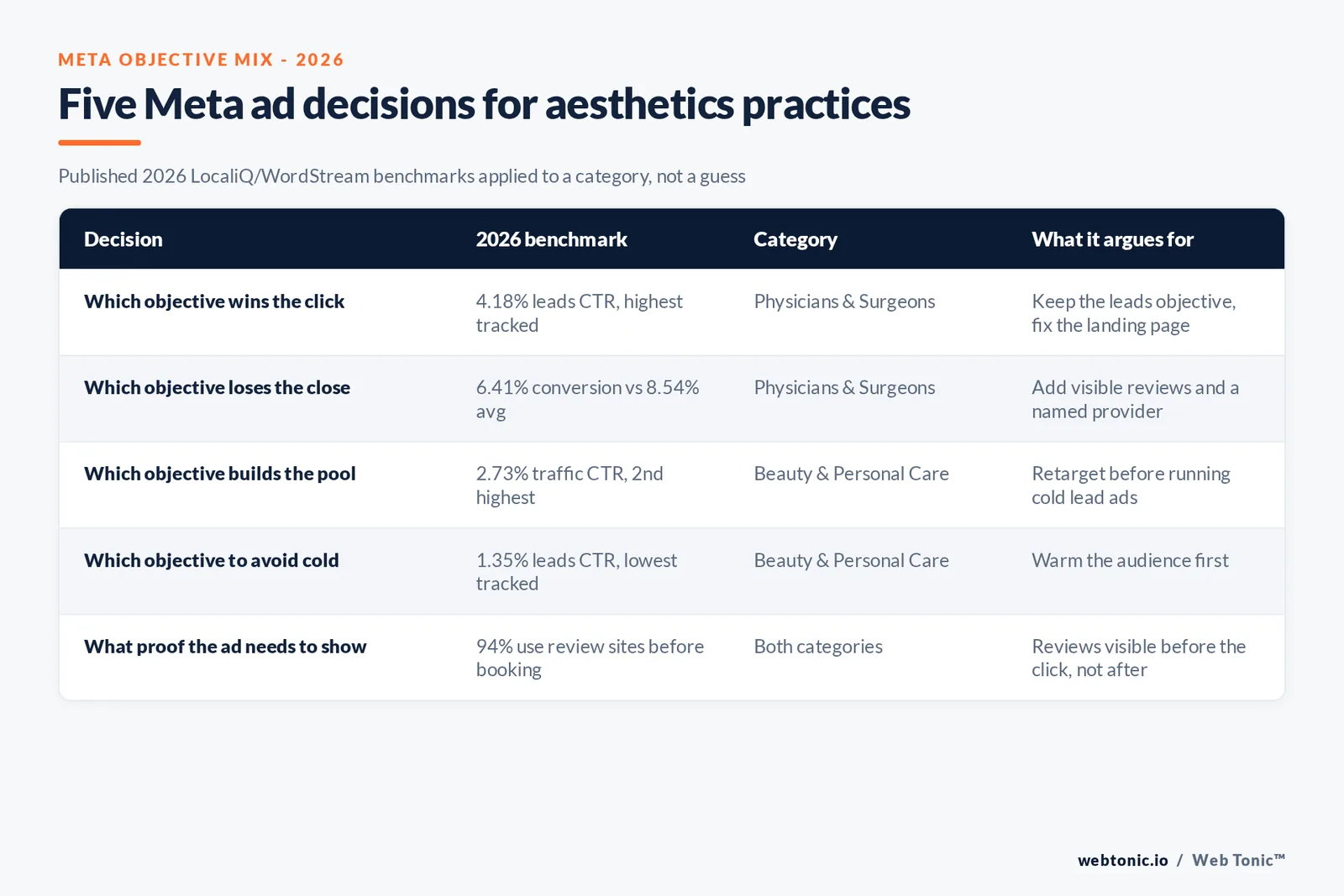
The data supports a specific reallocation, not a general call to "spend less on Meta." Given that Physicians & Surgeons already wins the click on leads objective, the fix is downstream: a landing page with visible reviews and a named provider photo, matching what 94% of the audience says it checks before booking. Given that Beauty & Personal Care wins the click on traffic objective, the fix is upstream: build a retargeting pool with traffic/engagement content before ever running a cold leads campaign into a category where leads-objective CTR is the lowest Meta tracks.
| Category | Where it already wins | Where the data shows leakage | What to change first |
|---|---|---|---|
| Physicians & Surgeons | Leads-objective CTR (4.18%) | Conversion rate (6.41% vs 8.54% avg) | Landing page proof: reviews, named provider |
| Beauty & Personal Care | Traffic-objective CTR (2.73%) | Leads-objective CTR (1.35%, lowest tracked) | Warm-audience retargeting before cold lead ads |
The compliance layer that sits over every number here
None of the metrics above override the advertising rules specific to health and appearance claims. The FTC's Health Products Compliance Guidance requires that any implied outcome claim - including a testimonial - be backed by competent evidence and reflect what a typical user can expect, not a best-case result. Separately, patient photos carry their own consent layer: Texas medical board rules require documented patient consent before a photo or representation of an actual patient appears in an advertisement, and California's Business and Professions Code Section 651 requires before-and-after images to use comparable lighting and pose and to disclose that results vary. These rules apply to the creative itself, whether it runs as a paid Meta ad or an organic post.
| Rule | Source | What it requires | Where it bites in a Meta campaign |
|---|---|---|---|
| Health claim substantiation | FTC Health Products Compliance Guidance | Competent evidence for implied outcomes | Before/after captions, injectable result claims |
| Patient photo consent (TX) | 22 Tex. Admin. Code SS 164.2 | Documented consent before use in advertising | Any UGC or patient-photo ad creative |
| Before/after presentation (CA) | Cal. BPC SS 651 | Comparable lighting/pose plus results-vary disclosure | Carousel and video before/after ads |
Market context: why the objective mismatch matters more here than elsewhere
The American Society of Plastic Surgeons' 2025 Plastic Surgery Statistics Report counted 1,585,878 cosmetic surgical and minimally invasive procedures in the prior reporting year, and the AAFPRS 2026 annual survey projects facial plastic surgery volume up 19% for 2025. Growing categories with high per-patient value amplify the cost of a mismatched objective: a USD 50.91 cost per lead in a category converting at half the average rate compounds fast across a monthly budget, while the same dollars spent building the retargeting pool the traffic-objective data already supports would be working with the platform's own numbers instead of against them.
| Category | Leads-objective CPL (2026) | Source |
|---|---|---|
| Dentists & Dental Services | USD 61.56 (highest tracked) | LocaliQ / WordStream |
| Beauty & Personal Care | USD 50.91 | LocaliQ / WordStream |
| Physicians & Surgeons | USD 32.14 | LocaliQ / WordStream |
| All-industry average | USD 27.39 | LocaliQ / WordStream |
How this compares to other high-cost lead categories
Aesthetics doesn't carry Meta's highest cost per lead - Dentists & Dental Services does, at USD 61.56, nearly double the Physicians & Surgeons figure. That context matters for setting expectations with a practice owner comparing notes with a dental colleague: a higher CPL in this bracket of categories is normal, and the number worth managing is the conversion rate on top of it, not the raw cost per lead in isolation.
What a stronger objective mix is worth, illustrated
Run the published averages against a simple monthly budget to see the size of the gap. A practice spending USD 3,000 a month on Physicians & Surgeons-type leads ads at the category's own USD 32.14 cost per lead buys roughly 93 leads. The same budget at the USD 27.39 all-industry average would buy roughly 110 leads - a 17-lead gap that traces directly to the category's below-average conversion rate, not to the ad itself. For Beauty & Personal Care at USD 50.91 per lead, the same USD 3,000 buys roughly 59 leads; closing even a third of that gap by warming the audience first is the difference between 59 and something closer to 80.
| Monthly Meta budget | Category | Published CPL | Illustrative leads bought |
|---|---|---|---|
| USD 3,000 | Physicians & Surgeons (actual) | USD 32.14 | ~93 |
| USD 3,000 | All-industry average | USD 27.39 | ~110 |
| USD 3,000 | Beauty & Personal Care (actual) | USD 50.91 | ~59 |
How to test this without guessing
Run a leads-objective campaign for Physicians & Surgeons-type services only into a landing page carrying visible reviews and a named provider, and compare cost per lead against the current flow. Separately, run a Beauty & Personal Care-type retargeting campaign built from traffic-objective engagement before adding a cold leads campaign, and compare its cost per lead against the USD 50.91 benchmark. If you want that funnel built and instrumented end to end, our performance creative team and Meta Ads practice can set up both tests, see our full breakdown of Facebook ad costs for budgeting context, or talk to us about auditing your current objective mix against these numbers.
Frequently Asked Questions
Is it true that most aesthetics brands misallocate their Meta ad budget?
The claim can't be proven for every brand, but LocaliQ/WordStream's 2026 benchmarks show a mismatch that matches what shows up in account audits: Physicians & Surgeons lead ads post the highest click-through rate of any of the 14 tracked categories, 4.18% against a 2.70% all-industry average, yet convert clicks into leads at 6.41%, below the 8.54% average, and pay USD 32.14 per lead against a USD 27.39 average. Beauty & Personal Care shows the opposite fault: a strong 2.73% traffic-objective click-through rate but the weakest lead-objective click-through rate on the list, 1.35%. Money is chasing clicks in the objective each category is worst at.
Why does Physicians & Surgeons get the best CTR but a weak conversion rate?
The published data doesn't say why, only what: a compelling ad earns the click, then a form, landing page or intake flow loses the person before they convert. ASDS 2025 consumer survey data offers a plausible reason - 94% of consumers use rating and review sites before booking a cosmetic procedure, so a cold Meta click without visible reviews or a named provider on the landing page is asking someone to skip a step they've already told researchers they take.
Should dermatology and plastic surgery practices use the Leads objective or Traffic objective?
The category data argues for testing objectives against your own funnel rather than defaulting to one. Physicians & Surgeons already gets a premium leads-objective CTR (4.18%), so the objective isn't the constraint - the destination is. Beauty & Personal Care's traffic-objective CTR (2.73%) is Meta's second highest of any category, which argues for using traffic/engagement campaigns to build a retargeting pool before ever running a cold leads campaign into a med-spa or injectable audience.
What compliance rules apply to Meta ads for dermatology or plastic surgery?
Health-adjacent claims sit under the same truth-in-advertising bar the FTC applies to any health product endorsement: implied outcomes need substantiation and any patient testimonial must reflect a typical result. Separately, several states regulate how a patient's photo can be used in advertising at all - Texas requires documented consent before a photo or representation of an actual patient runs in an ad, and California's before-and-after rules require comparable lighting and pose plus a disclosure that results vary. None of that is Meta-specific; it applies whether the same creative runs as a paid ad or an organic post.
Does a strong click-through rate mean the ad spend is working?
Not on its own. Physicians & Surgeons proves the opposite case: the best CTR in the LocaliQ/WordStream dataset paired with a below-average conversion rate and an above-average cost per lead. CTR measures whether the ad earned attention; CPL and conversion rate measure whether that attention turned into a patient. Reporting CTR alone to a practice owner hides the exact gap where aesthetics budgets tend to leak.
Sources
LocaliQ / WordStream - Facebook Advertising Benchmarks (2026 update)
WordStream - Facebook Ads Benchmarks 2025 (PDF)
ASDS - Consumer Survey on Cosmetic Dermatologic Procedures (2025)
FTC - Health Products Compliance Guidance
Cornell LII - 22 Texas Administrative Code SS 164.2, Physician Responsibilities
California Legislative Information - Business and Professions Code Section 651
American Society of Plastic Surgeons - 2025 Plastic Surgery Statistics Report
AAFPRS - 2026 Annual Survey, Trends Defining Facial Plastic Surgery
ISAPS - Global Survey 2024, Full Report and Press Releases