Table of contents
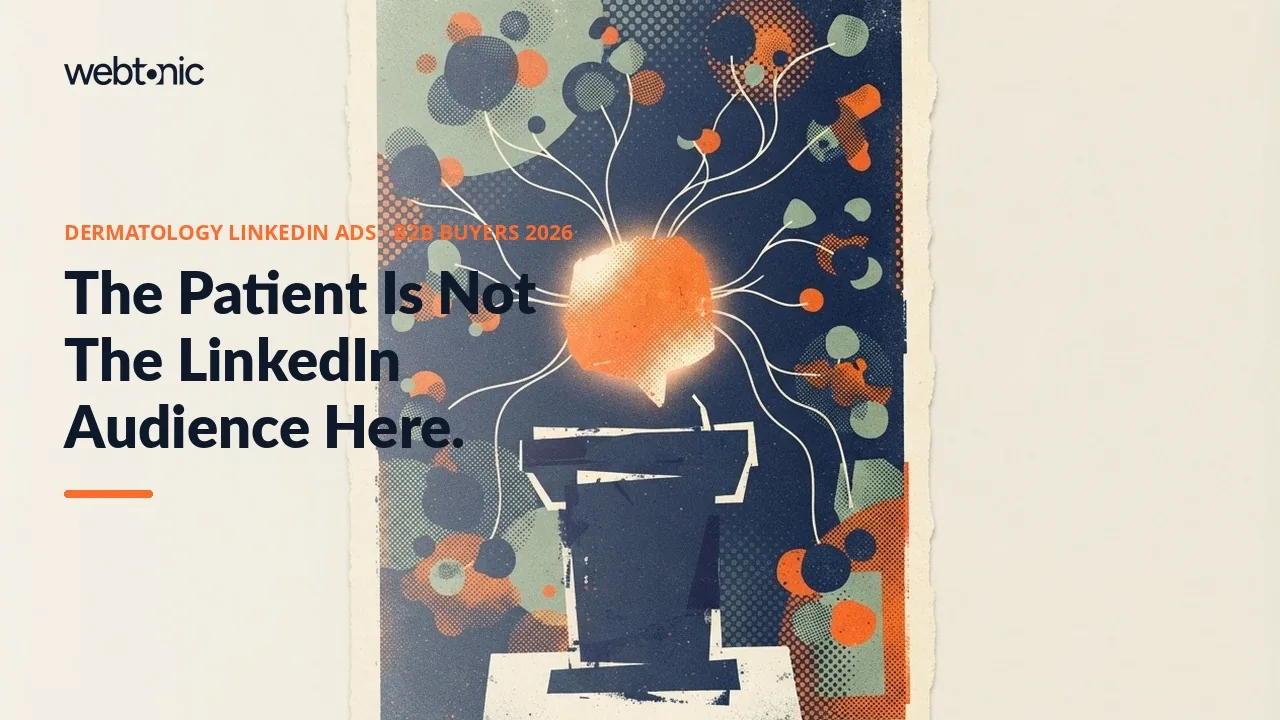
A LinkedIn ads budget for dermatology or plastic surgery is not reaching patients. It is reaching physician recruiters, practice-group consolidators, device and skincare suppliers, and referral partners, the actual professional audience LinkedIn serves. This page uses AAPPR's, PracticeMatch's, AmSpa's and Edelman-LinkedIn's own 2026 research to show where that spend is actually moving and why.
Key Takeaways
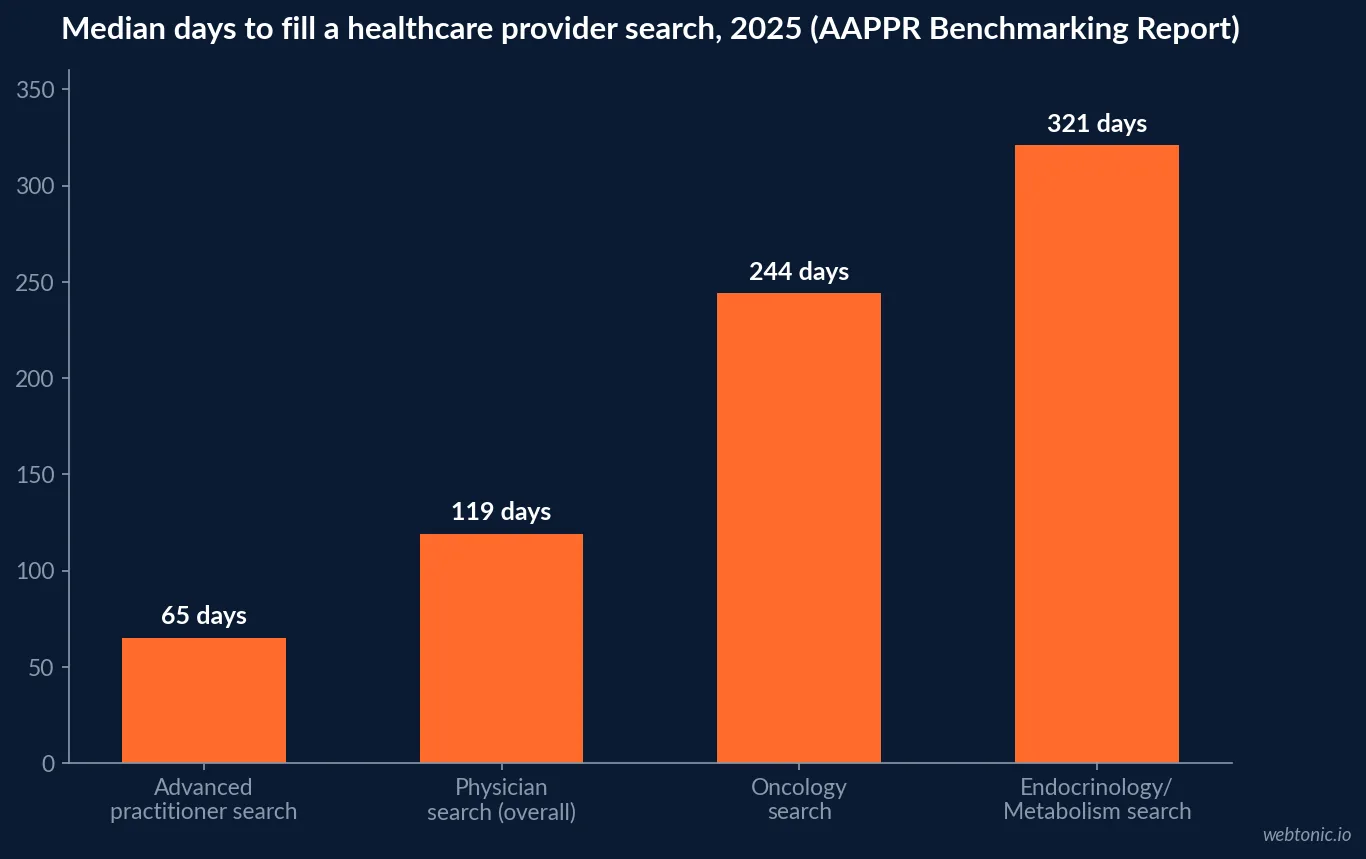
- Physician searches took a median 119 days to fill in 2025 (AAPPR).
- Advanced practitioner searches filled faster, in a median 65 days in 2025.
- Endocrinology/metabolism searches took a median 321 days, the longest tracked.
- Oncology searches took a median 244 days, the second longest.
- The typical organization ran 100 searches in 2025, down from a peak of 115 in 2023.
- Median internal recruitment budgets fell 7.4% year over year, to USD 512,500.
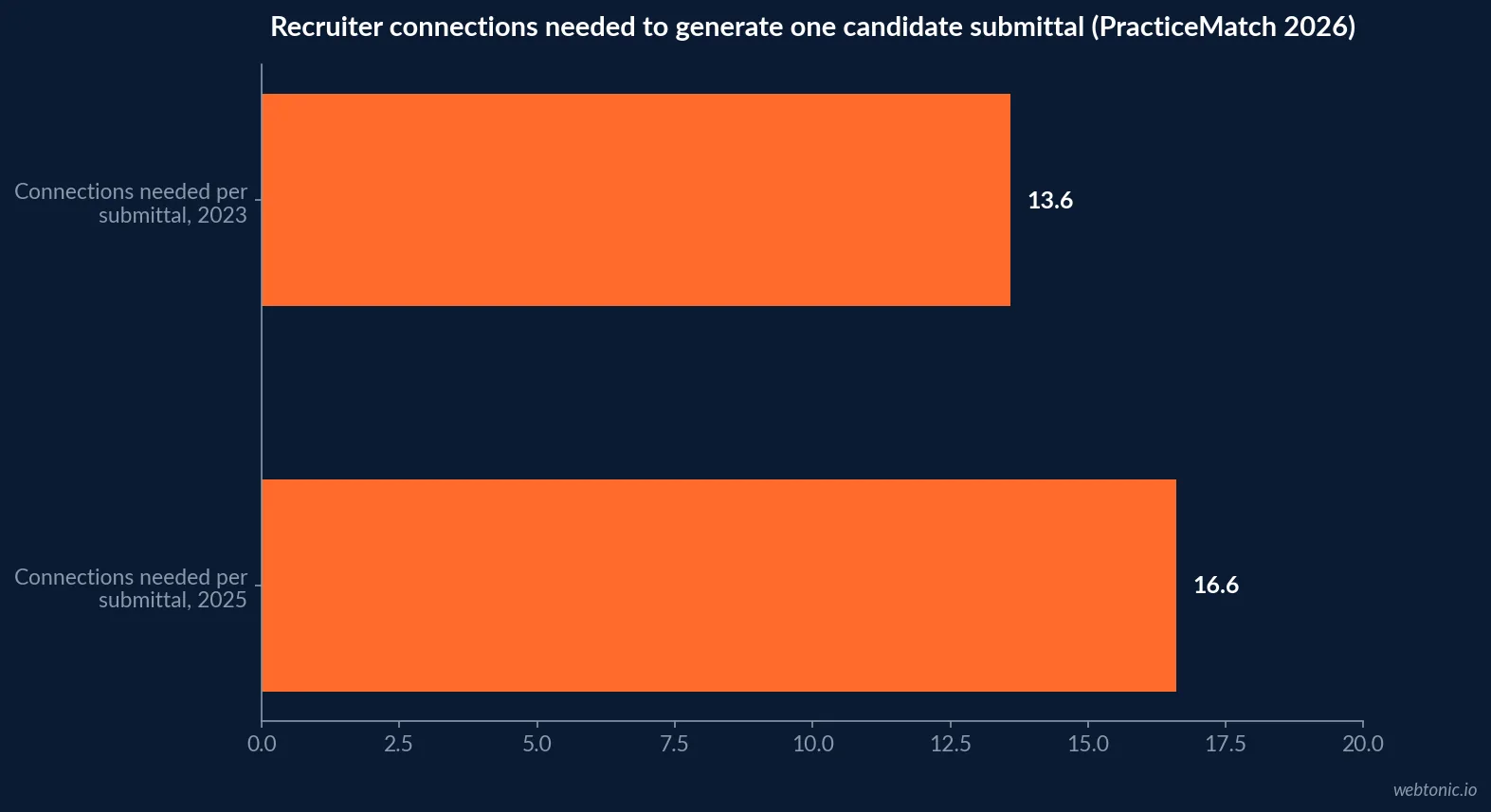
- Recruiters needed 16.6 connections per candidate submittal in 2025, up from 13.6 in 2023.
- Physician positions averaged just 0.4 applicants each in PracticeMatch's data.
- US medical aesthetics revenue exceeds USD 17 billion, per AmSpa's own research.
- That industry is growing by more than USD 1 billion a year, per the same source.
- More than 40% of B2B deals stall on buying-group misalignment (Edelman-LinkedIn 2025).
- The 2025 Edelman-LinkedIn study surveyed 1,934 US business decision-makers directly.
The audience mismatch that decides the whole strategy
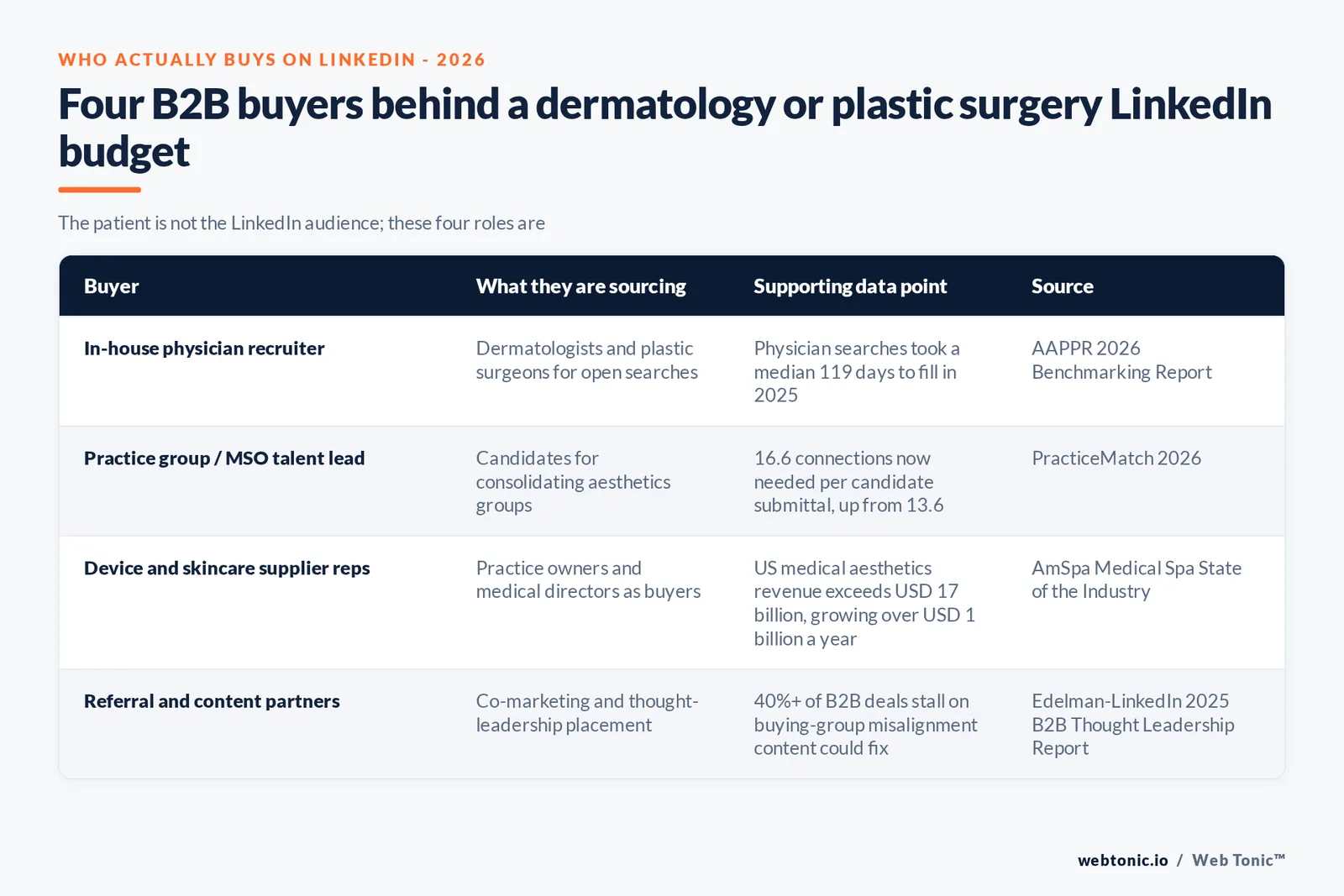
LinkedIn is a professional network, and the professionals on it are not shopping for a rhinoplasty or a chemical peel. A LinkedIn ads budget aimed at "dermatology patients" or "plastic surgery patients" is misreading the platform. The professionals actually reachable there are the ones with a documented, association-level presence in the recruiting and supply-chain data below: recruiters, practice-group talent leads, device and skincare suppliers, and referral partners. Every figure cited in this page comes from an association or vendor report about one of those four groups, not from a consumer marketing survey, because no consumer-facing study would capture this audience correctly.
| B2B buyer | What they source on LinkedIn | Supporting 2026 data point | Source |
|---|---|---|---|
| In-house physician recruiter | Dermatologists, plastic surgeons for open roles | Physician searches took a median 119 days to fill | AAPPR 2026 |
| Practice group / MSO talent lead | Candidates for consolidating aesthetics groups | 16.6 connections now needed per submittal, up from 13.6 | PracticeMatch 2026 |
| Device & skincare supplier reps | Practice owners, medical directors as buyers | Industry revenue exceeds USD 17 billion, +USD 1B/year | AmSpa State of the Industry |
| Referral & content partners | Co-marketing, thought-leadership placement | 40%+ of B2B deals stall on buying-group misalignment | Edelman-LinkedIn 2025 |
Recruiting is the clearest, most measurable buyer
The Association for Advancing Physician and Provider Recruitment's 2026 Benchmarking Report, built from over 10,000 active physician and provider searches across more than 21,000 healthcare locations, found physician searches took a median 119 days to fill in 2025, with endocrinology/metabolism the slowest specialty tracked at 321 days and oncology second at 244 days. Advanced practitioner searches moved faster, a median 65 days, down from 80 in 2024. Meanwhile median internal recruitment budgets fell 7.4% year over year, to USD 512,500.
Why recruiters are turning to LinkedIn harder than before
PracticeMatch's own 2026 data shows the number of candidate connections needed to generate a single physician submittal rose from 13.6 in 2023 to 16.6 by 2025, with the trend continuing into 2026. The same data shows an average of roughly 0.4 applicants for every open physician position. That combination, more outreach required per hire and fewer applicants per role, is exactly the condition that pushes recruiting budgets toward LinkedIn's targeted sourcing and ad tools rather than job boards alone.
| Recruiting metric (PracticeMatch / AAPPR, 2026) | 2023/2024 value | 2025 value | Direction |
|---|---|---|---|
| Connections per candidate submittal | 13.6 (2023) | 16.6 (2025) | Rising |
| Applicants per physician position | N/A | ~0.4 | Structurally low |
| Median internal recruitment budget | USD 553,376 (2024) | USD 512,500 (2025) | Falling 7.4% |
| Physician searches managed, typical org | 115 (2023 peak) | 100 (2025) | Down from peak |
| Median time to fill, advanced practitioner | 80 days (2024) | 65 days (2025) | Improving |
The supplier and consolidator side of the budget
The American Med Spa Association's own Medical Spa State of the Industry research puts US medical aesthetics revenue above USD 17 billion, growing by more than USD 1 billion a year. That scale is what pulls device manufacturers, injectable and skincare suppliers, and consolidation-minded practice groups onto LinkedIn: the buyers on the other side, practice owners and medical directors, are professionals researching supplier and partnership decisions, which is precisely the audience LinkedIn's targeting (job title, seniority, industry) is built to reach.
| Supply-side fact (AmSpa) | Figure | Why it matters on LinkedIn |
|---|---|---|
| US medical aesthetics industry revenue | USD 17 billion+ | Large enough to support dedicated supplier sales teams |
| Annual industry growth | USD 1 billion+ a year | A growing account base worth prospecting continuously |
| Buyer role | Practice owners, medical directors | Matches LinkedIn's job-title and seniority targeting |
The content problem behind every one of these deals
LinkedIn's own research, produced with Edelman, the 2025 B2B Thought Leadership Impact Report, surveyed 1,934 US business decision-makers directly on the platform and found more than 40% of B2B deals stall because of misalignment with the buying group, often because of "hidden buyers," internal stakeholders a seller never directly pitches. A supplier or recruiter selling into a dermatology practice or a consolidating MSO is rarely talking to only one decision-maker, and content built for a single named buyer misses the rest of that group.
How to measure a campaign that never touches a patient
A dermatology or plastic surgery LinkedIn campaign aimed at recruiters, suppliers or referral partners needs different success metrics than a patient-facing search or social campaign. Cost per patient lead is the wrong number to report against this spend; the right ones track the buyer types documented above: candidate submittals generated for a recruiting campaign, sales-qualified conversations booked for a supplier campaign, and content engagement from named accounts on a target account list for a consolidation or referral-partner campaign. Reporting patient-conversion metrics against a B2B audience misreads what the channel was ever built to do.
| Campaign type | Right success metric | Wrong metric to report |
|---|---|---|
| Physician / clinician recruiting | Candidate submittals, qualified applications | Cost per patient booked |
| Device / skincare supplier outreach | Sales-qualified conversations with practice buyers | Ad impressions alone |
| MSO / consolidation talent | Executive-level candidate connections | Patient lead volume |
| Referral / co-marketing partner | Named-account engagement on a target list | General click-through rate |
The procedure growth that keeps consolidators buying
The supplier and consolidator interest above is not speculative. The Aesthetic Society's own Aesthetic Plastic Surgery National Databank report, built with CosmetAssure from a dataset of more than 150,000 individual procedures, recorded a 2.9% rise in total surgical procedures from 2022 to 2023 alone, contributing to a 10.2% overall growth in surgical procedures from 2019 to 2023. That kind of multi-year growth is exactly what draws private equity-backed practice groups and device suppliers to keep expanding their footprint, and LinkedIn is where those groups recruit the talent and negotiate the partnerships that expansion requires.
| Aesthetic Society databank fact (2019-2023) | Figure |
|---|---|
| Surgical procedure growth, 2022 to 2023 | +2.9% |
| Surgical procedure growth, 2019 to 2023 | +10.2% |
| Dataset size behind the report | 150,000+ individual procedures |
| Data partner | CosmetAssure |
What this means for budget allocation
Route the LinkedIn budget toward the audiences that actually behave like the data: recruiting campaigns aimed at clinicians in the specialties with the longest time-to-fill (endocrinology, oncology, and by extension high-demand dermatology and plastic surgery subspecialties), supplier campaigns aimed at practice owners and medical directors inside the growing USD 17 billion aesthetics market, and thought-leadership content built for a buying committee rather than a single named contact. None of that budget should be justified against a "patient conversion" metric, because that patient is not the audience on this platform. Reporting frameworks built for consumer-facing paid media, cost per booked appointment chief among them, simply do not apply to a LinkedIn spend aimed at these four buyer types, and forcing that comparison is the single most common way this channel gets defunded for the wrong reason.
For the paid search and social budgets that do reach patients directly, see our breakdown of what Google Ads costs across industries, our growth marketing practice, or talk to us about structuring a B2B LinkedIn campaign for this specialty.
Frequently Asked Questions
Do patients actually book dermatology or plastic surgery appointments through LinkedIn ads?
Essentially no, and that is the point of this page. LinkedIn's user base skews toward working professionals researching career, hiring and supplier decisions, not toward people booking elective medical procedures. The real audience for a dermatology or plastic surgery LinkedIn budget is B2B: recruiters filling clinical roles, practice groups evaluating acquisitions, and suppliers selling into practices, all of which is where the association-level data below actually applies.
Who is actually worth targeting with LinkedIn ads in this specialty?
Four groups with real, documented activity: in-house physician recruiters (AAPPR's 2026 data shows physician searches took a median 119 days to fill), practice-group and MSO talent leads managing multi-site consolidation, device and skincare suppliers selling into a USD 17 billion-plus medical aesthetics industry (AmSpa), and referral or co-marketing partners, since Edelman-LinkedIn's own research found over 40% of B2B deals stall on buying-group misalignment that content can address.
How hard has physician and dermatologist recruiting gotten?
PracticeMatch's own 2026 data shows recruiters needed 13.6 candidate connections on average to generate one submittal in 2023; by 2025 that had risen to 16.6, with the trend continuing upward into 2026. AAPPR's 2026 Benchmarking Report, drawn from over 10,000 active physician and provider searches, separately found the typical organization managed 100 searches in 2025 against a peak of 115 in 2023, while median recruitment budgets fell 7.4% year over year.
Is the medical aesthetics industry big enough to matter to B2B advertisers?
Yes. The American Med Spa Association's own industry data puts US medical aesthetics revenue above USD 17 billion, growing by more than USD 1 billion a year. That scale is exactly what draws device manufacturers, skincare suppliers and consolidators to LinkedIn, since the buyers on the other side of those relationships, practice owners and medical directors, are professionals researching business decisions on a platform built for that, not consumers researching a procedure.
What content actually moves a B2B buyer in this space on LinkedIn?
LinkedIn's own 2026 research, produced with Edelman, found more than 40% of B2B deals stall because of misalignment with buying groups, often caused by 'hidden buyers,' internal stakeholders a seller never directly pitches. For a supplier or recruiter targeting dermatology and plastic surgery practices, that argues for thought-leadership content built to reach the whole buying committee, not just a single named decision-maker, since LinkedIn's own data says the deal usually stalls with someone the seller never spoke to.
Sources
AAPPR - 2026 Physician and Provider Recruitment Benchmarking Report
PracticeMatch - The End of Transactional Physician Recruiting, 2026 data
American Med Spa Association - Medical Spa State of the Industry Report
The Aesthetic Society - Aesthetic Plastic Surgery National Databank, 10.2% growth report
LinkedIn - 2025 Edelman-LinkedIn B2B Thought Leadership Impact Report
PracticeMatch - 2026 State of Physician Recruitment Report