Table of contents

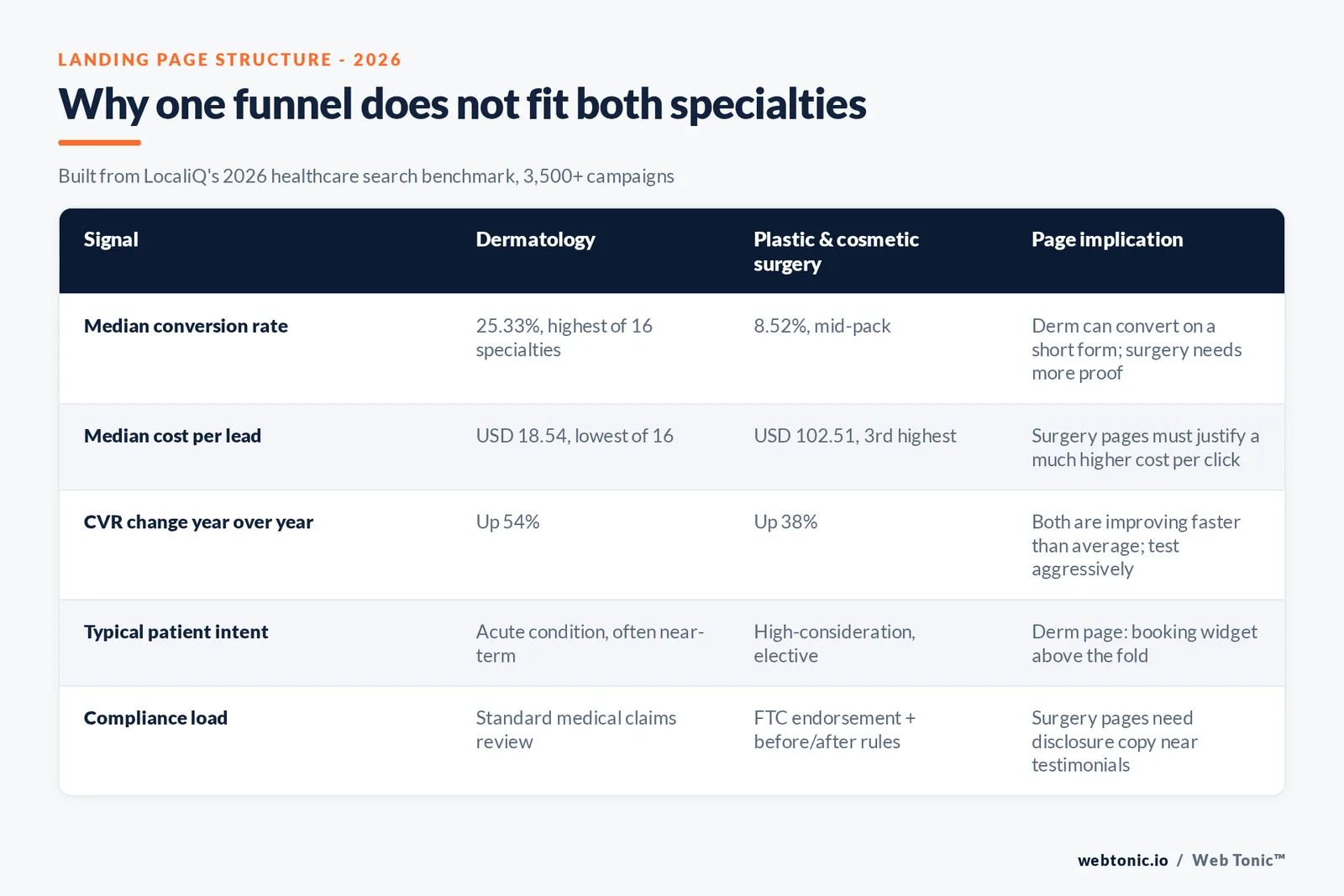
Dermatology and plastic surgery are usually sold as one "aesthetic medicine" landing page template, but the 2026 search data says otherwise. LocaliQ's healthcare benchmark, built from over 3,500 US campaigns, puts dermatology's conversion rate at 25.33% - the highest of 16 healthcare specialties - against 8.52% for plastic and cosmetic surgery. The unit of analysis here is that specialty-level gap, and the landing page structure each side of it needs.
Key Takeaways
- Dermatology converts at 25.33% on search ads, the highest of 16 tracked specialties.
- Plastic and cosmetic surgery converts at 8.52%, closer to the healthcare average.
- The all-healthcare average conversion rate is 8.09% across 3,500+ campaigns.
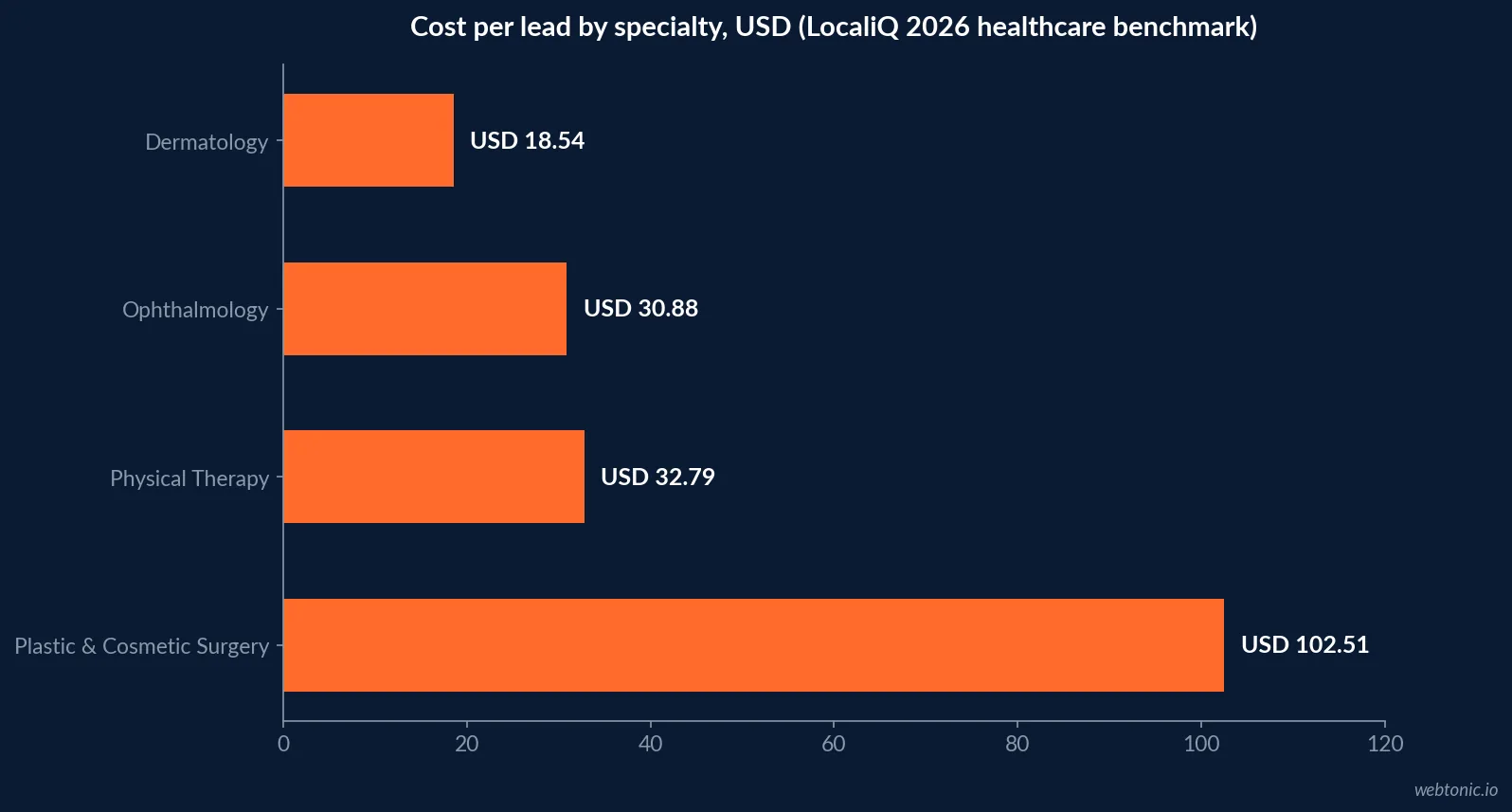
- Dermatology's cost per lead is USD 18.54, the lowest of the 16 specialties.
- Plastic surgery's cost per lead is USD 102.51, the third highest.
- Dermatology CVR rose 54% year over year, the biggest gain in the category.
- Plastic and cosmetic surgery CVR rose 38% over the same period.
- Dermatology CPL fell 37% year over year, the largest drop tracked.
- Plastic surgery CPL fell 29%, the third-largest drop.
- Dermatology's average CPC is USD 4.90 against USD 5.75 for plastic surgery.
- Dermatology's average CTR is 5.91% against 5.81% for plastic surgery.
- Orthodontics converts at 14.21%, a useful elective-but-defined-scope midpoint.
- ASPS logged 1,523,330 procedures in the top categories tracked in 2025, up 7% year over year.
- Breast augmentation rose 11% to 304,234 procedures in the 2025 ASPS report.
- Eyelid surgery rose 19% to 118,978 procedures in the same report.
- The FTC names a dermatologist directly in its endorsement-guide compliance example.
The specialty-level gap, in one table
LocaliQ's 2026 healthcare search advertising benchmark, built from over 3,500 US healthcare campaigns, treats dermatology and plastic and cosmetic surgery as two of its 16 tracked specialties. The gap between them is not close: dermatology's 25.33% average conversion rate is roughly three times the 8.18% all-industry average WordStream reports from over 13,000 campaigns, while plastic surgery's 8.52% sits close to that all-industry line.
| Metric (2026) | Dermatology | Plastic & cosmetic surgery | All healthcare average |
|---|---|---|---|
| Click-through rate | 5.91% | 5.81% | 6.07% |
| Cost per click | USD 4.90 | USD 5.75 | USD 5.64 |
| Conversion rate | 25.33% | 8.52% | 8.09% |
| Cost per lead | USD 18.54 | USD 102.51 | USD 66.02 |
| CVR change, year over year | +54% | +38% | Roughly flat |
| CPL change, year over year | -37% | -29% | -6% |

Why the gap exists: intent, not creative quality
A 25% conversion rate does not mean dermatology's ads or pages are better made than plastic surgery's. LocaliQ's own analysis of the category points to elective, high-consideration searches (orthodontics, plastic surgery) converting lower than searches tied to an acute condition that a patient wants resolved quickly. A dermatology search for a changing mole or a persistent rash carries urgency; a search for a rhinoplasty consultation carries a multi-week comparison process across several surgeons.
That distinction should decide the landing page brief before a single word of copy gets written. A dermatology page can ask for a booking on the first screen. A plastic surgery page has to earn that ask.
| Search intent signal | Dermatology pattern | Plastic surgery pattern |
|---|---|---|
| Typical trigger | New or changing symptom | Elective goal, no medical urgency |
| Decision window | Days | Weeks to months |
| Comparison behavior | Nearest available appointment | Multiple consultations, portfolios |
| Insurance relevance | Often partially covered | Almost always self-pay |
| Best page format | Single-condition page with booking widget | Procedure page with consultation funnel |
What the ASPS procedure mix tells a page builder
The 2025 ASPS Procedural Statistics Report, the American Society of Plastic Surgeons' own annual data, logged 1,523,330 procedures across its top tracked categories, up 7% year over year. Growth was not even: breast augmentation and revision rose 11% to 304,234 procedures, eyelid surgery rose 19% to 118,978, and facial fat grafting rose 39% to 34,117, while rhinoplasty fell 5% to 43,116.
That spread argues against a single "cosmetic procedures" landing page. A practice growing its breast augmentation volume and one growing its facial rejuvenation volume are answering two different search queries, and each deserves its own page rather than a shared services list that ranks for neither well.
| Procedure (ASPS 2025) | Volume | Change vs. 2024 | Landing page implication |
|---|---|---|---|
| Breast augmentation & revision | 304,234 | +11% | Warrants its own dedicated page |
| Eyelid surgery (blepharoplasty) | 118,978 | +19% | Fast-growing; worth a fresh page test |
| Facial fat grafting | 34,117 | +39% | Newer demand; page content likely thin industry-wide |
| Facelift (rhytidectomy) | 77,933 | +13% | Established procedure; page should carry more proof |
| Rhinoplasty (nose reshaping) | 43,116 | -5% | Declining category; do not over-invest in new pages |
Compliance the landing page has to carry, not the ad
The FTC's Guides Concerning the Use of Endorsements and Testimonials, 16 CFR Part 255, include a worked example built around a dermatologist: an expert who posts an unsubstantiated "clinically proven" claim about a treatment is personally liable for the claim, and the company paying for the endorsement shares that liability if the relationship is not disclosed. A before-and-after photo used as a testimonial on a landing page sits under the same rule as a spoken endorsement.
The FTC's Health Products Compliance Guidance extends this to the landing page itself: claims made anywhere in the marketing funnel, including a page a paid click lands on, need the same substantiation as a claim made in a broadcast ad.
| Compliance checkpoint | What the rule covers | Landing page action |
|---|---|---|
| Endorsement disclosure | 16 CFR Part 255, expert and patient endorsements | State any commercial relationship near the testimonial |
| Substantiation of efficacy claims | FTC Health Products Compliance Guidance | Support every outcome claim with evidence on file |
| Before-and-after image accuracy | 16 CFR Part 255 photo examples | Use unaltered images from the same lighting and angle |
| Typical-results framing | FTC Health Products Compliance Guidance | Note when a result is not typical, near the image |
Building the dermatology page
With a category-leading 25.33% conversion rate and the lowest cost per lead in the specialty set at USD 18.54, a dermatology page should not add friction it does not need. The pattern the data supports: name the single condition or treatment in the H1, put a booking widget or click-to-call above the fold, and keep the form short. Save the longer trust-building content, credentials, before-and-after galleries, for a secondary section rather than gating the booking action behind it.
Our growth marketing practice treats this as a template decision, not a one-off page edit: once one condition page proves the pattern, the same structure should roll out across the rest of the treatment list rather than each page being rebuilt from scratch.
Building the plastic surgery page
At 8.52% conversion and USD 102.51 cost per lead, a plastic surgery page is paying roughly five and a half times more per lead than a dermatology page for a conversion rate under a third as high. That economics only works if the page earns the higher cost: full-length before-and-after content with proper disclosure, named board certifications, a clear consultation-booking step rather than a hard sale, and pricing transparency where the practice is willing to give it, since elective buyers compare providers on exactly that information before they ever call.
| Page element | Dermatology default | Plastic surgery default |
|---|---|---|
| Primary call to action | Book appointment | Request a consultation |
| Form length | Name, phone, condition | Name, phone, procedure interest, timeline |
| Proof content placement | Below the fold | Woven through the page |
| Pricing disclosure | Rarely relevant | Often expected by comparison shoppers |
| Compliance copy | Standard claims review | Endorsement + before-after disclosure |
Testing priorities for both specialties
Both specialties improved in 2026: dermatology's conversion rate rose 54% year over year and plastic surgery's rose 38%, the two largest gains LocaliQ recorded across 16 healthcare specialties, while cost per lead fell for both. That is not a ceiling reached, it is evidence that focused landing page and targeting work is still paying off across the category. The priority order the data supports: fix the highest cost-per-lead pages first (plastic surgery), then protect the highest-converting pages from regressing (dermatology) as more competitors copy what is working.
Read our related work on what Google Ads actually costs across industries for the budget context behind these specialty figures, or talk to us about auditing a specific treatment page.
Frequently Asked Questions
Why does dermatology convert so much higher than plastic surgery on search ads?
LocaliQ's 2026 healthcare benchmark, built from over 3,500 US campaigns, puts dermatology's average search ad conversion rate at 25.33% against 8.52% for plastic and cosmetic surgery. Dermatology searches skew toward acute, often insurance-relevant conditions such as a suspicious mole or a rash that needs a same-week appointment, which produces short-cycle, high-intent clicks. Plastic surgery searches are higher consideration and elective, so more visitors compare surgeons and pricing before they book a consultation, which lowers the click-to-form rate even when the traffic quality is good.
What is a good landing page conversion rate for a plastic surgery practice?
Against LocaliQ's 8.52% average for the specialty, a page converting below roughly 5 to 6% has room to improve, while a page clearing 10 to 12% is outperforming the category. Cosmetic surgery pages carry a heavier cost per lead, USD 102.51 on average in the same 2026 data, the third highest of the 16 healthcare specialties LocaliQ tracks, so small conversion gains are worth defending with testing rather than treating the specialty's naturally lower rate as a ceiling.
Do before-and-after photos need a disclaimer on a landing page?
The FTC's endorsement guides, 16 CFR Part 255, address this directly with a dermatologist example: an expert who posts an unsubstantiated efficacy claim about a treatment is personally liable for it, and the advertiser sharing that liability if the connection between them is not disclosed. A results photo used as a testimonial is treated the same way as a spoken endorsement, so the safest landing page pattern states the procedure, states that results vary, and discloses any commercial relationship with the patient or reviewer shown.
Should every treatment get its own landing page instead of one general services page?
The specialty-level data supports it. Dermatology's lowest cost per lead sits at USD 18.54 and its highest conversion rate at 25.33%, both markedly better than the category average, which is consistent with pages built around a single, well-defined condition or procedure rather than a general 'services' page trying to rank and convert for everything at once. A page that names one condition, one outcome and one next step matches how LocaliQ's best-performing subcategories are structured.
Why did both specialties see conversion rates improve in 2026?
LocaliQ reports dermatology's conversion rate up 54% year over year and plastic and cosmetic surgery's up 38%, the two largest gains of the 16 healthcare subcategories tracked, while cost per lead fell for both (down 37% for dermatology, down 29% for plastic surgery). The report does not isolate a single cause, but it does note that healthcare CPL fell overall while most other industries saw it rise, which it links partly to more tailored ad copy and better-targeted campaigns feeding into the landing page.
Sources
LocaliQ - Healthcare Search Ads Benchmarks for 16 Specialties, 2026
WordStream - 2026 Google Ads Industry Benchmarks
American Society of Plastic Surgeons - 2025 Plastic Surgery Statistics Report
American Society of Plastic Surgeons - Plastic Surgery Statistics
U.S. Government Publishing Office - 16 CFR Part 255, FTC Endorsement Guides
Federal Trade Commission - Health Products Compliance Guidance