Table of contents
LocaliQ's 2026 healthcare benchmarks price dermatology's average Google Ads lead at USD 18.54 and plastic & cosmetic surgery's at USD 102.51 - a more than fivefold gap inside one paid search category healthcare advertisers often plan as a single budget line. The rest of this page is the full benchmark behind that number, plus the certification and compliance rules that actually govern what an ad can claim once the budget is set.
Key Takeaways
- Dermatology's average Google Ads cost per lead is USD 18.54, the lowest of 16 healthcare subcategories LocaliQ tracks.
- Plastic & Cosmetic Surgery's average cost per lead is USD 102.51, the third-highest of those 16 subcategories.
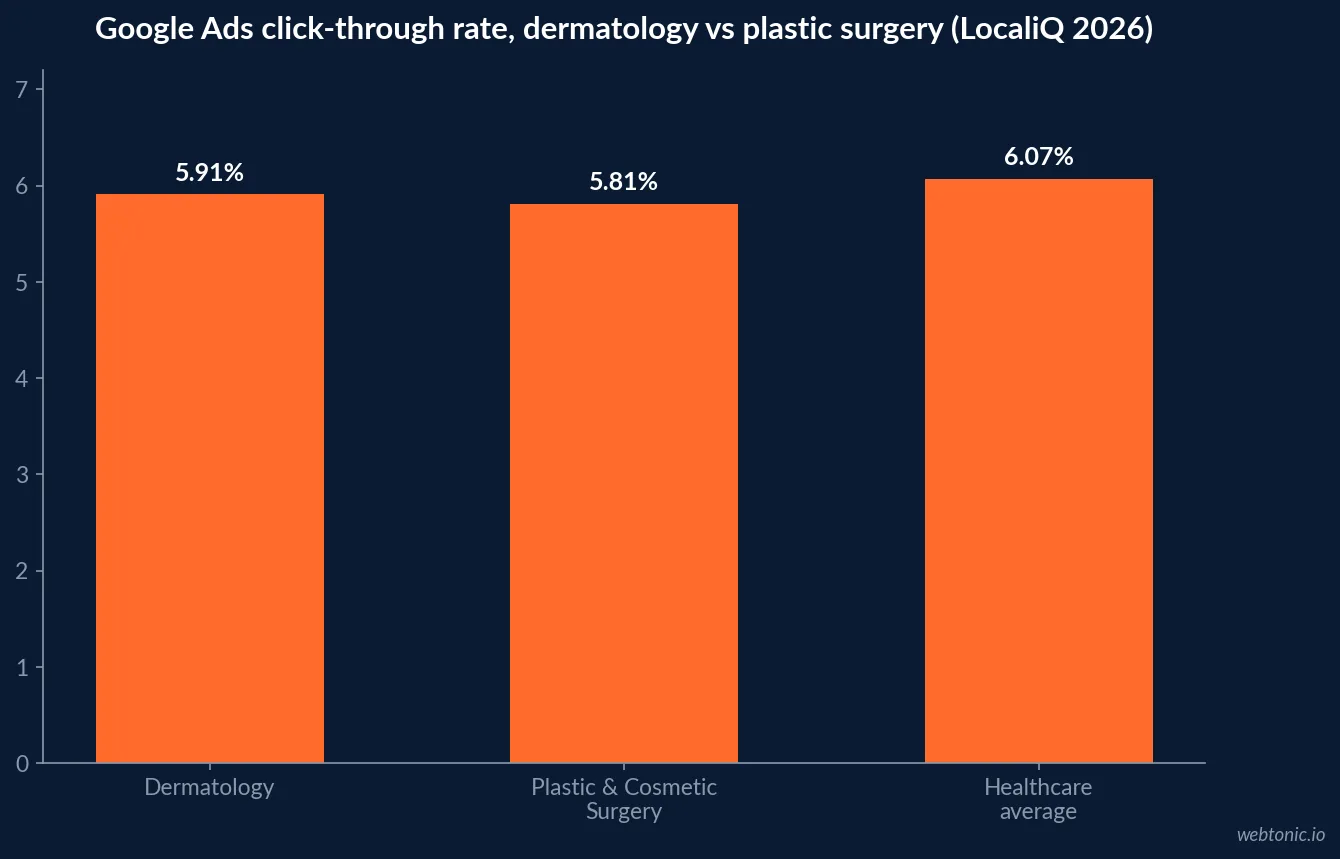
- Dermatology's click-through rate is 5.91%; Plastic & Cosmetic Surgery's is 5.81%, both close to the healthcare average of 6.07%.
- Dermatology's cost per click is USD 4.90; Plastic & Cosmetic Surgery's is USD 5.75, against a healthcare average of USD 5.64.
- Dermatology converts at 25.33%, the highest conversion rate of any healthcare subcategory tracked; Plastic & Cosmetic Surgery converts at 8.52%.
- Dermatology's cost per lead fell 37% year over year, the largest CPL decrease in the 2026 report; Plastic & Cosmetic Surgery's fell 29%.
- Dermatology's click-through rate fell 28% year over year even as its conversion rate rose 54%.
- Google's Healthcare and Medicines policy requires certification for prescription drug services and pharmaceutical manufacturers - not for elective cosmetic dermatology or plastic surgery services.
- Cosmetic surgical procedure volume rose 7% year over year in 2025, per the ASPS Procedural Statistics Report.
- Neuromodulators and hyaluronic fillers made up 80% of all minimally invasive plastic surgery procedures in 2025.
- 94% of consumers use rating and review sites to choose a cosmetic provider, per the ASDS's 2025 Consumer Survey - a direct input into Google's Quality Score via landing-page trust signals.
The full 2026 benchmark, both specialties
LocaliQ's 2026 healthcare search advertising benchmarks, built from a sample of 3,542 US search campaigns running October 1, 2024 through September 30, 2025 with a minimum of 43 active campaigns per subcategory, track dermatology and plastic & cosmetic surgery as two of 16 healthcare specialties. Figures in the report are technically median values, to reduce the influence of outlier accounts, and are reported in USD.
| Metric | Dermatology | Plastic & Cosmetic Surgery | Healthcare average (16 specialties) |
|---|---|---|---|
| Click-through rate | 5.91% | 5.81% | 6.07% |
| Cost per click | USD 4.90 | USD 5.75 | USD 5.64 |
| Conversion rate | 25.33% | 8.52% | 8.09% |
| Cost per lead | USD 18.54 | USD 102.51 | USD 66.02 |
| CTR, year over year | -28% | n/a published | n/a published |
| CVR, year over year | +54% | +38% | Steady overall |
| CPL, year over year | -37% | -29% | -6% |
Where each specialty ranks against the other 14
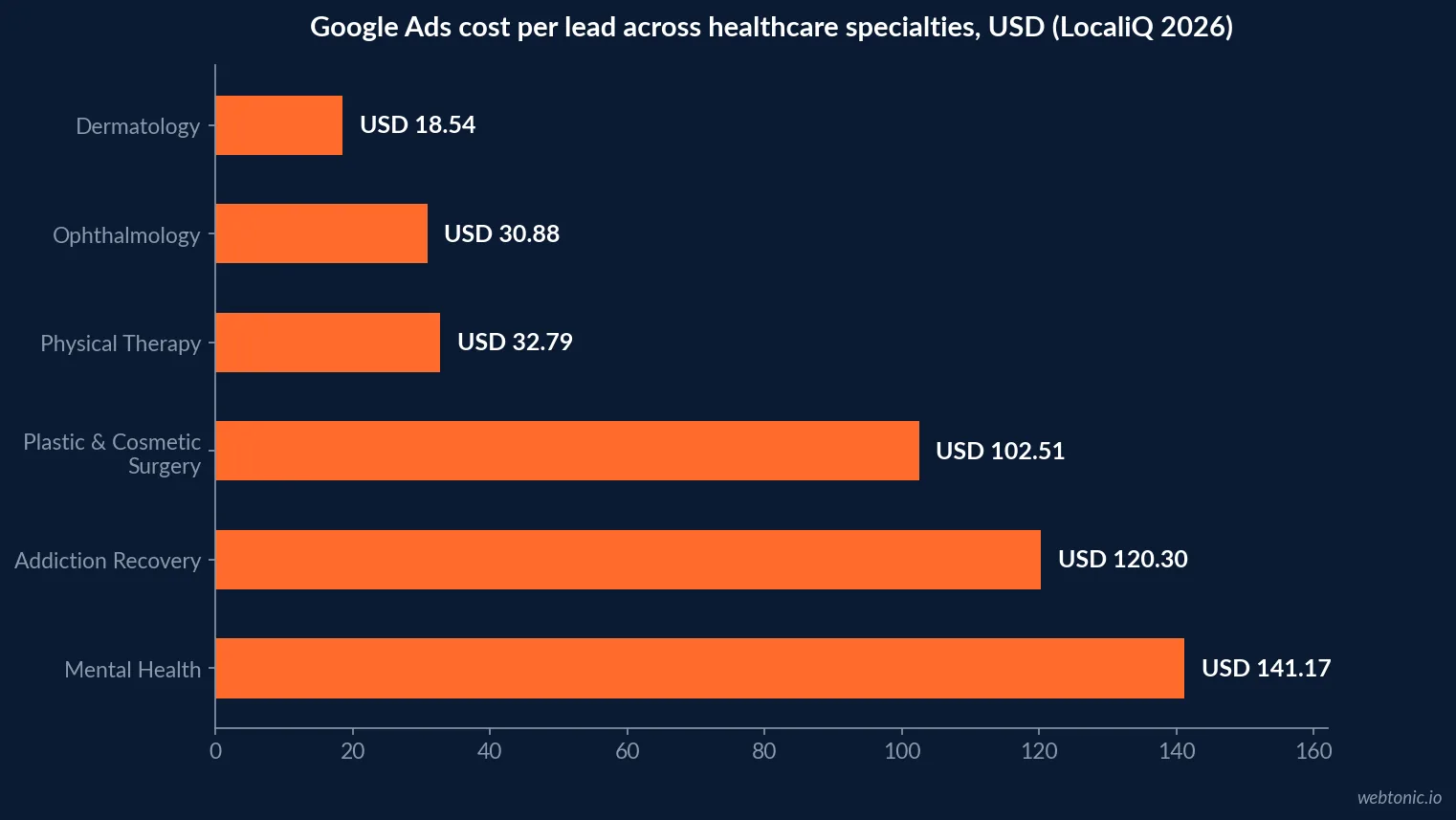
Neither specialty sits in the middle of the pack once ranked against the full healthcare set. Dermatology's USD 18.54 cost per lead is the cheapest of all 16 subcategories LocaliQ tracks, below Ophthalmology (USD 30.88) and Physical Therapy (USD 32.79). Plastic & Cosmetic Surgery's USD 102.51 sits behind only Mental Health (USD 141.17) and Addiction Recovery (USD 120.30) as the third most expensive lead in healthcare. Both categories also posted among the largest CPL declines in the 2026 report - dermatology's 37% drop was the single largest, and plastic surgery's 29% drop was the third-largest - which the report attributes broadly to more precise targeting and tighter ad copy rather than falling demand, since procedure volume was rising over the same window.
| Healthcare subcategory rank (cost per lead, 2026) | Cost per lead | Position among 16 |
|---|---|---|
| Dermatology | USD 18.54 | 1st cheapest |
| Ophthalmology | USD 30.88 | 2nd cheapest |
| Physical Therapy | USD 32.79 | 3rd cheapest |
| Plastic & Cosmetic Surgery | USD 102.51 | 3rd most expensive |
| Addiction Recovery | USD 120.30 | 2nd most expensive |
| Mental Health | USD 141.17 | Most expensive |
The certification rule that actually applies
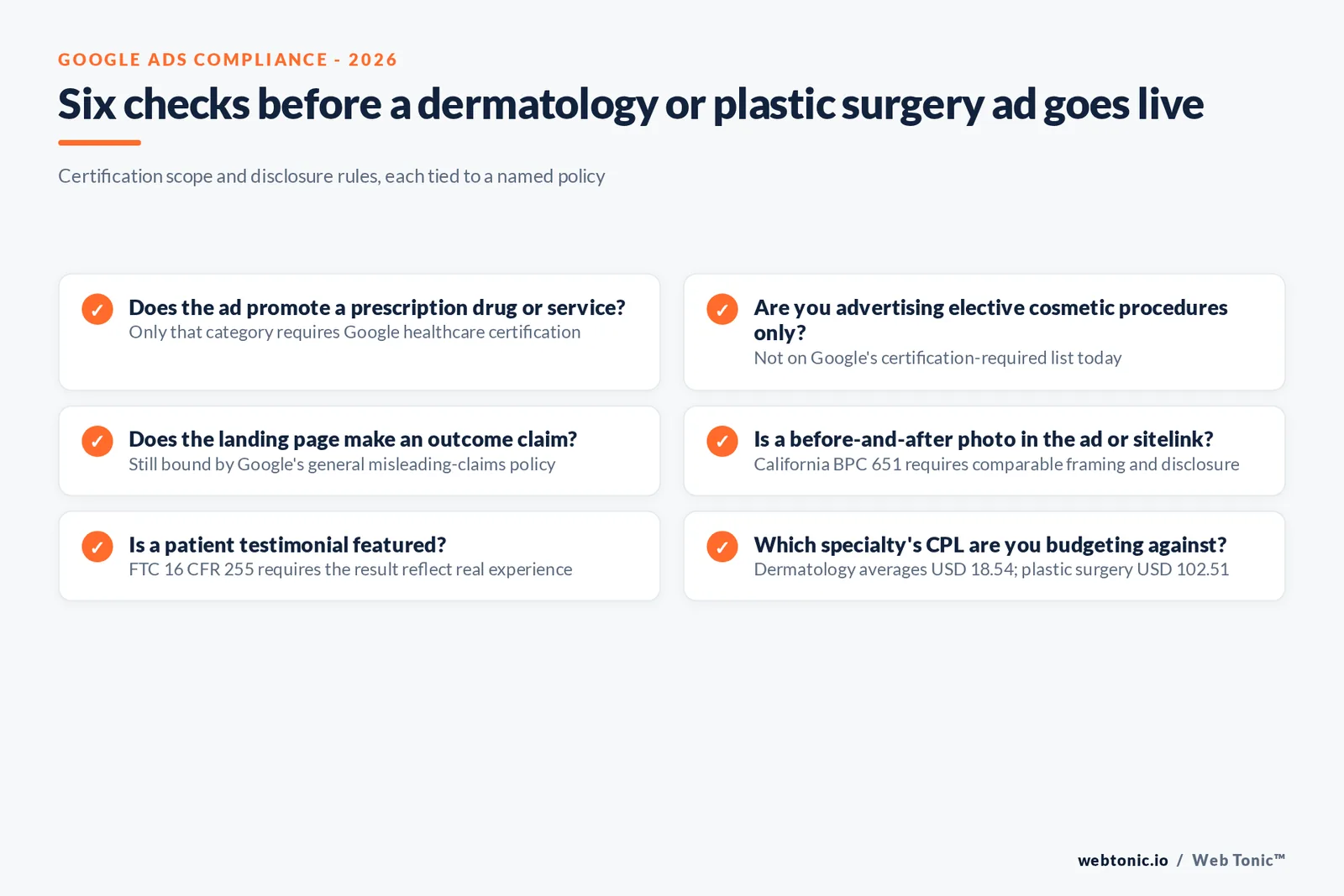
Google's Healthcare and Medicines advertising policy names specific categories that require advertiser certification and location approval before an ad can serve: prescription drug services, pharmaceutical manufacturers, unauthorized pharmacies, unapproved substances, prescription opioid painkillers, speculative and experimental medical treatments (including cell and gene therapies) and a handful of others. Cosmetic or elective dermatology and plastic surgery services are not named anywhere on that list - meaning a med-spa or plastic surgery practice advertising injectables, resurfacing or elective procedures does not go through Google's healthcare certification workflow the way a telehealth prescription service does. That does not exempt the account from Google's general misleading-claims, destination-quality and restricted-content policies, which still apply to every advertiser regardless of certification status.
| Google Ads healthcare policy category | Certification required? | Applies to derm/plastic surgery? |
|---|---|---|
| Prescription drug services | Yes | No |
| Pharmaceutical manufacturers | Yes | No |
| Unapproved substances / unauthorized pharmacies | Yes | No |
| Speculative or experimental treatment, cell/gene therapy | Yes | Only if the practice offers these specifically |
| Elective cosmetic dermatology / plastic surgery services | Not listed as a certification category | General ad policies still apply |
What still has to be defensible in the ad itself
Skipping certification does not skip the FTC. The FTC's Endorsement Guides (16 CFR Part 255) require that any patient testimonial or before-and-after result shown in a Google ad, sitelink or landing page reflect what that patient actually experienced, with a disclosure if the result is not typical. State medical board rules layer on top - California's Business and Professions Code Section 651 requires comparable presentation and a results-vary disclosure on any before-and-after image. None of this shows up as a Google Ads policy violation until a complaint is filed, which is precisely why it needs to be handled at the creative-review stage, not discovered at a disapproval.
Why the Facebook lead-ad picture looks different
Advertisers running Meta alongside Google should not expect the same spread. WordStream's 2025 Facebook Ads benchmarks report a broader Beauty & Personal Care category - not dermatology or plastic surgery specifically - at a 2.55% lead-objective click-through rate, a USD 3.06 cost per click, a 5.29% conversion rate and a USD 51.42 cost per lead, compared with a 0.83% CTR and USD 0.82 CPC on the narrower Physicians & Surgeons traffic objective. Neither category isolates dermatology or plastic surgery specifically, so use it only as a cross-platform sanity check, not as a Google Ads substitute.
| Cross-platform benchmark (2025-26) | Beauty & Personal Care, FB leads | Physicians & Surgeons, FB traffic |
|---|---|---|
| Click-through rate | 2.55% | 0.83% |
| Cost per click | USD 3.06 | USD 0.82 |
| Conversion rate | 5.29% | n/a reported |
| Cost per lead | USD 51.42 | n/a reported |
What the ad copy is actually competing against
A 2010 study published on PubMed, surveying 111 plastic surgery patients, found board-certification status carried a mean importance of 39.7% in choosing a surgeon, ahead of referral method (23.5%) and distance from home to office (13.2%). The figures are dated and the sample is small, but the ranking is consistent with what shows up in current ad copy: credential-led headlines outperform location- or price-led ones in this category precisely because certification is what patients say they weigh first. Google Ads assets that lead with "Board Certified" or a named credential are testing against that same decision hierarchy, not against a generic healthcare template.
| What patients weigh when choosing a surgeon (PubMed, n=111) | Mean importance |
|---|---|
| Board certification status | 39.7% |
| Method of referral | 23.5% |
| Distance from home to office | 13.2% |
| Office décor and other factors | Remainder |
Why demand keeps pushing these accounts to spend more
The cost pressure behind both specialties is a real demand curve, not just competitive noise. The American Society of Plastic Surgeons' 2025 Procedural Statistics Report recorded 7% year-over-year growth in cosmetic surgical procedure volume, with neuromodulators and hyaluronic fillers making up 80% of all minimally invasive procedures. The ASDS's 2025 Consumer Survey found 94% of consumers check review sites before booking - a landing-page trust signal that feeds directly into Google's Quality Score and, over time, into the CPCs both specialties are bidding against.
The individual procedure numbers behind that 7% growth figure show where the bidding pressure is concentrated. Liposuction remained the highest-volume cosmetic surgical procedure in 2025 at 317,196 procedures, even as its own volume dipped 1%. Breast augmentation and implant revision grew 11% to 304,234 procedures, and eyelid surgery posted the sharpest gain among the top five at 19%. Each of those procedure categories maps to a keyword cluster inside a dermatology or plastic surgery Google Ads account, and a category growing at double digits is a category where cost per click should be expected to keep climbing, independent of anything the account manager does differently.
| Top 2025 cosmetic surgical procedures (ASPS) | Volume | YoY change |
|---|---|---|
| Liposuction | 317,196 | -1% |
| Breast augmentation & implant revision | 304,234 | +11% |
| Tummy tuck (abdominoplasty) | 173,251 | +2% |
| Breast lift | 156,131 | +8% |
| Eyelid surgery (blepharoplasty) | 118,978 | +19% |
Our Google Ads team builds account structure and creative review around this exact split between certification-required and general-policy categories; see our related guides on building a Google Ads strategy and what Google Ads actually costs, or talk to us about auditing your own dermatology or plastic surgery account against these benchmarks.
Frequently Asked Questions
Are Google Ads costs per lead really that different between dermatology and plastic surgery?
Yes, by a factor of more than five on the current data. LocaliQ's 2026 healthcare search benchmarks, built from 3,542 US campaigns running October 2024 through September 2025, put dermatology's average cost per lead at USD 18.54 - the lowest of 16 healthcare subcategories tracked - against USD 102.51 for plastic & cosmetic surgery, the third-highest. Both categories sit inside the same broad 'aesthetic medicine' bucket advertisers often plan against as one budget line, which is exactly why treating them as one number understates plastic surgery's real cost.
Why is dermatology's conversion rate so much higher than plastic surgery's?
Dermatology converts paid clicks at 25.33%, the highest of any healthcare subcategory LocaliQ tracks; plastic & cosmetic surgery converts at 8.52%, close to the 8.09% healthcare average. No published study explains the gap directly, but the categories differ structurally: dermatology spans a high volume of lower-commitment, often insurance-adjacent visits (acne, mole checks, medical dermatology) alongside cosmetic work, while plastic surgery leads are almost entirely high-consideration surgical consultations. A generic landing-page form is a lower-friction ask for the first group than the second.
Do I need special Google certification to advertise cosmetic dermatology or plastic surgery?
Not under the certification categories Google lists today. Google's Healthcare and Medicines advertising policy names certification and approved-location requirements for prescription drug services, pharmaceutical manufacturers, unapproved substances and several other specific categories - cosmetic or elective dermatology and plastic surgery services are not among them. That does not exempt these ads from Google's general misleading-claims and destination-quality policies; it only means they skip the certification workflow that pharmacy and prescription-drug advertisers must complete.
Did these costs go up or down year over year?
Down for both, on LocaliQ's figures, but from very different starting points. Dermatology's cost per lead fell 37% year over year - the largest CPL decrease of the 16 healthcare subcategories in the report - while plastic & cosmetic surgery's fell 29%, the third-largest decrease. Dermatology's click-through rate fell 28% over the same period even as its conversion rate rose 54%, which is consistent with fewer, more qualified clicks converting at a higher rate.
Can I use before-and-after photos in my Google Ads assets?
Google's ad policies do not set a dermatology-specific before-and-after rule, but the advertiser is still bound by the FTC's Endorsement Guides (16 CFR Part 255), which require that a depicted result reflect what that patient actually experienced and be disclosed if it is not typical, and by state medical board advertising rules - California's Business and Professions Code Section 651 is the most detailed, requiring comparable presentation and a results-vary disclosure. Those obligations apply whether the photo runs in a display ad, a sitelink extension or an organic post.
Sources
LocaliQ - Healthcare Search Ads Benchmarks
WordStream - Facebook Ads Benchmarks 2025
Google Ads Advertising Policies Help - Healthcare and Medicines
Electronic Code of Federal Regulations - FTC Endorsement Guides, 16 CFR Part 255
California Legislative Information - Business and Professions Code Section 651
American Society of Plastic Surgeons - 2025 Procedural Statistics Report
American Society for Dermatologic Surgery - 2025 Consumer Survey on Cosmetic Dermatologic Procedures
PubMed - What Patients Look for When Choosing a Plastic Surgeon