Table of contents
Two forces are pulling dental reputation spending in the same direction: a growing review-management software market and a legal constraint - HIPAA - that most other local businesses never have to budget around. This page names both, with the vendor market-sizing data clearly labeled apart from the ADA's own dentist-survey figures, so the claim in the title is supported rather than asserted.
Key Takeaways
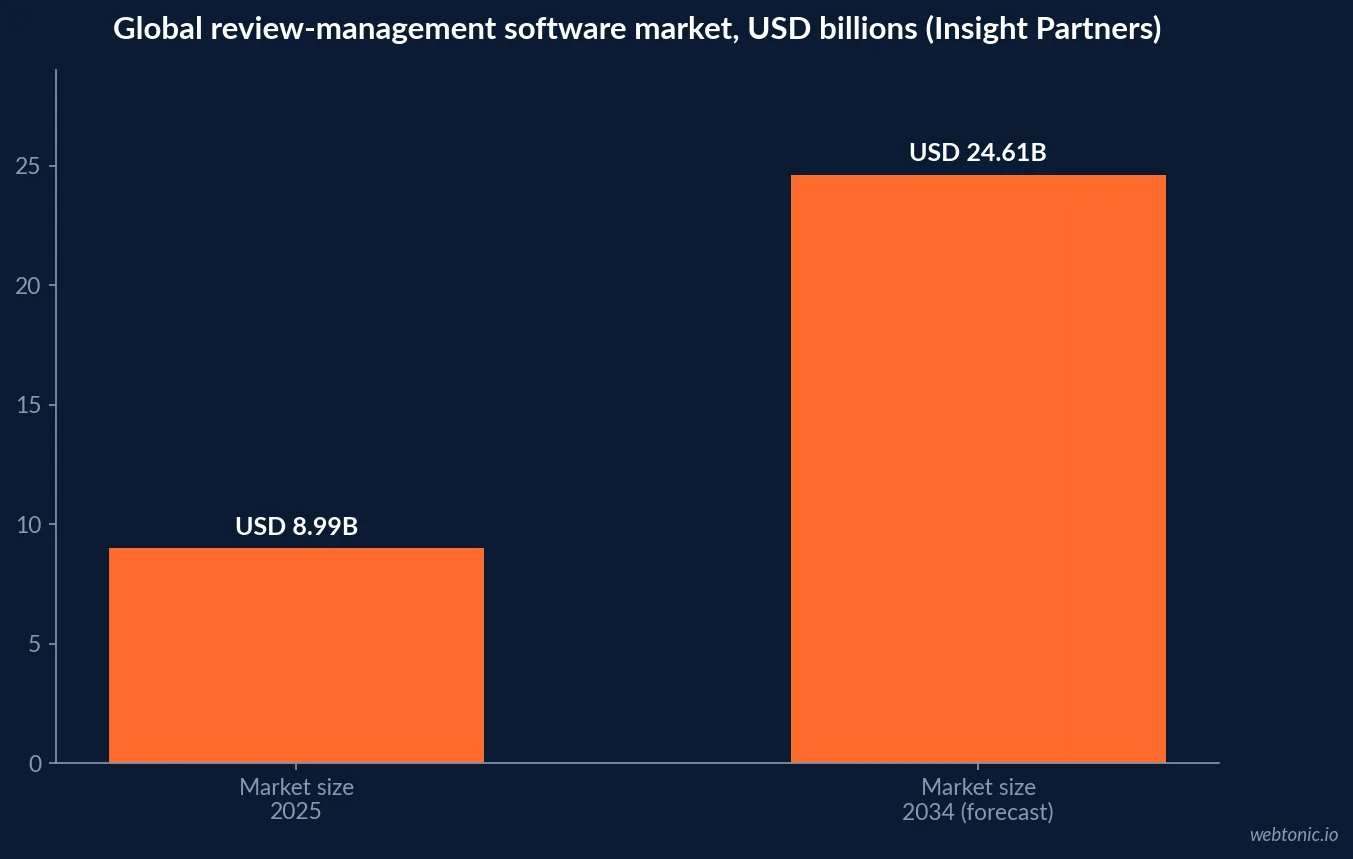
- The global review-management software market is valued at USD 8.99 billion in 2025 (vendor market sizing, Insight Partners).
- It is projected to reach USD 24.61 billion by 2034, an 11.84% CAGR.
- DSO penetration of US dental offices was about 23% in 2022, per L.E.K. Consulting.
- DSO penetration is forecast to reach roughly 39% by 2026.
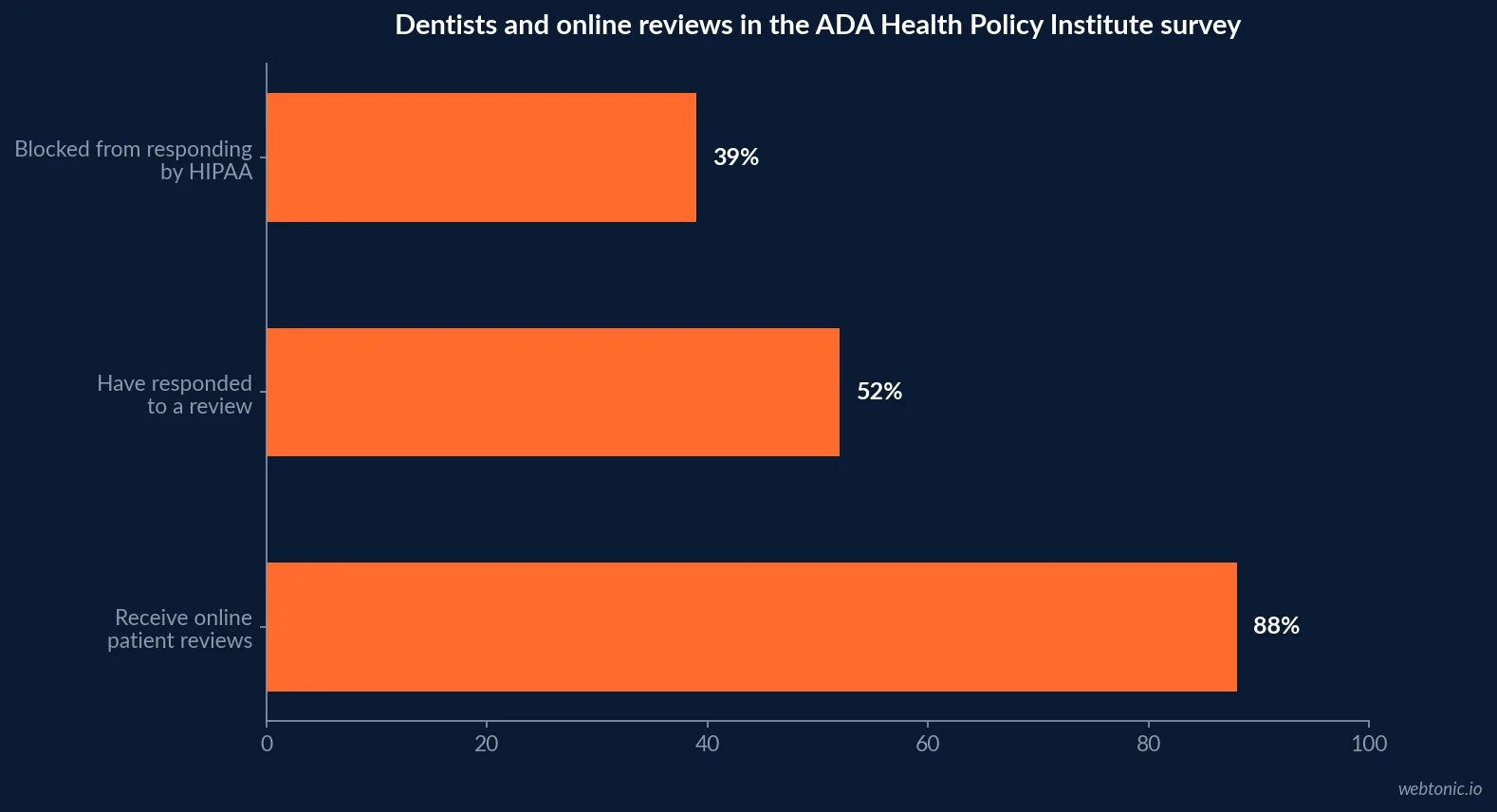
- 88% of dentists report receiving online patient reviews (ADA Health Policy Institute).
- Only 52% of those dentists say they have responded to a review.
- 39% say HIPAA rules stop them from responding at all.
- A California dental practice paid USD 23,000 to resolve a 2022 HHS OCR privacy case.
- 83% of Americans use online reviews to evaluate a dentist.
- 52% will only consider a dentist with at least 10 reviews.
- 95% say a negative review makes them reconsider a dentist.
- 91% of existing dentist reviews are positive, per the same consumer research.
- 36% of patients have left a review for a dental provider at least once.
- 89% expect a business owner to respond to reviews generally (BrightLocal LCRS 2026) - a standard HIPAA complicates for dentists.
- The FTC's fake-review rule (16 CFR Part 465) took effect October 21, 2024.
- Yelp filtered nearly 500,000 AI-generated reviews across all categories in 2025.
The market-sizing evidence for rising spend
The clearest evidence for the title's claim is vendor market research, and it should be read as such: The Insight Partners sizes the global review-management software market at USD 8.99 billion in 2025, projecting growth to USD 24.61 billion by 2034 at an 11.84% CAGR - a total addressable market of roughly USD 147.56 billion across the 2026-2034 forecast window. This is a cross-industry figure, not a dental-specific one, and it is a single vendor's forecast rather than an audited market census - but it is the most concrete public evidence that reputation-software spend is trending upward broadly, and dental is a buyer category inside it.
| Market metric | Figure | Period | Source (labeled) |
|---|---|---|---|
| Global review-management software market, 2025 | USD 8.99 billion | Base year | Insight Partners (vendor market report) |
| Projected market size, 2034 | USD 24.61 billion | Forecast | Insight Partners |
| Forecast CAGR, 2026-2034 | 11.84% | 9-year window | Insight Partners |
| Total addressable market, 2026-2034 | ~USD 147.56 billion | Cumulative forecast | Insight Partners |
Why dental specifically is a growing share of that spend
Consolidation is concentrating dental review volume into fewer, larger buyers. L.E.K. Consulting's dental industry outlook estimates dental support organization (DSO) penetration of US dental offices at approximately 23% in 2022, forecast to reach roughly 39% by 2026, with DSOs' share of total dental expenditure running higher still because they operate at scale. A multi-location DSO managing reviews across dozens of practices under one or several brands is exactly the buyer profile that graduates from manual review checks to paid reputation software - the same dynamic driving the broader market growth above.
| DSO metric | 2022 figure | 2026 forecast | Source |
|---|---|---|---|
| Share of US dental offices affiliated with a DSO | ~23% | ~37-41% | L.E.K. Consulting |
| Share of total dental expenditure via DSOs | Higher than office share | Rising further | L.E.K. Consulting |
| Large DSOs (150+ practices) | ~20 organizations | Consolidating further | L.E.K. Consulting |
The constraint most industries do not have: HIPAA
The American Dental Association's Health Policy Institute surveyed dentists directly and, per the ADA's own reporting on the survey via ADA News, found 88% of dentists reported receiving online patient reviews. Of those, only 52% said they had responded to a review, and 39% reported they were unable to respond because of HIPAA regulations. The ADA's own practice guidance is explicit that even a generic-sounding reply can violate the Privacy Rule if it confirms a named reviewer was a patient - "Thank you for coming in" is cited as a genuine risk, not just a name or treatment detail.
This is not hypothetical. In 2022, HHS's Office for Civil Rights resolved a complaint against a California general dental practice, B. Brandon Au, DDS, Inc. d/b/a New Vision Dental, which had responded to Yelp reviews using patients' full names and details about their visits and insurance. The practice paid USD 23,000 to resolve the matter and adopted a corrective action plan, per the settlement record naming HHS OCR.
| HIPAA-and-reviews metric | Figure | Source |
|---|---|---|
| Dentists receiving online patient reviews | 88% | ADA Health Policy Institute survey |
| Dentists who have responded to a review | 52% | ADA Health Policy Institute survey |
| Dentists blocked from responding by HIPAA | 39% | ADA Health Policy Institute survey |
| Settlement paid after a HIPAA-review violation | USD 23,000 | HHS OCR, New Vision Dental, 2022 |
| Applicable privacy rule | 45 CFR Part 164 | eCFR / HHS |
What patients actually expect from a dental practice's reviews
Consumer-side research from Dentaly (its own labeled survey) found 83% of Americans use online reviews to evaluate a dentist, and 8 in 10 use reviews as the first step when choosing a new one. 52% will only consider a dentist with at least 10 reviews - notably lower than the 20-review threshold BrightLocal's cross-industry survey finds for local businesses generally, which may simply reflect how few dental practices have historically solicited reviews. 95% say a negative review makes them reconsider, even though 91% of existing dentist reviews are positive and 36% of patients have left a review for a provider at least once, most citing personal satisfaction (72%) as the reason.
| Patient review behavior | Figure | Source |
|---|---|---|
| Use online reviews to evaluate a dentist | 83% | Dentaly consumer research |
| Use reviews as the first step in choosing | ~80% (8 in 10) | Dentaly consumer research |
| Require at least 10 reviews to consider a dentist | 52% | Dentaly consumer research |
| Reconsider after seeing a negative review | 95% | Dentaly consumer research |
| Existing dentist reviews that are positive | 91% | Dentaly consumer research |
| Have left a review for a dental provider | 36% | Dentaly consumer research |
Cross-industry response norms, and why dental cannot fully meet them
BrightLocal's Local Consumer Review Survey 2026 - a cross-industry figure, applicable to dental only as a benchmark, not a dental-specific finding - shows 89% expect a business owner to respond, with 80% more likely to use a business that responds to every review. For a general contractor or restaurant, meeting that expectation is a matter of habit. For a dental practice, the ADA's HIPAA guidance means every reply has to be written in deliberately generic terms - acknowledging feedback without confirming the person was a patient - which is slower and legally riskier to get wrong than review responses in almost any other local business category.
Fake reviews and platform enforcement
The same regulatory and platform trends covered in our plumbing reputation research apply here: the FTC's Trade Regulation Rule on Consumer Reviews and Testimonials (16 CFR Part 465) took effect October 21, 2024 and bans fake or paid reviews industry-wide, and Yelp's 2025 Trust & Safety Report disclosed filtering nearly 500,000 AI-generated reviews platform-wide in 2025. Neither is dental-specific, but a healthcare provider that gets caught soliciting reviews in a way that runs afoul of the rule - for instance, offering a discount in exchange for a positive review - faces the same civil-penalty exposure as any other business, on top of HIPAA risk.
What a compliant response actually looks like
The ADA's guidance offers a template worth quoting directly, because the difference between a compliant and a risky reply is subtle: a generic acknowledgment such as "Our office strives to provide the best service to all patients and we do our best to meet this goal. We encourage any patient who would like to discuss their experience to contact us directly" avoids confirming the reviewer was ever a patient. By contrast, even a warm, well-intentioned reply like "Thank you for coming in" or "We love treating your kids" can constitute a HIPAA disclosure, per the ADA's own reading of the rule, because it confirms a treatment relationship existed.
Budgeting for this correctly means training whoever writes replies - in-house staff or an outsourced reputation vendor - on the specific generic-language pattern, not just giving them review-management software and assuming compliance follows automatically.
| Response pattern | HIPAA risk | ADA guidance |
|---|---|---|
| "Thank you for coming in" | High - confirms a treatment relationship | Avoid, even though it feels warm |
| "We love treating your kids" | High - confirms patient status and demographic detail | Avoid |
| "Our office strives to serve all patients well..." | Low - speaks in generalities only | ADA's recommended template pattern |
| Silence (no response) | None, but costs trust | 39% of dentists choose this by default |
Where the spending actually goes
Put together, the evidence supports the title's claim without inventing a dental-specific market number: reputation software spend is rising market-wide (Insight Partners), the buyer base for that software is consolidating into larger DSOs (L.E.K.), and dental practices are spending disproportionately on the compliance side of reputation management - HIPAA-safe response training, legal review of reply templates, and generalized "thank you for your feedback" language - rather than on volume-driving review requests the way other local categories do. That is a different spending mix than plumbing or retail, not a smaller one.
If you manage a multi-location dental practice weighing a reputation platform against the HIPAA exposure of doing it manually, talk to us about a plan that keeps response templates compliant while still meeting the 81%-within-a-week response expectation patients bring from every other category of business. Our growth marketing practice sequences that work alongside the profile mechanics covered in our companion research on dental local SEO statistics.
Frequently Asked Questions
Is dental reputation management spending actually going up?
Directionally, yes, on the evidence available. The Insight Partners' market-sizing research (a vendor report, labeled as such) puts the global review-management software market at USD 8.99 billion in 2025, projected to reach USD 24.61 billion by 2034 at an 11.84% CAGR. That is market-wide, not dental-specific, but dental support organizations (DSOs) are consolidating fast - from roughly 23% of US dental offices in 2022 toward a projected 39% by 2026 per L.E.K. Consulting - and larger, multi-location dental operators are the buyer profile most likely to adopt paid reputation software.
Why can't dentists just respond to every review like other businesses?
HIPAA. The ADA's own Health Policy Institute survey found 88% of dentists receive online reviews, but 39% say they are unable to respond because doing so risks disclosing protected health information - even confirming someone was a patient can violate the Privacy Rule (45 CFR Part 164). A 2022 HHS Office for Civil Rights resolution against a California dental practice, which paid USD 23,000 after responding to Yelp reviews with identifying patient details, is the enforcement precedent practices are now managing around.
How many reviews does a dental practice need before patients trust it?
There is no dental-specific BrightLocal-style benchmark at the same scale, but a consumer research note from Dentaly found 52% of Americans will only consider a dentist with at least 10 reviews, and 83% use online reviews as a factor in choosing a dentist at all. That is a lower floor than the cross-industry 20-review threshold BrightLocal reports, which may reflect how few dental practices actively solicit reviews compared with retail or hospitality.
Do negative reviews really change a dentist's business?
According to Dentaly's consumer research, 95% of respondents say a negative review makes them reconsider choosing a dentist, and 91% of existing dentist reviews are positive - meaning a handful of negative reviews can carry outsized weight precisely because they are rare and therefore stand out.
What is driving up the cost of managing dental reviews specifically?
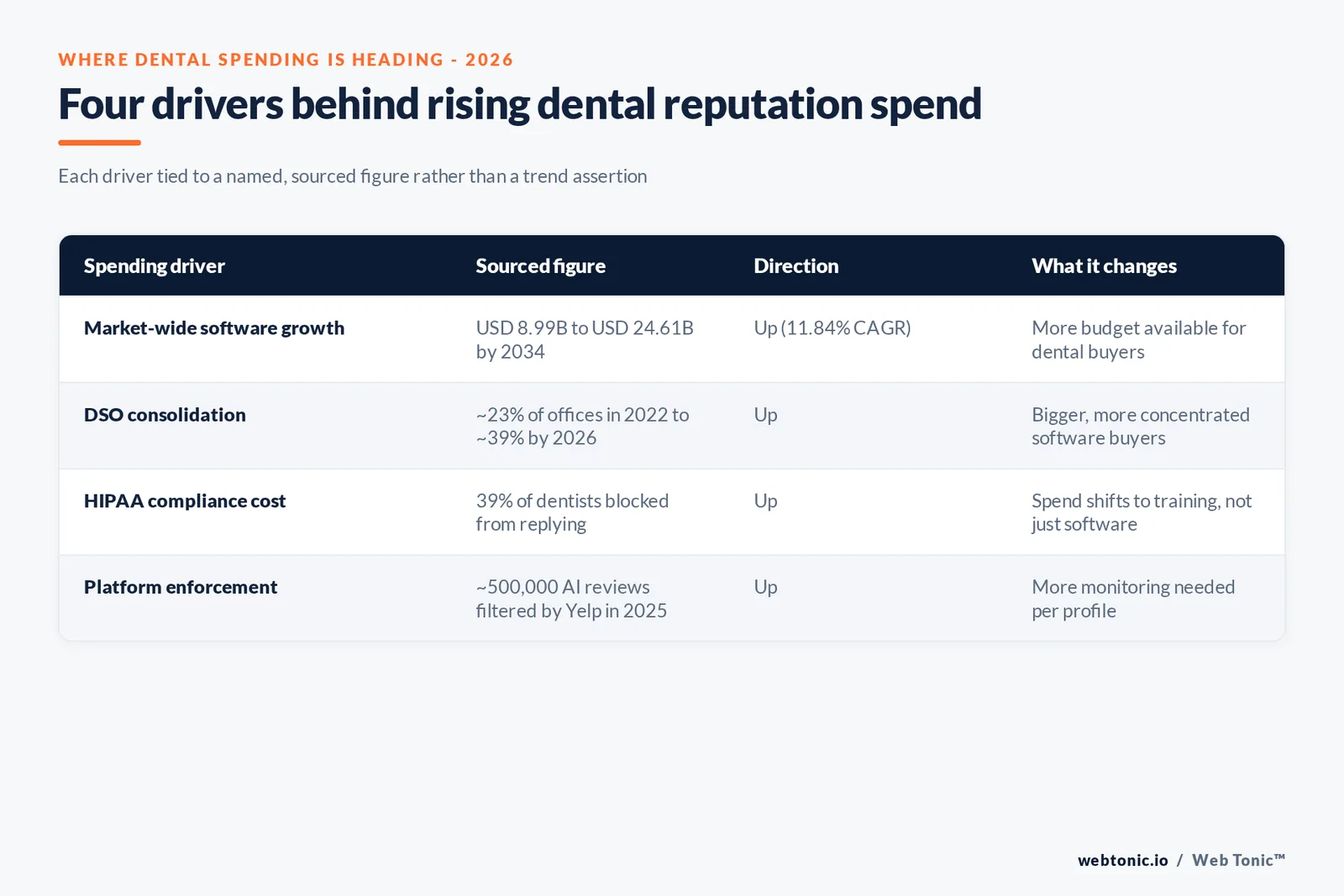
Three things layer on top of the general reputation-software market growth: HIPAA-compliant response training and legal review (a cost most other industries do not carry), DSO consolidation concentrating review volume across more locations per buyer, and platform enforcement (Yelp's 2025 Trust & Safety Report describes stepped-up moderation across service categories broadly) forcing practices toward paid monitoring rather than manual checks.
Sources
The Insight Partners - Review Management Software Market report
L.E.K. Consulting - Outlook for the US Dental Industry
ADA News - 5 best practices for responding to online reviews (ADA Health Policy Institute survey)
American Dental Association - Protect your practice's reputation
HHS Office for Civil Rights - New Vision Dental Resolution Agreement, 2022
Dentaly - 8 out of 10 Americans choose their dentist based on online reviews
BrightLocal - Local Consumer Review Survey 2026
Federal Register - FTC Trade Regulation Rule on Consumer Reviews and Testimonials, 16 CFR Part 465
Yelp - Trust & Safety Report 2025