Table of contents
A dental Business Profile is judged on the same Google mechanics as any local business - category, photos, Performance metrics, verification - but dental carries two twists most industries do not: fast DSO consolidation multiplying the number of locations to manage, and a patient-privacy layer that touches messaging as much as reviews. This page states what Google's own documentation defines, what Whitespark's 2026 survey weighs, and what that means operationally for a dental practice's profile in 2026.
Key Takeaways
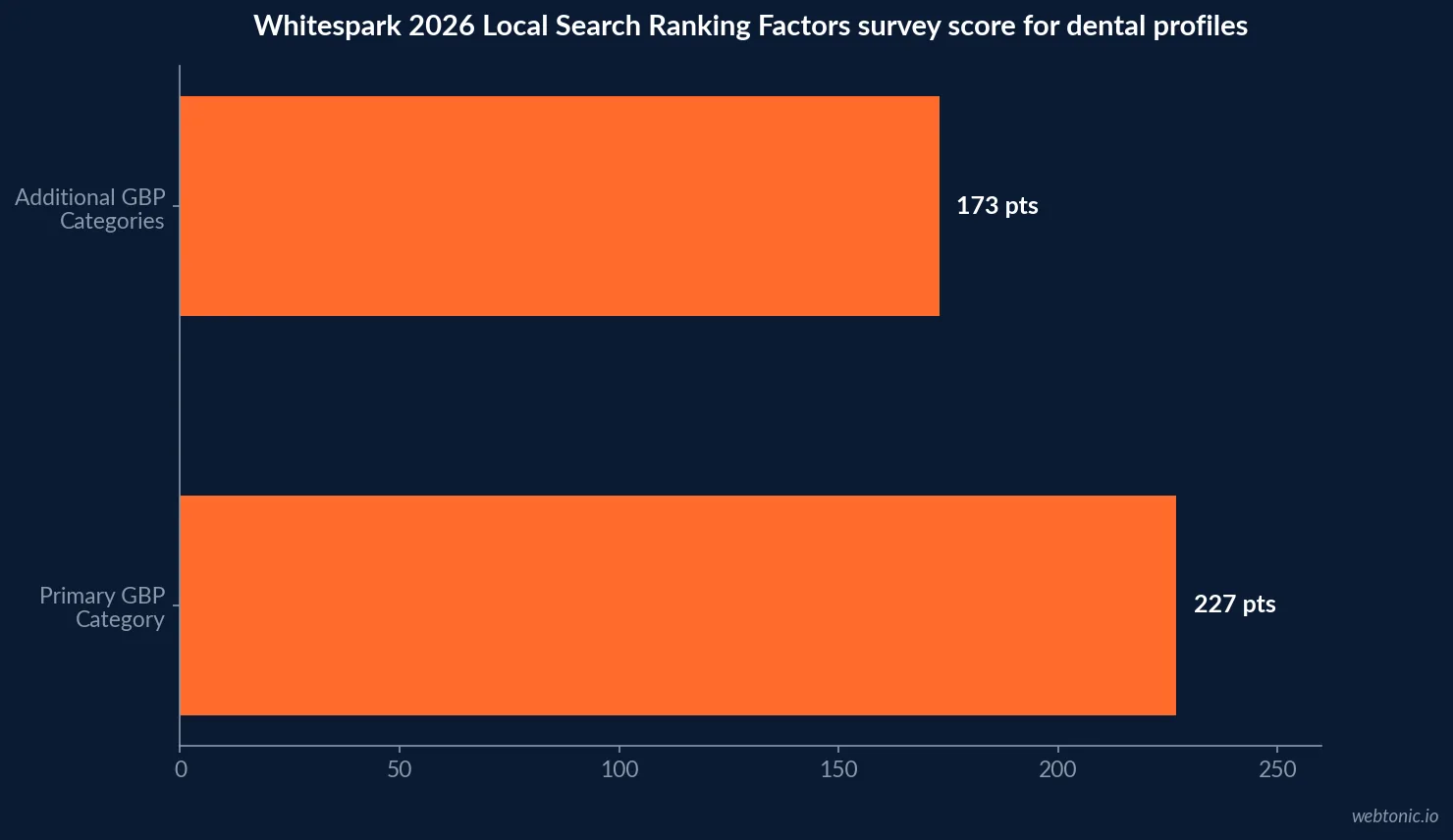
- Primary GBP Category is the top-scored ranking factor in Whitespark's 2026 survey, at 227 points.
- Additional GBP Categories rank eighth, at 173 points.
- 88% of dentists report receiving online patient reviews through their profile and other sites.
- Only 52% of those dentists have responded to a review.
- 39% say HIPAA prevents them from responding at all.
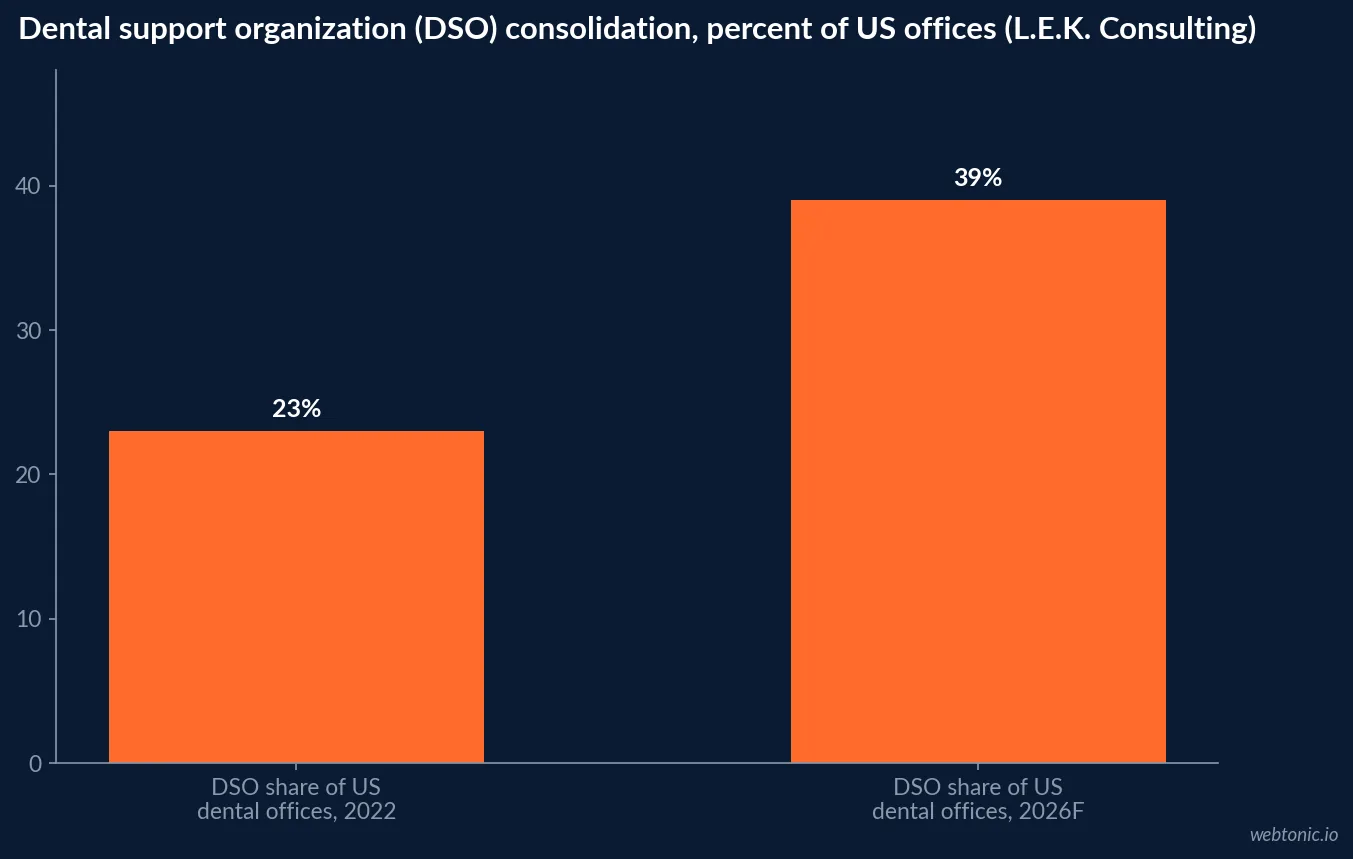
- DSOs covered about 23% of US dental offices in 2022, per L.E.K. Consulting.
- That share is forecast to reach roughly 39% by 2026.
- A business may hold only one profile per location under Google's duplicate policy.
- Businesses with photos get 42% more direction requests.
- Photo-equipped listings get 35% more website clicks.
- The median profile in a 45,000-listing study carried just 11 photos.
- Only 5% of profile views convert to a call, click or direction request.
- 84% of profile views originate from discovery searches, not branded searches.
- Google reports Performance data on a 3-4 day lag.
- GBP management software lists from USD 49 to USD 449 a month depending on tier.
- Suspended profiles require an evidence-backed appeal to reinstate.
What "state of" means here: mechanics, not reviews
This page covers the Business Profile itself - category, completeness, photos, verification, Performance metrics and management cost - as distinct from the review-content and HIPAA-response questions covered on our dental reputation research. The two overlap only where Google's own dashboard surfaces review counts as part of profile completeness.
| Profile element | Google's own guidance | 2026 status for dental practices |
|---|---|---|
| Primary category | Highest-weighted individual ranking factor (Whitespark) | General/pediatric/cosmetic/orthodontic must be distinguished |
| Additional categories | 8th-ranked factor (Whitespark) | Add every accurate secondary specialty |
| Photos | 42% more direction requests, 35% more website clicks with photos | Median listing has just 11 photos industry-wide |
| Verification | One profile per business location | DSO consolidation raises duplicate-listing risk |
| Performance report | Views, calls, directions, website clicks, 3-4 day lag | Under-monitored per cross-industry benchmark data |
| Messaging/Q&A | Native Google feature | Needs a HIPAA-aware handling process for patient practices |
Category precision matters more for dental than most industries
Whitespark's 2026 Local Search Ranking Factors report, based on a survey of 47 local search experts scoring 187 factors, found Primary GBP Category scores 227 points, the single highest-scored individual factor across the whole study, with Additional GBP Categories ranked eighth at 173 points. Dental is an unusually category-rich vertical on Google - general dentist, pediatric dentist, orthodontist, cosmetic dentist, endodontist and oral surgeon are distinct selectable categories, not synonyms - so a practice that defaults to the generic "Dentist" category when a more specific one applies is giving up ranking weight on the single most important factor Google's own local algorithm weighs, per the experts surveyed.
| Ranking factor (2026 Whitespark survey) | Score | Rank of 187 factors |
|---|---|---|
| Primary GBP Category | 227 | 1st |
| Additional GBP Categories | 173 | 8th |
| Review signal group (quantity, velocity, first/third-party) | Rising group weight for 2026 | Top group |
| Behavioral signal group | Rising group weight for 2026 | Rising |
DSO consolidation is a Business Profile management problem
L.E.K. Consulting's dental industry outlook estimates dental support organization (DSO) penetration of US dental offices at roughly 23% in 2022, forecast to reach approximately 39% by 2026, concentrated among roughly 20 large DSOs with 150 or more practices each plus a long tail of smaller groups. Per Google's duplicate-profile policy, a business may hold only one Business Profile per location - a rebrand, a practice merger, or an ownership change under DSO consolidation that is not paired with a deliberate profile-transfer or merge process routinely produces duplicate or orphaned listings that strand accumulated reviews and Performance history.
For a growing DSO, the management task is not just keeping one profile updated - it is auditing for duplicates across every acquired or rebranded location on a recurring schedule, something a single-practice dentist rarely has to think about.
| DSO consolidation metric | 2022 | 2026 forecast | Source |
|---|---|---|---|
| Share of US dental offices in a DSO | ~23% | ~37-41% | L.E.K. Consulting |
| Large DSOs (150+ practices) | ~20 organizations | Consolidating further | L.E.K. Consulting |
| Duplicate-profile risk per Google policy | One profile per location, always | Same rule applies at any scale | Google Business Profile Help |
Photos and completeness: an easy, patient-privacy-safe win
Unlike review replies, photo management carries no HIPAA exposure for a dental practice - office interiors, equipment, team photos and (with signed consent) before/after clinical work are all safe to publish. Google's own data, cited in BrightLocal's Google My Business Insights Study of 45,000 listings across 36 industries, found businesses with photos get 42% more direction requests and 35% more website clicks than those without, yet the median business in the study carried just 11 photos and 6% had only one. Dental practices that lean into photo volume are taking a low-risk, low-cost action most competitors are still skipping.
Reading the Performance report for a dental practice
Per Google's Business Profile Help documentation, the Performance report tracks Views (how many people saw the profile on Search or Maps), Calls (clicks on the call button), Directions (de-duplicated direction requests) and Website clicks, reported daily with a 3 to 4 day lag. BrightLocal's cross-industry study found 84% of views come from discovery searches rather than branded ones and that only 5% of views convert to one of these actions - a benchmark dental practices can use to sanity-check their own numbers, while remembering it is a cross-industry figure and not a dental-specific one.
Suspension and verification risk
Google can suspend or disable a profile that violates its guidelines, and per its own suspension-appeal documentation, reinstatement requires an appeal with supporting evidence - business registration, a professional license, tax certificates, or utility bills matching the business name and address. For a dental practice, a current copy of the practice's business license and state dental board registration, kept ready rather than located after a suspension hits, is the cheapest insurance against a profile going dark.
What management actually costs
No public study prices Business Profile management as a dental-specific line item, so the same cross-industry vendor rate cards apply here as to any local business: GBPcentral's published tiers run USD 49 to USD 349 a month depending on the number of profiles managed, while Podium's own published Core and Pro tiers run USD 399 to USD 599 a month. A DSO evaluating a platform should model the per-location rate against its actual location count rather than treat any single number as a flat organizational fee - and should confirm current pricing directly with the vendor, since these figures move.
If you manage Google Business Profiles across multiple dental locations and want a plan that accounts for both the ranking mechanics above and the HIPAA constraint covered in our dental reputation research, talk to us, or see how our growth marketing practice structures multi-location local visibility work. Our data and analytics practice can wire the Performance metrics above into a per-location dashboard, and our companion research on dental local SEO statistics covers the broader ranking picture beyond the profile itself.
Posts, Q&A and messaging for a dental practice
Posts, Q&A and messaging are native, no-cost Google features a dental practice can use before evaluating any paid platform. Posts can announce new-patient offers, extended hours or a new associate dentist; Q&A lets front-desk staff pre-answer common questions like insurance networks accepted or parking; messaging opens a scheduling channel. The one dental-specific caution: any message thread that references a specific patient's treatment, symptoms or billing should be moved off-platform to a secure channel rather than continued in Google's messaging tool, since the practice - not Google - owns the HIPAA exposure of what gets typed there.
| Feature | Cost to use | Dental-specific note |
|---|---|---|
| Posts | Free (native Google feature) | Good for hours, offers, new-provider announcements |
| Q&A | Free (native Google feature) | Pre-answer insurance and logistics questions publicly |
| Messaging | Free (native Google feature) | Move clinical/billing detail off-platform immediately |
| Photos | Free (staff time only) | Office and team photos carry no HIPAA risk |
| Paid management software | USD 49-449/month per location | Scales the above across DSO locations |
Putting the 2026 checklist together
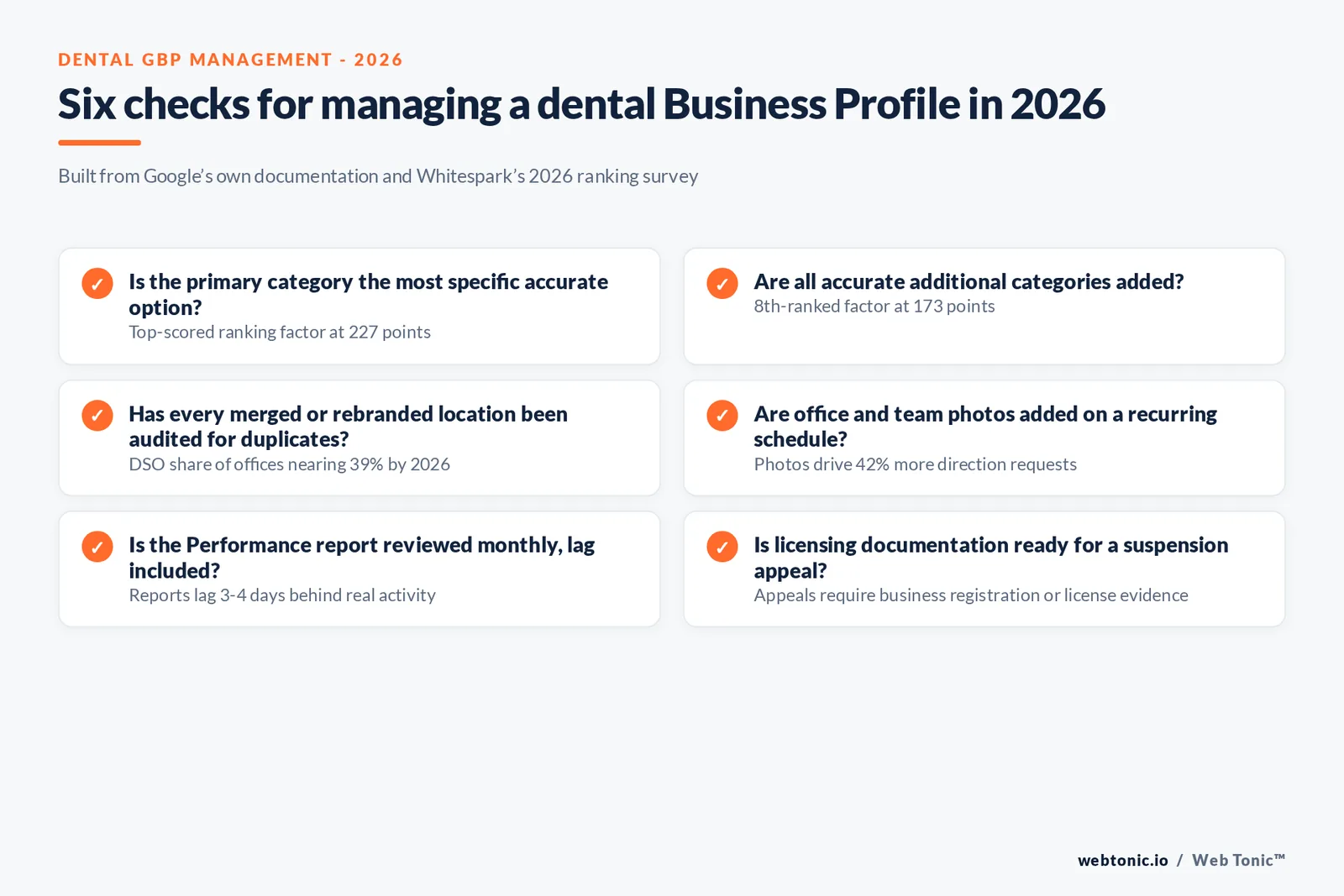
A dental practice or DSO auditing its Business Profile management program in 2026 should work through five checks in order: confirm the primary and additional categories are the most specific accurate options rather than a generic default, audit for duplicate or orphaned profiles across every location touched by a merger or rebrand, add office and team photos on a recurring schedule, review the Performance report monthly while remembering the 3-4 day lag, and keep licensing documentation current in case a suspension appeal becomes necessary. None of these five tasks require a paid platform to start - they require an assigned owner and a recurring calendar reminder, which is the cheapest management tool available before evaluating any vendor's rate card.
| GBP management tier | Published monthly rate | Vendor | Best fit |
|---|---|---|---|
| Single-profile starter | USD 49 | GBPcentral | One-location practice |
| Multi-profile professional | USD 89 | GBPcentral | 2-3 location group |
| Agency / large-DSO tier | USD 349 | GBPcentral | 20-profile portfolios |
| Core plan | USD 399 | Podium | Reviews + messaging, per location |
| Pro plan | USD 599 | Podium | Full automation + multi-location, per location |
Frequently Asked Questions
What Google Business Profile category should a dental practice use?
Whitespark's 2026 Local Search Ranking Factors survey scores Primary GBP Category as the single highest-weighted individual ranking factor at 227 points out of 187 surveyed factors, with Additional GBP Categories ranked eighth at 173 points. A general dental practice, a pediatric dentist, an orthodontist and a cosmetic dentist are distinct categories on Google, and using the wrong one is a measurable ranking cost, not a cosmetic detail.
Why do multi-location dental groups have Google Business Profile problems?
Consolidation. Dental support organizations (DSOs) covered roughly 23% of US dental offices in 2022, forecast to reach about 39% by 2026 per L.E.K. Consulting, and Google allows only one Business Profile per business location. A DSO that rebrands, merges, or opens satellite locations without a deliberate profile-management process risks duplicate listings, which Google will not show on Search or Maps until resolved.
Can a dental practice enable messaging on its profile?
Google supports it as a feature, but a practice enabling it needs a documented process so that any patient message referencing symptoms, appointments or billing is handled the same way review replies are: without confirming identifiable health information in a way that could create a HIPAA exposure. Google's own guidance does not address HIPAA - that risk sits entirely with the practice.
Does having more photos on a dental profile actually help?
Per Google's own data, cited in BrightLocal's Google My Business Insights Study of 45,000 listings, businesses with photos get 42% more direction requests and 35% more website clicks than those without. The median business in that study carried just 11 photos, and dental practices - which can show office, equipment and team photos without any patient privacy risk - have an easy, HIPAA-safe way to close that gap.
What does managing a dental Business Profile cost?
No dental-specific study prices this, so the honest budget uses published cross-industry vendor rates: GBPcentral's software lists at USD 49 to USD 349 a month depending on the number of profiles managed, while full-service platforms like Podium list at USD 399 to USD 599 a month per location on Podium's own published rate card. A DSO managing dozens of locations should model its own vendor quote at that per-location rate rather than assume a flat fee, since most pricing scales with location count.
Sources
Whitespark - 2026 Local Search Ranking Factors report
L.E.K. Consulting - Outlook for the US Dental Industry
Google Business Profile Help - Resolve duplicate profiles & ownership issues
Google Business Profile Help - Understand your performance & insights
BrightLocal - Google My Business Insights Study
Google Business Profile Help - Fix suspended or disabled profiles
GBPcentral - GBP management software pricing
Podium - Pricing
ADA News - 5 best practices for responding to online reviews (ADA Health Policy Institute survey)