Table of contents
Key Takeaways
- Clear dental practice branding increases new patient conversions by 30–45% while attracting higher-value patients willing to pay premium fees.
- Branding ROI ranges from 300% to 1,100% in the first year through higher conversion rates, better case acceptance, and improved retention.
- 97% of patients read online reviews before choosing a dentist, and 84% trust them as much as personal referrals — brand perception starts before the first visit.
- Top 10% dental practices maintain 99% patient retention versus the 57% industry average — branding is the differentiator.
- GBP-optimized practices receive 7x more patient calls and up to $75K additional annual revenue per location.
Dental Branding Impact on Revenue and Growth
Dental practice branding delivers measurable financial returns. Dental Marketing Guy's 2026 identity guide documents the direct revenue impact of professional branding — practices with clear positioning see 30–45% higher new patient conversion rates and attract patients willing to pay premium fees.
| Branding Metric | Impact | Source |
|---|---|---|
| New patient conversion lift | +30–45% | Dental Marketing Guy 2026 |
| First-year branding ROI | 300–1,100% | Dental Marketing Guy 2026 |
| Website rebrand appointment lift | +30% in 60 days | Hexcode Studio (Starbrite Dental) |
| Revenue above national average | +20% ($8M+ gross) | Wacky World Studios (Kids Rock) |
| Marketing cost reduction (brand equity) | $400K/year savings | Wacky World Studios (Kids Rock) |
The Kids Rock Dentistry case study illustrates the compounding value: the practice achieved $8 million+ in gross revenue (20% above the national average), a 5-star Google rating across 2,342 reviews, and estimated $400,000 in annual marketing savings due to brand recognition and word-of-mouth referrals.
Patient Trust, Reviews, and Brand Perception
Brand perception in dentistry is increasingly shaped online before patients ever step into the office. ZipDo's dental marketing research reveals just how dominant digital trust signals have become:
- 97% of patients read online reviews before choosing a dental practice.
- 84% trust online reviews as much as personal referrals — the traditional word-of-mouth advantage is now digital.
- 50% of patients trust a practice more if it has a 5-star Google rating and positive reviews.
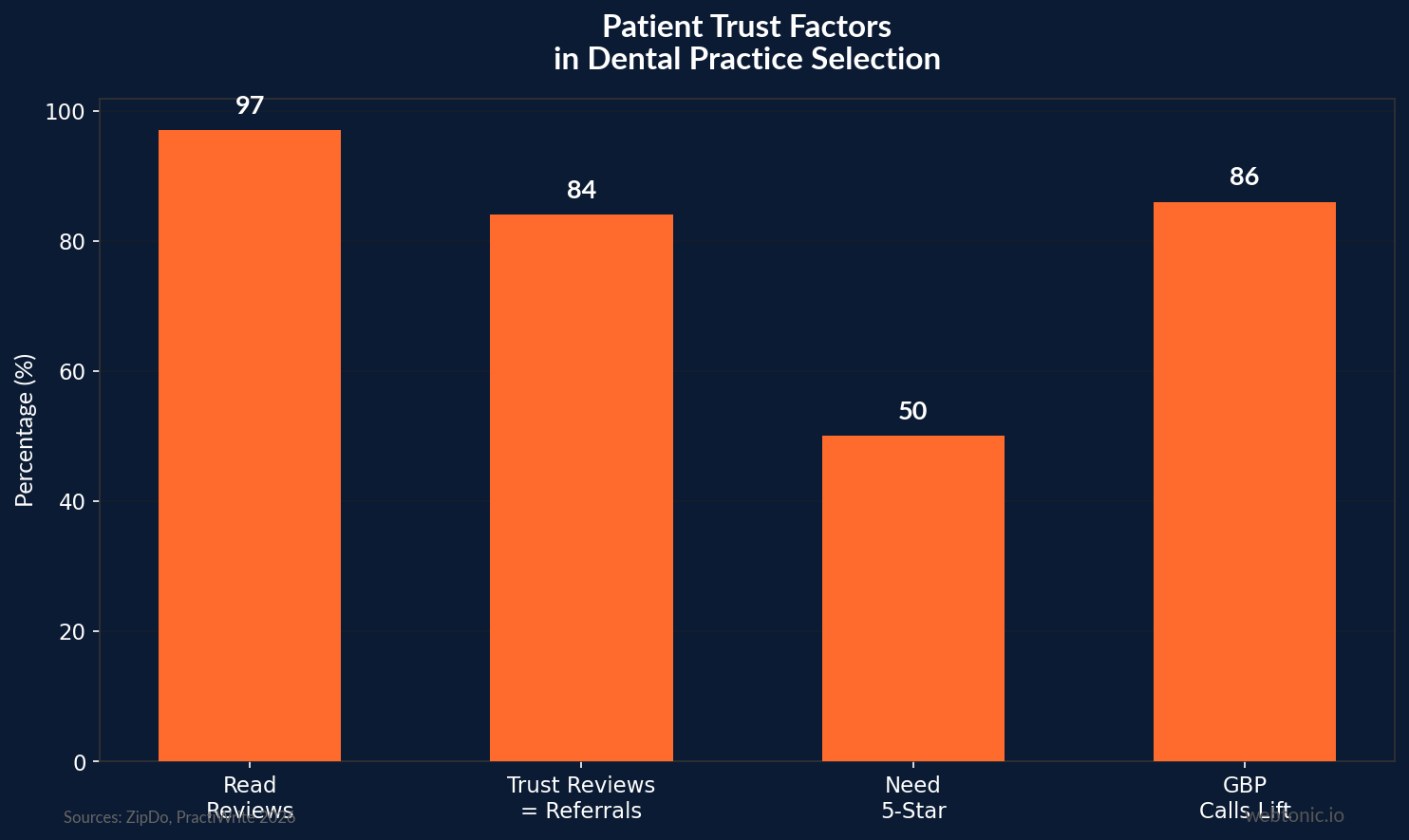
PractiWrite's Q1 2026 GBP study found that optimized Google Business Profiles deliver dramatic results:
| GBP Optimization Effect | Impact |
|---|---|
| Patient calls | 7x more calls |
| Patient trust level | 2.7x higher trust |
| Annual revenue per location | Up to $75K more |
| Search rankings | Higher local visibility |
| Profile clicks | Significantly more engagement |
For dental practices, brand consistency across digital touchpoints — website, GBP, social profiles, and review platforms — is now a measurable revenue driver, not a cosmetic upgrade.
Patient Retention and Brand Loyalty Statistics
Clerri's 2026 dental loyalty analysis reveals a massive performance gap between average and top-performing practices when it comes to patient retention:
| Retention Metric | Industry Average | Top 10% Practices | Gap |
|---|---|---|---|
| Patient retention rate | 57% | 99% | 42 percentage points |
| Acquisition-to-retention cost ratio | 5:1 | 3:1 | 40% more efficient |
The 5:1 acquisition-to-retention cost ratio means every dollar spent on retaining a patient through brand loyalty programs is 5x more efficient than acquiring a new one. Practices with strong brand identities — consistent visual standards, patient communication systems, and experience design — systematically outperform on retention because patients develop affective connections beyond clinical competence (Remedo).
Dental Rebrand Case Studies and Results
Real-world rebranding projects demonstrate the measurable impact of strategic dental brand overhauls. These case studies show what happens when practices invest in professional identity systems rather than generic templates:
| Practice | Rebrand Focus | Key Result | Timeline |
|---|---|---|---|
| Starbrite Dental | Brand + website refresh | +30% appointment requests | 60 days |
| Kids Rock Dentistry | Full identity + environment | $8M+ revenue, 20% above avg | Ongoing |
| Captain Dental | Brand + patient systems | +50% new patients | 6 months |
| Healthcare orgs (composite) | Strategic rebranding | Marketing costs: 9.6% to 7.2% of revenue | 12 months |

The Starbrite Dental case study is particularly instructive: a brand and website refresh — not a full practice overhaul — delivered a 30% increase in online appointment requests within 60 days, plus significant improvements in mobile engagement and time on site. AccelaBrand's healthcare analysis shows that strategic rebranding reduces marketing costs from 9.6% to 7.2% of total revenue as brand equity replaces paid acquisition.
Essential Dental Branding Elements and Their Impact
Remedo's branding guide identifies the key components of effective dental practice branding — moving beyond logo-level aesthetics to identity-level strategy that directly influences how patients choose and stay with a practice:
- Visual identity system. Logo, color palette, typography, and imagery guidelines that maintain consistency across all patient touchpoints — from the website to the waiting room to the appointment reminder email.
- Brand positioning and messaging. Clear differentiation from competitors: family-focused, cosmetic specialty, pediatric, luxury, or community-oriented. Practices with defined positioning see 30–45% higher conversion rates because patients self-select.
- Digital presence consistency. Website, Google Business Profile, social media, and review platforms all reflecting the same brand voice, imagery, and value proposition.
- Patient experience design. The in-office experience matching the brand promise — from check-in technology to treatment room ambiance to follow-up communication.
- Review and reputation strategy. Systematic review solicitation integrated into the patient journey, maintaining the 5-star rating that 50% of patients require for trust.
Dental Marketing and Branding Industry Benchmarks
Where does branding fit within the broader dental marketing landscape? Click-Vision's 80+ data points and Ryan Smith DDS's branding guide provide context:
- Healthcare digital ad spend in the US reached $19.7 billion in 2025, growing approximately 10% year-over-year — dental practices compete for attention in an increasingly expensive landscape.
- Brand equity compounds over years — unlike paid ads, which stop generating leads the moment you stop spending, a strong brand continues to attract referrals and organic traffic.
- Most dental practices have weak or nonexistent branding — generic names like "Smith Family Dental" with stock photography websites make differentiation impossible in competitive markets.
- Practices with 500+ Google reviews represent only 12.1% of the market, while nearly half have fewer than 100 — building a review-backed brand is still a competitive advantage.
Brand investment pays dividends across every marketing channel: branded search terms cost less on Google Ads, social media content converts better with consistent visual identity, and referral rates climb when patients can articulate what makes their dentist different.
Digital Branding Channels for Dental Practices
Dental branding extends far beyond the office walls. The modern patient journey involves 7–12 digital touchpoints before booking an appointment, and brand consistency across all of them compounds the conversion lift from professional branding:
| Digital Channel | Branding Impact | Priority Level |
|---|---|---|
| Google Business Profile | 7x more calls, $75K/yr revenue lift | Critical |
| Practice website | 30–45% conversion lift when branded | Critical |
| Social media (Instagram/FB) | Visual brand reinforcement, community trust | High |
| Review platforms (Google, Yelp) | 97% of patients check before booking | High |
| Email/SMS communication | Branded touchpoints increase retention | Medium |
| Paid search/social ads | Branded campaigns convert 2–3x better | Medium |
The compounding effect is significant: practices with consistent branding across all six channels see higher lifetime patient value than those with branding limited to the website alone. Each branded touchpoint reinforces the others, creating a recognition flywheel that reduces the cost of every subsequent patient acquisition.
The Cost of Poor Dental Branding
While the benefits of branding are well-documented, the cost of neglecting brand identity is equally measurable. Practices with generic or inconsistent branding face compounding disadvantages in competitive markets:
- Generic practice names ("Smith Family Dental") cannot be searched specifically — patients searching for a remembered brand find competitors instead, leaking referrals to better-branded practices.
- Stock photography websites generate 40–60% lower engagement than sites with authentic practice imagery — patients recognize generic visuals and associate them with generic care.
- Inconsistent visual identity across platforms creates trust gaps — when the website, GBP listing, and social profiles look like they belong to different businesses, patients question professionalism.
- Unbranded practices compete solely on price and proximity, the two least defensible advantages in dentistry. This commoditization drives down case acceptance rates and average production per patient.
- Patient acquisition costs rise year over year for unbranded practices as competitors invest in brand equity that compounds. The rising cost of dental digital advertising makes brand-driven organic acquisition increasingly valuable.
The data from Clerri's retention study puts this in stark financial terms: the 42-percentage-point gap in patient retention between average (57%) and top-performing (99%) practices represents hundreds of thousands of dollars in lost lifetime value annually for practices that fail to invest in their brand.
Measuring Dental Brand Performance
Dental practices investing in branding need clear metrics to track return on investment. The following KPIs directly correlate with brand strength and can be measured through standard analytics and practice management tools:
- Branded search volume. Track monthly searches for your practice name on Google Search Console. Growing branded search indicates increasing brand awareness in your market — top-performing practices see 15–30% year-over-year growth in branded queries.
- New patient source mix. Monitor the percentage of new patients citing referrals versus advertising. Strong brands shift the ratio toward 60–70% referral-driven acquisition, reducing dependence on paid channels.
- Case acceptance rate. Well-branded practices with clear positioning report case acceptance rates of 80–90%, compared to the industry average of 50–60%. Patients who chose you for your brand identity trust your treatment recommendations more.
- Average production per patient. Branded practices attract patients willing to invest in premium services — cosmetic dentistry, implants, Invisalign — because the brand promise matches their expectations for quality.
- Review velocity. The rate at which new reviews accumulate reflects patient satisfaction and brand advocacy. Top practices generate 15–25 new Google reviews per month, building the 500+ review profiles that only 12.1% of practices currently achieve.
Frequently Asked Questions
How much does dental practice branding cost?
A comprehensive dental rebrand — including logo, visual identity system, website redesign, and collateral — typically costs $15,000 to $50,000. The ROI data shows 300–1,100% returns in the first year through higher conversion rates and premium pricing power, making it one of the highest-return marketing investments available.
Does dental branding actually increase patient volume?
Yes. Data from multiple case studies shows 30–50% increases in new patient volume following strategic rebrands. Starbrite Dental saw a 30% lift in appointment requests within 60 days, and Captain Dental experienced a 50% increase in new patients within six months of their brand overhaul.
What is the most important element of dental branding?
Digital presence consistency — particularly Google Business Profile optimization — delivers the fastest measurable ROI. Practices with optimized GBPs receive 7x more patient calls and up to $75K in additional annual revenue. Visual identity and website design are the foundation, but GBP is where patients first encounter the brand.
How does branding affect dental patient retention?
Dramatically. The top 10% of dental practices maintain 99% patient retention versus the 57% industry average. Strong branding creates affective connections beyond clinical competence — patients stay because they identify with the practice's values, atmosphere, and communication style, not just the quality of care.
Should a solo dental practice invest in branding?
Absolutely. Solo practices benefit the most because the dentist's personal brand and the practice brand are synonymous. A $400,000 annual savings in marketing costs (as demonstrated by Kids Rock Dentistry) comes from brand recognition replacing paid acquisition — and that effect starts from the first year of intentional branding investment.
Sources
dentalmarketingguy.co – Dental Practice Branding 2026
zipdo.co – Marketing in the Dental Industry
clerri.com – Dental Patient Loyalty Statistics
practiwrite.com – Dental GBP Statistics Q1 2026
remedo.io – Branding Importance for Dental
hexcode.design – Starbrite Dental Case Study
wackyworldstudios.com – Kids Rock Case Study
click-vision.com – Dental Marketing Statistics
accelabrand.com – Healthcare Rebranding ROI
remedo.io – Brand Recognition vs Trust
ryansmithdds.com – Dental Branding Guide