Table of contents
NHTSA's own driver-record research puts DUI recidivism at 25%, and a 2026 survey of 100 US law firms found only 22% of them use call tracking at all. Read together, those two numbers say more about what a criminal-defense firm's tracking gap is actually costing than either number says alone.
Key Takeaways
- 25% of drivers arrested for DWI are repeat offenders, per NHTSA driver-record research.
- That is down from a 31% recidivism estimate in 1995, a 19% relative decline.
- 12,429 people died in alcohol-impaired crashes in 2023, per NHTSA, down 7.6% from 2022.
- Alcohol-impaired crashes caused 30% of all US traffic fatalities in 2023.
- One alcohol-impaired-driving fatality occurred every 42 minutes in 2023.
- All-offender ignition interlock laws cut recidivism by 67%, per the CDC via MADD.
- Interlocks have blocked over 5.7 million attempted drunk starts since 2006.
- That included more than 335,000 blocked attempts in 2025 alone.
- Only 22% of law firms use call tracking or call recording, per CallRail's 2026 survey.
- Only 51% of law firms have a CRM of any kind.
- Just 11% use a virtual receptionist for after-hours intake.
- 81% of firms say slow response has cost them business.
- 35% call that lost revenue "significant," 11-25% of annual revenue.
- The legal industry has a 28% missed-call rate, the second-highest of any industry tracked.
- In Clio's 2024 secret-shopper test, only 40% of firms answered live.
- 52% either answered or called back - meaning 48% got no response at all.
- Firm answer rates fell from 56% in 2019 to roughly 40% now.
What "recurrence" means in the actual arrest data
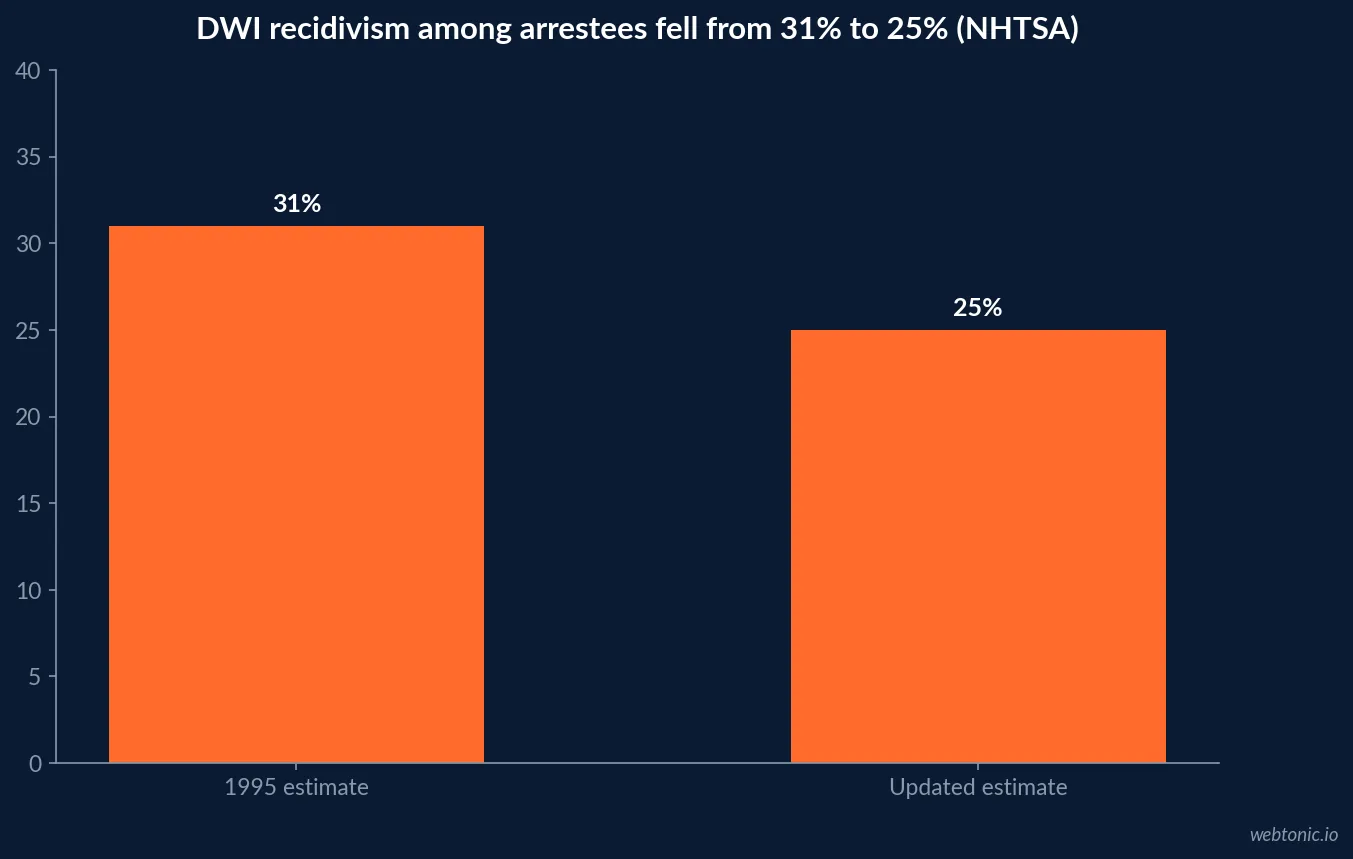
NHTSA's research note on DWI recidivism, built from state-level driver records rather than a single-year survey, is the authoritative source most local marketing copy about "repeat DUI offenders" is quietly borrowing from without citing. It found that the share of people arrested for driving while intoxicated who are repeat offenders fell from 31% in a 1995 estimate to 25% in the updated analysis - a real decline, but a base rate of one in four, not the one-in-three or one-in-two figure that gets thrown around in ad copy.
That 25% is the number a DUI-defense firm should actually be checking its own repeat-client rate against. If your own case files show a materially different recurrence rate, that gap - not a national average - is the one worth explaining to a partner or a marketing vendor.
| Recidivism measure | Figure | Source | What it actually covers |
|---|---|---|---|
| DWI recidivism, updated estimate | 25% | NHTSA driver-record research note | Share of DWI arrestees who are repeat offenders |
| DWI recidivism, 1995 estimate | 31% | NHTSA driver-record research note | The baseline the update revised down |
| Relative decline | 19% | NHTSA driver-record research note | Change from the 1995 to the updated estimate |
| Interlock recidivism reduction | 67% | CDC, cited in MADD's 2026 Interlock Report | Effect of all-offender interlock laws on repeat DUI |
The volume behind the recurrence number
NHTSA's 2023 Traffic Safety Facts data counted 12,429 people killed in alcohol-impaired-driving crashes, down 7.6% from 13,458 in 2022, and down further from 13,599 in 2021. Alcohol-impaired crashes were involved in roughly 30% of all US traffic fatalities in 2023, and on average one such fatality occurred every 42 minutes. That is a fatality count, not an arrest count, and the two move together but are not interchangeable in a headline.
| Year | Alcohol-impaired-driving fatalities | Change vs prior year | Source |
|---|---|---|---|
| 2021 | 13,599 | - | NHTSA Traffic Safety Facts |
| 2022 | 13,458 | -1.0% | NHTSA Traffic Safety Facts |
| 2023 | 12,429 | -7.6% | NHTSA Traffic Safety Facts |
What actually moves the recurrence rate down
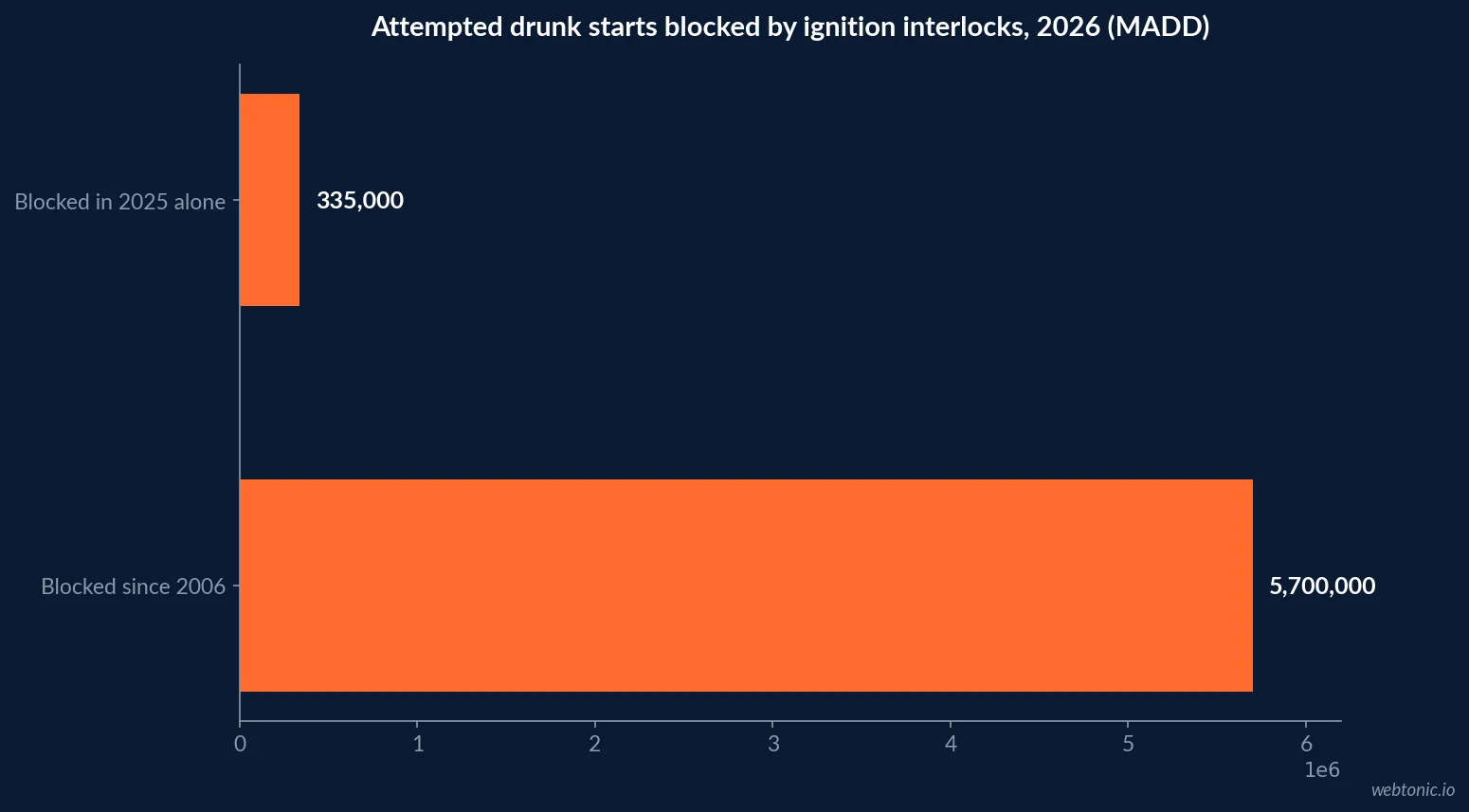
The clearest recidivism intervention in the public data is the ignition interlock, and MADD's 2026 Ignition Interlock Report is explicit about the scale: interlocks nationwide have stopped an attempted drunk start more than 5.7 million times since 2006, including over 335,000 in 2025 alone. MADD cites CDC research finding that all-offender interlock laws reduce drunk-driving recidivism by 67% compared with license suspension alone.
None of that is a defense firm's own outcome data. It is policy-level evidence for why courts widely order interlocks, and it is useful context for a firm explaining a client's sentencing options - not a number to repurpose as a claimed client result. The CDC's own analysis of state interlock laws, measured directly rather than through MADD's summary, found all-offender laws associated with 26% fewer drivers with a 0.08+ blood alcohol concentration involved in fatal crashes from 2001 to 2019, and the Insurance Institute for Highway Safety reports the same 26% figure independently. The 67% recidivism figure and the 26% crash-involvement figure measure two different things - repeat arrests versus fatal-crash involvement - and should not be swapped for each other in copy.
| Interlock metric | Figure | Source |
|---|---|---|
| Attempted drunk starts blocked since 2006 | 5.7 million+ | MADD 2026 Ignition Interlock Report |
| Attempted drunk starts blocked in 2025 | 335,000+ | MADD 2026 Ignition Interlock Report |
| Recidivism reduction, all-offender laws | 67% | CDC, cited in MADD 2026 report |
Why "tracking" is the weak link, and it isn't DUI-specific
The tracking gap sits upstream of any recurrence question. The 2026 CallRail Legal Marketing Outlook Report, surveying 100 US law firms, found only 51% have a CRM or client management system, only 22% use call tracking or call recording, and just 11% use a virtual receptionist for calls that come in after hours. This is a cross-industry legal-marketing figure, not a DUI-specific study - no vendor publishes a criminal-defense-only breakout - but a DUI case has a shorter, harder filing clock than most legal matters, which makes an untracked intake pipeline more costly here, not less.
| Intake capability | Share of law firms with it | Source |
|---|---|---|
| Any CRM or client management system | 51% | CallRail 2026 Legal Marketing Outlook |
| Call tracking or call recording | 22% | CallRail 2026 Legal Marketing Outlook |
| Virtual receptionist for after-hours calls | 11% | CallRail 2026 Legal Marketing Outlook |
| Rely on lawyers/paralegals for most intake | 68% | CallRail 2026 Legal Marketing Outlook |
What an untracked call actually costs
The same CallRail survey found 81% of firms say slow response to an inbound call, text, or web form has cost them business, and 35% call that lost revenue "significant" - an estimated 11-25% of annual revenue. The legal industry overall carries a 28% missed-call rate, the second-highest of any industry CallRail tracks, behind healthcare. Clio's 2024 secret-shopper study, testing 500 firms directly, found only 40% answered the phone live and 52% either answered or called back - meaning 48% of inbound inquiries got no response at all, down from a 56% live-answer rate in 2019.
Our data and analytics practice treats that gap as the first fix, before any spend on new traffic: a firm that answers 52% of calls is losing roughly half its paid and organic demand before a lawyer ever hears about the case.
| Response benchmark | Figure | Source |
|---|---|---|
| Firms that answered the phone live | 40% | Clio 2024 secret-shopper study |
| Firms that answered or called back | 52% | Clio 2024 secret-shopper study |
| Firms with no response at all | 48% | Clio 2024 secret-shopper study |
| Live-answer rate in 2019, for comparison | 56% | Clio 2024 secret-shopper study |
| Industry-wide missed-call rate | 28% | CallRail 2026 Legal Marketing Outlook |
Building the stack that actually catches a recurring case
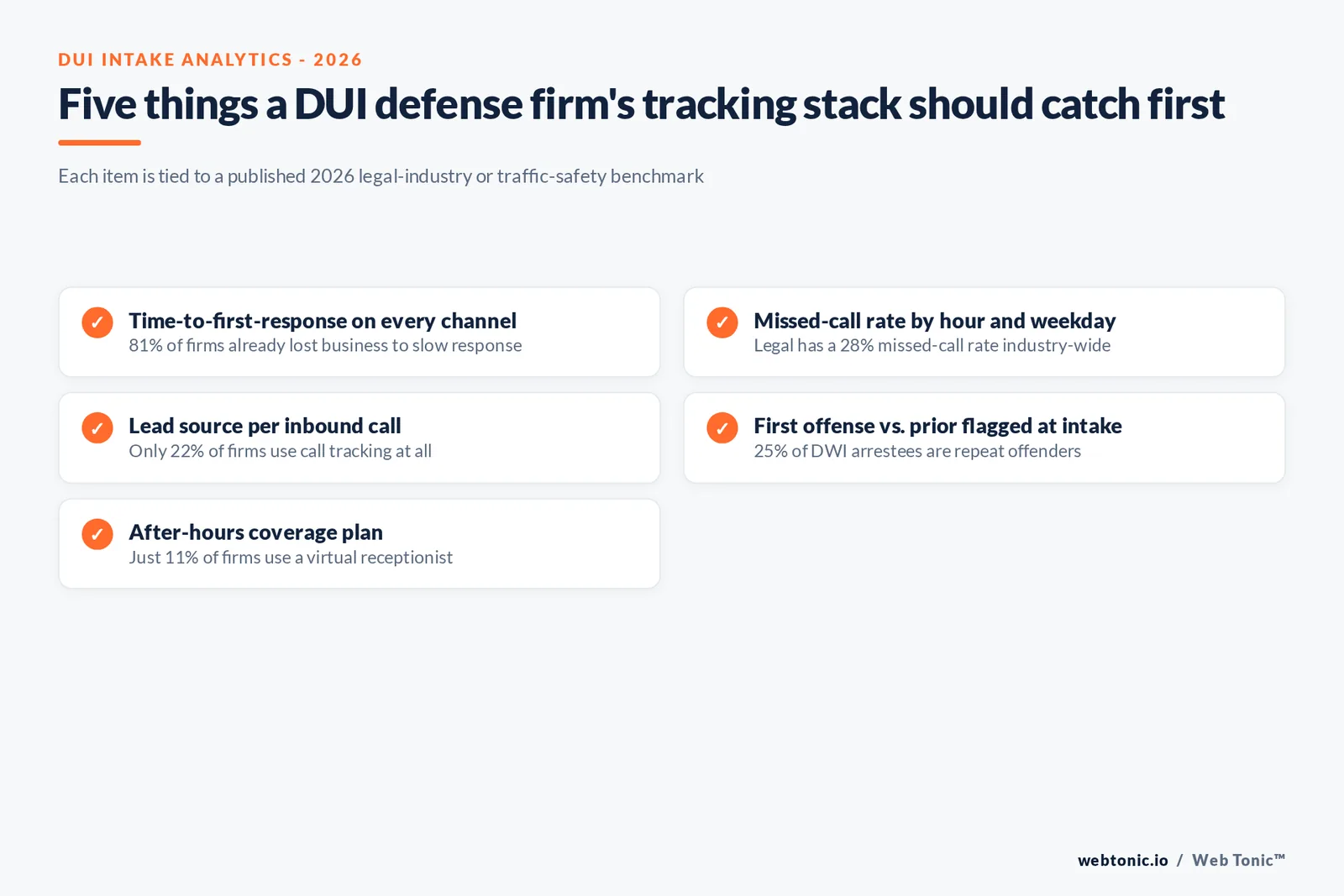
A defensible DUI intake analytics stack starts with the four numbers this data keeps surfacing: time-to-first-response on every channel, missed-call rate by hour and day of week, source attribution per lead (paid search, Local Services Ads, referral), and whether the matter is a first offense or a prior - since that single field is the difference between generic intake and a genuinely recurrence-aware pipeline. None of that requires new case law knowledge, and all of it is missing from the majority of firms surveyed above.
What the compliance layer looks like
Recurrence data belongs in operations, not in outbound messaging. State bar advertising rules generally require attorney marketing to be truthful and non-misleading, and using a prior arrest as a targeting signal without consent, or implying a guaranteed outcome tied to "repeat offender" status, risks both a bar complaint and an ad-platform policy violation. Treat every recurrence figure on this page as market context for staffing and response-time planning, never as a claim about a specific client's odds.
If your firm wants its own intake numbers benchmarked against these figures, talk to us, or read how we approach paid acquisition in our breakdown of what Google Ads actually costs before adding spend on top of an unmeasured funnel.
Frequently Asked Questions
What percentage of DUI arrests are repeat offenses?
NHTSA's most recent driver-record study puts recidivism among people arrested for driving while intoxicated at 25%, down from a 1995 estimate of 31% - a 19% relative decline measured over a look-back period. That means roughly one in four people arrested for DUI already has a prior DUI on record, which is the actual base rate behind any 'recurrence' claim, not a fixed one-in-three or one-in-two figure some marketing copy implies.
Are DUI arrests going up or down?
Down, on the two measures that track it. NHTSA's 2023 data counted 12,429 alcohol-impaired-driving fatalities, a 7.6% drop from 13,458 in 2022, and roughly 30% of all US traffic fatalities that year involved a driver over the legal limit. Arrest volume and fatality counts move together but are not the same statistic - a firm citing 'DUI arrests are rising' needs its own state's court filing data, not a national fatality trend, to back that up.
Do ignition interlocks actually reduce repeat DUIs?
MADD's 2026 Ignition Interlock Report cites a Centers for Disease Control finding that all-offender interlock laws cut drunk-driving recidivism by 67%, and MADD's own tally shows interlocks nationwide have blocked an attempted drunk start more than 5.7 million times since 2006, over 335,000 of those in 2025 alone. That is a policy-level recidivism number, not a firm's client outcome, and the two should never be conflated in marketing copy.
Why does a criminal-defense firm need call tracking?
Because the 2026 CallRail Legal Marketing Outlook Report (100 US law firms surveyed) found only 22% of law firms use call tracking or call recording, only 51% have any CRM at all, and 81% say slow response to an inbound call, text, or web form has already cost them business - with 35% calling that lost revenue 'significant,' in the 11-25% of annual revenue range. That is a cross-industry legal figure, not DUI-specific, but a DUI case is won or lost inside the first phone call more than most legal matters, since the arrest itself creates a hard filing deadline.
What should a DUI intake analytics stack track first?
Time-to-first-response on every inbound channel, missed-call rate by hour and day, source of the call (paid search, LSA, referral, walk-in), and whether the case involves a first offense or a prior. Clio's 2024 secret-shopper study of 500 firms found only 40% answered the phone live and 52% either answered or called back, meaning 48% of inbound legal inquiries got no response at all - a number worth re-testing against your own firm's numbers before assuming you are the exception.
Sources
NHTSA - Traffic Safety Facts 2023 Data, Alcohol-Impaired Driving
NHTSA - DWI Recidivism in the United States, research note
MADD - 2026 Ignition Interlock Report
CDC - Increasing Alcohol Ignition Interlock Use
IIHS-HLDI - Safety Solution: mandating ignition interlocks
CallRail - 2026 Legal Marketing Outlook Report
Clio - Legal Trends Report, secret-shopper response study