Table of contents
The honest starting point for a DUI TikTok ad budget is not a cost figure - it is TikTok's own policy on whether the ad can run at all. Criminal defense sits in a different compliance lane than personal injury or family law on this platform, and no benchmark prices DUI ads specifically, so this page builds the budget from policy plus cross-industry paid-social data, labelled as such.
Key Takeaways
- TikTok's Branded Content Policy restricts "legal and immigration services" branded content outright.
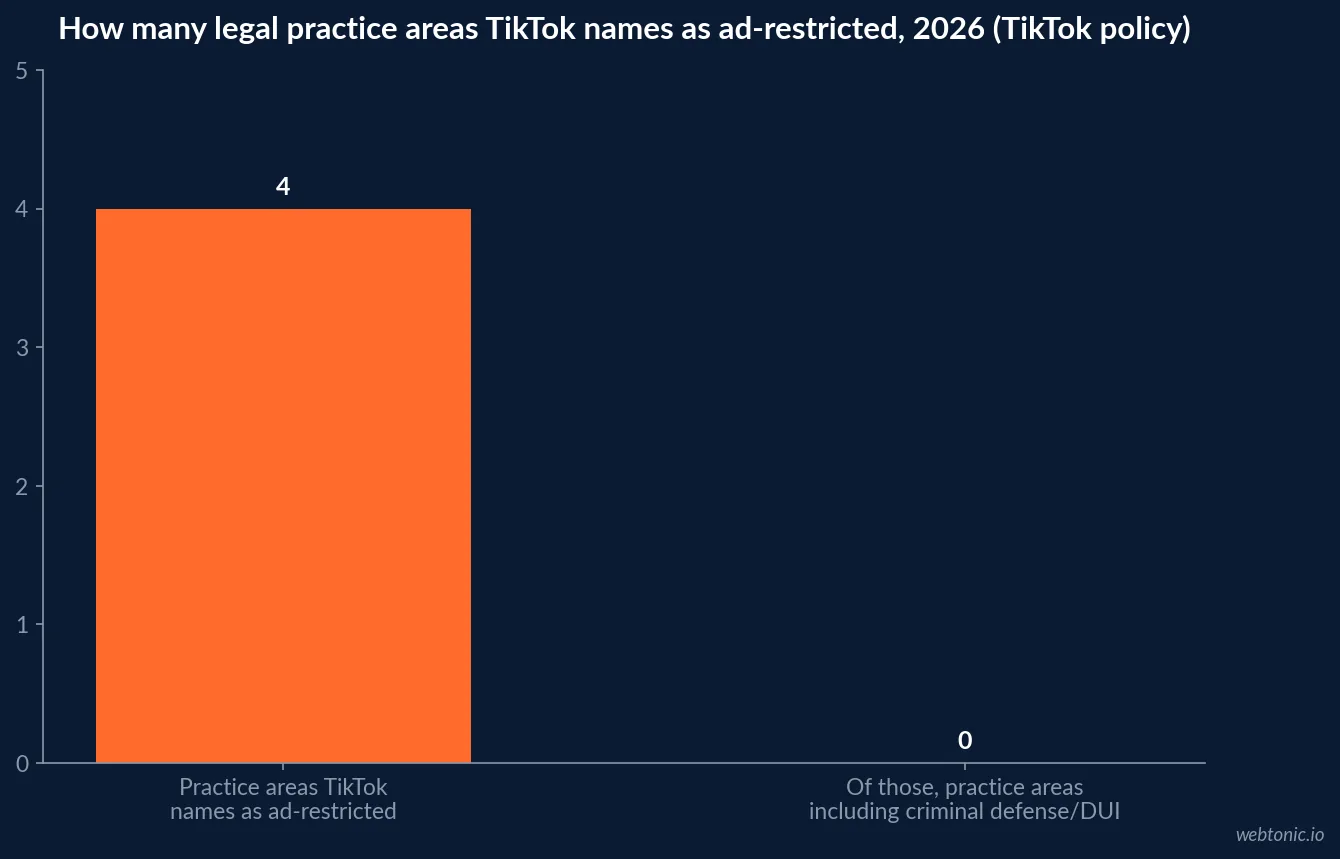
- Personal injury, family law, immigration law and employment law ads are barred from direct legal-service promotion.
- Criminal defense/DUI is not named in that prohibited list, unlike those four areas.
- Educational legal content is allowed if it is "purely informative," per TikTok's own wording.
- No published benchmark prices legal or DUI ads on TikTok specifically.
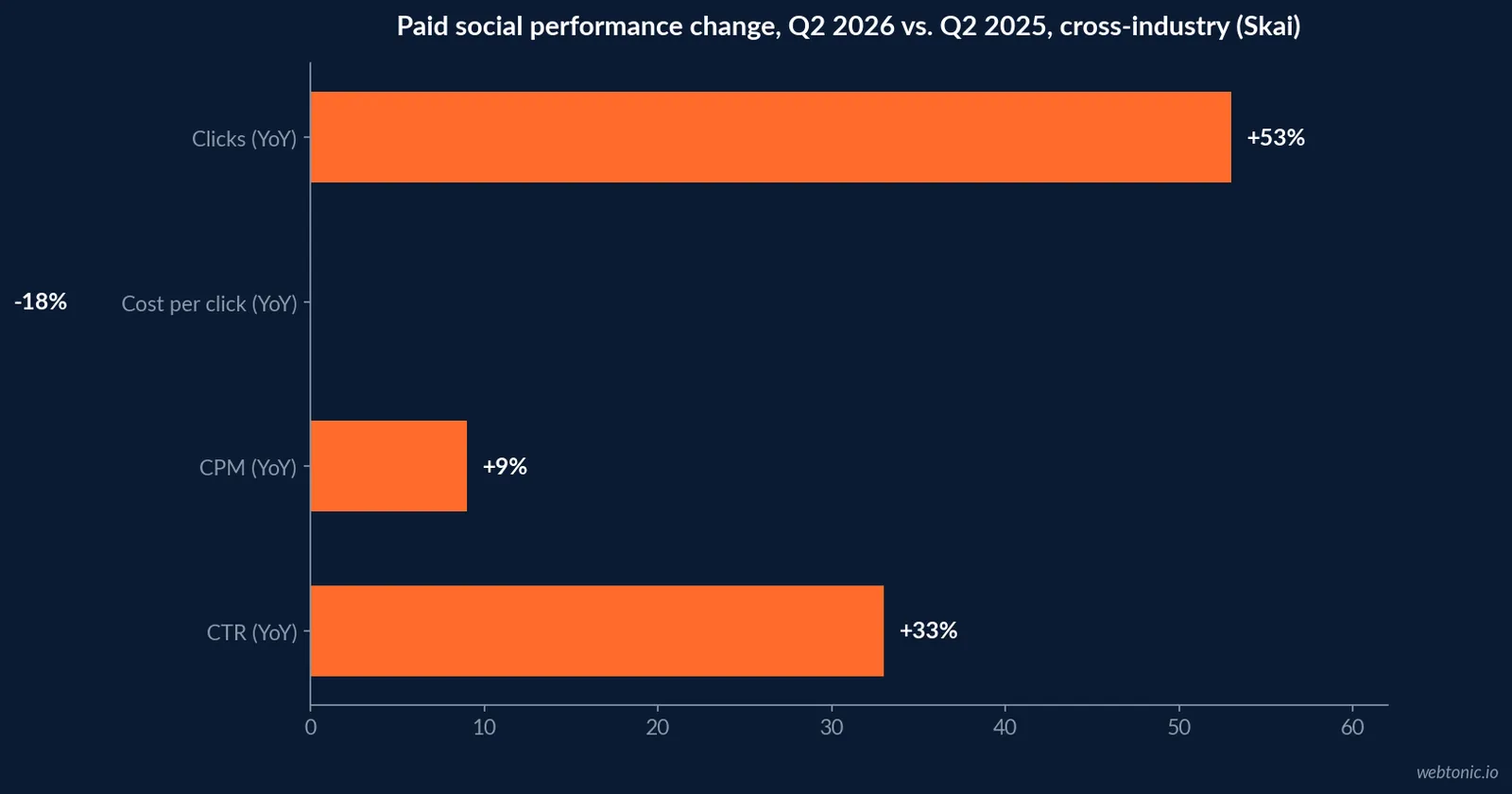
- Paid social clicks rose 53% year over year in Q2 2026 across tracked accounts (Skai).
- Cost per click fell 18% over the same period, cross-industry.
- Click-through rate rose 33% year over year, cross-industry.
- TikTok now takes roughly 17% of social ad budgets tracked by Skai.
- 687,396 DUI arrests were logged in the US in 2023 (FBI UCR).
- 12,429 people died in alcohol-impaired crashes in 2023 (NHTSA).
- An 18+ audience restriction applies to any legal-service ad TikTok does allow.
What TikTok's own policy actually says about legal ads
TikTok's Branded Content Policy lists "professional services - including accounting, legal and immigration services" as a restricted category for creator branded content, meaning creators cannot run paid partnership posts promoting law-firm services under that policy. The restriction sits at the professional-services level rather than being broken out by practice area, so DUI and criminal defense representation fall inside the same restricted bucket as immigration and accounting instead of being separately named or exempted. That is distinct from running paid TikTok Ads directly (not creator branded content) for legal services, which still goes through TikTok's standard ad review and age-targeting rules rather than the branded-content restriction.
| Content type | TikTok policy treatment | What still applies |
|---|---|---|
| Creator branded content promoting DUI/criminal defense services | Restricted (professional services category) | Cannot run as a paid partnership post |
| Direct TikTok Ads for legal services | Allowed, subject to standard ad review | 18+ age targeting, ad review, bar compliance |
| Educational legal content (any area) | Allowed | Must stay purely informative, not promotional |
Why "not prohibited" is not the same as "cheap and proven"
No public TikTok benchmark report breaks results out by legal vertical, let alone DUI defense specifically. Every industry table in circulation - retail, beauty, food and beverage, finance, technology - is a consumer-product category, and legal services are absent because the sample sizes running direct response legal ads on TikTok remain small relative to those verticals. That means a DUI firm testing TikTok ads is testing into a genuine data gap, not applying a known playbook.
The nearest honest proxy is platform-wide paid-social performance, not a legal number dressed up as one.
| Paid social metric (cross-industry, Q2 2026) | Year-over-year change | Source |
|---|---|---|
| Paid social clicks | +53% | Skai Q2 2026 Quarterly Digital Trends Report |
| Paid social cost per click | -18% | Skai Q2 2026 Quarterly Digital Trends Report |
| Paid social CPM | +9% | Skai Q2 2026 Quarterly Digital Trends Report |
| Paid social CTR | +33% | Skai Q2 2026 Quarterly Digital Trends Report |
| TikTok's share of tracked social ad budgets | ~17% | Skai Q2 2026 Quarterly Digital Trends Report |
Skai's Q2 2026 report, built on almost 1 trillion impressions and USD 10 billion in tracked spend across its platform, is a media-buying-software vendor's own dataset with a stated methodology - directly citable, but consumer-brand-heavy, and not a legal or DUI number. Read it as evidence that paid social overall got more efficient in 2026, and budget a DUI TikTok test accordingly rather than importing a CPC or CPL figure from it.
What the ad actually has to say to stay compliant
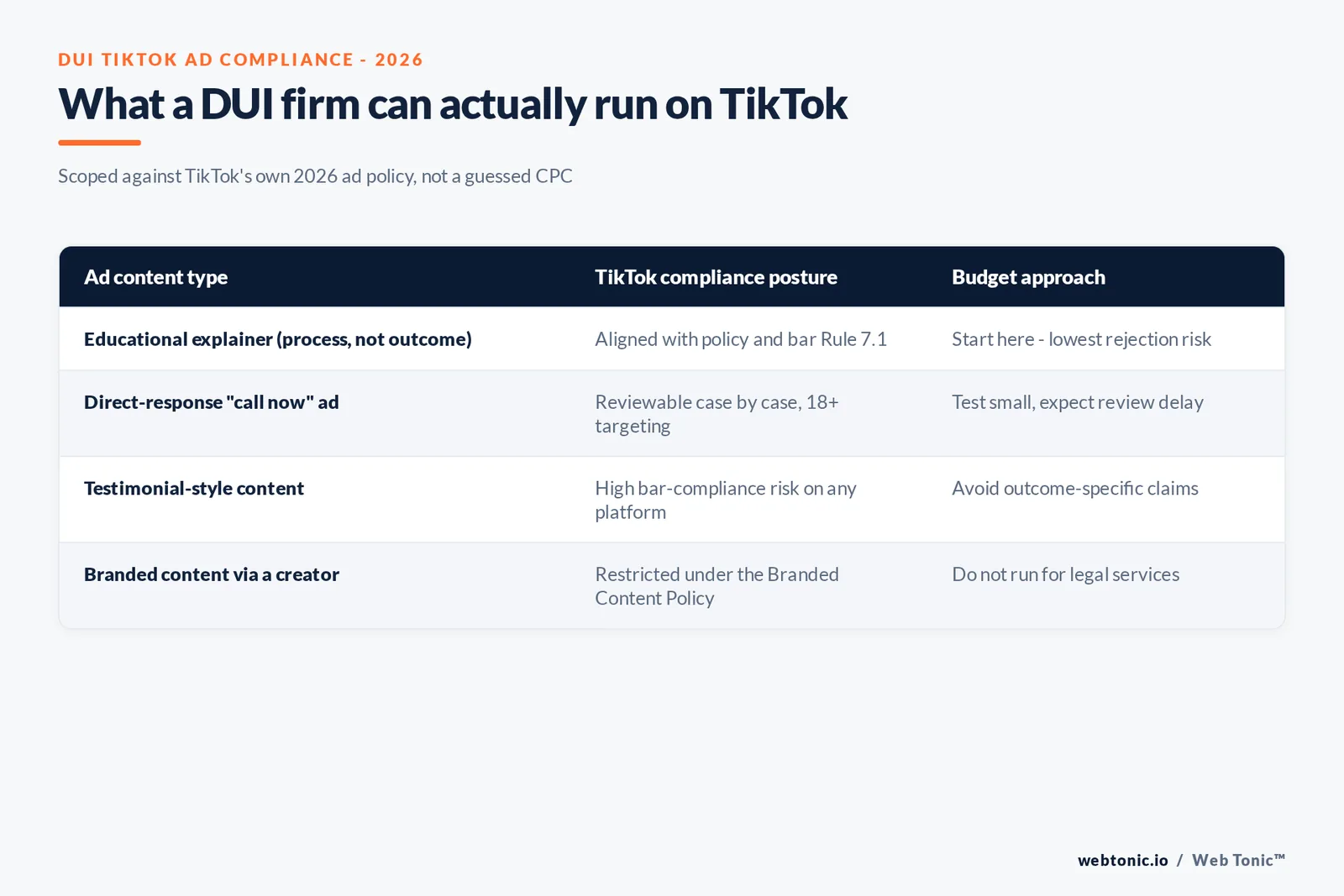
TikTok's own carve-out for "educational content about any legal topic, as long as the ad is purely informative" lines up almost exactly with what ABA Model Rule 7.1 and most state bar advertising rules already require: no guaranteed outcomes, no misleading claims, no direct solicitation language aimed at a specific pending case. A DUI firm's safest TikTok test is content that explains process - what a breath test measures, what a first DUI typically costs in fines and license time - rather than content that promises a result for a specific charge.
That also happens to be the content format most likely to clear TikTok's ad review the first time, since reviewers are checking for the same promotional-versus-educational line the bar rules draw.
| DUI TikTok ad test scope | Compliance posture | Budget approach |
|---|---|---|
| Educational explainer (process, not outcome) | Aligned with TikTok policy and bar rule 7.1 | Start here - lowest rejection risk |
| Direct-response "call now" ad | Reviewable case by case; 18+ targeting required | Test small, expect ad review delay |
| Testimonial-style content | High bar-compliance risk regardless of platform | Avoid outcome-specific claims |
| Branded content via a creator | Restricted under TikTok's Branded Content Policy | Do not run for legal services |
What a video-first budget on this platform borrows from other channels
Since no TikTok-specific legal benchmark exists, a DUI firm testing the platform is really renting the video content it already built for YouTube. Wyzowl's 2026 survey found 91% of businesses now use video as a marketing tool and 40% of video marketers already upload to TikTok specifically, even without legal-vertical data to benchmark against. That 40% adoption figure is the most concrete signal available that other industries have found TikTok worth the production cost - legal advertisers are simply earlier in that adoption curve, not absent from the logic behind it.
Reusing an existing YouTube explainer as a native-style TikTok cutdown, rather than commissioning TikTok-specific content from scratch, is the lowest-risk way to test the channel before committing a standalone production budget to it. It also means the 91% adoption figure above is not just a video-industry stat - it is the source pool a DUI firm's first TikTok test should draw from.
A real educational-content example the policy already allows
Ignition interlock deterrence data is a useful test case for what "purely informative" content looks like in practice. MADD's 2024 ignition interlock report found that interlocks prevented 379,020 attempts to drive at or above a 0.08 blood alcohol concentration in 2024 alone - more than 1,035 prevented attempts every day - and that from December 2006 through December 2024, interlocks stopped more than 5.3 million drunk-driving attempts nationwide. A short video or carousel explaining what an ignition interlock does and when a court orders one is squarely educational: it names no client, promises no outcome, and answers a question a huge share of DUI search traffic is already asking.
Content built from that kind of primary safety data also has a second advantage on TikTok specifically: it is the type of factual, sourced claim that TikTok's ad review team can verify quickly, which shortens the approval cycle relative to ad copy that makes case-specific or outcome-specific claims.
| MADD ignition interlock data point (2024) | Figure | Educational content angle |
|---|---|---|
| Drunk-driving attempts prevented in 2024 | 379,020 | "What an ignition interlock actually stops" |
| Prevented attempts per day, nationwide | 1,035+ | "Why courts order this device" |
| Cumulative attempts prevented, 2006-2024 | 5.3 million+ | "How long interlock requirements last" |
Sizing the demand behind the test
The underlying caseload is not small even where the platform data is thin. The FBI's Uniform Crime Reporting Program recorded 687,396 DUI arrests in the US in 2023, and NHTSA's 2023 Traffic Safety Facts counted 12,429 deaths in alcohol-impaired crashes. TikTok's own user base skews younger than the typical legal-services buyer, which is a genuine mismatch for most legal niches but a closer fit for DUI, given how disproportionately younger drivers appear in impaired-driving arrest data - one more reason DUI is the legal niche most worth testing on TikTok, even without a published benchmark to lean on.
For a channel with an actual legal-industry benchmark to compare a TikTok test against, see our breakdown of what Facebook ads cost by industry. Our growth marketing team can scope a compliant TikTok test end to end, or talk to us directly about a criminal defense practice's paid social plan.
Frequently Asked Questions
Can a criminal DUI defense firm even run ads on TikTok?
More often than other legal niches, yes. TikTok's Branded Content Policy explicitly restricts branded content for "professional services - including accounting, legal and immigration services," and its advertising rules separately bar direct legal-service ads for personal injury, family law, immigration law and employment law. Criminal defense and DUI representation are not named in that prohibited list, which means standard TikTok ads for DUI defense are typically reviewable case by case, subject to an 18+ audience restriction and compliance with local bar advertising rules - a materially different starting position than personal injury or family law firms have on the platform.
Is there a published TikTok ad benchmark specifically for legal or DUI advertisers?
No. Every TikTok benchmark report available publicly reports by consumer vertical (retail, beauty, finance, food and beverage) and none break out legal services or DUI defense specifically. Any number presented as a "DUI TikTok CPC" without a named source is fabricated. This page uses cross-industry paid-social benchmarks and labels them as such rather than inventing a legal-specific figure.
What does a cross-industry paid-social benchmark actually suggest about cost?
Skai's Q2 2026 Quarterly Digital Trends Report, built from nearly 1 trillion impressions and $10 billion in tracked ad spend, found paid social clicks up 53% year over year while cost per click fell 18% and CTR climbed 33%, with TikTok now taking roughly 17% of social ad budgets. That is a platform-wide efficiency trend, not a legal-vertical number, and it should be read as "TikTok ads got cheaper and more efficient broadly," not as a DUI-specific cost projection.
If legal ads are restricted, what content can a DUI firm actually post organically?
Purely educational, non-solicitation content. TikTok's policy allows "educational content about any legal topic, as long as the ad is purely informative," which opens a path for content explaining DUI law generally - what a breath test measures, what happens at arraignment - without directly soliciting a specific case. The same line that separates education from promotion in a TikTok video is the line ABA Model Rule 7.1 and most state bar advertising rules already draw, so compliant TikTok content and compliant bar-rule content overlap almost completely.
How large is the audience a compliant DUI TikTok presence would actually reach?
The underlying legal need is large: the FBI's Uniform Crime Reporting Program recorded 687,396 DUI arrests in the US in 2023, and NHTSA counted 12,429 deaths in alcohol-impaired-driving crashes that year. TikTok's own audience skews younger than most legal-services buyers, so the realistic reach for direct DUI intake is the 18-34 demographic disproportionately involved in impaired-driving incidents, not the full 687,396-arrest population - a narrower, but not small, addressable group.
Sources
TikTok - Branded Content Policy
Skai - Q2 2026 Quarterly Digital Trends Report press release
FBI Crime Data Explorer - DUI arrests, 2023
NHTSA - Traffic Safety Facts 2023: Alcohol-Impaired Driving
MADD - Ignition Interlocks Prevent Drunk Driving (5.7M attempts stopped, 2006-2025)