Table of contents
No SEO-budget study isolates criminal DUI defense from the rest of legal marketing, so the honest way to answer where those budgets are headed is to combine the cross-practice legal marketing-spend surveys that do exist with the demand-side arrest and crash data that explains why DUI search volume holds up regardless of any single firm's spend. Every figure below is labeled by what it actually measures.
Key Takeaways
- Only 57% of law firms expect to raise marketing budgets in 2026, down from 86% a year earlier.
- Just 11% of firms plan to cut marketing budgets outright for 2026.
- SEO was named by 28% of law firms among their marketing investments (ABA, cross-practice).
- Website design led at 42%, ahead of social media at 27% and PPC at 8%.
- 91% of firms with 2-9 attorneys already have a website, and 98% of firms with 10-49.
- Solo practitioner website adoption reached 70%, up from 61% in 2022 and 53% in 2021.
- 12,429 people died in alcohol-impaired-driving crashes in the US in 2023.
- That fell to 11,904 deaths in 2024, a 3.9% year-over-year decline.
- Alcohol-impaired crashes still caused 30% of all US traffic fatalities in 2023.
- One alcohol-impaired-driving fatality occurred every 44 minutes in 2024.
- The 21-24 age group had the highest share of alcohol-impaired drivers in fatal crashes.
- Criminal practice-area hourly rates average USD 217 for lawyers, the lowest of the practice areas Clio tracks.
- Firms confident in attribution or ROI measurement sit at just 53% industry-wide.
- Email leads planned 2026 budget increases at 51% among firms still investing more.
- Legal landing pages convert at a 6.3% median, just under the 6.6% all-industry baseline.
Why "SEO budgets are headed" needs a demand-side answer, not just a spend number
A criminal DUI defense firm's SEO budget is really answering two separate questions: how much search volume exists for DUI-related terms, and how much of the legal industry's marketing spend is moving toward or away from SEO generally. No single published source answers both at the DUI level, so this page walks through the demand side first, then the spend side, and states the gap between them plainly.
The demand floor: DUI incidents are down, but still enormous
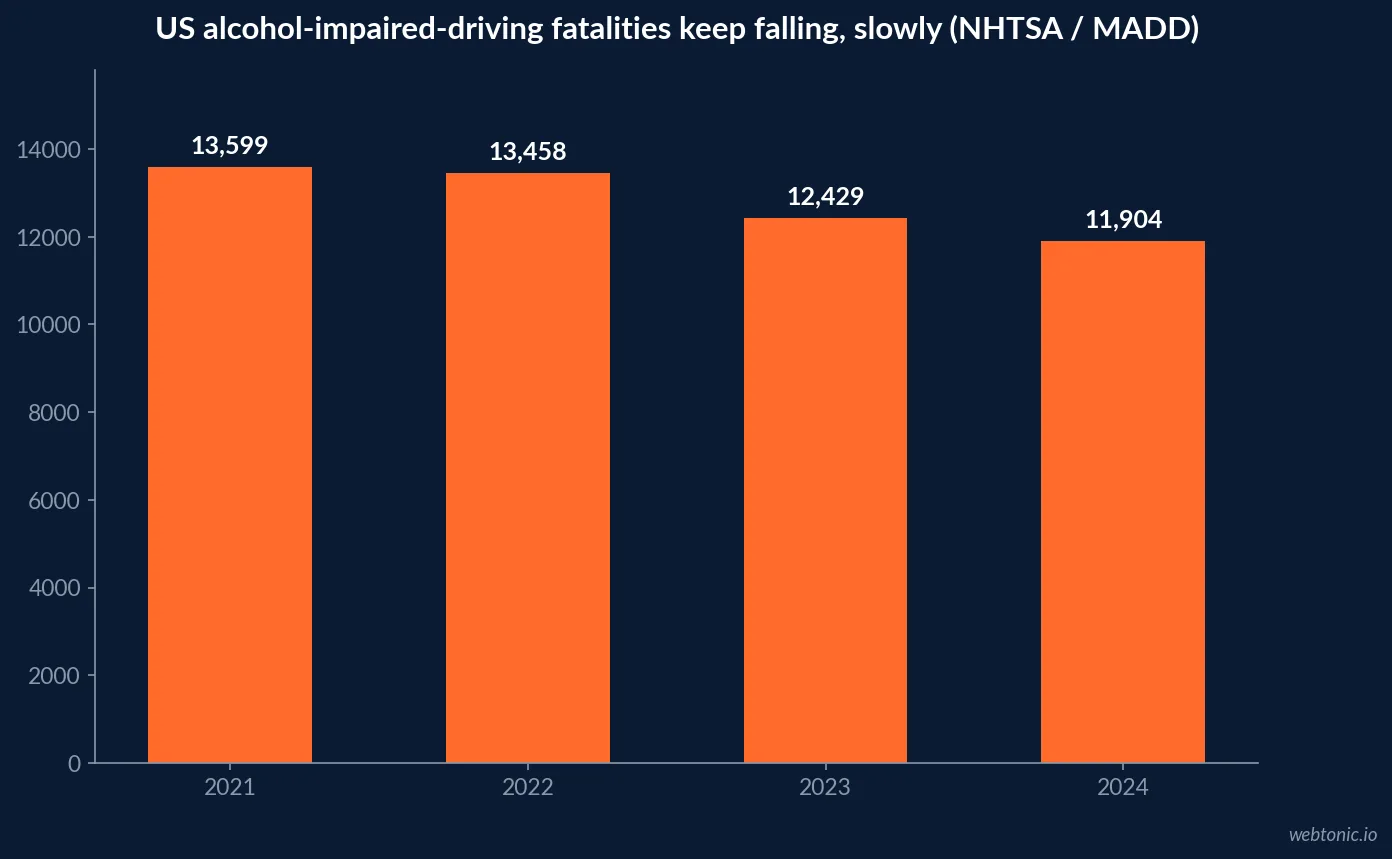
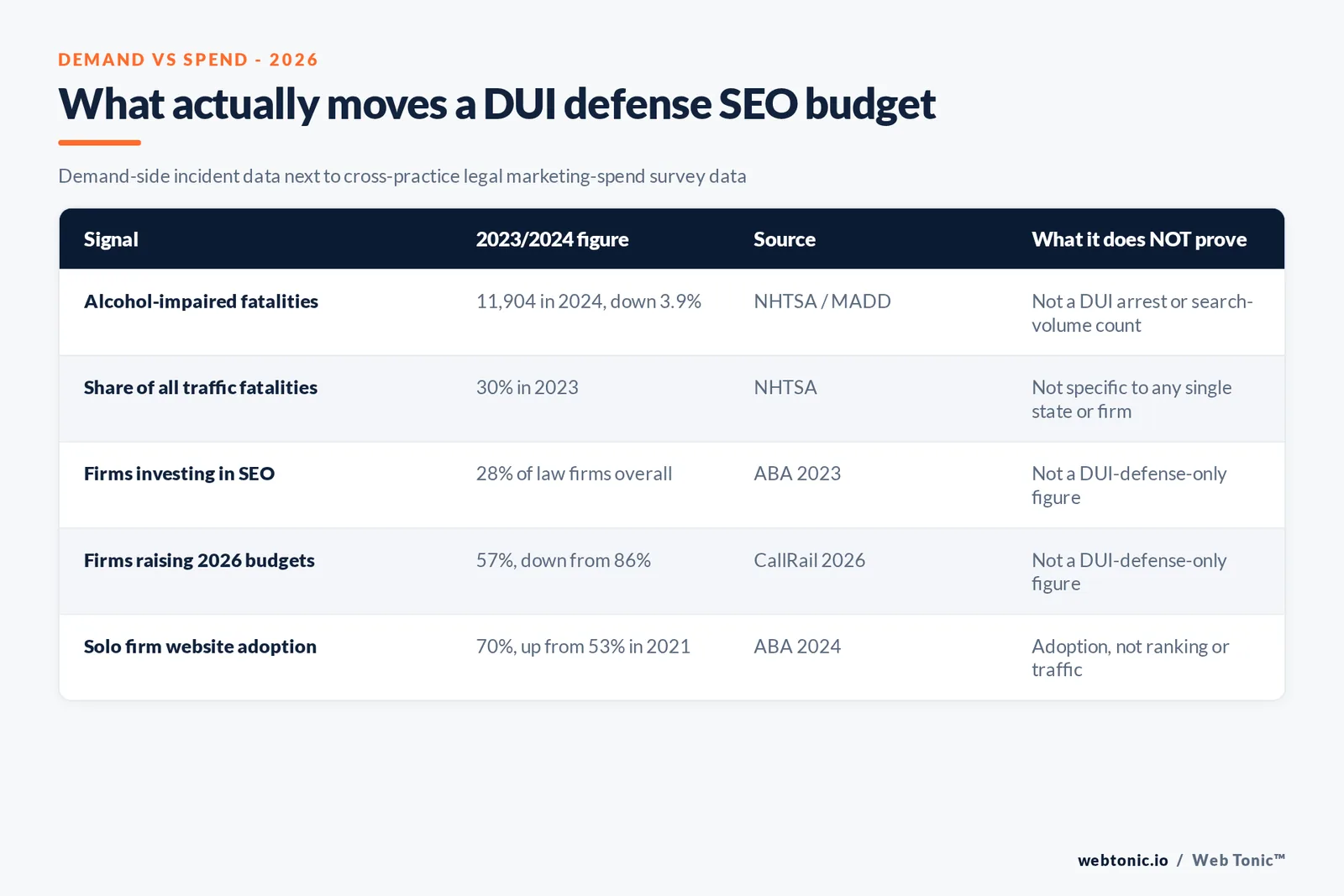
NHTSA's 2023 Traffic Safety Facts data recorded 12,429 alcohol-impaired-driving fatalities, a 7.6% decrease from 13,458 in 2022, and alcohol-impaired crashes still accounted for 30% of all US traffic fatalities that year. NHTSA's 2024 data showed the decline continuing to 11,904 deaths, down 3.9% year over year, with one fatality occurring every 44 minutes and the 21-24 age group carrying the highest share of alcohol-impaired drivers in fatal crashes. MADD's own statistics page confirms the 11,904 figure and adds that drunk driving fatalities fell 3.9% compared with 2023.
These are not arrest counts and not a proxy for search volume, but they show the incident base that generates DUI charges - and therefore DUI-related search demand - is declining gradually, not collapsing. A demand floor this large does not disappear on any firm's marketing timeline.
| NHTSA / MADD alcohol-impaired driving data (US) | 2021 | 2022 | 2023 | 2024 |
|---|---|---|---|---|
| Alcohol-impaired-driving fatalities | 13,599 | 13,458 | 12,429 | 11,904 |
| Share of all traffic fatalities | n/a | 31% | 30% | n/a |
| Year-over-year change | n/a | -1.0% | -7.6% | -3.9% |
The spend side: legal marketing budgets are cooling, not collapsing
CallRail's 2026 Legal Marketing Outlook Report found only 57% of law firms expect to increase marketing budgets in 2026, a steep drop from 86% who expected the same the year before. Still, only 11% plan to decrease budgets outright, and among firms increasing spend, the largest planned destinations are email at 51%, influencer marketing at 49%, and paid social at 47%. That is a cross-practice figure, not DUI-specific, but it is the most current signal on legal marketing budget direction available.
| CallRail 2026 legal marketing outlook finding | 2025 figure | 2026 figure |
|---|---|---|
| Firms expecting budget increases | 86% | 57% |
| Firms planning budget decreases | n/a | 11% |
| Firms confident in attribution/ROI measurement | n/a | 53% |
| Firms naming email as a top 2026 investment | n/a | 51% |
Where SEO specifically sits inside that spend
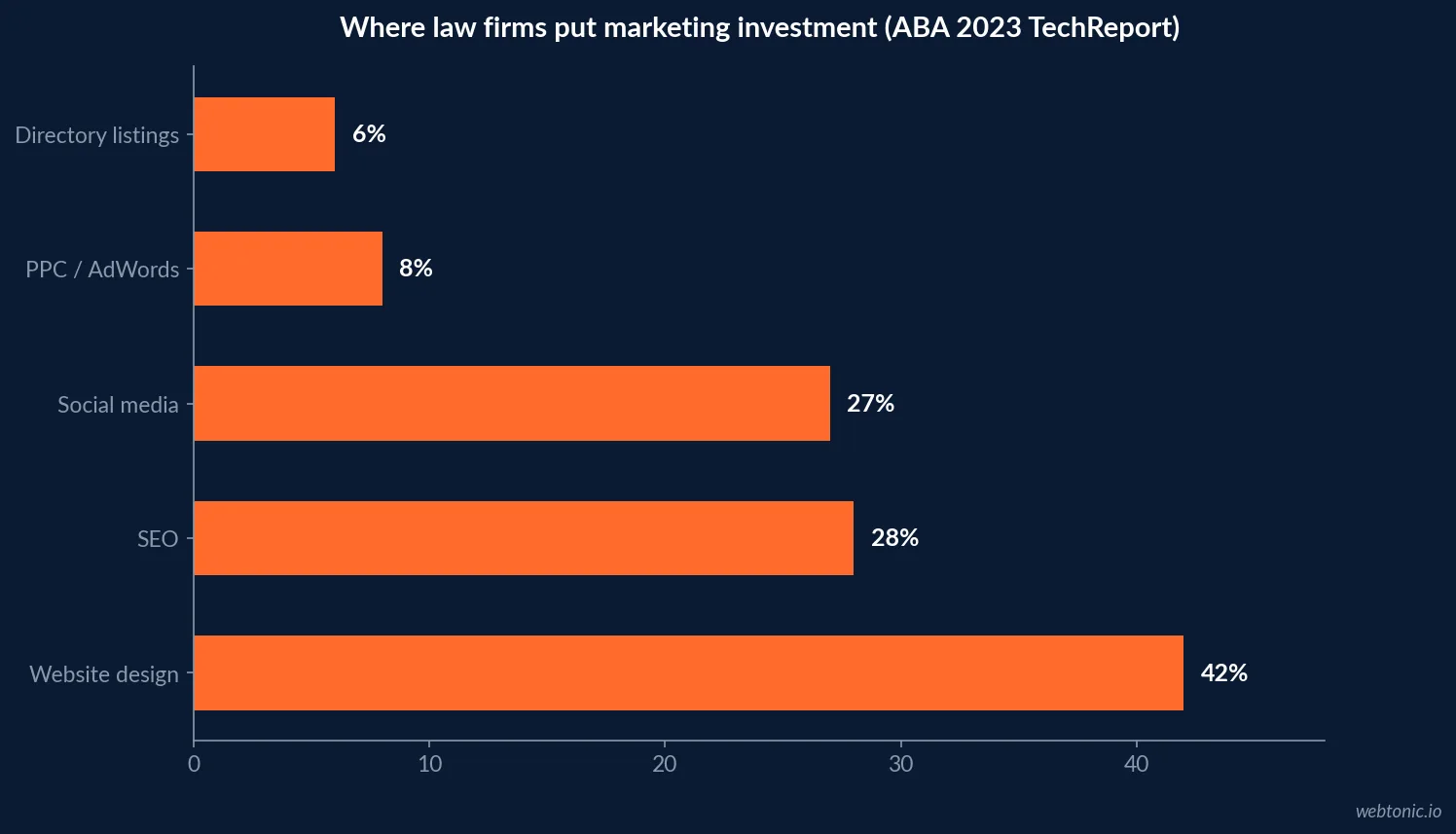
The ABA's 2023 Websites and Marketing TechReport asked firms which marketing channels they invest in and found website design named by 42%, SEO by 28%, social media by 27%, print marketing and online leads each at 9%, PPC/AdWords at 8%, and directory listings at 6%. SEO's 28% share sits comfortably inside the top three named channels, ahead of paid search - which matters for a DUI defense firm weighing organic against paid investment, since the underlying survey shows organic-adjacent spend (website, SEO) outweighing paid channels roughly five to one in the share of firms investing.
Website infrastructure to support that SEO spend keeps expanding too: the ABA's 2024 Solo and Small Firm TechReport found 91% of firms with 2-9 attorneys and 98% of firms with 10-49 attorneys already have a website, while solo practitioner adoption reached 70%, up from 61% in 2022 and 53% in 2021 - meaning the smallest, often most locally-focused DUI defense practices are the ones closing the website gap fastest.
| Marketing channel firms invest in (ABA 2023 TechReport) | Share of firms |
|---|---|
| Website design | 42% |
| SEO | 28% |
| Social media | 27% |
| Online leads / print marketing | 9% each |
| PPC / AdWords | 8% |
| Directory listings | 6% |
| Website adoption by firm size (ABA TechReport) | 2021 | 2022 | 2024 |
|---|---|---|---|
| Solo practitioners | 53% | 61% | 70% |
| Firms with 2-9 attorneys | n/a | n/a | 91% |
| Firms with 10-49 attorneys | n/a | n/a | 98% |
What this means for a DUI defense firm's SEO plan
The honest synthesis: incident volume that drives DUI search demand is declining slowly, not collapsing, while legal-industry marketing budgets overall are cooling from a strong 2025 without most firms cutting. SEO holds a real, named share of legal marketing investment - ahead of paid search in the ABA's data - and the infrastructure smaller firms need to compete on it (a functioning website) is still closing an adoption gap. None of that is a DUI-specific budget number, and any article claiming one without naming a source is not citing a real study.
A DUI defense firm sizing its own SEO budget is better served comparing its landing page performance against Unbounce's 6.3% median legal conversion rate than against a borrowed practice-area figure. Our growth marketing team builds that comparison before recommending a number, and our guide on building a paid search strategy is a useful companion read for the channels SEO budget usually competes against.
What the search behavior data says about who is actually looking
Clio's 2025 Legal Trends Report found 70% of consumers who hired a lawyer recently said it was easy to find and hire one, largely through referrals and internet search, and that more consumers - especially younger generations - now expect to search online for their next lawyer even when a referral is available. That is a cross-practice figure again, not DUI-specific, but it supports treating organic visibility as demand capture rather than demand creation: the incident has already happened, and the search is how someone facing a DUI charge finds the firm that will represent them, often under time pressure since many DUI defense timelines are short.
24% of clients said they would be unlikely to rehire the same lawyer even when satisfied, per the same report - a reminder that a single well-ranked page rarely earns repeat business in criminal defense the way it might in a recurring-need practice area, which is one more reason SEO budget here has to be justified case by case rather than assumed to compound.
| Clio 2025 consumer finding (cross-practice) | Figure |
|---|---|
| Clients who found hiring a lawyer easy | 70% |
| Clients unlikely to rehire the same lawyer | 24% |
| Average lawyer hourly rate, criminal practice area | USD 217 |
| Average law firm rate, criminal practice area | USD 212 |
The compliance layer that shapes SEO content, not just ads
Google's Local Services Ads program - which many DUI defense firms use alongside organic search - requires businesses to pass a screening and verification process that can include background, business registration, insurance and license checks before the firm is even eligible to appear. That verification bar has an indirect SEO effect: firms that have not completed it lean harder on organic content and local landing pages to compete for the same DUI-related searches, which is part of why SEO's 28% investment share sits where it does.
A budget-planning checklist, not a borrowed number
- Pull your own arrest-adjacent search volume rather than assuming NHTSA's crash trend maps one-to-one to your local court's DUI docket.
- Benchmark your landing pages against Unbounce's 6.3% legal median, not against a made-up DUI-specific number nobody has published.
- Track cost per signed case, not cost per click, since the ABA's spend data cannot tell you what SEO actually returns for your firm specifically.
- Reconcile organic against paid using our breakdown of what paid social costs for firms weighing the two channels against each other.
- Revisit the split annually, since CallRail's own year-over-year data shows budget intent shifting fast even when incident volume moves slowly.
Our paid search team and SEO practice run this exact comparison for legal clients before recommending a split, precisely because no published study will do it for a DUI defense firm specifically.
Frequently Asked Questions
Is there a published SEO budget study specific to criminal DUI defense firms?
No. No study breaks legal marketing-budget allocation out to the DUI or even the broader criminal defense practice-area level. What exists is the American Bar Association's cross-practice marketing budget survey and CallRail's cross-practice legal marketing outlook survey, both used here and labeled as cross-practice throughout.
Are DUI SEO budgets actually growing or shrinking in 2026?
CallRail's 2026 Legal Marketing Outlook Report found only 57% of law firms overall expect to increase marketing budgets in 2026, down sharply from 86% the year before, though only 11% plan outright cuts. That is a legal-industry-wide figure, not a DUI-specific one, but it is the most current directional signal available, and it points to caution rather than continued expansion.
What share of a law firm's marketing budget typically goes to SEO?
The ABA's 2023 Websites and Marketing TechReport found SEO named by 28% of firms among their marketing investments, behind website design at 42% and ahead of social media at 27%, PPC/AdWords at 8% and directory listings at 6%. This is again a cross-practice figure covering all law firm types surveyed, not DUI defense specifically.
Why would DUI-specific SEO demand be different from other legal SEO demand?
Because the underlying incident volume is large and fairly stable. The FBI's national arrest data and NHTSA's Traffic Safety Facts both show hundreds of thousands of DUI-related arrests and tens of thousands of alcohol-impaired-driving fatalities every year in the US, which sustains steady search volume around DUI charges regardless of any single firm's marketing spend - a demand floor personal injury or bankruptcy SEO does not have in quite the same way.
Does Google treat DUI/criminal defense ad and SEO content differently from other legal topics?
Not through a DUI-specific policy, but the general legal-services rules still apply. Google's Local Services Ads program requires business screening and verification - including license checks - before a firm can run Local Services Ads at all, and Google Ads' general legal-requirements policy makes advertisers responsible for complying with local advertising laws in every location they target.
Sources
NHTSA - Traffic Safety Facts 2023 Data: Alcohol-Impaired Driving
NHTSA - Traffic Safety Facts 2024 Data: Alcohol-Impaired Driving
MADD - Drunk Driving Statistics
CallRail - 2026 Legal Marketing Outlook Report
American Bar Association - 2023 Websites and Marketing TechReport
American Bar Association - 2024 Solo and Small Firm TechReport
Google Local Services Help - Screening and verification process
Unbounce - Legal industry conversion rate benchmarks
Clio - 2025 Legal Trends Report