Table of contents
A criminal DUI landing page is answering a different question than a personal-injury or estate-planning page: not "should I hire a lawyer" but "can this firm move fast enough before my court date." The legal-industry conversion benchmarks below set the floor; the consumer research explains why most DUI pages still miss it.
Key Takeaways
- Attorneys convert at 10.53% on Meta lead ads, the WordStream 2026 benchmark.
- Search-ad conversion for legal is 5.09%, against a roughly 7.52% all-industry rate.
- Attorney cost per lead runs USD 131.63 on search, one of the highest of any vertical.
- 85% of legal consumers expect a reply within 48 hours, and 40% expect one in a day.
- 55.2% name slow response as the top reason they would drop an attorney.
- 93.3% of legal consumers research an attorney further after finding one via search.
- That rises to 96.3% among people who went on to actually hire someone.
- Reviews are the top-cited helpful factor at nearly 70%, ahead of price and reputation.
- 70% of people who hired a lawyer recently say it was easy to find and hire one.
- 24% say they are unlikely to rehire the same lawyer next time.
- 92.4% of legal consumers research their issue online before hiring anyone.
- 687,396 DUI arrests were recorded across the US in 2023 (FBI UCR).
- California alone logged 100,483 DUI arrests in 2023, 14.6% of the national total.
- 12,429 people died in alcohol-impaired crashes in 2023, one every 42 minutes (NHTSA).
- That is 30% of all US traffic fatalities that year.
- Fatalities fell 7.6% from 2022 to 2023, so intake volume is not flat.
Benchmarks at a glance: what a legal landing page is up against
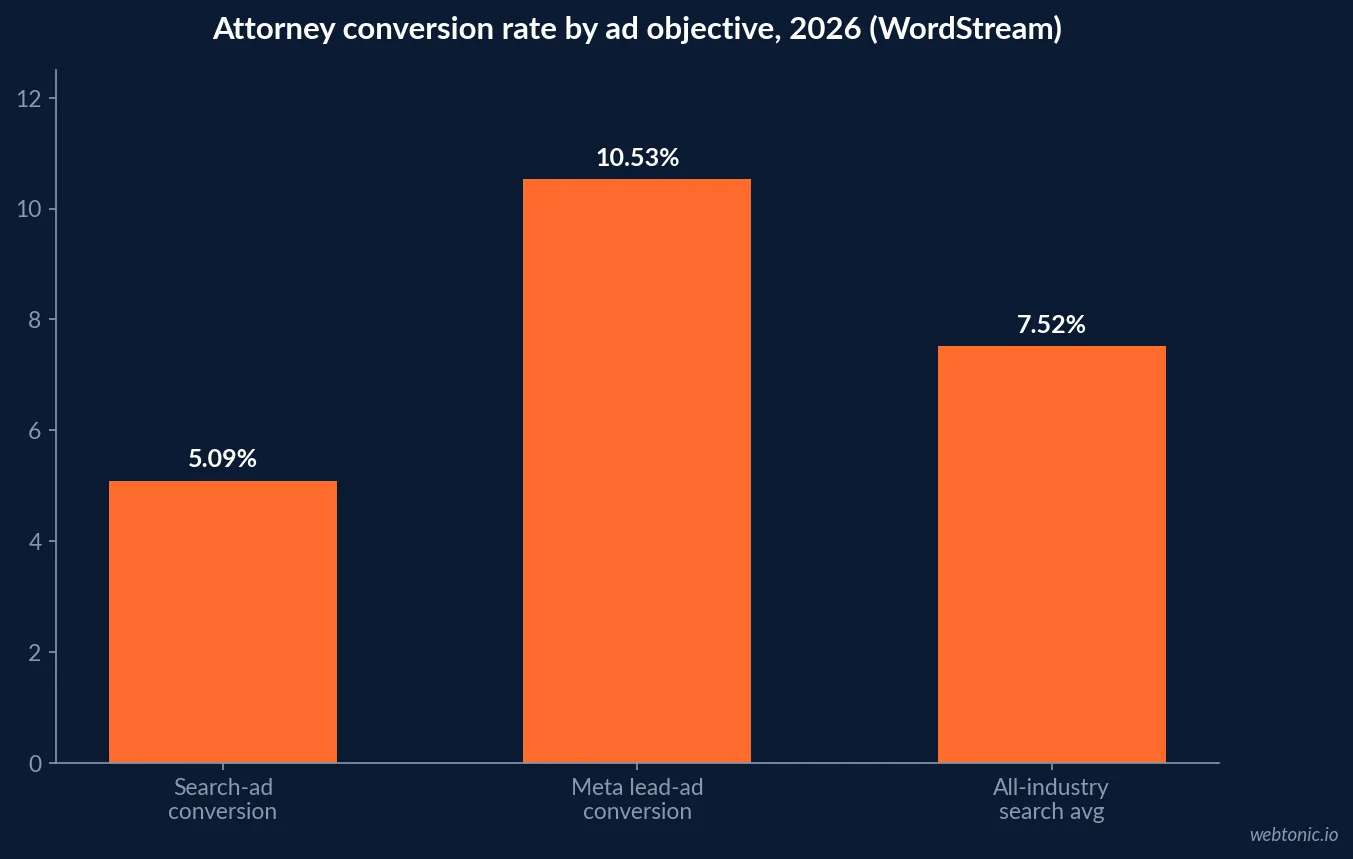
Two different objectives produce two different conversion numbers for the same industry, and a DUI page needs to know which one it is being measured against. WordStream's 2026 Conversion Rate Benchmarks report, built from over 13,000 search and social campaigns, splits Attorneys & Legal Services into a 5.09% search conversion rate and a 10.53% Meta lead-ad conversion rate - the lead-ad format wins because it removes the landing page from the equation entirely.
| Metric (Attorneys & Legal Services, 2026) | Value | Source |
|---|---|---|
| Search-ad conversion rate | 5.09% | WordStream 2026 Benchmarks |
| Meta lead-ad conversion rate | 10.53% | WordStream 2026 Benchmarks |
| Search cost per click | USD 9.87 | WordStream/LocaliQ 2026 Benchmarks |
| Search cost per lead | USD 131.63 | WordStream 2026 Benchmarks |
| Search click-through rate | 5.87% | WordStream/LocaliQ 2026 Benchmarks |
| All-industry search CVR (reference) | ~7.52% | WordStream 2026 Benchmarks |
Why a landing page loses to a lead-ad form on the same traffic
The 2x gap between 5.09% and 10.53% is not a fluke of one channel over another - it is the cost of the page itself. A Meta lead-ad form pre-fills contact details and never leaves the platform; a landing page has to load fast, load trust signals, and get a visitor who is often on a phone in a parking lot to a form before they bounce. Every extra second or extra form field on a DUI page is competing directly against a format that has already solved for zero-friction submission.
The fix most DUI sites skip is not a redesign, it is matching the lead-ad's speed with a landing page built around the same three fields a lead ad asks for: name, phone, and what happened.
| What consumers expect (2024-2026 data) | Figure | Source |
|---|---|---|
| Expect a response within 48 hours | 85% | Martindale-Avvo 2024 Legal Consumer Report |
| Expect a response within 24 hours | 40% | Martindale-Avvo 2024 Legal Consumer Report |
| Name slow response as top reason to leave | 55.2% | Martindale-Avvo 2024 Legal Consumer Report |
| Research an attorney further after finding via search | 93.3% | Martindale-Avvo 2024 Legal Consumer Report |
| Same, among people who went on to hire | 96.3% | Martindale-Avvo 2024 Legal Consumer Report |
What the page has to prove before the form matters
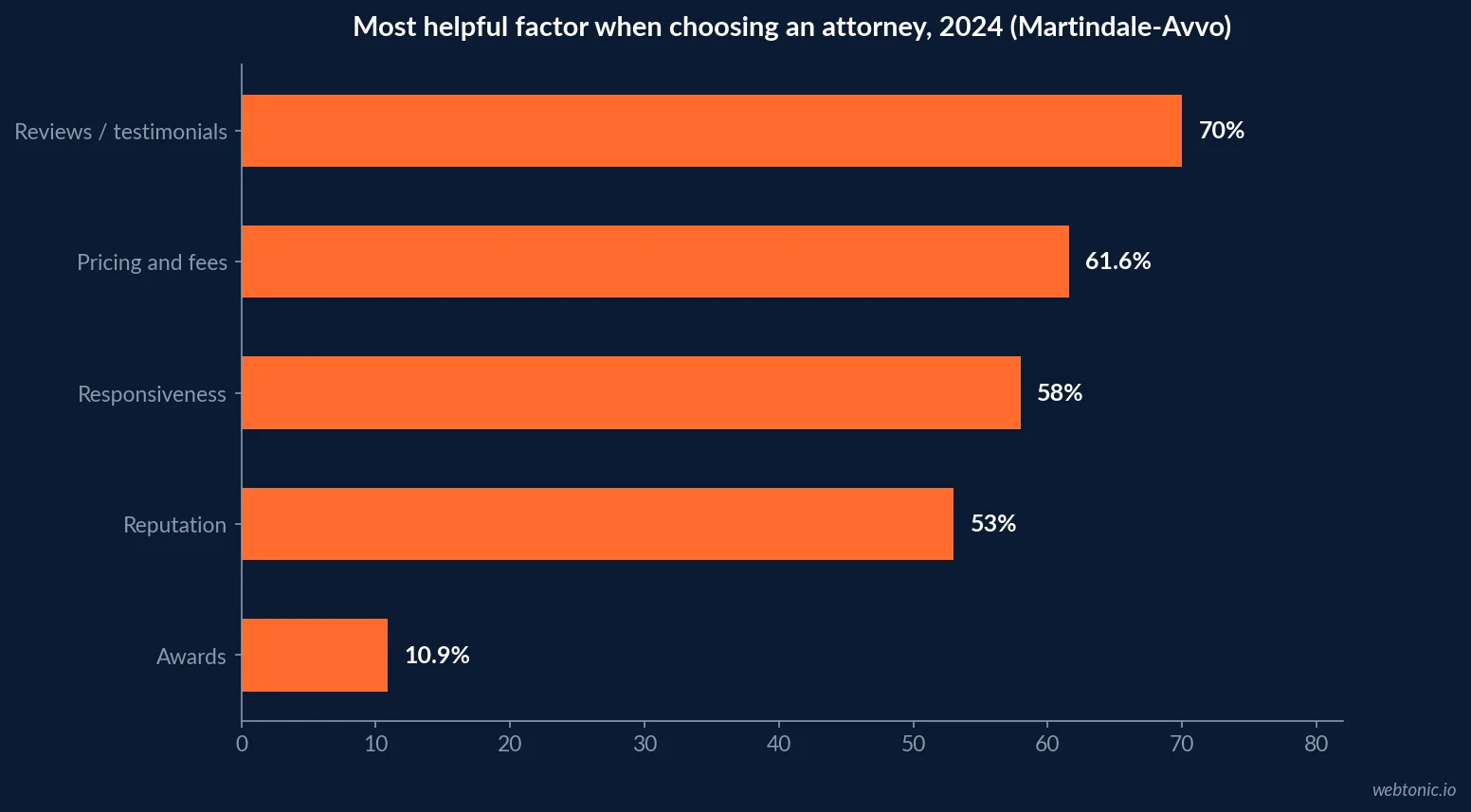
Martindale-Avvo's 2024 Legal Consumer Report, based on a survey of US consumers with recent legal needs, found that 92.4% of legal consumers research their issue online before hiring anyone, and that reviews are the single most helpful factor at nearly 70%, ahead of pricing and fees (61.6%), responsiveness (58.0%) and reputation (53.0%). Awards ranked far lower at 10.9%.
That ordering matters for page layout: a DUI landing page that leads with awards and bar badges before showing a single review or case outcome is optimizing for the factor consumers rank last.
| Most helpful factor when choosing an attorney | Share naming it | Source |
|---|---|---|
| Online reviews / testimonials | ~70% | Martindale-Avvo 2024 |
| Pricing and fees information | 61.6% | Martindale-Avvo 2024 |
| Responsiveness | 58.0% | Martindale-Avvo 2024 |
| Reputation | 53.0% | Martindale-Avvo 2024 |
| Awards and accolades | 10.9% | Martindale-Avvo 2024 |
The market this page is actually fighting for
The caseload behind DUI search traffic is large and unevenly distributed. The FBI's Uniform Crime Reporting Program recorded 687,396 total arrests for driving under the influence across the US in 2023, with California (100,483), Texas (60,177) and Pennsylvania (27,039) the three largest state totals. NHTSA's 2023 Traffic Safety Facts puts 12,429 people killed in alcohol-impaired-driving crashes that year - 30% of all US traffic fatalities and roughly one death every 42 minutes - which is the backdrop that makes DUI search intent skew toward same-day and next-day urgency rather than the weeks-long research cycle typical of other legal niches.
| State (2023 DUI arrests, FBI UCR) | Arrests | Share of US total |
|---|---|---|
| California | 100,483 | 14.62% |
| Texas | 60,177 | 8.75% |
| Pennsylvania | 27,039 | 3.93% |
| Washington | 23,495 | 3.42% |
| New York | 22,499 | 3.27% |
What growing legal practices do differently
Clio's 2025 Legal Trends Report found that 70% of people who recently hired a lawyer say it was easy to find and hire one, largely through referrals and search - which is the competitive bar a DUI page has to clear, not a low one. The same report found 24% of clients say they are unlikely to rehire their last lawyer, and that more than half of consumers now expect to look online for their next attorney rather than rely purely on a referral. A DUI defense practice competing on price alone in that market is competing against firms that already win on speed and trust signals instead.
| CRO checklist item | Why it matters (sourced) | Priority |
|---|---|---|
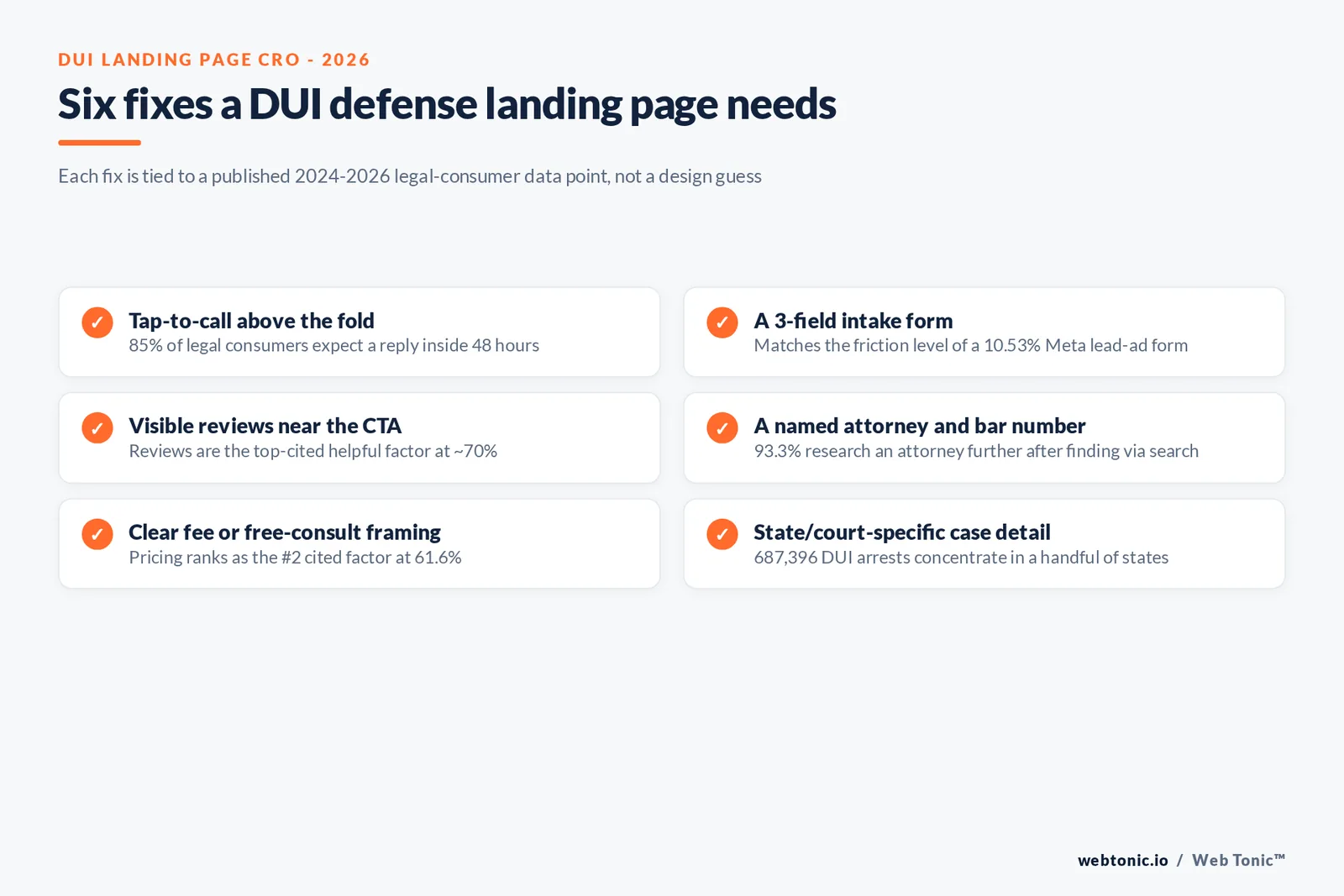
| Tap-to-call number above the fold | 85% expect a reply inside 48 hours; DUI has a court clock | High |
| 3-field intake form (name, phone, what happened) | Matches the friction of a 10.53% lead-ad form | High |
| Visible reviews near the CTA | Reviews are the top-cited helpful factor at ~70% | High |
| Named attorney + bar number | 93.3%-96.3% research further after finding via search | Medium |
| Clear fee structure or free consult framing | Pricing is the #2 cited factor at 61.6% | Medium |
| State/court-specific case detail (not generic copy) | 687k arrests are concentrated in a handful of states | Medium |
The all-industry number this page should not chase
It is tempting to benchmark a DUI landing page against the all-industry search click-through rate of 6.64% and all-industry search CPC of USD 5.42 that WordStream reports for 2026 - but Attorneys & Legal Services sits below both, at a 5.87% CTR and a USD 9.87 CPC. That gap is structural, not a sign of a broken page: legal clicks cost more because the traffic is scarcer and the intent is higher-value, and a DUI page judged against a restaurant's or a retailer's benchmark will always look like it is underperforming when it is not.
The state-level concentration in DUI arrest data reinforces the same point. NHTSA's 2023 data shows Hawaii at a 42% alcohol-impaired-driving fatality share and Texas at 40%, the two highest of any state, which means a firm operating in either market is competing for a proportionally larger and more urgent slice of search demand than the national 30% average implies.
| Legal vs. all-industry search benchmark (2026) | Attorneys & Legal Services | All-industry |
|---|---|---|
| Click-through rate | 5.87% | 6.64% |
| Cost per click | USD 9.87 | USD 5.42 |
| Search conversion rate | 5.09% | ~7.52% |
| Cost per lead | USD 131.63 | Varies; legal is among the highest verticals |
Compliance guardrails that shape what the page can say
None of the above overrides bar rules. ABA Model Rule 7.1 bars false or misleading communication about a lawyer's services, and most state bars extend that to prohibit guaranteed outcomes or comparisons that cannot be substantiated - both common temptations on a DUI landing page under pressure to convert. Rule 7.3 restrictions on solicitation also apply to how a form or chatbot can follow up with someone who has not yet retained the firm. A fast, benchmark-matching page and a compliant one are not in tension; the fixes above are about speed and trust signals, not about promising a result.
For the paid traffic feeding these pages, see our breakdown of what Google Ads actually costs by industry, or talk to us about auditing a DUI intake page against these benchmarks. Our performance creative team builds landing pages to the response-time expectations above, not just to a design brief.
Frequently Asked Questions
What conversion rate should a DUI defense landing page hit?
Use the legal-industry benchmark as the floor, not the ceiling. WordStream's 2026 data puts Attorneys & Legal Services at a 5.09% conversion rate on search ads and 10.53% on Meta lead ads, both well above the all-industry search average of roughly 7.52%. A DUI page that qualifies a real arrest, court date and county in the first form step should land inside or above that band; a generic "contact us" page usually sits below it.
Why does response time matter more on a DUI landing page than on most service pages?
Because the visitor already has a deadline. Martindale-Avvo's 2024 Legal Consumer Report finds that 85% of legal consumers expect a response within 48 hours and 40% expect one in under 24 hours, and "slow response" is the single most-cited reason (55.2%) consumers give for walking away from an attorney. A DUI arrest often carries a license-suspension clock and an arraignment date, so the same 48-hour patience most legal shoppers extend to a will or a lease rarely survives contact with a court calendar.
Do DUI defendants actually vet a firm before calling, or just grab the first result?
They vet first, then call. Martindale-Avvo reports that 93.3% of legal consumers who find an attorney through a search engine want to research that attorney further before deciding, rising to 96.3% among people who went on to hire someone. Reviews are the single most-cited helpful element at nearly 70%, ahead of pricing (61.6%), responsiveness (58.0%) and reputation (53.0%). A landing page without visible reviews, case-type detail and a named attorney is asking a skeptical visitor to skip the one step research says they will not skip.
Is a phone number or a form the better primary CTA for a DUI page?
Both, run in parallel, not either/or. Clio's 2025 Legal Trends Report finds 70% of people who recently hired a lawyer say it was easy to find and hire one, which means a DUI page is competing against firms that already clear that bar. A visible tap-to-call number handles the after-arrest, still-in-the-parking-lot visitor; a short form (arrest date, charge, court county) captures the researcher who is comparing options at 11 p.m. and is not ready to talk yet. Cutting either path costs one of those two visitors.
How big is the caseload actually feeding this landing page traffic?
Large and concentrated by state. The FBI's Uniform Crime Reporting Program recorded 687,396 total arrests for driving under the influence in the US in 2023, with California (100,483), Texas (60,177) and Pennsylvania (27,039) alone accounting for over a quarter of the national total. NHTSA's 2023 Traffic Safety Facts adds urgency to the search behavior behind that volume: 12,429 people were killed in alcohol-impaired-driving crashes that year, one every 42 minutes, which is also why DUI search traffic skews toward same-day intent.
Sources
WordStream - Conversion Rate Benchmarks for Your Industry, 2026
WordStream/LocaliQ - 2026 Google Ads Benchmarks report
Martindale-Avvo - Understanding the Legal Consumer Report, 2024
Clio - 2025 Legal Trends Report
FBI Crime Data Explorer - DUI arrests by state (UCR Arrest data), 2023
NHTSA - Traffic Safety Facts 2023: Alcohol-Impaired Driving
NHTSA - 2023 Summary of Motor Vehicle Traffic Crashes