Table of contents

No Google Ads benchmark isolates criminal DUI defense from the broader legal category, so this page uses WordStream/LocaliQ's 'Attorneys & Legal Services' vertical data - cross-practice by definition - and pairs it with NHTSA and MADD incident data to explain why legal search advertising stays this expensive. Every figure is labeled by the vertical it was actually measured on.
Key Takeaways
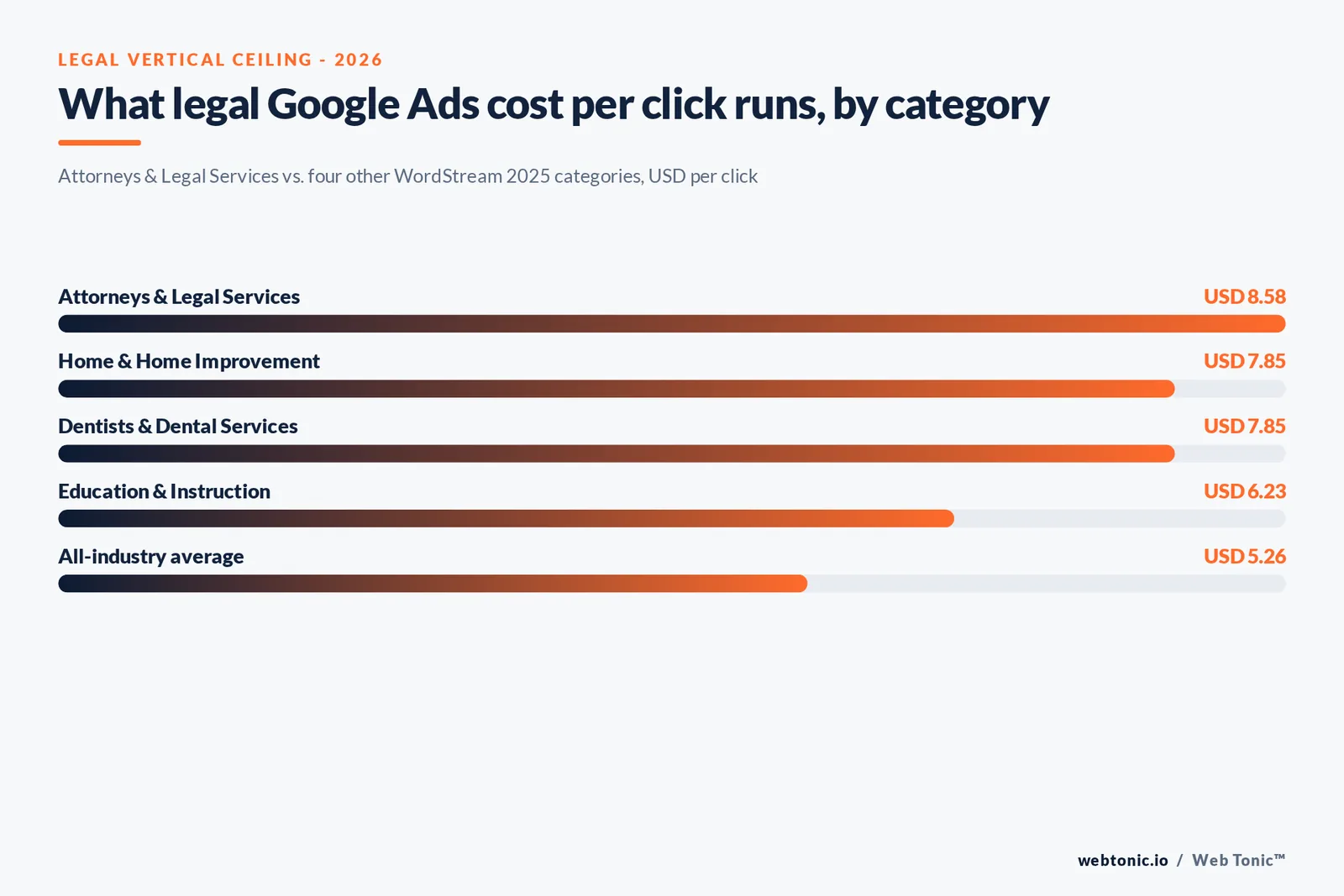
- Attorneys & Legal Services average cost per click is USD 8.58, the highest of any category WordStream tracks.
- That is 63% higher than the USD 5.26 all-industry average.
- Legal cost per lead runs USD 131.63, against a USD 70.11 all-industry average.
- Legal click-through rate is 5.97%, below the 6.66% all-industry figure.
- Legal CTR still grew 12.64% year over year, the third-largest gain WordStream tracked.
- Legal conversion rate is 5.09%, below the 7.52% all-industry average.
- Alcohol-impaired-driving fatalities fell to 11,904 in 2024, down 3.9% from 2023.
- Those crashes still caused 30% of all US traffic fatalities in 2023.
- One alcohol-impaired fatality occurred every 44 minutes in 2024.
- Criminal practice-area average lawyer hourly rate is USD 217, the lowest Clio tracks.
- Only 53% of law firms are confident in attribution or ROI measurement.
- High-performing legal marketers name paid search a critical channel at 63%, against 53% overall.
- Only 57% of firms plan to raise marketing budgets in 2026, down from 86% the year before.
- The median legal landing page converts at 6.3%, close to the 6.6% all-industry baseline.
- Legal Facebook leads-objective CPL fell 77% year over year to USD 18.17, far below search CPL.
Why the "legal" benchmark is the honest ceiling, not a DUI number
Every Google Ads benchmark report that covers law firms groups them into one "Attorneys & Legal Services" category. That means a DUI defense firm reading a legal-vertical CPL of USD 131.63 does not know whether personal injury's typically higher-value cases, or immigration's longer sales cycles, are pulling that average away from what a DUI-specific campaign would actually cost. This page treats every WordStream/LocaliQ figure as the legal-vertical ceiling to plan against, not a DUI-specific number.
The core Google Ads numbers
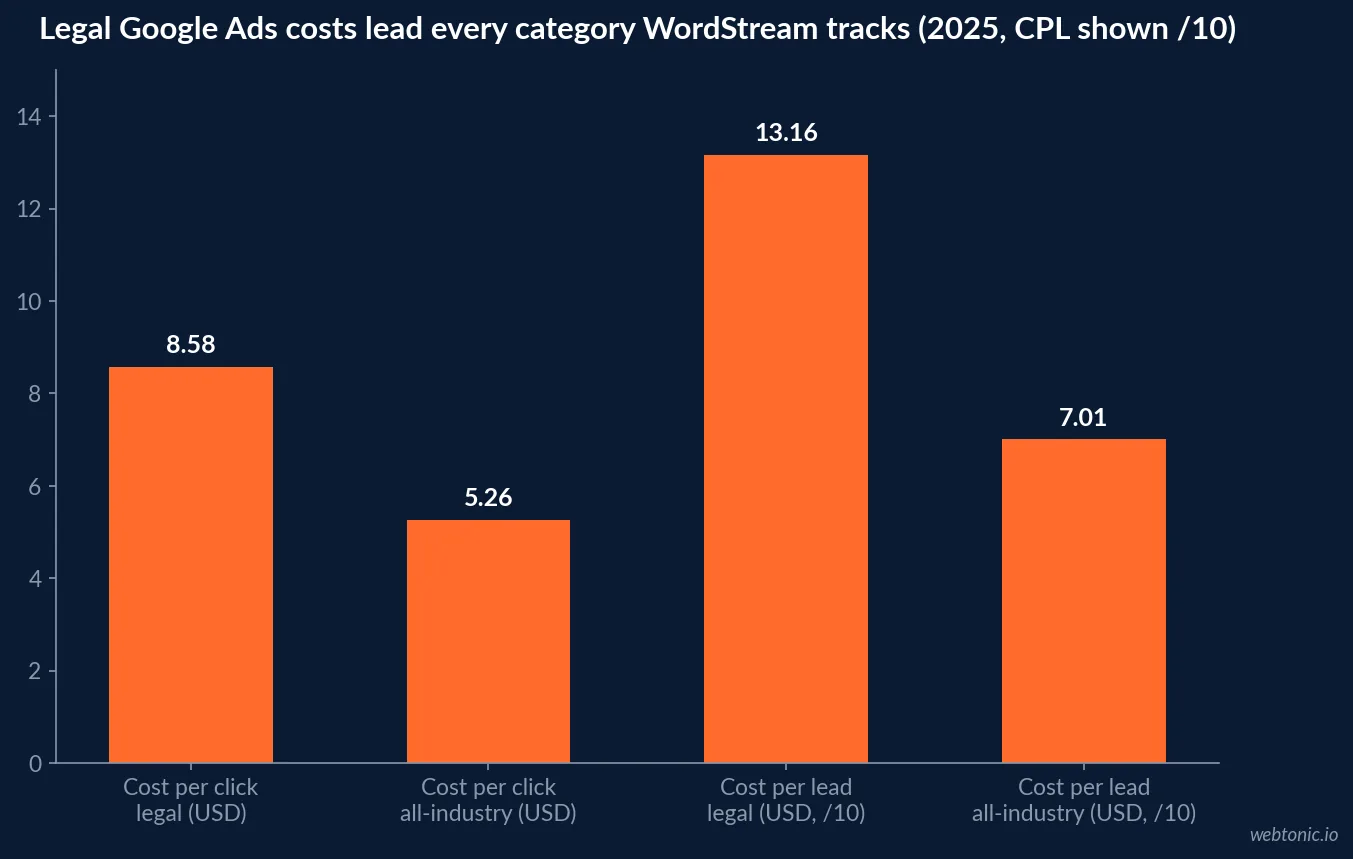
WordStream by LocaliQ's 2025 Google Ads Benchmarks report puts Attorneys & Legal Services cost per click at USD 8.58, the single highest figure in the entire report and 63% above the USD 5.26 all-industry average. Legal's click-through rate of 5.97% sits below the 6.66% average, but it grew 12.64% year over year, the third-largest increase WordStream measured behind shopping/collectibles/gifts and home improvement. Conversion rate lands at 5.09%, below the 7.52% average, which combines with the high CPC to produce a USD 131.63 cost per lead - 88% above the USD 70.11 all-industry figure and the highest CPL WordStream tracks for any category.
| Metric (Attorneys & Legal Services, WordStream 2025) | Legal vertical | All-industry average |
|---|---|---|
| Cost per click | USD 8.58 | USD 5.26 |
| Click-through rate | 5.97% | 6.66% |
| Click-through rate, YoY change | +12.64% | +3.74% |
| Conversion rate | 5.09% | 7.52% |
| Cost per lead | USD 131.63 | USD 70.11 |
Why the bid floor sits this high
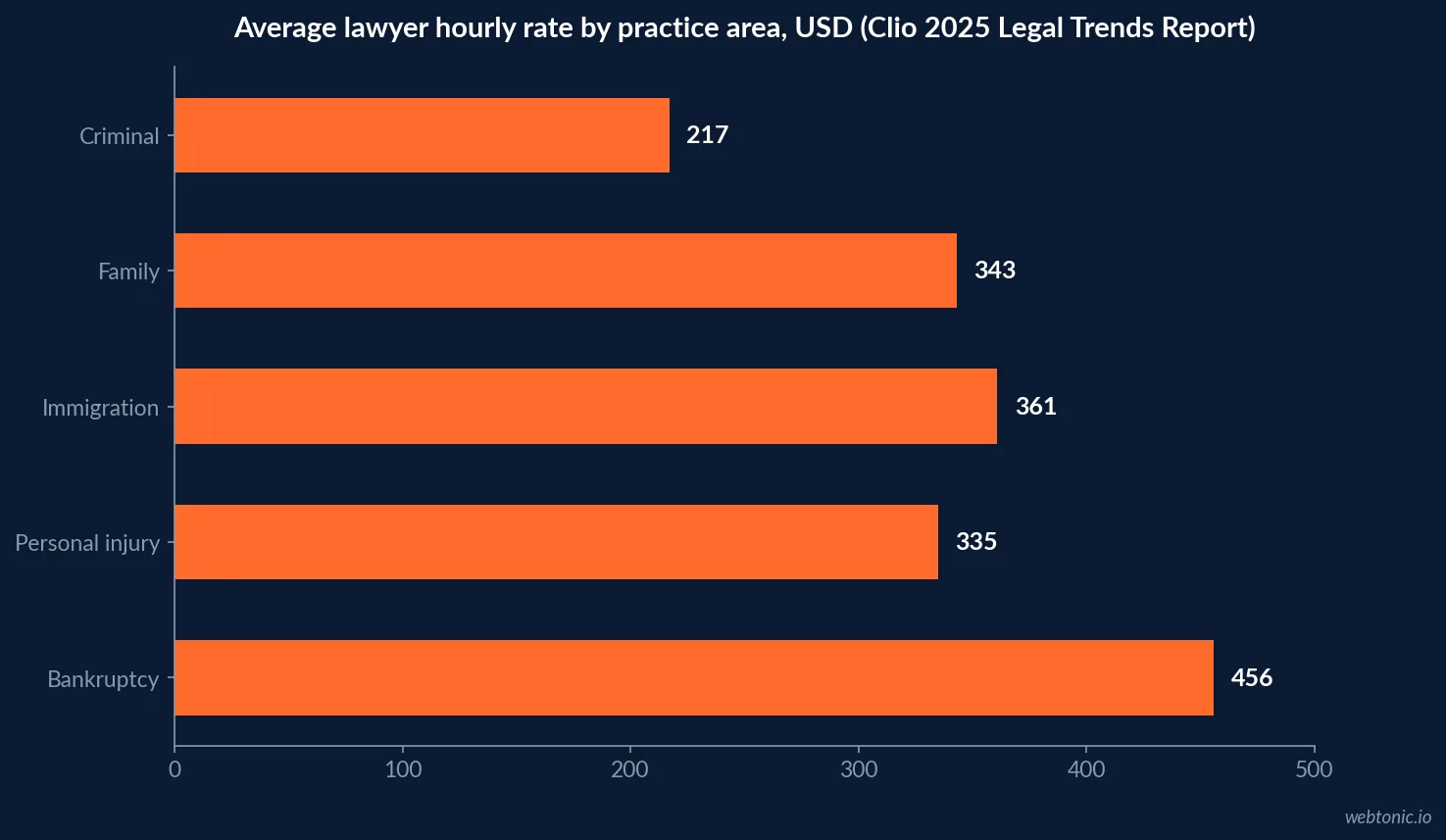
The standard explanation for legal's CPC ceiling is case value: a signed DUI or criminal defense retainer can be worth thousands of dollars, and Clio's 2025 Legal Trends Report puts the average criminal practice-area lawyer hourly rate at USD 217 - the lowest of the practice areas Clio tracks, notably below family law's USD 343 and immigration's USD 361, yet still high enough per case to sustain aggressive bidding once multiplied across a typical DUI matter's hours.
| Practice area vs. criminal (Clio 2025) | Avg. lawyer hourly rate | Premium over criminal |
|---|---|---|
| Criminal (baseline) | USD 217 | - |
| Family | USD 343 | +58% |
| Immigration | USD 361 | +66% |
The demand side: why the auction stays crowded
NHTSA's 2023 Traffic Safety Facts data recorded 12,429 alcohol-impaired-driving fatalities, representing 30% of all US traffic fatalities that year. 2024 data showed a 3.9% decline to 11,904 deaths, with one occurring every 44 minutes, a figure MADD's own statistics page confirms independently. Fatalities are a small fraction of total DUI incidents (most do not end in a fatal crash), but the trend they show - a large, only gradually shrinking incident base - explains why the search auction for DUI-related terms has stayed crowded even as overall crash numbers ease.
| NHTSA alcohol-impaired driving fatalities (US) | 2022 | 2023 | 2024 |
|---|---|---|---|
| Total fatalities | 13,458 | 12,429 | 11,904 |
| Year-over-year change | n/a | -7.6% | -3.9% |
| Share of all traffic fatalities | 31% | 30% | n/a |
What the Facebook comparison shows about channel mix
Search is not the only paid channel legal advertisers run, and the same WordStream/LocaliQ research family shows Facebook behaving very differently for the same "Attorneys & Legal Services" category. On the leads objective, legal Facebook ads convert at 10.53%, above the 7.72% all-industry average, and cost per lead sits at just USD 18.17 - a fraction of search's USD 131.63. That gap does not mean Facebook is simply "cheaper legal advertising"; it reflects a different intent stage, with search capturing people already looking for a DUI defense attorney and Facebook's leads objective often capturing people who have not started that search yet. Both channels showing up in a DUI defense media plan is normal; treating their costs as interchangeable is the mistake the data argues against.
| Channel comparison, Attorneys & Legal Services (2025) | Google search | Facebook leads objective |
|---|---|---|
| Cost per click | USD 8.58 | USD 4.10 |
| Conversion rate | 5.09% | 10.53% |
| Cost per lead | USD 131.63 | USD 18.17 |
Where firms with better tracking pull ahead
CallRail's 2026 Legal Marketing Outlook Report found that firms in its "growing" cohort name paid search a critical channel for new business at 63%, against 53% for firms overall - the clearest evidence in this data that firms treating paid search as core infrastructure, rather than a side experiment, get more from the same CPC. The same report found only 53% of firms overall are confident in attribution or ROI measurement, which likely explains part of the gap: a firm that cannot attribute which search term produced a signed case will systematically underinvest in the ones that actually work.
Budget conditions are also cooling industrywide: only 57% of firms plan to raise marketing budgets in 2026, down from 86% a year earlier, which makes attribution discipline more valuable, not less, heading into next year.
| CallRail 2026 finding | Growing firms | All firms |
|---|---|---|
| Name paid search a critical new-business channel | 63% | 53% |
| Confident in attribution/ROI measurement | n/a (measured overall) | 53% |
| Plan to raise 2026 marketing budgets | n/a (measured overall) | 57% |
What a DUI defense firm should actually budget against
Absent a DUI-specific figure, the defensible plan is to budget against the legal-vertical ceiling - USD 8.58 CPC, USD 131.63 CPL - while tracking each campaign's real cost per signed case against that number rather than assuming it. A landing page converting below Unbounce's 6.3% legal median is a fixable gap that directly lowers effective CPL without touching the bid. Our complete Google Ads pricing guide breaks down the same cost mechanics for other high-CPC verticals, and our growth marketing team can model what a realistic DUI-specific CPL looks like once your own call-tracking data exists to build it from.
On the compliance side, every legal-services Google Ads account is bound by Google's Misrepresentation policy against misleading claims about qualifications or results, plus the general requirement to comply with local advertising law in every location targeted - talk to us if you need that reviewed before launch.
A media-plan checklist before the next budget cycle
- Budget against the legal-vertical ceiling - USD 8.58 CPC, USD 131.63 CPL - as the number to beat, not the number to expect automatically.
- Track cost per signed retainer, not cost per lead, since a criminal practice-area case's real value depends on hours billed at roughly USD 217, per Clio, not on the lead's raw cost.
- Run Facebook's leads objective alongside search rather than as a replacement, given the intent-stage difference between the two channels' cost profiles above.
- Fix the landing page before cutting the bid, since a page converting below Unbounce's 6.3% legal median inflates effective CPL more than most bid adjustments would fix.
- Re-check attribution setup before scaling spend, since only 53% of firms in CallRail's survey are confident in this today, and scaling an unmeasured channel compounds the blind spot.
None of these five steps require a DUI-specific study to execute - they only require applying the legal-vertical ceiling honestly instead of guessing at a number nobody has published.
Frequently Asked Questions
Is there a Google Ads benchmark specific to DUI defense, or only to legal generally?
Only to legal generally. WordStream by LocaliQ's Google Ads Benchmarks report tracks an 'Attorneys & Legal Services' category that combines DUI defense, criminal defense, personal injury, family law, immigration and every other legal specialty into one set of figures. No public report isolates DUI defense Google Ads performance on its own, so every number below is the legal-vertical average, labeled as such.
What does a legal-vertical Google Ads lead actually cost?
WordStream's 2025 data puts the Attorneys & Legal Services average cost per lead at USD 131.63, against a USD 70.11 all-industry average - the highest cost per lead of any category the report tracks. That reflects a USD 8.58 average cost per click, also the highest tracked, combined with a 5.09% conversion rate that sits below the 7.52% all-industry average.
Why is legal cost per click the highest of any industry WordStream tracks?
The report does not isolate the cause, but a lifetime-value argument is the standard explanation: a single signed DUI or criminal defense case can be worth thousands of dollars in fees, which supports far higher bids than a lower-value transaction, pushing the auction price up for every advertiser in the category regardless of practice area.
Is DUI-related search demand actually growing?
Search demand and incident volume are not the same thing, and no public report tracks DUI-specific query volume directly. What NHTSA and MADD do show is that alcohol-impaired-driving fatalities, a proxy for how many DUI cases exist to be searched for, fell from 12,429 in 2023 to 11,904 in 2024 - a 3.9% decline - while still representing 30% of all US traffic fatalities. The incident base generating DUI search demand is large and only gradually shrinking.
What legal compliance rules apply specifically to Google Ads for DUI defense?
The same rules that apply to any legal-services Google Ads account: advertisers must comply with the advertising laws of every location they target, and Google's Misrepresentation policy bars misleading claims about qualifications, affiliations or results. Firms running Local Services Ads alongside search campaigns also go through Google's license, insurance and business-registration screening process before those ads can appear at all.
Sources
WordStream by LocaliQ - 2025 Google Ads Benchmarks
NHTSA - Traffic Safety Facts 2023 Data: Alcohol-Impaired Driving
NHTSA - Traffic Safety Facts 2024 Data: Alcohol-Impaired Driving
MADD - Drunk Driving Statistics
Clio - 2025 Legal Trends Report
CallRail - 2026 Legal Marketing Outlook Report
Unbounce - Legal industry conversion rate benchmarks
Google Ads Policies Help - Misrepresentation policy