Table of contents
Creating content that drives results requires a repeatable process — not just writing talent. In 2026, 94% of marketing teams use AI in their content creation process, yet the fundamentals remain unchanged: research your audience, plan strategically, produce with quality, and distribute with intent.
Key Takeaways
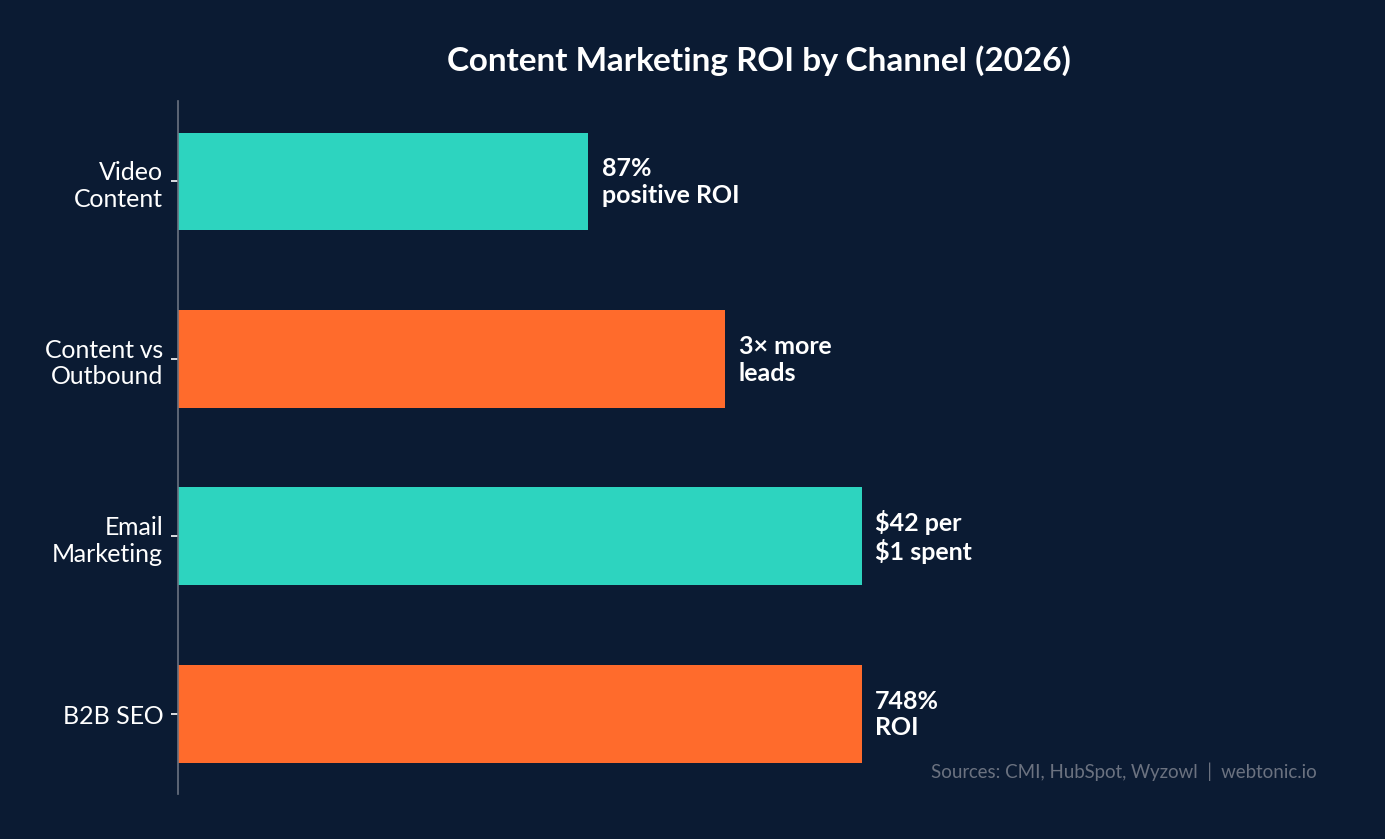
- Content marketing generates 3× more leads than outbound marketing and costs 62% less per lead (Content Marketing Institute, 2026).
- 94% of marketing teams now use AI for content creation, making it the standard rather than the exception (CMI, 2026).
- 207 million people worldwide identify as content creators in 2026, and the global creator economy has surpassed $250 billion (Marketful).
- B2B SEO delivers an average ROI of 748%, making content-led organic search the highest-returning channel (HubSpot, 2026).
- 72% of marketers plan to increase their content budgets in 2026 (HubSpot).
- Email marketing returns $42 for every $1 spent, making it the highest-ROI distribution channel for content.
- 87% of businesses report positive ROI from video content (Wyzowl, 2026).
- 58% of B2B marketers rate their content strategy as only "moderately effective" — nearly half lack clear goals.
- Short-form video leads ROI for 49% of marketers, but long-form content drives deeper loyalty and B2B conversion.
- Companies that lead with organic content see blended CAC 60% lower than paid-heavy peers.
What Does It Mean to Create Content?
To create content is to plan, produce, and distribute valuable information — articles, videos, social media posts, podcasts, infographics, or emails — that attracts and retains a defined audience. Content creation is the engine of content marketing, turning expertise into assets that generate traffic, leads, and revenue.
The content creation process has evolved beyond writing blog posts. Modern creating content involves strategic planning, audience research, multi-format production, SEO optimization, and performance measurement. In 2026, successful content creators treat each piece as a business asset with measurable ROI — not a creative exercise disconnected from growth goals.
The scale of the opportunity is enormous. There are 207 million content creators worldwide, and the creator economy exceeds $250 billion. For businesses, content marketing generates 6× more conversions than other methods for the same traffic volume — but only when the creation process is disciplined and goal-driven.
The Content Creation Process: Step by Step
Every high-performing content team follows a structured content creation process. While frameworks range from 4 to 17 stages, they all converge on six core activities. Here is the practical workflow that separates content that ranks from content that fills a calendar:
| Stage | What You Do | Key Output | Common Mistake |
|---|---|---|---|
| 1. Goal Setting | Define a measurable goal per content piece | Content brief with KPI, persona, and CTA | Creating content without a clear purpose |
| 2. Audience Research | Map audience needs, intent, and search behavior | Topic list tied to user intent stages | Writing what you want vs. what users search |
| 3. Content Brief | Outline keyword, format, tone, data points, and CTA | Complete brief with all requirements | Skipping the brief and creating rework |
| 4. Production | Write, design, film, or record the content | Draft content piece in target format | Context-switching between formats |
| 5. Optimization | SEO, readability, brand voice, and QA review | Publish-ready content with meta tags | Publishing without optimization |
| 6. Distribution | Publish and distribute across owned and earned channels | Content live + promotion schedule | Publishing without a distribution plan |
Stage 1: Set Goals Before You Create
The single most common reason content fails is that it was created without a measurable goal. 58% of B2B marketers rate their content strategy as only "moderately effective" — and nearly half report no clear goals for individual pieces. Before you open a document, define: what is this content piece supposed to achieve (traffic, leads, authority, engagement)? How will you measure success? Who is the audience?
A complete content brief includes the target keyword, audience persona and funnel stage, content goal, format and channel, tone guidance, required data points, and conversion CTA. Missing any of these creates rework after the draft is written.
Stage 2: Research Your Audience and Topics
Good content starts with understanding what your audience actually needs — not what you think they want. Keyword research, competitor analysis, and social listening reveal the questions your audience is asking, the language they use, and the gaps in existing content. Tools help, but the real skill is connecting search intent to business goals.
Map each topic to a funnel stage: awareness (informational queries), consideration (comparison queries), or decision (transactional queries). This ensures your content creation process produces assets for every stage of the buyer journey — not just top-of-funnel blog posts.
Stage 3: Build a Content Brief
The content brief is the bridge between strategy and production. It specifies the keyword, target word count, required sections, data points to include, internal links, and the call-to-action. High-quality briefs reduce revision cycles by 40–60% because the creator starts with clear direction instead of guessing.
Stage 4: Produce the Content
Production is where AI content creation tools have changed the game. 94% of marketing teams now use AI for drafting, outlining, or repurposing content. However, AI-assisted content creation reduces production time by 75–85% for first drafts while requiring human editing for accuracy, voice, and strategic depth.
Content batching — grouping similar creation tasks into focused sessions — improves both quality and productivity. Instead of writing one social media post per day, batch all posts for the week in one session. This minimizes context switching and keeps you in a state of flow.
Stage 5: Optimize for Search and Readability
Optimization transforms a draft into a discoverable asset. Best practices for content optimization include targeting one primary keyword per piece, using semantic variations naturally, structuring with H2/H3 headers for scannability, and optimizing meta titles (40–60 characters) and descriptions (120–155 characters). Internal linking connects the piece to your broader content ecosystem.
Stage 6: Distribute and Promote
Publishing content without a distribution plan is like opening a store with no sign. Effective distribution uses owned channels (email, social media, website), earned channels (guest posts, PR, social shares), and paid amplification when ROI justifies it. Email marketing returns $42 per $1 spent, making it the highest-ROI distribution channel for most businesses. Short-form video leads ROI for 49% of marketers, while long-form video and email drive deeper B2B conversion.

Content Creation Tools and Resources
The right design tools help content creators maintain brand consistency, stay productive, and scale output without sacrificing quality. Here are the essential tools by category:
| Category | Top Tools | Best For |
|---|---|---|
| Writing & AI | ChatGPT, Jasper, Grammarly, Hemingway | Drafting, editing, tone, grammar |
| Design Tools | Canva, Figma, Adobe Express | Social graphics, infographics, brand kits with fonts and colors |
| Video | CapCut, Descript, Riverside | Short-form video, podcasts, YouTube content |
| SEO | Ahrefs, Semrush, Surfer SEO | Keyword research, content optimization |
| Social Media | Buffer, Later, Hootsuite | Scheduling, analytics, multi-platform management |
| Project Management | Notion, Trello, Asana, ClickUp | Content calendars, team workflows, briefs |
Whether you are a solo content creator building a personal brand or a marketing team scaling content production, the tools you choose shape your output quality. The best content creation tools integrate with your workflow — from design tools that help maintain brand kits with custom fonts and colors, to social media scheduling tools that let you create content once and distribute it across every platform. Learning to use these creation tools efficiently is what separates productive content creators from those drowning in half-finished drafts.
The best content creation tools integrate with your existing stack. A design tool like Canva lets teams maintain brand kits with consistent fonts and colors in templates — so every piece of social media content stays on brand. The key is choosing tools that reduce friction in your content creation process rather than adding complexity.


Creating Content for Social Media
Social media content requires a different creation process than long-form articles. Each platform has unique content formats, audience expectations, and algorithm preferences that content creators must learn to navigate. Instagram favors visual storytelling and short-form video, YouTube rewards watch time and subscriber engagement, and LinkedIn prioritizes professional insights and thought leadership.
The most effective social media content creation strategy starts with platform-native design. Use design tools like Canva or Adobe Express to maintain brand kits with consistent fonts and colors in templates across every post. Content creators who stay on brand across platforms build recognition faster and earn higher engagement rates.
Key best practices for creating content on social media:
- Adapt the format to the platform. A blog post becomes carousel slides on Instagram, a thread on X, a short video on YouTube, and a document post on LinkedIn. Content creation tools help automate this repurposing.
- Prioritize user generated content. Encourage users to create content featuring your brand. User generated content builds trust, provides free media assets, and creates community engagement that no amount of branded content can replicate.
- Use templates for speed. Pre-built templates storing your brand's fonts, colors, and design elements let content creators produce high quality posts in minutes rather than hours. Design tools that support brand kits make this scalable across team members.
- Learn from analytics. Track which content types, topics, and posting times generate the highest engagement. The creation process should be informed by data, not guesswork.
Content Creation Best Practices for 2026
The landscape for creating content has shifted dramatically. Here are the best practices that separate high-quality content from noise:
- Start with user intent, not keywords. Keywords guide discoverability, but intent determines whether the content satisfies the reader. Every piece should answer a specific question or solve a specific problem.
- Repurpose systematically. One long-form article can become 5–10 social media content pieces, a newsletter section, a video script, and an infographic. Design for repurposing from the start to maximize the ROI of every content creation effort.
- Use AI as an accelerator, not a replacement. AI handles research, outlines, and first drafts. Humans add strategic depth, original insights, and brand voice. The best content comes from human-AI collaboration, not full automation.
- Invest in user-generated content. User generated content (UGC) builds trust because it comes from peers, not brands. Encourage reviews, testimonials, and community contributions as part of your content strategy.
- Measure content performance consistently. Track pageviews, time on page, conversion rate, and revenue attribution per content piece. Content that is not measured cannot be improved — and teams that measure content performance outperform those that publish blindly.
- Maintain a content calendar. A content calendar prevents gaps, ensures topical coverage across all funnel stages, and keeps the team accountable. Build it monthly, review weekly, and adjust based on performance data and trending opportunities.
Frequently Asked Questions
How do I start creating content?
Start by defining your audience, choosing 2–3 content formats you can produce consistently (blog posts, short-form video, social media posts), and creating a simple content calendar. Research 10–15 topics your audience searches for using free tools like Google Keyword Planner or AnswerThePublic. Write your first piece with a clear goal, optimize it for search, and distribute it on the channels where your audience spends time. Consistency matters more than perfection — publish regularly and improve with each piece.
What is the best content creation tool for beginners?
For beginners, Canva (design), Grammarly (writing quality), and a project management tool like Notion or Trello (planning) cover the essentials. These tools are free or affordable, easy to learn, and handle the core content creation process: plan, produce, and organize. As you scale, add SEO tools like Ahrefs or Semrush and scheduling tools like Buffer for social media content distribution.
How often should I create content?
Quality matters more than frequency, but consistency is essential. For most businesses, publishing 2–4 blog posts per month and 3–5 social media posts per week provides enough volume to build authority without sacrificing quality. HubSpot data shows that companies publishing 16+ blog posts per month get 3.5× more traffic than those publishing 0–4 — but only if every piece is high quality and strategically targeted.
What is user-generated content and why does it matter?
User generated content (UGC) is any content — reviews, photos, videos, testimonials — created by customers or community members rather than the brand. It matters because consumers trust peer recommendations more than brand messaging. UGC increases conversion rates by up to 29% and provides authentic social proof that no amount of branded content can replicate. Encourage UGC by creating shareable moments, running contests, and featuring customer stories on your channels.
How does AI change the content creation process?
AI accelerates research, outlining, and first-draft production by 75–85% while introducing risks around accuracy, originality, and brand voice. The most effective approach is human-AI collaboration: let AI handle repetitive tasks (topic research, draft generation, headline variations) while humans contribute strategic thinking, original insights, and editorial judgment. In 2026, 94% of marketing teams use AI as part of their content creation workflow, but the teams that produce the best content still rely on human expertise for final quality.
How do content creators make money on YouTube?
Content creators on YouTube create content through multiple revenue streams: ad revenue from the YouTube Partner Program (requiring 1,000 subscribers and 4,000 watch hours), sponsorship deals, merchandise, membership subscriptions, and affiliate marketing. The most successful YouTube content creators build a content creation process around consistent upload schedules, searchable topics, and high quality production. YouTube rewards creators who keep viewers on the platform longer, so learning to structure content for watch time retention is the single most impactful skill a content creator can develop.
Sources
marketful.com/content-creation
toolfountain.com/content-marketing-statistics
rankyak.com/blog/content-creation-best-practices
zernio.com/blog/content-creation-workflow
clickup.com/blog/content-batching
later.com/blog/content-creation