Table of contents
Cost per impression measures what you pay each time your ad is displayed to a user — and understanding this metric determines whether your advertising budget generates awareness or gets wasted on invisible placements. Below you will find the complete breakdown of how cost per impression works, how to calculate it, and current benchmarks across every major platform.
Key Takeaways
- Cost per impression is expressed as CPM (cost per mille), meaning the cost per 1,000 impressions. The standard formula is CPM = (Total Ad Spend ÷ Total Impressions) × 1,000.
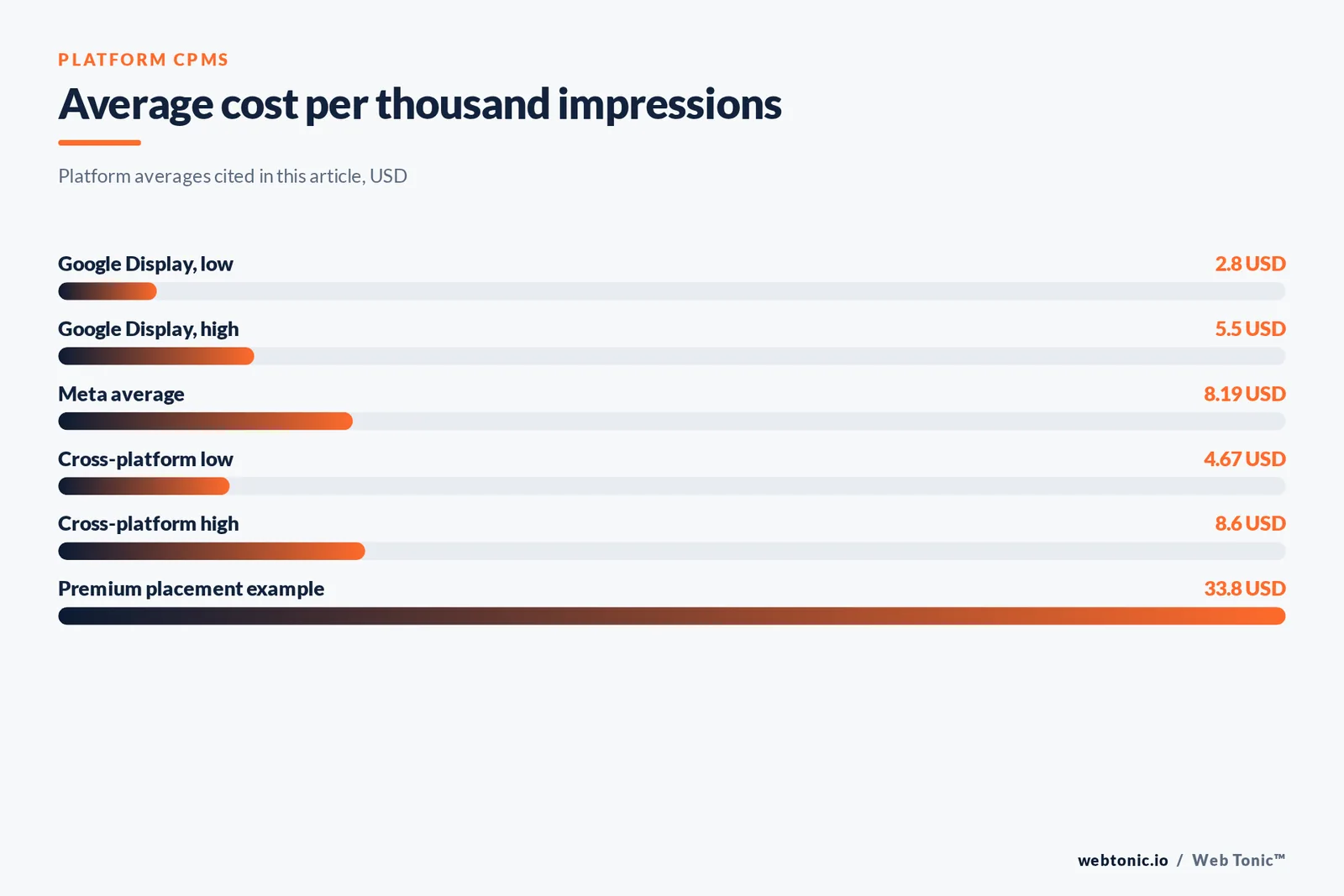
- The average CPM across digital advertising platforms ranges from $4.67 to $8.60 in 2025, with TikTok at the low end ($4.82) and Snapchat at the high end ($8.60).
- Google Display Network CPMs average $2.80–$5.50, making it one of the most cost-effective channels for impression-based awareness campaigns.
- Meta (Facebook and Instagram) CPMs average $8.19, though industry-specific CPMs range from $3.50 for entertainment to $28.50 for finance.
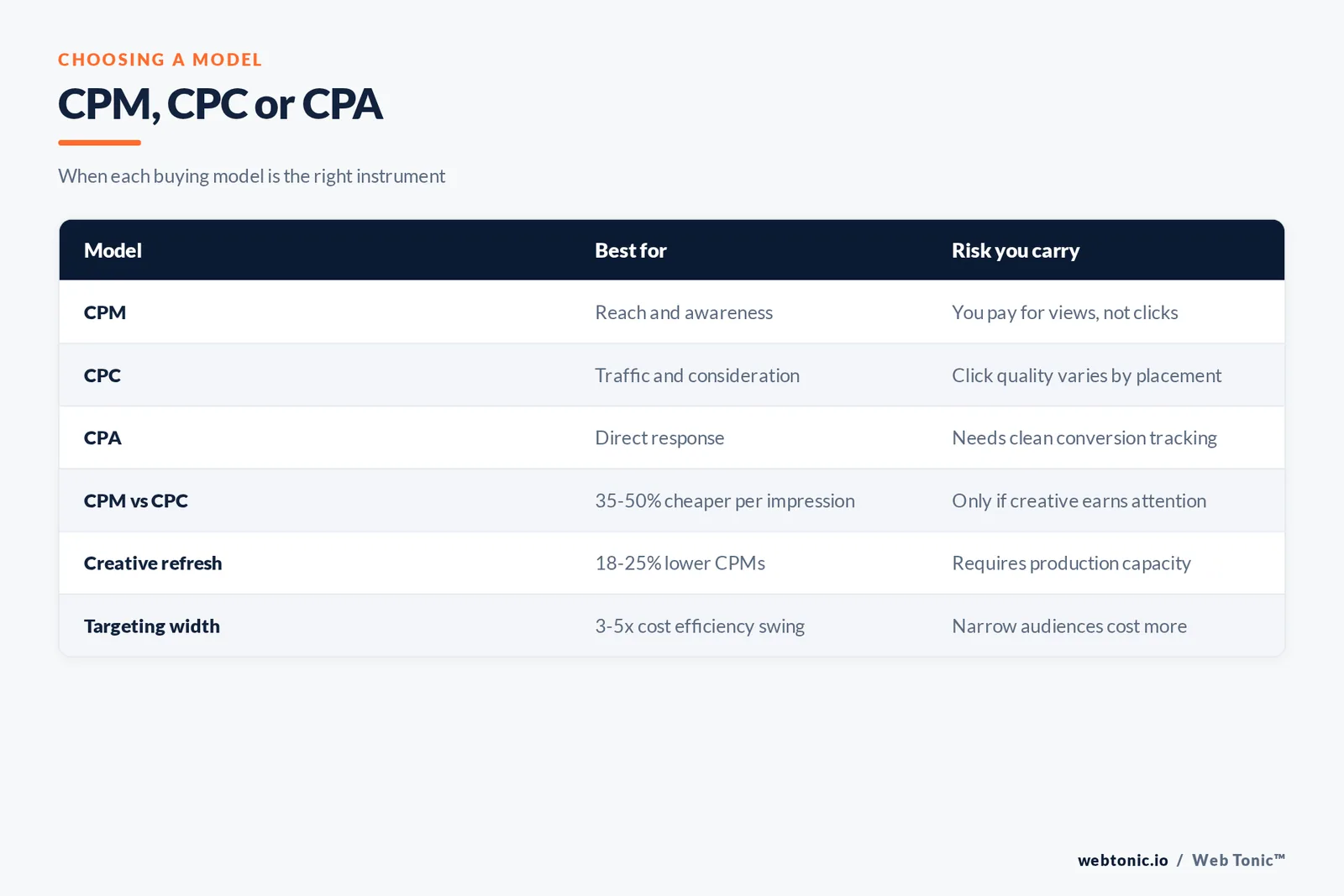
- CPM bidding is 35–50% cheaper per impression than CPC bidding for brand awareness campaigns, because you avoid the click-bid premium inherent in performance-focused auctions.
- Advertisers who optimize creative refresh cycles reduce CPMs by 18–25% by combating audience fatigue — the single biggest driver of rising impression costs over time.
Every digital advertising campaign begins with an impression — a single instance of your ad appearing on a user's screen. Whether you run Google Display ads, social media campaigns, or programmatic placements, cost per impression determines how far your budget stretches for reach and visibility. The metric matters most for top-of-funnel brand awareness where the goal is maximum exposure, not immediate clicks. At Web Tonic, we manage impression-based campaigns across multiple platforms and the difference between a well-optimized CPM strategy and a wasteful one can be 3–5x in cost efficiency. This guide covers everything from the basic formula to advanced optimization tactics.
What Is Cost Per Impression
Cost per impression (CPI) is the price an advertiser pays for a single ad impression — one view of an ad by one user. In practice, advertisers rarely discuss individual impressions because the numbers are too large. Instead, the industry standard metric is CPM (cost per mille), which represents the cost per 1,000 impressions. The word "mille" comes from the Latin word for thousand.
An impression is counted each time an ad is served to a user's device, regardless of whether the user interacts with it. This differs fundamentally from a cost per click (CPC) model, where you pay only when someone clicks, and a cost per acquisition (CPA) model, where you pay only when someone converts. According to industry definitions, CPM has been the standard media buying metric since the early days of print advertising and remains the dominant pricing model for display, video, and programmatic advertising.
The distinction matters for budget planning. If a platform charges a $10 CPM, you pay $10 for every 1,000 times your ad appears. A campaign with a $5,000 budget at that CPM would generate 500,000 impressions — regardless of whether anyone clicks or converts. This makes CPM pricing ideal for awareness goals but potentially wasteful for performance campaigns where conversions are the primary objective.
How to Calculate Cost Per Impression
The cost per impression formula is straightforward. According to Rule1's CPM formula guide, the calculation works in three directions depending on which variable you need to solve for:
| What You Need | Formula | Example |
|---|---|---|
| CPM | CPM = (Ad Spend ÷ Impressions) × 1,000 | ($500 ÷ 125,000) × 1,000 = $4.00 CPM |
| Total Cost | Cost = (CPM × Impressions) ÷ 1,000 | ($8.00 × 500,000) ÷ 1,000 = $4,000 total |
| Impressions | Impressions = (Ad Spend ÷ CPM) × 1,000 | ($3,000 ÷ $6.00) × 1,000 = 500,000 impressions |
| Single CPI | CPI = Ad Spend ÷ Total Impressions | $500 ÷ 125,000 = $0.004 per impression |
The single cost per impression (CPI) for most digital campaigns falls between $0.003 and $0.03 — fractions of a cent that only become meaningful at scale. This is why the industry uses CPM: it transforms unwieldy decimals into actionable dollar figures that can be compared across campaigns, platforms, and industries.
When analyzing campaign performance, always compare CPM against effective CPM (eCPM). The eCPM normalizes costs across different pricing models — if you pay CPC but want to understand your impression efficiency, calculate eCPM = (Total Spend ÷ Total Impressions) × 1,000. This allows apples-to-apples comparison between a $2.50 CPC campaign generating 100 impressions per click (eCPM = $25) and a direct $8 CPM buy.
Average Cost Per Impression by Platform
CPM rates vary dramatically across advertising platforms due to differences in audience quality, ad format, competition density, and targeting precision. The table below summarizes current average CPMs from Gupta Media's 2025 social advertising report and CalculateCPM's benchmark data.
| Platform | Average CPM | CPM Range | Best For |
|---|---|---|---|
| Google Display Network | $3.12 | $0.50–$8.00 | Broad reach, remarketing, cost-efficient awareness |
| Meta (Facebook + Instagram) | $8.19 | $3.50–$28.50 | Targeted social awareness, lookalike audiences |
| TikTok | $4.82 | $2.00–$12.00 | Gen Z and millennial reach, video-first campaigns |
| YouTube | $4.99 | $2.50–$15.00 | Video awareness, brand consideration, storytelling |
| Snapchat | $8.60 | $4.00–$18.00 | Young audience reach, AR/interactive formats |
| $4.67 | $2.00–$10.00 | Purchase-intent audiences, visual discovery | |
| $33.80 | $15.00–$65.00 | B2B audience targeting, professional reach | |
| Programmatic (DSP) | $1.50–$4.00 | $0.30–$12.00 | Scale reach, retargeting, open web inventory |
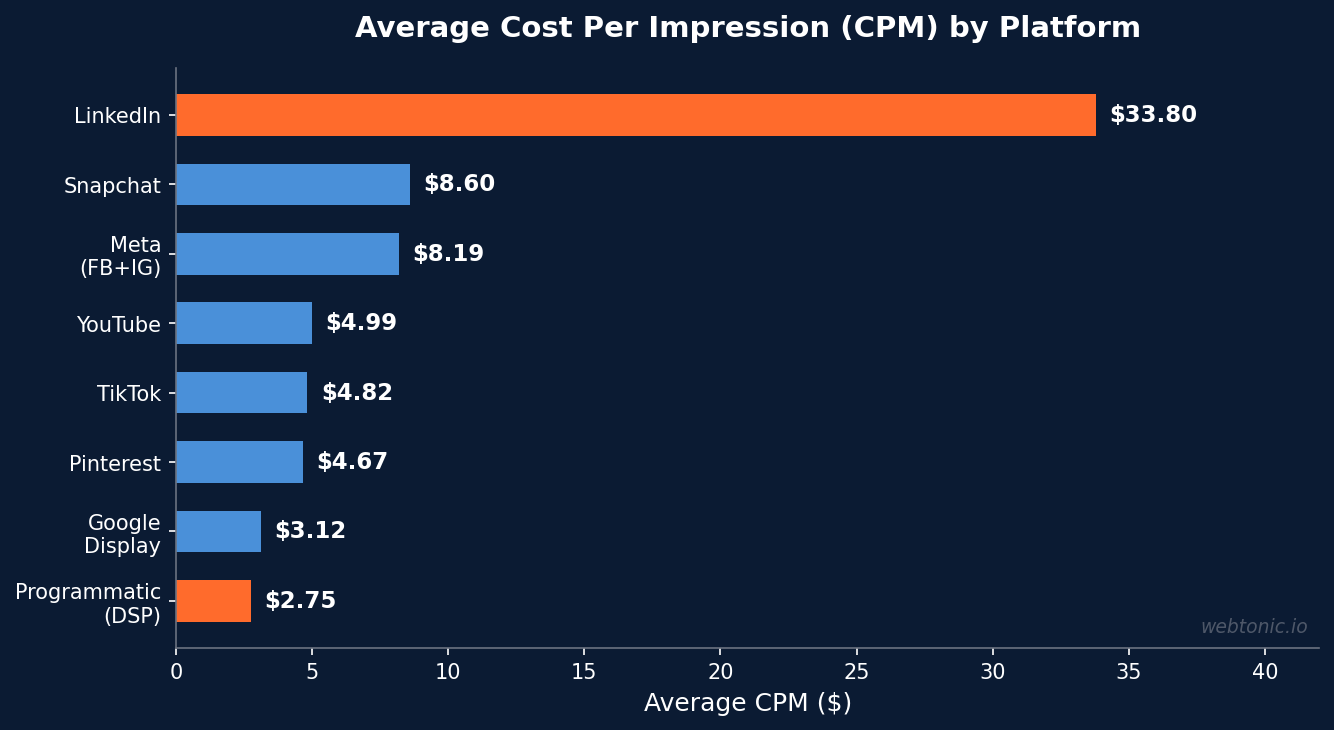
The spread between the cheapest and most expensive platforms is enormous. A $5,000 budget on Google Display at $3.12 CPM generates 1.6 million impressions, while the same budget on LinkedIn at $33.80 CPM produces just 148,000 impressions. The difference reflects audience value — LinkedIn's B2B decision-maker audience commands a premium because the conversion value per lead is significantly higher than a general display impression.
Cost Per Impression by Industry
Industry verticals drive CPM variation as much as platform choice does. According to Calc4Marketers' industry breakdown, CPMs range from under $3 for entertainment and gaming to over $28 for finance and insurance — a 9x difference driven by audience targeting precision and advertiser competition density.
Finance, insurance, and legal advertisers pay the highest CPMs because they compete for high-value customers. A single insurance lead can be worth $50–$500, which means advertisers willingly bid up impression costs knowing the downstream ROI justifies the premium. Conversely, entertainment and gaming advertisers target broad audiences with lower per-user value, keeping CPMs low but requiring massive impression volume to generate meaningful revenue.
For effective media planning, compare your industry's CPM benchmark against your campaign's actual CPM. If you are paying 25% or more above the industry median, your targeting may be too narrow, your creative may be fatigued, or your bidding strategy may need adjustment. Visit the Web Tonic blog for more advertising benchmarks by industry.
CPM vs. CPC vs. CPA: When to Use Each
Choosing the right pricing model depends entirely on your campaign objective. As Hubfluence's comparison guide explains, CPM is the pricing model for awareness and reach, CPC is for traffic and performance, and CPA is for direct response and conversions.
| Model | You Pay When | Best Objective | Typical Cost |
|---|---|---|---|
| CPM | Ad is displayed 1,000 times | Brand awareness, reach, visibility | $3–$15 per 1,000 views |
| CPC | User clicks the ad | Website traffic, lead generation | $0.50–$5.00 per click |
| CPA | User converts (purchase, sign-up) | Direct sales, app installs | $10–$100+ per conversion |
| CPV | User watches a video (30s or full) | Video awareness, consideration | $0.01–$0.10 per view |
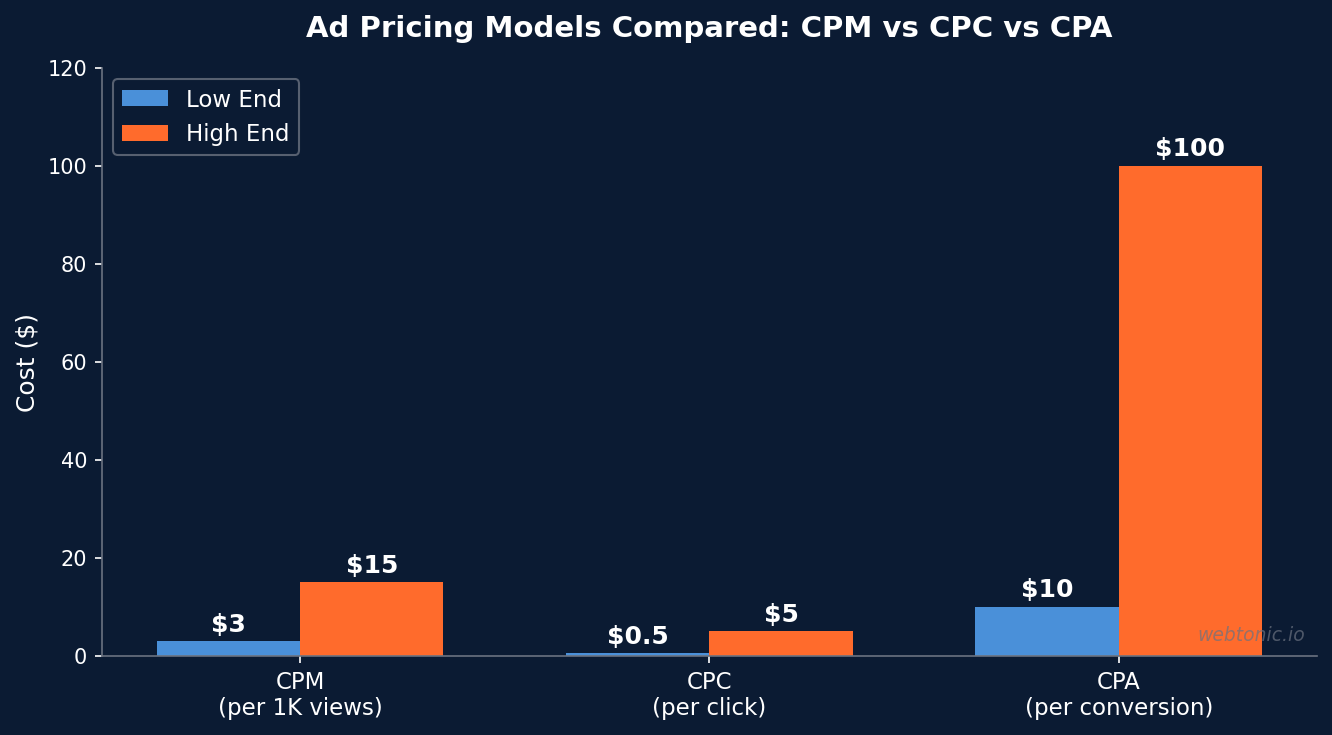
The strategic advantage of CPM bidding for awareness campaigns is cost predictability. You know exactly how many impressions your budget will buy before the campaign launches. CPC campaigns, by contrast, deliver variable impression volume — a $10 CPC with a 0.5% CTR produces an effective CPM of $50, which is 5–10x more expensive per impression than buying CPM directly. For top-of-funnel brand building, CPM is almost always the more efficient model.
That said, CPM is a poor choice when your goal is measurable downstream action. Paying for impressions that generate no clicks or conversions is the definition of waste in a performance marketing context. The hybrid approach — running CPM campaigns for awareness and CPC/CPA campaigns for conversion — gives you the best of both pricing models. Learn more about structuring multi-objective campaigns through our digital marketing services.
How to Lower Your Cost Per Impression
Reducing CPM means generating more impressions for the same budget — or the same impressions for less money. The most effective levers, ranked by impact, are creative optimization, audience expansion, timing adjustments, and placement strategy.
Creative refresh is the highest-impact lever. Ad fatigue drives up CPMs because platforms penalize low-engagement ads with higher costs. Advertisers who refresh creative every 2–3 weeks see CPMs 18–25% lower than those who let the same creative run for months. The refresh does not require new production — simple variations like different headlines, color changes, or reordered carousel cards can reset the fatigue signal.
Audience expansion reduces competition pressure. Narrow targeting forces you to compete in crowded auctions where demand exceeds supply. Broadening your audience by 20–30% while maintaining relevance through creative targeting (the ad self-selects the right audience) can reduce CPMs by 15–20% without sacrificing campaign quality. Meta's Advantage+ audience and Google's optimized targeting automate this expansion intelligently.
Timing adjustments exploit demand cycles. CPMs fluctuate significantly by day of week, time of day, and seasonality. Q4 CPMs are typically 30–50% higher than Q1 due to holiday advertising competition. Running awareness campaigns during off-peak periods (January, late summer) captures the same impressions at materially lower cost. Our team at Web Tonic helps clients time their awareness spending for maximum efficiency.
Related reading
- What Is Cost Per Click (CPC)? Formula, Benchmarks & Costs
- Marketing Audit Statistics: Cost and Pricing
- Marketing KPI Scorecard Cost and Pricing Statistics
- Marketing Strategy Consulting services at Web Tonic
FAQ
What is cost per impression in advertising?
Cost per impression is the price an advertiser pays for a single ad view. In digital advertising, it is typically expressed as CPM (cost per mille), meaning the cost per 1,000 impressions. The formula is CPM = (Total Ad Spend ÷ Total Impressions) × 1,000. Average CPMs range from $1.50 for programmatic display to $33.80 for LinkedIn depending on the platform and targeting.
How do you calculate cost per impression?
To calculate cost per impression, divide your total ad spend by the total number of impressions, then multiply by 1,000 to get CPM. For example, if you spent $500 and received 125,000 impressions, your CPM is ($500 ÷ 125,000) × 1,000 = $4.00. To find the single impression cost, simply divide spend by impressions: $500 ÷ 125,000 = $0.004 per impression.
What is a good CPM rate?
A good CPM rate depends on your platform and industry. On Google Display Network, $2–$5 CPM is considered efficient. On Meta (Facebook/Instagram), $5–$10 CPM is strong for most industries. On LinkedIn, $20–$30 CPM is competitive for B2B. Compare your CPM against industry benchmarks — if you are paying 25% or more above the median, optimization opportunities exist.
Is CPM or CPC better for advertising?
CPM is better for brand awareness and reach campaigns where maximum visibility is the goal. CPC is better for traffic and lead generation where you want measurable clicks. CPM is typically 35–50% cheaper per impression than CPC for awareness objectives because you avoid the click-bid premium. Most effective media plans use both: CPM for top-of-funnel awareness and CPC for mid- and bottom-funnel performance.
Why is my CPM so high?
Common causes of high CPMs include ad creative fatigue (running the same ads too long), narrow audience targeting (competing in small, expensive auctions), seasonal demand spikes (Q4 holiday competition), and low relevance scores (platforms charge more for poorly performing ads). Refreshing creative every 2–3 weeks, broadening audiences by 20–30%, and avoiding peak competition periods are the most effective ways to reduce CPM.
Sources
Google Ads Help — Cost Per Thousand Impressions (CPM) Definition
Wikipedia — Cost Per Mille
Gupta Media — Social Media Ads Cost 2025
CalculateCPM — CPM Benchmarks 2026
Calc4Marketers — Average CPM by Industry 2026
Rule1 — CPM Formula Guide
Hubfluence — CPM vs CPC Comparison 2026