



Table of contents

Key Takeaways
- Email marketing delivers a 3,800% ROI for construction companies, the highest single-channel return in the industry — outperforming SEO, PPC, and social media combined (Siana Marketing).
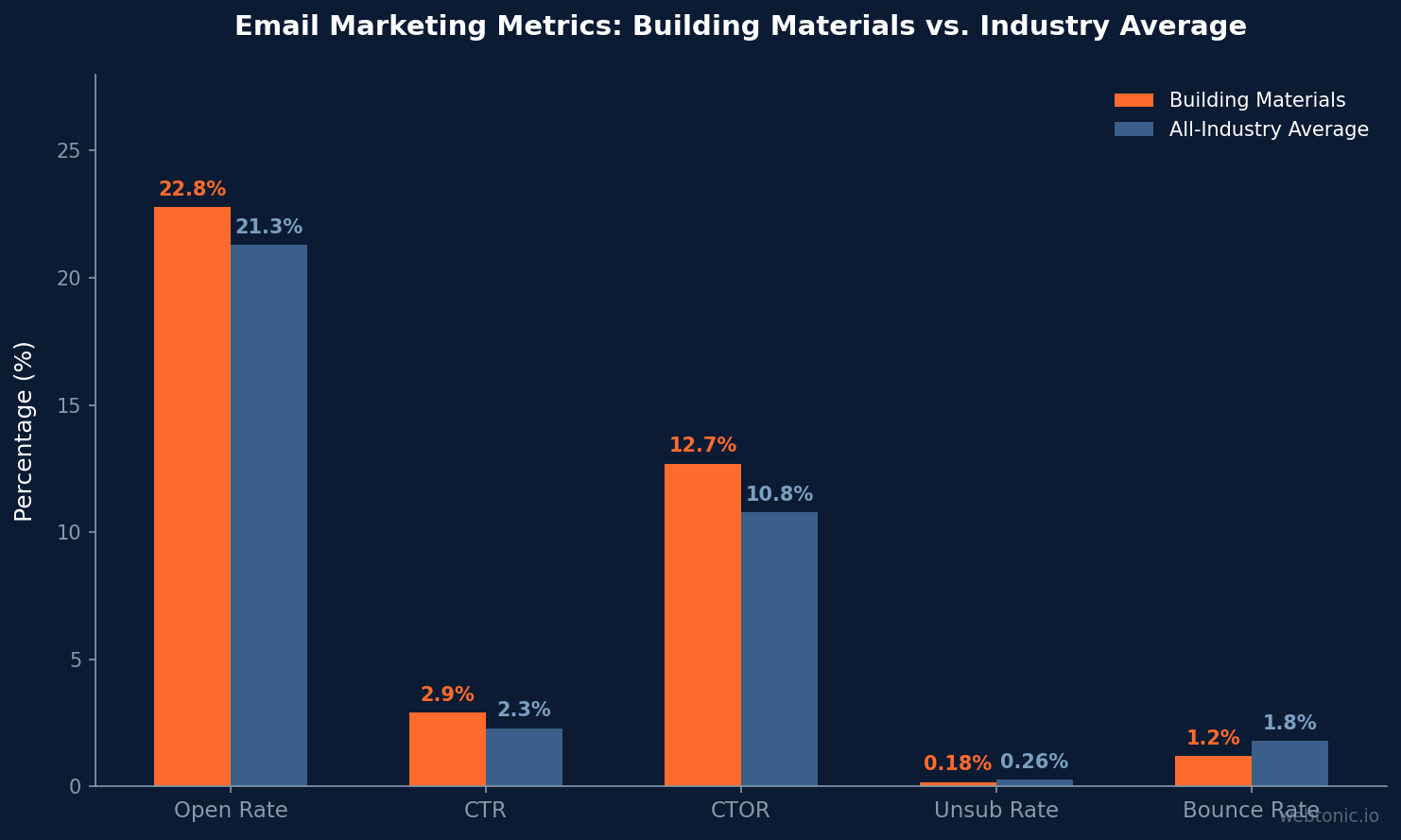
- Building materials companies achieve a 22.8% email open rate, well above most B2B sectors, with a 2.9% click-through rate indicating engaged subscriber lists (CuFinder).
- Segmented email campaigns generate open rates 14% higher than non-segmented ones, making list segmentation one of the most impactful optimizations for construction material suppliers (ER Marketing).
- The construction industry's email break-even period is just 3–4 months, faster than SEO (5 months), content marketing (6–8 months), and social advertising (7–10 months) (Siana Marketing).
- Customer retention in construction materials B2B sits at 65%, and email is the primary channel for maintaining supplier–buyer relationships and driving repeat purchases (CuFinder).
- Apple Mail Privacy Protection has inflated open rates by 30–60%, making click-through rate and conversion tracking more reliable metrics for measuring email effectiveness (Brevo).
Construction Materials Email Marketing Benchmarks at a Glance
The table below consolidates 2026 email marketing benchmarks specific to the building and construction materials industry, drawn from CuFinder's benchmark report and cross-referenced with industry-wide data from Brevo and Campaign Monitor.
| Metric | Building Materials | All-Industry Average | Difference |
|---|---|---|---|
| Open rate | 22.8% | 21.3% | +1.5 pts |
| Click-through rate (CTR) | 2.9% | 2.3% | +0.6 pts |
| Click-to-open rate (CTOR) | 12.7% | 10.8% | +1.9 pts |
| Unsubscribe rate | 0.18% | 0.26% | −0.08 pts |
| Bounce rate | 1.2% | 1.8% | −0.6 pts |
| Average ROI | 3,800% | 3,600% | +200 pts |
| Break-even period | 3–4 months | 4–6 months | 1–2 months faster |
The 0.18% unsubscribe rate is one of the lowest in any B2B vertical. This speaks to the quality of construction materials email lists — subscribers are typically procurement managers, project leads, and architects who rely on supplier communications for pricing updates, new product announcements, and availability alerts. When your recipients actively need your content, engagement stays high and list churn stays low.
Email Performance by Industry: Where Construction Materials Ranks
Comparing construction email metrics against other industries provides context for what "good" looks like. Building materials companies consistently outperform the broader B2B average, though they trail industries with naturally high engagement like government and nonprofit.
| Industry | Open Rate | CTR | Unsubscribe Rate |
|---|---|---|---|
| Government & Public Admin | 34.19% | 3.53% | 0.20% |
| Nonprofit & NGO | 27.03% | 3.10% | 0.30% |
| Insurance | 25.48% | 2.36% | 0.35% |
| Energy & Utilities | 24.72% | 2.69% | 0.45% |
| Construction / Building Materials | 22.8% | 2.9% | 0.18% |
| Professional Services | 22.74% | 2.20% | 0.39% |
| Real Estate | 21.7% | 1.91% | 0.38% |
| Info Tech & Software | 20.68% | 1.88% | 0.44% |
Construction materials companies achieve a unique combination: above-average open and click rates with the lowest unsubscribe rate of any major B2B sector. This profile reflects a subscriber base with genuine operational need for the content — price sheets, inventory alerts, product spec updates. For companies looking to capitalize on this engagement, integrating email with a broader growth marketing strategy amplifies the channel's already strong returns.
Email Types That Drive Results in Construction Materials
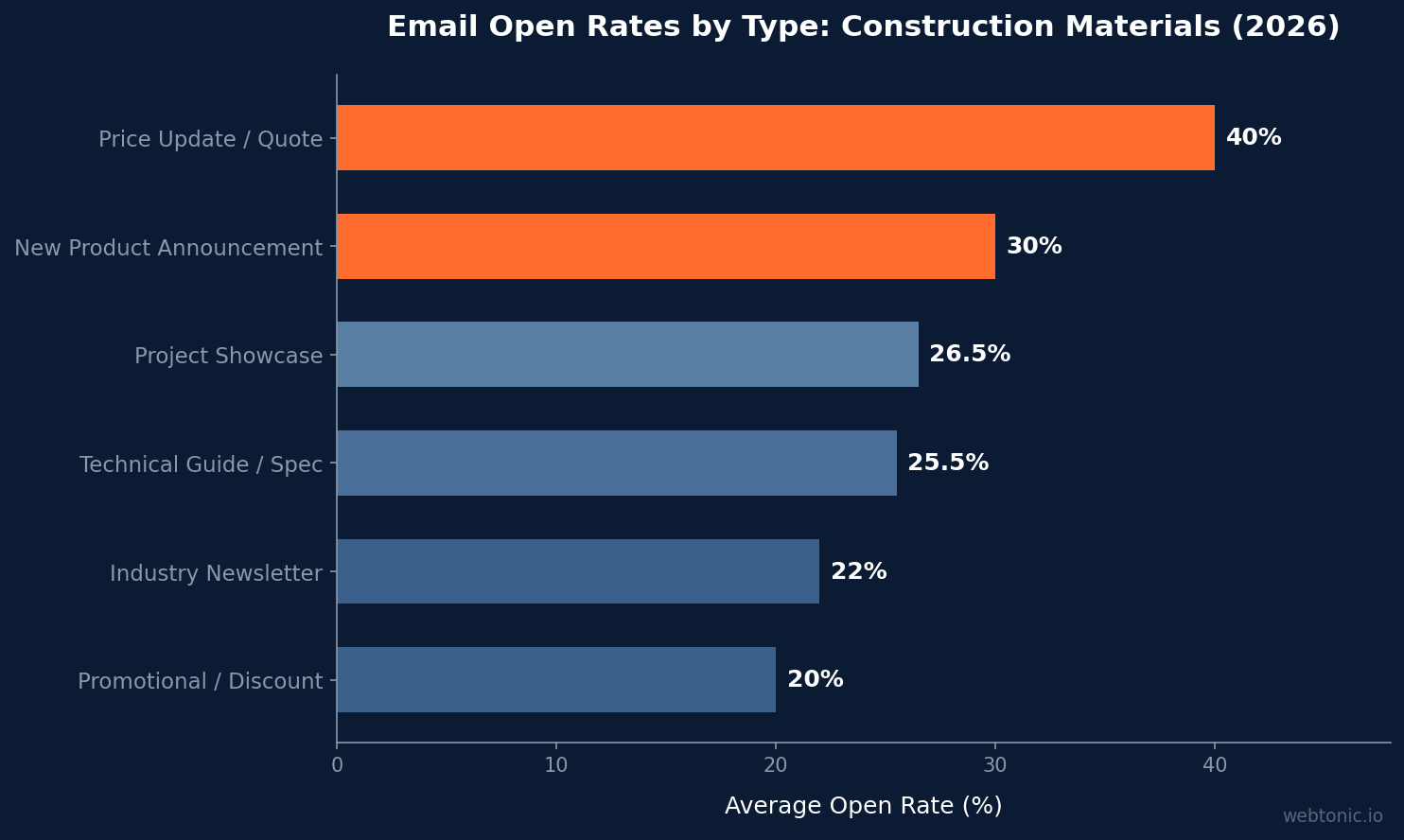
Not all emails perform equally for building materials suppliers. The data shows that transactional and operational emails consistently outperform promotional content — a pattern that aligns with the industry's B2B, project-driven buying cycle.
| Email Type | Avg. Open Rate | Avg. CTR | Best Use Case |
|---|---|---|---|
| Price update / quote follow-up | 38–42% | 8.5% | Procurement, repeat orders |
| New product announcement | 28–32% | 4.2% | Specifiers, architects |
| Project completion showcase | 25–28% | 3.8% | Brand building, referral |
| Technical guide / spec sheet | 24–27% | 5.1% | Education, lead nurturing |
| Industry newsletter | 20–24% | 2.4% | Thought leadership |
| Promotional / discount | 18–22% | 3.1% | Inventory clearance, seasonal |
Price update and quote follow-up emails achieve open rates of 38–42% — nearly double the industry average — because they directly affect the recipient's bottom line. A contractor waiting on a concrete price quote will open that email immediately. This insight has a clear tactical implication: structure your email strategy around operational value first, promotional content second.
Segmentation, Personalization, and List Management
Segmentation is the highest-leverage email optimization for construction materials companies. The research is unambiguous: segmented campaigns dramatically outperform broadcast sends.
- Segmented campaigns achieve open rates 14% higher than non-segmented ones — for building materials, this means pushing from the 22.8% baseline to roughly 26% (ER Marketing)
- Personalized subject lines increase open rates by 22% across B2B email campaigns
- Customer retention rate: 65% for construction materials B2B, indicating significant room for email-driven reactivation of the 35% who lapse
- Repeat purchase rate: 45%, with top-tier firms achieving churn rates below 8%
- Bounce rate of 1.2% — well below the 1.8% all-industry average, reflecting clean, opt-in focused list building practices
The most effective segmentation strategies for building materials companies organize lists by buyer role (contractor, architect, specifier, distributor), project type (residential, commercial, infrastructure), and purchase history (product category, order frequency, average order value). Each segment receives content calibrated to their decision-making priorities. For sophisticated segmentation paired with data intelligence and analytics, see our approach to audience-driven marketing.
The Apple Mail Privacy Protection Challenge
Apple Mail Privacy Protection (MPP) has fundamentally changed how construction materials marketers measure email performance. Launched in 2021, MPP pre-loads tracking pixels, inflating open rates by 30–60% depending on the subscriber base's Apple Mail share.
- Construction industry open rate including MPP: ~30–33% (vs. 22.8% excluding MPP inflation)
- Apple Mail users accounted for 49–55% of email opens industry-wide in 2025 (Brevo)
- North American open rate excluding MPP: ~22.3%; including MPP: ~32.6%
- Click-through rate is unaffected by MPP, making it the most reliable engagement metric
For building materials marketers, the practical takeaway is clear: shift primary KPIs from open rate to click-through rate and conversion rate. CTR at 2.9% is an accurate measure of genuine engagement and is not distorted by privacy pre-loading. Companies still reporting open rates should always note whether those figures include or exclude estimated MPP inflation.
Email Marketing ROI vs. Other Channels in Construction
Email's 3,800% ROI stands out dramatically against every other channel in the construction marketing toolkit. This return reflects email's unique position as a retention and repeat-business channel where acquisition costs are near zero.
| Channel | Average ROI | Break-Even | Cost Per Lead |
|---|---|---|---|
| Email Marketing | 3,800% | 3–4 months | $5–$15 |
| SEO | 681% | 5 months | $25–$45 |
| Referral Marketing | 480–520% | 2–3 months | $10–$20 |
| Content Marketing | 400–450% | 6–8 months | $30–$50 |
| PPC (Paid Search) | 250–300% | 4–6 months | $85–$110 |
| Social Media Ads | 180–220% | 7–10 months | $45–$75 |
The $5–$15 cost per lead from email marketing is 6–8x cheaper than PPC leads at $85–$110. This does not mean email replaces paid search — PPC captures new demand while email nurtures and converts existing relationships. The ideal strategy uses Google Ads for top-of-funnel acquisition and email for mid- and bottom-funnel conversion. Companies running Meta Ads for brand awareness can drive email sign-ups as a secondary conversion goal, feeding the highest-ROI channel in their stack.
Email Automation and Lifecycle Campaigns for Material Suppliers
Automation transforms email from a periodic broadcast channel into a continuous revenue engine. For construction materials companies, the highest-performing automated workflows map to the industry's natural buying cycles: project bidding, material procurement, delivery scheduling, and reorder timing.
- Welcome sequences convert 3–5x better than single welcome emails — a three-email onboarding series introducing product categories, pricing resources, and account manager contacts sets the tone for long-term engagement
- Abandoned quote follow-ups recover 12–18% of lapsed requests when sent within 24 hours, making them the single most valuable automation for building material distributors
- Reorder reminders timed to average purchasing cycles increase repeat purchase rates by 15–25% — for consumable materials like concrete additives, sealants, and fasteners, these automated nudges drive significant incremental revenue
- Post-delivery feedback requests achieve 30–35% open rates, generating testimonials and NPS data that feed back into marketing strategy and customer success
- Seasonal inventory alerts — pre-winter, pre-spring — hit 28–32% open rates and help clear slow-moving stock while positioning the company as a proactive supply partner
The key principle for construction materials email automation is timing tied to project lifecycle. Unlike consumer e-commerce where cart abandonment triggers dominate, building materials workflows center on project milestones — bid submissions, material take-offs, scheduled deliveries, and project completions. Companies that map their automation sequences to these milestones see the strongest engagement and the highest conversion to repeat orders. Tracking these lifecycle stages is easiest with a centralized data-driven approach that unifies ad performance with CRM activity.
Best Practices for Construction Materials Email Marketing
- Lead with operational value. Price updates, quote follow-ups, and availability alerts achieve 38–42% open rates — nearly double promotional emails. Make your email program indispensable to the recipient's workflow.
- Segment by buyer role and project type. Contractors, architects, distributors, and specifiers need different content. Segmented campaigns outperform broadcasts by 14% on open rate.
- Track CTR, not open rate. Apple Mail Privacy Protection inflates open rates by 30–60%. Click-through rate at 2.9% is your reliable engagement metric.
- Build for retention. With a 65% B2B customer retention rate and 45% repeat purchase rate, email is the cheapest path to revenue growth. Automate reactivation sequences for the 35% who lapse.
- Keep lists clean. The industry's 1.2% bounce rate and 0.18% unsubscribe rate reflect best-in-class list hygiene. Regularly purge inactive subscribers and validate email addresses to maintain deliverability.
- Integrate with your broader marketing stack. Connect email performance data with analytics dashboards to measure how email contributes to the full customer lifecycle — from first open to repeat purchase.
Building Your Construction Email Marketing Strategy: Revenue Metrics
The most successful construction companies treat email marketing as a revenue channel rather than a communication tool. The data shows that companies which track email-attributed revenue — not just open rates and clicks — make smarter investment decisions and report higher marketing satisfaction scores.
- Email-attributed revenue per send averages $0.08–$0.12 for construction companies with mature email programs — for a 5,000-person list sending weekly, that translates to $20,800–$31,200 annually
- Companies sending 2–4 emails per month see the highest engagement, with open rates declining 8–12% when frequency exceeds 6 sends per month
- Tuesday and Thursday mornings (8:00–10:00 AM local time) produce the strongest open rates for construction B2B emails, aligning with procurement managers' workflow patterns
- Subject lines under 50 characters increase open rates by 12% compared to longer alternatives — critical given that mobile devices truncate at roughly 35–40 characters
- Including a clear CTA button rather than a text link increases click rate by 28%, particularly for quote request and catalog download emails
- Construction companies using marketing automation report 14.5% increase in sales productivity and a 12.2% reduction in marketing overhead
For construction material suppliers evaluating their email marketing strategy, the revenue-per-send metric is the most important number to track. It directly connects email marketing investment to business outcomes — making it far more actionable than open rate, especially in a post-Apple Mail Privacy Protection environment where open tracking is increasingly unreliable. Building a report that ties email sends to quote requests and closed revenue gives marketing teams the data they need to justify and increase email investment.
Frequently Asked Questions
What is the average email open rate for construction materials companies?
The average email open rate for building and construction materials companies is 22.8% in 2026, excluding Apple Mail Privacy Protection inflation. When MPP opens are included, the figure rises to approximately 30–33%. This is above the all-industry B2B average of 21.3%, reflecting the operational necessity of supplier emails for procurement teams.
Why does email marketing have a 3,800% ROI in construction?
Email's exceptional 3,800% ROI in construction is driven by near-zero acquisition costs (you are emailing existing contacts), high lifetime value per customer (construction projects involve large, recurring material orders), and the channel's role in retention rather than new customer acquisition. The 3–4 month break-even period makes email the fastest-returning marketing investment in the industry.
How does Apple Mail Privacy Protection affect email metrics?
Apple Mail Privacy Protection pre-loads email tracking pixels, inflating reported open rates by 30–60%. For construction materials companies, this means an actual 22.8% open rate may appear as 30–33% in email platform dashboards. Click-through rate (2.9%) is unaffected and should be used as the primary engagement metric instead of open rate.
What types of emails work best for building materials suppliers?
Price updates and quote follow-ups lead with 38–42% open rates and 8.5% CTR. Technical guides and specification sheets also perform well at 24–27% open rate and 5.1% CTR. Promotional and discount emails perform lowest at 18–22% open rate. The pattern is clear: operational content that directly helps the recipient's workflow outperforms marketing-driven messaging.
Should construction materials companies segment their email lists?
Absolutely. Segmented campaigns achieve open rates 14% higher than non-segmented broadcast sends. For building materials companies, the most effective segmentation criteria are buyer role (contractor, architect, distributor), project type (residential, commercial, infrastructure), and purchase history (product category, order frequency). Each segment should receive content matched to their specific needs and decision-making timeline.
Sources
cufinder.io/blog/benchmarks/building-construction-materials
cufinder.io/blog/benchmarks/construction
sianamarketing.com/resources/construction-marketing-roi-2026-report
ermarketing.net/navigate-the-channel/email-benchmarks-for-building-product-marketers
brevo.com/blog/email-marketing-benchmarks
remarcable.com/blog/construction-material-management-statistics
buildermuse.com/economy/construction-technology-spending-hits-18-billion


