Table of contents
A competitive analysis is a structured comparison of the competitors in your market — what they sell, who they sell it to, how they price it, and where they win — turned into decisions you can act on. This guide walks the full process, gives you a reusable competitive analysis template, and shows how to keep the report alive instead of filing it.
Key Takeaways
- A working competitive analysis covers 3 surfaces: what a brand says about itself, what third parties say about it, and how AI search engines describe it.
- Track 4 competitor types — direct competitors, indirect competitors, substitutes and aspirational players — but score no more than 5 to 7 rivals per cycle.
- Porter's framework reduces market structure to 5 forces; SWOT analysis reduces your own position to 4 quadrants. Use both, in that order.
- Collect 6 data classes per competitor: product, pricing, content, acquisition channels, customer sentiment and market share signals.
- Refresh the competitive analysis report every 90 days; pricing pages and paid search creative move much faster than annual planning cycles.
What competitive analysis is — and what it is not
Competitive analysis is the research discipline of mapping the competitive landscape so strategic decision making rests on evidence rather than instinct. It is not a list of logos, and it is not a one-off slide. Semrush frames the modern version as covering three surfaces of a competitor's brand: owned marketing and sales content, third-party reviews and press, and — newly material — how AI answer engines summarise the company.
The distinction that matters is between competitive intelligence (the continuous collection of signals) and the competitive analysis report (the periodic synthesis you present). Intelligence without synthesis becomes a folder nobody reads. Synthesis without fresh intelligence becomes folklore. The US Small Business Administration treats market research and competitive analysis as a single planning input for exactly this reason: the point is a decision about positioning, pricing or channel, not the document.
The four types of competitors you should separate
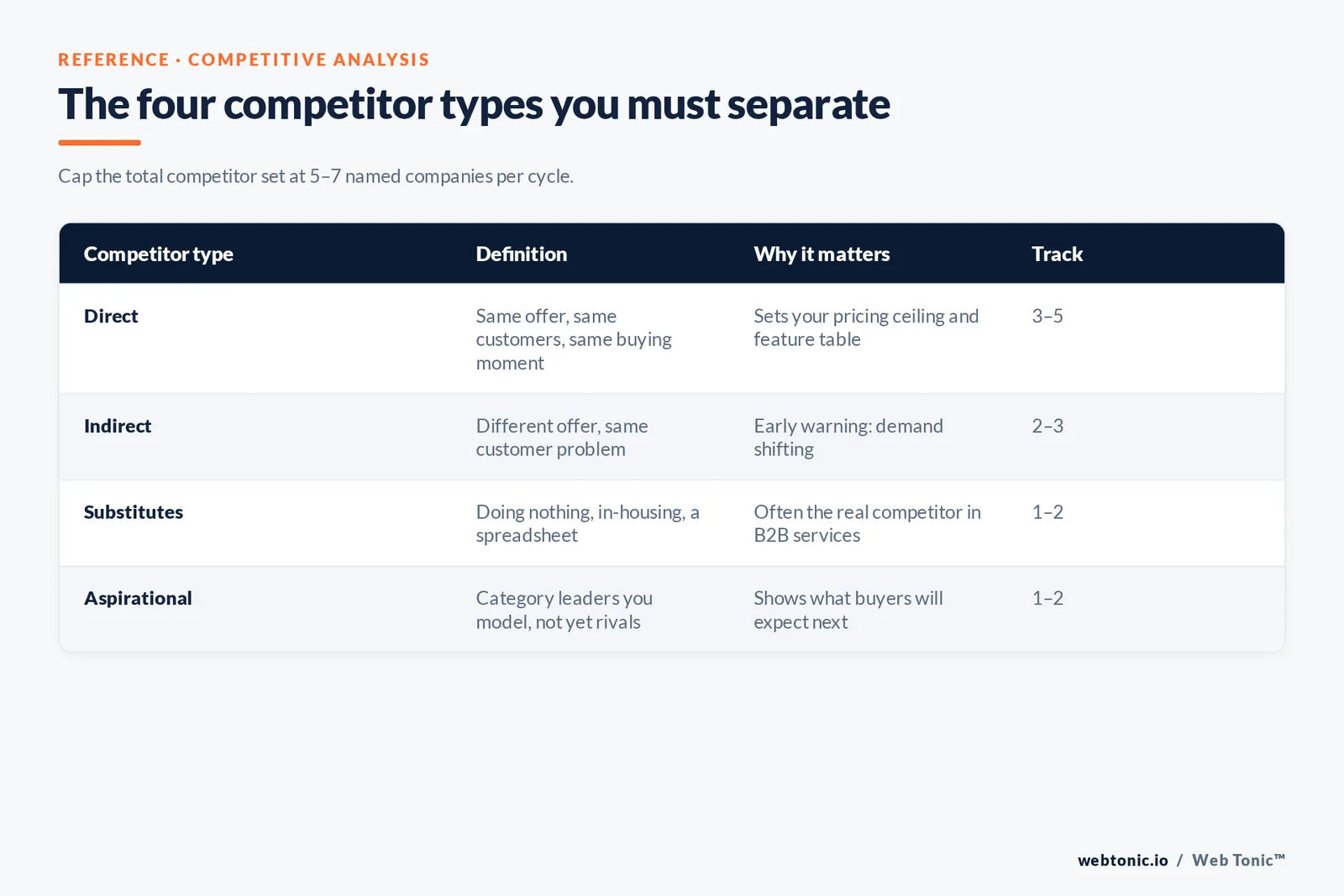
Businesses offer products and services that overlap in very different ways, and lumping them together is the most common mistake in a first competitive analysis. Separate them before you collect a single data point.
| Competitor type | Definition | Why it matters | How many to track |
|---|---|---|---|
| Direct competitors | Same product or service, same target customers, same buying moment | Sets your pricing ceiling and your feature table | 3-5 |
| Indirect competitors | Different offer solving the same customer problem | Early warning system: shifts here signal demand moving | 2-3 |
| Substitutes | Doing nothing, in-housing, or a spreadsheet workaround | Often the real competitor in B2B services deals | 1-2 |
| Aspirational competitors | Category leaders you model but do not yet compete with | Shows where the market is heading and what buyers will expect next | 1-2 |
Cap the total at 5 to 7 named companies. Beyond that, depth collapses and the analysis becomes a directory. Crunchbase is useful for funding and headcount context on each one,, and Google Trends gives you a free read on relative brand demand over time.
How to conduct a competitive analysis in seven steps
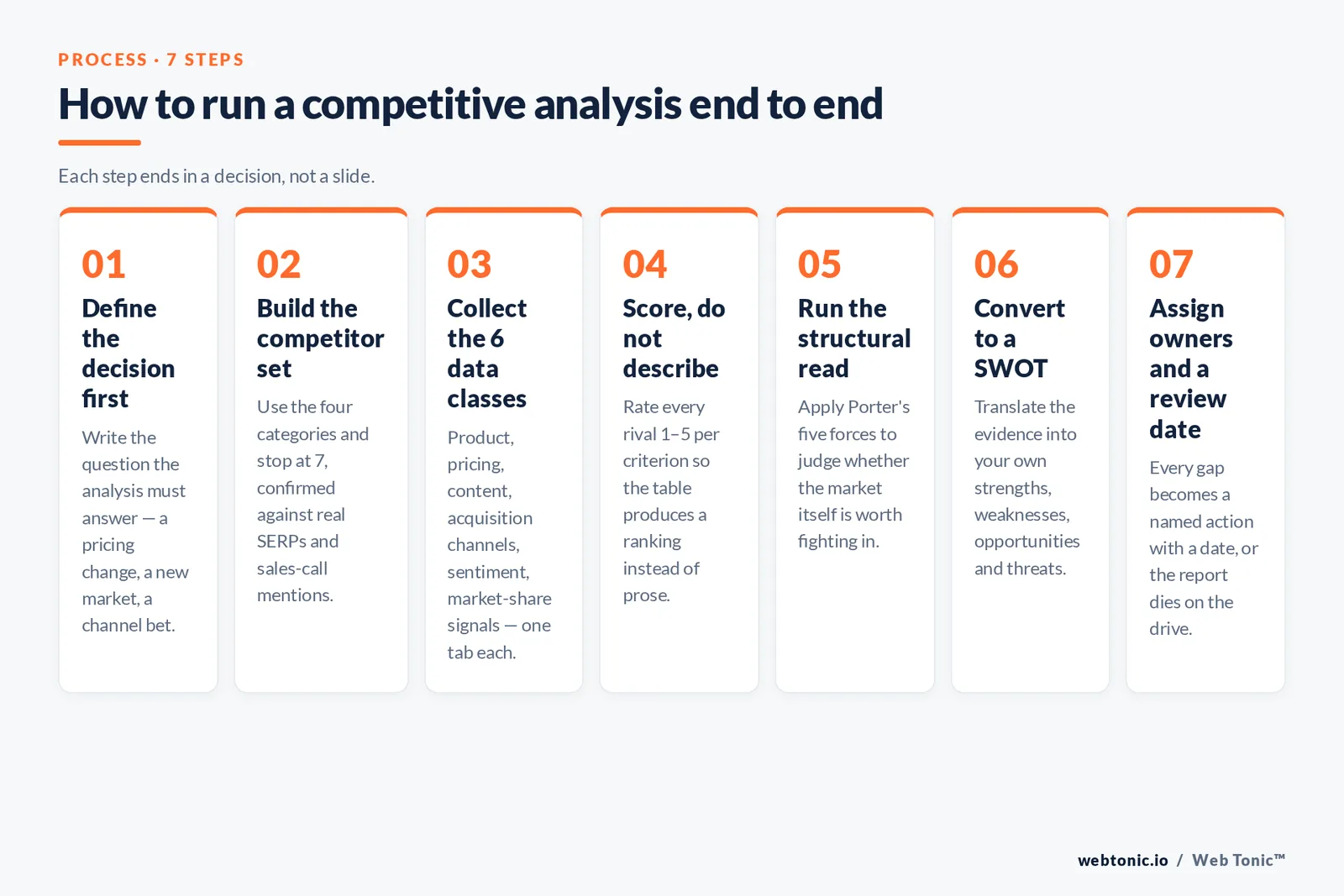
- Define the decision first. Write the question the analysis must answer — a pricing change, a new market, a channel bet. Analyses without a decision attached are never used.
- Build the competitor set. Use the four categories above and stop at 7. Confirm each one against real search results and real sales-call mentions, not memory.
- Collect the 6 data classes. Product features, pricing and packaging, content and messaging, acquisition channels, customer sentiment, and market share signals. One tab per class.
- Score, do not describe. Rate each competitor 1 to 5 per criterion so the comparison table produces a ranking instead of prose.
- Run the structural read. Apply Porter's five competitive forces to judge whether the market itself is worth fighting in.
- Convert to a SWOT analysis. Turn the evidence into your own strengths, weaknesses, opportunities and threats — the four-quadrant SWOT framework exists to force that translation.
- Assign owners and a review date. Every gap becomes a named action with a date, or the competitive analysis report dies on the shared drive.
Teams that want the structural theory in more depth should read the five forces walkthrough before scoring, because the forces determine how much any individual competitor's behaviour actually matters.
The competitive analysis template
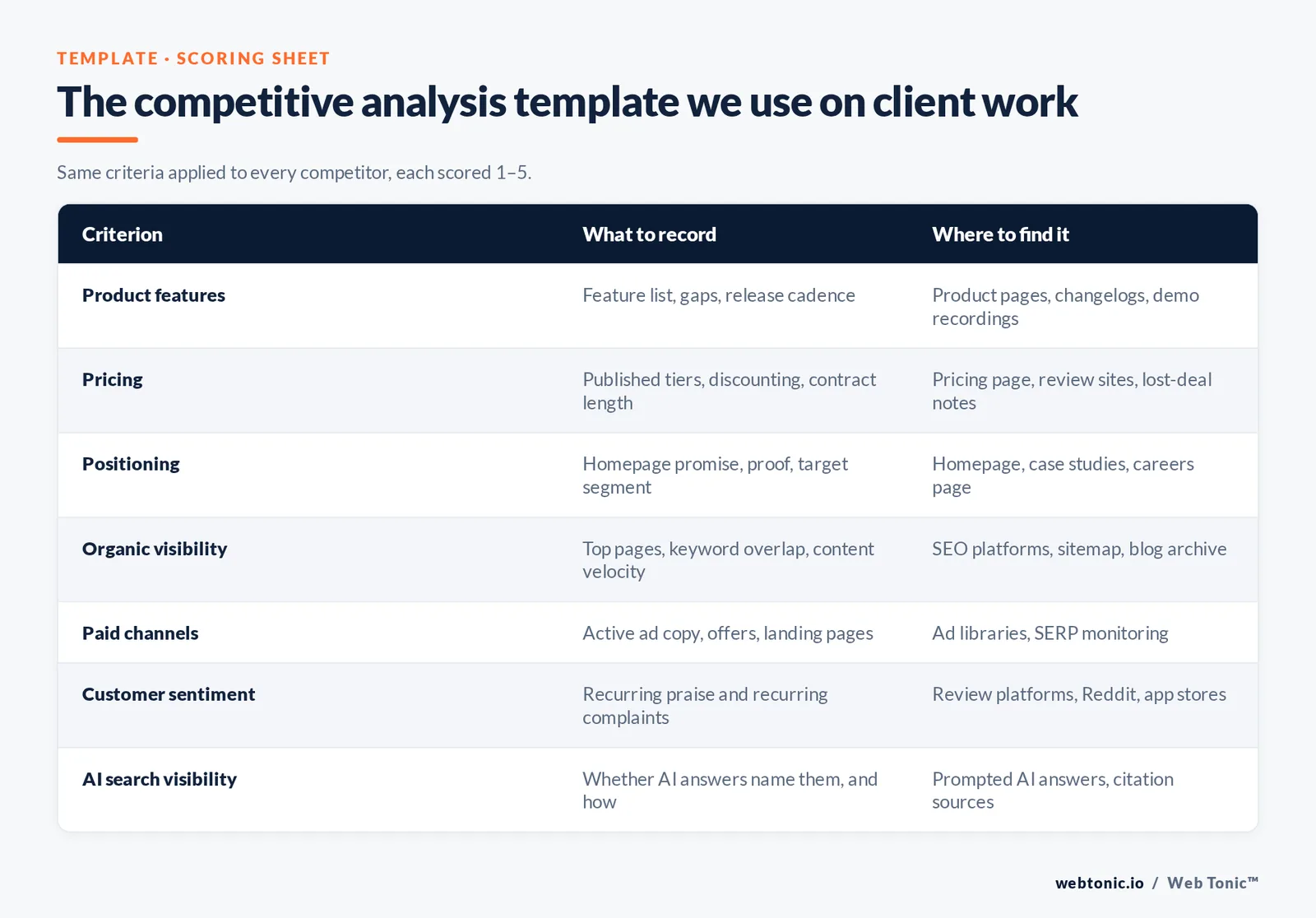
This is the sheet we use on client engagements. Copy the columns exactly; the value comes from the same criteria being applied to every competitor.
| Criterion | What to record | Where to find it | Score |
|---|---|---|---|
| Product features | Feature list, gaps, release cadence | Product pages, changelogs, demo recordings | 1-5 |
| Pricing | Published tiers, discounting, contract length | Pricing page, review sites, lost-deal notes | 1-5 |
| Positioning | Homepage promise, proof, target segment | Homepage, case studies, careers page | 1-5 |
| Organic visibility | Top pages, keyword overlap, content velocity | SEO platforms, sitemap, blog archive | 1-5 |
| Paid channels | Active ad copy, offers, landing pages | Ad libraries, SERP monitoring | 1-5 |
| Customer sentiment | Recurring praise, recurring complaints | Review platforms, Reddit threads, app stores | 1-5 |
| AI search visibility | Whether AI answers name them, and how | Prompted AI answers, citation sources | 1-5 |
Filled-out competitive analysis examples help calibrate the level of detail: Asana's worked example is strong on operational framing, and HubSpot's kit supplies the blank grids. Neither replaces the scoring discipline in step 4.
Turning competitor data into marketing strategy
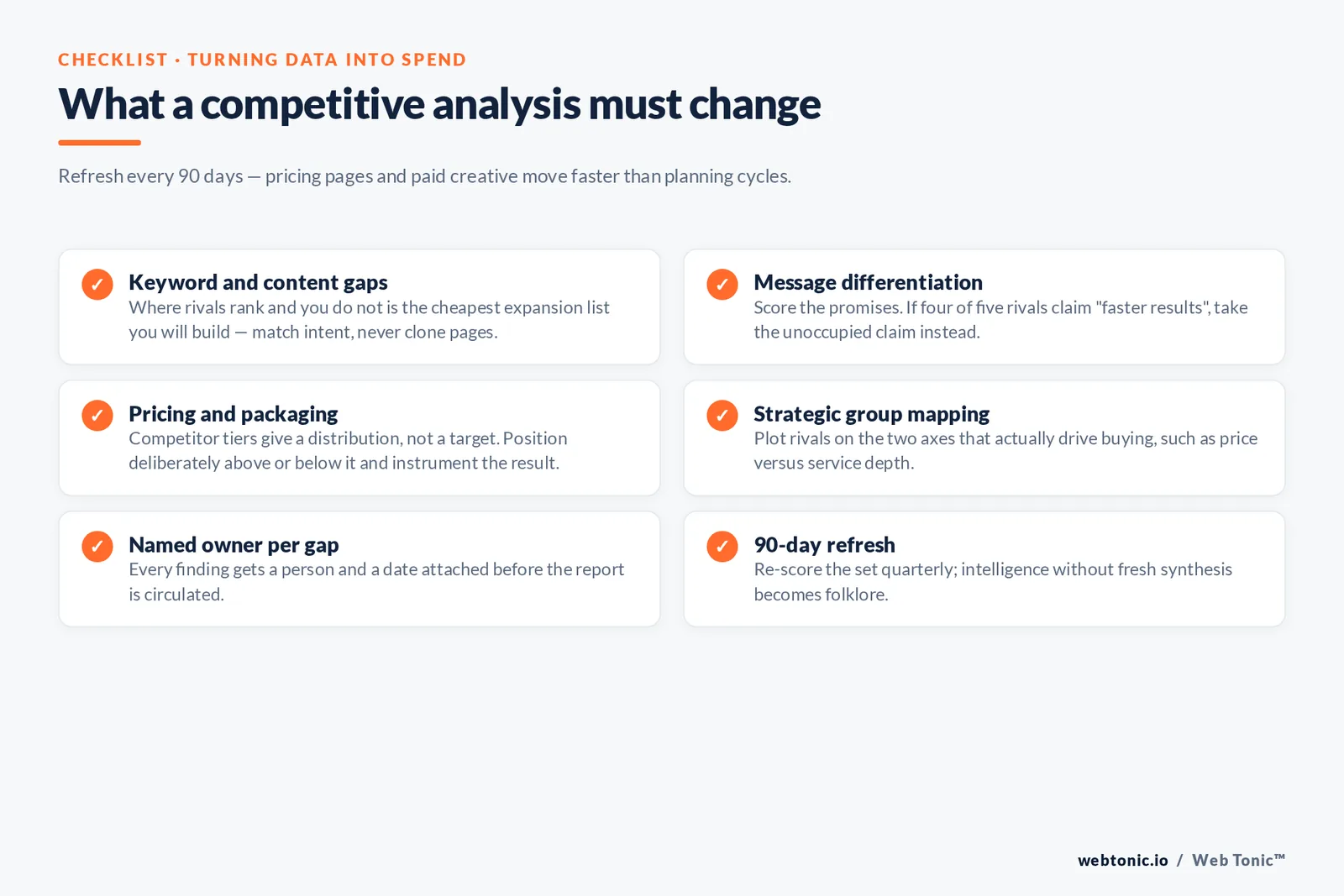
The output should change spend, not just slides. Three translations do most of the work.
Keyword and content gaps. Where competitors rank and you do not is the cheapest expansion list you will ever build, and it is why gap analysis is standard practice in SEO. Google's own documentation is the guardrail: match intent and depth, do not clone pages. This is the exact method behind our growth marketing engagements.
Message differentiation. If four of five competitors promise "faster results", that claim is now worthless. Score the promises, then take the unoccupied one — the workflow our performance creative team runs before writing a single ad.
Pricing and packaging. Competitor tiers give you a distribution, not a target. Position deliberately above or below it, and instrument the result properly; event-based analytics is the minimum, which is where data intelligence work starts. Think with Google makes the same point from the auction side: share-of-voice shifts show up in ad data weeks before they show up in revenue.
Advanced techniques once the basics run
- Strategic group mapping. Plot competitors on two axes that actually drive buying (price versus service depth, for instance). Empty quadrants are positioning opportunities.
- Win-loss interviews. Ask 10 recent lost deals who they chose and why. This is the highest-signal, least-used input in competitive analysis.
- Pricing-page change monitoring. Track competitor pricing pages weekly. Changes here precede aggressive acquisition pushes.
- AI answer auditing. Prompt the major assistants with your category's buying questions and record which brands get named. Being absent from AI answers is now a distribution problem, not a vanity one.
- Talent signals. A competitor hiring 6 paid-media specialists is telling you their next quarter's channel strategy for free.
None of these require enterprise tooling. They require a recurring 90-day slot on someone's calendar. If you would rather that slot sat with a team that does it weekly across dozens of accounts, that is what our services exist for — and there are more teardowns like this one on the Web Tonic blog.
Where to gather competitor data without buying more tools
Most of the data you need for a thorough competitive analysis is public. The skill is knowing which artefact answers which question, and recording it the same way every quarter so the comparison holds.
Competitor websites carry more strategy than any report. The homepage headline is their positioning statement. The pricing page is their packaging strategy. The careers page tells you which functions they are scaling, and a sitemap tells you which content clusters they are betting on. Screenshot all four each cycle; drift between quarters is the signal.
Review platforms and community threads supply customer sentiment at a level no survey will match. Read the 3-star reviews rather than the 1- and 5-star ones — they contain the trade-offs buyers actually weigh. Log recurring complaints verbatim, because those phrases become your differentiating copy.
Ad libraries show which offers competitors are paying to distribute right now. An offer that has been live for 90 days is working for them; one that vanished in a week did not. That is free creative testing you did not have to fund.
Your own sales calls are the most under-used source in the stack. Every deal names competitors, objections and the price the buyer expected. Tag those mentions in the CRM and you will have a live competitive intelligence feed inside a single quarter — and the market share signals it produces are far more accurate for your specific segment than any published estimate.
Store all of it in one place with a date stamp on every row. A competitive analysis that cannot show what changed since last quarter is a snapshot, and snapshots do not drive strategic decision making.
What a competitive analysis helps you understand about your industry
Done properly, a competitive analysis helps marketing teams understand three things at once: how the industry is structured, which competitive strategies rivals are actually funding, and where customers are underserved. Those insights are what separate a competitive analysis report from a competitor scrapbook.
Start with the industry read. Count how many companies compete for the same target customers, how concentrated market share is, and how quickly new products and services enter. In a fragmented industry, gaining traffic and sales is mostly an execution race between marketing teams. In a concentrated one, positioning against the leader's weaknesses matters more than any single tool or template.
Next, read the competitive strategies in market. Every company broadcasts its strategy through its content, its pricing and its hiring. A rival publishing product comparison content weekly is competing on features and search traffic. A rival investing in social media and brand campaigns is competing on awareness. A rival cutting pricing is competing on volume. Identify which game each competitor is playing before deciding which one you want to play, because matching a competitor's strategy with half their budget is how marketing teams lose a year.
Then read the customers. Review sentiment, community threads and your own sales notes identify the jobs customers still cannot get done. Those unmet needs are the highest-value insights in the whole exercise: a documented list of customer complaints about competitors' products and services is a product roadmap, a positioning brief and a content plan in one artefact. Web Tonic's web development team uses exactly that list when rebuilding a client site, because the objections competitors fail to answer are the ones the new pages have to answer above the fold.
Finally, quantify. For each competitor, record estimated organic traffic, paid presence, review volume and average rating, headcount trend and pricing position. Five numbers per company, tracked quarterly, tell you more about the competitive landscape than fifty pages of description — and they make the strengths and weaknesses in your SWOT analysis defensible when a leadership team pushes back on them.
Common mistakes in a competitive analysis
| Mistake | Why it breaks the analysis | Fix |
|---|---|---|
| Tracking 20+ competitors | Depth collapses into a logo directory | Cap at 5-7 named companies per cycle |
| Describing instead of scoring | No ranking, so no decision | Force a 1-5 score on every criterion |
| Ignoring indirect competitors | Misses demand shifting to a different solution shape | Reserve 2-3 slots for indirect and substitute options |
| One-off exercise | Data is stale within a quarter | Standing 90-day refresh with a named owner |
| Copying the leader | Cedes the differentiation you were looking for | Use gaps to position against, not to imitate |
FAQ
What is competitive analysis in simple terms?
It is a structured comparison of the companies competing for your customers, scored on the same criteria, so you can see where you win, where you lose, and what to change. The output is a decision about product, pricing, message or channel — not a document.
How many competitors should a competitive analysis cover?
Five to seven named companies: three to five direct competitors, two to three indirect competitors, and one or two substitutes or aspirational players. More than seven and the depth per competitor drops below the level where the comparison is useful.
What is the difference between competitive analysis and SWOT analysis?
Competitive analysis looks outward at rivals and market structure. SWOT analysis looks inward, translating that external evidence into your own strengths, weaknesses, opportunities and threats. Run the competitive analysis first, then use SWOT as the synthesis step.
How often should you update a competitive analysis report?
Every 90 days for the full report, with lightweight monitoring in between on pricing pages, ad creative and review sentiment. Annual refreshes are too slow because paid search creative and packaging change monthly in most categories.
Which competitive analysis tools do you actually need?
An SEO platform for keyword and traffic overlap, the platform ad libraries for creative, a review aggregator for sentiment, a funding database for company context, and one spreadsheet as the system of record. The spreadsheet matters more than any single tool.
Sources: Harvard Business Review, "The Five Competitive Forces That Shape Strategy" · US Small Business Administration, Market Research and Competitive Analysis · Semrush, Competitor Analysis · Ahrefs, Competitive Analysis · Mind Tools, SWOT Analysis and Porter's Five Forces · Asana Resources, Competitive Analysis Example · HubSpot, Competitive Analysis Kit · Think with Google · Google Search Central · Google Analytics Help · Crunchbase.