Table of contents
No published census counts exactly what share of cleaning businesses track their marketing, but the surrounding evidence lines up: 89% of janitorial firms employ fewer than 20 people, cleaning owners report the lowest pricing confidence of any home service trade, and the one direct cost figure available says un-tracked leads cost 20% more. This page tests the claim in the headline against that evidence, not against a guess.
Key Takeaways
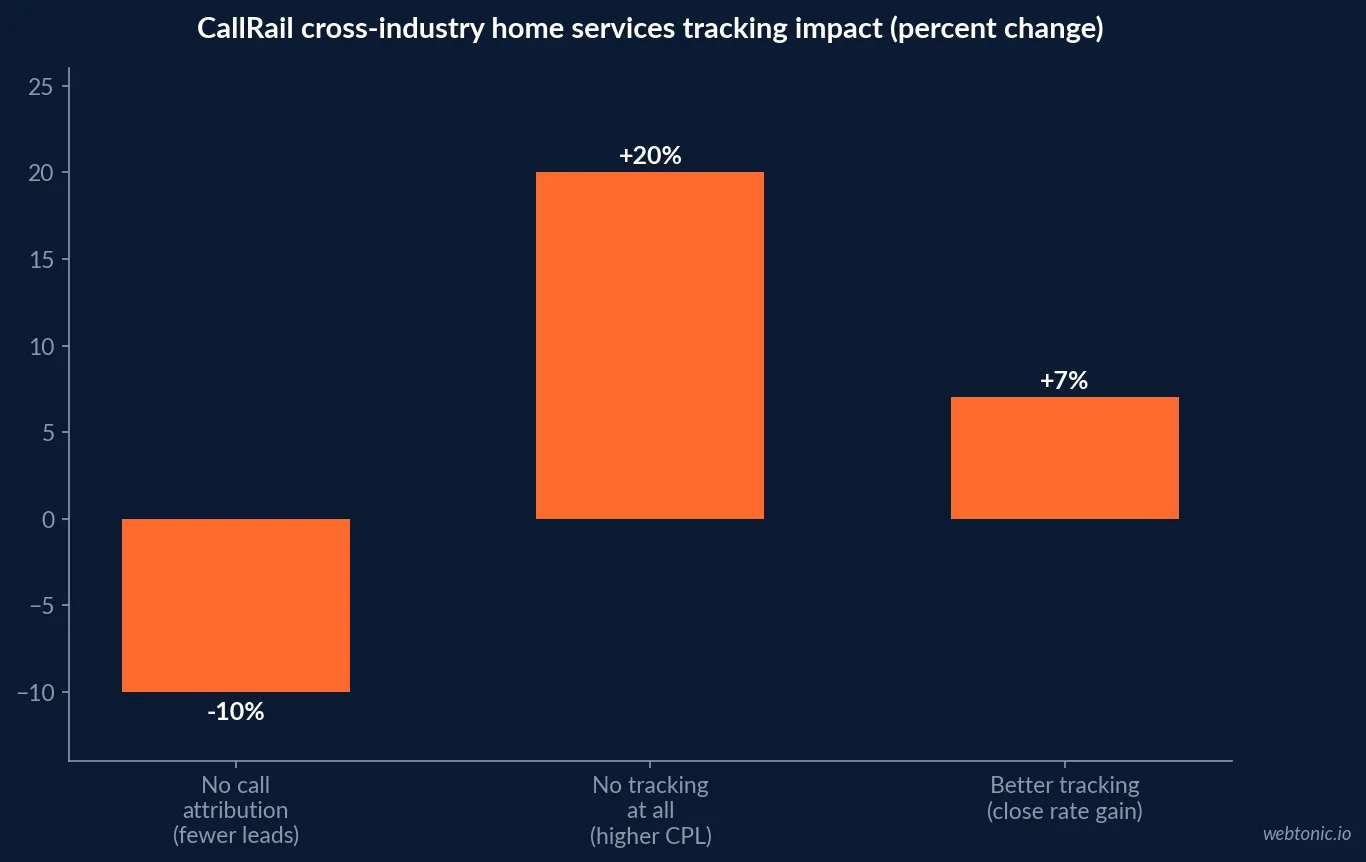
- Businesses with no lead attribution see 10% fewer leads for the same marketing spend (CallRail, cross-industry home services data).
- Businesses that don't track leads at all pay 20% more per lead (CallRail).
- Better lead tracking correlates with a 7% higher call-to-close rate (CallRail).
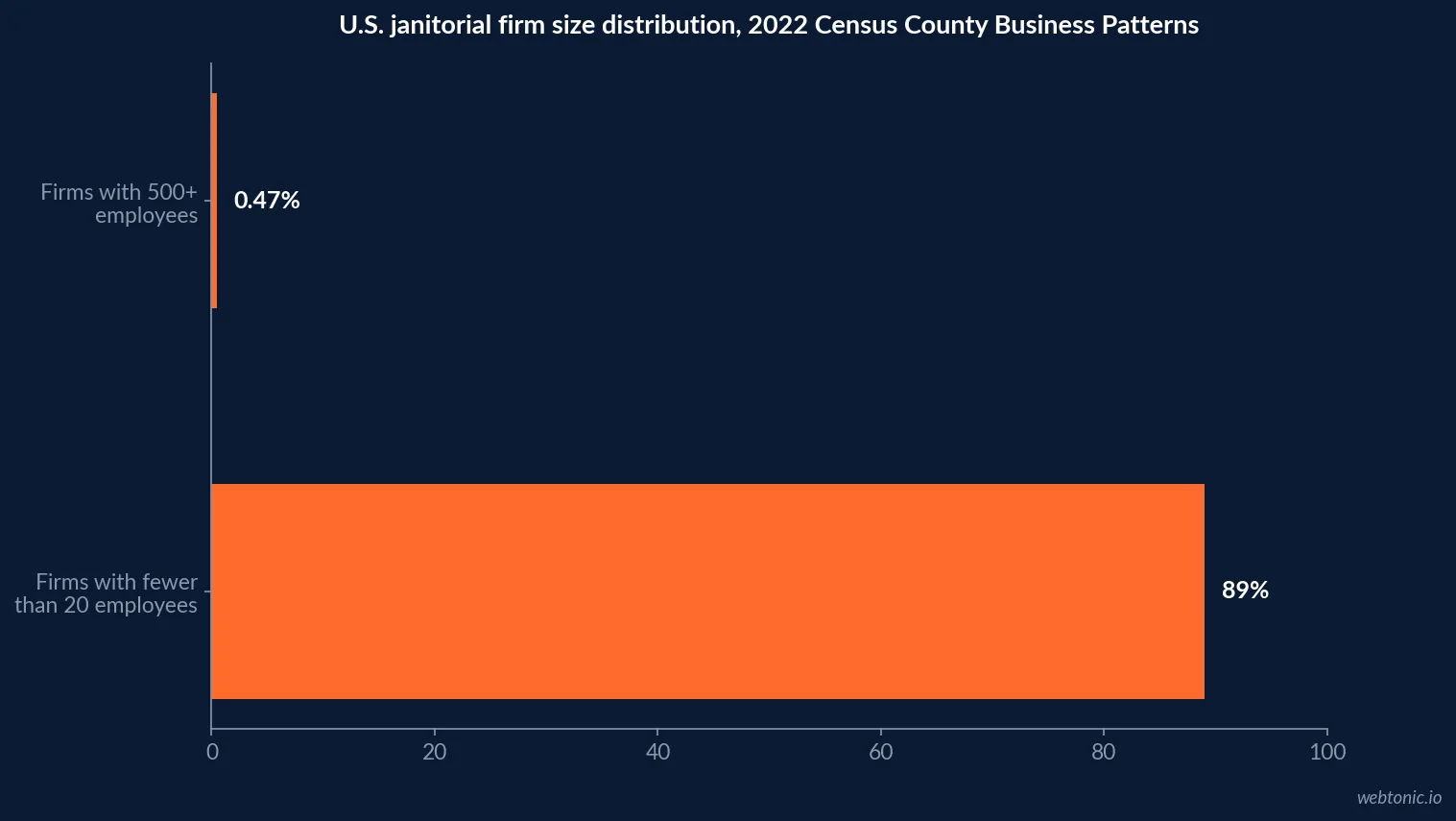
- 89.0% of U.S. janitorial-services firms employ fewer than 20 workers (U.S. Census Bureau, 2022 County Business Patterns, NAICS 561720).
- 62,970 janitorial-services firms operated 67,295 establishments in 2022 (Census 2022 SUSB).
- Cleaning pros report the lowest pricing confidence of any trade, at 48% (Jobber, 2026 Home Service Trends Report, 1,000+ owners surveyed).
- Cleaning businesses show the widest close-rate uncertainty of the trades Jobber surveyed in 2026.
- Cleaning businesses are the fastest phone responders, with 26% replying within an hour, against 11% for HVAC (Jobber, 2026).
- Residential and commercial cleaning revenue grew 7.6% year over year in June 2026 (Jobber, Q2 2026 Home Service Economic Report).
- 43% of cleaning business owners actively use AI, the highest of any trade Housecall Pro surveyed (Housecall Pro, Spring 2025 AI Industry Report, 400+ owners) - a figure that directly contradicts Jobber's "cleaning lags" finding; both are cited below.
- Janitorial industry net margin has compressed to -1% to -2% in parts of the market (ISSA, 2026 State of the Industry).
- Labor is 80% to 90% of a cleaning company's total cost (ISSA, 2026).
- Janitorial employee turnover runs 200% to 400% a year, the highest of any blue-collar sector tracked (ISSA / Cleaning & Maintenance Management, 2026).
- The U.S. janitorial services market is worth USD 112.4 billion in 2026, growing 2.7% a year (IBISWorld industry summary, 2026).
- Under half of marketers connect their video platform to a CRM to unify tracking, a broader disconnected-data pattern (Wistia, 2026 State of Video Report).
What "flying blind" means for a cleaning business, in numbers
The claim in this page's headline is really two separate claims: that most cleaning operators lack real tracking, and that the lack of it costs them something specific. The second claim has a direct answer. CallRail's own home services marketing research states plainly that businesses with no way to attribute calls to a channel see 10% fewer leads for the same spend, and that businesses that don't track leads at all pay 20% more per lead than ones that do. Neither number is broken out for cleaning specifically; both are CallRail's broader home services findings, and every figure on this page is labeled by scope.
| Tracking gap, home services (cross-industry) | Figure | Source |
|---|---|---|
| Fewer leads with no call attribution | -10% | CallRail |
| Higher cost per lead with no tracking at all | +20% | CallRail |
| Call-to-close rate improvement from better tracking | +7% | CallRail |
| Marketers who connect video data to a CRM | Under 50% | Wistia, 2026 State of Video Report |
The first claim: is cleaning actually behind on tracking?
No study measures cleaning-specific tracking-tool adoption directly, so this section builds the case from what does exist: how confident cleaning owners are in their own numbers, and how fragmented the industry is structurally. Jobber's 2026 Home Service Trends Report, based on a survey of more than 1,000 U.S. home service business owners, found cleaning pros report the lowest pricing confidence of any trade surveyed at just 48%, and cleaning showed the widest variability in close-rate certainty, with the report noting many cleaning owners are simply "unsure of their numbers." A business unsure of its close rate is unlikely to have built out lead-source attribution underneath it.
The same report found cleaning businesses the least likely of any trade to have raised prices in 2026 (55%, against 83% for HVAC), and the most likely to report having the most open, unbooked capacity of any trade Jobber tracks, both consistent with an industry that is under-instrumented on the numbers that would normally drive those decisions.
| Jobber 2026 Home Service Trends Report finding | Cleaning | Comparison trade |
|---|---|---|
| Pricing confidence | 48% (lowest of all trades) | HVAC and Roofing highest |
| Raised prices in 2026 | 55% | HVAC 83%, Roofing 74% |
| Reply within one hour | 26% (fastest of all trades) | HVAC 11% (slowest) |
| Same-day payment rate | 60% (highest, tied with Tree Care) | Tree Care 51% |
Why the industry is structurally set up to under-track
The U.S. Census Bureau's 2022 County Business Patterns data (NAICS 561720, Janitorial Services) counted 62,970 firms operating 67,295 establishments, with 89.0% employing fewer than 20 workers. At the other end, just 294 firms, 0.47% of the total, employed 459,747 of the industry's 1,067,762 payroll workers, or 43.1% of all industry labor. That split matters for tracking adoption specifically: dashboards, call tracking numbers, and CRM-to-marketing integrations are overwhelmingly bought by the operations layer a 294-firm segment can afford and a 56,000-firm segment of sub-20-employee shops typically cannot.
ISSA's 2026 State of the Industry briefing adds the margin picture: labor is 80% to 90% of a cleaning company's cost, wages are climbing 4.3% a year, and net margins in parts of the market have gone negative. Annual turnover of 200% to 400%, the highest of any blue-collar sector ISSA tracks, adds a second reason: the operations staff who would normally own a tracking rollout are themselves churning constantly.
| Industry structure fact (2022 Census SUSB, NAICS 561720) | Figure |
|---|---|
| Total firms | 62,970 |
| Total establishments | 67,295 |
| Firms with fewer than 20 employees | 56,069 (89.0%) |
| Firms with 500+ employees | 294 (0.47%) |
| Share of industry payroll workers in those 294 firms | 459,747 of 1,067,762 (43.1%) |
| Industry payroll, 2022 | USD 30.78 billion |
The competing 2026 evidence on cleaning and AI adoption
Two 2026 surveys reach opposite conclusions about where cleaning sits on technology adoption, and the honest answer is that both are right for their own sample. Jobber's Trends Report states cleaning and lawn care "lag behind" on AI, pointing to where the company sees the least education. Housecall Pro's Spring 2025 AI Industry Report, a national survey of 400+ trades business owners, found the reverse: cleaning led every trade surveyed at 43% active AI use, ahead of plumbing (40%), HVAC (38%), and general contracting (35%).
Both companies sell field-service software to overlapping but not identical customer bases, surveyed at different points in 2025 and 2026, using different questions about what counts as "using AI." That gap is the finding: even the platforms with the best first-party visibility into this industry cannot agree on its technology-adoption ranking, which is itself evidence that instrumented, comparable data on cleaning-business operations is thin.
| Source | Sample | Cleaning finding |
|---|---|---|
| Jobber, 2026 Home Service Trends Report | 1,000+ home service owners | Cleaning and lawn care 'lag behind' on AI adoption |
| Housecall Pro, Spring 2025 AI Industry Report | 400+ trades business owners | Cleaning leads all trades at 43% active AI use |
What the fragmentation means for a specific cleaning business
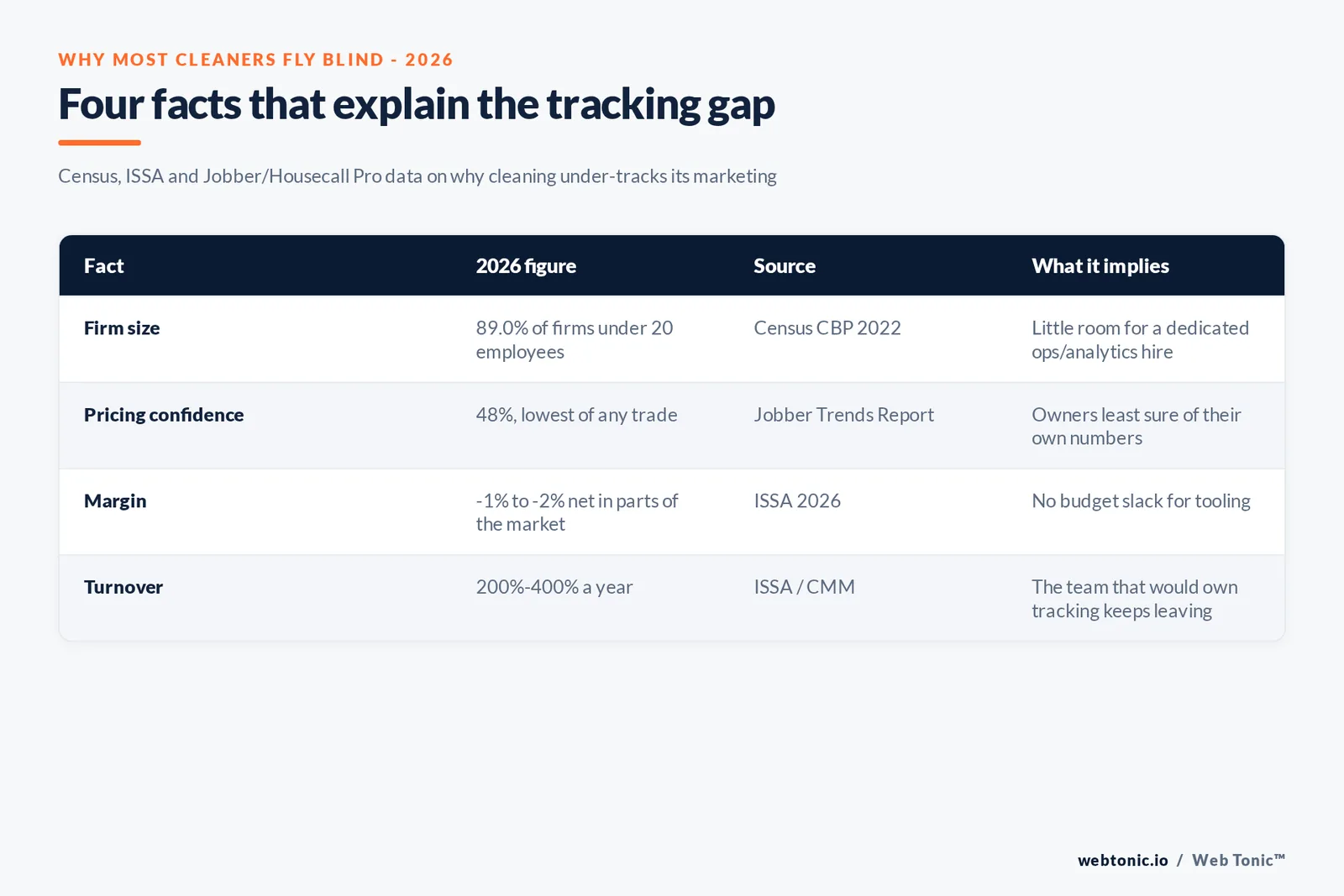
None of this proves any single cleaning company is or isn't tracking its marketing; it shows why the base rate probably runs low. A market with 89% of firms under 20 employees, negative margins in places, and 200%-plus annual staff turnover is a market where "install call tracking and connect it to a dashboard" competes for time against payroll, hiring, and same-week cash flow. The 20% cost-per-lead penalty CallRail measured is the argument for doing it anyway; the Census and ISSA numbers are the argument for why so many haven't yet.
A cleaning operator reading this with growth ambitions -- Jobber's data shows the segment growing revenue every month of Q2 2026, up 7.6% year over year in June -- has a specific, cheap first move: call tracking numbers per channel, which is the one piece of the stack every cited source agrees moves the cost-per-lead number, not a guess about whether AI adoption is 43% or lagging.
| Growth signal, cleaning segment (Jobber Q2 2026 Economic Report) | Figure |
|---|---|
| Median revenue growth, June 2026, year over year | +7.6% |
| Segment status through Q2 2026 | Grew revenue every month of the quarter |
| Driver cited | Rising invoice sizes and repeat/loyal customers |
What a minimum-viable tracking stack looks like for this industry
Given the margin and staffing constraints above, the realistic goal for most cleaning operators is not a full business-intelligence rollout, it is three connected pieces: a call tracking number per marketing channel, a CRM (Jobber or Housecall Pro are the two platforms cited throughout this page) that already logs jobs and revenue, and one dashboard that joins the two so cost per lead is visible without a spreadsheet. CallRail's research above ties the first piece directly to a 20% cost-per-lead reduction; the second and third pieces are what make that number visible at all, since neither platform natively reports blended marketing cost per lead without being connected to a tracking source.
The order matters for a cash-constrained operator: call tracking is the cheapest of the three and the one every source above ties to a measured dollar figure, so it is the reasonable first purchase, before a full dashboard build.
| Minimum-viable tracking stack, in priority order | Why this order |
|---|---|
| 1. Call tracking numbers per channel | Only piece with a directly measured 20% CPL reduction (CallRail) |
| 2. CRM already in use (Jobber / Housecall Pro) | Most cleaning firms already have one; the gap is connecting it, not buying a new one |
| 3. One blended cost-per-lead dashboard | Turns the first two into a number an owner can act on weekly |
Where to go from here
Our data intelligence practice builds the attribution layer -- call tracking, CRM-to-ad-platform connections, and a real dashboard -- that CallRail's own research ties to a lower cost per lead. Our growth marketing practice sits on top of that same data once it exists. For the paid-media side that tracking is meant to measure, our breakdown of what Google Ads actually costs is a useful companion read before setting a 2026 budget.
Frequently Asked Questions
Is it true that most cleaning businesses don't track their marketing?
No single study puts an exact percentage on it, but the surrounding evidence points the same direction. The U.S. Census Bureau's 2022 County Business Patterns data shows 89.0% of janitorial-services firms employ fewer than 20 people, and Jobber's 2026 Home Service Trends Report, a survey of over 1,000 home service owners, found cleaning pros report the lowest pricing confidence (48%) and the widest close-rate uncertainty of any trade surveyed. Small, uncertain-of-their-numbers operations are the least likely to have call tracking or attribution software installed, even though none of these sources measured that adoption rate directly.
What does it actually cost a cleaning business to not track leads?
CallRail's own research, published in its home services marketing toolkit, states that businesses with no way to attribute calls to a source see 10% fewer leads for the same spend, and that businesses that don't track leads at all pay 20% more per lead than ones that do. Neither figure is cleaning-specific; both are CallRail's cross-industry home services findings, and this page labels them as such throughout.
Does cleaning lag or lead the home service industry on tracking-adjacent technology like AI?
The two most-cited 2026 surveys disagree, and the disagreement itself is informative. Jobber's 2026 Home Service Trends Report (1,000+ owners) found cleaning and lawn care 'lag behind' on AI adoption. Housecall Pro's Spring 2025 AI Industry Report (400+ owners) found the opposite: cleaning led every trade surveyed at 43% active AI use, ahead of plumbing (40%) and HVAC (38%). Different platforms, different customer bases, different survey windows. Read both, and treat neither as the final word on where cleaning sits.
What's the fastest first tracking step for a cleaning business with none in place?
Call tracking numbers on each marketing channel, because phone is still how most local service leads arrive and it is the single most measurable gap. CallRail's own data above ties the absence of that step directly to a 10% volume loss and a 20% cost penalty. A second, cheap step is connecting whatever CRM or invoicing tool is already in place (Jobber, Housecall Pro) to a reporting view, since Wistia's 2026 State of Video Report separately found under half of all marketers connect video platforms to a CRM at all, a broader pattern of disconnected data that shows up across service verticals, cleaning included.
Is cleaning's technology gap explained by the industry's economics?
Largely, yes. ISSA's 2026 State of the Industry briefing put janitorial net margins at negative 1% to 2% in some segments, with labor absorbing 80% to 90% of cost and turnover running 200% to 400% a year. A business running on margins that thin, in a market Census counts at 62,970 firms (2022 SUSB), rarely has budget left for a dedicated ops or marketing-analytics hire, which is a structural reason tracking adoption lags even where the ROI case is clear.
Sources
CallRail - Building the Home Services Marketing Toolkit
U.S. Census Bureau - County Business Patterns datasets
Jobber - 2026 Home Service Trends Report
Jobber - Home Service Economic Reports
Housecall Pro - AI Industry Report, Spring 2025
ISSA - State of the Industry, 2026
IBISWorld - Janitorial Services industry summary, 2026
Wistia - 2026 State of Video Report