Table of contents
The one cleaning-specific social media figure that actually exists comes straight from TikTok's own newsroom: over 78 billion views logged under #CleanTok. Everything else on this page - the format preferences, the session-time data - is cross-platform benchmark data, clearly labeled, because no vendor publishes a cleaning-only breakdown of engagement rate or reach the way TikTok has publicly stated its own hashtag total.
Key Takeaways
- #CleanTok has logged over 78 billion views, per TikTok's own newsroom.
- 60% of TikTok users say short-form video is their most-engaged format, the highest share of any platform Sprout Social tracked.
- 52% of Instagram users and 52% of YouTube users favor short-form video equally.
- 48% of Facebook users now say short-form video is what they engage with most.
- Only 27% of LinkedIn users favor short-form video - the weakest fit of the platforms measured.
- TikTok users average 9.05 monthly app-session hours, second only to YouTube's 11.32.
- Facebook users average 5.15 monthly app-session hours, ahead of Instagram's 4.41.
- TikTok and Unilever's #CleanTok partnership ran across 10 countries and 40 weeks of dedicated content.
- The US janitorial and cleaning services market is worth USD 112.4 billion in 2026, the commercial backdrop this attention sits against.
- 97% of consumers still read reviews before choosing a local business, a signal social proof content feeds directly.
- The FTC's ban on fabricated testimonials has applied since October 21, 2024, covering video captions the same as written reviews.
#CleanTok is real; a cleaning-specific engagement-rate benchmark is not
TikTok's own newsroom, announcing a global partnership with Unilever, states the #CleanTok community has logged over 78 billion views to date and describes it as one of the platform's most entertaining and engaged genres. That is a real, TikTok-stated figure - not a third-party estimate - and it is the strongest evidence available that cleaning content specifically, not just home-and-garden content broadly, has outsized organic reach on the platform.
What TikTok has not published is a per-post engagement rate or reach figure specific to cleaning content, so this page does not invent one. The format-preference and session-time data below come from Sprout Social's cross-platform 2026 research and are presented as the closest available proxy for where that reach is likely to compound.
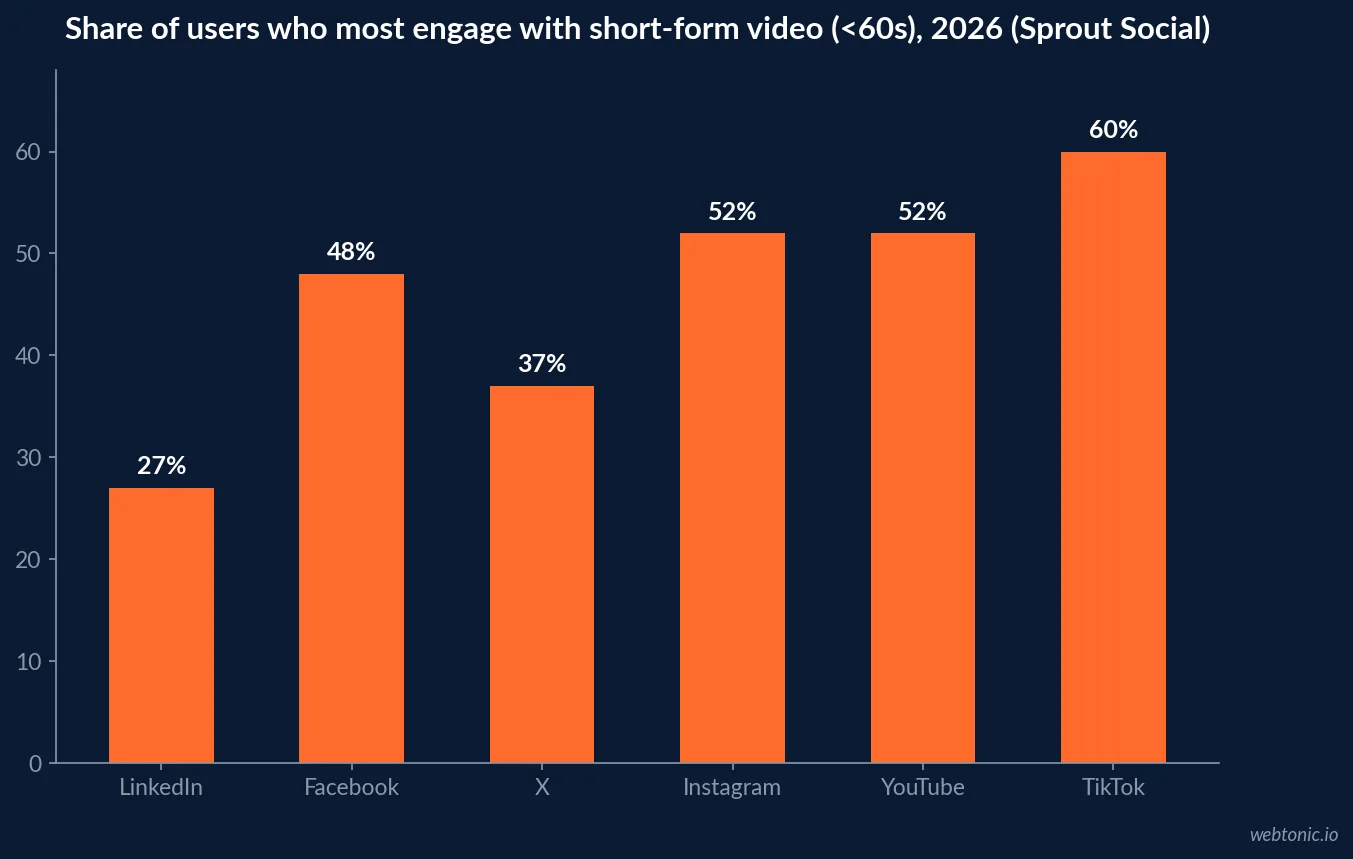
| Platform | Share favoring short-form video (<60s), 2026 | Best-performing content type |
|---|---|---|
| TikTok | 60% | Short-form video (native format) |
| 52% | Short-form video, then UGC/influencer content | |
| YouTube | 52% | Short-form video, with 49% still favoring long-form |
| 48% | Short-form video, then text posts (32%) | |
| X | 37% | Short-form video, narrowly ahead of text posts (36%) |
| 27% | Still text-post dominant |
Session time is the other half of the reach story
Format preference only matters if people are actually spending time on the platform. Sprout Social's 2026 video statistics report measured average monthly app sessions in the US as of August 2025: YouTube at 11.32 hours, TikTok at 9.05 hours, Facebook at 5.15 hours, and Instagram at 4.41 hours. A platform that both prefers short-form video and holds attention longer - which TikTok does relative to Facebook and Instagram - is structurally the better home for a before-and-after cleaning clip, independent of any cleaning-specific benchmark.
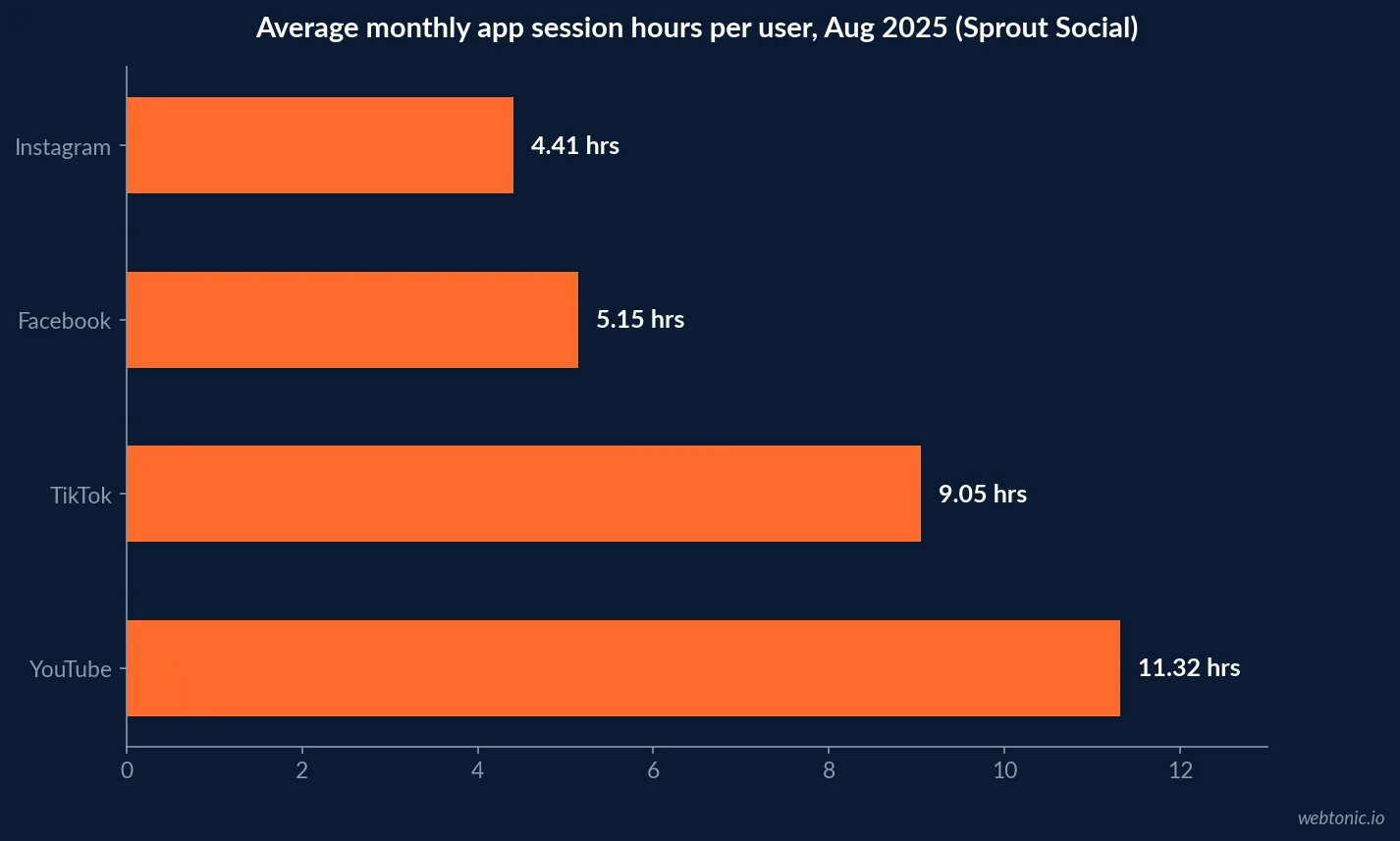
| Platform | Avg. monthly app-session hours, Aug 2025 | Rank |
|---|---|---|
| YouTube | 11.32 | 1st |
| TikTok | 9.05 | 2nd |
| 5.15 | 3rd | |
| 4.41 | 4th |
What the partnership tells cleaning brands that don't have Unilever's budget
The Unilever-TikTok #CleanTok partnership ran co-created content across 10 countries over a 40-week program, per TikTok's own announcement. A single independent cleaning business obviously cannot replicate that scale, but the partnership itself is evidence of what TikTok has already validated works in the category: cleaning hacks, "clean with me" formats, and satisfying transformation content, all formats an individual crew can produce with a phone and a real job.
The commercial backdrop makes the audience worth pursuing: IBISWorld sizes the US janitorial services market at USD 112.4 billion in 2026, and ISSA counts roughly 1.23 million competing businesses - most of whom are not yet posting into a genre TikTok has already proven gets watched.
| Fact | Figure | Source |
|---|---|---|
| #CleanTok total views logged | 78 billion+ | TikTok Newsroom |
| Unilever #CleanTok partnership countries | 10 | TikTok Newsroom |
| Partnership program length | 40 weeks | TikTok Newsroom |
| US janitorial services market size, 2026 | USD 112.4 billion | IBISWorld |
Visual proof still has to earn trust, not just views
A viral transformation clip and a Google review are answering the same underlying question for a prospective customer: can I trust this crew in my home. BrightLocal's 2026 Local Consumer Review Survey found 97% of consumers still read reviews before choosing a local business, and generative AI tools have jumped from 6% to 45% usage as a source of local recommendations year over year - both signs that social proof, whether written or filmed, keeps compounding in influence rather than fading as video content grows.
The compliance line is the same one that applies to every other channel on this site: the FTC's rule on consumer reviews and testimonials, enforceable since October 21, 2024, applies to a spoken customer testimonial in a TikTok video exactly as it applies to a written review - it has to be real and attributable, not staged or purchased.
The content formats #CleanTok has already proven, without an ad budget
TikTok's own newsroom names the specific content series it built with Unilever - a "Festival of Cleaning" editorial series featuring the platform's top creator-generated cleaning content, tailored to local trends within each of the 10 partner countries. That is a direct signal of which formats TikTok itself considers strong enough to co-brand around: satisfying "clean with me" sessions, transformation reveals, and professional-tip content, all formats that require a phone and a real job rather than production budget.
A cleaning business does not need a brand partnership to use the same formats. The organic reach #CleanTok already demonstrates - 78 billion-plus views logged with no paid distribution behind that total - is the strongest argument that posting real job footage consistently outperforms polished but generic content for this specific category.
Where paid social still has a role, honestly framed
None of the figures above are paid-media benchmarks, and this page keeps that distinction deliberate. Meta's own advertising benchmarks for the broader Home & Home Improvement category show a category that pays a near-top-three cost per click and converts leads at one of the lowest rates Meta tracks, per WordStream's 2025 Facebook Ads Benchmarks report. Strong organic social content does not fix that paid-media pattern by itself, but a library of proven before-and-after clips is exactly the creative raw material a paid campaign needs to test against that weak baseline.
The honest sequence is organic first, to build and validate the content formats an audience actually watches, then paid second, to put budget behind the clips that already proved themselves organically rather than guessing at creative from scratch. Our performance creative practice handles exactly that hand-off.
What the format data means for a commercial vs. residential audience
The platform data above skews toward a residential, consumer audience - the same audience #CleanTok itself is built for. A cleaning business selling commercial or janitorial contracts to facility managers and property managers is targeting a different, more LinkedIn-native buyer, and 27% LinkedIn short-form preference is the honest ceiling for that channel's visual content, not a reason to abandon it. LinkedIn's value for a B2B cleaning brand is closer to case studies and compliance credentials than transformation clips.
The practical split: run before-and-after video content on TikTok, Instagram and Facebook to reach and convert residential prospects, and reserve LinkedIn for the commercial side of the business where a facility manager is evaluating a vendor relationship, not a single job.
| Audience | Best-fit platform (by format data above) | Content type |
|---|---|---|
| Residential homeowners | TikTok, then Instagram/Facebook | Before-and-after transformation clips |
| Facility & property managers | Case studies, credentials, compliance detail | |
| Existing customers (retention) | Facebook, Instagram | Seasonal reminders, behind-the-scenes crew content |
A realistic content mix for a cleaning brand's social calendar
Given the data above, the highest-leverage mix is short-form before-and-after clips built for TikTok first and repurposed to Instagram Reels and Facebook second, since both platforms already show short-form video as their top-engaged format. LinkedIn is worth skipping for this content type specifically - its audience still rewards text, and its short-form share is the lowest measured - unless the target is B2B facility managers rather than residential customers, a distinction covered in our commercial-cleaning content planning work.
If social content needs to connect to a measurable pipeline instead of just views, our performance creative practice builds that testing structure, our guide to social ad partners covers how organic content and paid social should hand off to each other, and our growth marketing practice connects the content calendar to the booking funnel behind it.
Frequently Asked Questions
Is #CleanTok organic content or paid advertising?
Organic. The 78 billion-plus view figure logged by TikTok's own newsroom describes user-generated and creator content posted under the hashtag, not paid ad spend. A cleaning business can post into that organic conversation for free; running a paid campaign on TikTok is a separate line item with its own targeting and creative rules, and this page keeps the two clearly separate.
Which platform is actually the best fit for before-and-after cleaning content?
By engagement format alone, TikTok: 60% of TikTok users say short-form video under 60 seconds is their most-engaged content type, per Sprout Social's 2026 Content Strategy Report, ahead of Instagram and YouTube at 52% each. LinkedIn is the weakest fit for this content type at 27%, because its audience still favors text posts.
Does a strong TikTok or Instagram presence replace the need for Google Business Profile or Meta ads?
No - they answer different questions. Social platforms build discovery and brand affinity around visual proof of work; Google Business Profile and Local Services Ads capture someone actively searching for a cleaner near them right now. The two channels compound each other but do not substitute for one another.
Can a cleaning business legally use customer testimonials in social video content?
Yes, if the testimonial is real and attributable. The FTC's 2024 rule on consumer reviews and testimonials, enforceable since October 21, 2024, bans fabricated reviews, undisclosed insider testimonials, and reviews incentivized by outcome - all of which apply equally to a TikTok caption or an Instagram Reel as they do to a written review.
How much time do people actually spend on the platforms cleaning content lives on?
TikTok users average 9.05 monthly app-session hours as of August 2025, per Sprout Social, second only to YouTube at 11.32 hours and well ahead of Facebook (5.15) and Instagram (4.41). That session depth is part of why a single viral before-and-after clip on TikTok can reach a disproportionate audience compared to the same clip on a lower-session platform.
Sources
TikTok Newsroom - Unilever and TikTok announce global #CleanTok partnership
Sprout Social - 60+ Social Media Video Statistics To Know in 2026
BrightLocal - Local Consumer Review Survey 2026
IBISWorld - Janitorial Services industry report, 2026
ISSA - The state of the cleaning and facility solutions industry, 2026
Federal Trade Commission - Trade Regulation Rule on Consumer Reviews and Testimonials
Federal Register - Final rule text, consumer reviews and testimonials