Table of contents
No published benchmark isolates email performance for the cleaning industry, so this page compares Mailchimp's closest 2026 category figures against what home-service platforms themselves report about automated versus manually remembered follow-up. The honest read is that the email metrics are cross-industry; the automation-adoption figures are the real, home-service-specific data.
Key Takeaways
- The all-user average email open rate is 35.63% across Mailchimp's tracked industries in 2026.
- The all-user average click rate is 2.62%.
- Non-Profits open at 40.04%, the highest of the categories closest to service-business use cases.
- Ecommerce opens at just 29.81%, the lowest of the comparable categories.
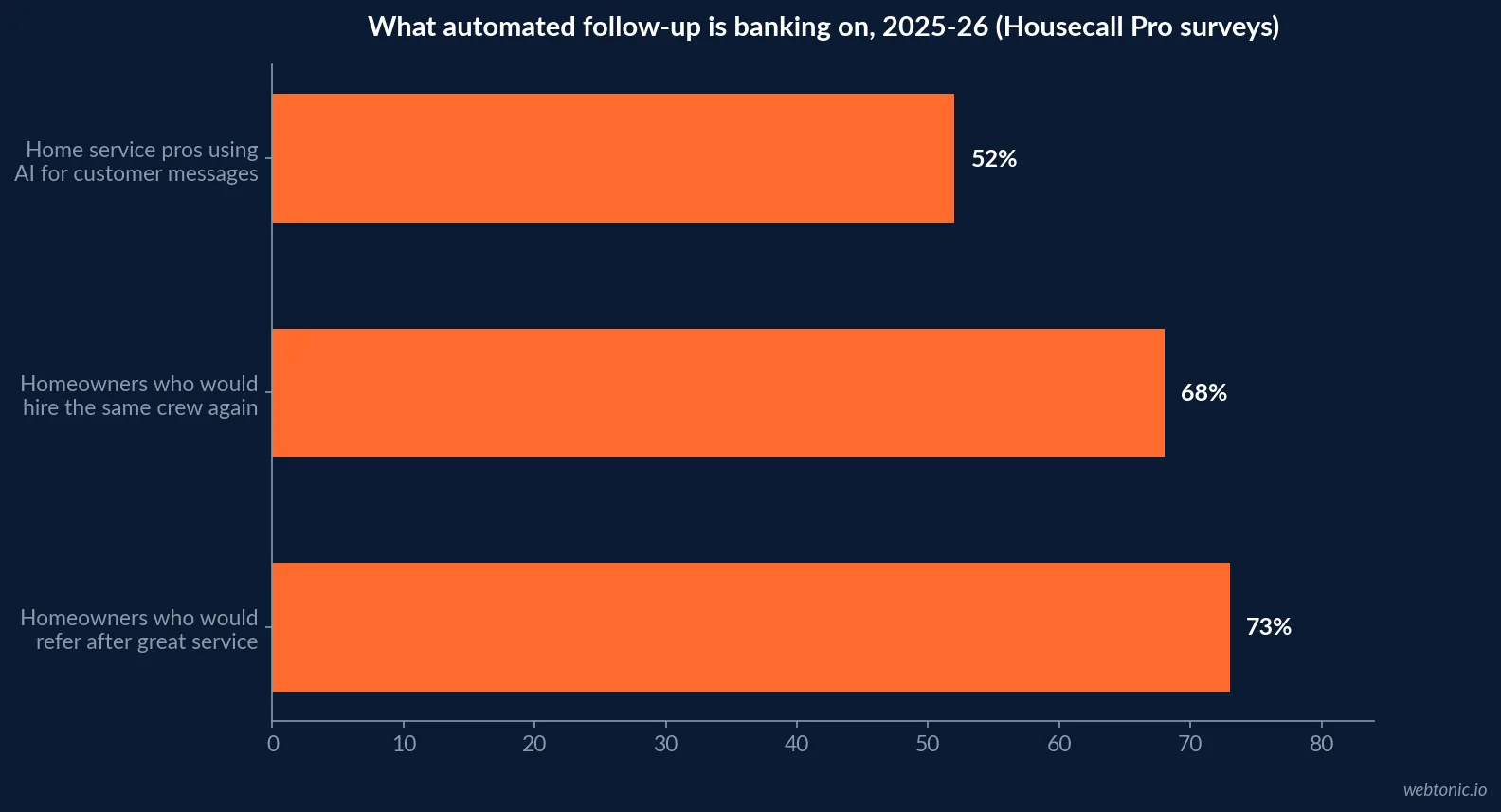
- 73% of homeowners would refer a business after excellent service, per Housecall Pro's 2025 survey - if asked.
- 68% say they would hire the same company again.
- 52% of home service pros using AI use it for customer communication, per Housecall Pro's 2026 survey.
- ServiceTitan's automated package shows call booking rates up over 500 basis points versus peers.
- Close rates are up over 1,000 basis points on that same automated package.
- Cleaning businesses grew revenue 7.6% year over year by June 2026, per Jobber's Home Service Economic Report.
- Every major home service segment returned to revenue growth by June 2026, driven by pricing discipline, not just new leads.
- Digital payments in home services grew 6% year over year in Q2 2026.
- The FTC's ban on incentivized reviews has applied since October 21, 2024, ruling out pay-for-review automation.
Why there's no cleaning-industry email benchmark
Mailchimp's email marketing benchmarks are calculated from billions of tracked sends across roughly 38 industry categories the platform's users self-report - Business & Finance, Education & Training, Ecommerce, Non-Profits, and similar broad groupings. There is no "Cleaning Services" or "Home Services" category in that list, so any number attributed to the cleaning industry specifically would be invented. What this page uses instead is the all-user average and the handful of categories closest in structure to a service business - subscription-style recurring contact, not one-off transactional receipts.
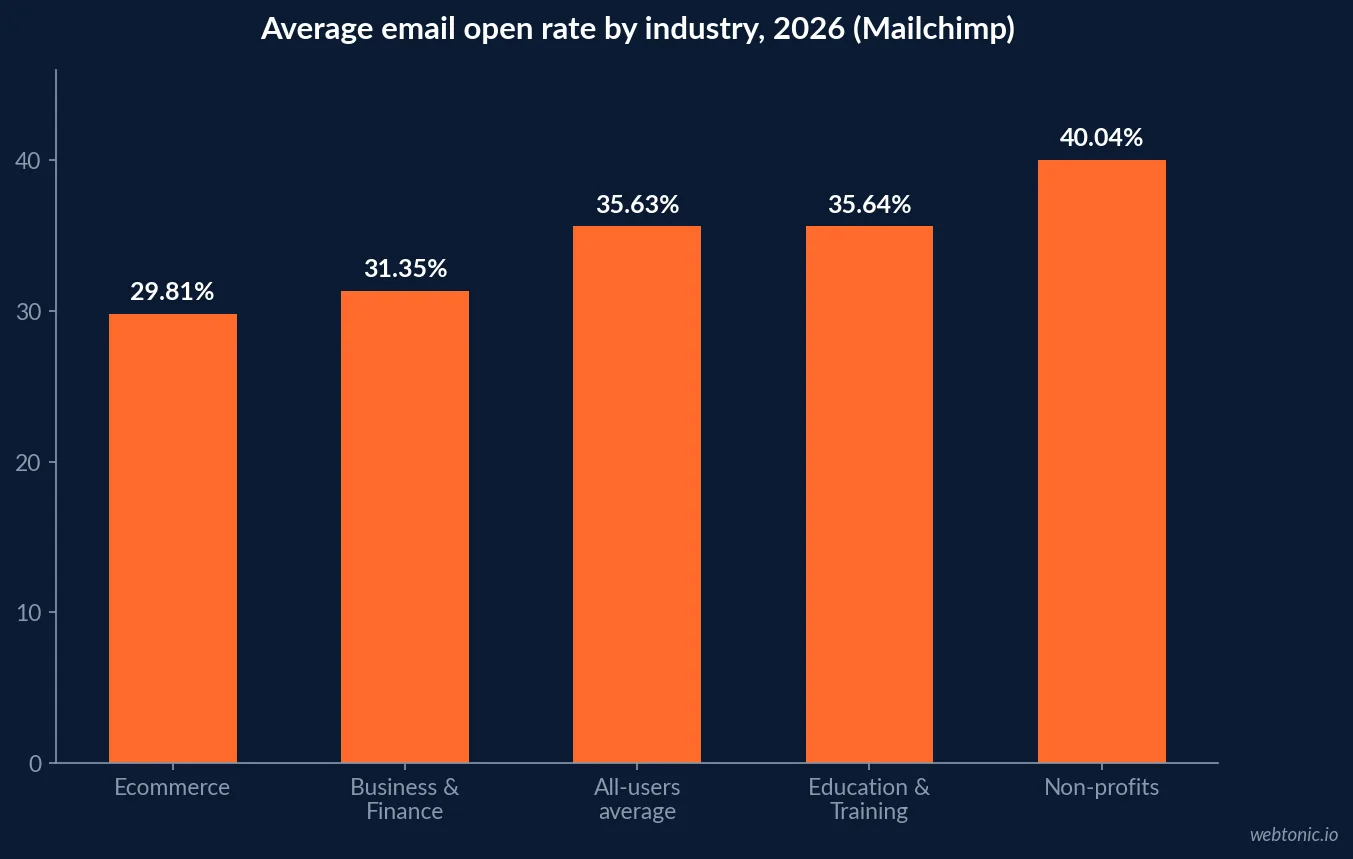
| Email metric, 2026 (Mailchimp) | Category | Value |
|---|---|---|
| Open rate | All users | 35.63% |
| Open rate | Non-Profits | 40.04% |
| Open rate | Education & Training | 35.64% |
| Open rate | Business & Finance | 31.35% |
| Open rate | Ecommerce | 29.81% |
| Click rate | All users | 2.62% |
| Unsubscribe rate | All users | 0.22% |
What the manual version of this channel actually loses
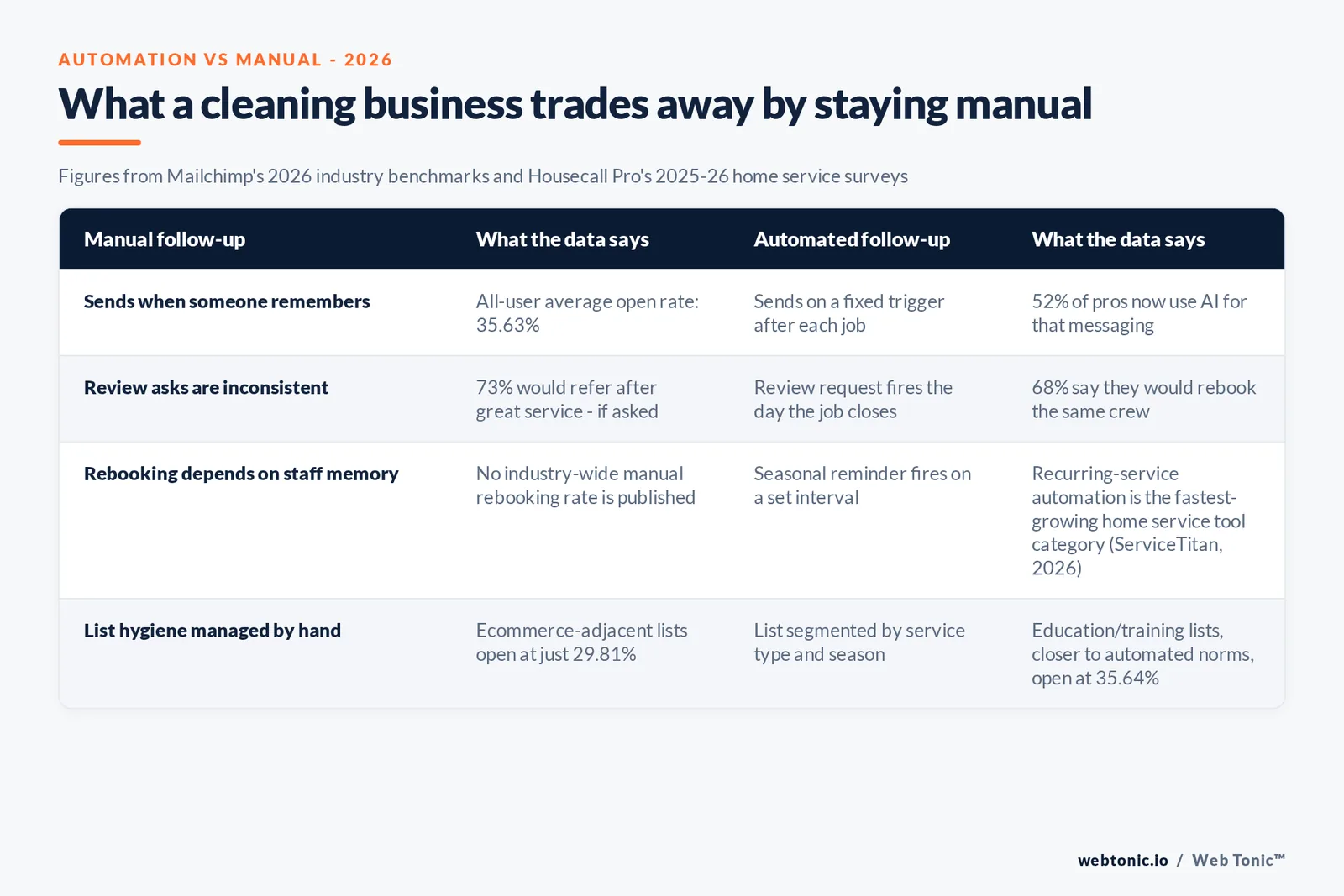
The gap this article's title points to isn't between two email platforms - it's between a message that fires on a trigger and one that depends on a person remembering. Housecall Pro's 2025 survey of home service customers found 73% would refer a business after excellent service and 68% say they'd hire the same company again - both conditional on being asked. A manual process asks inconsistently, whenever staff has time; an automated one asks the same way, every time, the day the job closes.
The same resource reports that 52% of home service pros who use AI use it specifically for customer communication, per Housecall Pro's 2026 survey - the clearest signal yet that this shift is already underway across the category, cleaning included, even without a cleaning-only breakout.
| Follow-up trigger | What it replaces (manual) | Source |
|---|---|---|
| Review request on job-complete | Staff remembering to ask after each job | Housecall Pro |
| Payment reminder on invoice overdue | A phone call or a second invoice mailed late | Housecall Pro |
| Seasonal rebooking prompt on last-service-date | A calendar note that gets missed during busy weeks | Housecall Pro |
| AI-assisted response drafting | A manually typed reply to every inbound message | Housecall Pro 2026 survey |
The revenue context automation is competing inside
Jobber's Home Service Economic Report for Q2 2026, drawn from more than 100,000 home and commercial service businesses, found cleaning businesses growing revenue 7.6% year over year by June 2026, with every major home-service segment returning to growth on the strength of pricing discipline rather than lead-volume growth alone. Digital payments across the category grew 6% year over year in the same quarter.
That matters for the automation-vs-manual question because a business growing on pricing, not volume, gets more value from retaining and rebooking existing customers than from chasing new leads - exactly what the review-request and rebooking-prompt triggers above are built to do.
| Home service economic fact, Q2 2026 | Figure | Source |
|---|---|---|
| Cleaning segment revenue growth, year over year (June) | 7.6% | Jobber |
| Green (lawn/landscaping) segment revenue growth | 7.5% | Jobber |
| Construction segment revenue growth | 9.1% | Jobber |
| Digital payments growth, year over year | 6% | Jobber |
Where ServiceTitan's aggregate automation data fits in
ServiceTitan's own release on its Max automation package reports call booking rates up over 500 basis points and close rates up over 1,000 basis points versus peer businesses not running the automated package. That data spans the trades broadly rather than cleaning in isolation, and ServiceTitan is reporting on its own product's aggregate performance, which this page states plainly rather than implying a cleaning-specific result.
Read conservatively, it is still directional evidence that trigger-based automation outperforms ad hoc manual follow-up in the same category of business the email benchmarks above cover.
The one compliance line automated review requests can't cross
The FTC's rule on consumer reviews and testimonials, enforceable since October 21, 2024, bans incentivizing reviews conditioned on sentiment - offering a discount specifically for a positive review, for example. An automated review-request sequence is fine; an automated sequence that only follows up with customers who rated the job highly, or dangles an incentive for a 5-star review, is exactly the practice the rule targets.
Why click rate matters more than open rate for a cleaning business's list
Open rate gets most of the attention, but Mailchimp's own guidance is that click-through rate is the metric that reflects whether the message actually moved someone to act - book a slot, pay an invoice, leave a review - rather than just glance at a subject line. The all-user average click rate of 2.62% sits inside Mailchimp's own reported range of 1% to 5% depending on industry, and a cleaning business benchmarking itself against the all-user average rather than an invented cleaning-specific number at least starts from an honest baseline.
The unsubscribe rate matters just as much for a service business with a small, high-value list: the all-user average is 0.22%, and a cleaning company sending seasonal rebooking prompts to the same few hundred repeat customers loses far more by triggering unsubscribes with irrelevant sends than it gains from one extra promotional email.
| Why the metric matters | All-user 2026 figure (Mailchimp) | What it signals for a cleaning list |
|---|---|---|
| Open rate | 35.63% | Subject line and sender name recognition |
| Click rate | 2.62% | Whether the message content drove an action |
| Unsubscribe rate | 0.22% | Whether send frequency and relevance are calibrated |
| Mailchimp's stated optimal click rate range | 1%-5% | The honest cross-industry band to benchmark against |
List size and personalization trade off, and small crews should lean into it
Constant Contact's internal data found that campaigns sent to 35 subscribers or fewer - the kind of list size a single-crew cleaning business would realistically have - averaged an open rate around 55%, while campaigns sent to more than 7,500 subscribers averaged only about 14%. A small, well-known list is not a disadvantage in this channel; it is the reason a personal, locally-recognized sender name often outperforms a scaled Ecommerce sender at 29.81% open rate.
The same source found top-performing customers emailing three times a week reach open rates around 48% on average, evidence that consistent, automated cadence beats sporadic manual sends even on the open-rate metric that gets the most scrutiny.
A simple sequence to automate first
Start with the three triggers Housecall Pro documents as most common - job complete, invoice overdue, payment received - because each maps to a real behavior stat above, then layer in a seasonal rebooking email tied to the last service date. None of this requires a new platform for most cleaning businesses; it requires turning on sequences most CRMs and field-service platforms already support.
If email sits inside a broader retention and growth stack, our data and analytics practice builds the trigger logic and reporting behind it, our guide on choosing an email marketing partner covers what to look for beyond the platform itself, and our growth marketing practice ties the rebooking sequence above into the rest of a retention program.
Frequently Asked Questions
Does Mailchimp publish a cleaning-services email benchmark?
Not by name. Mailchimp's 2026 benchmarks report tracks metrics across roughly 38 general industry categories - Business & Finance, Ecommerce, Education & Training, Non-Profits and similar groupings - with no dedicated cleaning or home-services category. The all-user average open rate of 35.63% and click rate of 2.62% are the honest closest reference point, clearly labeled as cross-industry, not cleaning-specific.
What is the real difference between automated and manual follow-up for a cleaning business?
The trigger. A manual process depends on staff remembering to send a review request or a seasonal reminder; an automated one fires on a fixed event - job marked complete, invoice sent, payment received. Housecall Pro's own 2025 survey found 73% of homeowners would refer a business after excellent service and 68% would rebook the same company - but only if asked, and automation is what makes the ask happen every time instead of when someone remembers.
Is there published data on how much automation improves cleaning business revenue specifically?
Not isolated to cleaning. ServiceTitan's aggregate data on its Max automation package - across the trades broadly, not cleaning alone - reports call booking rates up over 500 basis points and close rates up over 1,000 basis points versus peers not on the automated package. That is directional evidence for the category, not a cleaning-specific number, and is labeled as such.
Are AI-written follow-up messages compliant to send?
The compliance risk in this channel isn't AI-generated copy - it's fabricated review content. The FTC's 2024 rule on consumer reviews and testimonials bans buying or incentivizing reviews conditioned on sentiment. An automated review-request email is compliant; an automated review-request email that offers a discount only for a 5-star review is not.
What should a cleaning business automate first?
The three triggers Housecall Pro documents as most common in home services: a review request sent the day a job is marked complete, a payment reminder if an invoice goes unpaid, and a seasonal rebooking prompt tied to the last service date. Each maps to a stat in this article, and none requires replacing a CRM - most home-service platforms already support trigger-based sequences.
Sources
Mailchimp - Email Marketing Benchmarks & Industry Statistics 2026
Housecall Pro - How to automate customer follow-up for home service businesses
ServiceTitan - Max drives AI-powered growth for contractors
Jobber - Home Service Economic Report, Q2 2026 (own report)
Constant Contact - How to improve your email open rate in 2026
Federal Trade Commission - Trade Regulation Rule on Consumer Reviews and Testimonials
Federal Register - Final rule text, consumer reviews and testimonials