Table of contents
Car shoppers are not on LinkedIn during a purchase decision, but fleet buyers, parts wholesalers and technician candidates are. No published study prices LinkedIn Ads specifically for car dealerships or powersports retailers, so this page separates the platform's real dealership use cases from consumer-shopper myths and applies the best available 2026 cross-industry benchmarks to each, labelling every cross-industry figure as such.
Key Takeaways
- 91% of thought leader ad clicks never reach a landing page (cross-industry).
- Median cross-industry cost per lead is $164 for a content offer.
- Demo-request leads median $343 across the same 2026 panel.
- A good landing page CTR is 0.67%, median 0.46%.
- Lead Gen Forms complete at 18.7% in the best accounts, median 10.8%.
- Commercial fleet sales rose 6.5% year over year through August 2026.
- 575,092 fleet vehicles sold through August 2026, per Automotive Fleet.
- Automotive technician supply meets only 42% of national demand.
- 241,842 annual technician openings across ten skilled trades.
- 71,000 technicians retire a year against fewer than 50,000 entering, per NADA.
- Powersports dealer lead response averages 44 out of 100, stalled for three years.
- Only 47% of powersports dealers answer a web question at all.
- Just 13% offer a specific appointment time to a web lead.
- Social media is 14.2% of dealership ad budgets in 2025, per NADA.
- Conversation ad open rates reach 48.8% in the best accounts.
- A good cost per landing page click is $8.37, median $14.71.
- Auto student completions fell 34% from their 2012 peak.
Who a dealership or powersports store actually reaches on LinkedIn
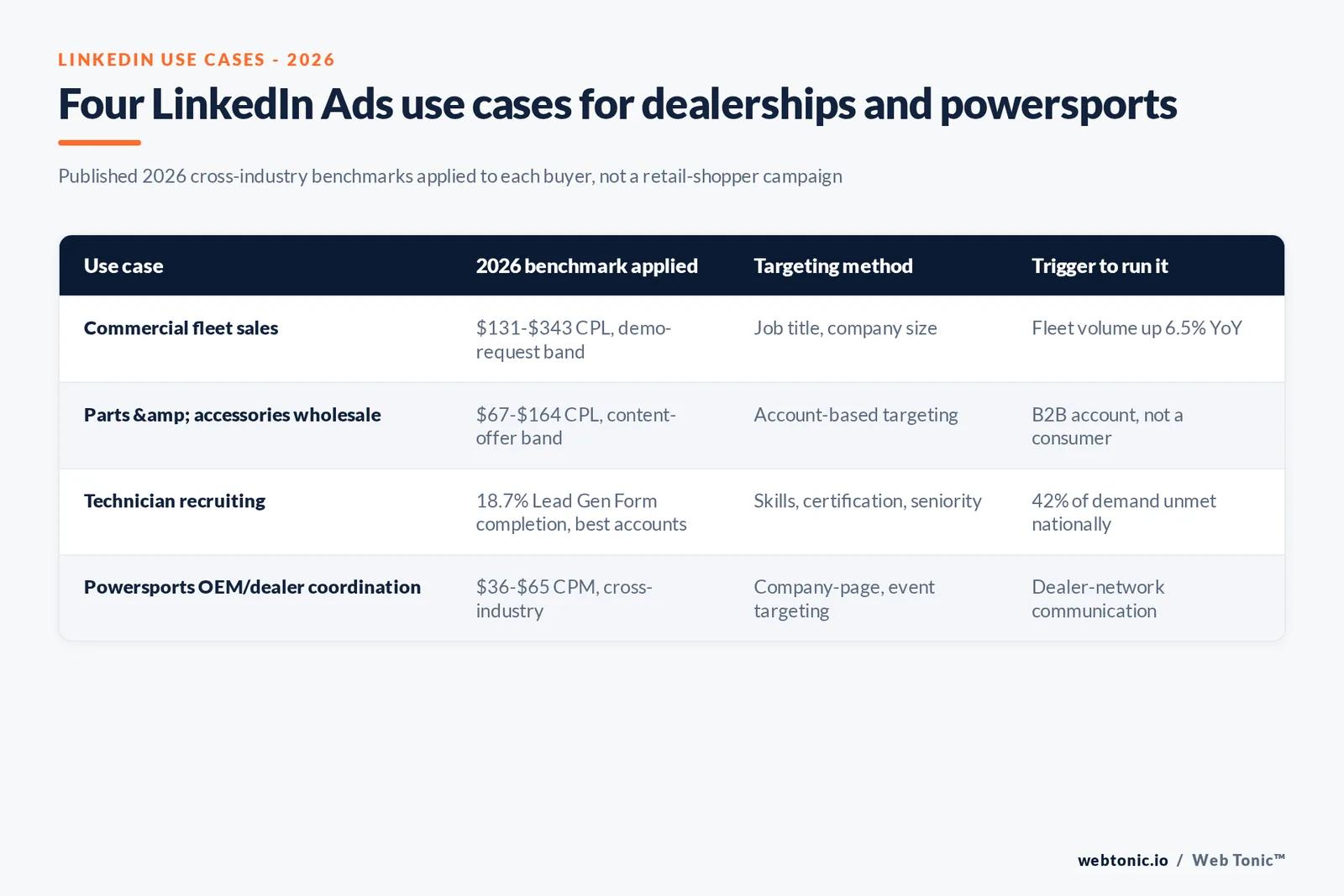
LinkedIn's audience is built from job titles and company data, not shopping intent, so the honest use cases for this pairing are narrow: commercial fleet purchasing managers buying trucks and vans for a company, parts and accessories wholesale accounts at other dealers or independent shops, OEM and dealer-group recruiters filling technician and sales roles, and powersports OEM channel partners coordinating with dealer networks. None of those buyers resemble a consumer browsing a used-truck listing on a Saturday.
That narrowness is not a weakness. It means every dollar spent should be pointed at one of these four use cases, never at general brand awareness for retail shoppers who are not there.
| Dealership/powersports LinkedIn use case | Who is targeted | What LinkedIn does well here | What it cannot do |
|---|---|---|---|
| Commercial fleet sales | Fleet/procurement managers | Job-title and company-size targeting | Cannot show local inventory |
| Parts & accessories wholesale | Shop owners, parts buyers | B2B account-based targeting | Weak for price-sensitive impulse buys |
| Technician recruiting | Certified techs, trade-school grads | Skills and seniority filters | Thin reach among newest graduates |
| Powersports OEM/dealer coordination | Dealer-network staff | Company-page and event targeting | Not a consumer discovery surface |
| General brand awareness | Retail car/powersports shoppers | Nothing distinctive | Consumers are not there for this |
The cross-industry cost benchmarks (no automotive-specific study exists)
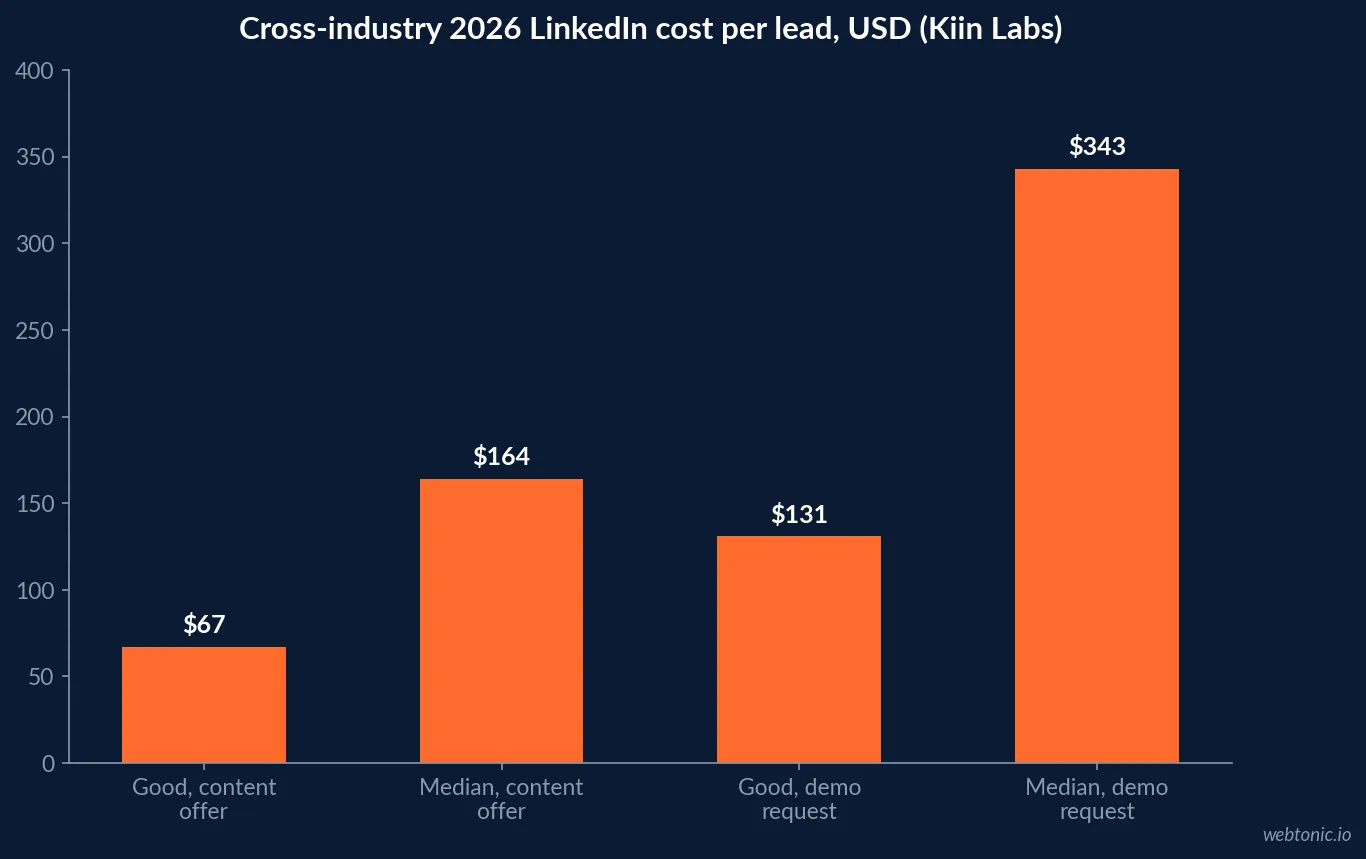
Kiin Labs' 2026 studies pool 1,000-plus advertiser accounts and $58 million of spend across every industry and objective from September 2025 to September 2026. No firm publishes a car-dealership or powersports-only cut of LinkedIn performance, so every number below is a cross-industry ceiling to plan against, not a quote for this pairing specifically.
A good cost per landing page click is $8.37 (median $14.71), a good CPM is $36 (median $65), and a good content-offer cost per lead is under $67 against a median of $164. Demo-request leads run higher: good is under $131, median $343. A fleet-sales campaign, which behaves like a demo request, should be judged against that second column, not the first.
| Metric (2026, cross-industry) | Good | Median | Which dealership use case it maps to |
|---|---|---|---|
| Cost per landing page click | $8.37 | $14.71 | All four use cases |
| CPM | $36 | $65 | Awareness-only spend (avoid for retail) |
| Landing page CTR | 0.67% | 0.46% | Wholesale/parts landing pages |
| Cost per lead, content offer | <$67 | $164 | Recruiting, wholesale accounts |
| Cost per lead, demo request | <$131 | $343 | Fleet sales, OEM coordination |
| Lead Gen Form completion | 18.7% | 10.8% | Recruiting forms, fleet inquiries |
Fleet sales is the strongest fit, and it is growing
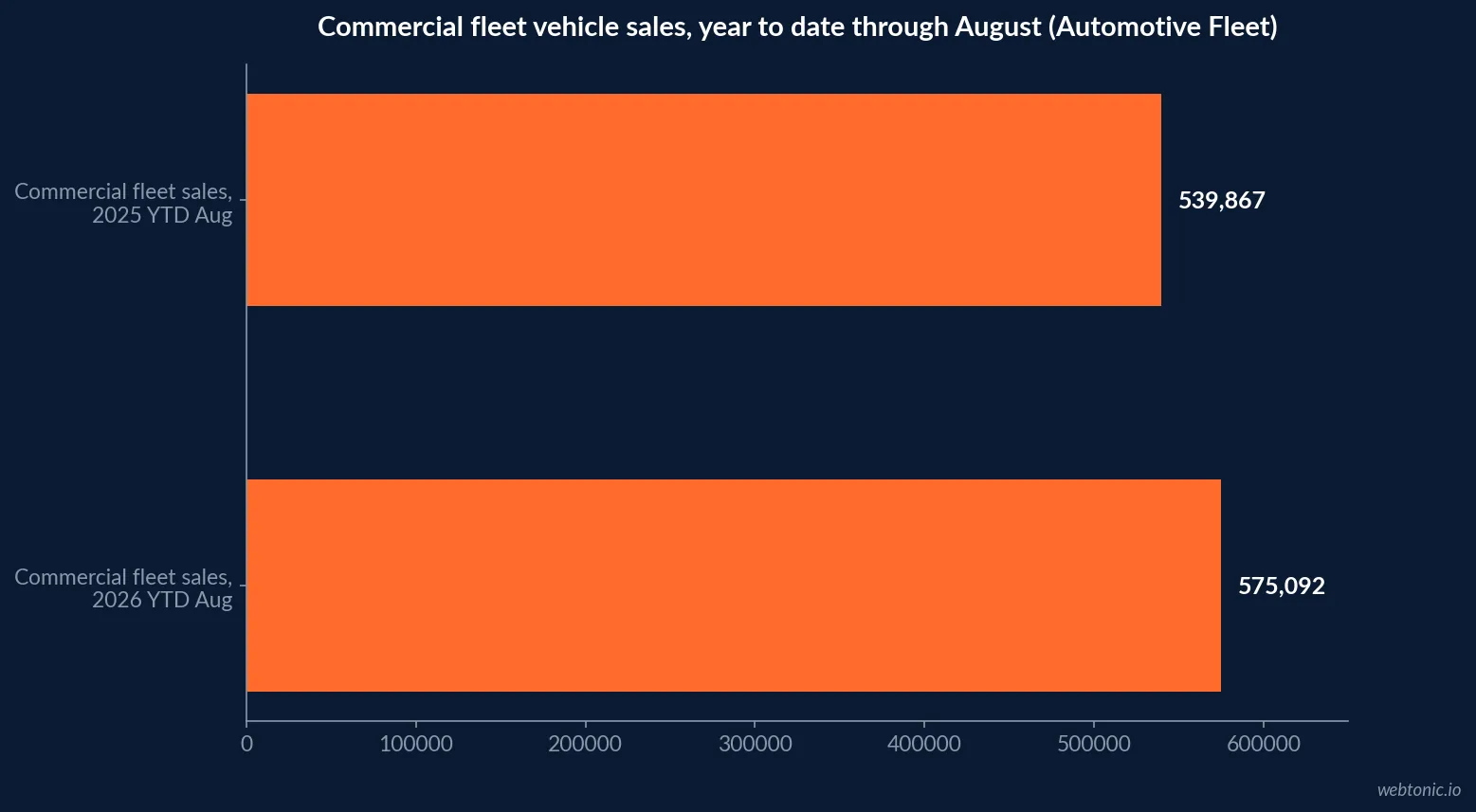
Commercial fleet volume is the one dealership revenue line that maps cleanly onto LinkedIn's B2B targeting. Automotive Fleet, tracking data from Bobit Business Media, reports comparable commercial fleet sales up 6.5% year over year through August 2026, reaching 575,092 vehicles against 539,867 a year earlier, and commercial fleet is now the largest single driver of growth across the commercial, government and rental segments combined.
That growth is concentrated among purchasing managers and small-business owners buying multiple units, exactly the seniority and function LinkedIn's targeting is designed to isolate. A dealership group running one narrowly scoped fleet campaign is closer to LinkedIn's core use case than any retail-shopper campaign will ever be.
A second panel says the same thing: response, not reach
ZenABM's 2026 LinkedIn ABM Performance Benchmarks Report, built from 211 B2B companies, 161,256 ads and $5.5 million in tracked spend across 29 countries, reports a median B2B company generating $5.21 in pipeline for every dollar spent on LinkedIn ads - a pipeline-to-spend read that only makes sense for a genuine B2B buyer such as a fleet account or a wholesale parts customer. Neither panel isolates automotive retail, which is exactly the point: two independent, cross-industry 2026 studies agree that LinkedIn pays off when the buyer is a company, and neither has ever measured a consumer vehicle shopper on the platform because that shopper is not there to measure.
Powersports Business, reporting separately on LeadVenture's dealer research, frames the same discipline for that vertical: dealerships "recognizing the shift and executing the fundamentals consistently are separating themselves from the competition," a framing that applies just as directly to a narrowly scoped B2B LinkedIn campaign as it does to a dealership website.
Where dealership ad budgets already sit, and where LinkedIn fits
NADA's most recent annual financial profile puts average dealership advertising spend at $586,246 a year, split across search engine marketing (21.1%), third-party listing sites (20.0%), SEO and website optimization (19.5%), social media advertising at 14.2%, TV (10.5%), radio (6.9%), direct mail (5.6%) and newspaper (2.1%). LinkedIn is not broken out separately inside that social line, and NADA does not publish a platform-level split, which is itself evidence that most dealership social spend is going to consumer platforms, not LinkedIn.
The practical read: LinkedIn should be funded as a distinct fleet-and-recruiting line item pulled from that 14.2% social allocation or from a recruiting budget, never folded into a consumer social campaign where its B2B targeting is wasted.
| Ad spend line (NADA, 2025 avg. dealership) | Share of $586,246 budget | Dollar amount | LinkedIn relevance |
|---|---|---|---|
| Search engine marketing | 21.1% | $123,698 | None - consumer intent |
| Third-party listing sites | 20.0% | $117,249 | None - inventory discovery |
| SEO and website optimization | 19.5% | $114,318 | None - organic consumer search |
| Social media advertising | 14.2% | $83,247 | Fleet/recruiting sub-line only |
| TV | 10.5% | $61,556 | None - broad consumer reach |
| Radio | 6.9% | $40,451 | None - broad consumer reach |
The technician shortage is the strongest hiring case
TechForce Foundation's ninth annual workforce report, drawn from federal IPEDS and BLS data across ten skilled-trade sectors, finds 241,842 annual technician job openings against just 101,743 completions nationally, meaning supply meets barely 42% of demand and the gap costs $7.42 billion in lost wages annually. Auto-specific completions fell 34% from their 2012 peak, the largest single-year drop on record. Separately, NADA has cited a figure of 71,000 technicians retiring each year against fewer than 50,000 entering the trade.
LinkedIn's skills, certification and seniority filters were built for exactly this kind of recruiting problem. No comparable channel lets a service department target "ASE-certified technician, 2-5 years experience, within 25 miles" the way LinkedIn does.
| Technician workforce fact (TechForce/NADA, 2026) | Figure | What it means for hiring ads |
|---|---|---|
| Annual technician openings, 10 sectors | 241,842 | Demand LinkedIn recruiting ads compete for |
| Annual completions, 10 sectors | 101,743 | Supply pool a job post reaches |
| Demand met by supply | 42% | 58% of roles have no qualified applicant pipeline |
| Auto student completions vs. 2012 peak | -34% | Fewer entry-level candidates every cycle |
| Technicians retiring per year (NADA) | 71,000 | Baseline attrition a recruiting budget must offset |
| New entrants per year (NADA) | <50,000 | Net annual shortfall against retirements |
Powersports has its own, worse lead-response problem
Pied Piper's 2026 Internet Lead Effectiveness study submitted real customer inquiries to 2,133 powersports dealership websites across every major brand. The industry-wide average response score has been stuck in the mid-40s for five straight years, landing at 44 out of 100 in 2026. Only 47% of dealers answered a customer's question by email or text, just 13% offered an appointment for a specific date and time, and more than half of all inquiries went unanswered after 24 hours.
Separately, LeadVenture's State of the Dealer research across 6,800-plus dealerships found paid search cost per click up 19.3% in 2025 while click-through and conversion rates fell, and that the top 10% of stores generate 4.5 times more leads than average by fixing response failures, not by outspending competitors. Any LinkedIn budget aimed at powersports recruiting or B2B accounts is wasted if the same response gap sits on the receiving end of the lead.
| Powersports lead-response metric (Pied Piper/LeadVenture 2026) | Figure |
|---|---|
| Industry-wide average ILE score | 44 / 100 |
| Years stuck in the mid-40s | 5 |
| Dealers answering a web question | 47% |
| Dealers offering a specific appointment | 13% |
| Inquiries unanswered after 24 hours | >50% |
| Paid search CPC increase, 2025 | +19.3% |
| Lead volume gap, top 10% vs. average store | 4.5x |
The vehicle population behind the fleet opportunity
The fleet buyer LinkedIn can reach is shopping inside a growing vehicle base. The Auto Care Association's 2026 Factbook and Lang Annual reports the U.S. light-duty vehicle population is projected to exceed 301 million vehicles by 2029, up nearly 10 million from 2025 levels, with total auto care industry revenue projected to reach $676.5 billion by 2029, growing 5.4% in 2026 alone. A larger fleet base sustains the commercial buying LinkedIn is built to reach, independent of anything happening in the retail showroom.
A launch checklist before spending on LinkedIn
- Pick exactly one use case per campaign: fleet, wholesale parts, or recruiting. Never blend them.
- Budget against the demo-request cost-per-lead band ($131-$343) for fleet, not the cheaper content-offer band, since a fleet inquiry behaves like a sales demo.
- Route every recruiting lead into a response process that beats the powersports industry's 44/100 average before adding media spend on top of it.
- Track cost per lead against the two published bands separately; blending them hides which use case is actually working.
- Reserve LinkedIn budget from the 14.2% social line or a recruiting budget, not from search or listing-site spend, which serve a different buyer entirely.
Where this fits alongside your other channels
LinkedIn is a supporting channel here, not a primary one. Search and third-party listing sites still absorb 41.1% of the average dealership's ad budget because that is where the actual car and powersports shopper starts, and our breakdown of Google Ads pricing covers that spend in depth. If fleet, wholesale or recruiting is a real revenue line for your store, our growth marketing team can scope a narrowly targeted LinkedIn test against the benchmarks above, or talk to us about fixing the lead-response gap first.
Frequently Asked Questions
Should a car dealership or powersports store advertise on LinkedIn at all?
Only for the buyers who are actually on it during work hours: commercial fleet purchasing managers, parts-and-accessories wholesale accounts, dealer-group recruiters and OEM channel partners. Kiin Labs' 2026 panel of 1,000-plus advertiser accounts shows 91% of thought leader ad clicks never reach a landing page at all, which tells you the platform's real strength is impressions in front of a job title, not showroom traffic. Commercial fleet sales rose 6.5% year over year through August 2026 per Automotive Fleet, and that growth is the buyer LinkedIn actually reaches.
What does a LinkedIn lead cost for a dealership group?
There is no published per-industry LinkedIn benchmark for automotive retail, so treat the cross-industry 2026 figures as a ceiling, not a quote: Kiin Labs reports a median cost per lead of $164 for a content offer and $343 for a demo request across its panel, with a good result under $67 and $131 respectively. A fleet or hiring campaign that stays inside the content-offer band is performing at the market's better quartile; a demo-request campaign that lands near $343 is simply typical, not broken.
Is LinkedIn better for hiring technicians than for selling vehicles?
The numbers say yes. TechForce Foundation's 2026 workforce report puts automotive technician supply at just 42% of demand nationally, with 241,842 annual openings across ten skilled-trade sectors and only 101,743 completions, and NADA has cited 71,000 technicians retiring a year against fewer than 50,000 entering. LinkedIn's job-title and seniority targeting is built for exactly that shortage; it has no comparable targeting for someone shopping a used truck.
Do powersports dealers see the same lead-quality problems as car dealerships?
Worse, on the published data. Pied Piper's 2026 Internet Lead Effectiveness study of 2,133 powersports dealership websites found the industry-wide average response score stuck at 44 out of 100 for a third straight year, with only 47% of dealers answering a customer's question and just 13% offering a specific appointment time. That response gap sits downstream of any ad click, LinkedIn or otherwise, and fixing it is cheaper than any media budget increase.
What is the cross-industry benchmark actually missing for this pairing?
A named study that isolates automotive retail or powersports LinkedIn accounts. Every CPC, CPM and CPL figure in the tables below comes from Kiin Labs' whole-panel 2026 studies across industries, not from an automotive-only sample, and that gap is stated plainly everywhere it applies rather than smoothed over.
Sources
Kiin Labs - LinkedIn Ads Benchmarks 2026
NADA - 2026 Annual Financial Profile of America's Franchised New-Car Dealerships
Automotive Fleet - Commercial fleet sales data, 2026
TechForce Foundation - Supply, Demand & Opportunity: 2026 Technician Workforce Report
Pied Piper - 2026 Internet Lead Effectiveness Powersports Industry Study
LeadVenture - The State of the Dealer 2026, via Motorcycle & Powersports News
ZenABM - 2026 LinkedIn ABM Performance Benchmarks Report
Auto Care Association - 2026 Auto Care Factbook and Lang Annual
Powersports Business - LeadVenture State of the Dealer coverage