Table of contents

Automated email flows generate roughly 18 times more revenue per recipient than one-off campaigns in the automotive vertical, yet campaigns still account for 94.7% of everything dealers and powersports retailers send. No vendor tracks a standalone "powersports" email category, so this page uses Klaviyo's automotive line for car dealerships and its sporting-goods line as the closest labeled proxy for powersports.
Key Takeaways
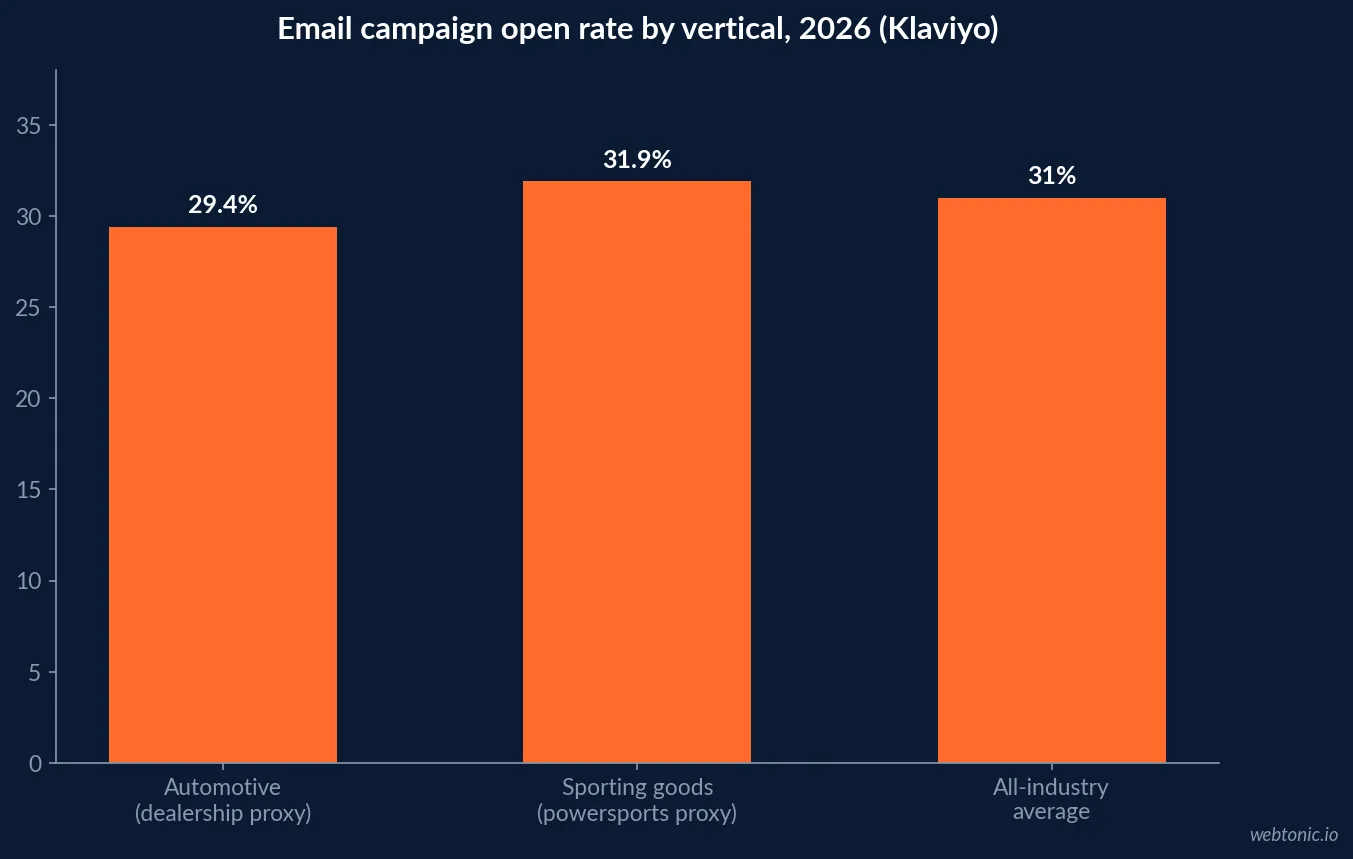
- Automotive campaign open rate is 29.4%, against a 31% all-industry average (Klaviyo, 2026).
- Sporting goods (powersports proxy) opens at 31.9% on campaigns (Klaviyo, 2026).
- Automotive campaign click rate is 1.83%, tied with clothing & accessories (Klaviyo, 2026).
- Sporting goods clicks at 1.88% on campaigns, just above automotive (Klaviyo).
- Automotive placed-order rate on campaigns is 0.11%, matching sporting goods (Klaviyo, 2026).
- Flows generate 41% of total email revenue from just 5.3% of sends (Klaviyo, 2026).
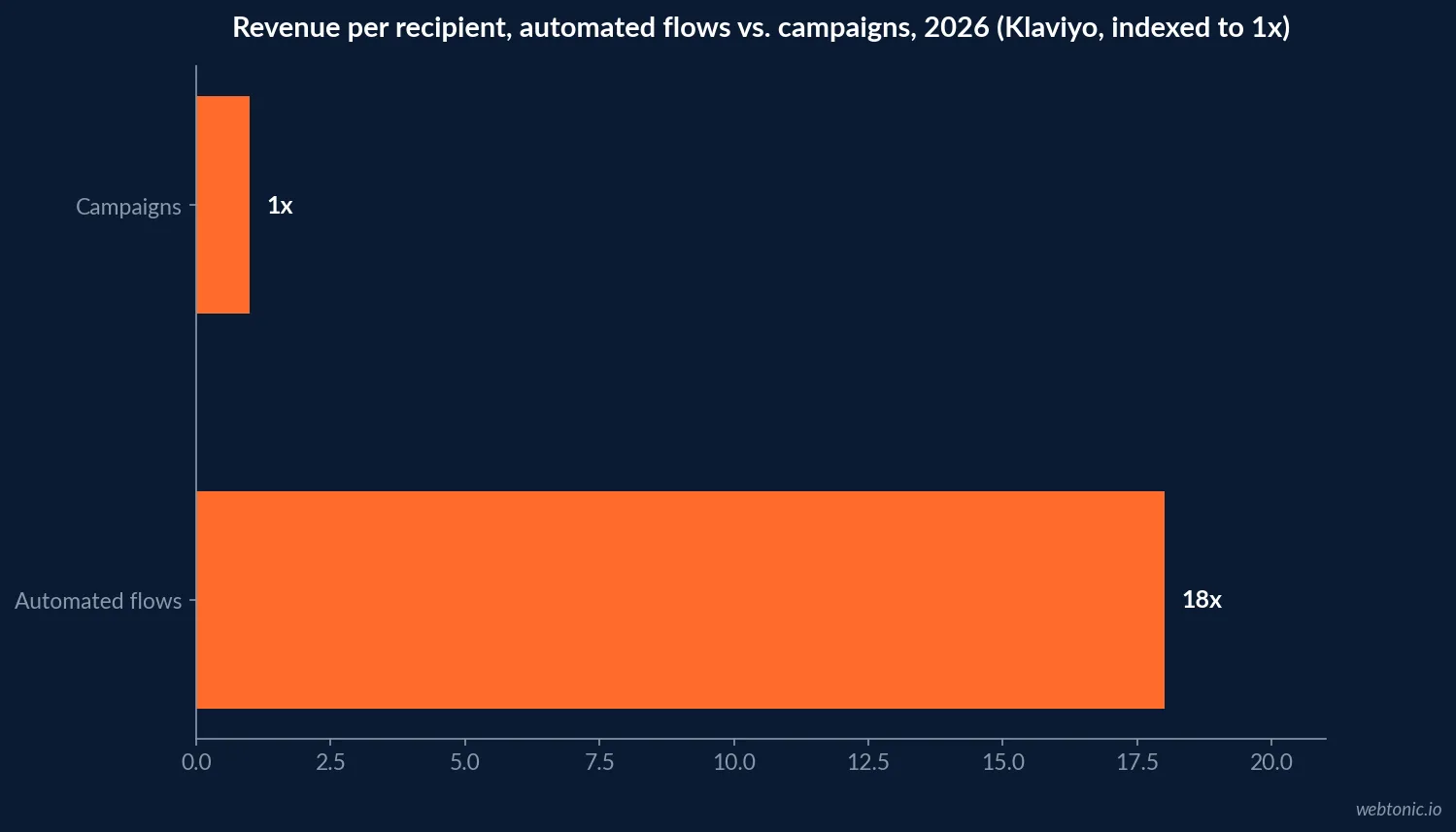
- Flow revenue per recipient runs 18x higher than campaigns across industries (Klaviyo, 2026).
- Automotive flow open rate is 30.2%, sporting goods flows open at 33.3% (Klaviyo, 2026).
- Automotive flow click rate is 5.45%, roughly 3x its own campaign click rate (Klaviyo, 2026).
- Automotive flow placed-order rate is 1.94%, against 0.11% for campaigns (Klaviyo, 2026).
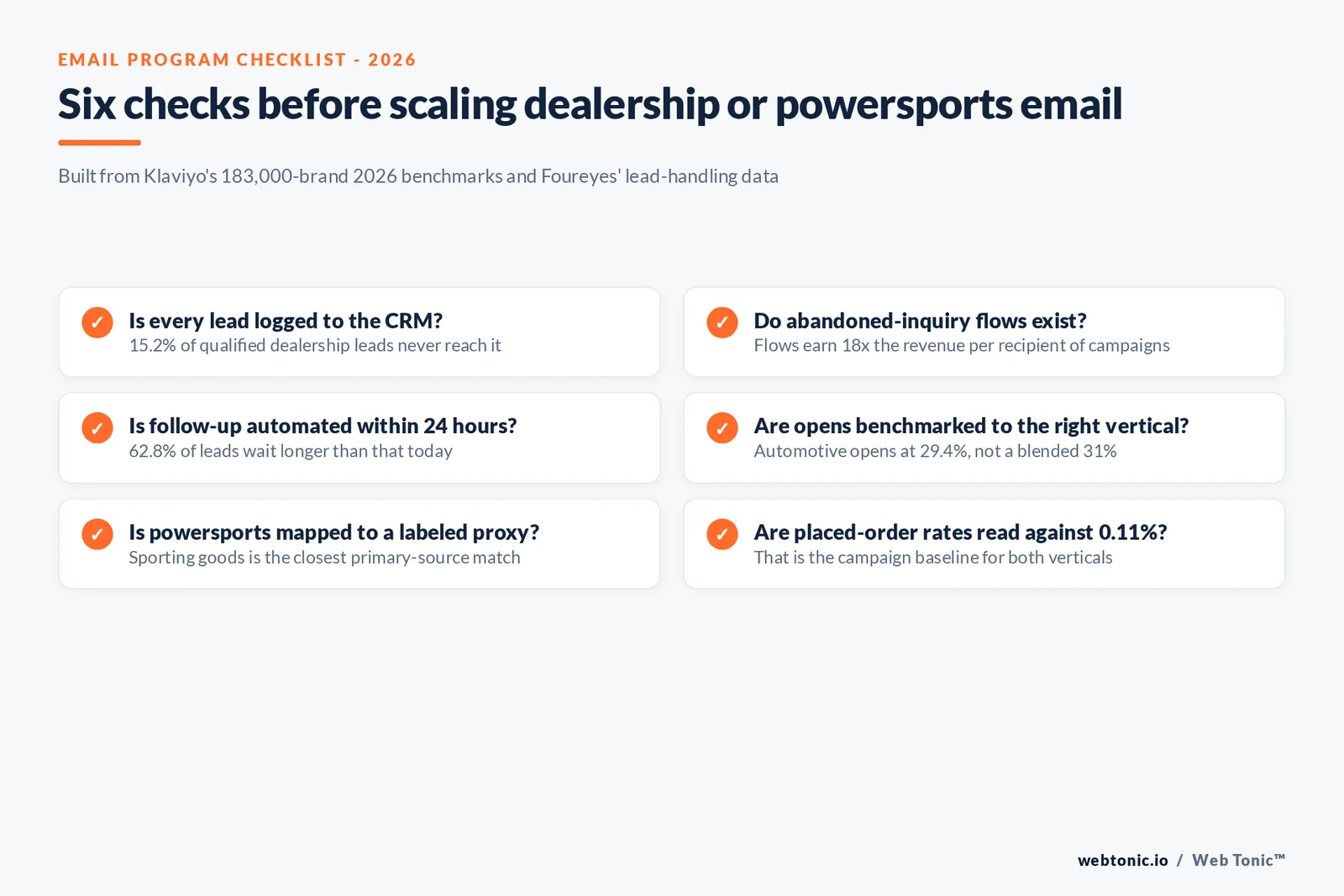
- 15.2% of qualified dealership leads never reach the CRM, up from 10.6% in 2020 (Foureyes, 2026).
- 62.8% of sales leads wait over 24 hours for follow-up across all channels (Foureyes, 2026).
- Cross-industry average email open rate is 30.8% in 2026 (Constant Contact).
- Cross-industry average click-through rate is 2.03% (Constant Contact, 2026).
| Metric (2026, campaigns) | Automotive | Sporting goods (powersports proxy) | All-industry average |
|---|---|---|---|
| Open rate | 29.4% | 31.9% | 31% |
| Click rate | 1.83% | 1.88% | 1.69% |
| Placed order rate | 0.11% | 0.11% | 0.16% |
Why "automotive" and "sporting goods" are the honest labels here
Klaviyo's 2026 email marketing benchmarks, drawn from over 183,000 brands, track roughly a dozen retail verticals, and neither "car dealership" nor "powersports" is one of them. Automotive is the direct match for car dealerships. Sporting goods, not motorcycles or marine, is the closest labeled category available for powersports, since Klaviyo's customer base skews toward ecommerce retailers rather than franchise vehicle dealers. Every figure below states which label it came from rather than blending the two into an invented "vehicles" category that does not exist in the source data.
Campaigns carry the volume, flows carry the revenue
The gap between a one-off campaign email and an automated flow, an abandoned-cart message, a post-purchase sequence, a service reminder, is the single largest number in Klaviyo's 2026 dataset. Campaigns account for 94.7% of total send volume but only about 59% of email revenue, while flows generate nearly 41% of total email revenue from just 5.3% of sends. Average revenue per recipient on a flow runs roughly 18 times higher than on a campaign. For automotive specifically, the flow click rate of 5.45% is about three times the campaign click rate of 1.83%, and the flow placed-order rate of 1.94% is close to 18 times the campaign rate of 0.11%.
| Email type (2026, all industries) | Share of sends | Share of revenue | Click rate | Placed order rate |
|---|---|---|---|---|
| Campaigns | 94.7% | ~59% | 1.69% | 0.16% |
| Automated flows | 5.3% | ~41% | 5.58% | 2.11% |
What the campaign-versus-flow gap looks like inside a typical send calendar
Put in calendar terms, a dealership or powersports retailer sending a weekly newsletter and a monthly inventory blast is running almost entirely inside the 94.7%-of-sends, lower-revenue-per-send campaign bucket that Klaviyo's data describes. The flows that generate the outsized 18x return, abandoned-form-fill, price-drop alert, service-due reminder, post-purchase upsell, typically require a one-time build in the ESP and then run untouched for months. That is a fixed engineering cost against a recurring revenue return, which is a very different budget conversation than "send one more newsletter this quarter."
Automotive versus its closest powersports proxy, flow by flow
Where the comparison holds up best is on automated flows, since both verticals sell considered, higher-ticket purchases that benefit from a nurture sequence rather than a single blast. Sporting goods opens slightly ahead of automotive on both campaigns (31.9% vs. 29.4%) and flows (33.3% vs. 30.2%), while automotive's flow click rate (5.45%) sits close behind sporting goods (6.13%). The placed-order rates converge almost exactly: automotive flows place orders at 1.94% against sporting goods at 2.13%, both well inside the all-industry flow average of 2.11%.
| Flow metric (2026, Klaviyo) | Automotive | Sporting goods (powersports proxy) |
|---|---|---|
| Open rate | 30.2% | 33.3% |
| Click rate | 5.45% | 6.13% |
| Placed order rate | 1.94% | 2.13% |
The follow-up gap that makes email flows underperform in practice
A flow can only fire on a lead the business actually captured. Foureyes' 2026 Automotive Dealer Benchmarks Report, built from 1.4 billion dealer website visits, finds 15.2% of qualified leads were never logged to the CRM at all in 2025, up every year since 10.6% in 2020, and 62.8% of sales leads across every channel waited more than 24 hours for a salesperson's follow-up. Every one of those unlogged or delayed leads is also a missed trigger for an abandoned-inquiry or price-drop email flow, the exact mechanism that produces 18x the revenue per recipient of a campaign.
A second dataset agrees: automotive opens sit just under 31%
Klaviyo is not the only vendor publishing an "Autos & Vehicles" style line. Omnisend's 2026 email marketing benchmarks, drawn from more than 20 billion campaign emails and 470 million automated sends across 27,000+ brands, puts the Autos & Vehicles category open rate at 30.68%, close to Klaviyo's 29.4% automotive figure despite the two vendors sampling entirely different customer bases. Two independent 2026 datasets landing within two points of each other is a stronger signal than either number alone.
Omnisend's automation-versus-campaign split tells the same story as Klaviyo's, in different units: automated emails generated $3.41 per email sent in 2025 against $0.155 for campaign emails, a 22x gap, while automated emails converted at 1.49% against 0.08% for campaigns, roughly 19x higher. Two vendors, two different measurement methods, and both conclude that automation outperforms one-off sends by an order of magnitude, not by a marginal percentage.
| Cross-vendor automation vs. campaign check (2026) | Klaviyo (all industries) | Omnisend (all industries) |
|---|---|---|
| Revenue-per-send multiple, automation vs. campaign | ~18x higher | ~22x higher |
| Conversion/placed-order multiple, automation vs. campaign | ~13x higher | ~19x higher |
| Automotive-line open rate | 29.4% ("Automotive") | 30.68% ("Autos & Vehicles") |
Why the CRM gap keeps showing up in the email data too
The lead-logging problem behind Foureyes' 15.2% figure has an infrastructure explanation. DealerSignals' 2026 State of Dealer Technology report, built from a programmatic scan of 1,760 U.S. dealership websites rather than a self-reported survey, finds that only 19% of dealers run a detectable CRM platform and just 17% run a DMS, both trailing the 79% adoption rate for a basic website or digital-marketing platform by a wide margin. The average dealer runs only 3.8 of 15 measured retail-technology categories. An email program built on Klaviyo or any other ESP still needs a CRM on the other end to capture the reply, the phone number, and the trigger event a flow depends on, and for roughly four out of five dealers, that system is either absent or invisible from the outside.
| Dealer technology category (2026 scan, DealerSignals) | Detectable adoption rate |
|---|---|
| Website & digital marketing platform | 79% |
| Listing platforms | 48% |
| Inventory management | 43% |
| Reputation management | 42% |
| CRM platforms | 19% |
| DMS platforms | 17% |
How the two verticals compare with a plain cross-industry baseline
Constant Contact's 2026 data, drawn from 37,000 of its own customers spanning 20+ industries, puts the average email open rate across all industries at 30.8% and the average click-through rate at 2.03%. Both automotive and sporting goods sit close to, slightly under on opens, slightly under on clicks, that broader baseline, confirming that neither vertical is an outlier once measured against a second, independent dataset rather than Klaviyo alone.
| Cross-check metric (2026) | Klaviyo automotive | Klaviyo sporting goods | Constant Contact, all industries |
|---|---|---|---|
| Open rate | 29.4% (campaign) | 31.9% (campaign) | 30.8% |
| Click-through rate | 1.83% (campaign) | 1.88% (campaign) | 2.03% |
What this means for a dealership or powersports email program
Three actions follow directly from the gap between the two email types. First, build the CRM logging and lead-capture layer before investing further in flow design, since 15.2% of qualified leads never reach a system a flow could trigger from. Second, treat campaign sends as a relationship and inventory-awareness channel, not a revenue channel, given their 0.11% placed-order rate, and shift incremental effort toward flows where the placed-order rate is close to 18 times higher. Third, if a powersports business wants a benchmark closer to its own category than sporting goods, pair this data with primary sales research from the Motorcycle Industry Council rather than assuming email behavior transfers one-to-one. Our growth marketing team and our breakdown of what paid social costs both start from the same lead-capture math, and our team can audit where your flow-versus-campaign split sits against these 2026 benchmarks.
Frequently Asked Questions
What is a good email open rate for a car dealership in 2026?
Klaviyo's 2026 benchmarks, built from over 183,000 brands, put the automotive campaign open rate at 29.4%, slightly below the all-industry campaign average of 31%. Automated flow emails perform a little better for the same vertical, at 30.2% open, against a 32.2% all-industry flow average. Both sit within a normal range; automotive is neither the strongest nor weakest of the roughly dozen verticals Klaviyo tracks.
Is there a published email benchmark specifically for powersports dealers?
No vendor publishes a dedicated powersports line. The closest primary-source proxy is Klaviyo's sporting goods category, which behaves similarly to other durable-goods retail: 31.9% campaign open rate and 1.88% campaign click rate, both slightly above the automotive vertical's 29.4% and 1.83%. Treat sporting goods as a labeled proxy, not a direct powersports figure, until a segment-specific study exists.
Do automated email flows really outperform one-off campaigns by that much?
Yes, and the gap is one of the widest in the entire Klaviyo dataset. Flows generate nearly 41% of total email revenue from just 5.3% of sends, with average revenue per recipient roughly 18 times higher than campaigns. Flows also click at 5.58% against 1.69% for campaigns (about 3x) and place orders at 2.11% against 0.16% for campaigns (roughly 13x).
Why do so many dealership email leads never get a timely follow-up?
The bottleneck is logging, not the email tool. Foureyes' 2026 Automotive Dealer Benchmarks Report finds 15.2% of qualified leads were never logged to the CRM at all in 2025, a share that has risen every year since 10.6% in 2020, and 62.8% of sales leads across all channels waited more than 24 hours for a salesperson to follow up. An email flow can only convert a lead the CRM actually captures in the first place.
What is a realistic placed-order rate to expect from dealership email in 2026?
Modest, by design, since a vehicle or powersports purchase is a considered, infrequent buy. Klaviyo's 2026 data puts the automotive campaign placed-order rate at 0.11%, in line with hardware & home improvement (0.11%) and sporting goods (0.11%), against an all-industry campaign average of 0.16%. The real revenue driver is the flow side: automotive flow placed orders run 1.94%, close to 18 times the campaign rate.
Sources
Klaviyo — 2026 Email Marketing Benchmarks by Industry
Klaviyo — Email Marketing Benchmarks 2026: Open, Click and Conversion Rates
Foureyes — 2026 Automotive Dealer Benchmarks Report
Constant Contact — How to Improve Your Email Open Rate in 2026
Motorcycle Industry Council — Powersports Statistics
Omnisend — Email Marketing Benchmarks: Open Rates, Clicks, and Conversions
DealerSignals — The 2026 State of Dealer Technology