



Table of contents

Campaign budget optimization is the feature that decides whether Meta's algorithm or your manual settings control how money moves between ad sets — and the data shows it cuts cost per purchase by up to 12% on average when configured correctly. Below you will find a complete breakdown of how CBO works, when to use it over ad set budgets, and the specific setup steps that separate profitable campaigns from budget waste.
Key Takeaways
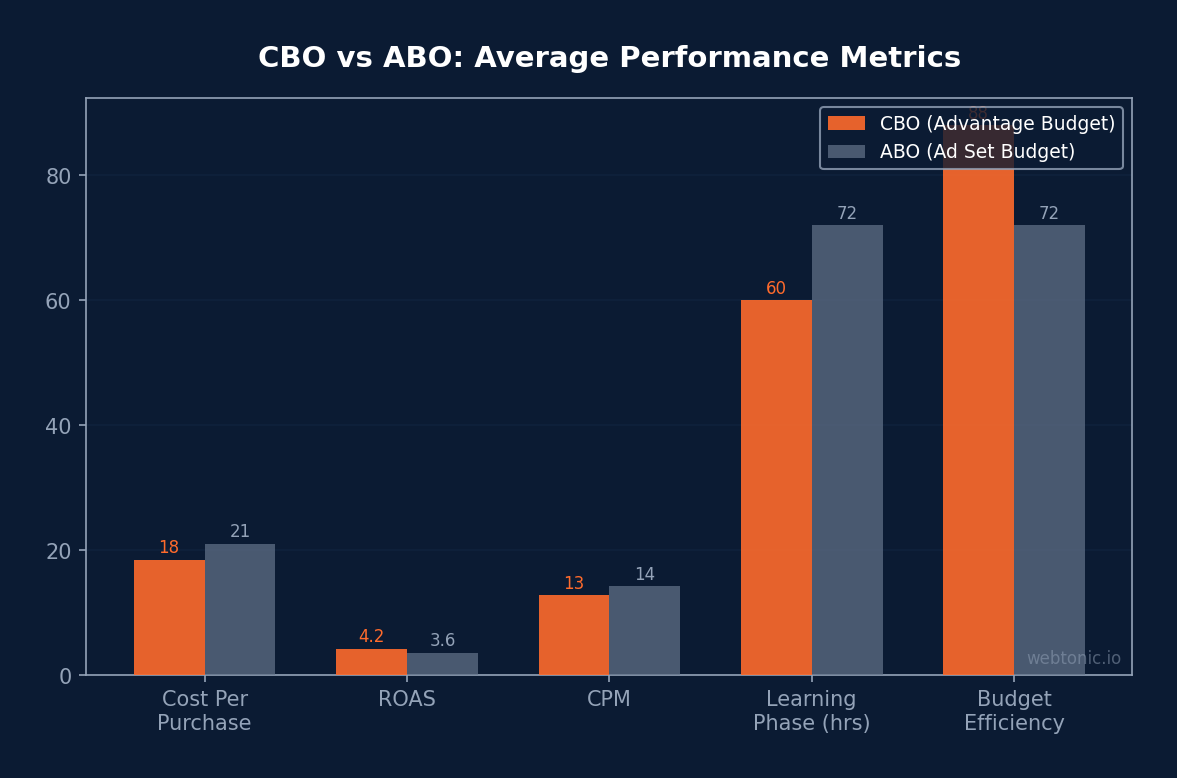
- CBO reduces cost per purchase by up to 12% versus manual ad set budget allocation, according to Strike Social's analysis of Meta's Advantage Campaign Budget data.
- Meta's algorithm needs 48–72 hours of uninterrupted learning before budget allocation becomes efficient — premature edits reset the learning phase entirely.
- Campaigns using CBO with 50+ weekly conversions consistently outperform those with fewer conversions because the algorithm has enough signal to optimize distribution.
- Advantage+ Shopping Campaigns reduce CPA by 12–17% compared to manual campaigns when paired with sufficient conversion data and 5–10 creative variations.
- Healthy ad accounts run both CBO and ABO simultaneously — CBO for scaling proven concepts and ABO for testing new audiences, creatives, or geographies.
Campaign budget optimization (CBO), now called Advantage Campaign Budget inside Meta Ads Manager, sets one budget at the campaign level and lets Meta's delivery algorithm split it across your ad sets in real time. Instead of manually assigning $50 to each of four ad sets, you assign $200 to the campaign and let the system find the cheapest path to your optimization event. This fundamental shift from fixed allocation to dynamic distribution is why CBO has become the default budget strategy for performance advertisers managing more than $10,000/month in ad spend. Whether you are running growth marketing campaigns or scaling an e-commerce brand, understanding CBO mechanics is essential for maximizing return on ad spend.
How Campaign Budget Optimization Works
CBO operates on a simple principle: Meta's algorithm evaluates which ad sets have the best opportunity to deliver results at the lowest cost, then shifts budget toward those ad sets automatically. The system evaluates this continuously throughout the day, not just once. A single ad set can absorb 70–80% of the total campaign budget if it consistently delivers cheaper conversions than the others.
The algorithm considers several factors when distributing budget:
| Factor | How It Affects Distribution | Impact Level |
|---|---|---|
| Auction Competitiveness | Ad sets facing less competition receive more budget because cost per result is lower | High |
| Audience Size | Larger audiences give the algorithm more room to find cheap conversions | High |
| Ad Quality Score | Higher relevance scores lower CPM, making those ad sets more cost-efficient | Medium |
| Conversion Probability | Ad sets with higher predicted conversion rates get more spend allocation | High |
| Time of Day | Budget shifts throughout the day as auction dynamics change across time zones | Medium |
| Ad Set Spend Limits | Minimum and maximum spend limits override algorithmic distribution | High (when set) |
The key insight most advertisers miss is that CBO is not trying to give every ad set a fair test. It is trying to find the cheapest path to your optimization event. If one ad set converts at $8 and another at $22, the algorithm will heavily favor the $8 ad set regardless of whether you wanted equal testing across both audiences. This behavior is exactly what makes CBO powerful for scaling but problematic for testing.
CBO vs ABO: When To Use Each Strategy
The CBO versus ABO debate is not a binary choice — it is a routing decision that changes week to week based on your campaign objectives. According to Superscale's 2026 analysis, healthy accounts run both simultaneously, using CBO for scaling proven concepts and ABO for isolating variables in tests.
Use CBO when you are scaling a proven creative or audience combination across similar ad sets with enough conversion volume for the algorithm to read signal. The minimum threshold is roughly 50 conversions per week per campaign — below that, the algorithm is guessing rather than optimizing. Use ABO when you need each ad set to get a clean read on its own learning phase, particularly when testing distinct concepts, audiences, or geographies where uneven budget distribution would invalidate the test.
| Scenario | Best Strategy | Why |
|---|---|---|
| Scaling proven creatives | CBO | Algorithm maximizes spend on best performers automatically |
| Testing 3+ new audiences | ABO | Ensures each audience gets equal budget for valid comparison |
| Retargeting campaigns | ABO | Small, high-value audiences need controlled spend |
| Broad prospecting at scale | CBO | Large audiences + high volume = ideal CBO conditions |
| Multi-geo campaigns | ABO | Prevents algorithm from favoring cheaper markets |
| Launch phase (new product) | ABO → CBO | Test with ABO first, then migrate winners to CBO for scale |
| Catalog / DPA campaigns | CBO | Product-level optimization benefits from dynamic distribution |
A common mistake is switching entirely to CBO across an account because it "performed better in one campaign." The strategy that works depends on the campaign's conversion volume, audience similarity, and testing stage — not a blanket policy. For a deeper look at how to build effective campaign structures, visit the Web Tonic blog.
Setting Up CBO in Meta Ads Manager
Setting up campaign budget optimization in Meta (now labeled Advantage Campaign Budget) takes less than a minute, but the configuration choices you make during setup determine whether the feature helps or hurts performance. Here is the step-by-step process with the settings that matter most.
Step 1: Create a new campaign and select your campaign objective (Sales, Leads, Traffic, etc.). At the campaign level, you will see the toggle for Advantage Campaign Budget — turn it on. This replaces individual ad set budgets with a single campaign-level budget.
Step 2: Set your campaign budget. Choose between daily budget (Meta spends roughly this amount each day, with up to 75% variance on any single day balanced over the week) or lifetime budget (total spend over a set date range). Daily budgets give more flexibility; lifetime budgets work better for promotions with fixed end dates.
Step 3: Configure ad set spend limits. This is the most misunderstood CBO setting. You can set minimum spend per ad set (guarantees each gets at least X amount) and maximum spend (caps any single ad set). Use minimums sparingly — setting a $20 minimum on an ad set that cannot profitably spend $20/day forces the algorithm to waste budget. According to Rapid Ads, advertisers who skip spend limits entirely see better CBO performance than those who over-constrain allocation.

Step 4: Choose your bid strategy. CBO works with all bid strategies, but the combination matters. Lowest Cost + CBO gives the algorithm maximum flexibility. Cost Cap + CBO adds a ceiling but may under-deliver if the cap is too aggressive. Bid Cap + CBO provides the tightest control but requires precise knowledge of your target cost per result.
Step 5: Build 3–5 ad sets with similar audience sizes. CBO performs worst when ad sets have wildly different audience sizes (one with 500K reach and another with 50M reach). The algorithm gravitates toward the larger audience because it offers more opportunities, even if the smaller audience converts better on a per-impression basis.
The Learning Phase and Why It Matters
Every CBO campaign enters a learning phase that typically lasts 48–72 hours — and during this window, cost per result is often 20–30% higher than steady-state performance. The learning phase is not optional; it is the algorithm calibrating which ad sets deserve what share of the budget.
According to Benly's 2026 Advantage+ guide, you should wait 7–14 days before making significant changes to a CBO campaign. Premature optimization — changing budgets, swapping creatives, or pausing ad sets before the learning phase completes — resets the algorithm and forces it to recalibrate from scratch.
Actions that reset the learning phase include:
- Changing the campaign budget by more than 20% in a single adjustment
- Adding or removing ad sets from the campaign
- Changing the optimization event (e.g., switching from Purchase to Add to Cart)
- Pausing the campaign for more than 7 days
- Significant creative changes within the first 72 hours
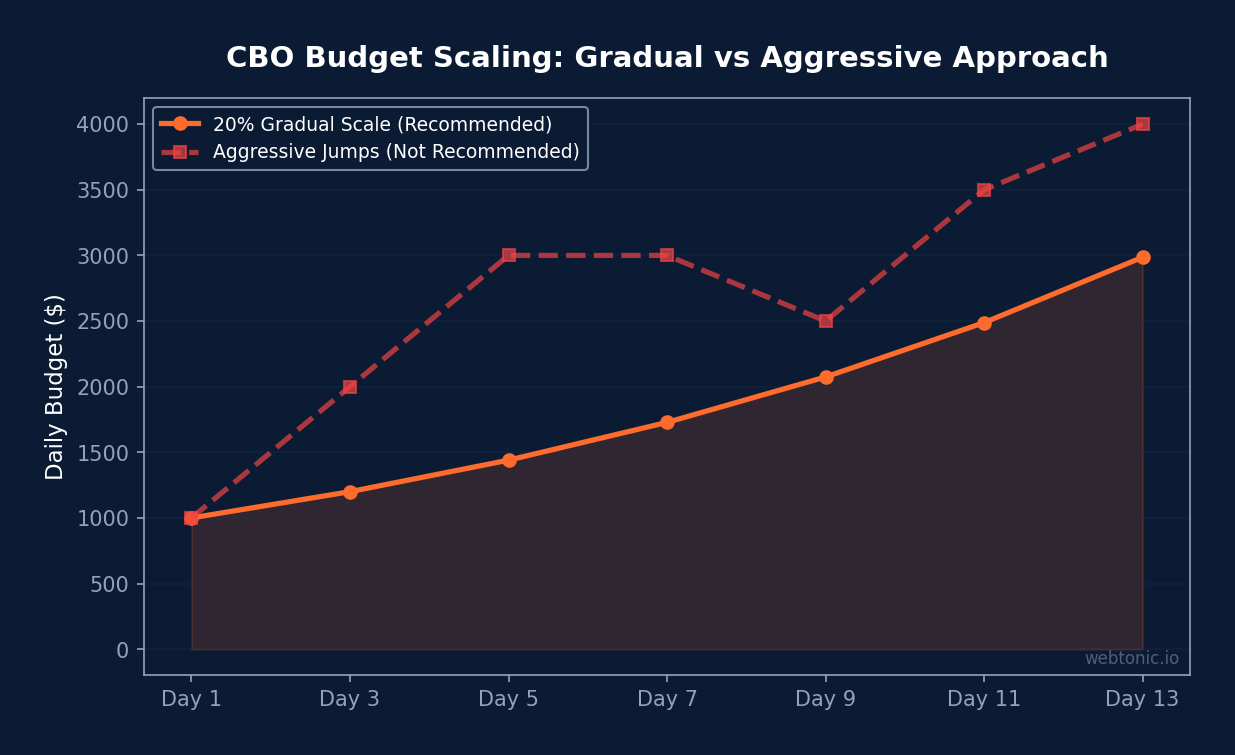
The safest budget adjustment strategy is to increase spend by no more than 20% every 48–72 hours. This keeps the campaign in its optimized state while gradually scaling delivery. Advertisers who follow this rule report 15–25% lower CPA volatility during scaling compared to those who make large budget jumps.
Campaign Budget Optimization Across Platforms
While CBO is most closely associated with Meta, budget optimization features exist across all major advertising platforms — though they work differently on each one.
Meta (Facebook/Instagram): CBO is the most mature implementation, rebranded as Advantage Campaign Budget. Meta's algorithm distributes budget across ad sets dynamically and has the deepest conversion data to optimize against. Best suited for campaigns with 50+ weekly conversions.
TikTok Ads Manager: TikTok offers Campaign Budget Optimization with similar mechanics to Meta's version. The key difference is that TikTok's algorithm generally needs more data volume to optimize effectively because its conversion tracking infrastructure is less mature. Advertisers report needing 1.5–2x the conversion volume compared to Meta for CBO to outperform manual allocation.

Google Ads: Google does not have a feature called CBO. According to Coinis, the closest equivalent is pairing Shared Budgets with Portfolio Bid Strategies. This combination lets Google distribute a single budget across multiple campaigns based on performance signals. Google offers three budget models: Average Daily Budget, Campaign Total Budget, and Shared Budget.
Snapchat Ads: Snapchat's Auto-Bidding with campaign-level budgets functions similarly to CBO but with a smaller optimization dataset. Performance tends to be more volatile because Snapchat's auction has fewer advertisers competing for the same audiences.
Common CBO Mistakes and How to Avoid Them
Even experienced media buyers make CBO mistakes that cost thousands in wasted ad spend. Here are the most common errors and their fixes, based on patterns observed across hundreds of campaigns.
Mistake 1: Mixing wildly different audience types in one CBO campaign. If you put a 1% lookalike, a broad interest audience, and a retargeting audience in the same CBO campaign, the algorithm will almost always dump budget into the largest audience. The retargeting audience — often your highest-value segment — gets starved. Fix: Group similar audience types together. Run retargeting in a separate ABO campaign.
Mistake 2: Over-constraining with ad set spend limits. Setting minimum spends on every ad set defeats the purpose of CBO. If you tell the algorithm it must spend at least $30 on each of five ad sets in a $200 campaign, you have locked 75% of the budget into fixed allocation. Fix: Use minimums only on ad sets you absolutely need data from, and keep the total minimum under 50% of the campaign budget.
Mistake 3: Judging CBO performance after 24 hours. CBO needs 48–72 hours minimum to exit the learning phase. Looking at day-one results and making changes is the most common reason CBO "doesn't work." Fix: Set a calendar reminder to evaluate performance after 5–7 full days of uninterrupted delivery.
Mistake 4: Running CBO with too few conversions. The algorithm needs roughly 50 optimization events per week per campaign to make intelligent distribution decisions. Below that threshold, budget allocation is essentially random. Fix: If you cannot hit 50 conversions/week, move to a higher-funnel optimization event (e.g., Add to Cart instead of Purchase) or use ABO until volume builds.
Mistake 5: Ignoring the bid strategy interaction. Pairing CBO with an overly aggressive Cost Cap can cause the campaign to under-deliver entirely. The algorithm cannot find conversions below your cost cap, so it stops spending rather than overpay. Fix: Start with Lowest Cost to establish baseline performance, then layer in Cost Cap once you know your true CPA range.
Advanced CBO Strategies for Scaling
Once you have a CBO campaign delivering consistent results, these advanced strategies can help you scale without destroying performance.
The 20% rule for budget increases: Increase your campaign budget by no more than 20% every 48–72 hours. This gradual scaling keeps the algorithm in its optimized state while expanding delivery. A $1,000/day campaign should go to $1,200, then $1,440, then $1,728 — not jump straight to $3,000.
Ad set rotation: Instead of pausing underperforming ad sets (which resets the learning phase for the whole campaign), add new ad sets alongside existing ones. The algorithm will naturally shift budget toward the new ad sets if they perform better, and the transition happens without a hard reset.
CBO + Advantage+ hybrid: Run your proven winners in an Advantage+ Shopping Campaign (which uses its own budget optimization layer) and use standard CBO for prospecting and testing. This two-campaign structure gives you the benefits of both systems without overlap.
Dayparting with CBO: While Meta does not natively support dayparting with CBO (only available with lifetime budgets), you can approximate it by running separate campaigns for peak and off-peak hours. This gives you cost control during expensive hours while letting CBO maximize cheaper overnight delivery.
Frequently Asked Questions
What is campaign budget optimization in simple terms?
Campaign budget optimization (CBO) is a feature in ad platforms like Meta that sets one budget at the campaign level instead of individual ad set budgets. The platform's algorithm then automatically distributes that budget across your ad sets based on which ones are delivering the best results at the lowest cost. It shifts money toward better-performing ad sets in real time rather than requiring you to manually adjust spending.
Should I use CBO or ABO for my campaigns?
Use CBO when you are scaling proven creatives and audiences with at least 50 conversions per week. Use ABO when testing new audiences, creatives, or geographic markets where you need controlled, equal budget distribution. Most successful advertisers run both strategies simultaneously — CBO for scaling and ABO for testing — and migrate winning ABO tests into CBO campaigns once performance is validated.
How long does the CBO learning phase take?
The initial learning phase for a CBO campaign typically takes 48–72 hours, but Meta recommends waiting 7–14 days before evaluating performance or making significant changes. During the learning phase, cost per result may be 20–30% higher than steady-state performance. Any significant edits during this period — budget changes over 20%, creative swaps, or ad set additions — reset the learning phase entirely.
Does Google Ads have campaign budget optimization?
Google Ads does not have a feature called CBO. The closest equivalent is combining Shared Budgets with Portfolio Bid Strategies, which lets Google distribute a single budget across multiple campaigns based on performance. Google offers three budget models: Average Daily Budget (per campaign), Campaign Total Budget (for set date ranges), and Shared Budget (across campaigns).
How much should I increase my CBO budget at a time?
Increase your CBO campaign budget by no more than 20% every 48–72 hours. Larger increases reset the learning phase and cause temporary performance drops. A $500/day budget should scale to $600, then $720, then $864 over roughly a week. Advertisers who follow this gradual approach report 15–25% less CPA volatility during scaling compared to those who make large budget jumps.
Sources
Clarigital — Campaign Budget Optimisation: CBO vs ABO
Superscale — CBO vs ABO: Meta Ads Budget Strategy for 2026
Rapid Ads — Master Campaign Budget Optimization: 2026 Guide
Benly — Advantage+ Campaigns: Complete Setup & Optimization Guide 2026
Coinis — When to Use CBO Google Ads: The Right Budget Model
Clarigital — Complete Guide to Advantage Campaign Budget


