Table of contents
Nearly half of boosted creator spend on Meta in 2026 delivered zero measurable brand value, even as 94% of organizations report influencer-driven branded content outperforming traditional advertising. The gap between those two numbers is execution, not format.
Key Takeaways
- 45% of boosted creator spend on Meta delivered zero measurable value.
- 86% of viewers who drop off do so in the first three seconds.
- Half of creator ads miss establishing the brand in that same window.
- 94% of organizations say influencer content beats traditional ads.
- That outperformance is often reported at 2x-3x returns.
- 86% of US marketers partnered with influencers in 2025.
- 26% of brands allocate 40%+ of their budget to influencer content.
- The influencer marketing industry was projected at USD 32.6 billion for 2025.
- That is up from USD 1.7 billion in 2016.
- Short-form video delivers the highest ROI among video formats, at 41%.
- 60%+ of product discovery now happens on TikTok, Instagram and YouTube.
- 66% of consumers ask friends and family before trusting a brand's message.
- 73% of consumers will switch brands over a poor social response.
- Disciplined branding fundamentals drive double-digit completion gains.
- 65% of influencers want a say in the creative before it airs.
Branded content at a glance in 2026
Two studies define the state of branded content in 2026, and they are not in conflict so much as measuring different things. Sprout Social's dataset says the format outperforms on average. CreativeX's analysis, covered by Influencer Marketing Hub, says a huge share of individual campaigns are throwing that advantage away.
| Metric (2026) | Figure | Source | What it measures |
|---|---|---|---|
| Boosted creator spend delivering zero value | 45% | CreativeX / Influencer Marketing Hub | Unbranded or unwatched paid creator content on Meta |
| Viewer drop-off window | 86% drop off by second 3 | CreativeX / Influencer Marketing Hub | How little time branded content has to register |
| Orgs saying influencer content beats traditional ads | 94% | Sprout Social 2026 | Perceived branded content ROI vs. traditional media |
| US marketers who partnered with an influencer in 2025 | 86% | Sprout Social 2026 | Adoption of creator-led branded content |
| Projected 2025 influencer marketing industry size | USD 32.6B | Sprout Social 2026 | Scale of the branded content economy |
Why nearly half of boosted branded content is wasted spend
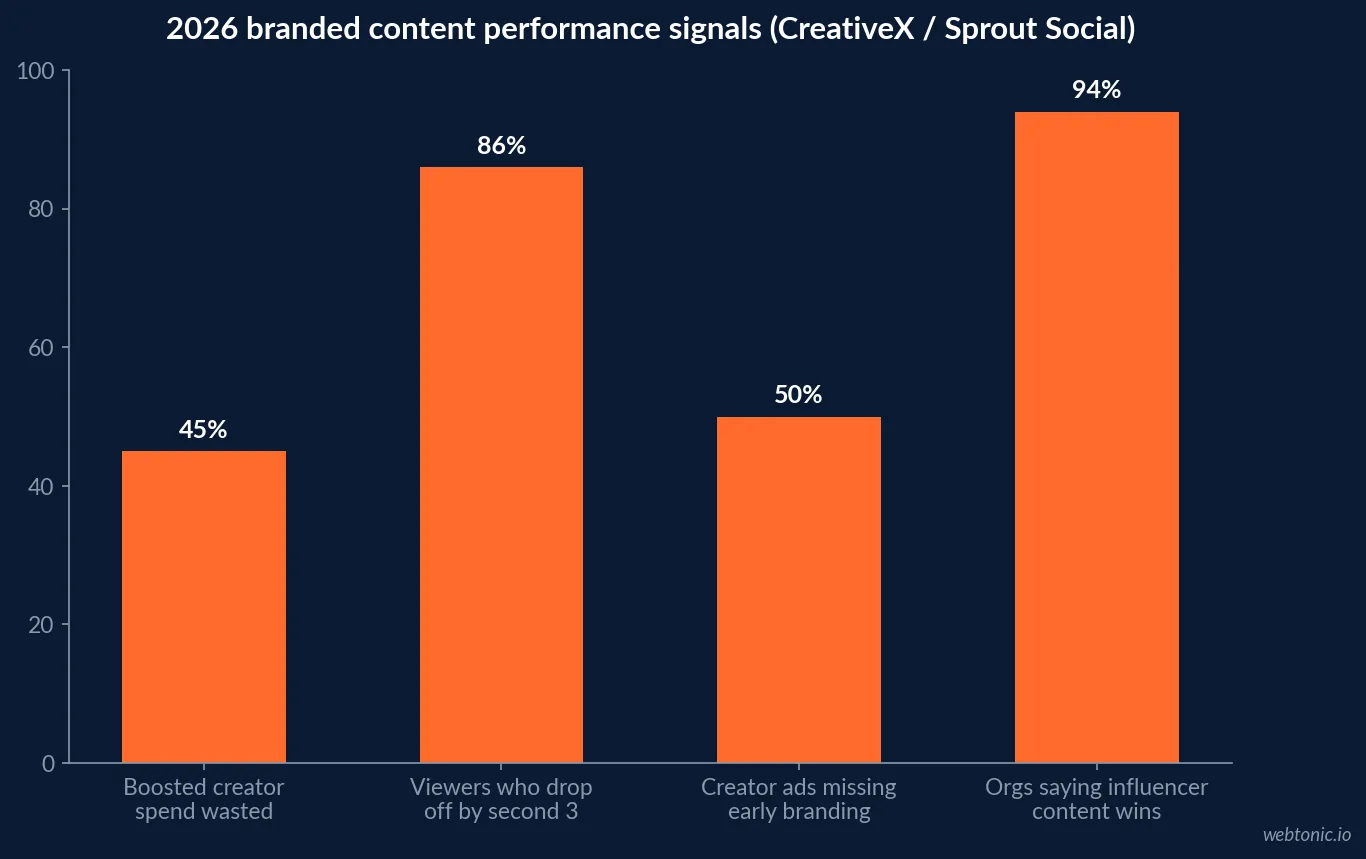
The moment a brand pays to boost a creator's organic post, that post becomes an ad in every way that matters financially, even if it was built to feel organic. CreativeX's analysis found 45% of boosted creator spend on Meta delivered zero value by the combined measure of unbranded content and unwatched content. The report's own framing is pointed: brands are "underwriting someone else's personality while their own brand fades into the scroll."
The mechanism is simple. 86% of viewers who are going to drop off do so within the first three seconds, and CreativeX found that roughly half of creator ads fail to establish the brand inside that exact window. A creative can be genuinely engaging and still deliver zero brand value if the audience leaves before the brand appears on screen.
| Branded content failure mode | Share affected | Root cause | Fix that moves the number |
|---|---|---|---|
| Unbranded or unwatched boosted content | 45% of Meta creator spend | Post treated as organic, not as paid media | Score every post before boosting, not after |
| Missed early branding | ~50% of creator ads | Brand mark appears too late in the cut | Brand within the first 3 seconds, before drop-off |
| Ignored platform safe zones | Not separately quantified, but tied to completion loss | Text/logo placement clipped by UI overlays | Design to the platform's safe-zone spec, not the raw frame |
| No standardized scoring across creators | Reported as a scale problem, not isolated cases | Creator posts treated as bespoke, not systematized | Map every execution back to one core brand idea |
What the fix actually looks like
CreativeX is explicit that the answer is not to make creator content look like a traditional TV spot. It is to apply the handful of principles that make any paid placement work — branding early, respecting safe zones, keeping length disciplined — while leaving the creator's own voice and pacing intact. Brands that do this see double-digit gains in completion rate and cost efficiency without losing the authenticity that made the creator format attractive in the first place.
The report's short version: authenticity and suitability are not a trade-off. Treating a boosted post like the ad it has become, while keeping the creator's humanized storytelling intact, is what actually scales.
The adoption side: budgets keep moving toward creator-made branded content
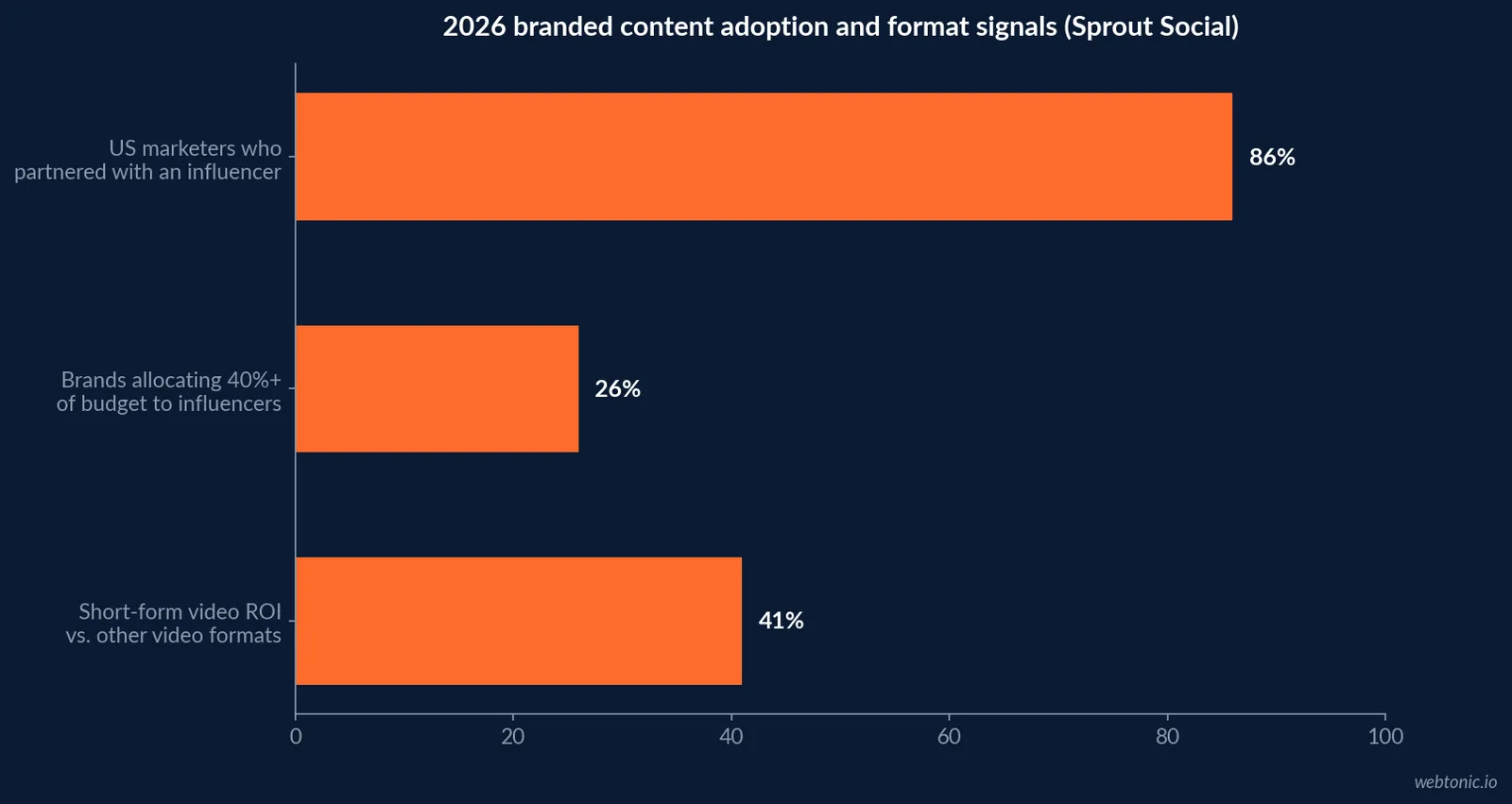
Sprout Social's 2026 influencer marketing dataset shows why brands keep funding the format despite the execution gap. 86% of US marketers partnered with an influencer in 2025, and the industry itself was projected at USD 32.6 billion for 2025, up from USD 1.7 billion in 2016. 26% of agencies and brands worldwide now put more than 40% of their marketing budget into influencer partnerships, while the share allocating under 10% has fallen year over year.
On format specifically, Sprout Social's broader 2026 social data found short-form video delivering the highest ROI among video formats at 41%, and platforms like TikTok, Instagram and YouTube now account for over 60% of product discovery, ahead of Google search for that specific use case.
| Adoption signal (2026) | Figure | Source | Implication for branded content |
|---|---|---|---|
| US marketers who worked with an influencer in 2025 | 86% | Sprout Social | Creator-led branded content is now the default, not the test |
| Brands allocating 40%+ of budget to influencer work | 26% | Sprout Social | A meaningful minority are already budgeting like it's core media |
| Influencer marketing industry, projected 2025 size | USD 32.6B | Sprout Social | Up nearly 20X from USD 1.7B in 2016 |
| Short-form video ROI vs. other video formats | 41%, highest | Sprout Social | Format choice inside branded content now has a clear leader |
| Product discovery happening on social platforms | 60%+ | Sprout Social | Branded content is now doing discovery work, not just awareness |
Where user-generated content fits inside the strategy
Sprout Social's UGC research found 66% of consumers talk to friends and family to stay on top of trends before a polished ad ever enters the decision, which is the same trust mechanic that makes reshared customer content perform. Brands that fold UGC and creator content into one branded content calendar — rather than running influencer budget and UGC budget as separate lines — are matching how audiences actually consume the two: as points on the same authenticity spectrum, not different categories.
The commercial stakes for getting the tone right are real: 73% of consumers say they will switch to a competitor if a brand does not respond appropriately on social media, per Sprout Social's 2026 dataset, which extends the same authenticity standard to how a brand behaves after the branded content goes live, not just how it is produced.
What creators want out of the partnership
Sprout Social's Influencer Marketing Report found 65% of influencers want to be involved in the creative process rather than follow a rigid brief, and marketers and creators measure success differently once the content is live: marketers lean on engagement (68%) and link traffic (50%), while creators track audience growth. A branded content brief that leaves room for the creator's own creative judgment, while still enforcing the three-second branding rule and platform safe zones, is the version most likely to satisfy both measurement standards at once. Our measurement team sets up that dual tracking — engagement for the creator, watch-through and brand recall for the media budget — before a single dollar boosts a post.
Our performance creative team builds branded content briefs around that split — creator autonomy on tone, brand discipline on the first three seconds — and if you want a review of how your current creator content is scoring against these fundamentals, talk to us.
The standards and category context behind the numbers
The classification of what counts as "branded" versus a plain ad unit is set at the industry level, not per platform. The IAB maintains the standards that native and branded content formats are measured against, and the Content Marketing Institute tracks the broader content-marketing discipline that branded content sits inside of, from editorial-style brand content to long-form branded entertainment. Both are useful reference points for benchmarking a branded content program against the wider content marketing category rather than in isolation.
A branded content scorecard for 2026
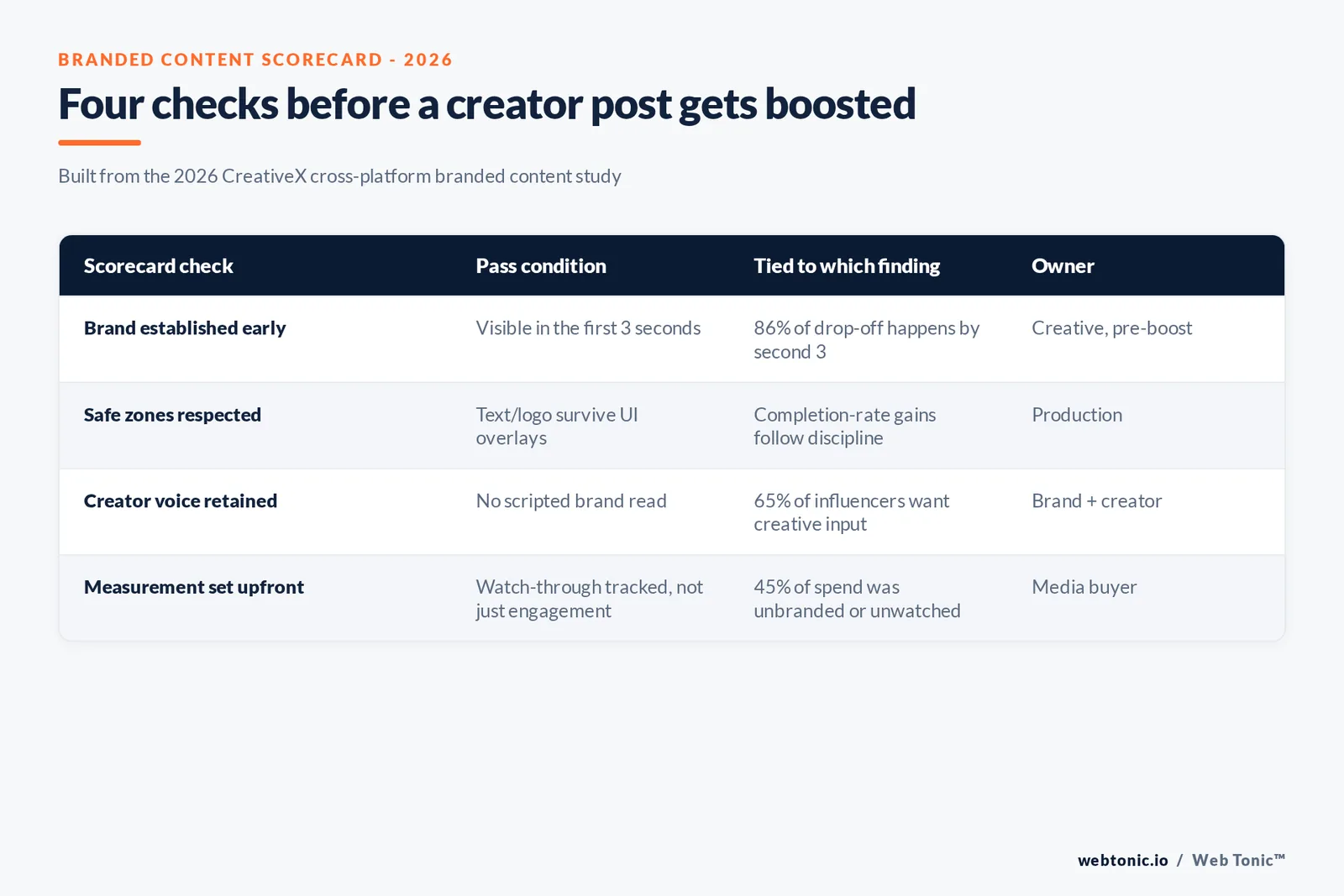
Most branded content programs still get evaluated on reach and engagement alone, which is exactly the gap CreativeX's data exposes — a post can engage well and still deliver zero brand value. A scorecard that checks branding discipline before a post is boosted catches the failure mode before the budget is spent, not after the report comes back.
| Scorecard check | Pass condition | Tied to which finding | Who owns the check |
|---|---|---|---|
| Brand established in first 3 seconds | Logo, product or clear brand cue visible | 86% of drop-off happens by second 3 | Creative/production before boost |
| Platform safe zones respected | Text and branding survive UI overlays | CreativeX completion-rate findings | Production, checked per platform |
| Creator retains authentic voice | No scripted brand-read replacing natural delivery | 65% of influencers want creative input | Brand + creator, at brief stage |
| Measurement plan set before boosting | Engagement AND watch-through both tracked | 45% of spend wasted was unbranded or unwatched | Media buyer, before spend commits |
What to watch through the rest of 2026
Three trends are worth tracking as branded content budgets keep growing. First, whether the 45% wasted-spend figure improves as more platforms build branding-compliance checks directly into their boosting tools, rather than leaving it to individual brand discipline. Second, whether short-form video's 41% ROI lead over other video formats holds as more budget chases the same inventory and costs rise. Third, whether UGC and creator content formally merge into single briefs and budgets, given how similarly audiences already treat the two in terms of trust.
Frequently Asked Questions
What counts as branded content in 2026?
Any content a brand pays to have made or distributed that is designed to read like the platform's native content rather than a traditional ad unit - creator partnerships, sponsored posts, user-generated content reshared by the brand, and branded entertainment. The common trait is that it is judged by content performance metrics like watch time and completion, not just click-through rate, which is also why it fails differently than a traditional ad when it fails.
Why does so much boosted creator content underperform?
Because brands skip the basics that make paid media work once organic content becomes an ad. CreativeX's analysis, covered by Influencer Marketing Hub, found 45% of boosted creator spend on Meta delivered zero measurable value - unbranded, unwatched, or both. Half of creator ads failed to establish the brand within the first three seconds, the exact window where 86% of viewers who are going to drop off, drop off.
Does influencer-made branded content actually outperform traditional ads?
By a wide reported margin. Sprout Social's 2026 dataset found 94% of organizations say influencer marketing outperforms traditional digital advertising, often delivering 2x-3x returns, and 86% of US marketers partnered with influencers in 2025. The gap between that headline number and the 45% wasted-spend figure is explained by execution: the format outperforms on average, but a large share of individual campaigns skip the fundamentals.
What actually separates branded content that converts from content that doesn't?
Branding early, respecting platform safe zones, and treating a boosted post like the ad it legally and financially is. CreativeX's report ties double-digit gains in completion rate and cost efficiency directly to disciplined execution of those basics, on top of the creator's own authentic voice rather than a scripted brand read. The report's framing is blunt: authenticity without effectiveness is still a wasted media dollar.
How big a role does user-generated content play in branded content strategy in 2026?
A foundational one. Sprout Social reports 66% of consumers talk to friends and family to stay on top of trends before they trust a polished ad, which is the same instinct that makes reshared customer content perform - it reads as a recommendation, not a pitch. Brands increasingly blend UGC and creator content inside one branded content strategy rather than running them as separate budget lines.
Sources
Influencer Marketing Hub - CreativeX study on wasted branded content ad spend
Sprout Social - 32 influencer marketing statistics, 2026
Sprout Social - Social media marketing statistics, 2026
Sprout Social - User-generated content guide
Hootsuite - Instagram Branded Content Partnerships feature
IAB - Interactive Advertising Bureau
Content Marketing Institute
Wikipedia - Branded content