Table of contents
Brand suitability fail rates in 2026 vary by as much as 2.5X between markets, and most global media plans still apply one blanket setting across all of them. Brand safety and brand suitability are also, still, routinely treated as the same line item when they measure two different kinds of risk.
Key Takeaways
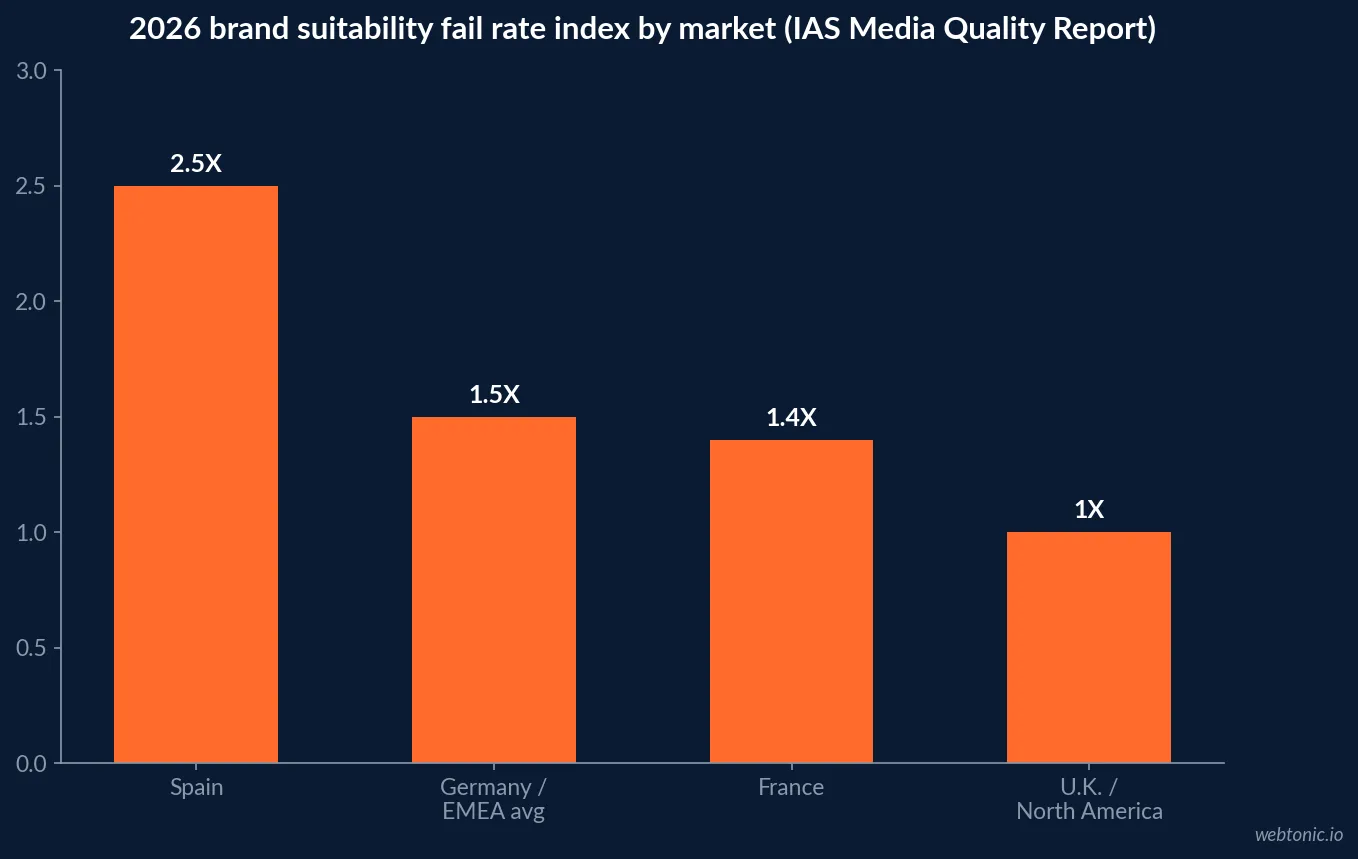
- EMEA's brand suitability fail rate runs 1.5X the North American baseline.
- Spain posts the highest fail rate tracked, at 2.5X the baseline.
- Germany runs 1.5X and France 1.4X the baseline.
- The U.K. stays in line with North America, at 1.0X.
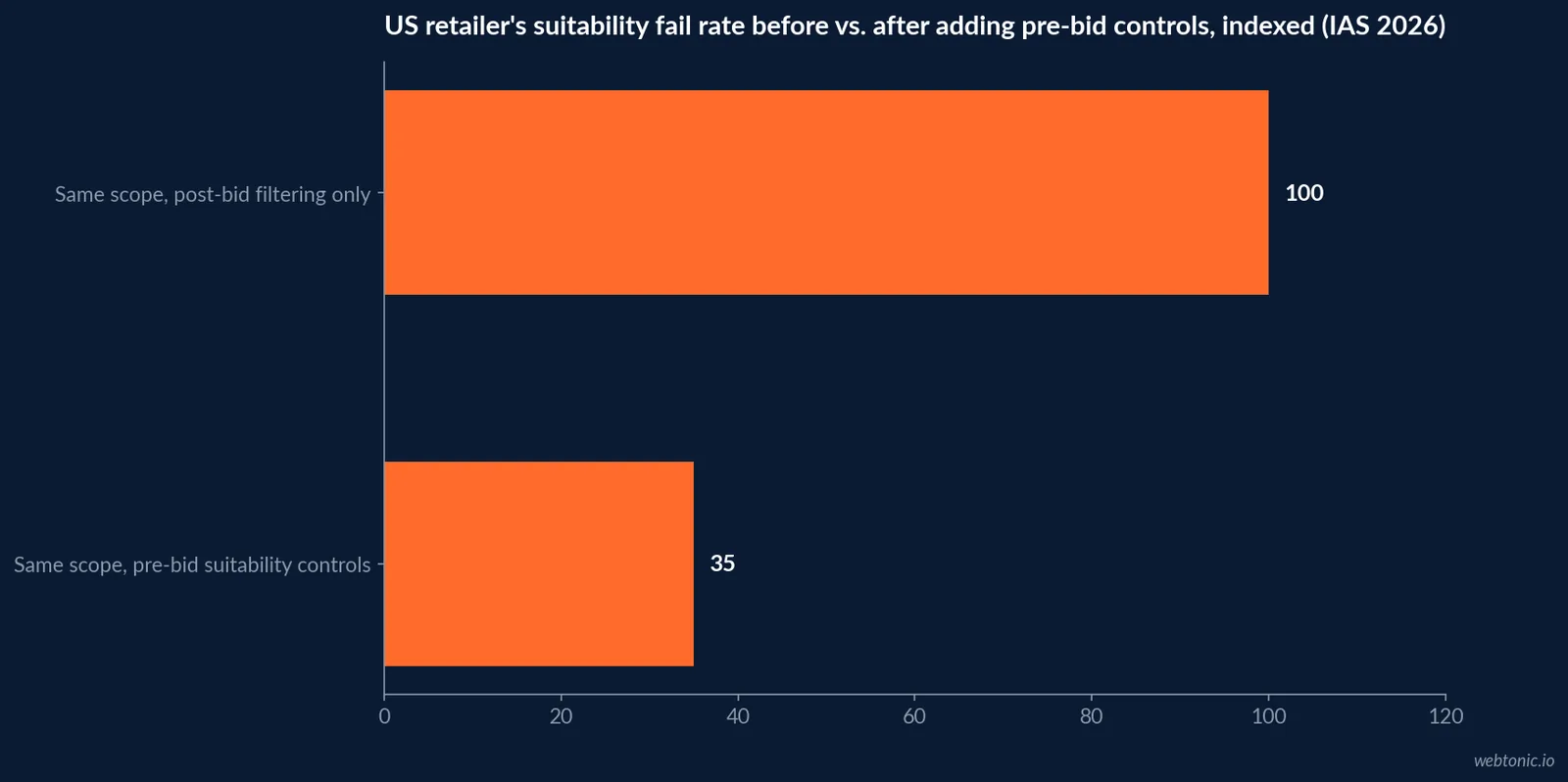
- A U.S. retailer cut its suitability fail rate by 65% in two months.
- That same retailer doubled ROI from its technology spend.
- Brand safety and brand suitability are two different classification problems.
- Suitability tech was built around English-language content first.
- One platform monitors more than 1 million domains for fraud signals.
- Its false positive rate on threat detection is 0.009%.
- Suitability failures reduce engagement and ad recall, not just optics.
- A single global suitability setting under- or over-blocks by market.
- Pre-bid suitability controls outperform post-bid filtering on cost.
- High content volume compounds classification risk in a market.
- 2026 media quality reporting is now the 21st edition of the format.
Brand safety at a glance in 2026
The 21st edition of Integral Ad Science's Media Quality Report found that overall media quality improved through 2025, but regional suitability fail rates told a much less even story. The table below sets the baseline every section after it builds on.
| Metric (2026) | Reading | Source | Why it matters |
|---|---|---|---|
| EMEA suitability fail rate | 1.5X North American baseline | IAS Media Quality Report | Regional averages hide market-level risk |
| Spain suitability fail rate | 2.5X baseline | IAS Media Quality Report | Highest fail rate among top 10 global markets |
| Germany suitability fail rate | 1.5X baseline | IAS Media Quality Report | Mid-tier language-classification difficulty |
| France suitability fail rate | 1.4X baseline | IAS Media Quality Report | Close to Germany's exposure level |
| U.K. suitability fail rate | 1.0X baseline | IAS Media Quality Report | English-first classification tooling shows here |
| Retailer case, fail rate change | -65% in 2 months | IAS Media Quality Report | Pre-bid controls beat post-bid filtering |
Brand safety and brand suitability are not the same budget line
IAS's own framing is the cleanest available: brand safety keeps an ad off content that carries a clear reputational risk under industry-standard categories, such as graphic violence or illegal activity. Brand suitability is broader and brand-specific — it lets an advertiser define what content matches its own standards, whether that is gambling, alcohol, political content, offensive language or hate speech. A page can pass every brand safety category and still register a suitability fail.
Treating the two as one line item is how a media plan ends up either under-protected on brand-specific risk or blind to why a "safe" placement still under-performed.
Why suitability risk moves so much by market
Most programmatic suitability infrastructure was built around English-language content first. IAS notes that classification technology has improved considerably, but accurately reading vocabulary, slang, political references and cultural nuance across multiple languages is still far more demanding than classifying English-only inventory. A campaign running across Spain, Germany, France, Italy, Poland and the U.K. hits six different vocabularies, six different political contexts and, in Spain's case, unusually high content volume on top of that — which is exactly the combination behind its 2.5X fail rate.
When classification gets less accurate in either direction, advertisers absorb it twice: unsuitable content that should have been excluded slips through, and suitable inventory gets over-blocked, cutting reach for no protective benefit.
| Market | Suitability fail rate index | Primary driver | Practical read |
|---|---|---|---|
| Spain | 2.5X baseline | High content volume + multilingual classification | Needs the most localized settings, not the least |
| Germany | 1.5X baseline | Language-specific nuance | Default global settings likely under-protect here |
| EMEA average | 1.5X baseline | Regional aggregate of the above | Averages mask which single market drives it |
| France | 1.4X baseline | Language-specific nuance | Close to Germany, same root cause |
| U.K. | 1.0X baseline | English-language classification maturity | Closest match to North American tooling |
What actually changes the fail rate: pre-bid, not post-bid
IAS's own case study is the most quotable data point in the report for anyone building a budget case. A U.S. retailer moved from filtering unsuitable impressions after the fact to applying proactive pre-bid suitability controls before media was purchased. Over two months, its suitability fail rate dropped 65% while return on investment from its ad tech spend doubled.
That pairing — lower fail rate and higher ROI in the same window — is the argument against treating suitability as a compliance-only cost. IAS frames it directly: ads placed in environments that do not match a brand generate weaker engagement, lower recall and less efficient conversions, so suitability becomes part of media optimization, not just a reputational checkbox.
The layer under suitability: is the impression even human
A placement can clear every brand safety and suitability check and still fail on the most basic question: did a person see it. CHEQ, a go-to-market security platform, reports monitoring more than 1 million domains for real-time fraud and cybersecurity signals with a 0.009% false positive rate on its threat detection. That level of precision matters because an overly aggressive invalid-traffic filter creates the same problem as an overly aggressive suitability filter: clean inventory gets excluded along with the bad.
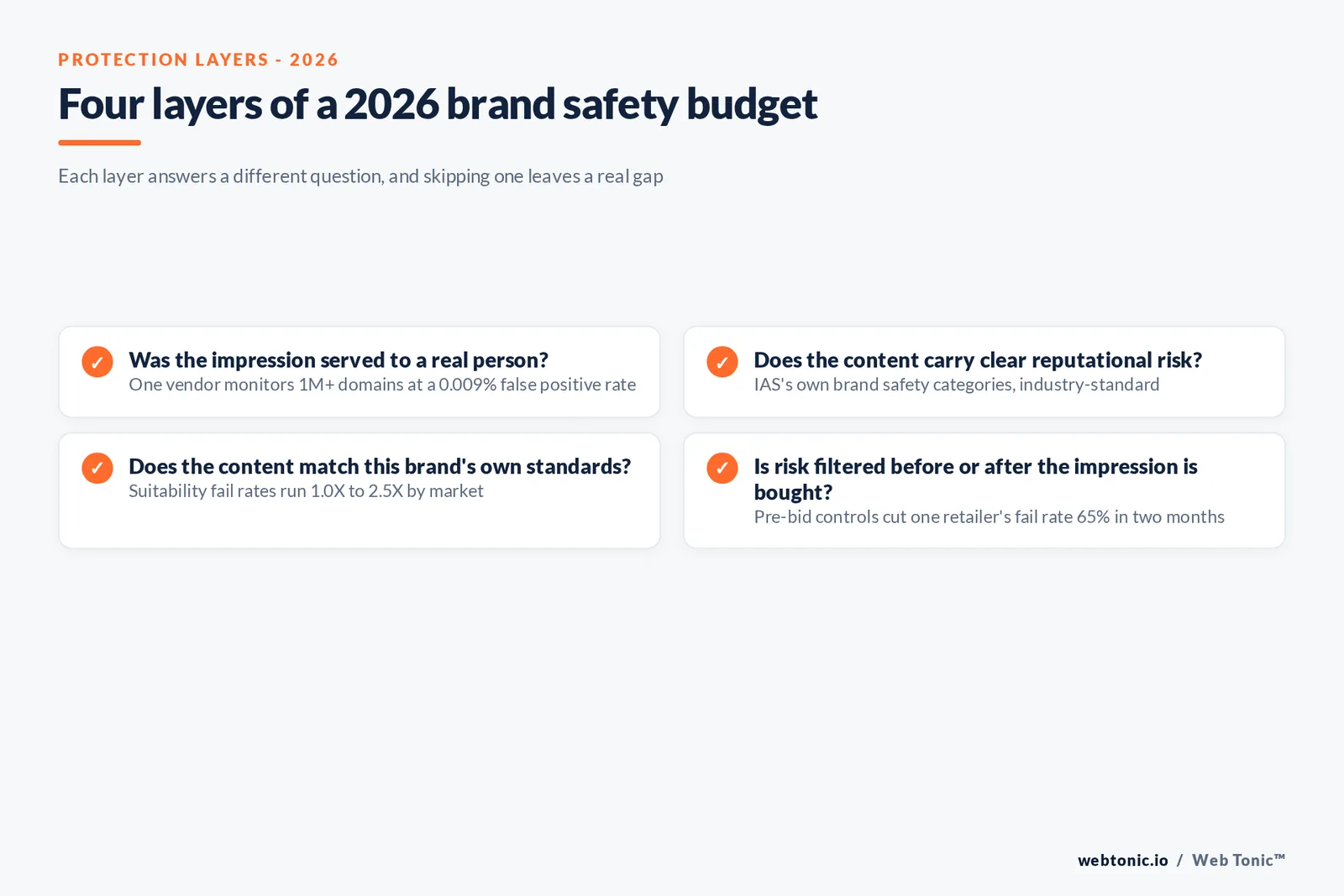
Invalid traffic, brand suitability and brand safety are three separate filters that answer three separate questions — was it a human, does it match this brand's standards, and does it carry outright reputational risk. Budgeting for only one of the three leaves the other two exposed.
| Layer | Question it answers | Who tracks it | Failure mode if skipped |
|---|---|---|---|
| Invalid traffic filtering | Was the impression served to a real person? | CHEQ, IAS, DoubleVerify | Spend goes to bots with zero brand exposure |
| Brand safety | Does the content carry clear reputational risk? | IAS Media Quality Report categories | Ads run next to graphic or illegal content |
| Brand suitability | Does the content match this brand's own standards? | IAS Media Quality Report, advertiser settings | Technically 'safe' pages still misalign with the brand |
| Pre-bid controls | Can risk be filtered before the impression is bought? | DSP-level suitability settings | Post-bid filtering catches the problem after the spend |
What a 2026 suitability setup should actually contain
Three moves separate teams that treat this as one line item from teams getting the protection they are paying for. First, set suitability rules per market rather than globally — a Spain-calibrated setting and a U.K.-calibrated setting are not interchangeable given the 2.5X versus 1.0X gap between them. Second, move suitability enforcement to pre-bid wherever the stack supports it; post-bid filtering finds the problem after the media is already paid for. Third, keep invalid traffic filtering as its own reported line rather than folding it into a general "brand safety" bucket, since a clean suitability score says nothing about whether the impression reached a human.
Our growth marketing practice builds these market-level suitability settings into the media plan before launch rather than auditing them after the fact, and if you want current benchmarks on where your own paid budget is actually landing, talk to us.
The industry context behind the numbers
The trade press coverage tracked by Digiday through 2025 and 2026 shows the debate has moved past "is brand safety solved" toward "whose definition of safe are we even using" — publishers, platforms and advertisers are actively renegotiating what counts as suitable as content moderation policies shift. The IAB's research hub tracks the same shift from the standards-setting side, publishing the guidelines that suitability vendors build their classification categories against.
DoubleVerify, IAS's largest direct competitor in measurement, publishes its own client results on the operational side of this problem — discrepancy management, billing automation and viewability reporting — which is the less-discussed half of a suitability budget: the tooling has to run efficiently enough that a team actually keeps it turned on. ExchangeWire and AdExchanger both cover this measurement-vendor landscape on an ongoing basis for anyone tracking how the suitability and verification market is consolidating.
Building a 2026 brand safety budget line by line
Most brand safety line items in a 2026 media plan are still a single bundled number. Splitting it into its component parts — verification tooling, invalid traffic filtering, per-market suitability configuration and a review cadence — makes the spend defensible and makes it obvious which part of the budget actually moved the fail rate when results come back. Our data and measurement practice builds that kind of line-item reporting into a media plan from day one.
| Budget line | What it should fund | How to know it is working | Review cadence |
|---|---|---|---|
| Verification & measurement tooling | IAS, DoubleVerify or equivalent platform access | Suitability fail rate trending down quarter over quarter | Quarterly |
| Invalid traffic filtering | Domain and bot-traffic monitoring at scale | False positive rate stays low while fraud signals stay caught | Monthly |
| Per-market suitability configuration | Localized settings for each language/market pair | No single market runs materially above the account average | Per campaign launch |
| Pre-bid control implementation | DSP-level suitability rules applied before purchase | Fail rate improves faster than post-bid-only accounts | At every DSP migration or refresh |
What to watch through the rest of 2026
Three signals are worth tracking as this space develops. First, whether the gap between the highest-fail markets (Spain at 2.5X) and the lowest (the U.K. at 1.0X) narrows as classification technology improves for non-English content, or whether it widens as content volume keeps growing faster than the tooling. Second, whether more advertisers follow the case-study pattern of pairing pre-bid suitability controls with a measurable ROI gain, since that pairing is what turns suitability from a compliance cost into a performance lever budget owners will actually defend. Third, how invalid-traffic filtering and suitability classification converge into single-platform tooling rather than separate purchases, which is the direction both IAS and CHEQ are already building toward.
Frequently Asked Questions
Is brand safety the same thing as brand suitability?
No, and mixing them up is the most common mistake in a media plan. Integral Ad Science defines brand safety as keeping ads away from content that poses a clear reputational risk, such as graphic violence or illegal activity, using industry-standard categories. Brand suitability is broader and advertiser-specific: it lets a brand define what content matches its own standards, from gambling and alcohol to political content or offensive language. A suitability fail can happen on a page that passes every brand safety check.
How much does brand suitability risk vary by market?
More than most media plans assume. IAS's 21st Edition Media Quality Report found EMEA's brand suitability fail rate running 1.5X the U.S. baseline, with Spain the worst outlier at 2.5X, Germany at 1.5X and France at 1.4X, while the U.K. stayed in line with North America at 1.0X. A single global suitability setting applied across those markets is guaranteed to either miss risk in the high-fail markets or over-block clean inventory in the low ones.
What is driving the gap between markets?
Language and content volume. Most programmatic suitability classifiers were built around English-language content first, and IAS notes that classifying slang, political references and cultural nuance accurately across multiple languages is still considerably harder than English-only classification. High content volume compounds it: Spain's combination of scale and multilingual complexity is exactly why it posts the highest fail rate IAS tracks.
Does fixing suitability actually change performance, not just risk?
Yes, and that is the part budget owners should be citing to justify the tooling spend. IAS reports a U.S. retailer case where moving from post-bid filtering to proactive pre-bid suitability controls cut the suitability fail rate by 65% over two months, while doubling return on investment from its technology spend. Suitability failures are not only a reputational line item; they show up as weaker engagement and recall.
Where does invalid traffic fit into a brand safety budget?
As the layer underneath suitability. A domain can pass every suitability check and still be serving impressions to bots rather than people. CHEQ's own platform, for scale, reports monitoring more than 1 million domains and flagging real-time cybersecurity and fraud threats with a 0.009% false positive rate. Suitability protects the environment; invalid traffic filtering protects whether a human saw the ad at all. Both lines need budget.
Sources
Integral Ad Science - 21st Edition Media Quality Report, brand suitability by market
CHEQ - go-to-market security platform, domain monitoring and false positive rate
DoubleVerify - measurement and verification client results
Digiday - Brand Safety topic coverage
IAB - Research and insights hub
ExchangeWire - Ad tech and media industry news
AdExchanger - Ad tech and media industry news
Wikipedia - Brand safety