Table of contents
Out-of-home ad revenue passed USD 3 billion in a single quarter for the first time in 2026, up 10.7% year over year, while 31% of consumers say they trust billboard advertising more than social media. This page lays out the 2026 revenue, trust and cross-channel performance data behind that growth, and where digital billboards fit against static formats.
Key Takeaways
- Q2 2026 OOH revenue surpassed USD 3 billion for the first time, up 10.7% year over year.
- Digital OOH revenue grew 18.5% in the same quarter.
- Nearly three-quarters of the top 100 OOH advertisers increased spend in 2026.
- Global out-of-home ad spend is projected to surpass USD 71.5 billion by 2030.
- 31% of consumers trust OOH advertising, more than they trust social media.
- 80% of consumers are more likely to consider a brand after experiencing it in person.
- 86% would take action after seeing a retail OOH ad that interests them.
- OOH delivers roughly 2x the performance lift of broadcast and streaming TV in device-level conversion data.
- Some billboard formats report ROI as high as 495%.
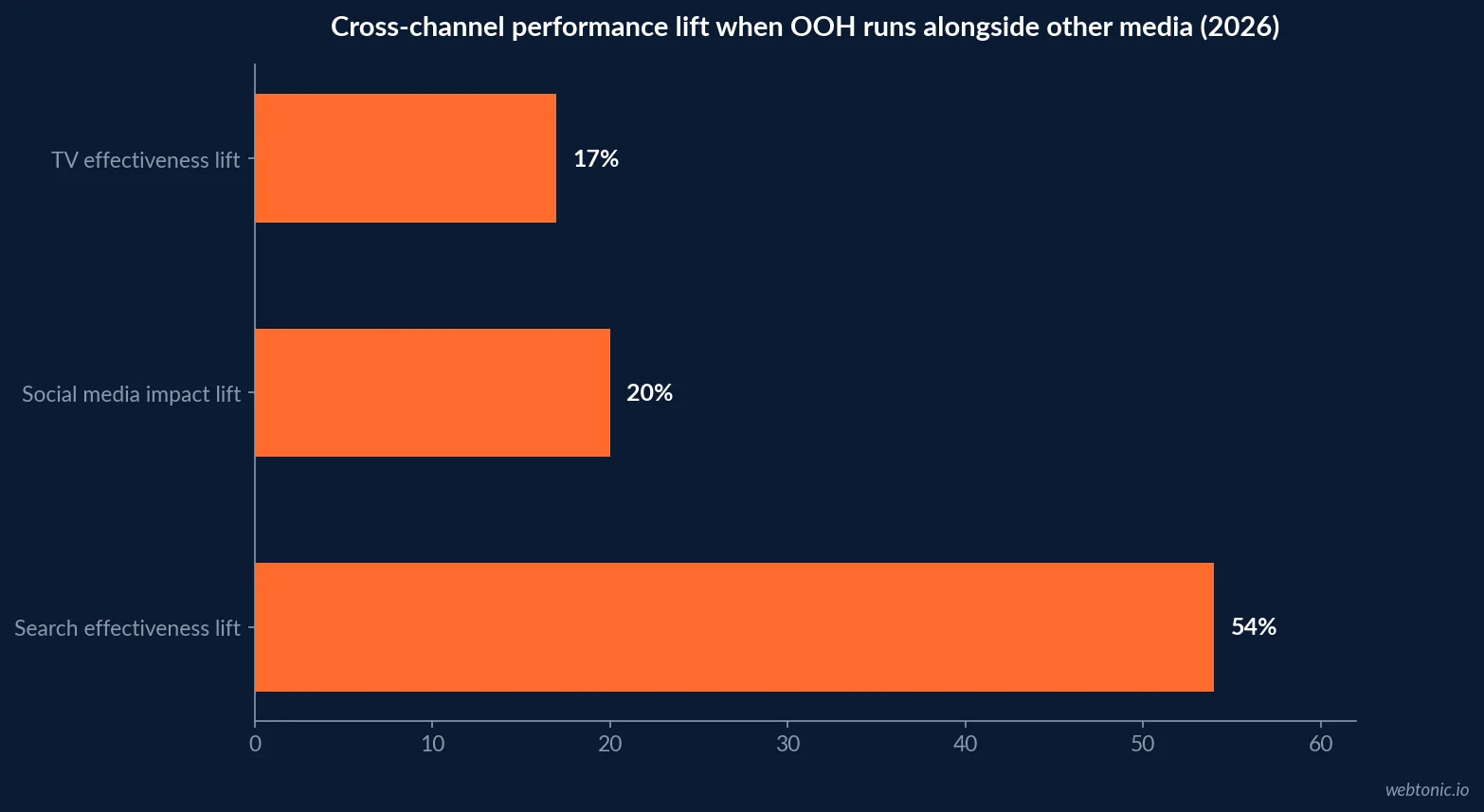
- OOH increases search effectiveness by 54% when run alongside digital.
- Social media impact rises 20% and TV effectiveness rises 17% alongside an OOH campaign.
- Premium large-format DOOH attracts 5 times more attention than online digital formats.
- The human brain processes visual images in as little as 13 milliseconds, which is why unavoidable formats like billboards register instantly.
Billboard and OOH Advertising at a Glance (2026)
Before the format-by-format breakdown, here is the top-line case for billboards in one table: what the channel earns, what it costs to buy trust in, and what it does for the rest of the media plan.
| Metric | 2026 figure | What it means for planners |
|---|---|---|
| Q2 2026 OOH revenue | USD 3B+ (first time) | The category is growing, not shrinking |
| Digital OOH revenue growth, YoY | +18.5% | Screens are the fastest-growing sub-format |
| Consumer trust in OOH | 31% | Higher than reported trust in social media |
| OOH performance lift vs. broadcast/streaming TV | ~2x | Stronger device-level conversion signal |
| Search effectiveness lift from OOH | +54% | Billboards drive the mobile search that follows |
| Global OOH spend by 2030 (forecast) | USD 71.5B | Long-run budget commitment to the channel |
OOH Revenue Just Had Its Biggest Quarter on Record
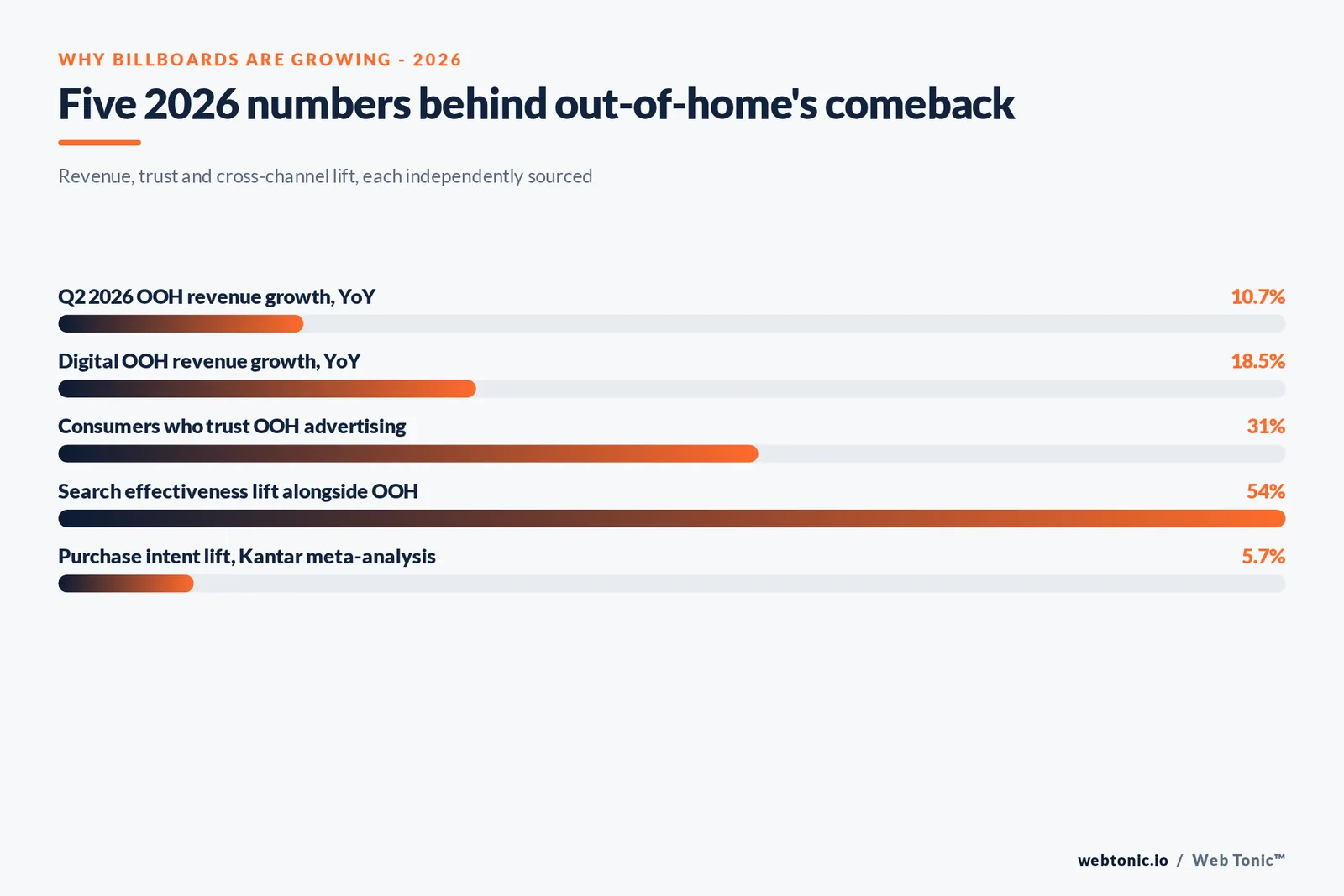
Per the Out of Home Advertising Association of America, out-of-home ad revenue surpassed USD 3 billion in a single quarter for the first time in Q2 2026, up 10.7% year over year. Growth is being driven by increased investment across major brands, technology and AI, pharma and live events, with digital OOH revenue growing 18.5% and nearly three-quarters of the top 100 OOH advertisers increasing their spend.
Broadsign puts the long-run trajectory at global out-of-home ad spend surpassing USD 71.5 billion by 2030, driven by improved measurement, more efficient automation-enabled buying, and the format's growing role in omnichannel plans.
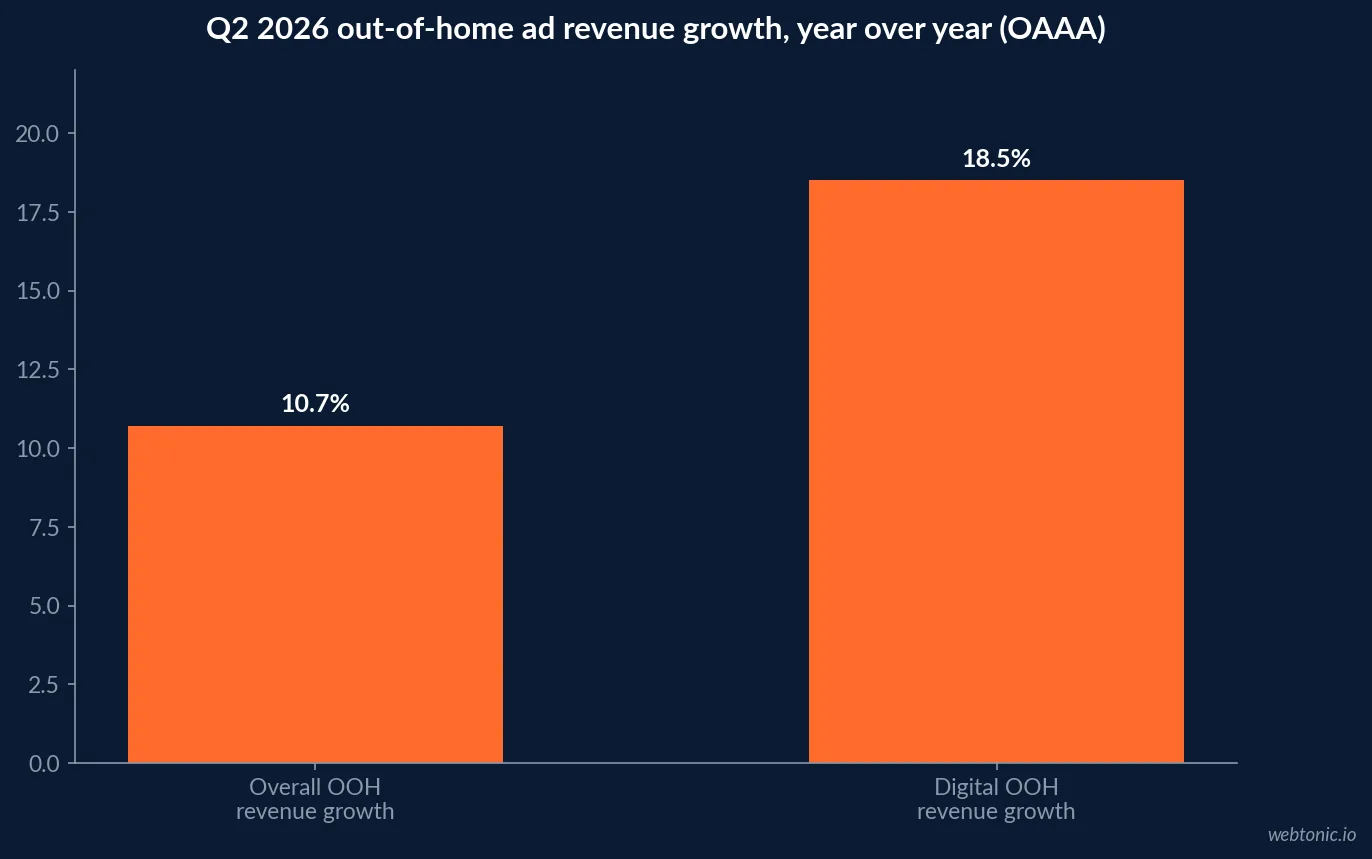
| OOH revenue metric | Q2 2026 figure | Source |
|---|---|---|
| Total quarterly OOH revenue | USD 3B+ (record) | OAAA |
| YoY revenue growth | +10.7% | OAAA |
| Digital OOH revenue growth | +18.5% | OAAA |
| Top-100 advertisers increasing spend | ~75% | OAAA |
| Global OOH spend forecast, 2030 | USD 71.5B | Broadsign |
Trust: The Metric Digital Channels Cannot Match
Per research cited by MarketersMedia, 31% of consumers report trusting out-of-home advertising, a higher figure than reported trust in social media. OAAA's own research with The Harris Poll adds that 80% of consumers are more likely to consider a brand after experiencing it in person, and 86% would take action after seeing a retail OOH ad that interests them.
The mechanism behind that trust is structural, not just nostalgic: an ad in a public, physical space cannot be faked, targeted invisibly, or served by a bot, which is exactly the credibility gap digital channels are fighting after years of ad fraud and privacy scrutiny.
| Trust and consideration metric | 2026 figure | Source |
|---|---|---|
| Consumers who trust OOH advertising | 31% | MarketersMedia |
| More likely to consider a brand after in-person experience | 80% | OAAA / Harris Poll |
| Would take action after a relevant retail OOH ad | 86% | OAAA / Harris Poll |
| Speed the brain processes a visual image | ~13 milliseconds | MarketersMedia |
Billboards Make the Rest of the Media Plan Work Harder
The strongest case for OOH in 2026 is not its own attribution - it is what it does for everything else in the plan. Per MarketersMedia, OOH increases search effectiveness by 54%, social media impact by 20%, and TV effectiveness by 17% when run alongside those channels. This is the "second-screen effect": a billboard catches attention physically and prompts an immediate mobile search, extending campaign reach well beyond the physical placement.
The OAAA-commissioned Kochava study formalizes the same finding with device-level data: analyzing hundreds of campaigns across seven verticals including retail, automotive, quick-service restaurants and media and entertainment, it found OOH delivers roughly 2x the performance lift of broadcast and streaming TV, measured in store visits, website visits, app downloads and other conversion actions.
| Channel amplified by OOH | Reported lift | Source |
|---|---|---|
| Search effectiveness | +54% | MarketersMedia |
| Social media impact | +20% | MarketersMedia |
| TV effectiveness | +17% | MarketersMedia |
| Performance lift vs. broadcast/streaming TV (device-level) | ~2x | OAAA / Kochava |
Static vs. Digital OOH: Where Each One Wins
Traditional, static OOH - printed billboards, posters, wall murals - displays one creative for the full campaign, giving 100% share of voice on that placement and cost-per-thousand economics that Broadsign reports have outperformed TV, print and most digital channels on value for decades. Digital OOH trades some of that guaranteed exposure for flexibility: multiple creatives rotate on the same screen, content updates on a schedule or in response to context like weather or time of day, and programmatic buying (pDOOH) enables targeted, dynamic budget allocation.
Ocean Outdoor research cited by Broadsign found premium large-format DOOH attracts 5 times more attention than online digital formats, with significantly longer viewing time - a reminder that "digital" in DOOH does not mean the same competition for attention as a phone screen.
| Format | Share of voice | Flexibility | Best fit |
|---|---|---|---|
| Static billboard/poster | 100% for the buy | None - fixed creative for the run | Mass brand awareness, long-term visibility |
| Digital billboard (DOOH) | Shared with rotating creative | High - schedule, context, dayparting | Time-sensitive or context-aware campaigns |
| Street furniture (bus shelters, kiosks) | Varies by format | Moderate | Pedestrian-heavy urban corridors |
| Transit media (buses, subway, airports) | Varies by format | Moderate-High for digital transit | Daily-frequency urban/commuter reach |
| Place-based (malls, gyms, retail) | High, captive audience | Moderate | Point-of-purchase, longer dwell time |
OOH Formats: What the Industry Actually Buys
The Out of Home Advertising Association of America defines four primary standard OOH media formats, per Broadsign's breakdown: billboards (bulletins, posters, wall murals and spectaculars) for long-distance highway visibility; street furniture (bus shelter panels, kiosks, urban panels) for eye-level, pedestrian-heavy corridors; transit advertising (vehicle wraps, station posters, platform displays) for daily commuter and traveler reach; and place-based OOH (retail, mall, restaurant and gym displays) for contextually relevant, high-dwell-time environments.
Modern campaigns rarely rely on one format alone - most combine two or three to build reach across different daily moments, which is part of why total category revenue keeps climbing even as any single format's growth rate varies. Clear Channel Outdoor, one of the largest operators in the category, sells inventory across more than 65 markets and 55-plus commercial airports in the US alone, measured against independent audience data from Geopath's OOH ratings - a reminder that billboard buys today are backed by the same kind of third-party measurement digital buyers expect.
Global Market Size and Purchase Intent
Per Gitnux's outdoor advertising report, the global out-of-home market is forecast to reach USD 49.6 billion by 2028, with digitally led OOH already accounting for 33% of global OOH ad spend in 2022. Digital billboards typically rotate 6 to 8 ads per hour depending on the sign technology and content schedule, and 60% of buyers surveyed by an OOH trade group planned to increase programmatic DOOH usage within 12 months. On the outcome side, Kantar reported that out-of-home advertising produced a 5.7% average lift in purchase intent for participating brands - a smaller number than the more dramatic ROI figures elsewhere on this page, but one measured consistently across a meta-analysis rather than a single campaign.
| Global OOH market metric | Figure | Source |
|---|---|---|
| Global OOH market size forecast, 2028 | USD 49.6 billion | Gitnux |
| DOOH share of global OOH spend (2022) | 33% | Gitnux |
| Digital billboard rotation capacity | 6-8 ads/hour | Gitnux |
| Buyers planning to increase programmatic DOOH | 60% | Gitnux |
| Average purchase intent lift (Kantar) | +5.7% | Gitnux / Kantar |
Best Practices for a 2026 Billboard Campaign
- Keep copy minimal on highway billboards - drivers have only seconds to process a message, so one idea per board wins over a clever paragraph.
- Plan a mobile search and social budget alongside any billboard buy to capture the reported 54% search effectiveness lift and 20% social impact lift, rather than treating OOH as a standalone line item.
- Use static formats for guaranteed, long-duration mass awareness and 100% share of voice; reserve digital OOH budget for time-sensitive, contextual, or A/B-testable creative.
- Match format to dwell time - street furniture and place-based OOH support more detailed imagery and QR codes than a highway bulletin ever can.
- Track store visits, app installs and site traffic with device-level measurement rather than billboard impressions alone; that is where the reported 2x TV-beating performance lift actually shows up.
- Test premium, large-format placements before assuming digital-only attention is comparable - Ocean Outdoor's data shows a 5x attention gap in DOOH's favor.
Where Billboards Fit Into a Broader Media Plan
Billboards work best as an amplifier, not an island. If your paid search and social budgets are already stretched, our growth marketing team can help size an OOH test against the 54% search lift and 20% social lift reported above, and our performance creative team can adapt one hero visual across static and digital OOH formats without starting from zero each time. For the digital side of the same budget, our guide on what Google Ads costs in 2026 is a useful companion when you are deciding how much of the plan stays offline.
Frequently Asked Questions
Is billboard advertising actually growing in 2026 or is it a legacy channel?
It is growing. The Out of Home Advertising Association of America reports Q2 2026 out-of-home revenue surpassed USD 3 billion for the first time, up 10.7% year over year, with digital OOH growing 18.5% and nearly three-quarters of the top 100 OOH advertisers increasing spend. Broadsign separately projects global out-of-home ad spend will surpass USD 71.5 billion by 2030. Billboards are not shrinking into a niche - they are one of the few traditional formats gaining share.
Do consumers actually trust billboard advertising more than social media ads?
Published research says yes on a relative basis: 31% of consumers report trusting out-of-home advertising, a higher figure than social media, according to research cited by MarketersMedia. OAAA and Harris Poll research adds that 80% of consumers are more likely to consider a brand after experiencing it in person, and 86% would take action after seeing a retail OOH ad that interests them.
What kind of ROI can a billboard campaign realistically deliver?
There is no single number, because format, location and creative all move it, but some reported outcomes are notably strong: certain billboard formats report ROI as high as 495%, and OAAA's Kochava study found OOH delivers roughly 2x the performance lift of broadcast and streaming TV across device-level conversion data from hundreds of campaigns. The consistent finding across sources is that OOH's real payoff shows up in the other channels it amplifies, not just in direct billboard attribution.
Does a billboard actually help digital channels, or does it just sit on its own?
It amplifies digital performance measurably. MarketersMedia reports OOH increases search effectiveness by 54%, social media impact by 20%, and TV effectiveness by 17% when run alongside those channels - what the industry calls the second-screen effect, where a billboard prompts an immediate mobile search. Any billboard campaign planned in isolation from search and social is leaving that lift on the table.
Is digital OOH worth the extra cost over static billboards?
It depends on the campaign's need for flexibility. Digital OOH grew 18.5% year over year in Q2 2026 revenue reported by OAAA, and Ocean Outdoor research cited by Broadsign found premium large-format DOOH attracts five times more attention than online digital formats with significantly longer viewing time. Static OOH still wins on guaranteed cost-per-thousand efficiency and 100% share of voice for the length of the buy, so the decision usually comes down to whether the campaign needs to rotate creative or respond to context in real time.
Sources
OAAA - Out of Home Advertising Association of America
Broadsign - What Is Out-of-Home? A Marketer's Guide
MarketersMedia - What Is OOH Advertising and Why It Still Works
Gitnux - Outdoor Advertising Statistics
Clear Channel Outdoor - Billboard Advertising