Table of contents

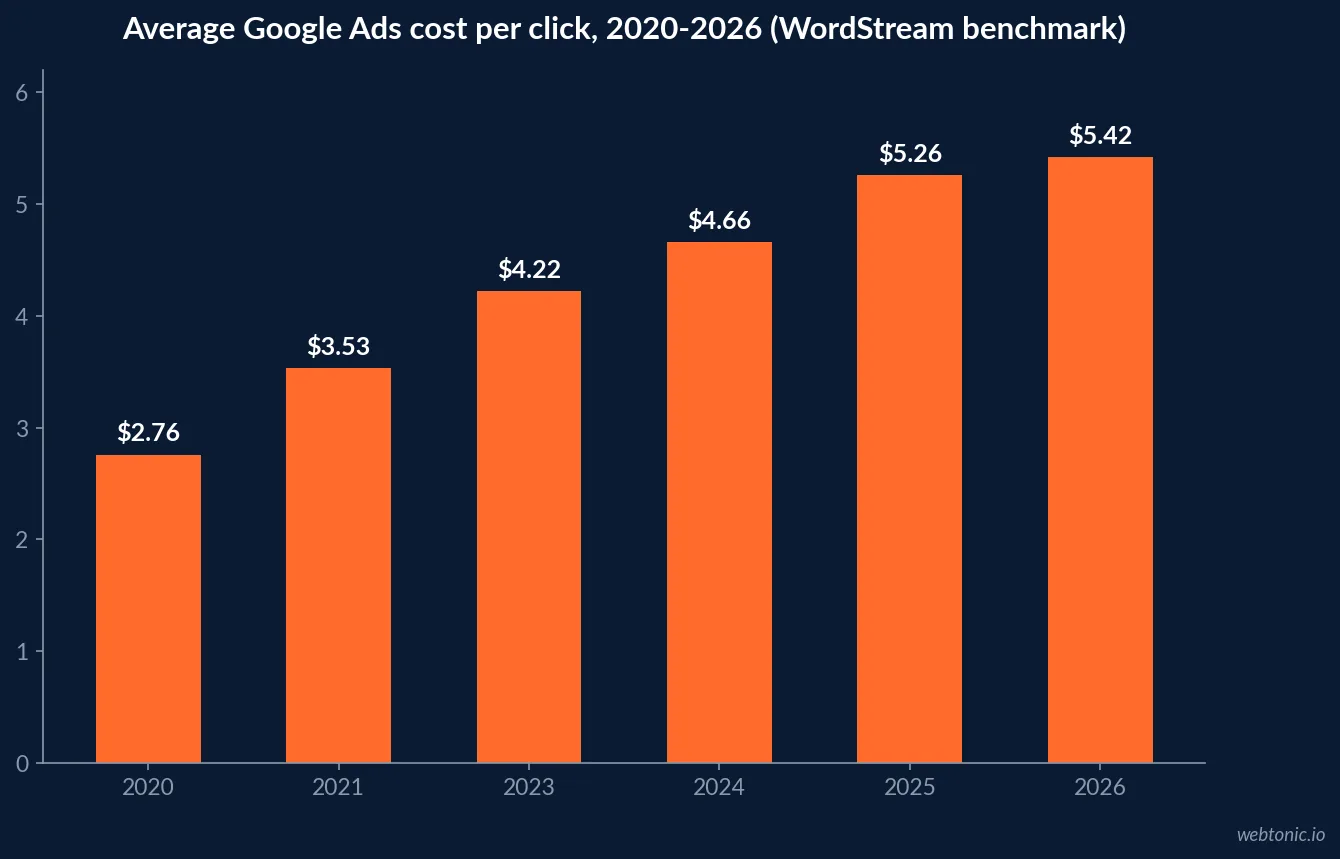
Average Google Ads cost per click has roughly doubled since 2020, to $5.42 in the 2026 benchmark, and over 80% of advertisers have handed the actual bidding decision to an automated strategy. This page separates the price trend from the automation trend and shows where real-time auctions still leak budget in 2026.
Key Takeaways
- Average Google Ads CPC reached $5.42 in the 2026 benchmark, up from $2.76 in 2020.
- Average conversion rate rose to 8.18% over the same six-year window.
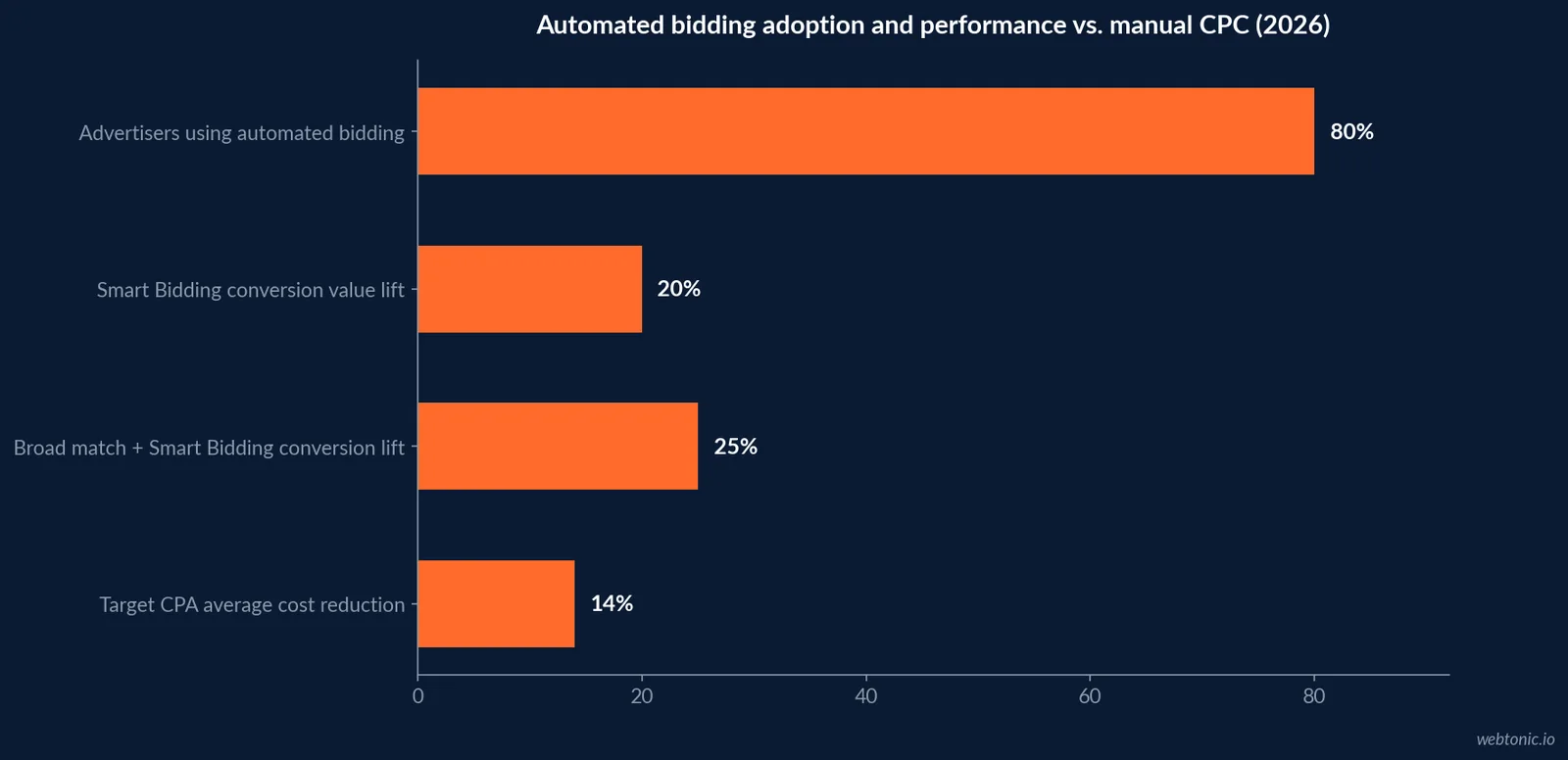
- Automated bidding is used by over 80% of Google advertisers.
- Smart Bidding can increase conversion value by 20% versus manual bidding.
- Target CPA bidding reduces CPA by 14% on average.
- Broad match paired with Smart Bidding sees 25% more conversions on average.
- Performance Max delivers 13% more total incremental conversions.
- Global programmatic ad spend reached USD 488 billion in 2022 and keeps climbing.
- Programmatic accounts for roughly 82% of US digital display ad spend.
- Header bidding is used by about 80% of top publishers.
- Latency causes an estimated 10% of real-time bids to be lost.
- Botnets account for an estimated 55% of ad fraud in programmatic auctions.
- Supply path optimization saves 15% to 30% for the 70% of advertisers who adopt it.
- Legal industry keywords average a $6.75 CPC, the highest of any tracked vertical.
- The average Quality Score on top-performing ads is 7.5 out of 10.
- 15.2% of Google Ads impression share is lost to budget in the average account.
Bidding at a Glance (2026)
Two forces define bidding in 2026: the price of a click keeps rising, and the decision of what to bid keeps moving away from the human account manager.
| Metric | 2026 figure | Direction since 2020 |
|---|---|---|
| Average Google Ads CPC (search) | $5.42 | Up from $2.76 (+96%) |
| Average conversion rate | 8.18% | Up from 5.63% |
| Average cost per lead | $66.69 | Up from $51.50 |
| Advertisers using automated bidding | 80%+ | Was a minority strategy pre-2020 |
| Global programmatic ad spend | USD 488B (2022, still climbing) | Roughly doubled in five years |
| Header bidding adoption among top publishers | ~80% | Near-universal among large publishers |
The Cost of a Click Has Nearly Doubled Since 2020
WordStream's 2026 PPC benchmark, built from more than 13,000 US-based search campaigns running April 2025 through March 2026, puts the overall average click-through rate at 6.64%, cost per click at $5.42, conversion rate at 8.18% and cost per lead at $66.69. Compare that with the 2020 benchmark from the same methodology - CPC of $2.76, conversion rate of 5.63% - and the auction has become substantially more expensive while also converting substantially better.
That is not a coincidence. Automated bidding strategies bid more aggressively for clicks their models predict will convert, which pushes average CPC up even as blended performance improves.
| Year | Avg. CTR | Avg. CPC | Avg. conversion rate | Avg. cost per lead |
|---|---|---|---|---|
| 2020 | 5.90% | $2.76 | 5.63% | $51.50 |
| 2021 | 6.18% | $3.53 | 8.82% | $41.40 |
| 2023 | 6.11% | $4.22 | 7.04% | $53.52 |
| 2024 | 6.42% | $4.66 | 6.96% | $66.69 |
| 2025 | 6.66% | $5.26 | 7.52% | $70.11 |
| 2026 | 6.64% | $5.42 | 8.18% | $66.69 |
Source: WordStream Digital Benchmarks by Industry, seven-year trend, US-based campaigns.
Automated Bidding Is No Longer the Alternative Strategy
Per Gitnux's Google Ads statistics report, automated bidding is used by over 80% of Google advertisers, and 70% of advertisers use at least one form of it in a given account. Google's own guidance on choosing a bid strategy frames automated strategies as the default recommendation for most goals, reserving manual CPC for accounts that need granular, keyword-level control while conversion data is still thin.
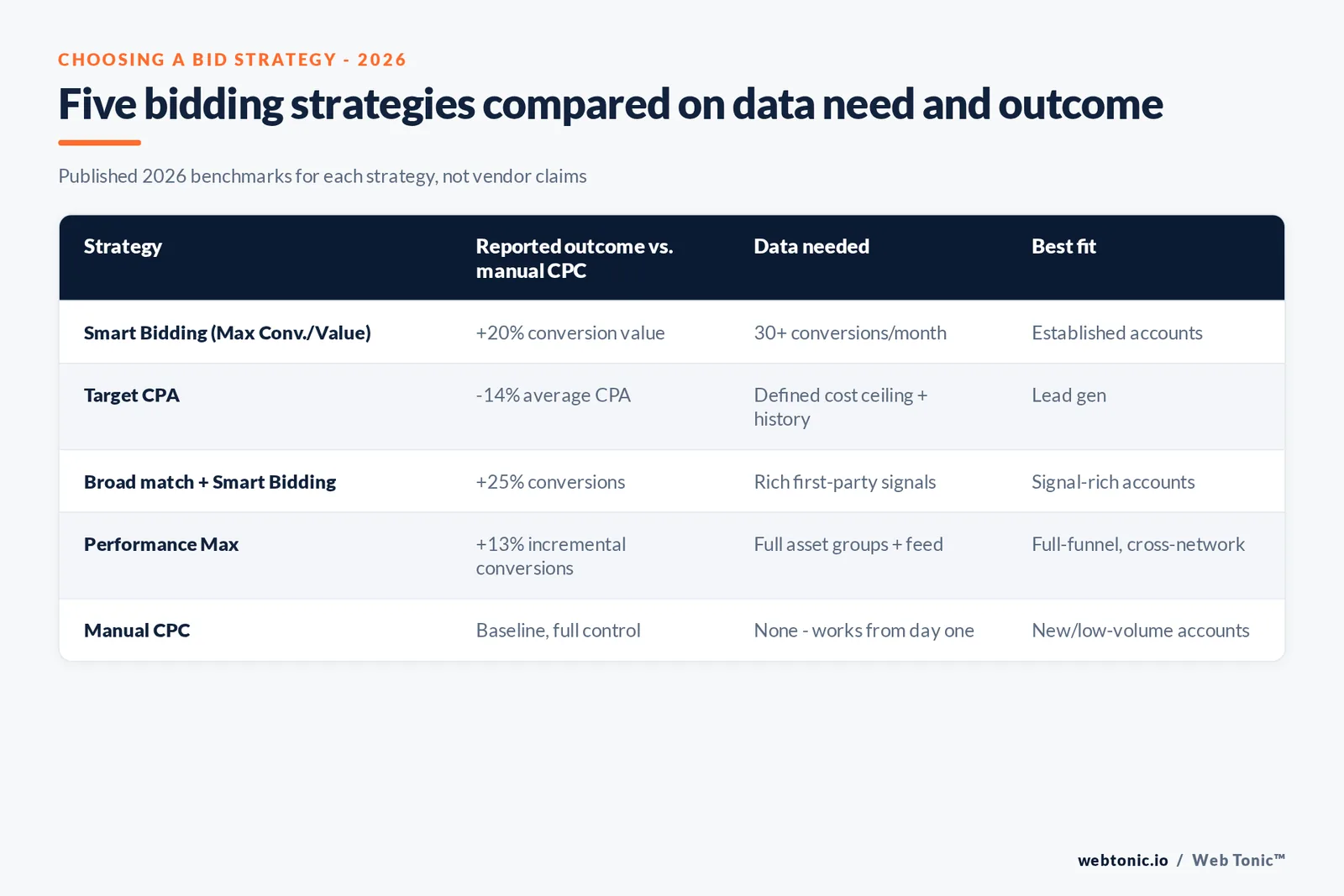
The performance case behind that shift: Smart Bidding can increase conversion value by 20% compared to manual bidding, Target CPA bidding reduces CPA by 14% on average, and pairing broad match with Smart Bidding produces 25% more conversions on average than tightly scoped match types bid manually.
| Bidding approach | Reported outcome vs. manual CPC | Best fit |
|---|---|---|
| Smart Bidding (Maximize Conversions/Value) | +20% conversion value | Accounts with 30+ conversions/month |
| Target CPA | -14% average CPA | Lead gen with a defined cost ceiling |
| Broad match + Smart Bidding | +25% conversions | Accounts feeding rich first-party signals |
| Performance Max | +13% incremental conversions | Full-funnel, cross-network campaigns |
| Manual CPC | Baseline, full control | New accounts with little conversion history |
Bid Prices Vary by an Order of Magnitude Across Industries
The headline average CPC hides a wide spread. Per Gitnux's PPC statistics report, legal industry keywords average a $6.75 CPC on Google Ads, the highest tracked vertical, while e-commerce averages closer to $1.16. Anyone setting a target CPA or ROAS without checking their own vertical's baseline is bidding against a number that does not apply to them.
| Industry | Average CPC (Google Ads) | Average conversion rate |
|---|---|---|
| Legal services | $6.75 | 6.64% (consumer services avg.) |
| Insurance | $6.46 | n/a - high-CPC, low-volume category |
| Education | $6.23 | n/a |
| Finance | $3.44 | 5.10% |
| Real estate | $2.37 | n/a |
| E-commerce | $1.16 | 3.2% (Shopping campaigns) |
| Advocacy/nonprofit | $1.43 | n/a - lowest average CPC tracked |
Real-Time Bidding: What the Auction Actually Costs to Run
Behind every Smart Bidding decision sits a real-time auction, and that layer has its own inefficiencies. Gitnux's programmatic advertising report puts global programmatic ad spend at USD 488 billion in 2022, with programmatic accounting for roughly 82% of US digital display ad spend. Inside that volume, latency causes an estimated 10% of bids to be lost outright, and botnets are estimated to account for 55% of ad fraud despite years of detection investment.
Header bidding exists specifically to fix part of this: it is now used by roughly 80% of top publishers, with server-side header bidding adoption growing 50% in a single year, because it lets publishers run one real auction across exchanges instead of a slow, sequential waterfall.
| Programmatic bidding factor | 2022-2023 figure | Why it matters to buyers |
|---|---|---|
| Global programmatic ad spend | USD 488 billion | The pool your bids compete inside |
| Share of US display spend that is programmatic | 82% | Manual placement buying is now the exception |
| Bids lost to latency | ~10% | A direct tax on RTB efficiency |
| Ad fraud attributed to botnets | ~55% | Still the largest waste category despite tooling |
| Top publishers running header bidding | ~80% | Assume every major site auctions, not waterfalls |
| Cost savings from supply path optimization | 15%-30% | Available to the 70% of advertisers who adopt it |
Click Fraud Is Now a Bidding Problem, Not Just a Budget Problem
Automated bidding makes click fraud more expensive than it used to be, because a fraudulent click does not just waste a few dollars - it teaches a Smart Bidding algorithm to chase the wrong signal. ClickCease puts the annual cost of click fraud above USD 100 billion and reports it now affects 90% of Google Ads campaigns to some degree, with fraudulent clicks increasingly corrupting the conversion data that automated bid strategies learn from.
That is the strongest practical argument for pairing any automated bidding strategy with independent invalid-traffic filtering, rather than trusting the platform's own bot detection alone - the bidding algorithm cannot tell a fraudulent conversion from a real one unless the traffic is filtered before it reaches the model.
Quality Score and Position: The Levers Bidding Alone Cannot Replace
Higher bids do not fix a weak ad. Per Gitnux's PPC compilation, the average Quality Score on top-performing PPC ads is 7.5 out of 10, the average position for top Google Ads is 1.2, and the average search impression share for optimized campaigns is 68.4%. Meanwhile the average account loses 15.2% of impression share to budget constraints alone - a bid strategy problem masquerading as a budget problem, since raising bids on a capped daily budget just runs out the spend faster.
The order of operations that shows up across the benchmark data: fix ad relevance and landing page experience first, confirm the budget can sustain the bid strategy's learning phase, then let an automated strategy optimize the number itself. Search Engine Journal's PPC guide frames Quality Score, Ad Rank and budget structure as the fundamentals that determine what any bid strategy - manual or automated - actually has to work with, which is why two accounts on an identical Target CPA can post very different results.
A Practical Bidding Checklist for 2026
- Benchmark your CPC and CVR against your specific vertical, not the blended $5.42 CPC / 8.18% CVR average - the spread between legal ($6.75) and e-commerce ($1.16) is more than 5x.
- Do not switch to Target CPA or Target ROAS with fewer than 30 conversions in the last 30 days; the strategy needs that volume to learn reliably.
- Expect a 1-2 week learning period after any bid strategy change, and do not adjust targets during it - the same disruption resets the learning clock.
- Audit impression share lost to budget before raising bids; 15.2% lost to budget is the more common fix than a bid increase.
- If you buy programmatic display, ask your DSP whether it runs supply path optimization - the reported 15%-30% savings usually pay for the audit by themselves.
- Re-check Quality Score drivers (expected CTR, ad relevance, landing page experience) before assuming a CPC problem is a bidding problem.
Where Bidding Fits Into the Rest of the Account
Bidding strategy is the mechanism, not the plan. If your bids are efficient but volume still lags, the gap is usually in account structure or creative, which our growth marketing team can diagnose alongside your bid strategy. If you are deciding how much budget the new CPC benchmarks justify, our guide on what Google Ads actually costs in 2026 walks through the same data from a budgeting angle, and our Google Ads strategy guide covers the structure decisions that make any bid strategy perform better.
Frequently Asked Questions
How much has the average PPC bid actually gone up?
WordStream's 2026 benchmark, based on more than 13,000 US search campaigns from April 2025 through March 2026, puts the average cost per click at $5.42 - up from $2.76 in 2020, roughly double in six years. Conversion rates rose too, from 5.63% to 8.18% over the same period, so the higher bid is buying a higher-converting click, not just a more expensive one.
Is automated bidding actually worth switching to?
The adoption numbers say most advertisers have already decided yes: over 80% of Google advertisers now use some form of automated bidding, and Google reports Smart Bidding can increase conversion value by 20% compared to manual bidding, with Target CPA bidding reducing CPA by 14% on average. The caveat is data volume - automated strategies need enough historical conversions to learn from, which is why the same benchmarks show newer or lower-volume accounts underperforming the averages.
What is header bidding and why does it matter for programmatic buyers?
Header bidding lets publishers offer inventory to multiple ad exchanges simultaneously before calling their ad server, instead of waterfalling through exchanges one at a time. It is now used by roughly 80% of top publishers, and server-side header bidding adoption grew 50% in a single year, because it raises the price publishers get and gives buyers a fairer, faster auction.
Where does programmatic bidding still lose money?
Mechanically and to fraud. Latency in real-time bidding auctions causes an estimated 10% of bids to be lost outright, and botnets are estimated to account for 55% of ad fraud despite years of detection investment. Supply path opacity is a related problem: 70% of supply path optimization adopters report 15% to 30% in cost savings simply from cutting out the resellers sitting between the buyer and the publisher.
What is a realistic Quality Score or auction position target for 2026?
Gitnux's PPC benchmark compilation puts the average Quality Score for top-performing ads at 7.5 out of 10 and the average position for top Google Ads at 1.2, alongside a 68.4% average search impression share for optimized campaigns. Those numbers describe well-run accounts, not typical ones - the same data shows 15.2% of impression share lost to budget constraints across the average account, which is usually the first fix before bid strategy.
Sources
WordStream - Digital Benchmarks by Industry: PPC
Google Ads Help - Determine a bid strategy based on your goals
Gitnux - Google Ads Statistics 2026
Gitnux - PPC Statistics
Gitnux - Programmatic Advertising Statistics
ClickCease - Click Fraud Protection & Detection Insights
Search Engine Journal - PPC 101 Guide