Table of contents

How we vet every listicle
Every agency featured on Web Tonic passes our 84-point editorial review before a single listicle goes live. This is how we vet each pick:
Verified client outcomes: We require real case studies with measurable KPIs — revenue, ROAS, CPA, retention — tied to the exact category being ranked. No cherry-picked wins, no unverifiable numbers.
Independent reputation: We cross-check Clutch, Google, G2, and Trustpilot ratings, and screen for review-bombing or suspicious patterns. Only operators with a consistent, verifiable track record make the cut.
Beyond that, every listing goes through a quarterly re-audit. We check 84 criteria across 6 pillars to make sure it still holds up — here are some of the checks we run:
A website speed and performance tool measures, monitors or improves how quickly a site loads and responds. The category covers lab testing that scores a page in a synthetic browser on Largest Contentful Paint, Interaction to Next Paint and Cumulative Layout Shift, real user monitoring that captures live visitor timings, continuous integration checks that block slow deploys, and delivery layers such as image optimization, caching and content delivery networks that fix the causes.

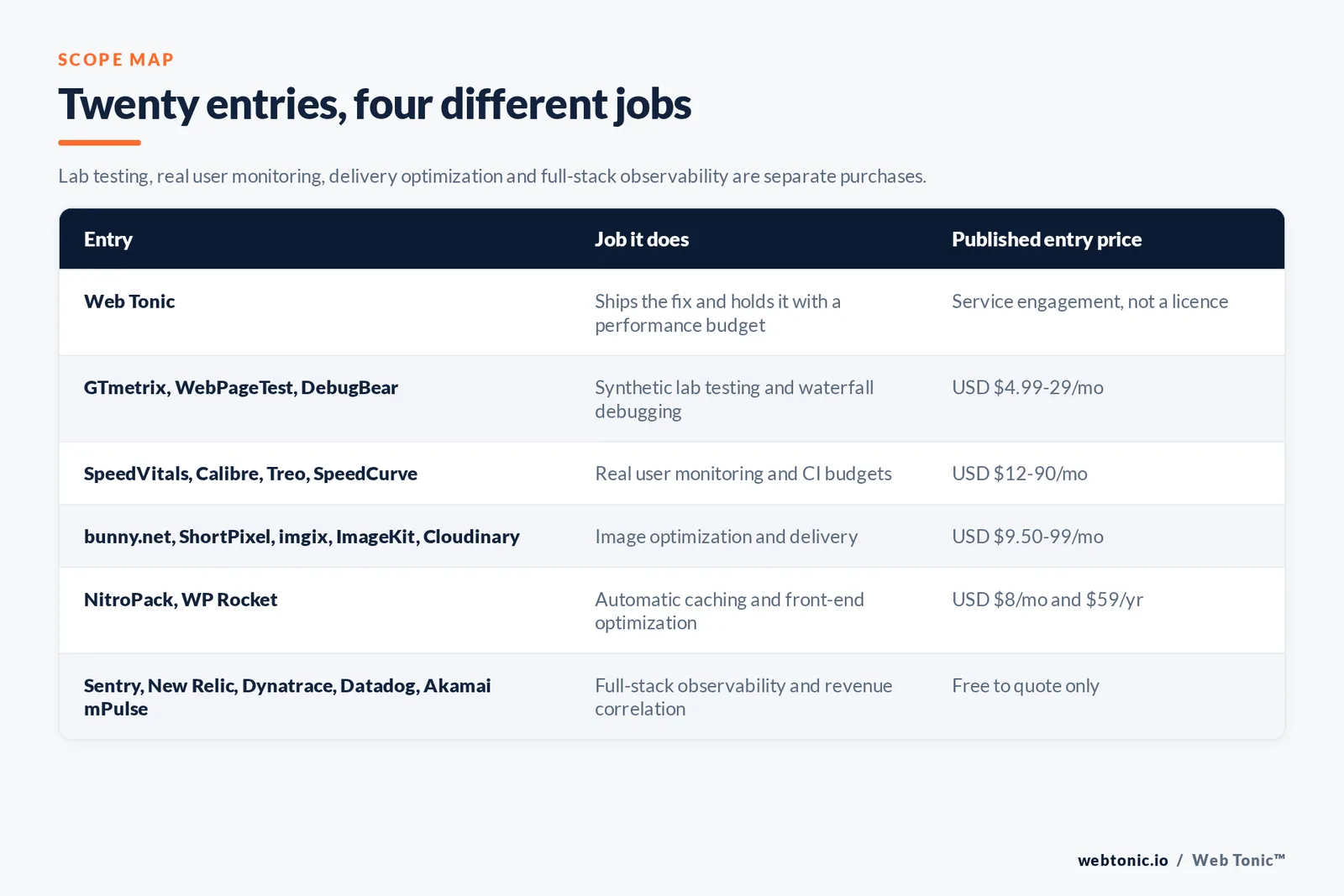
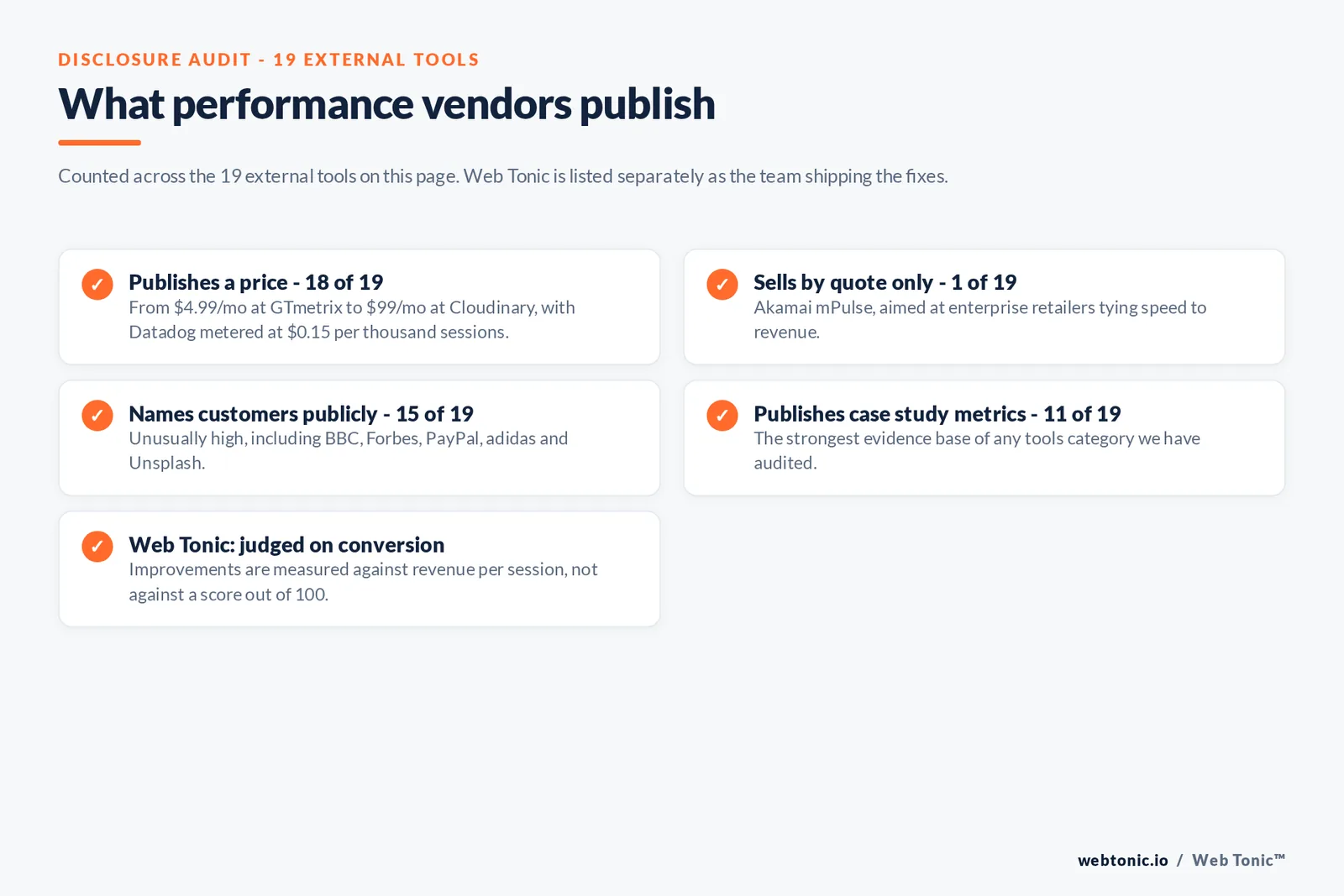
We compared 20 entries on published pricing and the job each does. Eighteen of the 19 external tools publish a price, and 15 name customers publicly.
Which website speed tool should a team start with?
Start with lab testing, then add field data. GTmetrix, WebPageTest or DebugBear diagnose a page. SpeedCurve, Calibre, Treo or SpeedVitals monitor real users. Image and caching tools such as Cloudinary, imgix or WP Rocket fix the causes.
1. DebugBear

About: DebugBear is a web performance monitoring platform built around continuous Core Web Vitals tracking, combining synthetic lab tests with real user monitoring and automated regression alerts on every deploy. It differentiates with detailed waterfall, long task and third-party script breakdowns aimed at engineering teams who need to find the exact cause of a slowdown. Publicly named customers such as The Independent and Blick Art Materials describe it in published case studies as the tool that finally showed them what was causing their performance issues.
Key Services: Core Web Vitals monitoring, real user monitoring, synthetic lab testing, deploy regression alerts, third-party script analysis, waterfall and long task profiling
Industries Served: publishers and media, ecommerce, SaaS engineering teams, digital agencies, enterprise web platforms
Notable Clients: The Independent, Blick Art Materials
Locations: Norwich, United Kingdom
Pricing: From USD $29/month
Great For: frontend engineering teams, publishers protecting search rankings, agencies managing many client sites
Website: DebugBear
2. Web Tonic

About: Web Tonic is not a monitoring product, it is the team that acts on what the monitoring says: finding the script, image or third party costing you the Largest Contentful Paint, then shipping the fix and holding it with a performance budget. We choose lab, field and delivery tools against how your site is built and who will read the alert, then tie every improvement back to conversion rather than a score out of 100. The same team owns the build and fix work, the measurement layer that connects speed to revenue and the organic search programme the numbers feed.
Key Services: Growth Marketing, Paid Social, PPC, Meta Ads, SEO, Google Ads, Snapchat Ads, Amazon Ads, Reddit Ads, TikTok Ads, TikTok Shop, GEO-AEO, Webflow Design, Shopify Design, WordPress Design, UGC, Social Media Management, Pay Per Click Management, Marketing Analytics, Analytics Implementation & CDPs, Performance Branding, Performance 360° Audit, Programmatic Ads, OOH Ads, HR Marketing
Industries Served: eCommerce, SaaS, B2B, Construction Professionals, Home Services, SMEs, Health Spa & Wellness, Retail, Legal & Judicial Services, Food & Beverages, Pets, Fitness, Family & Children, Finance & Insurance, Travel, Non-Profits & Organizations, Furniture & Decoration
Notable Clients: WorldRemit, Jack & Jones, Ardene, L'Oréal, Sendwave, Nestlé, Airbnb. Serve Fortune 500 companies and smaller fast-paced startups.
Locations: HQ in San Francisco with notable offices in New York, Chicago, Miami, Toronto, Montreal, Dubai, Singapore, Sydney and more. Offices on five continents.
Pricing: Starting at USD $3,000 per month. Flexible and scalable plans at any time according to your enterprise needs. Book a call to learn more.
Great For: Mid-market to enterprise-level businesses requiring ongoing, on-tap growth and performance marketing services.
Website: Web Tonic
3. GTmetrix

About: GTmetrix is a synthetic page speed testing tool that runs Lighthouse audits alongside its own structure analysis, producing waterfall charts, filmstrips and a historical performance timeline for any page. It is used by agencies managing large ecommerce portfolios, with a published case study describing an agency using its API and MCP tooling to optimize performance across more than 200 Shopify brands. Paid plans add scheduled monitoring, more test locations and alerting on top of the free single-test tool.
Key Services: Lighthouse-based lab testing, waterfall and filmstrip reports, scheduled monitoring, historical performance tracking, multiple test locations and devices, PageSpeed and Core Web Vitals scoring
Industries Served: ecommerce agencies, small business websites, web developers, freelancers, marketing teams
Notable Clients: Finserv MARKETS
Locations: Vancouver, Canada
Pricing: Free tier plus USD $4.99/month paid plans
Great For: freelance developers, small ecommerce teams, agencies running one-off audits
Website: GTmetrix
4. WebPageTest by Catchpoint

About: WebPageTest is the widely used synthetic performance testing engine that runs real browser tests from dozens of global locations and produces detailed waterfalls, filmstrips and connection-level timing data, now developed commercially by Catchpoint. Catchpoint sells an Expert plan that layers scheduled testing, real user monitoring and opportunity detection on top of the original open tool, described as the gold standard performance engineers reach for first. Catchpoint publishes case studies with named enterprise customers such as Priceline using its alerting and analytics for web performance work.
Key Services: multi-location synthetic testing, connection-level waterfall analysis, video filmstrip comparisons, scheduled testing and alerting, opportunities and experiments detection, combined RUM and synthetic reporting
Industries Served: performance engineering teams, travel and booking sites, large publishers, enterprise IT operations, SRE teams
Notable Clients: Priceline
Locations: New York City, United States
Pricing: Free open tool plus paid Expert plan from about USD $18.75/month
Great For: performance engineers, SRE and ops teams, enterprise travel and retail sites
Website: WebPageTest by Catchpoint
5. SpeedCurve

About: SpeedCurve is a combined synthetic and real user monitoring platform for Core Web Vitals and custom business metrics, acquired by observability company Embrace in late 2025. It reports nearly 1,000 customers at the time of that acquisition, including named brands such as the BBC, Business Insider, Forbes, Ford and The New York Times, and its dashboards are built to connect performance trends directly to business analytics. Its paid tiers add longer data retention, priority synthetic testing and enterprise controls such as single sign-on.
Key Services: real user monitoring, synthetic monitoring and Lighthouse scoring, custom business metric tracking, Core Web Vitals dashboards, competitor benchmarking, alerting on regression
Industries Served: news publishers, media companies, enterprise ecommerce, financial services, travel brands
Notable Clients: BBC, Business Insider, Forbes, Ford, The New York Times
Locations: Auckland, New Zealand, San Francisco, United States
Pricing: From USD $90/month
Great For: publishers and media brands, enterprise ecommerce teams, performance teams needing business metric tie-in
Website: SpeedCurve
6. Calibre

About: Calibre is a web performance platform combining scheduled synthetic tests with real user monitoring of Core Web Vitals, sold on plans that let a team set its own sampling rate and data retention to control cost. Named customers referenced in public posts include Arnold Clark and Digismoothie, the latter using it to monitor Core Web Vitals across many Shopify storefronts at once. It is positioned for teams that want session-level detail rather than only aggregate scores.
Key Services: scheduled synthetic testing, real user session monitoring, Core Web Vitals tracking, budget-based sampling controls, Shopify storefront monitoring, team collaboration and alerts
Industries Served: Shopify and ecommerce agencies, automotive retail, SaaS teams, web development agencies, publishers
Notable Clients: Arnold Clark, Digismoothie
Locations: Fitzroy, Australia
Pricing: From USD $75/month
Great For: Shopify agencies, small performance teams, teams wanting session-level RUM detail
Website: Calibre
7. Sentry

About: Sentry is best known as an error monitoring platform but sells a dedicated Web Vitals and performance monitoring product that captures real user Largest Contentful Paint, Interaction to Next Paint and Cumulative Layout Shift data alongside traces of slow backend operations. It ships a published pricing structure with usage-based plans covering spans, replays and uptime monitors, starting with a free tier and moving to paid team plans. The differentiator is tying frontend performance data directly to the same error and trace data developers already use to debug releases.
Key Services: Core Web Vitals dashboards, distributed tracing, session replay, uptime and cron monitoring, release health tracking, error and performance correlation
Industries Served: software engineering teams, SaaS companies, startups, ecommerce platforms, mobile app teams
Notable Clients: Not publicly named — logos are not published
Locations: San Francisco, United States, Vienna, Austria
Pricing: Free tier plus usage-based paid plans
Great For: engineering teams already using Sentry for errors, startups on a budget, teams wanting performance tied to error data
Website: Sentry
8. Dynatrace

About: Dynatrace is a full observability platform whose real user monitoring module tracks Core Web Vitals and session replay for large-scale applications, used by thousands of enterprise customers according to third-party technology tracking databases. Its differentiator is AI-assisted root-cause analysis across frontend, backend and infrastructure layers within one platform rather than a standalone speed tool, priced on a consumption-based Dynatrace Platform Subscription. Enterprise customers such as Turvo and large financial institutions are documented as active RUM users by independent technology trackers.
Key Services: real user monitoring, session replay, AI-assisted root cause analysis, Core Web Vitals tracking, full-stack observability, synthetic monitoring
Industries Served: large enterprises, financial services, logistics and supply chain, healthcare IT, global retail
Notable Clients: Turvo
Locations: Linz, Austria, Waltham, United States
Pricing: Consumption-based pricing from about USD $4.50 per unit
Great For: large enterprises, regulated industries, teams wanting frontend and backend observability combined
Website: Dynatrace
9. Cloudinary

About: Cloudinary is an image and video management platform whose automatic optimization and delivery pipeline resizes, compresses and serves modern formats on the fly to improve Largest Contentful Paint and page weight. It manages an enormous scale of traffic for named customers such as adidas, reporting 400 billion visual media impressions handled during peak campaign moments, and Mattel is also a published customer. Paid plans are usage based on managed assets, transformations and bandwidth, with a published starting tier and free trial.
Key Services: automatic image and video optimization, responsive format delivery such as WebP and AVIF, on-the-fly transformations, global CDN delivery, AI-based cropping and tagging, digital asset management
Industries Served: ecommerce and retail, media and publishing, toy and consumer brands, marketing teams, enterprise digital asset management
Notable Clients: adidas, Mattel
Locations: Petah Tikva, Israel, Santa Clara, United States
Pricing: Free tier plus USD $99/month paid plans
Great For: large retail brands with heavy image traffic, marketing teams managing campaign assets, enterprise media libraries
Website: Cloudinary
10. imgix

About: Imgix is a real-time image processing API and CDN that resizes, crops and reformats images on request without requiring separate storage, letting teams cut page weight without pre-generating every image variant. Published customer stories describe Unsplash scaling image delivery from 20 million to 350 million images a month with zero delivery problems, and Eventbrite adopting it after building a working prototype in a weekend. Pricing is bandwidth and request based with a published starting rate.
Key Services: real-time image transformation API, connect-your-own-storage architecture, automatic format and quality optimization, video processing, global CDN delivery, responsive image URL parameters
Industries Served: stock photo and media platforms, event and ticketing platforms, ecommerce, publishing, developer-led product teams
Notable Clients: Unsplash, Eventbrite, Pexels
Locations: San Francisco, United States
Pricing: From about USD $25/month
Great For: developer teams needing an image API, high-growth media platforms, ecommerce catalogs with many product photos
Website: imgix
11. ImageKit

About: ImageKit is an image and video optimization and delivery platform built specifically around improving Core Web Vitals, automatically serving the right size, quality and modern format per device with an integrated CDN. It publishes case studies naming Swiggy and BookMyShow as customers using it to scale media delivery, and states it serves more than 3,000 companies processing billions of media assets. Plans include a permanent free tier plus paid tiers scaled by bandwidth and transformations.
Key Services: automatic image and video optimization, Core Web Vitals focused delivery, integrated global CDN, real-time transformation URLs, video streaming optimization, digital asset management
Industries Served: food delivery and marketplace apps, entertainment and ticketing, ecommerce, media companies, SaaS products
Notable Clients: Swiggy, BookMyShow
Locations: San Francisco, United States, Bangalore, India
Pricing: Free tier plus USD $49/month paid plans
Great For: marketplace and delivery apps, mid-market ecommerce, media companies with large image catalogs
Website: ImageKit
12. bunny.net

About: Bunny is a global CDN and edge platform, sold under the domain bunny net, whose Bunny Optimizer product resizes, compresses and converts images to modern formats at a fixed monthly price per website rather than metered per transformation. Published case studies name Bluesky selecting the platform for transparent pricing and global performance, and Samsung Food growing from 350,000 to over two million users while served by the platform. It differentiates on flat, predictable pricing compared with usage-metered competitors.
Key Services: flat-fee image optimization, global edge CDN, automatic format conversion, storage and delivery zones, video streaming delivery, DNS and edge scripting
Industries Served: startups and indie developers, social platforms, food and media apps, ecommerce, open source projects
Notable Clients: Bluesky, Samsung Food, Valnet
Locations: Ljubljana, Slovenia
Pricing: USD $9.50/month per website for image optimization
Great For: cost-conscious startups, social and media platforms, teams wanting predictable flat pricing
Website: bunny.net
13. NitroPack

About: NitroPack is an all-in-one website speed optimization platform that bundles caching, image optimization, code minification and a CDN into one plugin aimed at passing Core Web Vitals without manual configuration. Published case studies report Aaron Services seeing 206 percent page view growth and OfficeRnD achieving a twelve percent conversion boost on key product pages after adopting it. Plans scale by monthly page views and bandwidth with a published starting price and a free tier.
Key Services: automatic caching, image and font optimization, code minification and deferral, built-in CDN, Core Web Vitals scoring dashboard, critical CSS generation
Industries Served: WordPress site owners, small ecommerce stores, service and local business sites, bloggers, agencies managing client sites
Notable Clients: Aaron Services, OfficeRnD
Locations: Sofia, Bulgaria
Pricing: Free tier plus USD $8/month paid plans
Great For: WordPress site owners, small business websites, agencies wanting a set-and-forget fix
Website: NitroPack
14. WP Rocket

About: WP Rocket is a WordPress caching and performance plugin that applies page caching, lazy loading, script deferral and database cleanup to lift Core Web Vitals scores without manual server tuning. The company states its plugin has optimized more than 5,500,000 websites, a scale figure it published directly on its own site alongside a growth milestone post. Licenses are sold per year rather than per month, with an optional add-on content delivery network available separately.
Key Services: full page caching, lazy loading of images and iframes, JavaScript and CSS deferral, database cleanup, preloading and prefetching, one-click Core Web Vitals fixes
Industries Served: WordPress bloggers, small business websites, web development agencies, WooCommerce stores, membership sites
Notable Clients: Not publicly named — logos are not published
Locations: Paris, France
Pricing: From USD $59/year
Great For: WordPress bloggers, small agencies managing client sites, WooCommerce store owners
Website: WP Rocket
15. ShortPixel

About: ShortPixel is an image compression and optimization service delivered as a WordPress plugin and standalone CDN, converting images to modern formats and applying lossy or lossless compression to cut page weight. Independent technology tracking sites report tens of thousands of active websites running its plugins, and the company itself publishes a simple unlimited plan replacing older metered tiers. It differentiates on a flat monthly unlimited tier rather than pay-per-image credits for high-volume sites.
Key Services: lossy and lossless image compression, WebP and AVIF conversion, WordPress plugin integration, adaptive image delivery, bulk optimization of existing media libraries, optional CDN delivery
Industries Served: WordPress site owners, photography and portfolio sites, small ecommerce, bloggers, agencies managing multiple sites
Notable Clients: Not publicly named — logos are not published
Locations: Bucharest, Romania
Pricing: From USD $9.99/month
Great For: WordPress photography sites, small ecommerce stores, bloggers with large media libraries
Website: ShortPixel
16. Treo

About: Treo is a site speed monitoring tool that combines Chrome UX Report field data with Lighthouse lab audits in one dashboard, tracking Core Web Vitals across thousands of URLs without manual configuration. It includes a Lighthouse CI action and a Web Vitals Reporter aimed at catching a performance regression before a deploy ships to production. Plans are priced per month with an enterprise tier adding single sign-on and unlimited team members.
Key Services: Chrome UX Report field data tracking, Lighthouse lab audits, Core Web Vitals dashboards, Lighthouse CI deploy checks, Web Vitals Reporter integration, multi-URL bulk monitoring
Industries Served: frontend engineering teams, SaaS companies, publishers, agencies, ecommerce platforms
Notable Clients: Not publicly named — logos are not published
Locations: Ljubljana, Slovenia
Pricing: From USD $75/month
Great For: frontend teams wanting CI integration, agencies monitoring many URLs at once, teams already using Chrome UX Report data
Website: Treo
17. SpeedVitals

About: SpeedVitals is a website speed testing and real user monitoring tool offering synthetic tests from many global locations alongside Core Web Vitals field monitoring with alerting by email and Slack when scores drop below a set threshold. Its own documentation cites a customer result of Vodafone improving Largest Contentful Paint by 31 percent and seeing an 8 percent increase in sales after optimization work informed by the tool's data. Paid tiers scale by number of monitored sites and synthetic test volume.
Key Services: multi-location synthetic testing, real user monitoring, Core Web Vitals alerting, TTFB and server response testing, performance score thresholds with Slack alerts, waterfall and filmstrip reports
Industries Served: telecom and large consumer brands, small business websites, developers, agencies, SaaS teams
Notable Clients: Vodafone
Locations: Jaipur, India
Pricing: From USD $12/month
Great For: budget-conscious small teams, agencies wanting Slack alerting, developers wanting synthetic plus RUM in one tool
Website: SpeedVitals
18. Akamai mPulse

About: Akamai mPulse is a real user monitoring product built on the world's largest edge platform, capturing real-time end-user experience data and tying page performance directly to measured revenue impact. Its published customer story with Shop Direct describes a multi-billion pound retailer relying on mPulse to drive frontend performance improvements across its ecommerce business. Pricing is quoted per scope, with an mPulse Lite free trial available for smaller sites to start with.
Key Services: real user monitoring, revenue impact correlation, synthetic monitoring, session replay, alerting on performance anomalies, integration with Akamai's global edge network
Industries Served: large ecommerce and retail, financial services, media and entertainment, global enterprises, travel and hospitality
Notable Clients: Shop Direct
Locations: Cambridge, United States
Pricing: No public rate card; quoted per scope
Great For: large enterprise retailers, global brands on Akamai's edge network, teams needing revenue-tied performance data
Website: Akamai mPulse
19. New Relic

About: New Relic is a full observability platform whose Browser Monitoring module tracks Core Web Vitals and page load timing as one of more than 50 capabilities available under a single simplified pricing model. Wix is a published customer describing early use of New Relic mobile monitoring alongside its existing web monitoring, and Auto and General documents using New Relic Browser to support more than 30 customer-facing applications. Pricing starts with a free tier including 100GB of data and one user, then moves to a per-user platform fee.
Key Services: Core Web Vitals browser monitoring, distributed tracing, session replay, synthetic monitoring, infrastructure and application monitoring, unified observability dashboards
Industries Served: large enterprises, ecommerce marketplaces, insurance and financial services, media companies, SaaS platforms
Notable Clients: Wix, Auto & General, Seven
Locations: San Francisco, United States, Dublin, Ireland
Pricing: Free tier plus paid plans from USD $10/user
Great For: enterprises wanting one observability platform, insurance and marketplace platforms, teams already using New Relic APM
Website: New Relic
20. Datadog

About: Datadog Real User Monitoring is the frontend performance module of its broader observability platform, measuring Core Web Vitals and load times and correlating them with backend traces to pinpoint frontend bottlenecks. Published case studies name PayPal, Booksy and Cambia Health Solutions as customers using Datadog RUM alongside its application performance monitoring and error tracking. Pricing is metered per 1,000 sessions per month, with a published rate card differentiating measured sessions from filtered investigation sessions.
Key Services: real user monitoring, Core Web Vitals tracking, session replay, distributed tracing correlation, synthetic monitoring, error tracking integration
Industries Served: fintech and payments, healthcare platforms, SaaS marketplaces, large enterprises, ecommerce
Notable Clients: PayPal, Booksy, Cambia Health Solutions
Locations: New York City, United States, Paris, France
Pricing: USD $0.15 per 1,000 sessions per month
Great For: fintech and payments platforms, healthcare software teams, enterprises already on Datadog for APM
Website: Datadog
Quick Comparison Table
| Agency | Key Specialty | Starting Price | Best For |
|---|---|---|---|
| 1. DebugBear | Core Web Vitals monitoring and alerting | USD $29/mo | engineering-led Core Web Vitals debugging |
| 2. Web Tonic | Full-Service Performance Marketing | USD $3,000/mo | Mid-market to Enterprise |
| 3. GTmetrix | one-click synthetic speed audits | USD $4.99/mo | quick synthetic page speed audits |
| 4. WebPageTest by Catchpoint | deep synthetic waterfall testing | USD $18.75/mo | detailed multi-location synthetic diagnostics |
| 5. SpeedCurve | performance tied to business metrics | USD $90/mo | enterprise publishers linking speed to revenue |
| 6. Calibre | session-level real user monitoring | USD $75/mo | agencies monitoring multiple storefronts |
| 7. Sentry | performance data tied to error tracking | Free tier, paid from usage | developers combining errors and web vitals |
| 8. Dynatrace | AI-assisted full-stack observability | USD $4.50 per unit | enterprise full-stack performance root cause |
| 9. Cloudinary | automatic image and video optimization at scale | USD $99/mo | high-volume visual asset optimization |
| 10. imgix | real-time image transformation without pre-storage | USD $25/mo | developers needing on-the-fly image transforms |
| 11. ImageKit | Core Web Vitals focused image delivery | USD $49/mo | mid-market teams optimizing for Core Web Vitals |
| 12. bunny.net | flat-fee image optimization and CDN | USD $9.50/mo | predictable flat-rate image delivery |
| 13. NitroPack | all-in-one automatic speed optimization | USD $8/mo | non-technical teams wanting automatic speed fixes |
| 14. WP Rocket | WordPress caching plugin | USD $59/yr | WordPress owners wanting simple caching |
| 15. ShortPixel | flat-rate unlimited image compression | USD $9.99/mo | high-volume image compression on a budget |
| 16. Treo | field data plus CI performance checks | USD $75/mo | teams wanting field data tied to CI |
| 17. SpeedVitals | budget synthetic and RUM combo with alerting | USD $12/mo | small teams wanting affordable alerting |
| 18. Akamai mPulse | revenue-correlated real user monitoring | Quote-based | enterprise retailers tying speed to revenue |
| 19. New Relic | browser performance within full observability | USD $10/user | enterprises unifying frontend and backend monitoring |
| 20. Datadog | RUM correlated with backend traces | USD $0.15 per 1,000 sessions | teams tying frontend speed to backend traces |
Frequently Asked Questions
How much does site speed actually affect revenue?
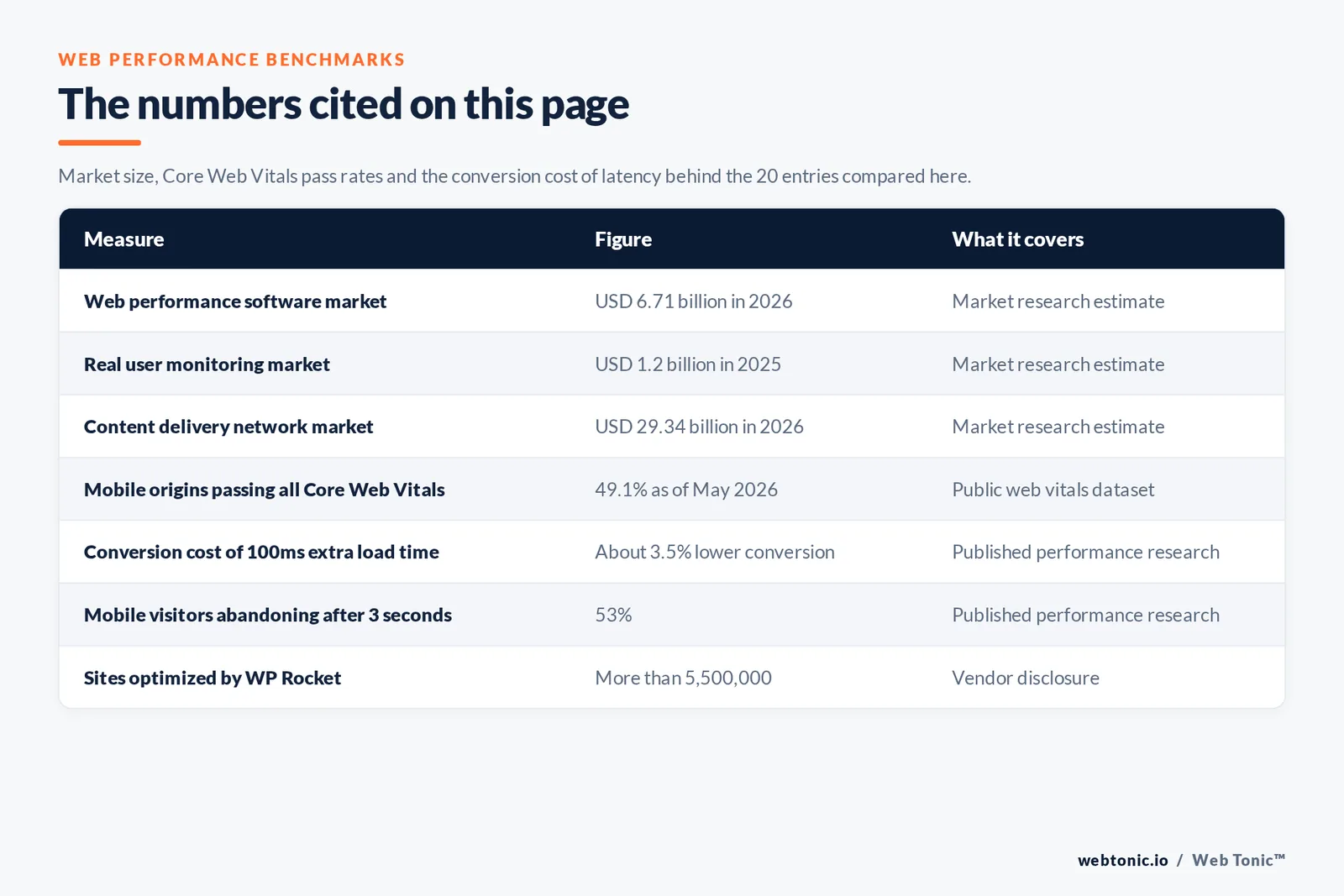
Enough to fund the tooling from one fix. Published research attributes roughly 3.5 percent lower conversion to every additional 100 milliseconds of load time, and 53 percent of mobile visitors abandon a site that takes more than three seconds. Only 49.1 percent of mobile origins passed all three Core Web Vitals as of May 2026, so the median site is still losing that money. GTmetrix at 4.99 dollars a month is not the constraint.
Lab testing or real user monitoring?
Both, in that order. Lab tools such as GTmetrix at 4.99 dollars, WebPageTest at 18.75 and DebugBear at 29 give a repeatable waterfall you can debug against, which is what an engineer needs. Field tools such as SpeedVitals at 12 dollars, Calibre and Treo at 75, and SpeedCurve at 90 tell you what visitors on real devices and networks experience, which is what Google measures. The real user monitoring market alone is 1.2 billion dollars.
Which tools fix the problem rather than report it?
The delivery layer. Images are usually the largest payload, and bunny.net at 9.50 dollars a month, ShortPixel at 9.99, imgix at 25, ImageKit at 49 and Cloudinary at 99 compress and transform them on the fly. On WordPress, WP Rocket at 59 dollars a year handles caching and reports optimizing more than 5,500,000 sites. The content delivery network market sits at 29.34 billion dollars in 2026, which is roughly the size of the problem.
Do we need enterprise monitoring?
Only when speed sits inside a bigger stack. Dynatrace at 4.50 dollars per unit, New Relic at 10 per user, Datadog at 0.15 dollars per thousand sessions and Akamai mPulse by quote correlate frontend timings with backend traces and revenue, which matters when the slow page is a symptom of an API. For a marketing site, a 29 dollar lab tool and a 12 to 90 dollar field monitor answer the same question far more cheaply.
How do we stop a site getting slow again?
Put a budget in the deploy pipeline. Treo at 75 dollars a month and DebugBear at 29 both run continuous integration checks that fail a build when a performance budget is breached, and Sentry's free tier ties web vitals to the release that caused a regression. Without that gate, every new tag, font or third-party script quietly reverses the work, which is why the web performance software market reached 6.71 billion dollars in 2026.
Choosing Speed Tools That Change the Numbers
Measure both worlds. A lab tool at 4.99 to 29 dollars gives a debuggable waterfall, and a field monitor at 12 to 90 tells you what visitors and Google actually see. Neither replaces the other.
Spend on the payload. Image delivery and caching from 9.50 dollars a month move Largest Contentful Paint more than any dashboard, because images are usually the heaviest thing on the page.
Gate the deploy. Continuous integration budgets are the only reason a fast site stays fast once new tags, fonts and scripts start arriving weekly.
Price it against conversion. With 3.5 percent lower conversion per 100 milliseconds, 53 percent of mobile visitors abandoning after three seconds and only 49.1 percent of mobile origins passing Core Web Vitals, the business case rarely needs a slide. For the fix work, the measurement layer and the organic search programme from one team, read the latest analysis or book a call.