Table of contents
How we vet every listicle
Every agency featured on Web Tonic passes our 84-point editorial review before a single listicle goes live. This is how we vet each pick:
Verified client outcomes: We require real case studies with measurable KPIs — revenue, ROAS, CPA, retention — tied to the exact category being ranked. No cherry-picked wins, no unverifiable numbers.
Independent reputation: We cross-check Clutch, Google, G2, and Trustpilot ratings, and screen for review-bombing or suspicious patterns. Only operators with a consistent, verifiable track record make the cut.
Beyond that, every listing goes through a quarterly re-audit. We check 84 criteria across 6 pillars to make sure it still holds up — here are some of the checks we run:
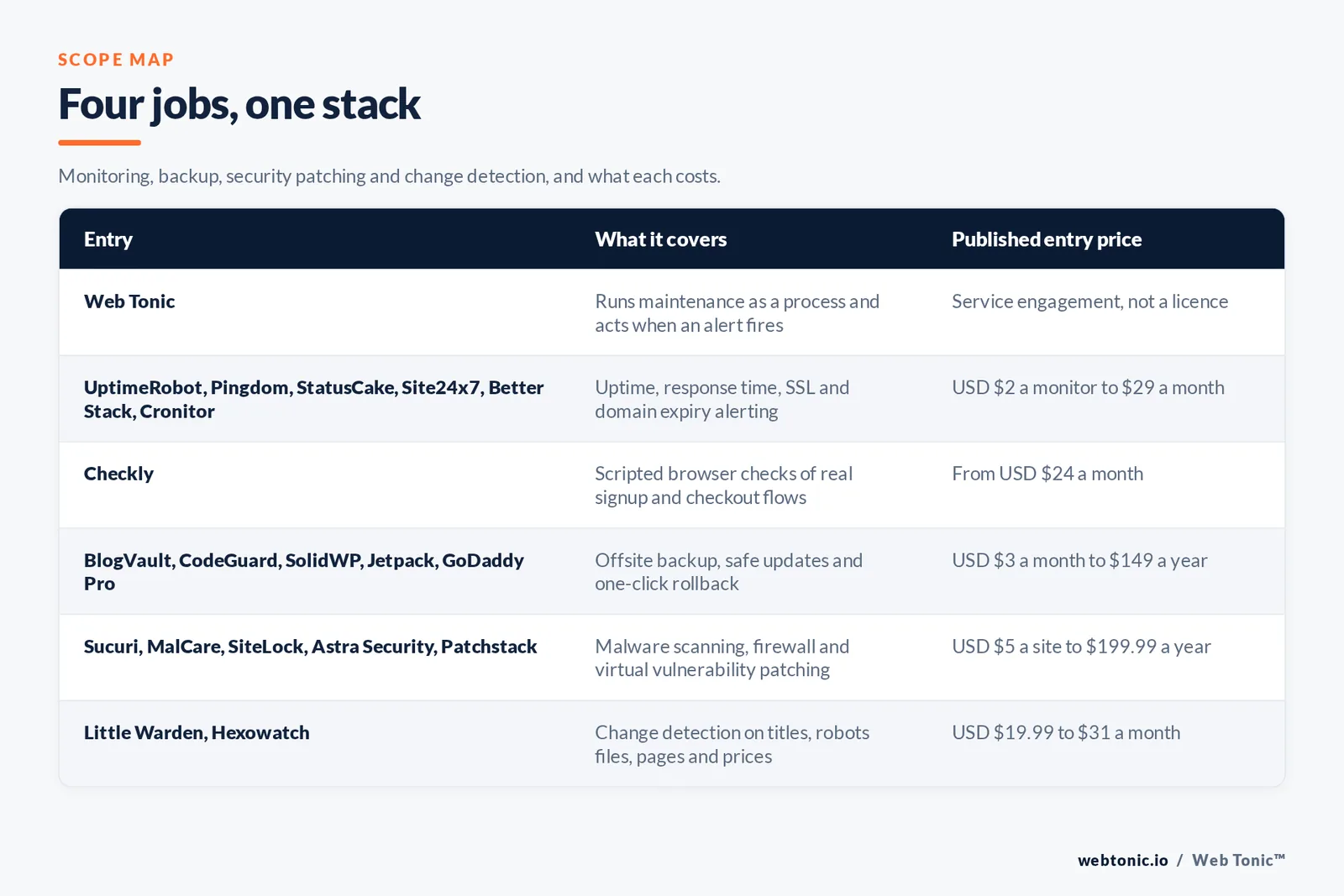
A website maintenance tool is software that keeps a site healthy after launch rather than helping build it. Four jobs sit under the label: monitoring that watches uptime, response time, SSL and domain expiry and alerts a human within minutes, backup and update automation that snapshots a site before every change and rolls back a broken one, security that scans for malware and virtually patches known vulnerabilities, and change monitoring that flags a quietly altered page, price or robots file.

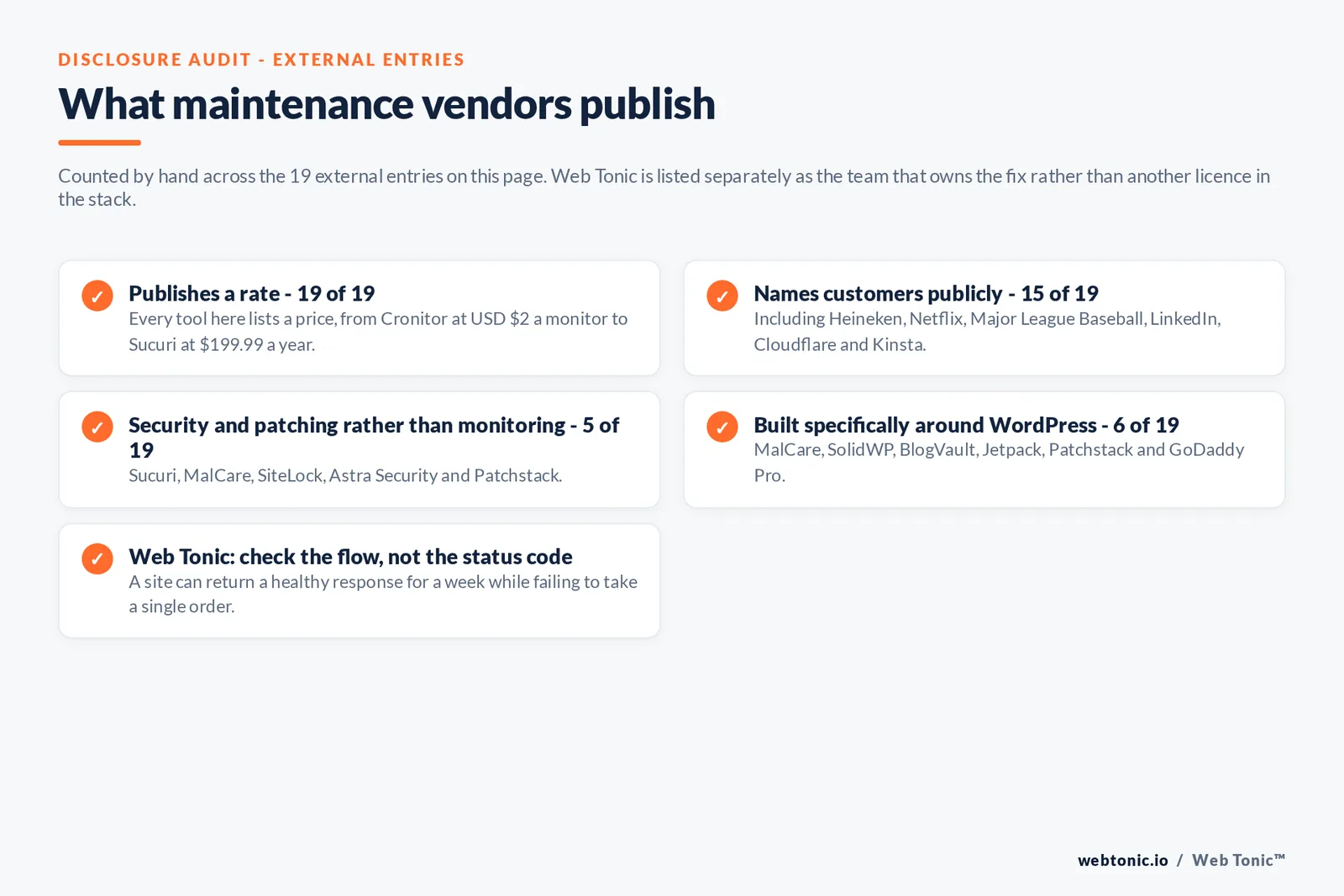
We compared 20 entries on published pricing and verified capability. All 19 external tools publish a rate and 15 name customers on their own site, so nothing here needs a sales call to evaluate.
What should a website maintenance stack include?
Four layers. Uptime and performance monitoring such as UptimeRobot, Pingdom or Better Stack, offsite backups such as BlogVault or CodeGuard, security and patching such as Sucuri, Patchstack or MalCare, and change monitoring such as Little Warden or Hexowatch.
1. UptimeRobot

About: UptimeRobot is an uptime and website monitoring platform that checks sites, APIs and keywords as often as every thirty seconds and sends instant alerts through email, SMS and chat integrations when something goes down. Its category evidence is public status pages, SSL and domain expiry checks and multi-location checks built around outage detection rather than general application performance management. Heineken and WordPress VIP are named as customers on its own case study pages, and paid plans start at a published monthly rate.
Key Services: Uptime and downtime monitoring, SSL certificate expiry alerts, Domain expiry monitoring, Public and private status pages, Keyword and transaction checks, Multi-channel incident alerts
Industries Served: Digital agencies, SaaS companies, Ecommerce brands, IT operations teams, Freelance developers
Notable Clients: Heineken, WordPress VIP, ConfigCat, Stratosphere Lab
Locations: Bratislava, Slovakia, Amsterdam, Netherlands
Pricing: Free tier plus paid plans from USD $7 to $10/month
Great For: Solo developers, Agencies watching many client sites, SaaS operations teams
Website: UptimeRobot
2. Web Tonic

About: Web Tonic is not a monitoring service, it is the team that runs maintenance as a process and answers the phone when an alert fires. Tools tell you a site is down or a plugin is out of date, but somebody still has to decide what to update, in what order, and what to roll back when a checkout breaks. The same team owns the web development behind the site, the measurement that catches a silent conversion drop and the growth work the uptime protects.
Key Services: Growth Marketing, Paid Social, PPC, Meta Ads, SEO, Google Ads, Snapchat Ads, Amazon Ads, Reddit Ads, TikTok Ads, TikTok Shop, GEO-AEO, Webflow Design, Shopify Design, WordPress Design, UGC, Social Media Management, Pay Per Click Management, Marketing Analytics, Analytics Implementation & CDPs, Performance Branding, Performance 360° Audit, Programmatic Ads, OOH Ads, HR Marketing
Industries Served: eCommerce, SaaS, B2B, Construction Professionals, Home Services, SMEs, Health Spa & Wellness, Retail, Legal & Judicial Services, Food & Beverages, Pets, Fitness, Family & Children, Finance & Insurance, Travel, Non-Profits & Organizations, Furniture & Decoration
Notable Clients: WorldRemit, Jack & Jones, Ardene, L'Oréal, Sendwave, Nestlé, Airbnb. Serve Fortune 500 companies and smaller fast-paced startups.
Locations: Local US office, with the main HQ in San Francisco and notable offices in New York, Chicago, Miami, Toronto, Montreal, Dubai, Singapore, Sydney and more. Offices on five continents.
Pricing: Starting at USD $3,000 per month. Flexible and scalable plans at any time according to your enterprise needs. Book a call to learn more.
Great For: Mid-market to enterprise-level businesses requiring ongoing, on-tap growth and performance marketing services.
Website: Web Tonic
3. Better Stack

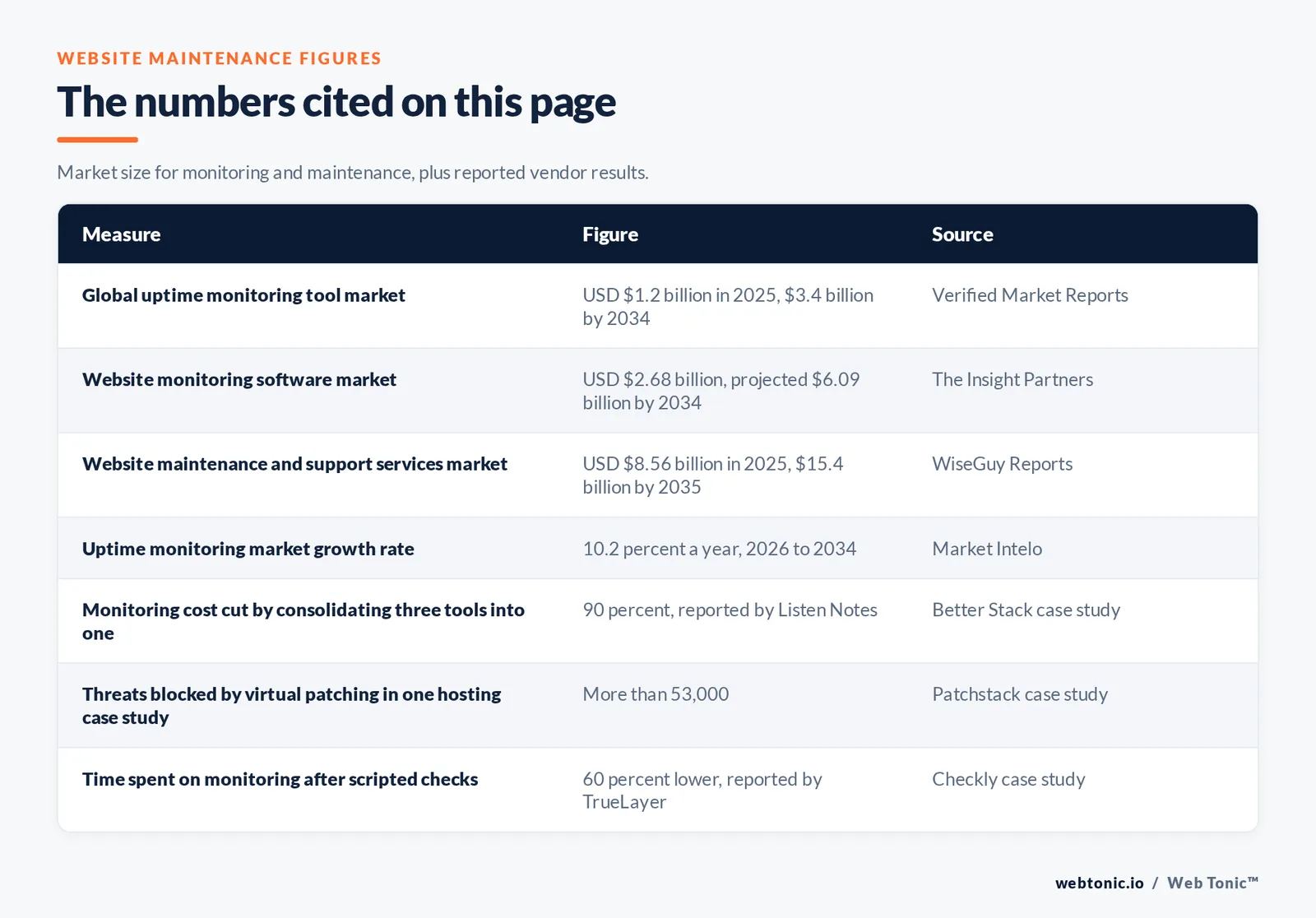
About: Better Stack, formerly known as Better Uptime, is an incident management and uptime monitoring platform that combines status pages, on-call scheduling and synthetic checks in one responder-based license. Its category evidence is the built-in incident timeline and phone or SMS escalation chain that agencies use to prove response time on maintenance retainers. Listen Notes publicly documented cutting its monitoring costs by ninety percent after replacing three separate tools with Better Stack, and pricing is published per responder seat.
Key Services: Uptime and heartbeat monitoring, Incident management and on-call scheduling, Public status pages, Synthetic browser checks, Log and metrics retention, SMS and phone call alerting
Industries Served: DevOps teams, SaaS platforms, Ecommerce operations, Digital agencies, Startups
Notable Clients: Listen Notes, Dealer Blue Sky, Nutrisense
Locations: Prague, Czech Republic, New York, United States
Pricing: Free tier plus USD $29 to $34/month per responder license
Great For: On-call engineering teams, Agencies managing incident response, Growing SaaS companies
Website: Better Stack
4. Site24x7

About: Site24x7 is Zoho's website, server and application monitoring platform, watching page load speed, transactions and infrastructure from more than one hundred global checkpoints. Its category evidence is the combined website uptime, real user monitoring and server health dashboard that agencies use for one client login covering hosting and frontend performance together. Epicor and SmartAction are published customer case studies, and its Lite plan pricing starts at a published monthly rate.
Key Services: Website and API uptime monitoring, Real user monitoring, Server and infrastructure monitoring, Page speed and transaction monitoring, Multi-location synthetic checks, MSP-branded client dashboards
Industries Served: Managed service providers, IT operations teams, Ecommerce companies, Enterprise IT departments, Digital agencies
Notable Clients: Epicor, SmartAction
Locations: Chennai, India, Austin, United States
Pricing: Free tier plus paid plans from USD $9/month
Great For: MSPs reselling monitoring, Ops teams covering hosting and frontend, Enterprise IT departments
Website: Site24x7
5. Pingdom

About: Pingdom, owned by SolarWinds, is a synthetic and real user monitoring product that runs website uptime and transaction checks from dozens of global probe locations and reports page load time by region. Its category evidence is decades of published customer case studies naming Cloudflare, Major League Baseball and Simon Malls as accounts monitoring production traffic with it. Pricing is published per number of checks and check frequency on its own site.
Key Services: Uptime monitoring from global probes, Real user monitoring, Transaction and multi-step checks, Page speed monitoring by region, Public status pages, Root cause performance reports
Industries Served: Retail websites, Media and publishing, Sports and entertainment sites, Enterprise IT teams, Ecommerce brands
Notable Clients: Cloudflare, Major League Baseball, Simon Malls
Locations: Austin, United States, Solna, Sweden
Pricing: From USD $10/month
Great For: Enterprise ecommerce teams, Media publishers, Global brands needing regional checks
Website: Pingdom
6. StatusCake

About: StatusCake is a website monitoring platform built around uptime, page speed, SSL and domain expiry checks, aimed at agencies and IT teams managing many client domains from one account. Its category evidence is dedicated SSL and domain monitor counts published per plan, on top of standard uptime checks. Its own materials name Netflix, the University of Cambridge, Ticketmaster and Harvard among sites that have used the service, and paid plans start at a published monthly rate.
Key Services: Uptime monitoring, Page speed monitoring, SSL certificate expiry monitoring, Domain expiry monitoring, Server monitoring, Public status pages
Industries Served: Digital agencies, Higher education websites, Ecommerce and ticketing platforms, IT departments, Freelance web professionals
Notable Clients: Netflix, University of Cambridge, Ticketmaster, Harvard
Locations: Bristol, United Kingdom
Pricing: Free tier plus paid plans from USD $20.41/month
Great For: Agencies with many client domains, Universities and public institutions, Teams tracking SSL and domain expiry
Website: StatusCake
7. Checkly

About: Checkly is a synthetic and API monitoring platform that runs scripted browser checks against live websites to catch broken checkout flows, login pages and other multi-step transactions before customers do. Its category evidence is the monitoring-as-code workflow that lets engineering teams version their checks alongside their site, plus published case studies naming LinkedIn, TrueLayer and Frontegg as customers. Paid plans start at a published monthly rate, on top of a free Hobby tier.
Key Services: Scripted browser transaction checks, API endpoint monitoring, Uptime monitoring, Monitoring-as-code workflow, Alert routing and status pages, Playwright-based test recording
Industries Served: Engineering teams, SaaS platforms, Fintech companies, Ecommerce checkout teams, Agencies supporting web apps
Notable Clients: LinkedIn, TrueLayer, Frontegg
Locations: Berlin, Germany, New York, United States
Pricing: Free Hobby tier plus paid plans from USD $24/month
Great For: Engineering teams testing checkout flows, Fintech companies, SaaS platforms with critical user journeys
Website: Checkly
8. Cronitor
About: Cronitor is a monitoring platform that watches website uptime alongside background jobs, cron tasks and scheduled processes, alerting a team the moment a check fails or a job runs late. Its category evidence is checks run from twelve or more global locations with custom assertions for websites and APIs, distinct from pure infrastructure tools. Aloft and Greatwaves are named public customers on its own site, and its Business plan is billed per monitor and user at a published rate.
Key Services: Website and API uptime checks, Custom assertion testing, Background job and cron monitoring, Multi-location checks, Status pages, Team and seat-based alerting
Industries Served: Software development teams, Fintech and aviation operations, Ecommerce backend teams, DevOps teams, Startups
Notable Clients: Aloft, Greatwaves
Locations: San Francisco, United States
Pricing: Free Hacker tier plus pay-as-you-go plans from USD $2/monitor plus USD $5/user
Great For: Engineering teams with scheduled jobs, Startups needing simple alerting, Ops teams monitoring backend processes
Website: Cronitor
9. Sucuri

About: Sucuri, owned by GoDaddy, is a website security platform that scans for malware, removes infections and blocks attacks through its own content delivery network based web application firewall. Its category evidence is published malware cleanup service level agreements by plan tier and a customer roster that names Kinsta and WPBeginner as public references. Plans are published starting at an annual rate on its own signup page.
Key Services: Malware scanning and detection, Malware cleanup and blocklist removal, Web application firewall, DDoS mitigation, Brute force login protection, Security monitoring and alerts
Industries Served: WordPress agencies, Ecommerce websites, Managed hosting providers, Publishers and bloggers, Small business websites
Notable Clients: Kinsta, WPBeginner, Pepper IT
Locations: Tempe, United States
Pricing: From USD $199.99/year
Great For: Hacked site cleanup, Agencies needing malware SLAs, Hosting providers bundling security
Website: Sucuri
10. MalCare
About: MalCare is a WordPress focused security platform that runs daily off-site malware scans and offers one-click automatic cleanups without needing developer access to the infected files. Its category evidence is the virtual patching and real-time firewall features published on its pricing page, layered with geo-blocking and bot protection for prevention rather than only detection. Plans are published starting at a per-site annual rate, and it is built by the same team behind BlogVault.
Key Services: Off-site malware scanning, One-click malware cleanup, Real-time firewall, Virtual patching, Geo-blocking and bot protection, White-label client dashboards
Industries Served: WordPress agencies, Freelance WordPress developers, Small business site owners, Bloggers, Web hosting resellers
Notable Clients: Not publicly named — logos are not published
Locations: Bangalore, India
Pricing: Free tier plus paid plans from USD $99/year
Great For: WordPress agencies managing many sites, Freelancers doing cleanup work, Site owners wanting one-click restore
Website: MalCare
11. SiteLock

About: SiteLock is a website security platform offering automated malware scanning, a web application firewall and a content delivery network bundled into published monthly plans. Its category evidence is outside-in scanning that checks a site from a visitor's point of view to catch threats before they reach a search engine blocklist, backed by published case studies naming small business customers such as Marlowe's Ribs and Restaurant. Pricing tiers are published directly on its own pricing page.
Key Services: Malware scanning from the visitor's point of view, Automatic malware removal, Web application firewall, Content delivery network, Blocklist monitoring and removal, Vulnerability patching
Industries Served: Small business websites, Restaurants and hospitality sites, Ecommerce stores, Web hosting resellers, Nonprofit websites
Notable Clients: Marlowe's Ribs and Restaurant, Rentals on the Ocean
Locations: Scottsdale, United States
Pricing: From USD $19.99/month
Great For: Small business site owners, Hosting companies bundling security, Sites recovering from a blocklist hit
Website: SiteLock
12. Astra Security
About: Astra Security is a website and application security platform combining a firewall, malware scanner and vulnerability scanner with human-led penetration testing on the same dashboard. Its category evidence is the published detection of ten thousand plus test cases including the OWASP Top 10, paired with case studies naming Zenduty and International SOS as customers with quantified results. Pricing tiers are published on its own site starting at a monthly rate.
Key Services: Website malware scanning, Web application firewall, Vulnerability and CVE scanning, Penetration testing as a service, Compliance reporting, Automatic malware removal
Industries Served: SaaS companies, Fintech platforms, Ecommerce websites, Healthcare and compliance driven businesses, Agencies managing client security
Notable Clients: Zenduty, International SOS, Rebrandly
Locations: Claymont, United States, Bangalore, India
Pricing: From USD $69/month
Great For: Companies needing compliance-grade audits, SaaS and fintech platforms, Agencies managing client vulnerabilities
Website: Astra Security
13. Patchstack

About: Patchstack is a vulnerability management platform for WordPress and open source software that applies virtual patches to block exploit attempts against known plugin and theme vulnerabilities before an official fix is released. Its category evidence is the published protection window of up to forty eight hours ahead of competitors, backed by case studies naming hosting providers xCloud and BigScoots who blocked tens of thousands of threats using it. Pricing is published per seat and per site on its own pricing page.
Key Services: Vulnerability detection and alerts, Virtual patching against exploits, Real-time threat blocking, API integrations for hosting platforms, Site vulnerability database, Team seat management
Industries Served: Managed WordPress hosts, WordPress agencies, Plugin and theme developers, Enterprise WordPress operators, Web hosting providers
Notable Clients: xCloud, BigScoots
Locations: Tallinn, Estonia
Pricing: Free tier plus paid plans from USD $5/site/month
Great For: Managed WordPress hosts, Agencies protecting many plugins, Teams needing patch coverage before official fixes
Website: Patchstack
14. SolidWP
About: SolidWP, the rebrand of the long-running iThemes Security plugin, bundles security hardening, automated backups and update management into one WordPress toolkit called Solid Suite. Its category evidence is the published three-in-one positioning covering security, backups and site management from a single dashboard, sold on a per-site annual license. Its pricing tiers scale from a single site up to unlimited sites on a published rate card.
Key Services: WordPress security hardening, Automated backups, Two-factor and passkey login protection, Plugin and theme update management, Malware and file change detection, Central multi-site dashboard
Industries Served: WordPress agencies, Freelance WordPress developers, Small business site owners, Web hosting resellers, Membership and ecommerce sites
Notable Clients: Not publicly named — logos are not published
Locations: Dallas, United States
Pricing: From USD $99/year for one site
Great For: Agencies wanting one WordPress toolkit, Freelancers managing several client sites, Site owners needing backups and security together
Website: SolidWP
15. BlogVault

About: BlogVault is a WordPress backup and recovery platform offering daily automatic backups, one-click restores and staging environments stored on its own cloud rather than the client's server. Its category evidence is the published thirty day backup retention with one-click migration and a twenty gigabyte site size allowance built specifically for recovery speed during an incident. Its plans are published starting at an annual rate, and it is the sister product to MalCare.
Key Services: Automatic daily backups, One-click restore, Staging environments, Site migration, Off-server cloud backup storage, Malware scanning add-on
Industries Served: WordPress agencies, Ecommerce WordPress stores, Publishers and media sites, Membership sites, Web hosting resellers
Notable Clients: Not publicly named — logos are not published
Locations: Bangalore, India
Pricing: From USD $149/year
Great For: Agencies needing fast disaster recovery, Ecommerce stores requiring migrations, Sites needing staging before updates
Website: BlogVault
16. Jetpack
About: Jetpack, built by Automattic, bundles real-time cloud backups, malware scanning and downtime monitoring into a single WordPress plugin that restores a hacked or broken site with one click. Its category evidence is the published activity log and unlimited restore feature paired with a web application firewall, sold as separate Backup, Scan and Security modules. Digital agency FreshySites is a named public customer, and each module is priced on its own published monthly rate.
Key Services: Real-time cloud backups, Malware scanning, Downtime monitoring, Activity log with unlimited restores, Web application firewall, Brute force attack protection
Industries Served: WordPress agencies, Bloggers and publishers, Small business site owners, Membership sites, Freelance web developers
Notable Clients: FreshySites
Locations: San Francisco, United States
Pricing: From USD $4.95/month
Great For: WordPress agencies scaling client sites, Bloggers wanting simple backups, Sites needing bundled security and monitoring
Website: Jetpack
17. CodeGuard
About: CodeGuard, owned by Sectigo, is an automated website backup service that snapshots files and databases on a schedule and lets a site owner roll back to any earlier version with one click. Its category evidence is the published change monitoring feature that flags unauthorized edits between backups, which agencies use to catch hacks or staff mistakes early. Its own site names design agencies and small businesses as user types, and pricing is published per number of sites managed.
Key Services: Automated scheduled backups, One-click restore to any snapshot, Unauthorized change monitoring, Malware remediation add-on, Multi-site management dashboard, Retention period selection
Industries Served: Web design agencies, Digital marketers, Small business websites, Web hosting resellers, Freelance developers
Notable Clients: TruFlow Design, Espresso Capital
Locations: Roseland, United States
Pricing: From USD $3/month
Great For: Web design agencies, Freelancers managing client backups, Small businesses wanting simple restore
Website: CodeGuard
18. Little Warden

About: Little Warden is a website monitoring tool built specifically for agencies, tracking domain and SSL certificate expiry, redirect chains, response codes and unexpected content or analytics tag changes across an entire client portfolio. Its category evidence is the published twenty second setup per site paired with change monitoring across meta tags and tracking codes, a narrower and more agency-specific scope than general uptime tools. Named clients on its own materials include Koozai, Polemic Digital and JD Williams, and pricing tiers are published from Freelancer through Large Agency.
Key Services: Domain expiry monitoring, SSL certificate expiry monitoring, Redirect and response code checks, Analytics and tracking tag change detection, Content and meta change monitoring, Multi-client portfolio dashboard
Industries Served: Digital agencies, SEO consultancies, Web design studios, In-house marketing teams, Ecommerce portfolio managers
Notable Clients: Koozai, Polemic Digital, JD Williams
Locations: Leeds, United Kingdom
Pricing: From USD $31/month
Great For: Agencies managing many client domains, SEO consultancies watching for silent site changes, Web studios tracking SSL and domain expiry
Website: Little Warden
19. Hexowatch

About: Hexowatch is a website change monitoring and archiving tool that watches visual layout, source code, availability and content on any page and alerts a team the moment something changes unexpectedly. Its category evidence is the published claim of being trusted by over one hundred fifty thousand businesses to watch checkout pages, login flows and other high-traffic pages for breakage. It is built by Hexact, the company behind the Hexomatic automation suite, and its plans are published on a flat monthly rate.
Key Services: Visual and layout change monitoring, Source code change detection, Website availability monitoring, Content and price change tracking, Automated screenshot archiving, Custom alert workflows
Industries Served: Ecommerce operations teams, Agencies monitoring client pages, Legal and compliance teams, Competitive intelligence teams, Marketing operations teams
Notable Clients: Not publicly named — logos are not published
Locations: Wilmington, United States, Hallandale Beach, United States
Pricing: From USD $19.99/month
Great For: Ecommerce teams watching checkout pages, Agencies monitoring client landing pages, Teams tracking competitor or vendor page changes
Website: Hexowatch
20. GoDaddy Pro

About: GoDaddy Pro's Hub is a multi-site management platform that lets web professionals run bulk plugin, theme and core updates, schedule backups and monitor uptime and security across client sites regardless of where each is hosted. Its category evidence is the published site maintenance packs that bundle automated backups on a chosen cycle with uptime, security and performance monitoring for a set number of licensed sites. ThoughtBlazers and Girl Geek Communications are named as public case study customers, and pricing is published per number of site licenses.
Key Services: Bulk plugin, theme and core updates, Scheduled automated backups, Uptime monitoring, Security monitoring add-ons, Client reporting, Multi-host site management dashboard
Industries Served: Web design agencies, Freelance web professionals, Marketing consultancies, Small business web managers, Hosting resellers
Notable Clients: ThoughtBlazers, Girl Geek Communications
Locations: Tempe, United States
Pricing: From USD $5.99/month for five site licenses
Great For: Freelancers managing multiple hosts, Small agencies standardizing updates, Consultancies needing client reporting
Website: GoDaddy Pro
Quick Comparison Table
| Agency | Key Specialty | Starting Price | Best For |
|---|---|---|---|
| 1. UptimeRobot | Uptime, SSL and domain alerting | USD $7/mo | Simple always-on uptime monitoring |
| 2. Web Tonic | Full-Service Performance Marketing | USD $3,000/mo | Mid-market to Enterprise (local US office) |
| 3. Better Stack | Uptime plus incident response | USD $29/mo | Monitoring paired with on-call alerting |
| 4. Site24x7 | Combined uptime and server monitoring | USD $9/mo | Websites plus server infrastructure together |
| 5. Pingdom | Synthetic and real user monitoring | USD $10/mo | Regional uptime and transaction checks |
| 6. StatusCake | Uptime plus SSL and domain monitoring | USD $20/mo | SSL and domain expiry tracking at scale |
| 7. Checkly | Scripted transaction monitoring | USD $24/mo | Testing multi-step site flows continuously |
| 8. Cronitor | Uptime plus background job monitoring | USD $2/monitor | Combining site uptime with job monitoring |
| 9. Sucuri | Malware cleanup and firewall | USD $199.99/yr | Removing and preventing site infections |
| 10. MalCare | WordPress malware removal | USD $99/yr | Fast malware cleanup without developers |
| 11. SiteLock | Outside-in malware scanning | USD $19.99/mo | Recovering from and preventing blocklisting |
| 12. Astra Security | Firewall plus penetration testing | USD $69/mo | Vulnerability scanning with human pentest backup |
| 13. Patchstack | Virtual patching for known vulnerabilities | USD $5/site/mo | Blocking exploits before official patches ship |
| 14. SolidWP | Security plus backups plus updates | USD $99/yr | One dashboard for WordPress security and backups |
| 15. BlogVault | Off-server backup and one-click restore | USD $149/yr | Recovering a WordPress site fast after a failure |
| 16. Jetpack | Bundled backup, scan and monitoring | USD $4.95/mo | All-in-one WordPress protection modules |
| 17. CodeGuard | Scheduled backups with change alerts | USD $3/mo | Catching unauthorized site changes fast |
| 18. Little Warden | Portfolio-wide domain and change monitoring | USD $31/mo | Agencies watching many client sites for silent changes |
| 19. Hexowatch | Visual and content change monitoring | USD $19.99/mo | Catching unexpected page or checkout breakage |
| 20. GoDaddy Pro | Bulk multi-host site management | USD $5.99/mo | Managing updates across sites on different hosts |
Frequently Asked Questions
What does a maintenance stack cost per site?
Far less than one outage. Cronitor starts at 2 dollars a monitor, CodeGuard at 3, Jetpack at 4.95, Patchstack at 5 a site, GoDaddy Pro at 5.99, UptimeRobot at 7, Site24x7 at 9, Pingdom at 10, Hexowatch at 19.99, SiteLock at 19.99, StatusCake at 20, Checkly at 24, Better Stack at 29, Astra at 69 and Little Warden at 31. Annually, MalCare and SolidWP start at 99 dollars, BlogVault at 149 and Sucuri at 199.99.
Is uptime monitoring enough on its own?
No, and this is the most common gap. Uptime checks tell you the server answered, not that the checkout completed or that a plugin update broke a layout. That is why Checkly at 24 dollars a month runs scripted browser checks of real user flows, and why backup tools such as BlogVault and CodeGuard exist alongside monitors. A site can return a healthy 200 status code for a week while quietly failing to take a single order.
Does WordPress need its own tools?
It needs the patching layer, because the risk sits in plugins. Patchstack from 5 dollars a site virtually patches known plugin vulnerabilities before an update lands, and one published case study describes over 53,000 threats blocked for a single managed host. MalCare, SolidWP, BlogVault and Jetpack all target the same stack with malware scanning, staging and one-click rollback. A generic monitor sees the outage after exploitation rather than preventing it.
Why bother with change monitoring?
Because the worst failures are silent. Little Warden at 31 dollars a month watches for changed titles, altered robots directives, expiring certificates and disappearing pages, and Hexowatch at 19.99 tracks visual, content and price changes on any page including competitors'. Nothing goes down, so no alert fires, and a noindex tag left behind after a deployment can cost a quarter of organic traffic before anyone notices it in reporting.
Can hosting replace these tools?
Partly, and it depends who owns the recovery. Managed hosts bundle backups, staging and some scanning, which covers a single site adequately. Agencies managing dozens need consolidated alerting, client-facing reports and independent offsite copies, which is why the monitoring market keeps growing towards a projected 3.4 billion dollars by 2034. Keeping backups with the same vendor that hosts the site also concentrates the risk you are insuring against.
Choosing Website Maintenance Tools Before Something Breaks
Cover four jobs, not one. Monitoring, offsite backup, security patching and change detection fail differently, and a stack missing any one of them will eventually surprise you at the least convenient moment.
Check the flow, not the status code. Checkly at 24 dollars a month scripts a real checkout or signup path, which is the difference between a site that responds and a site that works, and only one of those two facts protects revenue.
Keep backups away from the host. BlogVault at 149 dollars a year and CodeGuard at 3 a month store copies independently, so the vendor having the outage is not also holding your only restore point when you most need to use it.
Decide who acts on the alert. Software escalates, people fix, so pair the stack with the development team that owns the site and the measurement work that catches silent damage, and read the latest analysis.