Table of contents
How we vet every listicle
Every agency featured on Web Tonic passes our 84-point editorial review before a single listicle goes live. This is how we vet each pick:
Verified client outcomes: We require real case studies with measurable KPIs — revenue, ROAS, CPA, retention — tied to the exact category being ranked. No cherry-picked wins, no unverifiable numbers.
Independent reputation: We cross-check Clutch, Google, G2, and Trustpilot ratings, and screen for review-bombing or suspicious patterns. Only operators with a consistent, verifiable track record make the cut.
Beyond that, every listing goes through a quarterly re-audit. We check 84 criteria across 6 pillars to make sure it still holds up — here are some of the checks we run:
A web design or UI/UX tool is software used to plan, draw, validate and hand off an interface before production code exists. Five jobs hide under the label: low-fidelity wireframing and journey mapping, vector interface editing with shared component libraries, prototyping that makes screens clickable or sensor-aware, design-to-code handoff that turns a file into specs or React, and usability research that puts the design in front of real users. Most teams buy a stack, not a winner.

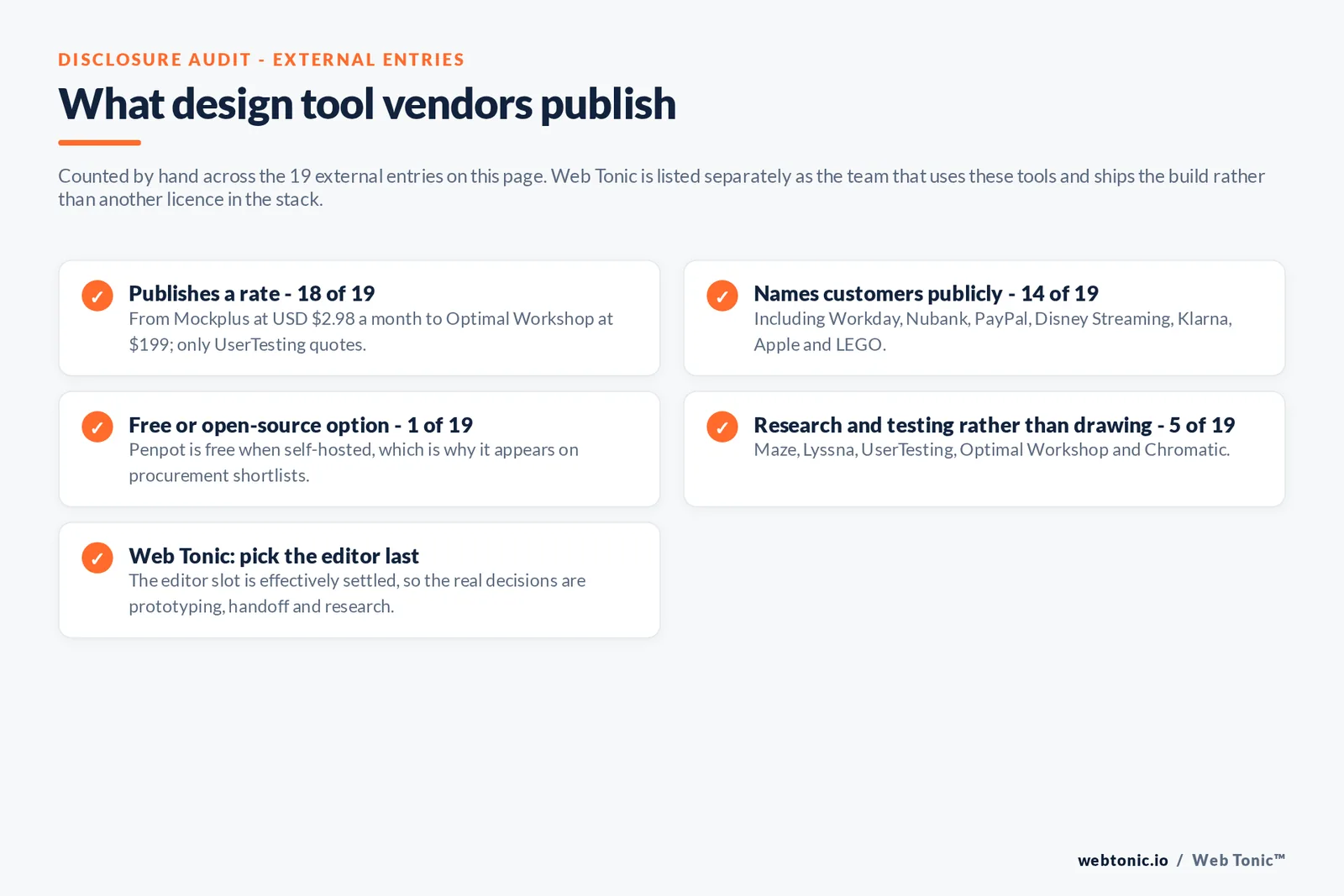
We compared 20 entries on published pricing and verified capability. Eighteen of the 19 external tools publish a rate and 14 name customers on their own site, which makes this the most price-transparent category we have reviewed.
Which web design tools does a team really need?
Usually three, not one. A primary editor such as Figma, Sketch, Penpot or Framer, a prototyping or handoff layer such as Axure, ProtoPie, Zeplin or Anima, and a research tool such as Maze, Lyssna, UserTesting or Optimal Workshop.
1. Figma
About: Figma is a browser-based vector interface design and prototyping platform that lets teams draw screens, build component libraries and click through interactive prototypes in one shared file. Its Dev Mode ships design specs, variables and code snippets straight to engineers, which is the design-to-code handoff evidence that anchors its category leadership. Figma disclosed 13 million monthly active users and named enterprise customers such as Workday, Nubank and Commonwealth Bank of Australia in its own case studies.
Key Services: Vector interface design, Real-time multiplayer editing, Interactive prototyping, Dev Mode design-to-code handoff, FigJam whiteboarding, Reusable component libraries
Industries Served: Product design teams, Marketing and web design agencies, Enterprise software companies, Startups, Financial services
Notable Clients: Workday, Nubank, Commonwealth Bank of Australia, ServiceNow, Perplexity
Locations: San Francisco, United States
Pricing: Free tier plus USD $16/mo Professional seat, higher Organization and Enterprise tiers
Great For: Cross-functional product teams, Design agencies handling client handoff, Startups needing a single design tool
Website: Figma
2. Web Tonic
About: Web Tonic is not a design tool, it is the team that uses one and then ships the result as a working site. A prototype that tests well and never survives the build is a wasted month, so we design, validate and hand off inside one accountable team rather than across a vendor boundary. The same people own the web development that turns the design into code, the brand and identity work it inherits and the measurement that tells us whether the new layout actually converts better.
Key Services: Growth Marketing, Paid Social, PPC, Meta Ads, SEO, Google Ads, Snapchat Ads, Amazon Ads, Reddit Ads, TikTok Ads, TikTok Shop, GEO-AEO, Webflow Design, Shopify Design, WordPress Design, UGC, Social Media Management, Pay Per Click Management, Marketing Analytics, Analytics Implementation & CDPs, Performance Branding, Performance 360° Audit, Programmatic Ads, OOH Ads, HR Marketing
Industries Served: eCommerce, SaaS, B2B, Construction Professionals, Home Services, SMEs, Health Spa & Wellness, Retail, Legal & Judicial Services, Food & Beverages, Pets, Fitness, Family & Children, Finance & Insurance, Travel, Non-Profits & Organizations, Furniture & Decoration
Notable Clients: WorldRemit, Jack & Jones, Ardene, L'Oréal, Sendwave, Nestlé, Airbnb. Serve Fortune 500 companies and smaller fast-paced startups.
Locations: Local US office, with the main HQ in San Francisco and notable offices in New York, Chicago, Miami, Toronto, Montreal, Dubai, Singapore, Sydney and more. Offices on five continents.
Pricing: Starting at USD $3,000 per month. Flexible and scalable plans at any time according to your enterprise needs. Book a call to learn more.
Great For: Mid-market to enterprise-level businesses requiring ongoing, on-tap growth and performance marketing services.
Website: Web Tonic
3. Sketch

About: Sketch is a native Mac vector design application built specifically for interface design, with reusable symbols, auto-layout components and built-in developer handoff inspection. It was one of the original tools that popularized component-based UI design before browser-based competitors arrived, and it still publishes documented case studies with named product teams such as Letterboxd. Sketch runs both a cloud collaboration workspace and a desktop license model, which keeps it distinct from browser-only rivals.
Key Services: Native macOS vector design, Reusable symbols and components, Auto layout for responsive components, Cloud collaboration workspace, Developer inspection handoff, Version history
Industries Served: Mac-based design studios, App development teams, Digital product agencies, Independent designers, Media and entertainment brands
Notable Clients: Letterboxd, Tapbots, Tripsy
Locations: Eindhoven, Netherlands
Pricing: From USD $12/mo per editor, billed annually
Great For: Mac-only design teams, App and iOS-focused studios, Designers wanting a native desktop app
Website: Sketch
4. Framer

About: Framer is a design-to-live-website platform that lets teams design a page visually and publish it as a real, hosted website with a CMS, without a separate build step. Its AI website generation and code-editing layer differentiate it from pure prototyping tools, since the output ships as production code rather than a mockup. Framer names customers including Perplexity, Mollie and Superhuman on its own site as evidence of enterprise and startup adoption.
Key Services: Visual website design and publishing, AI website generation from a prompt, CMS collections for dynamic content, Interactive animation and interaction design, Component libraries, Hosting and staging environments
Industries Served: Marketing teams, Startups launching landing pages, Web design agencies, SaaS companies, Independent designers
Notable Clients: Perplexity, Mollie, Superhuman, Miro
Locations: Amsterdam, Netherlands
Pricing: Free tier plus USD $20/mo Pro plan, higher Scale and Enterprise tiers
Great For: Marketing teams shipping sites without developers, Startups needing fast landing pages, Agencies designing and hosting client sites in one tool
Website: Framer
5. Penpot
About: Penpot is an open-source design and prototyping platform built around the open standard SVG format, so files stay portable between design and code instead of locked into a proprietary format. It supports interactive prototyping, CSS grid and flex layouts, and design system libraries, and can be self-hosted for teams with data residency requirements. Penpot has raised over USD $20 million in funding and reported passing 250,000 signed-up users after a surge in interest following a large competitor acquisition.
Key Services: Open-source vector interface design, Interactive prototyping, CSS grid and flex layout tools, Self-hosting option, Design system libraries, Real-time collaboration
Industries Served: Open-source and privacy-conscious teams, Government and public sector, Startups on a budget, Design agencies, Developer-led product teams
Notable Clients: Not publicly named — logos are not published
Locations: Madrid, Spain
Pricing: Free and open source; self-host free, or use hosted cloud plans starting free with paid team tiers
Great For: Teams wanting an open-source design tool, Organizations needing self-hosted design software, Budget-conscious startups
Website: Penpot
6. UXPin

About: UXPin is a code-backed prototyping platform whose Merge technology lets designers build prototypes from a team's actual React component library instead of static shapes, so what gets tested behaves like the real product. This code-fidelity approach is the specific feature that separates it from static prototyping tools such as Marvel or InVision's earlier model. UXPin publishes named customer stories with PayPal, T Rowe Price and HBO describing how design teams used it to scale design without hiring more designers.
Key Services: Code-backed prototyping with Merge technology, AI-assisted prototyping, Design system integration with Storybook, Interactive component states, Role and permission management, Developer handoff specs
Industries Served: Enterprise design systems teams, Fintech and banking, Streaming and media, Product design agencies, SaaS platforms
Notable Clients: PayPal, T Rowe Price, HBO, Sapient
Locations: Las Vegas, United States, Gdansk, Poland
Pricing: From USD $29/mo per editor
Great For: Enterprise design system teams, Teams needing code-accurate prototypes, Design and engineering pairs
Website: UXPin
7. Axure RP
About: Axure RP is a desktop and cloud prototyping tool built for detailed interaction logic, letting teams create conditional flows, variables and functional specifications alongside wireframes rather than simple click-through mockups. This specification-heavy depth is what has kept it a standard tool for enterprise business analysts and UX teams documenting complex application logic. Axure publishes a published per-seat rate card starting at USD $29 per month and reports roughly USD $11 million in annual revenue as an independent, privately held company.
Key Services: Functional prototyping with logic and variables, Wireframing and diagramming, UX specification documentation, Conditional interaction flows, Team cloud publishing, Design handoff notes
Industries Served: Business analysts, Enterprise UX teams, Government and defense contractors, Financial services, Healthcare software teams
Notable Clients: Not publicly named — logos are not published
Locations: San Diego, United States
Pricing: From USD $29/mo per user
Great For: Teams documenting complex interaction logic, Business analysts and UX architects, Enterprises needing detailed specs
Website: Axure RP
8. Marvel App
About: Marvel is a lightweight prototyping and wireframing tool built around quickly turning static screens into clickable prototypes and design specs, aimed at teams who want speed over deep feature depth. It differentiates on simplicity, running entirely in the browser with a design handoff view that developers can inspect without extra plugins. Marvel names customers including Nokia, Monzo and BuzzFeed and discloses annual revenue of roughly USD $6.7 million as an independent company headquartered in London.
Key Services: Rapid clickable prototyping, Wireframing, Design specs handoff, User testing recordings, Mobile app prototyping, Team commenting and feedback
Industries Served: Startups, Marketing teams, Freelance designers, Small product teams, Agencies needing fast client mockups
Notable Clients: Nokia, Monzo, BuzzFeed, Hudl
Locations: London, United Kingdom
Pricing: Free tier plus USD $12/mo paid plans
Great For: Fast client-facing mockups, Freelancers and small teams, Quick mobile app prototypes
Website: Marvel App
9. Balsamiq

About: Balsamiq is a low-fidelity wireframing tool designed to keep early product conversations focused on structure and flow rather than pixel-level visuals, using a deliberately sketchy visual style. That constraint is the specific feature that has kept it a favorite for early-stage product discovery instead of final visual design. Balsamiq publishes a named customer story with PostHog describing a fifty percent reduction in idea-to-code time and reports roughly USD $9 million in annual revenue.
Key Services: Low-fidelity wireframing, Drag-and-drop UI components, Cloud and desktop apps, AI-assisted wireframing, Reusable custom components, Reviewer commenting
Industries Served: Early-stage product teams, Business analysts, Agencies scoping projects, Startups, Non-designers doing UX work
Notable Clients: PostHog
Locations: Sacramento, United States, Bologna, Italy
Pricing: From USD $16/mo per editor, billed annually
Great For: Early discovery and scoping work, Non-designers sketching flows, Teams wanting to avoid pixel-perfect debates early
Website: Balsamiq
10. Whimsical

About: Whimsical is a collaborative whiteboard tool built specifically for wireframes, flowcharts and mind maps that product teams use to plan a UI before high-fidelity design begins. Its focus on structured, editable diagram shapes rather than freeform drawing is what separates it from general whiteboards. Whimsical publishes named customer stories with Sharetribe and Goodpatch describing how distributed product teams use it to shape features together.
Key Services: Wireframing, Flowcharts and user flow mapping, Mind mapping, Sticky-note style boards, Docs with embedded diagrams, Real-time collaboration
Industries Served: Distributed product teams, Design agencies, Startups, Marketplace and SaaS companies, Product managers
Notable Clients: Sharetribe, Goodpatch, Marker.io
Locations: Denver, United States
Pricing: Free tier plus USD $10/mo per editor, higher Business tier at USD $20/mo
Great For: Early-stage flow and structure planning, Distributed teams, Product managers mapping user journeys
Website: Whimsical
11. ProtoPie

About: ProtoPie is an interaction-focused prototyping tool that lets designers wire up sensor inputs, gestures and device data such as voice or camera feeds without writing code, going well beyond click-through screen prototypes. That sensor and interaction depth is what has made it the tool of choice for teams prototyping automotive dashboards, wearables and IoT interfaces rather than only web screens. ProtoPie has raised USD $39.9 million in funding and reports roughly USD $3 million in annual revenue from its Seoul headquarters.
Key Services: Sensor and gesture-based interaction design, No-code prototyping logic, Cross-device prototyping including IoT and voice, Video and audio-triggered interactions, Design tool import from Figma and Sketch, Team cloud sharing
Industries Served: Automotive UX teams, IoT and hardware product teams, Enterprise product design, Gaming interface designers, Medtech interface teams
Notable Clients: Not publicly named — logos are not published
Locations: Seoul, South Korea
Pricing: From USD $25/mo per editor, billed annually
Great For: Automotive and IoT interface teams, Advanced interaction prototyping, Teams prototyping beyond flat screens
Website: ProtoPie
12. Zeplin

About: Zeplin is a design-to-code handoff tool that turns finished designs into structured specs, style guides and exportable code snippets so developers can build a screen without re-measuring spacing or guessing colors. Its annotation and style guide tooling are more detailed than most all-in-one design tools' built-in handoff views, which is why many teams pair it alongside Figma or Sketch rather than relying on those tools alone. Zeplin publishes named customer stories with Electrolux, Disney Streaming and IDFC FIRST Bank describing measurable production time savings.
Key Services: Design-to-code handoff specs, Style guide generation, Component documentation, Annotation tools for developer notes, Integration with Figma and Sketch, Design system versioning
Industries Served: Product engineering teams, Design systems teams, Banking and finance apps, Media streaming platforms, Consumer electronics brands
Notable Clients: Electrolux, Disney Streaming, IDFC FIRST Bank, Cloudera
Locations: San Francisco, United States, Istanbul, Turkey
Pricing: From USD $13.75/mo per seat, billed annually
Great For: Teams needing detailed developer handoff, Design systems documentation, Cross-functional design and engineering pairs
Website: Zeplin
13. Anima

About: Anima converts Figma designs directly into production-ready React, HTML and Tailwind code, going a step further than static spec-based handoff tools by generating usable frontend code from the design file itself. That code-generation feature is the specific capability that puts it in this category rather than as a general handoff viewer. Anima is headquartered in Tel Aviv and publishes a transparent per-seat rate card that runs from a free tier up to a USD $500 per month Enterprise plan.
Key Services: Figma-to-code export, React, HTML and Tailwind code generation, Two-way design and code sync, AI chat-based code editing, Responsive breakpoint handling, Developer playground links
Industries Served: Frontend development teams, Agencies delivering client websites, Startups needing fast MVP builds, Design system engineers, Freelance developers
Notable Clients: Not publicly named — logos are not published
Locations: Tel Aviv, Israel, New York, United States
Pricing: Free tier plus USD $20/mo Starter plan, up to USD $500/mo Enterprise
Great For: Teams needing real code from Figma files, Agencies shipping client sites fast, Frontend developers avoiding manual rebuilds
Website: Anima
14. Uizard

About: Uizard is an AI-native UI design tool that generates editable mockups and prototypes from a text prompt or a hand-drawn sketch photo, aimed at people who need a design fast without deep design skills. Its Autodesigner AI generation engine is the specific feature separating it from manual vector editors, since it produces a full multi-screen layout rather than requiring the user to draw each screen. Uizard publishes a customer story with Ingenico describing a two-thirds reduction in ideation time and runs a transparent published pricing page.
Key Services: AI text-to-UI generation, Sketch-to-design conversion from photos, Interactive prototyping, Developer handoff in React and CSS, Template library, Real-time team collaboration
Industries Served: Non-designers and founders, Product managers, Marketing teams needing quick mockups, Consultants and agencies, Early-stage startups
Notable Clients: Ingenico
Locations: Copenhagen, Denmark
Pricing: Free tier plus USD $12/mo Pro plan, USD $39/mo Business plan
Great For: Non-designers needing quick mockups, Founders validating ideas fast, Agencies pitching design concepts quickly
Website: Uizard
15. Mockplus
About: Mockplus is an all-in-one product design suite covering wireframing, prototyping and design system documentation, positioned as a lower-cost alternative for teams migrating off discontinued tools such as Adobe XD. Its combination of a lightweight prototyping app, a design handoff cloud and a separate rapid-wireframing tool under one umbrella is the structural feature that distinguishes it from single-purpose competitors. Mockplus publishes a per-seat rate card starting under USD $3 per month and is developed by Chengdu-based Mockplus Technology.
Key Services: Wireframing and rapid prototyping, Design handoff cloud, Design system documentation, Team collaboration and commenting, Import from Sketch, Figma and Adobe XD, Interactive component states
Industries Served: Cost-conscious product teams, Enterprises migrating off discontinued tools, Design agencies, Software development teams, Educational institutions
Notable Clients: Not publicly named — logos are not published
Locations: Chengdu, China
Pricing: From USD $2.98/mo per user, billed annually
Great For: Teams migrating from discontinued design tools, Budget-conscious design teams, Enterprises needing bundled design and handoff tools
Website: Mockplus
16. Maze

About: Maze is a rapid user testing platform that lets teams run unmoderated usability tests, prototype tests and surveys directly against Figma or coded prototypes, then automatically synthesizes participant behavior into reports. Its direct integration with design tools and automated insight synthesis is what puts it ahead of generic survey software in this category. Maze publishes a named customer story with Klarna describing user-informed decisions made at ten times its previous research scale.
Key Services: Unmoderated usability testing, Prototype testing with Figma integration, Surveys and concept validation, Card sorting and tree testing, AI-generated research summaries, Participant panel recruitment
Industries Served: Product research teams, UX researchers, SaaS product teams, Fintech companies, Design agencies validating concepts
Notable Clients: Klarna
Locations: Menlo Park, United States
Pricing: Free tier plus USD $99/mo Starter plan, custom Organization tier
Great For: Product teams testing prototypes fast, UX researchers scaling studies, Design teams validating concepts pre-build
Website: Maze
17. Lyssna

About: Lyssna, formerly known as UsabilityHub, is a user research platform built around five-second tests, first-click tests, card sorting and preference tests that measure how real users react to a design in seconds rather than long moderated sessions. That rapid, quantitative testing format is the specific capability that separates it from full moderated research platforms. Lyssna runs its own recruitment panel of more than 690,000 participants and publishes named customer stories with Klarna, Hexagon and YNAB.
Key Services: Five-second and first-click testing, Card sorting and tree testing, Preference and design testing, Built-in participant recruitment panel, Survey tools, Session recording
Industries Served: UX researchers, Marketing and design teams, Enterprise research teams, SaaS product teams, Agencies validating client designs
Notable Clients: Klarna, Hexagon, YNAB, Goosechase
Locations: Collingwood, Australia
Pricing: Free tier plus USD $165/mo paid plans
Great For: Quick quantitative design validation, Teams without an existing participant panel, Card sorting and information architecture testing
Website: Lyssna
18. UserTesting

About: UserTesting is a human insight platform that records real participants speaking their thoughts aloud while navigating a design, prototype or live site, giving qualitative video evidence rather than only clickstream data. Its scale of an on-demand global participant network and enterprise-grade research operations is what separates it from smaller research tools. UserTesting states it has over 3,000 customers including 75 of the Fortune 100 and publishes named case studies with BT Group and Tealium.
Key Services: Moderated and unmoderated video-based user testing, Global on-demand participant network, Prototype and live site testing, AI-assisted insight analysis, Survey and card sorting tools, Enterprise research operations dashboard
Industries Served: Enterprise UX research teams, Consumer brands, Financial services, Telecommunications, Government agencies
Notable Clients: BT Group, AWS, Tealium
Locations: Bellevue, United States
Pricing: No public rate card; quoted per scope, with average enterprise contracts reported near USD $188,903 per year
Great For: Enterprise research teams needing scale, Consumer brands validating major launches, Teams needing qualitative video insight
Website: UserTesting
19. Chromatic
About: Chromatic is a visual regression testing and review platform built by the team behind Storybook, the most widely used open-source tool for building and cataloging UI components. It automatically captures a snapshot of every component state and flags pixel-level visual changes across browsers before they ship, which is the specific evidence-generation feature that makes it a design-system quality tool rather than a general test runner. Chromatic reports its tooling is used by thousands of frontend teams including Shopify, Adobe and the BBC.
Key Services: Automated visual regression testing, Component snapshot review workflow, Cross-browser UI testing, Storybook integration, TurboSnap for faster test runs, UI review and approval workflow
Industries Served: Frontend engineering teams, Design systems teams, SaaS product companies, Media organizations, Enterprise software teams
Notable Clients: Shopify, Adobe, BBC
Locations: San Francisco, United States
Pricing: Free tier plus USD $149/mo Starter plan
Great For: Teams maintaining a component library, Frontend teams preventing visual regressions, Design systems engineers
Website: Chromatic
20. Optimal Workshop

About: Optimal Workshop is a suite of information architecture and usability research tools covering card sorting, tree testing, first-click testing and surveys, purpose-built for validating how findable and understandable a site's structure is before visual design begins. That specific focus on structural and navigational testing, rather than general usability recording, is what separates it from broader research platforms. Optimal Workshop publishes named customer stories describing a decade of UX discovery work with Apple and structural research projects with LEGO and Lowe's.
Key Services: Card sorting studies, Tree testing for navigation validation, First-click testing, Surveys and qualitative research, Prototype usability testing, Participant recruitment credits
Industries Served: Information architects, UX researchers, Government digital services, Retail and ecommerce, Enterprise product teams
Notable Clients: Apple, LEGO, Lowe's
Locations: Wellington, New Zealand
Pricing: From USD $199/mo
Great For: Information architecture validation, Navigation and content structure testing, Enterprise UX research teams
Website: Optimal Workshop
Quick Comparison Table
| Agency | Key Specialty | Starting Price | Best For |
|---|---|---|---|
| 1. Figma | Collaborative vector UI design | USD $16/mo | Real-time team design collaboration |
| 2. Web Tonic | Full-Service Performance Marketing | USD $3,000/mo | Mid-market to Enterprise (local US office) |
| 3. Sketch | Native macOS UI design | USD $12/mo | Mac-native interface design |
| 4. Framer | Design-to-published-website workflow | USD $20/mo | Visual design that ships as a live site |
| 5. Penpot | Open-source design collaboration | Free (self-hosted) | Open-source, self-hostable design platform |
| 6. UXPin | Code-backed prototyping | USD $29/mo | High-fidelity, code-based prototyping |
| 7. Axure RP | Logic-driven functional prototyping | USD $29/mo | Complex conditional-logic prototypes |
| 8. Marvel App | Fast, simple prototyping | USD $12/mo | Quick clickable prototypes |
| 9. Balsamiq | Low-fidelity wireframing | USD $16/mo | Fast, rough early-stage wireframes |
| 10. Whimsical | Structured wireframe and flow diagramming | USD $10/mo | User flow mapping and wireframes |
| 11. ProtoPie | Sensor and gesture interaction prototyping | USD $25/mo | Complex device and gesture interactions |
| 12. Zeplin | Design-to-code handoff and specs | USD $13.75/mo | Structured developer handoff |
| 13. Anima | Figma-to-code generation | USD $20/mo | Turning Figma designs into working code |
| 14. Uizard | AI-generated UI mockups | USD $12/mo | Fast AI-generated design concepts |
| 15. Mockplus | Low-cost bundled design suite | USD $2.98/mo | Affordable prototyping and handoff bundle |
| 16. Maze | Rapid prototype and usability testing | USD $99/mo | Fast unmoderated usability testing |
| 17. Lyssna | Rapid quantitative usability testing | USD $165/mo | Five-second and first-click design tests |
| 18. UserTesting | Enterprise video-based user research | Quote-based | Large-scale qualitative user research |
| 19. Chromatic | Visual regression testing for components | USD $149/mo | Catching visual UI bugs before release |
| 20. Optimal Workshop | Information architecture and navigation testing | USD $199/mo | Card sorting and tree testing navigation |
Frequently Asked Questions
Has Figma already won this category?
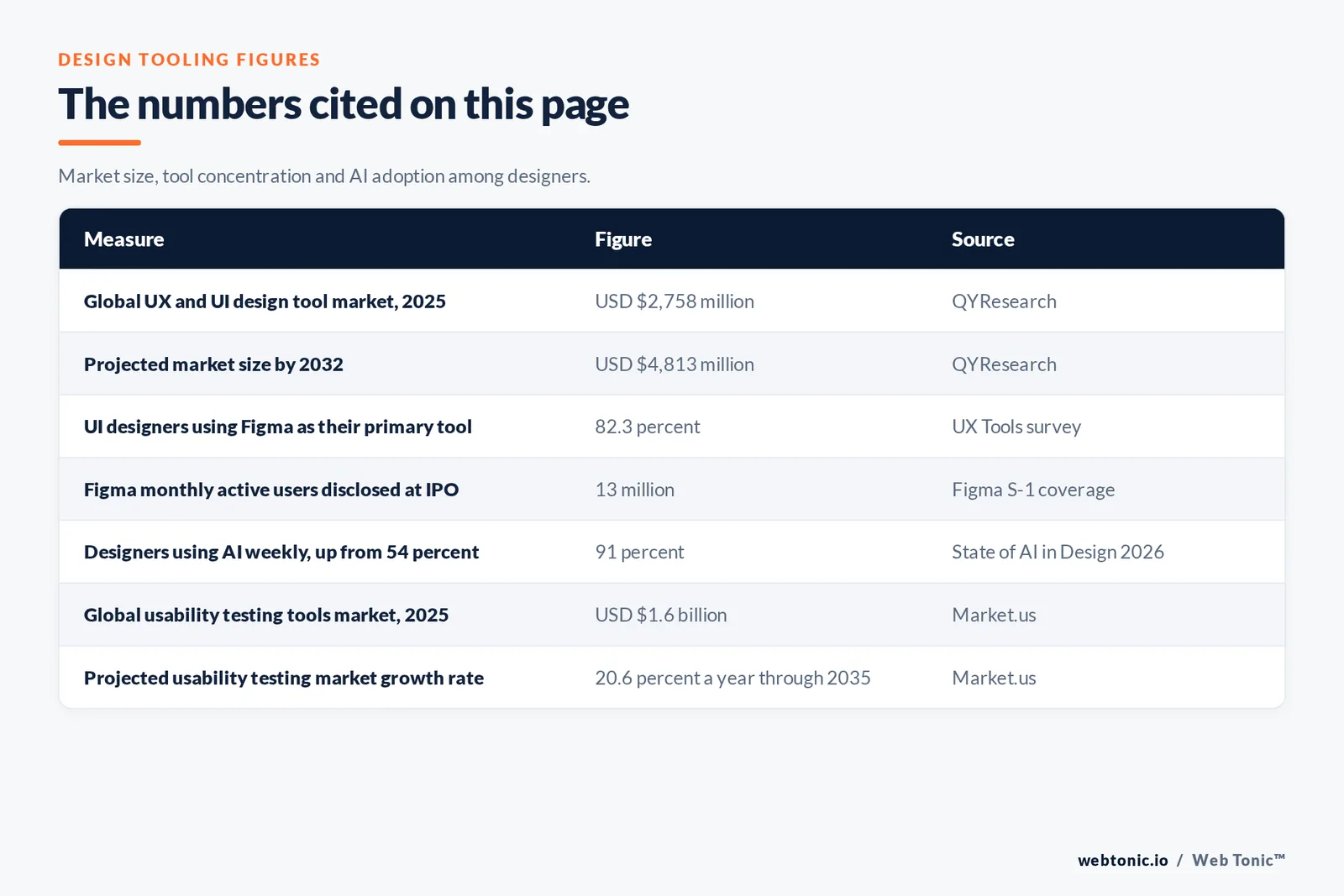
In the editor slot, close to it. The UX Tools survey puts Figma as the primary design tool for 82.3 percent of UI designers, and its IPO filing disclosed 13 million monthly active users. That dominance is exactly why the rest of this list exists: Sketch at 12 dollars a month keeps a native Mac following, Penpot answers the open-source and self-hosted requirement, and Framer takes design straight to a hosted site instead of into a handoff.
What do these tools cost for a small team?
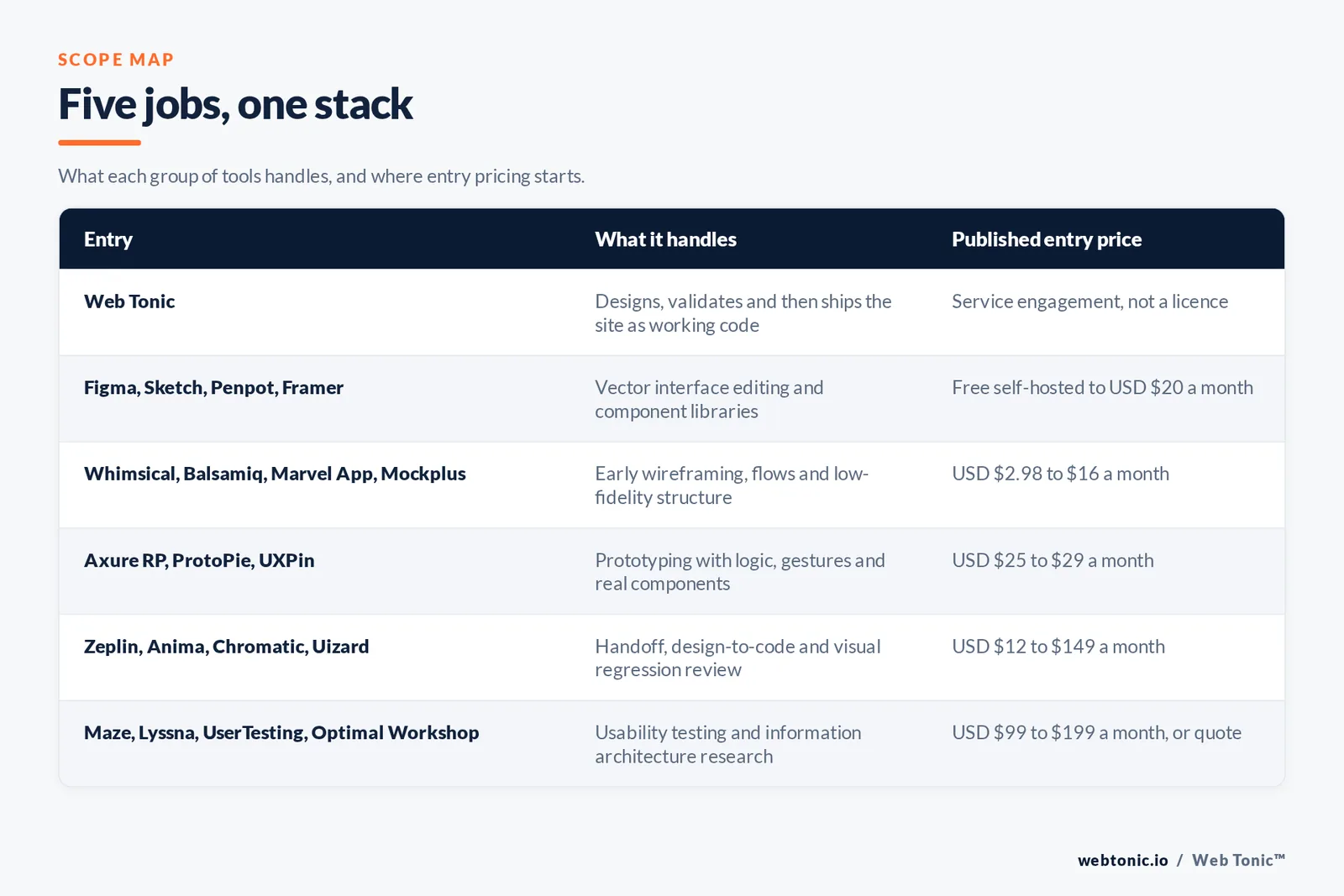
Less than most stacks. Mockplus starts at 2.98 dollars a month, Whimsical at 10, Sketch, Marvel and Uizard at 12, Zeplin at 13.75, Figma and Balsamiq at 16, Anima and Framer at 20, ProtoPie at 25, and UXPin and Axure at 29. Research tools sit higher: Maze at 99, Chromatic at 149, Lyssna at 165 and Optimal Workshop at 199, with UserTesting quote-based. Penpot is free if you self-host.
Do I need a separate prototyping tool?
Only when the interaction is the risk. Modern editors prototype well enough for click-through flows, so the specialist tools earn their place on harder problems: Axure at 29 dollars a month for conditional logic and variables, ProtoPie at 25 for gestures, sensors and device data, and UXPin for prototypes built from a team's real React components. If you are validating navigation rather than a complex interaction, the editor you already pay for is enough.
Is AI changing design tooling this year?
Rapidly, by the industry's own count. The State of AI in Design report puts weekly AI use among designers at 91 percent in 2026, up from 54 percent a year earlier. In practice it shows up in two places: generation, where Uizard at 12 dollars a month builds editable mockups from a prompt or a sketch photo, and translation, where Anima at 20 dollars converts Figma into React, HTML or Tailwind. Neither removes the need for a designer's judgement about hierarchy.
When is usability testing worth the licence?
As soon as a design decision costs more than the test. Maze at 99 dollars a month runs unmoderated tests straight against a Figma prototype, Lyssna at 165 handles five-second, first-click and preference tests, Optimal Workshop at 199 covers card sorting and tree testing for navigation, and UserTesting records people narrating their confusion aloud. The usability testing tools market sat near 1.6 billion dollars in 2025 because rebuilding a shipped site costs vastly more.
Choosing Web Design Tools as a Stack, Not a Winner
Pick the editor last, not first. Figma holds 82.3 percent of designers for a reason, so the real decisions are which prototyping, handoff and research tools sit around it, since the editor slot is effectively settled and the rest is not.
Buy the specialist only for the specialist problem. Axure at 29 dollars a month and ProtoPie at 25 exist for conditional logic and sensor interactions, and a click-through flow does not need either, and a lighter wireframing tool often answers the question faster.
Treat research as insurance. Maze at 99 dollars a month or Optimal Workshop at 199 costs a fraction of rebuilding navigation after launch, which is why that market keeps compounding at a projected twenty percent a year through 2035.
Close the gap to production. Handoff tools like Zeplin at 13.75 dollars and Anima help, but pair them with the development team and the measurement work that follows launch, and read the latest analysis before a redesign.