Table of contents
How we vet every listicle
Every agency featured on Web Tonic passes our 84-point editorial review before a single listicle goes live. This is how we vet each pick:
Verified client outcomes: We require real case studies with measurable KPIs — revenue, ROAS, CPA, retention — tied to the exact category being ranked. No cherry-picked wins, no unverifiable numbers.
Independent reputation: We cross-check Clutch, Google, G2, and Trustpilot ratings, and screen for review-bombing or suspicious patterns. Only operators with a consistent, verifiable track record make the cut.
Beyond that, every listing goes through a quarterly re-audit. We check 84 criteria across 6 pillars to make sure it still holds up — here are some of the checks we run:
The best video production companies are not the ones with the flashiest reel — they are the ones whose process, rights terms and distribution thinking match the job you are hiring for. This guide gives you the scoring rubric, the price drivers and the brief template to pick one.
Key Takeaways
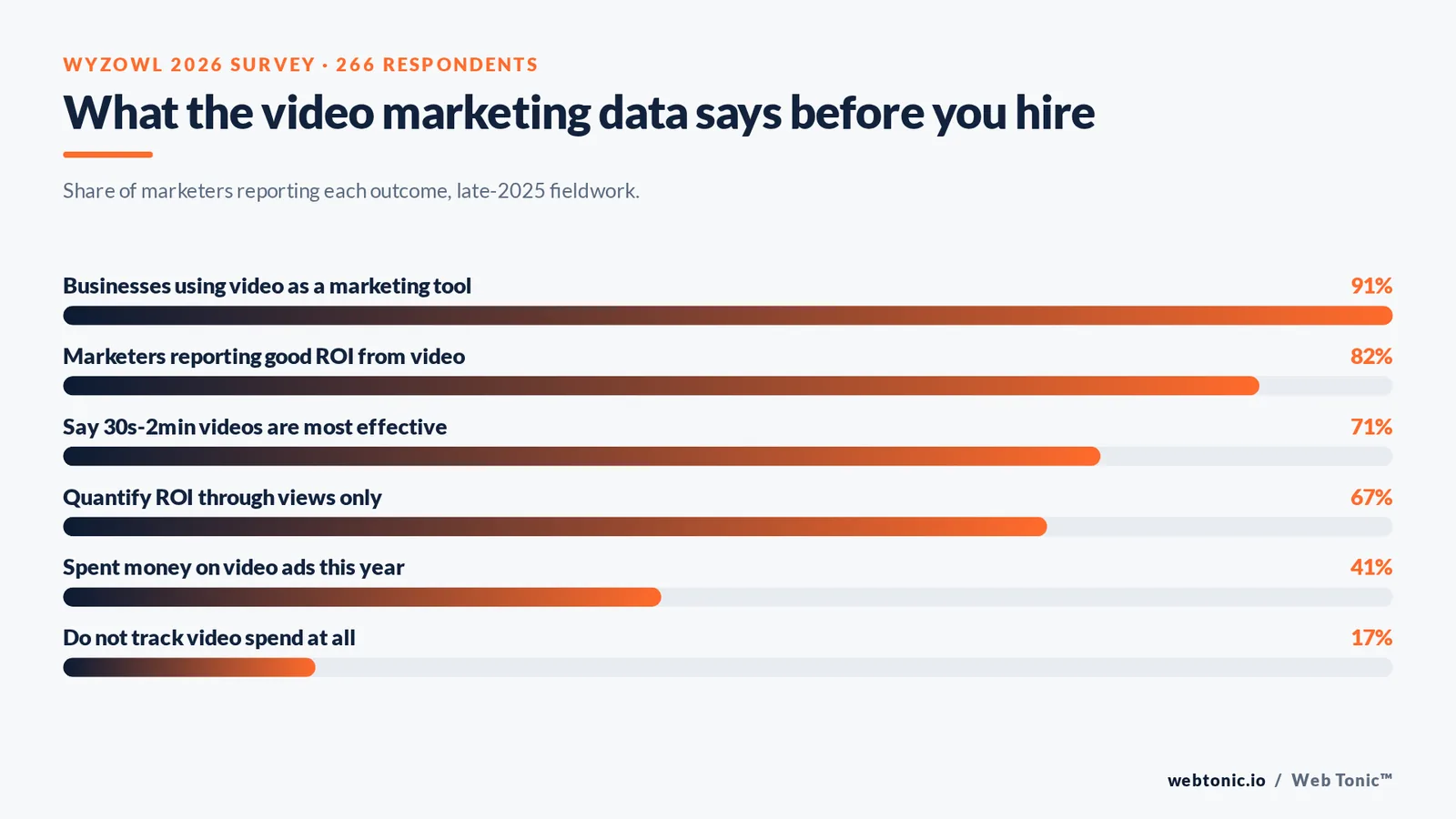
- 91% of businesses now use video as a marketing tool, and 93% of video marketers call it an important part of overall strategy, so the supply side is crowded and uneven.
- 82% of marketers report a good return from video, but only 32% measure that return against bottom-line sales — a gap that shapes how you should brief a studio.
- There are 5 distinct company types (full service agency, boutique studio, animation house, freelance crew, production-plus-media partner) and picking the wrong type costs more than picking the wrong price.
- Score shortlists on 10 weighted criteria; portfolio quality alone predicts less than a third of project success.
- 46% of marketers put a third or less of their budget into video, and 17% do not track video spend at all — set the number before you request a quote.
- Usage rights, not day rate, is the clause that decides whether a video is reusable: 95 years is the copyright term for a work made for hire from publication.
What video production companies actually deliver
A video production company owns some or all of three phases: pre-production (strategy, scripting, storyboards, casting, scheduling), production (the shoot itself) and post production (edit, colour, sound mix, motion graphics, versioning). The label "full service" should mean the vendor covers all three under one contract with one accountable producer. It often does not.
Rule 1 — map the 3 phases before you compare quotes. Two proposals that differ by 40% usually differ in scope, not in quality: one includes scripting and 12 social cutdowns, the other hands you a single master file.
| Phase | Typical deliverables | Who owns it in a full service contract | What clients forget to ask for |
|---|---|---|---|
| Pre-production | Creative brief, script, storyboard or animatic, shot list, casting, location scouting, call sheet | Producer plus creative director | Two script revisions in writing before the shoot is locked |
| Production | Shoot days, crew, camera and lighting package, sound, direction, on-set client review | Line producer plus director of photography | Named crew roles, not "a professional team" |
| Post production | Assembly, edit, colour grade, sound design, licensed music, motion graphics, captions | Post supervisor plus editor | Round count, turnaround time per round, caption files |
| Versioning | Aspect-ratio variants (16:9, 9:16, 1:1), length cutdowns, localisation, thumbnails | Editor under the same statement of work | A named number of cutdowns per master |
| Delivery and archive | Final masters, project files, raw footage, transcripts, asset handover | Post supervisor | Raw footage and project files in the contract, not as a favour |
Versioning is the phase that quietly decides value. 71% of marketers say videos between 30 seconds and 2 minutes work best, which means a single long master is rarely the asset you actually run — the cutdowns are. Our performance creative team plans versioning at brief stage for exactly this reason.
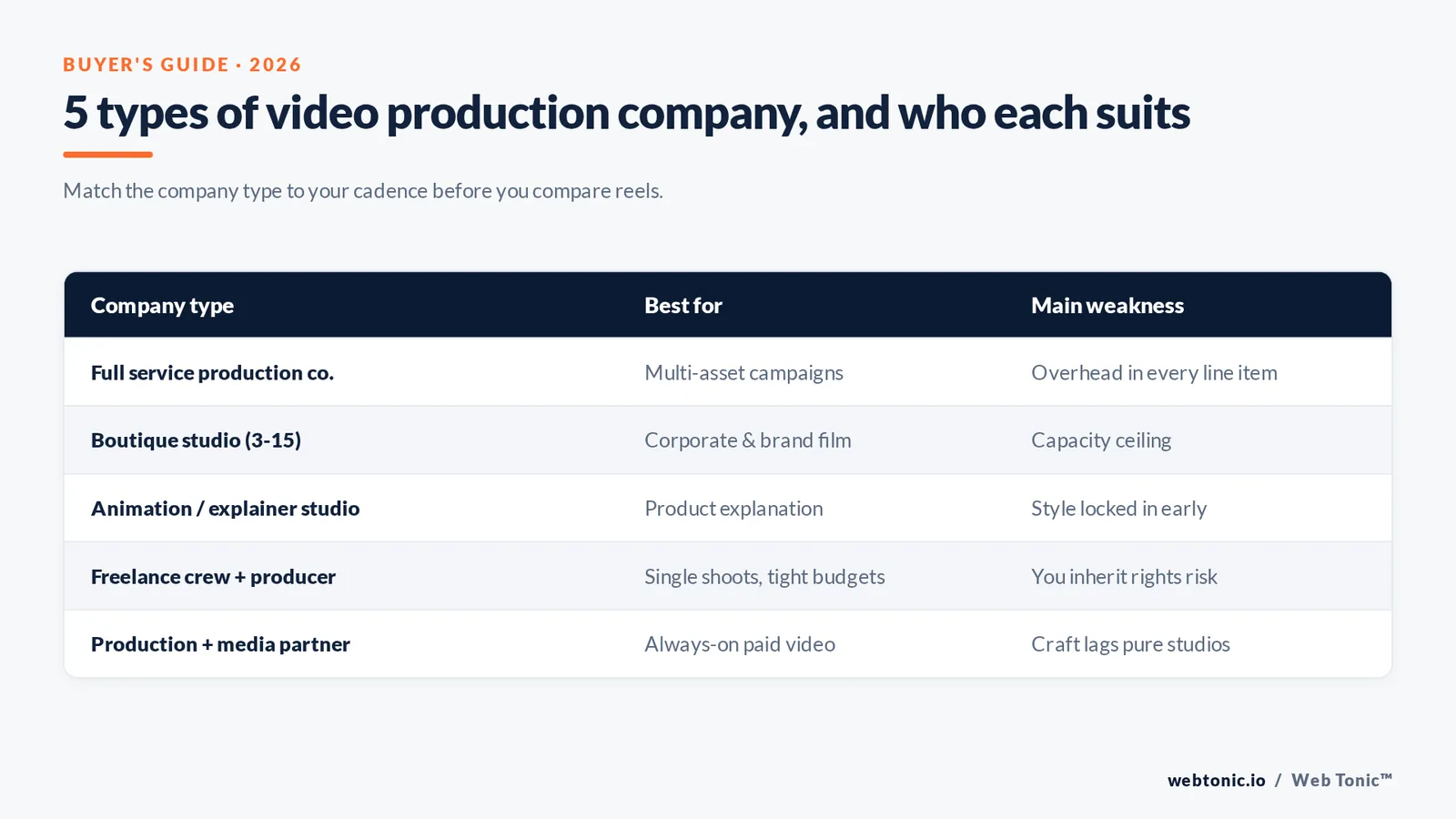
The 5 types of video production company, and who each one suits
"Video production agency", "commercial production company", "film production company" and "branded content agency" are not synonyms. They describe different cost structures and different failure modes.
| Company type | Best for | Strength | Weakness | Signal in their reel |
|---|---|---|---|---|
| Full service video production company | Multi-asset campaigns needing strategy through delivery | One accountable producer, consistent quality across a slate | Overhead priced into every line item | Campaigns, not one-off films |
| Boutique studio (3-15 people) | Corporate video, brand films, recurring content | Senior people actually on your project | Capacity ceiling; one big client can eat their calendar | Repeat clients over multiple years |
| Animation and explainer studio | Product explanation, SaaS, abstract or unfilmable concepts | No location or talent logistics; easy localisation | Style is baked in early and expensive to change | Animated explainer videos with distinct art direction, not template motion |
| Freelance crew assembled by a producer | Tight budgets, single-shoot needs, testing a format | Lowest overhead per shoot day | You inherit coordination and rights risk | Individual credits rather than a company slate |
| Production plus media partner | Paid social and YouTube programmes where creative is tested continuously | Feedback loop from ad results into the next shoot | Craft can lag pure production houses | Performance data alongside the work |
Rule 2 — match type to cadence. One flagship film a year points to a boutique or full service studio. 41% of marketers spent money on video ads this year, up from 36%, and an always-on ad programme points to a production plus media partner instead.
A 10-criterion scoring rubric for shortlisting
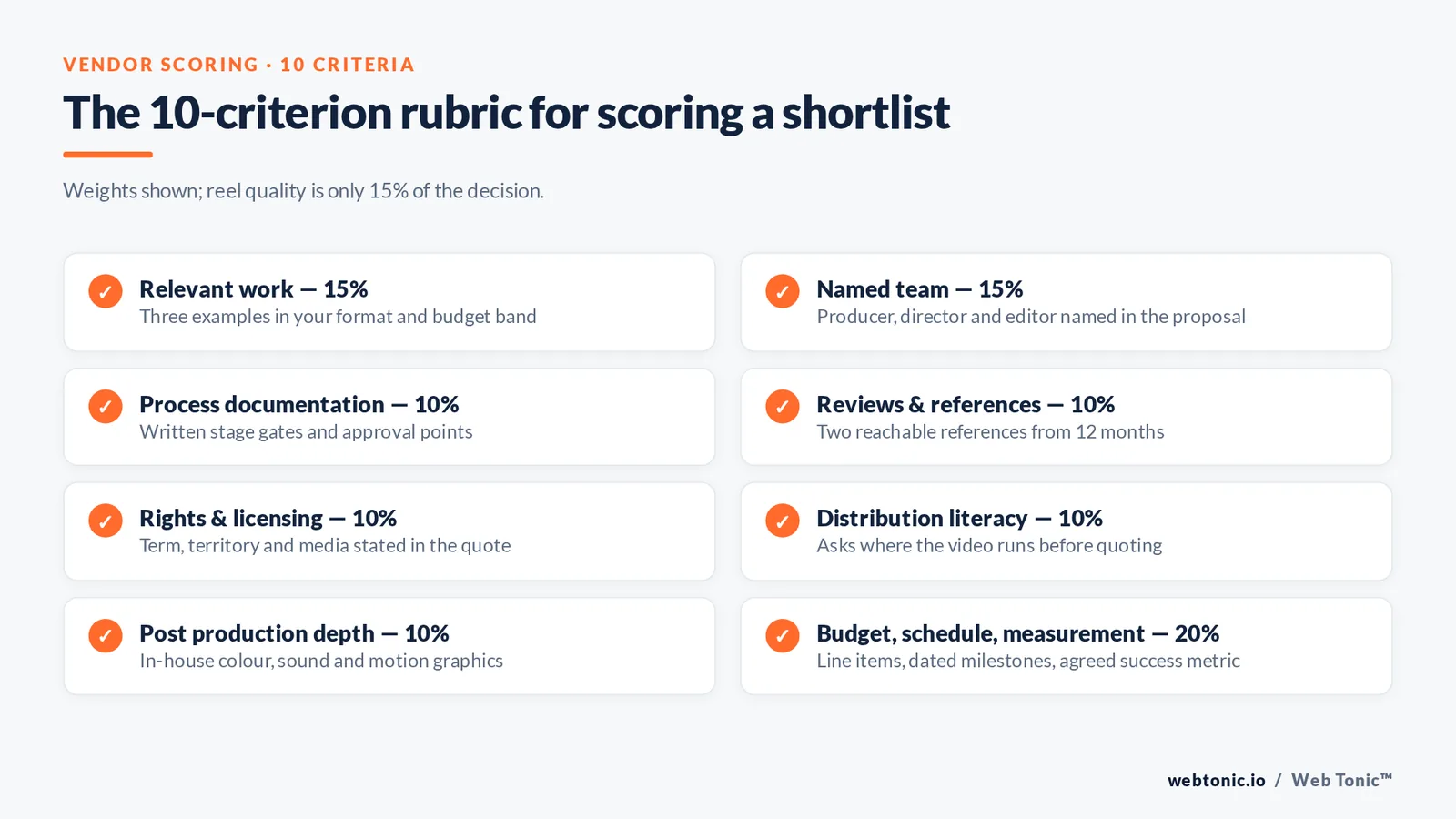
Score each shortlisted video production company out of 10 on the criteria below, multiply by the weight, and compare totals. It converts "we liked them" into something a finance approver can read.
| Criterion | Weight | What a 9-10 looks like | What a 3 looks like |
|---|---|---|---|
| Relevant work | 15% | Three examples in your format, industry and budget band | A beautiful reel with nothing comparable in it |
| Named team on your project | 15% | Producer, director and editor named in the proposal | "Our team" with no names or roles |
| Process documentation | 10% | Written stage gates, review rounds and approval points | Process described verbally on a call only |
| Client reviews and references | 10% | Two reachable references from the last 12 months | Testimonials with first names only |
| Rights and licensing clarity | 10% | Perpetual, worldwide, all-media terms stated in the quote | Rights "to be discussed later" |
| Distribution literacy | 10% | Asks where the video runs before quoting | Quotes a master file with no channel questions |
| Post production depth | 10% | In-house colour, sound and motion graphics | All post outsourced with no named partner |
| Budget transparency | 8% | Line-item quote with contingency shown | A single number with no breakdown |
| Schedule realism | 7% | Dated milestones with client dependencies flagged | "Four to six weeks" with no gates |
| Measurement willingness | 5% | Agrees to a success metric in the statement of work | Treats results as the client's problem |
Fact 3 — reel quality is 15% of this rubric, not 100%. Reels are edited by the people you are evaluating; process, rights and named crew are the variables that actually move project outcomes.
How to read a portfolio by video type
Judge the reel against the format you are buying. A studio that excels at corporate video production can be weak at 9:16 social, and the reverse is common.
| Video type | Share of what marketers create | What to look for in the reel | Failure tell |
|---|---|---|---|
| Live action | 51% — most common | Consistent lighting and sound across different locations | Great hero shots, muddy dialogue audio |
| Animated and explainer | 23% | Original art direction; clear information sequencing | Same template characters across unrelated brands |
| Screen-recorded and product demo | 19% | Readable UI at mobile size, tight pacing | Full-screen captures nobody can read on a phone |
| Testimonial and case study | Common add-on | Real customers speaking specifically, not vaguely | Interviewees reciting marketing copy |
| Social-first vertical | Fast-growing | Hooks landing in the first 2 seconds; native captions | 16:9 masters cropped after the fact |
Ask for one unedited case: the brief, the budget band, the timeline slip and what they would change. Studios that answer that question in detail are the ones worth a second call. Wyzowl's 12-year video marketing survey is the source for the format mix above, drawn from 266 respondents surveyed in late 2025.
What drives the price of video production services
Nobody can quote your project from a blog post, but every quote is built from the same seven drivers. Knowing them lets you cut cost without cutting quality. 38% of marketers say video costs are rising while 30% say they are falling — the spread is mostly about which drivers each buyer is triggering.
| Cost driver | Why it moves the number | Cheapest sensible version | When to pay up |
|---|---|---|---|
| Shoot days | Crew, gear and location are all billed per day | Batch 3-5 videos into a single day | Multi-location brand films |
| Crew size | Each specialist adds a day rate | Producer, camera plus sound for talking-head work | Complex lighting, moving camera, live audience |
| Talent and voiceover | Usage terms are priced separately from the session | Employees or customers with signed releases | Paid media running beyond 12 months |
| Location and permits | Fees, insurance and travel days stack up | Your own office or a controlled studio | Category-defining brand imagery |
| Post production hours | Edit, colour, sound and graphics scale with round count | Cap at 2 review rounds with consolidated feedback | Motion-graphics-heavy explainers |
| Music and stock licensing | Term, territory and media type set the fee | Library music cleared for paid social | Recognisable tracks in broadcast work |
| Versioning volume | Every ratio and length is editor time | One master plus 6 defined cutdowns | Multi-market localisation |
Limit 4 — decide your number before you request a quote. With 46% of marketers allocating a third or less of their budget to video and 17% not tracking video spend at all, most briefs arrive without a ceiling, and unpriced briefs get padded quotes. The US Small Business Administration's marketing guidance is a reasonable starting point for setting a total marketing budget you then split.
Where the best production companies cluster, and whether location matters
Production talent concentrates around advertising and studio economies. That matters less than it used to for remote-friendly work, and still matters for anything with a crew call.
| Market | Typical strength | Why brands travel there | Location premium worth paying? |
|---|---|---|---|
| Los Angeles | Commercial production, film crews, celebrity talent | Deepest crew and stage pool in the USA | Yes for broadcast and celebrity-led work |
| New York City | Brand films, fashion, finance and editorial work | Agency proximity and location variety | Yes when senior creative direction is the point |
| San Francisco | Product and software storytelling | Crews fluent in technical subject matter | Often, for complex product narratives |
| Chicago, Dallas, Atlanta, Boston | Corporate video, manufacturing, healthcare, education | Strong crews at lower day rates than the coasts | Rarely needed; usually the value pick |
| Vancouver and Toronto | Film-grade crews, tax incentives | Production value per dollar | Yes for ambitious scripted work |
| Remote and distributed | Animation, editing, versioning, localisation | No travel cost; follow-the-sun turnaround | Not applicable — the default for post-only work |
Fact 5 — hire local for the shoot, hire best-in-class for post. Grips and gaffers need to be in the room; a colourist does not. Splitting those two decisions is the single most reliable way to raise quality without raising the total.
The request-for-quote brief that gets comparable proposals
Most "request a quote" forms collect too little to price properly, so vendors guess and you cannot compare. Send this instead, in one page, to every shortlisted company.
| Brief section | What to state | Why the vendor needs it |
|---|---|---|
| Objective | One business outcome and the metric attached to it | Determines format, length and tone |
| Deliverables | Masters, ratios, lengths, caption files, thumbnails | Sets post production hours |
| Distribution | Every channel and whether paid media is involved | Drives licensing and talent usage terms |
| Budget band | A range, not a single number | Lets them scope up or down honestly |
| Timeline | Launch date plus internal approval dates | Reveals whether the schedule is feasible |
| Approvers | Names and how many rounds each gets | Round count is a top cost overrun cause |
| Assets and constraints | Brand guidelines, existing footage, legal review needs | Avoids rework after the shoot |
| Rights required | Term, territory, media, and whether raw footage transfers | Priced very differently by vendor |
Ask every vendor to return the same three artefacts: a line-item budget, a dated schedule and a named crew list. Anything less is not a proposal. If you want a second opinion on a shortlist, our team reviews briefs and quotes for clients running video programmes.
Contract terms that decide whether the video keeps earning
Ownership is where cheap projects become expensive. Under US law a work made for hire is protected for 95 years from publication or 120 years from creation, whichever expires first, per the US Copyright Office — so the question of who holds that copyright is not academic.
| Clause | Safe default for the buyer | Common vendor position | Cost of getting it wrong |
|---|---|---|---|
| Copyright in the finished film | Assigned to you on final payment | Vendor retains, licenses to you | Re-licensing fees for every reuse |
| Raw footage and project files | Delivered with the masters | Retained by the studio | Future edits must go back to the original vendor |
| Talent usage | Term, territory and media matched to your media plan | 12 months, single market | Ads pulled mid-flight or renegotiated at a premium |
| Music licence | Cleared for paid social and web in perpetuity | Web-only, limited term | Takedowns and re-scoring costs |
| Revisions | 2 rounds named, extra rounds priced up front | "Reasonable revisions" | Open-ended change orders |
| Substantiation of claims | Buyer supplies evidence, vendor scripts to it | Not addressed | Regulatory exposure on advertising claims |
| Portfolio use | Allowed after your launch date | Allowed immediately | Campaign leaks before launch |
Claims in the finished video are your legal responsibility as the advertiser: the FTC's advertising guidance for small businesses requires substantiation before a claim runs, and testimonials must reflect typical results. Build that review into the script gate, not the final cut.
How video production supports marketing and brand development
A studio that never asks where the video runs will hand you an asset you cannot distribute. Match format to channel before the shoot, because distribution rules are specific: YouTube counts a skippable in-stream view at 30 seconds of watch time (or the full ad if shorter), per Google's YouTube advertising documentation.
| Channel | Format that performs | Length | Production implication |
|---|---|---|---|
| YouTube in-stream | Story-led with brand in the first 5 seconds | 15-30s plus a 6s bumper | Shoot for a skippable opening; cut a bumper from the same session |
| Paid social feed | Problem-first hook, captions burned in | 15-30s | Frame for 9:16 and 1:1 on set, not in post |
| Website and landing pages | Product demo or explainer | 60-120s | Screen capture at native resolution; readable UI |
| Sales and email | Customer testimonial, case study | 90-180s | Interview setup with clean audio; transcript delivered |
| Organic social media marketing | Behind-the-scenes, founder-led, series formats | 15-60s | Batch-shoot 10+ pieces per day for cadence |
| Events and retail | Ambient brand film, no dialogue | 30-90s loop | Design for silent playback |
Think with Google's video research and YouTube's advertising resources both push the same point: creative built for the placement beats creative retrofitted to it. If your programme is paid-media-led, brief the studio alongside the team running the media — that is how our growth marketing and creative pods work together.
Measuring the work, so the next brief is better
Video marketers mostly count views (67%) and engagement (63%), while only 52% count leads or clicks and 32% count sales. That ranking is why so many video budgets feel unprovable.
| Metric | What it tells you | Read it when | Trap |
|---|---|---|---|
| Hook rate (3s views / impressions) | Whether the opening earns attention | First 48 hours of a paid flight | Comparing across placements with different autoplay rules |
| Hold rate (completions / 3s views) | Whether the middle earns time | After 1,000+ views per variant | Short cutdowns always look better than long masters |
| View-through rate | Relevance to the audience | Weekly, per placement | Cheap views on low-intent inventory |
| Cost per qualified lead | Commercial value of the asset | After a full sales cycle | Attribution windows shorter than your cycle |
| Assisted revenue | Contribution across the funnel | Monthly, in a modelled view | Crediting video for demand it only touched |
| Cost per usable asset | Efficiency of the production itself | Post-project review | Counting unused cutdowns as output |
Wistia's annual State of Video research and HubSpot's video marketing coverage are useful benchmarks to set expectations before the first shoot, and IAB's insights library covers the ad-spend context around video inventory. For instrumentation, see our data intelligence work.
Video production companies vs full-service digital agencies
Some buyers do not need a production house at all — they need one partner to manage website development, social media marketing and video under a single scope. Others need a specialist studio and nothing more. Work out which shape of engagement you are buying before you start comparing profiles.
| Partner shape | What it manages | Best when you need to | What it will not do well |
|---|---|---|---|
| Specialist video production company | Productions end to end: shoot, post production, high quality masters | Buy craft for a defined slate of videos | Media buying, website or mobile development, ongoing community management |
| Branded content agency | Editorial concepts, series formats, publisher and news distribution | Attract an audience with content rather than ads | Direct-response performance video |
| Full service digital agency | A complete programme: web development, paid social, Facebook and Instagram campaigns, SEO, video | Run one accountable roadmap across channels | Deliver film-grade production without subcontracting |
| Communications and PR firm | Executive communications, internal video, news and crisis assets | Protect or shape reputation | Sustained paid creative volume |
| In-house team plus contractors | Daily social output, quick-turn edits, community replies | Publish thousands of small assets a year | Flagship brand films and complex shoots |
Rule 7 — one partner per accountability, not per task. If your website, your paid click volume and your video all depend on the same launch, a single roadmap owner beats three specialists reporting separately. Web Tonic runs both shapes: specialist creative pods, or a complete programme spanning web development and media. Read the Web Tonic blog for how those engagements are structured.
Production hubs by city profile
Beyond the obvious markets, a lot of excellent corporate and commercial production sits in mid-size cities where day rates are lower and crews are just as experienced. Use this to decide where to learn about local options before defaulting to Los Angeles or New York.
| City | Profile of local production companies | Typical client mix | Practical note |
|---|---|---|---|
| Los Angeles, California | Deepest bench of commercial and film crews in the USA | National brands, entertainment, celebrity talent | Book 6-8 weeks ahead in peak season |
| New York City, New York | Brand film, fashion, finance, editorial and news-adjacent work | Enterprise, publishers, agencies | Permits and load-in logistics add cost |
| San Francisco | Product, software and mobile storytelling specialists | Technology and B2B SaaS | Crews fluent in complex product narratives |
| Chicago and Boston | Corporate video, healthcare, education, manufacturing | Mid-market and institutional | Strong value per shoot day |
| Portland, Atlanta and Dallas | Boutique studios with strong outdoor, retail and lifestyle craft | Consumer brands, community-led campaigns | Often the best quality-to-cost ratio |
| Vancouver | Film-grade crews with incentive-supported budgets | Scripted and high production-value work | Cross-border paperwork adds lead time |
Fact 8 — a shortlist of 4 vendors across 2 markets is enough. More profiles to review does not improve the decision; it delays it. Pick two local companies you could visit and two remote studios whose work you admire, then run the same brief past all four.
8 steps from longlist to signed statement of work
- Step 1 — define the outcome and the single metric it will be judged on.
- Step 2 — pick the company type from the 5 above before you look at any reels.
- Step 3 — build a longlist of 8-12 vendors from referrals, credits on work you admire and category searches.
- Step 4 — screen to 4 using relevant work and named-team criteria only.
- Step 5 — send the identical one-page brief to all 4 on the same day.
- Step 6 — score proposals with the 10-criterion rubric and interview the top 2 producers, not the salespeople.
- Step 7 — negotiate rights and revision rounds before price; price follows scope.
- Step 8 — sign a statement of work that names deliverables, dates, approvers and the success metric.
Two useful sanity checks along the way: Vimeo's production resources for format and delivery specs, and a quick read of any vendor's own published process — studios that document how they work tend to work that way.
7 red flags that predict a bad project
| Red flag | What it usually means | What to do |
|---|---|---|
| A single-number quote | Scope is not defined and will be argued later | Request a line-item budget or drop them |
| No questions about distribution | They deliver files, not outcomes | Ask which channel each deliverable is cut for |
| Reel with no comparable project | You are funding their first attempt at your format | Ask for a paid test at small scope |
| Rights deferred to "later" | A licensing bill is coming | Settle term, territory and media in writing |
| Unlimited revisions promised | Either padded price or an unhappy edit suite | Cap at 2 rounds and price extras |
| No producer on the calls | The people quoting will not run the job | Insist on meeting the named producer |
| Notable clients listed without work | A logo wall from subcontracted or tiny engagements | Ask which asset they made for that client |
Trap 6 — the logo wall. Enterprise brands like Nike, IBM, Microsoft, Adobe and Patagonia set the visual reference most briefs point at, and plenty of studios list big names from a one-day subcontract. Ask which specific asset they delivered, for which team, in which year.
FAQ
What are the best video production companies for corporate or marketing videos?
There is no single ranking that survives contact with your brief. The best fit is the company with three comparable projects in your format and budget band, a named producer, documented process and rights terms that match your media plan. Score a shortlist of four on the 10 criteria above and the answer becomes specific to you rather than borrowed from a directory.
How do I choose the right video production company for my brand?
Pick the company type first — full service agency, boutique studio, animation house, freelance crew or production-plus-media partner — then screen on relevant work and named team, then compare line-item quotes against one identical brief. Rights, revision rounds and versioning volume explain most price gaps between otherwise similar proposals.
What services do video production companies typically offer?
Pre-production (strategy, scripting, storyboards, casting, scheduling), production (crew, camera, lighting, sound, direction) and post production (edit, colour, sound mix, motion graphics, captions, versioning). Full service video production companies cover all three plus delivery and archive; specialist studios cover one or two and subcontract the rest.
What is the typical process and timeline for video production projects?
A standard single-shoot project runs discovery and scripting, then approval, then one to two shoot days, then two rounds of edit review, then delivery of masters and cutdowns. The client-side approval calendar, not the crew, is usually the critical path — which is why the brief should name approvers and how many rounds each gets.
How much should I budget for video production services?
Set the number from your marketing budget rather than from vendor quotes: 46% of marketers put a third or less of their budget into video content, and 17% do not track it at all. Give vendors a range so they can scope honestly, then control cost through shoot-day batching, crew size and a capped revision count rather than by cutting post production quality.
Sources
Wyzowl, Video Marketing Statistics 2026 (266 respondents, late 2025) · Wistia, State of Video · HubSpot, video marketing resources · Google, YouTube advertising documentation and Think with Google video research · Vimeo production resources · IAB insights library · US Copyright Office, What Is Copyright · US Federal Trade Commission, advertising FAQs for small business · US Small Business Administration, marketing and sales guidance. Figures cited as reported by each source; last reviewed August 2026.