Table of contents
Across the three largest public datasets, the safest general answer is Tuesday to Thursday, late morning to late afternoon — and Sunday is the worst day on almost every network.
But those three datasets disagree by up to eight hours on the same platform. This guide shows all of them side by side, then how to find your own window.
Key Takeaways
- Sprout Social's 2026 analysis of nearly 2 billion engagements across roughly 307,000 profiles puts the overall peak at Tuesdays and Wednesdays, 11 a.m.–6 p.m. local time.
- Hootsuite, normalising more than 1 million posts across 118 countries, names a single best slot instead: 8 a.m. on Wednesday.
- Buffer's cheat sheet disagrees with both on LinkedIn — 3–6 p.m., Wednesday to Sunday versus Sprout's 11 a.m.–5 p.m. weekdays.
- Sunday is the weakest day across the board, and posts published between midnight and 4 a.m. underperform on every platform.
- TikTok is the 1 major exception to the weekend slump — weekend mornings still perform.
- Timing is a multiplier, not a strategy: 71% of marketing directors think teams should publish more, while only about half of social media managers agree.
Why every "best time to post" answer you find is different
Three credible sources produce three different answers because they measure different things. Before you copy any table, check four methodology questions.
- Question 1 — what counts as engagement? Sprout Social's 2026 study counts reactions, comments, shares, direct messages and link clicks together. A dataset weighted toward DMs peaks at different hours than one weighted toward reactions.
- Question 2 — whose accounts? Sprout's sample is drawn from over 30,000 paying brands, which skews B2B and mid-market. Buffer's data includes far more solo creators and small businesses.
- Question 3 — which time zone? Sprout and Hootsuite both normalise to local time, so 9 a.m. means 9 a.m. in Los Angeles and 9 a.m. in London. Older studies pinned everything to US Central, which shifted results by 1–3 hours.
- Question 4 — what window? Sprout's figures cover 27 November 2025 to 27 February 2026 — a three-month slice that includes the holidays. Seasonality alone moves peaks.
The practical conclusion: treat published tables as a starting hypothesis for your first 30 days, not as an answer. Audience-level data always wins, and building that measurement loop is the same discipline our data intelligence practice applies to paid channels.
The three datasets, side by side
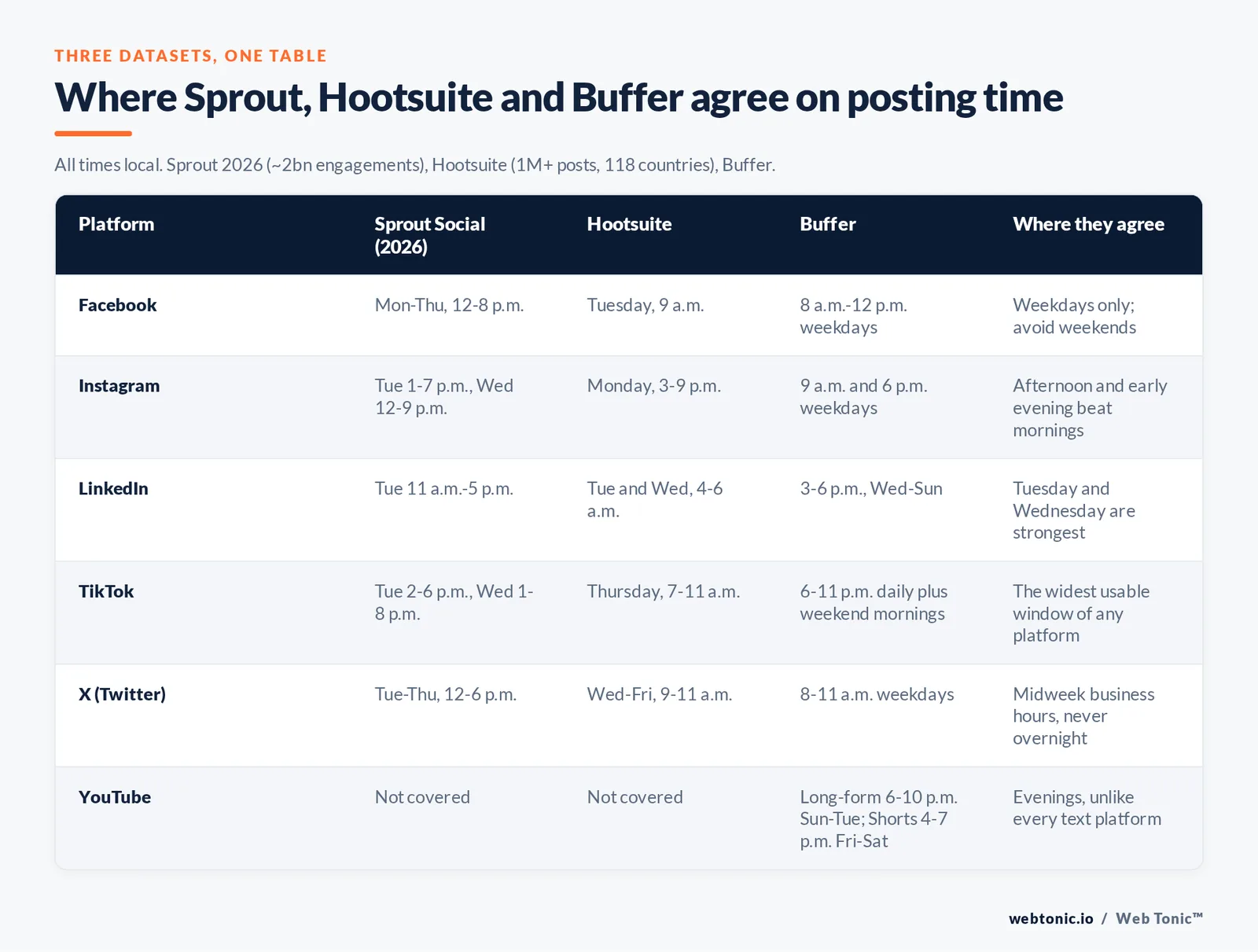
Here is where the major studies agree and where they diverge. All times are local.
| Platform | Sprout Social (2026) | Hootsuite | Buffer | Where they agree |
|---|---|---|---|---|
| Mon–Thu, 12–8 p.m. | Tuesday, 9 a.m. | 8 a.m.–12 p.m. weekdays | Weekdays only; avoid weekends | |
| Tue 1–7 p.m., Wed 12–9 p.m. | Monday, 3–9 p.m. | 9 a.m. and 6 p.m. weekdays | Afternoon and early evening beat mornings | |
| Tue 11 a.m.–5 p.m., Wed 11 a.m.–4 p.m. | Tue and Wed, 4–6 a.m. | 3–6 p.m., Wed–Sun | Tuesday and Wednesday are the strongest days | |
| TikTok | Tue 2–6 p.m., Wed 1–8 p.m. | Thursday, 7–11 a.m. | 6–11 p.m. daily plus weekend mornings | The widest usable window of any platform |
| X (Twitter) | Tue–Thu, 12–6 p.m. | Wed–Fri, 9–11 a.m. | 8–11 a.m. weekdays | Midweek, business hours, never overnight |
| YouTube | Not covered | Not covered | Long-form 6–10 p.m. Sun–Tue; Shorts 4–7 p.m. Fri–Sat | Evening viewing, unlike every text platform |
| Threads | Not covered | Tuesday, 8 a.m. | 7 a.m.–12 p.m. weekdays | Mornings, like early X |
| Included in sample | Friday, 12 p.m. | Not covered | End of week, weekend-planning intent |
Best times to post, platform by platform
Facebook is a habit platform: people check it at fixed points in the day. Buffer identifies 9 a.m. on Thursday as the single strongest slot, with Wednesday leading by total engagement and Saturday the quietest day. Sprout sees a broader afternoon-to-evening wave, 12–8 p.m. Tuesday and Wednesday.
Reconciling the two: post once in the 9–11 a.m. band for reach among habitual morning checkers, and once between 1 and 4 p.m. for the lunch-and-afternoon-break audience. Skip midnight to 4 a.m. entirely.
Instagram is the clearest afternoon platform in every dataset. Sprout puts Wednesday's window at 12–9 p.m., the longest single-day window it measured. Hootsuite's 3–9 p.m. Monday and Later's Instagram timing research both land in the same afternoon-to-evening block, and Metricool's Instagram analysis agrees that early mornings underperform.
One useful nuance from Hootsuite's strategists: brand accounts do better early in the day, while personal and creator accounts peak at 8–9 p.m. Industries where browsing is a leisure activity — real estate, retail, entertainment — skew later still.
LinkedIn produces the widest disagreement of any platform: Hootsuite says 4–6 a.m., Buffer says 3–6 p.m., Sprout says 11 a.m.–5 p.m. That is a spread of roughly 12 hours on one network.
The explanation is that LinkedIn engagement is bimodal. There is a pre-work commute-and-coffee spike and a mid-afternoon spike, and which one dominates depends on whether your audience is executives (early) or practitioners (afternoon). LinkedIn's own Pages guidance emphasises consistent weekday publishing over precise hours. Test 7–8 a.m. against 1–3 p.m. for four weeks and let your own data settle it.
TikTok
TikTok has the most forgiving schedule because the For You feed surfaces content well after publication. Buffer's 6–11 p.m. daily recommendation and Sprout's 1–8 p.m. Wednesday window overlap in the early evening. TikTok's newsroom is worth watching for feature changes that shift distribution more than timing ever will.
TikTok is also the only platform where weekends hold up — weekend mornings are a genuine opportunity while every other network dips.
X (Twitter)
X remains a real-time news platform, so timeliness beats timing. Sprout's 12–6 p.m. Tuesday-to-Thursday window and Buffer's 8–11 a.m. both fall inside business hours; the practical range is 8 a.m.–6 p.m. on weekdays, with the caveat that a post tied to breaking news outperforms any scheduled slot.
YouTube
YouTube is the one network that inverts the pattern. Buffer's data puts long-form viewing at 6–10 p.m. Sunday to Tuesday and Shorts at 4–7 p.m. Friday and Saturday. Publish two to three hours before the viewing window so indexing and early impressions have time to build.
The worst times to post
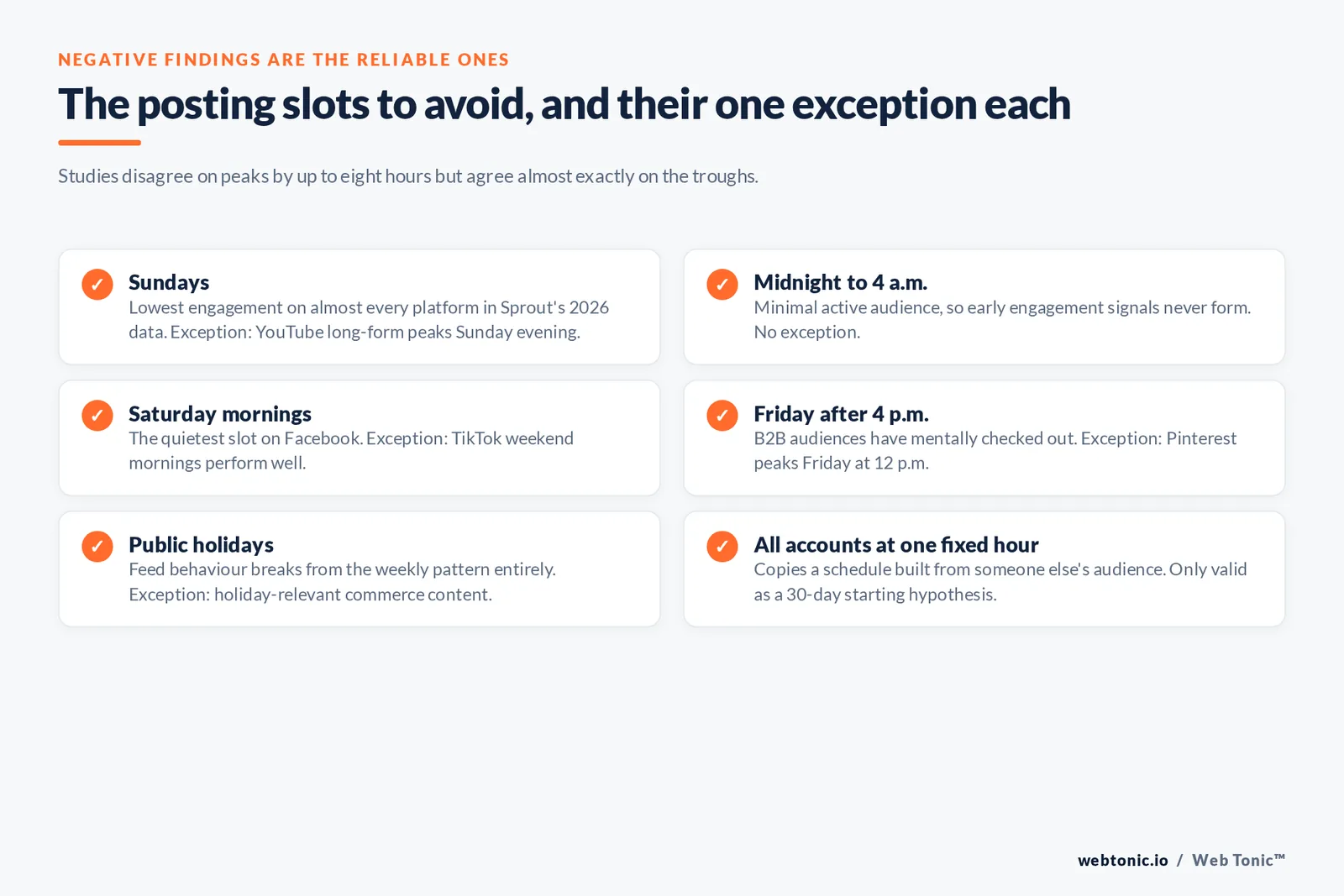
Negative findings are more consistent across studies than positive ones, which makes them more reliable.
| Avoid | Why | Exception |
|---|---|---|
| Sundays | Lowest engagement across almost every platform in Sprout's 2026 data | YouTube long-form viewing peaks Sunday evening |
| Midnight–4 a.m. | Minimal active audience; early engagement signals never form | None |
| Saturday mornings | Quietest slot on Facebook | TikTok weekend mornings perform well |
| Friday after 4 p.m. | B2B audiences have mentally checked out | Pinterest peaks Friday at 12 p.m. |
| Public holidays | Feed behaviour breaks from the weekly pattern entirely | Holiday-relevant commerce content |
| All accounts at one fixed hour | Copies a schedule built from someone else's audience | Only as a 30-day starting hypothesis |
What changes the answer for your account
- Factor 1 — audience geography. A US-and-UK audience means two peaks 5 hours apart. Publish to the larger segment and use the second peak for reshares or Stories.
- Factor 2 — B2B versus B2C. B2B follows the working day; B2C follows leisure hours. Same platform, different windows.
- Factor 3 — content format. Short video under 60 seconds demands active attention and performs best in leisure windows; text and link posts scan fine during a work break.
- Factor 4 — content half-life. A Pinterest pin can drive traffic for months, an X post is dead in 2 hours. Precision timing matters inversely to half-life.
- Factor 5 — posting frequency. At 1 post a week, the exact hour matters. At 5 a day you are covering the whole window anyway.
- Factor 6 — industry norms. Engagement rates and rhythms vary widely by sector; Socialinsider's benchmark data is the fastest way to see where your vertical sits.
- Factor 7 — audience demographics. Platform usage differs sharply by age and education, as Pew Research's social media fact sheet documents — a younger audience shifts your whole curve later.
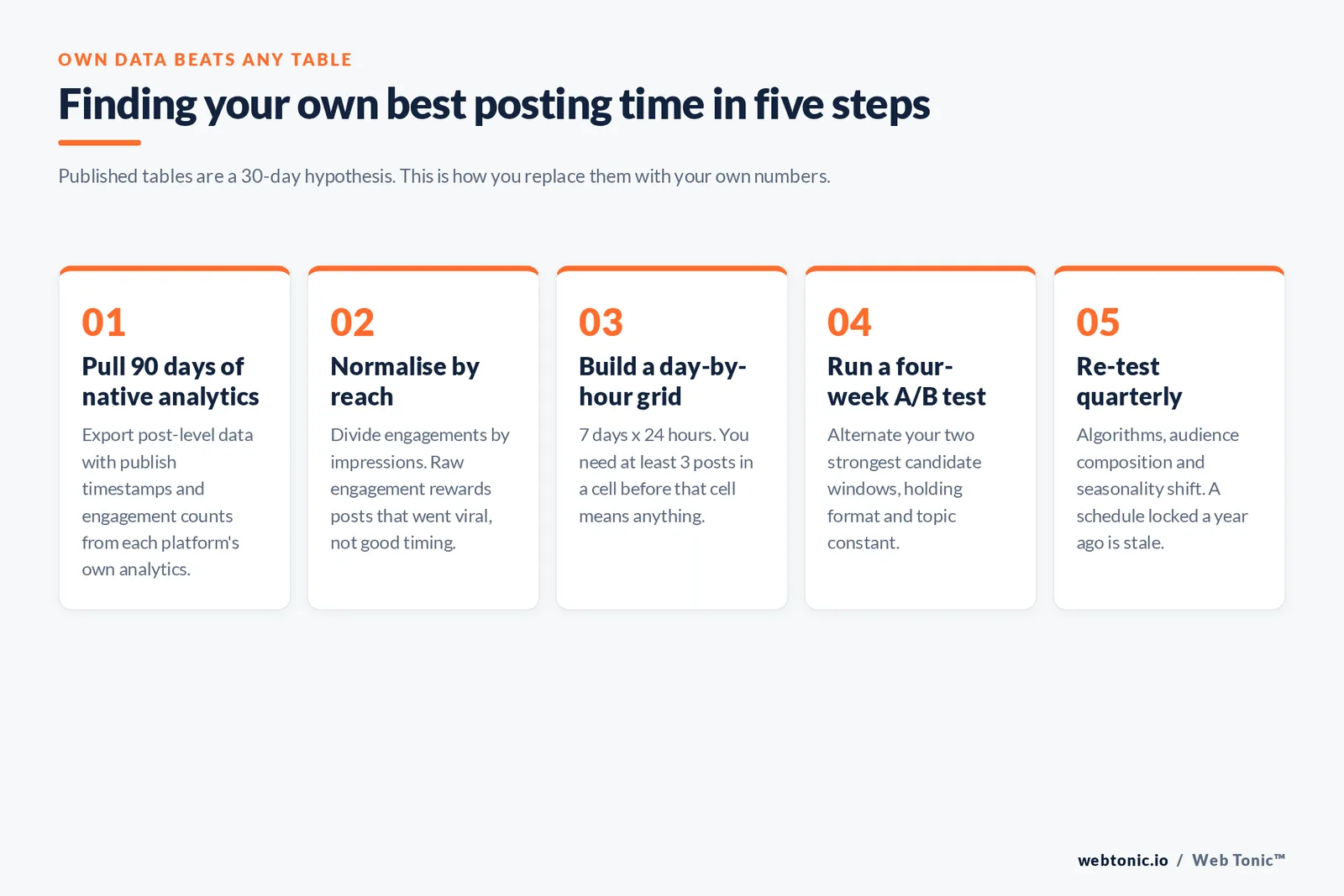
How to find your own best time in five steps
- Step 1 — pull 90 days of native analytics. Export post-level data with publish timestamps and engagement counts from each platform's own analytics.
- Step 2 — normalise by reach. Divide engagements by impressions. Raw engagement rewards posts that happened to go viral, not good timing.
- Step 3 — build a day-by-hour grid. 7 days × 24 hours. You need at least 3 posts per cell before a cell means anything.
- Step 4 — run a four-week A/B test. Pick your two strongest candidate windows and alternate them, holding format and topic constant.
- Step 5 — re-test quarterly. Algorithms, audience composition and seasonality all shift. A schedule locked in 12 months ago is stale.
If you would rather this ran as a repeatable process than a quarterly scramble, that is the kind of operating cadence we build into growth marketing engagements, alongside the creative testing that decides whether the post works once someone sees it. More on measurement discipline across our blog.
Turning best posting times into a weekly social media calendar
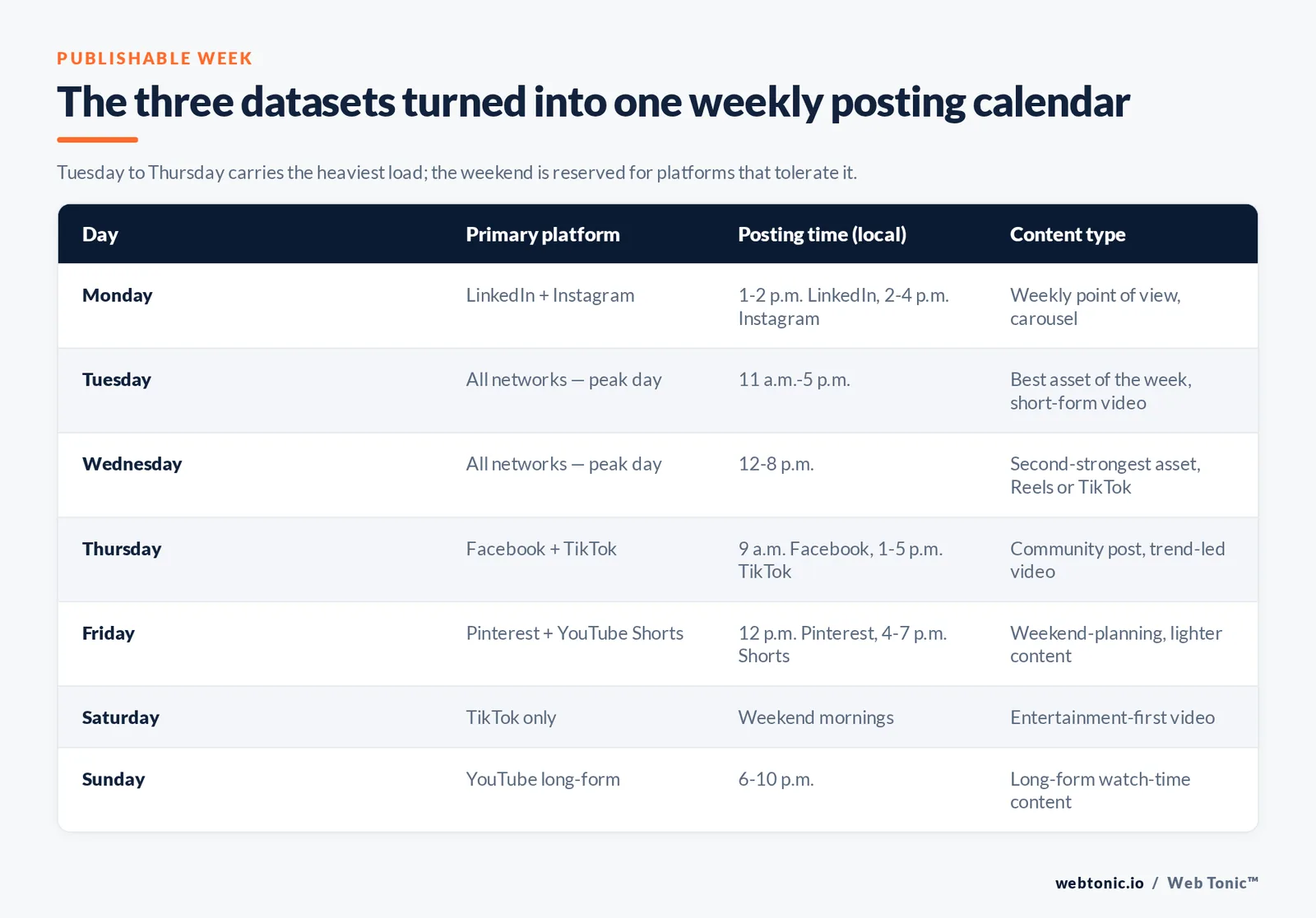
Best days to post and worst days to post are only useful once they sit in a schedule. The grid below turns the three datasets into one publishable week — Tuesdays, Wednesdays and Thursdays carry the heaviest load, Monday and Friday take lighter content, and the weekend is reserved for the platforms that tolerate it.
| Day | Primary platform | Posting time (local) | Content type |
|---|---|---|---|
| Monday | LinkedIn + Instagram | 1–2 p.m. LinkedIn, 2–4 p.m. Instagram | Weekly point of view, carousel |
| Tuesday | All networks — peak day | 11 a.m.–5 p.m. | Best asset of the week, short-form video |
| Wednesday | All networks — peak day | 12–8 p.m. | Second-strongest asset, Reels or TikTok |
| Thursday | Facebook + TikTok | 9 a.m. Facebook, 1–5 p.m. TikTok | Community post, trend-led video |
| Friday | Pinterest + YouTube Shorts | 12 p.m. Pinterest, 4–7 p.m. Shorts | Weekend-planning and lighter content |
| Saturday | TikTok only | Weekend mornings | Entertainment-first video |
| Sunday | YouTube long-form | 6–10 p.m. | Long-form watch-time content |
Three rules keep the calendar honest as posting times drift. First, protect the peak: never schedule your strongest asset outside Tuesday, Wednesday or Thursday just because a slot was free. Second, stagger platforms rather than cross-posting at one fixed hour — the same 9 a.m. slot that suits Facebook and Threads is one of Instagram's weakest windows. Third, log the publish time on every post from day one; social media management gets much easier when your own posting times are queryable rather than remembered.
Time zones are the piece teams most often get wrong. All three studies normalise to local time, so a schedule built for a single-country audience transfers cleanly, but a US-plus-Europe following needs two publish times per asset rather than one compromise slot in the middle. If more than 25% of your audience sits outside your primary market, treat it as a second calendar, not a rounding error.
Tools that calculate it for you
| Tool | How it decides | Best for |
|---|---|---|
| Sprout Social | Optimal Send Times and ViralPost analyse your own audience patterns | Mid-market and enterprise teams already in Sprout |
| Hootsuite | Recommended Times inside the composer, per profile | Multi-brand agencies managing many profiles |
| Buffer | Optimised posting slots in the content calendar | Creators and small teams on a budget |
| Later | Best Time to Post from your Instagram history | Visual-first Instagram and TikTok accounts |
| Metricool | Heat-map of your historical engagement by hour | Teams that want the raw grid, not a recommendation |
| Native analytics | Platform-owned data, free, no sampling | Anyone willing to build the grid manually |
Every one of these tools is doing the same arithmetic on your own history. The value is the saved hours, not a secret signal — so do not pay for a scheduler purely to learn your posting window. Broader context on platform reach is worth pairing with your timing work: DataReportal's global overview, Statista's social networks hub and Sprout's social media statistics roundup all track how audiences are shifting between networks. Our full service overview explains where organic timing fits alongside paid distribution.
FAQ
What is the single best time to post on social media?
If you only get one answer, use Tuesday or Wednesday between 11 a.m. and 2 p.m. local time. It sits inside Sprout Social's measured peak, close to Hootsuite's midweek recommendation, and inside Buffer's window for most platforms. Treat it as a default for new accounts with no data of their own, then replace it as soon as you have 90 days of post-level analytics.
Does posting time still matter if the algorithm decides reach?
Yes, but less than it did. Recency is one of the strongest early signals on every major feed: posts that collect engagement quickly get shown to more people. Timing does not override weak content, it only removes a handicap from strong content. On TikTok and Pinterest, where content is surfaced long after publication, the effect is smallest.
Why do Sprout Social, Hootsuite and Buffer give different answers?
They measure different customer bases, define engagement differently, and cover different date ranges. Sprout counts DMs and clicks alongside reactions across roughly 307,000 mostly-brand profiles; Hootsuite normalises over a million posts across 118 countries; Buffer's sample includes many more small creators. Where all three agree — midweek, avoid Sundays, avoid overnight — the finding is robust.
How often should I post on each platform?
Consistency beats volume. One to two posts a day works for Instagram and Facebook, three to five for X, three to five a week for LinkedIn, and one to three a day for TikTok if you can sustain the quality. Sprout's own research found that most social media managers do not believe raising volume raises impact, even though most marketing directors do.
Do time zones matter if my audience is global?
They matter a lot. The major studies normalise to local time, which is only helpful if your followers cluster in one region. For a genuinely global audience, identify your two largest country segments, schedule the primary post for the bigger one, and repurpose the same content into a second slot for the other.
Sources
Sprout Social — best times to post on social media (2026 data, ~2 billion engagements across ~307,000 profiles) and social media statistics · Hootsuite — best time to post on social media (1M+ posts, 118 countries) · Buffer — best time to post on social media · Later — best time to post on Instagram · Metricool — Instagram timing analysis · Socialinsider — social media benchmarks · Pew Research Center — social media fact sheet · DataReportal — Digital global overview report · Statista — social networks · LinkedIn Marketing Solutions — LinkedIn Pages · TikTok Newsroom. All sources accessed 1 August 2026.