



Table of contents
How we vet every listicle
Every agency featured on Web Tonic passes our 84-point editorial review before a single listicle goes live. This is how we vet each pick:
Verified client outcomes: We require real case studies with measurable KPIs — revenue, ROAS, CPA, retention — tied to the exact category being ranked. No cherry-picked wins, no unverifiable numbers.
Independent reputation: We cross-check Clutch, Google, G2, and Trustpilot ratings, and screen for review-bombing or suspicious patterns. Only operators with a consistent, verifiable track record make the cut.
Beyond that, every listing goes through a quarterly re-audit. We check 84 criteria across 6 pillars to make sure it still holds up — here are some of the checks we run:
The right SEO tool turns hours of manual work into a few clicks. We tested and compared the best SEO tools for 2026 across features, pricing, and real-world performance.
Key Takeaways
- Google Search Console remains the single most important free SEO tool — it provides first-party data on index coverage, search performance, and Core Web Vitals that no third-party tool can replicate (Search Engine Land).
- Semrush leads in overall feature breadth with 55+ tools spanning keyword research, rank tracking, site audits, competitive intelligence, and PPC analysis — starting at $139.95/month.
- Ahrefs has the largest backlink index, crawling over 16 billion pages daily, making it the default for link builders and competitive analysts (Truescho).
- Free SEO tools have closed the feature gap with paid platforms in four key areas: site auditing up to 500 URLs, keyword tracking for owned properties, Core Web Vitals monitoring, and basic backlink visibility (AuthoritySpecialist).
- AI SEO agents like Ahrefs Agent A and Optimatio now research keywords, write content, fix technical issues, and track rankings autonomously — shifting agencies from "doing SEO" to "approving SEO."
Best SEO Tools for Every Workflow (2026 Comparison)
| Tool | Best For | Pricing | Standout Feature |
|---|---|---|---|
| Semrush | All-in-one SEO + PPC | From $139.95/mo | 55+ integrated marketing tools |
| Ahrefs | Backlink analysis + competitor research | From $129/mo | Largest backlink index (16B+ pages/day) |
| SE Ranking | Mid-market agencies | From $65/mo | Best value keyword + rank tracker combo |
| Screaming Frog | Technical SEO audits | Free (500 URLs) / £259/yr | Desktop crawler with custom extraction |
| Google Search Console | First-party search data | Free | Index coverage + Core Web Vitals from Google |
| Surfer SEO | Content optimization | From $99/mo | Real-time NLP content scoring |
| Moz Pro | Domain authority tracking | From $49/mo | Proprietary DA/PA metrics |
| Ubersuggest | Budget-friendly keyword research | From $29/mo (lifetime option) | Lifetime plan + Chrome extension |
Keyword Research Tools: Finding the Right Queries
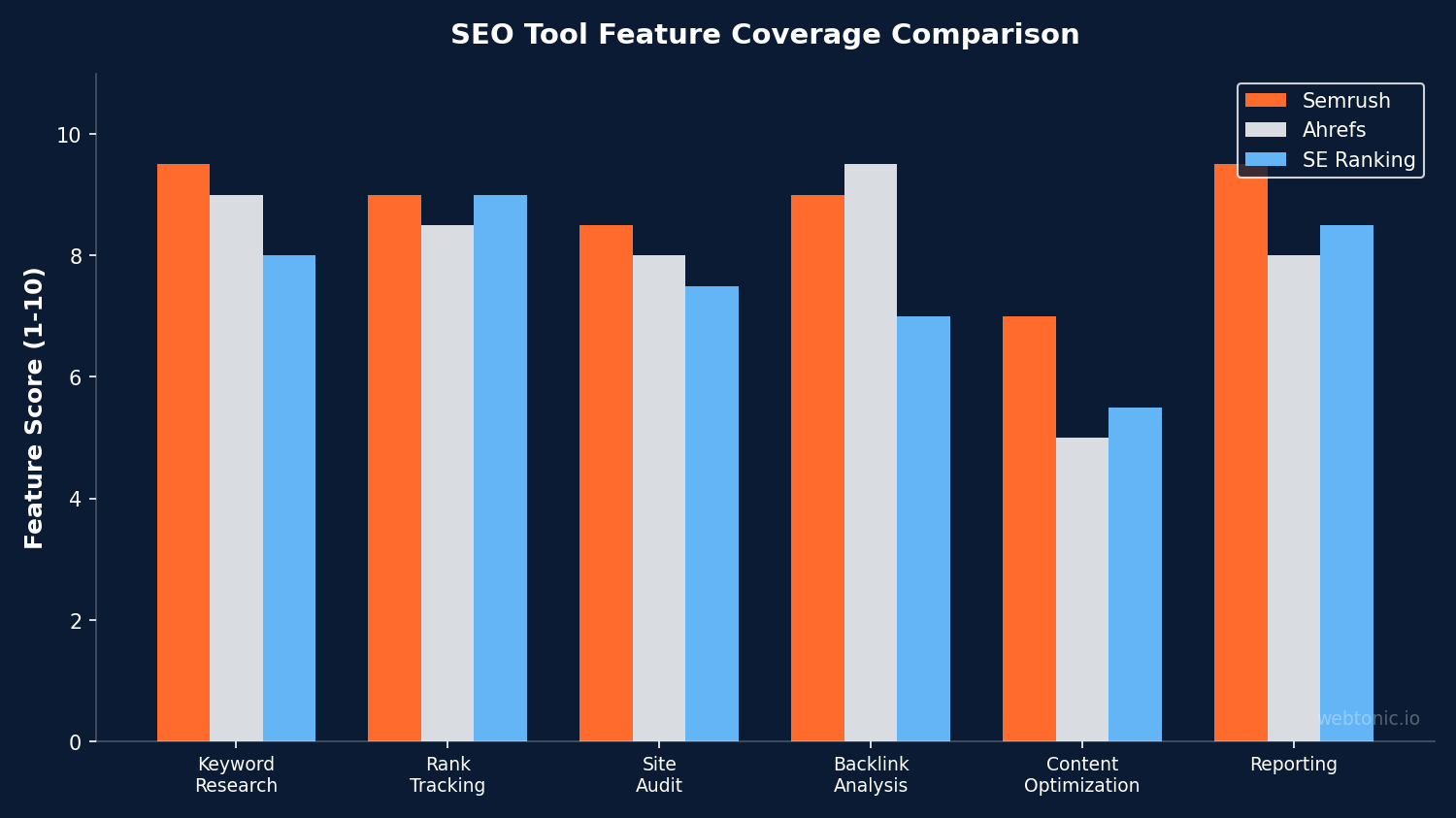
Keyword research is the foundation of every SEO strategy, and the best SEO tools for keyword discovery go far beyond basic search volume. In 2026, AI-enhanced keyword tools cluster semantically related queries, predict ranking difficulty with machine learning models, and surface People Also Ask questions that reveal search intent at scale.
Semrush's Keyword Magic Tool contains over 26 billion keywords across 142 country databases, with filters for intent type (informational, navigational, commercial, transactional). This granularity helps content teams prioritize terms that align with their funnel stage rather than chasing raw volume.
Nitaq's 2026 comparison found that Ahrefs excels at keyword difficulty calibration because it ties difficulty scores directly to the number and strength of backlinks on the current top-10 results — a more reliable proxy than generic domain-level metrics. For agencies managing multiple clients, SE Ranking offers keyword grouping at a fraction of the price, making it the best value pick for mid-market teams.
Google Keyword Planner remains essential as the only tool with first-party Google Ads data, showing real CPC bids and competitive density. While its organic search volume ranges are intentionally broad, pairing it with Google Search Console data gives you the ground-truth keyword performance that no third-party database can match. A strong growth marketing approach starts here.
Rank Tracking Tools: Monitoring Your Positions
Knowing where you rank — and how positions shift daily — is critical for measuring SEO ROI. The best rank tracking tools in 2026 refresh data daily, segment results by device and location, and flag SERP feature changes (featured snippets, AI Overviews, video carousels) that affect click-through rates even when positions stay constant.

SE Ranking provides the best balance of accuracy, frequency, and price for rank tracking. Its daily tracking covers 750+ locations with auto-grouping by URL, making it practical for agencies running 100+ keyword portfolios per client. Semrush's Position Tracking tool adds competitor comparison layers and cannibalization detection — valuable for enterprise teams.
For budget-conscious users, Google Search Console's Performance report is the only free rank tracking source with 100% data accuracy for your own properties. It shows average position, impressions, and CTR for every query that triggered your pages, going back 16 months. The tradeoff: it only tracks your own site, not competitors.
Site Audit and Technical SEO Tools
Technical SEO errors — broken links, duplicate content, slow page speeds — silently erode rankings. The best SEO tools for technical audits crawl your site like Google does and surface issues in priority order.
Screaming Frog SEO Spider is the industry standard for desktop crawling. Its free version audits up to 500 URLs with full redirect chain analysis, duplicate content detection, and custom extraction via XPath and regex. The paid version (£259/year) removes the URL limit and adds JavaScript rendering, making it indispensable for modern JavaScript-heavy sites. According to Truescho's 2026 comparison, Screaming Frog remains unmatched for granular, developer-oriented technical analysis.
Semrush Site Audit takes a cloud-based approach, running scheduled crawls that track issue resolution over time. It scores your site health on a 100-point scale and categorizes problems as errors, warnings, or notices — making it easier for non-technical marketers to prioritize. Ahrefs Site Audit offers similar functionality with tighter integration into its backlink data, letting you cross-reference technical issues with link equity impact.
Backlink Analysis Tools: Building Authority
Backlinks remain a top-three ranking factor, and the best SEO tools for backlink analysis provide the freshest, most comprehensive link data available:
- Ahrefs crawls over 16 billion pages daily and maintains the web's largest backlink index, updating its data every 15–30 minutes. Its "Best by Links" report instantly shows which of a competitor's pages attract the most links — a goldmine for content gap analysis.
- Semrush's Backlink Analytics offers similar coverage with the added bonus of toxic link scoring, which flags spammy backlinks that could trigger manual penalties. Its Link Building Tool automates outreach workflows by matching prospects from your keyword gaps.
- Moz's Link Explorer provides the proprietary Domain Authority and Page Authority metrics that remain the industry's most-cited link quality benchmarks, despite Moz's smaller crawl. DA/PA are especially useful for quick link prospect qualification without deep-diving individual backlink profiles.
Pairing a dedicated backlink tool with data intelligence services ensures your link-building efforts translate into measurable ranking gains, not just vanity metrics.
Content Optimization Tools: Writing What Ranks
Content optimization tools bridge the gap between keyword research and on-page SEO by scoring your content against the current top-ranking pages for a target query. They tell you which terms, entities, and topics your content needs to include — and which are overused.
| Tool | Approach | Best Feature | Pricing |
|---|---|---|---|
| Surfer SEO | NLP content scoring vs SERP | Real-time content editor with keyword density targets | From $99/mo |
| Clearscope | Semantic term mapping | Editorial workflow for revenue-critical content | From $189/mo |
| Frase | SERP research + AI writing | Fastest brief-to-draft pipeline | From $15/mo |
| MarketMuse | Topic modeling + content gaps | Content inventory scoring at scale | From $149/mo |
SeoHive's 2026 head-to-head concluded that Surfer wins for on-page optimization of existing drafts, Frase wins on brief generation speed, and Clearscope wins for editorial teams on revenue-critical pages. For most teams, Frase at $15/month offers the best value entry point before upgrading to Surfer or Clearscope as content volume scales.
AI-Powered SEO Tools: The 2026 Frontier
The biggest shift in the SEO tool landscape is the arrival of agentic AI — autonomous systems that execute SEO tasks, not just analyze them. Two standout entrants in 2026:
- Ahrefs Agent A drafts pages, emails, and reports using Ahrefs' own data layer. It accesses the same endpoints as the Ahrefs UI — every metric, filter, and report — and is trained to use them like an expert analyst. For agencies, this means more client work delivered by the same team size.
- Optimatio deploys a crew of AI agents that research keywords, write content, fix technical issues, and track rankings across Google and AI search engines. The workflow is "they propose, you approve, they push live" — a fully autonomous SEO operation with human guardrails.
According to ToolChase's 2026 ranking, AI-powered SEO tools now outperform manual workflows on content optimization tasks by 3–5× in speed and produce comparable quality when supervised. The key differentiator is not the AI model itself but the quality of the underlying data — which is why Ahrefs and Semrush's agent tools have a structural advantage over standalone AI writing tools.
Free vs. Paid SEO Tools: What's Worth the Investment?
AuthoritySpecialist's 2026 analysis found that free SEO tools have closed the feature gap with paid platforms in four specific areas:

- Site auditing up to 500 URLs — Screaming Frog's free tier handles most small-to-medium sites.
- Keyword performance tracking for owned properties — Google Search Console delivers unmatched accuracy at zero cost.
- Core Web Vitals monitoring — PageSpeed Insights and CrUX data are free, first-party, and authoritative.
- Basic backlink visibility — Google Search Console shows your top linking domains and pages.
Where paid tools justify their cost is in competitive intelligence, historical data depth, and multi-site management. You cannot see a competitor's keyword rankings, backlink profile, or ad spend with free tools. For agencies managing 10+ client websites simultaneously, the productivity gain of a unified dashboard in Semrush or SE Ranking easily offsets the monthly subscription. Read our blog for more in-depth comparisons.
Reporting and Analytics: Turning Data Into Action
The best SEO tools don't just collect data — they help you build reports that clients and stakeholders actually read. Semrush's reporting suite generates white-label PDF reports with drag-and-drop widgets covering traffic, keyword rankings, backlink growth, and site health. For agencies, this helps reduce reporting time from hours to minutes.
SE Ranking offers automated reporting with scheduled delivery — set up a report template once and it emails clients weekly with updated metrics. Nightwatch takes a different approach: its reporting focuses specifically on rank tracking with hyper-local SERP visibility charts that help local SEO professionals show clients exactly where they stand in their target markets.
For WordPress users, SEO plugins like Yoast and Rank Math provide on-page optimization reports directly in the CMS editor. While these plugins don't replace full SEO platforms, they help content writers follow SEO best practices during the writing process without switching between tools. Pair a WordPress plugin with a dedicated platform like Semrush or SE Ranking for a complete SEO plan that covers both technical analysis and content execution.
One emerging trend: ChatGPT and AI assistants are being integrated into SEO reporting workflows to summarize data, identify anomalies, and draft review narratives. Tools that support AI-generated reporting summaries save time for agencies managing 20+ client reports per month.
Pros and Cons of the Top SEO Platforms
Every SEO tool has tradeoffs. Here are the key cons to weigh alongside the features:
- Semrush cons: highest pricing in the industry, steep learning curve for beginners, limited seats per plan (add-on users cost extra).
- Ahrefs cons: no built-in PPC or social media tools, pricing starts at $129/month with no free tier (only a limited Webmaster Tools version).
- Screaming Frog cons: desktop-only (no cloud option), overwhelming UI for non-technical users, requires manual scheduling for recurring audits.
- Moz cons: smaller keyword and backlink databases compared to Semrush and Ahrefs, slower crawl speeds, limited international keyword data.
- Ubersuggest cons: data accuracy concerns on low-volume keywords, fewer features than premium tools, lifetime plan has feature limitations.
Understanding these cons helps you pick a tool that aligns with your workflow rather than overpaying for features you won't use. A review of your current SEO needs — traffic analysis, keyword research, competitive intelligence — will help narrow the list to 2–3 finalists before committing to a paid plan.
How to Choose the Right SEO Tool for Your Needs
There is no single "best SEO tool" — the right pick depends on your workflow, team size, and budget:

- Solo bloggers and small sites — Start with Google Search Console + Screaming Frog (free) + Ubersuggest ($29/mo). Total: under $30/month for a complete SEO stack.
- Growing teams and in-house marketers — SE Ranking ($65/mo) or Moz Pro ($49/mo) paired with Frase ($15/mo) for content. Total: under $100/month with rank tracking, audits, and content optimization.
- Agencies and enterprise — Semrush ($139.95+/mo) or Ahrefs ($129+/mo) as the core platform, plus Screaming Frog for technical depth and Surfer/Clearscope for content QA. Budget $250–500/month for a professional-grade toolkit.
The most important principle: no SEO tool replaces strategy. Tools surface data; the value comes from how you act on it. A strong digital marketing partner combines the best tools with the expertise to turn data into ranking gains.
SEO Tool Pricing Plans Compared
Pricing plans across SEO tools vary dramatically, and understanding the tier structures helps you avoid overpaying for features your team doesn't need. Here is how the major platforms structure their pricing plans in 2026:
- Semrush — Three plans: Pro ($139.95/mo), Guru ($249.95/mo), and Business ($499.95/mo). The Pro plan covers keyword research, rank tracking, and site audit for up to 5 projects. Guru adds content marketing tools, historical data, and Clearscope-level content optimization. Business adds white-label reporting, API access, and extended limits across all features.
- Ahrefs — Four plans from Lite ($129/mo) to Enterprise ($1,499/mo). Each plan increase adds more tracked keywords, crawl credits, and user seats. Ahrefs does not offer a free plan but provides Webmaster Tools with limited features for verified site owners.
- SE Ranking — Pricing starts at $65/month for the Essential plan, making it the best value full-featured SEO tool for growing teams. The Pro plan ($119/mo) adds more tracked keywords and reporting features. Custom enterprise plans are available for agencies managing high volumes of client accounts.
- Nightwatch — A rank tracking specialist with plans starting at $39/month. Nightwatch excels at local SERP tracking with support for Google, Bing, YouTube, and location-specific rankings. Its plans scale based on tracked keyword volume rather than feature tiers, making it predictable for budgeting.
- Surfer SEO — Content optimization plans start at $99/month for the Essential tier. The Scale plan ($219/mo) is designed for agencies and teams producing content at high volume, with additional AI writing credits and SERP analysis features.
When comparing pricing plans, look beyond the monthly cost: consider how many keywords you need to track, how many site audits you run per month, and whether your team needs multi-user seats. A tool that seems expensive on paper may deliver more value per dollar than a cheap tool you outgrow in three months. ChatGPT and AI writing tools can complement these SEO platforms but do not replace dedicated rank tracking, keyword research, or backlink analysis — they help with content writing and report summarization at a fraction of the cost.
Rank Tracking Specialists: Nightwatch, AccuRanker, and Wincher
While Semrush and Ahrefs include rank tracking as one feature among many, dedicated rank trackers offer deeper capabilities for teams whose primary need is monitoring keyword positions:
- Nightwatch is a specialist rank tracking platform with plans starting at $39/month. Nightwatch supports Google, Bing, YouTube, and location-specific SERP tracking, making it the tool of choice for local SEO agencies that track rankings across dozens of cities. Nightwatch also offers intuitive reporting dashboards that help teams visualize ranking trends without exporting data to spreadsheets.
- AccuRanker refreshes rankings on demand rather than on a fixed daily schedule, giving SEO professionals real-time position data when running time-sensitive campaigns or monitoring algorithm update impacts.
- Wincher provides affordable daily rank tracking starting at $49/month with a clean, no-frills interface that helps smaller teams focus on keyword performance without feature overload.
Choosing between an all-in-one SEO platform and a specialist tool like Nightwatch depends on your workflow. If rank tracking is your primary daily task, a dedicated tracker delivers better data granularity and costs less than a full-suite tool. If you need keyword research, backlink analysis, content optimization, and rank tracking in one platform, an all-in-one tool reduces context-switching and consolidates your reporting workflow.
Building Your SEO Tool Stack: A Practical Framework
Rather than choosing one tool to do everything, the best approach for most teams is a carefully assembled stack where each tool covers a specific workflow. Here is a practical framework that helps SEO professionals build an efficient toolkit:
- Core platform — Semrush, Ahrefs, or SE Ranking for keyword research, rank tracking, backlink analysis, and site audit. Choose based on your primary need: Semrush for breadth, Ahrefs for link data, SE Ranking for value.
- Technical crawling — Screaming Frog for deep technical SEO audits. Even if your core platform has a site audit tool, Screaming Frog's desktop crawler catches issues that cloud-based crawlers miss, especially on WordPress sites with complex plugin stacks and JavaScript-rendered content.
- Content optimization — Surfer SEO, Clearscope, or Frase for writing SEO content that ranks. These tools help writers cover the right topics at the right density without over-optimizing.
- Free foundations — Google Search Console for first-party search data, Google Analytics for traffic analysis, and Google Keyword Planner for CPC and search volume context. These free tools provide data that no paid platform can replicate because they come directly from Google.
This stacked approach gives you the features and data depth of premium SEO tools while keeping your total investment under control. It also helps avoid vendor lock-in — if one tool raises pricing or degrades in quality, you can swap it out without rebuilding your entire SEO workflow.
What Makes the Best SEO Tools Stand Out in 2026
After reviewing dozens of SEO tools, the platforms that consistently earn the "best" label share a few critical traits. The best SEO tools provide accurate keyword data updated daily, comprehensive site audit capabilities that catch technical issues before they impact rankings, and reporting features that help SEO professionals communicate results clearly to clients and stakeholders.
Key features that separate the best SEO tools from average ones include:
- Data freshness — The best tools update keyword rankings, backlink data, and site audit results daily. Stale data leads to bad decisions.
- Competitor intelligence — The ability to review competitor keyword portfolios, traffic estimates, and content gaps is what makes paid tools worth the investment over free alternatives.
- Integration with writing and content workflows — Tools like Surfer SEO and Clearscope integrate directly into Google Docs and WordPress, letting writers optimize content as they write rather than after publication.
- Scalable pricing plans — The best tools offer plans that grow with your business. Starting with a basic plan and upgrading as your keyword portfolio and traffic expand helps manage SEO tool costs effectively.
- AI capabilities — ChatGPT integrations, AI-generated content briefs, and automated reporting summaries are becoming table-stakes features in 2026. Tools that don't offer AI-assisted workflows risk falling behind.
Ultimately, the best SEO tool is the one your team will actually use daily. A review of your workflow requirements, combined with free trials of the top contenders, helps ensure you choose the right tool for your specific needs.
FAQ
What is the best free SEO tool in 2026?
Google Search Console is the best free SEO tool because it provides first-party data directly from Google's index — including search performance, index coverage, Core Web Vitals, and URL inspection. No third-party tool can replicate this data source. Pair it with Screaming Frog's free tier for technical audits.
Is Semrush or Ahrefs better for SEO?
It depends on your primary workflow. Semrush is better for all-in-one marketing teams that need PPC, social, and content tools alongside SEO. Ahrefs is better for link builders and competitive analysts who prioritize backlink data freshness and depth. Both are industry leaders with different strengths.
Do I need paid SEO tools if I'm just starting?
Not necessarily. A combination of Google Search Console, Google Keyword Planner, Screaming Frog (free), and Ubersuggest covers keyword research, rank monitoring, site auditing, and basic competitor insights for under $30/month. Upgrade to a full-suite tool once your site exceeds 500 indexed pages or you need competitive intelligence.
What are AI SEO tools and are they worth it?
AI SEO tools use machine learning to automate tasks like keyword clustering, content optimization, technical issue detection, and even autonomous content creation. Tools like Ahrefs Agent A and Optimatio are worth exploring for agencies seeking to scale output without proportionally scaling headcount. They are most effective when supervised by experienced SEOs who validate the AI's recommendations.
Which SEO tool is best for agencies?
Semrush and SE Ranking are the top picks for agencies. Semrush offers white-label reporting, client management dashboards, and the broadest tool suite. SE Ranking delivers similar core features at a lower price point, making it ideal for mid-market agencies managing 10–50 clients. Both support multi-user access and project-based organization.
Sources
Search Engine Land — What Is SEO?
Truescho — Best 7 SEO Tools 2026: Honest Comparison
Nitaq — Best SEO Analysis Tools in 2026
AuthoritySpecialist — Free vs Paid SEO Tools 2026
SeoHive — Surfer SEO vs Frase vs Clearscope
ToolChase — 8 Best AI SEO Content Optimizers 2026


