Table of contents
How we vet every listicle
Every agency featured on Web Tonic passes our 84-point editorial review before a single listicle goes live. This is how we vet each pick:
Verified client outcomes: We require real case studies with measurable KPIs — revenue, ROAS, CPA, retention — tied to the exact category being ranked. No cherry-picked wins, no unverifiable numbers.
Independent reputation: We cross-check Clutch, Google, G2, and Trustpilot ratings, and screen for review-bombing or suspicious patterns. Only operators with a consistent, verifiable track record make the cut.
Beyond that, every listing goes through a quarterly re-audit. We check 84 criteria across 6 pillars to make sure it still holds up — here are some of the checks we run:
The best SEO companies are the ones that can show you a documented link between the work they do and the revenue you get — not the ones with the longest client logo wall. Everything else in the selection process is a test of whether that link is real.
This guide gives you the pricing benchmarks, the vetting questions and the agency categories you need to compare SEO firms without relying on a paid directory ranking.
Key Takeaways
- SEO costs $2,917 per month on average across 439 polled providers, with most businesses spending between $500 and $5,000 per month.
- Agencies charge 138% more than freelancers: $3,209/month on average versus $1,348/month.
- The average hourly rate for SEO work is $111, and 1 in 10 providers charge more than $150/hour.
- Local SEO is cheaper, averaging $1,557 per month — a useful ceiling for single-location businesses.
- 78.2% of providers work on a monthly retainer, 48.9% also sell per-project work and 34.8% bill hourly.
- Google still handles 91.25% of worldwide search (June 2026), so an agency's Google competence remains the core of the deal — but AI answers now sit above it.
- No SEO company can promise a ranking. Any guarantee of "#1 in 30 days" is the single fastest disqualifier in the market.
What separates the best SEO companies from the rest
Every SEO firm sells the same nouns: audits, keywords, content, links, technical fixes. The differences that matter are structural, and there are only five of them.
1. They work from a business model, not a keyword list. A good team asks about margin, sales cycle, average order value and capacity before it asks about keywords. Ranking for a term you cannot profitably serve is a cost, not a win.
2. They can explain how search works. Google's own SEO starter guide and its Search Essentials are the base layer of the job. If a pitch contradicts either document, walk.
3. They produce content people would read anyway. Google's guidance on creating helpful, people-first content is now the plain-English version of the quality bar, and it is the part cheap agencies skip.
4. They own measurement. The best firms instrument conversions, calls and pipeline before month one and report on assisted revenue, not screenshots of rankings.
5. They tell you what they will not do. Purchased link networks, expired domain redirects and mass AI publishing all still get sold in 2026. A firm that names those tactics as off-limits is telling you where its risk tolerance sits.
What SEO companies actually charge
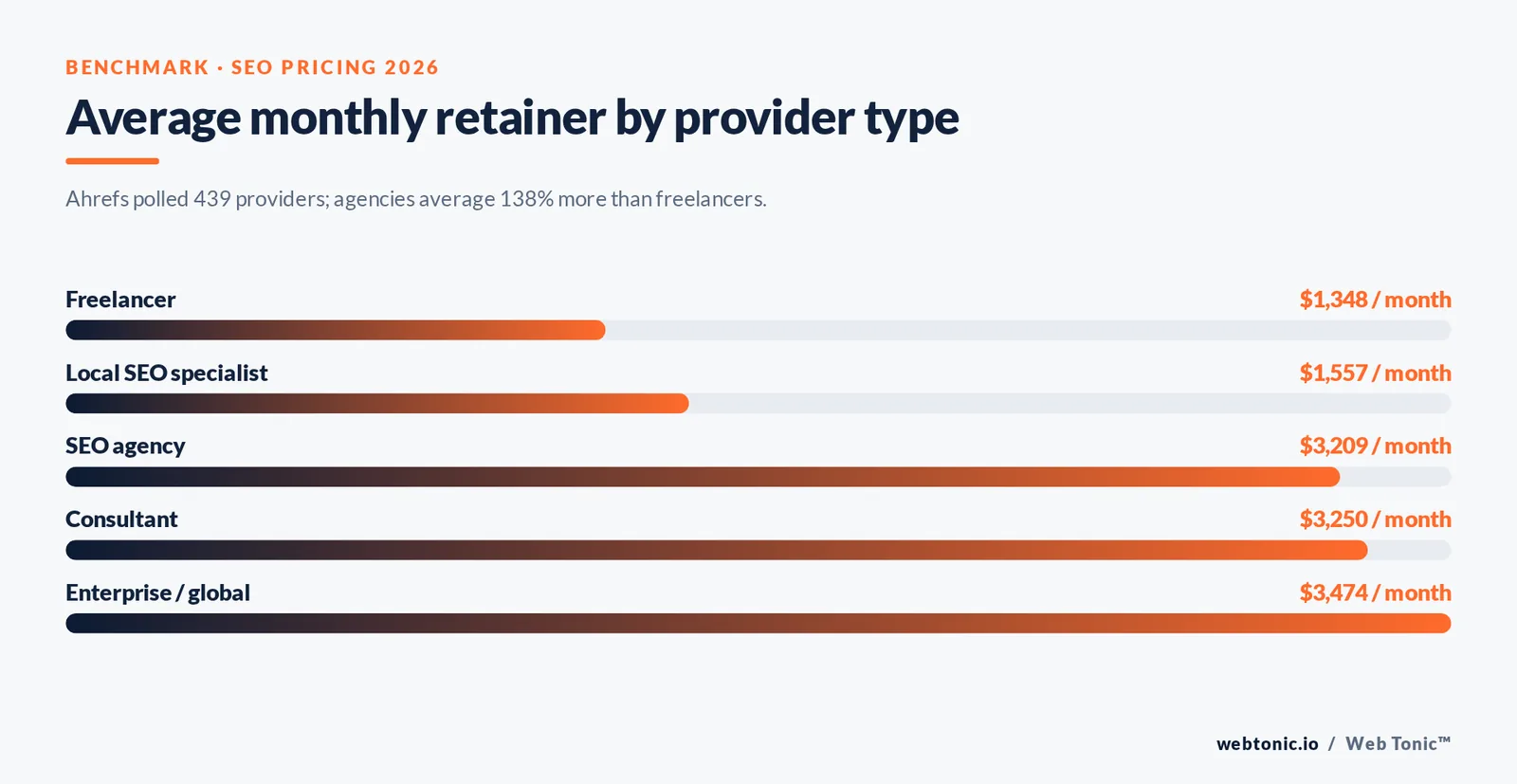
Pricing is the fastest way to sort serious firms from the rest, because the market is unusually well-surveyed. Ahrefs polled 439 SEO service providers for its SEO pricing study, and Semrush ran a parallel survey of nearly 400 respondents for its SEO pricing guide. Together they give you defensible ranges.
| Provider type | Average monthly retainer | Typical hourly rate | Best fit |
|---|---|---|---|
| Freelancer | $1,348 | $75–$100 | One channel, one site, in-house strategy already exists |
| Consultant | $3,250 | $139 worldwide / $145 in the U.S. | Senior direction for an existing internal team |
| SEO agency | $3,209 | $134 worldwide / $148 in the U.S. | Execution at volume across content, technical and links |
| Local SEO specialist | $1,557 | $75–$100 | Single-location and service-area businesses |
| Enterprise / global | $3,474 and up, to $25,000+ | $150+ | Multi-market sites, migrations, large catalogues |
Three benchmarks are worth memorising before any sales call. 68.8% of providers charge $2,000/month or less, so a five-figure quote needs to justify itself with scope, not prestige. Providers with 5–10 years in business average $3,648/month, roughly double the $1,541 average of those trading two years or less. And in the U.S. and Canada, 79.1% of providers charge at least $1,001/month — sub-$500 offers from that market are usually resold offshore.
The categories of SEO company — and who each one is for
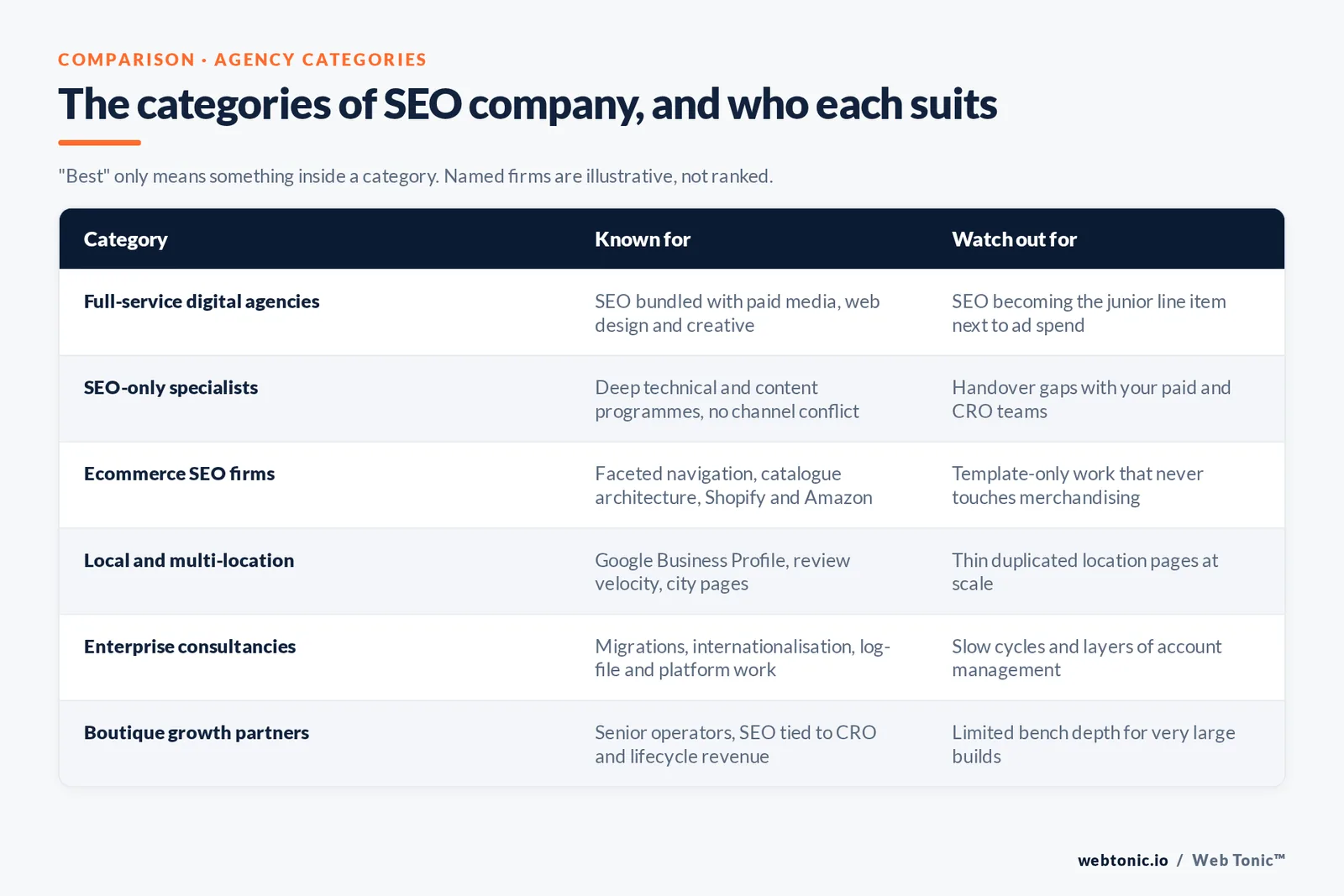
"Best" only means something inside a category. A 300-person performance shop and a six-person publisher-SEO studio are both excellent and almost never right for the same client.
| Category | Known for | Named examples | Watch out for |
|---|---|---|---|
| Full-service digital agencies | SEO bundled with paid media, web design and creative | Thrive Internet Marketing Agency, WebFX, SmartSites, Ignite Visibility | SEO becoming the junior line item next to ad spend |
| SEO-only specialists | Deep technical and content programmes, no channel conflict | Victorious, Siege Media, Terakeet | Handover gaps with your paid and CRO teams |
| Ecommerce SEO firms | Faceted navigation, catalogue architecture, Shopify and Amazon | Coalition Technologies, Inflow, Blue Wheel | Template-only work that never touches merchandising |
| Local and multi-location | Google Business Profile optimization, review velocity, city pages | Sterling Sky, Whitespark, Rio SEO | Thin duplicated location pages at scale |
| Enterprise consultancies | Migrations, internationalisation, log-file and platform work | Brainlabs, Merkle, Distilled-lineage teams | Slow cycles and layers of account management |
| Boutique growth partners | Senior operators, SEO tied to CRO and lifecycle revenue | Web Tonic and similar 10–40 person teams | Limited bench depth for very large builds |
Named examples are illustrative of each category's typical positioning, not a ranked league table. Directory rankings are a poor substitute for this kind of category thinking: most "top SEO companies" lists are pay-to-participate, and the ordering usually reflects review volume and sponsorship tier rather than results. Verify claims independently on Search Engine Land's SEO library, in the agency's own published case-study library, and by reading the agency's own client sites in your niche.
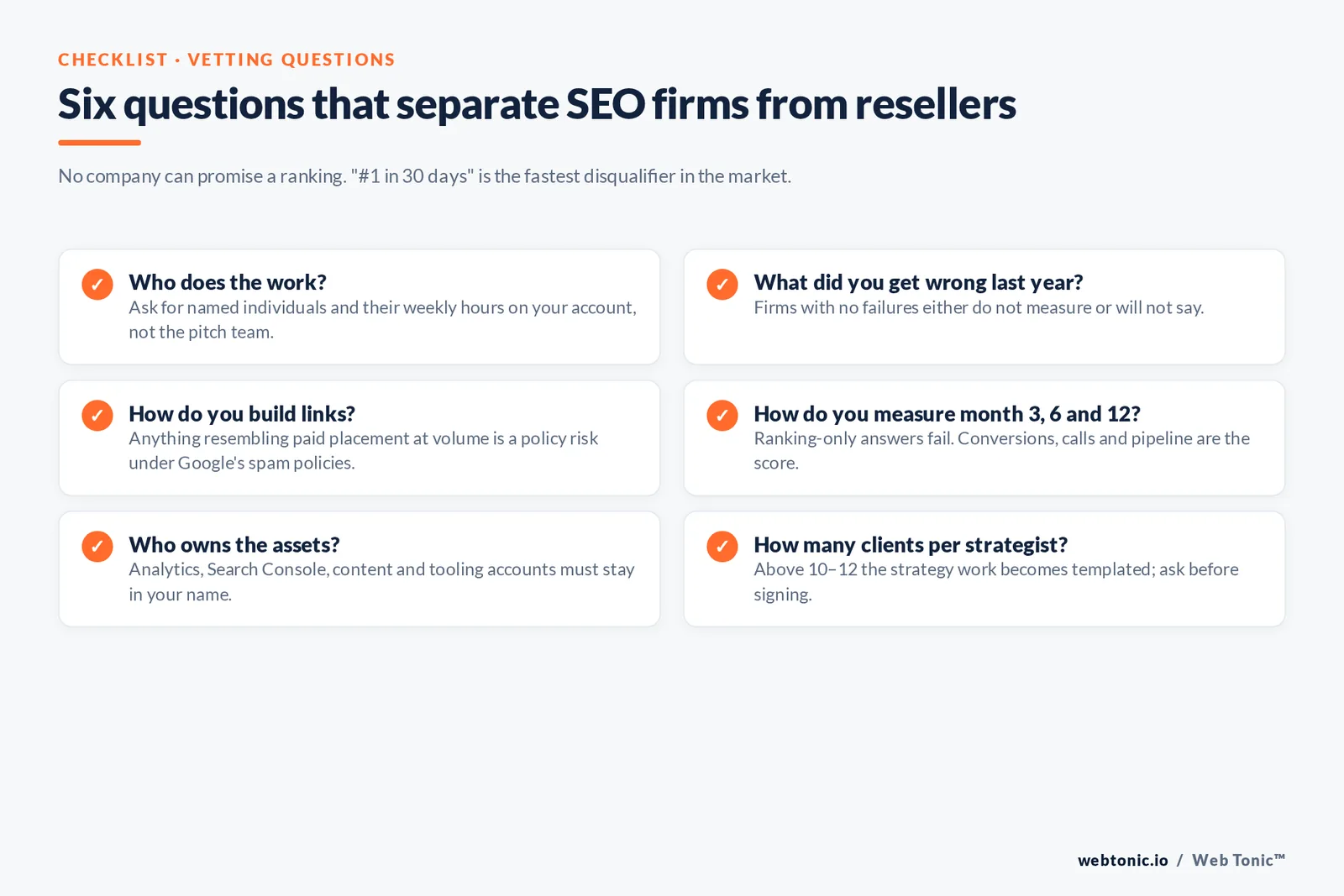
Twelve questions that separate real SEO companies from resellers
- Who does the work? Ask for the named individuals and their weekly hours on your account.
- Show me two clients in a similar sales motion. Not the same industry — the same buying cycle.
- What did you get wrong last year? Firms with no failures either do not measure or will not say.
- How do you build links? Anything resembling paid placement at volume is a policy risk under Google's spam policies.
- What is your content brief process? Look for search-intent mapping and subject-matter input, not word counts.
- How do you measure success in month 3, 6 and 12? Ranking-only answers fail this question.
- Who owns the assets? Analytics, Search Console, content and any tooling accounts must stay yours.
- How do you handle AI answers? A credible answer covers entity coverage, citations and brand mentions, not tricks.
- What is the notice period? Three months or less is normal; 12-month locks are a red flag on a first engagement.
- How many clients per strategist? Above 10–12, the strategy work becomes templated.
- What do you need from us? Good agencies name developer time, approvals and subject-matter access up front.
- What would make you resign the account? The answer reveals their standards faster than any deck.
How a top SEO company builds a 12-month strategy
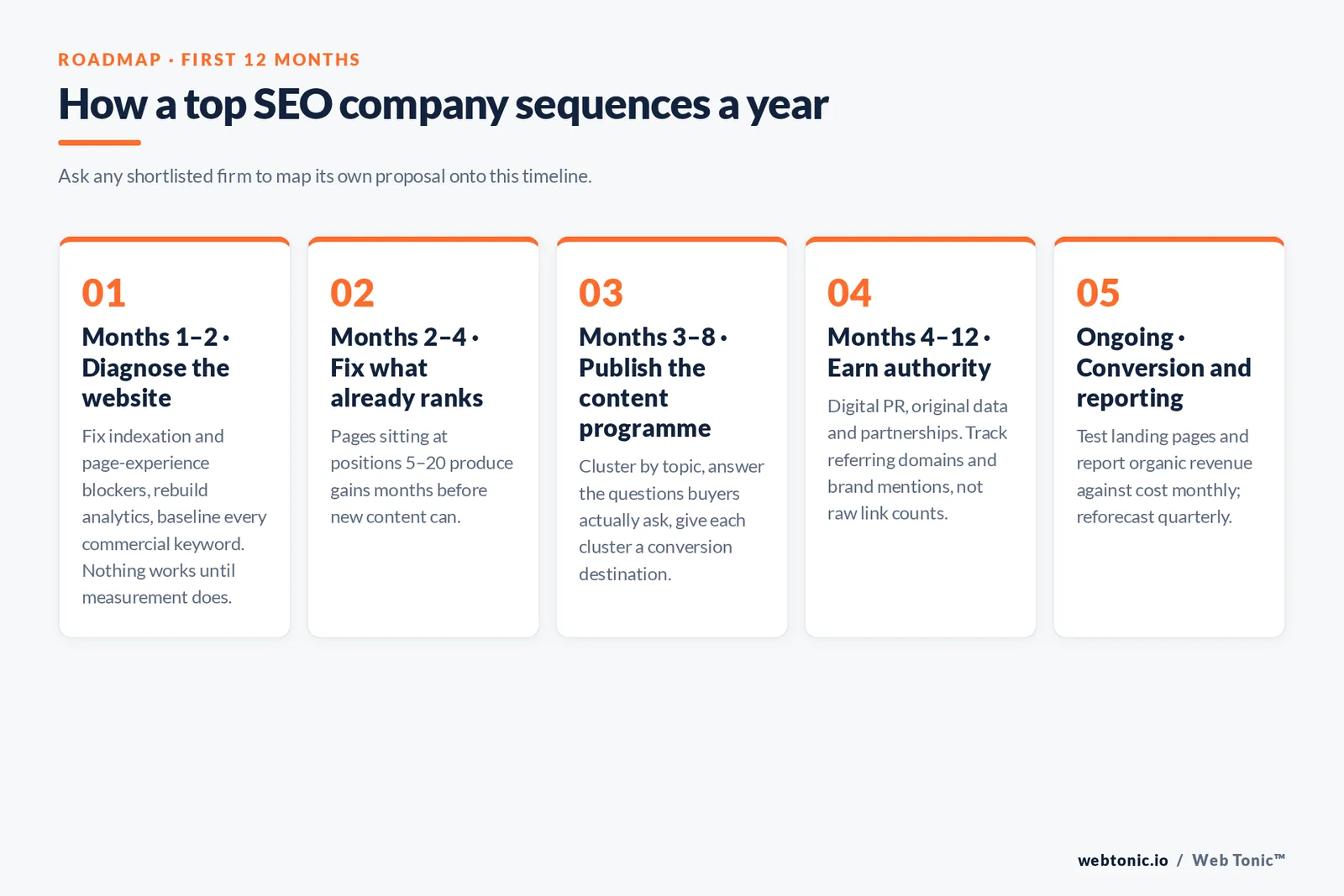
Great SEO agencies do not sell a bundle of tactics; they sell a sequence. Below is the approach the strongest firms follow, and the timeline you should expect a proposal to commit to.
Months 1–2: diagnose the website. Crawl the site, fix indexation and page experience blockers, rebuild analytics so organic traffic and revenue are trustworthy, and baseline every commercial keyword. Nothing else works until measurement does.
Months 2–4: fix what already ranks. The fastest performance gains in almost every account come from pages that sit at positions 5–20. On-page optimization, internal links and better search intent matching on those pages produce results months before new content can.
Months 3–8: publish the content programme. Cluster by topic, cover the questions your buyers actually ask, and give each cluster a conversion destination. This is where a content strategy either supports growth or becomes a cost centre.
Months 4–12: earn authority. Digital PR, original data and partnerships attract organic links that a link vendor cannot replicate. Track referring domains and brand mentions, not raw link counts.
Ongoing: conversion and reporting. Improve the on-site experience, test landing pages, and report organic revenue against cost every month. The best SEO firms reforecast quarterly instead of defending a plan that stopped working.
Ask any shortlisted company to map its own proposal onto that timeline. Firms with a real strategy will do it in ten minutes; firms selling packaged SEO services will resist, because the deliverables are fixed regardless of what your website needs. And treat the first quarter as a paid audition — the best partners expect to be judged on shipped work by month three, not on promised rankings in month twelve.
SEO company, in-house team, or full-service digital marketing agency?
There are three ways to buy search engine optimization, and the right answer depends on how much internal capacity you have.
Hire an SEO agency when you need execution across technical, content and links faster than you can recruit for it. Agencies average $3,209 per month, which is typically less than one mid-level hire, and they bring a bench of specialists plus tooling. The risk is attention: ask how many clients each strategist carries.
Build in-house when search is a permanent core channel and you can afford a strategist plus writers and developer time. The total cost usually clears $150,000 a year once tools are included, but institutional knowledge stays with your brand and iteration speed is unbeatable.
Choose a full-service digital marketing agency when organic search only makes sense alongside paid media, web design and creative — for example when an ecommerce shop needs SEO, Google Ads and a replatform in the same year. The upside is one accountable partner across channels; the risk is that SEO becomes the smallest line item on a media plan.
A useful hybrid many businesses land on: an in-house owner who controls priorities and reporting, and an agency or consultant supplying specialist capacity. It keeps strategy internal, buys deep skills on demand, and keeps the working relationship honest because someone on your side can evaluate the work.
Whichever route you take, insist on the same three artefacts every month: what was shipped, what it changed, and what happens next. Agencies that provide those three things are rarely the ones you need to replace a year later.
Red flags, and what they cost you
The failure modes in this market are consistent, and most of them are expensive to unwind.
| Red flag | Why it appears | Typical cost to fix |
|---|---|---|
| Guaranteed rankings | Sales pressure; no control over the algorithm | Wasted retainer plus 3–6 months lost |
| Bulk link packages | Cheap to deliver, easy to invoice | Disavow work and months of recovery |
| Mass unedited AI content | Margin engineering | Full content prune and rewrite |
| Agency-owned analytics | Retention lever | Loss of historical data at handover |
| Undisclosed subcontracting | Capacity gaps | Quality variance, no accountability |
| Reporting without conversions | Weak measurement setup | Rebuild tracking, re-baseline the programme |
Two related points. If an SEO company markets your business with testimonials or influencer content, the FTC endorsement guides apply to you as the advertiser, not just to them. And if you are a small business weighing whether to hire at all, the SBA's marketing and sales guidance is a sober starting point for setting a budget you can sustain for the full 6–12 month horizon SEO requires.
What the best SEO companies actually deliver
Scopes look identical on paper, so compare deliverables rather than service names. A complete search engine optimization programme covers six workstreams, and a top SEO company will tell you which two it is prioritising this quarter and why.
| Workstream | What good looks like | What weak SEO services look like | Reporting metric |
|---|---|---|---|
| Technical SEO | Crawl and indexation fixes shipped with your developers, Core Web Vitals monitored, structured data on every template | A 90-page audit PDF with no implementation | Indexed pages, crawl errors, page experience |
| Content strategy | Topic clusters mapped to buying stages, briefs built from search intent and expert input | Four generic blog posts a month by word count | Ranking pages, assisted conversions |
| On-page optimization | Titles, internal links and entity coverage revised on the pages that carry revenue | Bulk meta tag rewrites across the whole website | Click-through rate, position by page |
| Digital PR and link building | Earned coverage and data-led assets that attract organic links | Paid guest post packages at a fixed cost per link | Referring domains, brand mentions |
| Local SEO | Google Business Profile optimization, review velocity, consistent citations, distinct city pages | Duplicated location templates with a swapped city name | Map pack visibility, calls, direction requests |
| Measurement and CRO | Clean analytics, revenue attribution and conversion rate work on landing pages | Ranking screenshots emailed monthly | Organic revenue, cost per acquisition |
Notice the pattern: in every row the difference between the best SEO agencies and the rest is implementation. Advice is cheap; shipped work is what moves organic traffic. That is also why the best digital marketing partners insist on developer access, subject-matter interviews and a working reporting stack before they quote — without those inputs, no agency can be accountable for growth.
One more test of a real SEO company: ask what it will stop doing. A mature partner prunes low-performing content, kills pages that cannibalise each other, and reallocates budget away from tactics that stopped working. Firms whose scope only ever grows are selling activity, not performance.
Choosing by business model: ecommerce, local, B2B and enterprise
The right SEO company is decided by how your business makes money, not by a directory's top-10 list.
Ecommerce. An ecommerce SEO agency has to think like a merchandiser. Category architecture, faceted navigation, out-of-stock handling, review schema and product feed hygiene decide whether an online shop compounds or stalls. Ask any ecommerce specialist how it handles thin variant pages and seasonal demand before you look at its client logos — and whether it can connect organic search work to marketplace presence on channels like Amazon.
Local and multi-location. For a service business, the local SEO win is proximity plus proof: Google Business Profile optimization, a steady flow of genuine reviews, accurate citations and one substantive page per service and city. Local search is also the cheapest place to see fast results, which is why local retainers average $1,557 per month against $2,917 across the whole market.
B2B and lead generation. Volume is the wrong metric when a single client is worth six figures. The best B2B SEO companies build content for a buying committee, instrument lead quality back to the CRM, and accept a lower traffic target in exchange for pipeline. If a proposal talks about traffic growth without mentioning lead quality, it was written for a different business model.
Enterprise. At enterprise scale the bottleneck is rarely strategy — it is deployment across templates, markets and stakeholders. Enterprise SEO services should include internationalisation, log-file analysis, migration governance and a change-management approach that survives your release cycle. Worldwide-facing providers average $3,474 per month and the top tier commands $25,000+, so define success metrics before signing anything.
Two cross-cutting notes. Reviews and case studies help, but read them for mechanism rather than praise: a testimonial that names the tactic and the timeline is evidence, while one that says the team was a pleasure to work with is decoration. And whatever the category, the agency you hire should be able to explain its work to your finance lead in one page — the clearest signal of a partner that understands business success rather than search rankings.
Do the best SEO companies have to be local to you?
Almost never. Search engine optimization is remote-native work, and the top SEO companies for a New York fintech may sit in Texas, Ohio or California. City-level searches like "SEO company Los Angeles" or "best SEO agency Philadelphia" mostly reflect buyer habit rather than a technical requirement.
There are three exceptions where geography genuinely helps. If your revenue depends on foot traffic, a partner who understands the local market and can visit the shop will get better photography, reviews and Google Business Profile results. If you operate in a regulated sector, being in the same jurisdiction speeds up legal review. And if your team needs on-site workshops to adopt the strategy, time zone overlap matters more than address.
Otherwise, judge providers on the same criteria nationwide: implementation record, category fit, measurement discipline and price. Note that worldwide-facing firms average $3,474 per month versus $1,557 for locally focused providers, so a national brand hiring a local specialist on a local budget is usually mispriced work. And in the U.S. and Canada, where 79.1% of providers charge at least $1,001 per month, an unusually cheap "local" quote is often outsourced anyway — ask directly who does the work and where.
The practical shortlist rule: search the category you compete in, not the city you live in. Look at which agencies' clients rank for the commercial terms in your niche, then check whether those results held for more than a year. Sustained organic performance in your own market is the closest thing to a verified review this industry offers.
How to run a 3-week selection process
Most bad hires come from compressed decisions. Three weeks is enough.
Week 1 — define the job. Write down the commercial outcome, the constraints (developer time, brand rules, legal review) and the one metric that decides renewal. Shortlist five firms by category, not by directory rank.
Week 2 — paid discovery. Buy a small scoped audit from your top two. Paying $1,500–$5,000 for real analysis is the cheapest due diligence available, and the deliverable tells you more than any pitch: does it find the technical debt, does it read your market, does it prioritise by revenue?
Week 3 — reference and contract. Speak to two current clients and one former client. Check the scope covers technical SEO, content, links, local search where relevant, and reporting. Confirm asset ownership and a sane notice period.
If you would rather compare an in-house build against an agency, our services overview, growth marketing and data intelligence pages set out how the disciplines fit together, and the Web Tonic blog has the deeper method write-ups.
What "best" means in 2026: AI search changed the brief
Search behaviour moved before most agency scopes did. Google still holds 91.25% of worldwide search share against Bing's 4.68% per Statcounter's June 2026 data, but AI answer surfaces and assistants now intercept a growing share of informational queries, and DataReportal's Digital 2026 report puts monthly AI users above 1 billion people.
That changes what a top SEO company must be able to do. Three additions to any 2026 scope: entity and brand-mention work so models can cite you; structured data and clean HTML so machines can parse the page, which is the practical value of guides like Yoast's SEO primer; and conversion depth, because fewer, higher-intent visits make on-site conversion rate the deciding variable. Market-level context on where budgets are moving is tracked in Statista's internet marketing topic hub.
Firms still selling a 2019 playbook of 20 blog posts and 15 links a month are not the best at anything. Ask specifically how the last two algorithm and AI-surface shifts changed their delivery — the answer separates practitioners from packagers. When you are ready to compare a scope against ours, talk to our team.
FAQ
How much should I pay an SEO company per month?
For most small and mid-sized businesses, $1,500–$5,000 per month buys a real programme; the polled average across all providers is $2,917 and local-only work averages $1,557. Below roughly $1,000/month you are usually buying a few hours of templated work, not strategy.
Are agencies better than freelancers or consultants?
They are different products. Agencies average $3,209/month and give you execution capacity across content, technical and links. Consultants average $3,250/month for senior direction without delivery. Freelancers average $1,348/month and work best when you already own the strategy.
How long before SEO produces results?
Expect early technical and content wins in 1–3 months, meaningful traffic movement in 4–6 months and compounding revenue effects from 6–12 months. Anyone promising ranked results in 30 days is describing luck or a paid channel.
Can an SEO company guarantee first-page rankings?
No. Rankings are set by Google's systems, not by any vendor, and Google's own documentation is explicit that no one can guarantee placement. A guarantee is a marketing device, and it is the clearest reason to end a conversation.
How do I check an SEO company's claims?
Ask for two client sites you can inspect yourself, then verify the claimed growth independently in a third-party tool and in the client's own words on a reference call. Cross-check the firm's published thinking against primary sources like Google Search Central before you sign.
Sources: Ahrefs SEO pricing survey (439 providers) · Semrush SEO pricing guide · Google Search Central (SEO Starter Guide, Search Essentials, Helpful Content guidance) · Statcounter Global Stats, search engine market share, June 2026 · DataReportal Digital 2026 Global Overview Report · Search Engine Land SEO library · Yoast SEO primer · Statista internet marketing topic hub · FTC endorsement guides · U.S. Small Business Administration marketing guidance.