Table of contents
How we vet every listicle
Every agency featured on Web Tonic passes our 84-point editorial review before a single listicle goes live. This is how we vet each pick:
Verified client outcomes: We require real case studies with measurable KPIs — revenue, ROAS, CPA, retention — tied to the exact category being ranked. No cherry-picked wins, no unverifiable numbers.
Independent reputation: We cross-check Clutch, Google, G2, and Trustpilot ratings, and screen for review-bombing or suspicious patterns. Only operators with a consistent, verifiable track record make the cut.
Beyond that, every listing goes through a quarterly re-audit. We check 84 criteria across 6 pillars to make sure it still holds up — here are some of the checks we run:
The best email marketing company for you is the one whose pricing model, automation depth and deliverability support match your list size and business model — not the one at the top of a ranked list. Below, 12 platforms and service types are compared by job, price and free plan.
Key Takeaways
- 12 platforms and 3 service models are compared here by the job they do best, not by an invented score.
- Entry paid pricing across the major tools clusters between about $11 and $25 per month for small lists, verified on vendor pricing pages in August 2026.
- According to Mailchimp’s benchmark data, all-industry email averages sit near a 35.63% open rate, 2.62% click rate and 0.22% unsubscribe rate.
- In Litmus’s State of Email research, 35% of marketing leaders report $10–$36 back per $1 spent on email and 30% report $36–$50.
- Rule 1 — pick on billing basis first: per-contact, per-send and per-1,000-emails models can differ by 10x at the same volume.
What “best email marketing company” should mean for your business
Every “best email marketing services” list ranks the same brands in a different order, because the ranking depends entirely on whose problem is being solved. A 400-contact consultancy, a Shopify store sending abandoned-cart flows and a SaaS company routing product emails through an API have almost nothing in common except the word email. Score the categories below against your own situation before you shortlist anything.
| Evaluation criterion | What to check | Why it decides the winner | Weight |
|---|---|---|---|
| Billing basis | Per contact, per send, per 1,000 emails or flat seat fee | Limit 1: the same 50,000 sends can cost $8 or $300 depending on the model | High |
| Automation depth | Multi-trigger workflows, branching, split tests inside a flow | Decides whether revenue runs on autopilot or on manual campaigns | High |
| Deliverability tooling | Dedicated IP option, authentication setup, bounce and spam dashboards | Inbox placement drives more revenue than subject-line tweaks | High |
| Editor and templates | Drag-and-drop email templates, saved blocks, mobile preview | Determines how fast a small team can ship weekly emails | Medium |
| Data and integrations | Ecommerce sync, CRM, API, webhooks, SMS | Bad data limits every segment you will ever build | High |
| Support model | Chat, phone, dedicated manager thresholds | Trap 2: support is often gated behind $400+/month spend | Medium |
| Free plan and trial | Contact caps, send caps, feature locks | Lets you test the real workflow before committing budget | Medium |
| Compliance features | Consent capture, preference centre, one-click unsubscribe | A legal requirement, not a nice-to-have | High |
The 12 best email marketing platforms, grouped by the job they do best
Group the market by job and the shortlist writes itself. Each platform below is placed where its own product positioning and pricing model point, with the free plan and paid entry point taken from the vendor’s live pricing page.
| Platform | Best-fit job | Free plan | Paid entry point (checked Aug 2026) |
|---|---|---|---|
| Brevo | Multi-channel marketing (email + SMS + CRM) on a send-based model | Yes, with a daily send cap | Paid Starter tiers priced by monthly email volume |
| Mailchimp | Brand-led campaigns with the widest template and integration library | Yes, limited | From $20/month after a 14-day trial |
| MailerLite | Clean, cheap sending for creators, newsletters and small teams | Yes | Comfort from $12/month; Power from $25/month |
| GetResponse | List-size-bracketed plans with unlimited messages and funnels | Trial-based | From $19/month for up to 1,000 subscribers |
| Omnisend | Ecommerce automation with email + SMS in one flow builder | Yes, $0/month tier | Standard from $11.20/month; Pro from $41.30/month |
| Klaviyo | Data-heavy ecommerce segmentation and predictive analytics | Yes — 250 profiles, 500 sends/month | Usage-based, scaling with active profiles |
| Amazon SES | Developer-owned transactional and high-volume sending | AWS free-tier credit for new accounts | $0.16 per 1,000 emails on Essentials |
| Moosend | Budget automation for small lists that still need branching flows | Trial-based | Published by list size on the vendor site |
| Constant Contact | Local and non-profit senders that want phone support and events | Trial-based | Tiered by contact count |
| Campaign Monitor | Design-first campaigns and agency client accounts | Free to build and test | Tiered, with add-ons from $10/month |
| ActiveCampaign | CRM-plus-automation for considered B2B sales cycles | Trial-based | Tiered by contacts and features |
| Zoho Campaigns | Companies already standardised on the Zoho suite | Yes, limited | Low per-month tiers by subscriber count |
Three of those — Klaviyo, Omnisend and Amazon SES — are not really competitors to the others. They serve ecommerce data, ecommerce SMS and raw sending infrastructure respectively. Comparing them head-to-head with Mailchimp is the single most common mistake in these buying decisions.
Pricing benchmarks: what email marketing software actually costs
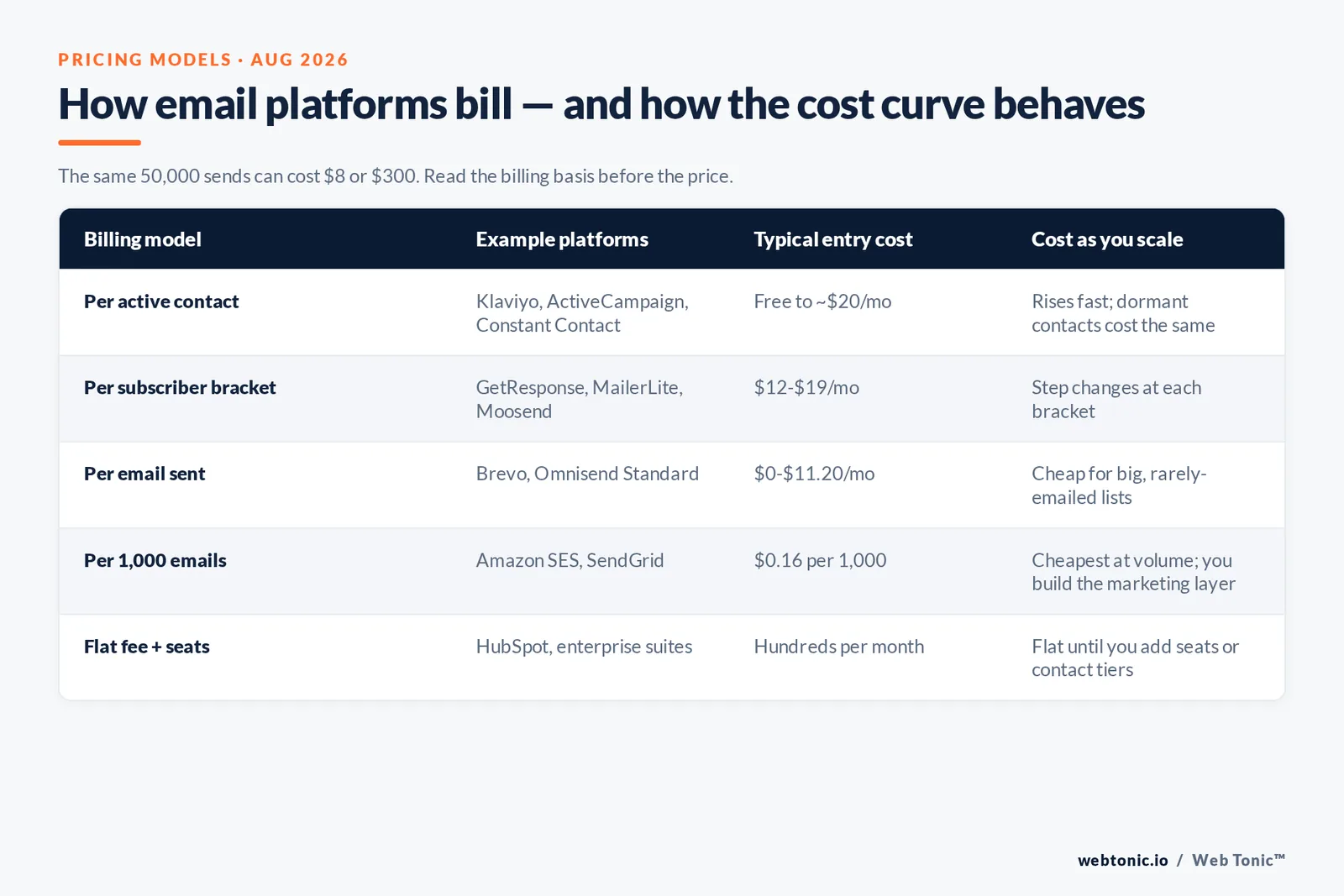
Entry prices are the marketing number. What matters is the cost curve as your list and send volume grow, which is why the billing basis column below is the one to read first.
| Billing model | Example platforms | Typical entry cost | Cost behaviour as you scale |
|---|---|---|---|
| Per active contact | Klaviyo, ActiveCampaign, Constant Contact | Free tier to ~$20/month | Rises fast: dormant contacts cost the same as buyers |
| Per subscriber bracket | GetResponse, MailerLite, Moosend | $12–$19/month | Step changes at each bracket, predictable in between |
| Per email sent | Brevo, Omnisend Standard | $0–$11.20/month | Cheap for big lists that are emailed occasionally |
| Per 1,000 emails (infrastructure) | Amazon SES, SendGrid | $0.16 per 1,000 emails | Cheapest at volume, but you build the marketing layer |
| Flat platform fee + seats | HubSpot, enterprise suites | Hundreds per month | Flat until you add seats or contact tiers |
Limit 2: a 40,000-contact list emailed twice a month costs roughly $13 in raw sending on Amazon SES at $0.16 per 1,000, and several hundred dollars a month on a per-contact platform. You are paying the difference for templates, automation, reporting and support — which is usually worth it, but should be a decision rather than an accident.
Free email marketing plans compared
The best free email marketing plan is the one whose cap you will hit last. Caps come in three flavours: contacts, monthly sends and locked features — and most generous free plan claims only look generous on one of the three.
| Free plan | Contact or profile cap | Send cap | Main feature lock |
|---|---|---|---|
| Klaviyo free | 250 active profiles | 500 email sends/month plus $5 of mobile messages | Volume, not features |
| Omnisend free | Starter-level contacts | Limited monthly sends at $0/month | Advanced automation and SMS volume |
| Brevo free | Unlimited contact storage | Daily send cap | Branding removal and advanced reporting |
| MailerLite free | Small subscriber tier | Monthly send cap | Some templates, seats and dedicated IP |
| Mailchimp free | Small audience tier | Low monthly send cap | Automation depth and support level |
| Zoho Campaigns free | Small subscriber tier | Monthly send cap | Automation and advanced segmentation |
Rule 2 — test the workflow, not the send: build one real automation, one signup form and one segment on the free plan. If you cannot reproduce your actual customer journey inside the free tier, the paid tier will not fix a structural gap.
Which email marketing service fits which business type
This is the shortcut most buyers want: skip the feature matrix and start from your business model. The recommendations below follow directly from the billing basis and automation depth each platform is built around.
| Business type | Primary email job | Platform shape to shortlist | Budget to expect |
|---|---|---|---|
| Ecommerce, under $1M revenue | Cart, browse and post-purchase flows | Ecommerce-native automation (Omnisend, Klaviyo) | $11–$60/month |
| Ecommerce, scaling past $1M | Segmented lifecycle plus SMS | Profile-based platform with predictive data | $150–$1,000+/month |
| Local service business | Reactivation, reviews, seasonal offers | Contact-tiered tool with phone support | $20–$80/month |
| B2B services and consultancies | Nurture sequences tied to a CRM | CRM-plus-automation platform | $50–$300/month |
| Creator or newsletter business | Weekly send, paid subscriptions | Low-cost subscriber-bracket tool | $12–$25/month |
| Non-profit | Donor appeals and event invitations | Tool with a non-profit discount (MailerLite offers 30% off) | $0–$40/month |
| SaaS or app | Transactional plus onboarding lifecycle | API sending layer plus a light marketing tool | $0.16 per 1,000 plus tool fee |
| Enterprise or multi-brand | Governance, permissions, multi-region | Suite platform with account hierarchy | Custom contract |
Software, agency or in-house: the three service models
“Email marketing company” is used for two different things: the software vendor and the team that runs the programme. Most underperforming email channels have the software solved and the operating model unsolved.
| Service model | What you buy | Monthly cost shape | Best when |
|---|---|---|---|
| Self-serve software | The platform only | $12–$300/month | You have someone who owns email weekly |
| Platform + managed service | Software plus strategy and production | Software fee plus retainer | Email drives revenue but nobody owns it |
| Full-service agency | Strategy, design, build, reporting | Retainer, often $1,500–$8,000/month | You need lifecycle flows built once, properly |
| Freelance operator | Production capacity only | Hourly or per-campaign | Strategy exists, execution is the bottleneck |
| In-house hire | A dedicated lifecycle marketer | Salary plus tooling | Email is a top-three revenue channel |
Web Tonic sits in the second and third rows: our growth marketing team runs lifecycle programmes on whichever platform a client already owns, with performance creative handling template and campaign design and data intelligence wiring the reporting. Full service list here, or start a conversation from the contact page.
Deliverability and compliance: the part no platform does for you
Bulk senders have been under stricter mailbox-provider rules since 2024. Authentication, spam-rate ceilings and one-click unsubscribe are now table stakes, and your platform can only help if the configuration is right on your side.
| Requirement | What it means in practice | Where it is defined | Failure symptom |
|---|---|---|---|
| SPF and DKIM on the sending domain | Authenticate every message you send | Google’s sender guidelines | Bulk mail rejected or bulked |
| DMARC record published | Tell providers what to do with spoofed mail | Google’s sender guidelines | Domain spoofing, reputation loss |
| Spam rate kept low | Stay well under the 0.3% reported-spam threshold | Google’s sender guidelines | Sudden delivery collapse |
| One-click unsubscribe header | Machine-readable opt-out in the message | RFC 8058 one-click unsubscribe | Complaints instead of unsubscribes |
| Accurate headers and honest subject lines | No deceptive From, To or subject fields | FTC CAN-SPAM compliance guide | Regulatory exposure |
| Opt-out honoured within 10 business days | Process every request promptly | FTC CAN-SPAM compliance guide | Statutory penalties |
| Physical postal address in the email | Include a valid address in every send | FTC CAN-SPAM compliance guide | Non-compliant campaigns |
| Consent records for EU contacts | Store when and how consent was given | GDPR-aligned consent capture | Unlawful processing risk |
Trap 3: switching platforms resets your sending reputation on the new provider’s IP pool. Warm up over 2–4 weeks, starting with your most engaged 10% of contacts, before you migrate a full-list campaign.
The benchmarks that tell you whether your platform is the problem
Before you blame the software, check your numbers against published averages. Per Mailchimp’s benchmark data, these are the reference points by sector.
| Audience type | Open rate | Click rate | Unsubscribe rate |
|---|---|---|---|
| All users | 35.63% | 2.62% | 0.22% |
| Ecommerce | 29.19% | Below the all-user average | Around the all-user average |
| Business and finance | 31.35% | Around the all-user average | Low |
| Education and training | 35.64% | Above average | Low |
| Non-profit | Above 40% | Above average | Lowest of the groups |
On the money side, Litmus reports that 35% of marketing leaders see $10–$36 per $1 spent, 30% see $36–$50 and 5% see more than $50 — while 21% still do not measure email ROI at all, down from 36% in 2023. If you are in that 21%, no platform change will feel like an improvement, because nothing will be measurable.
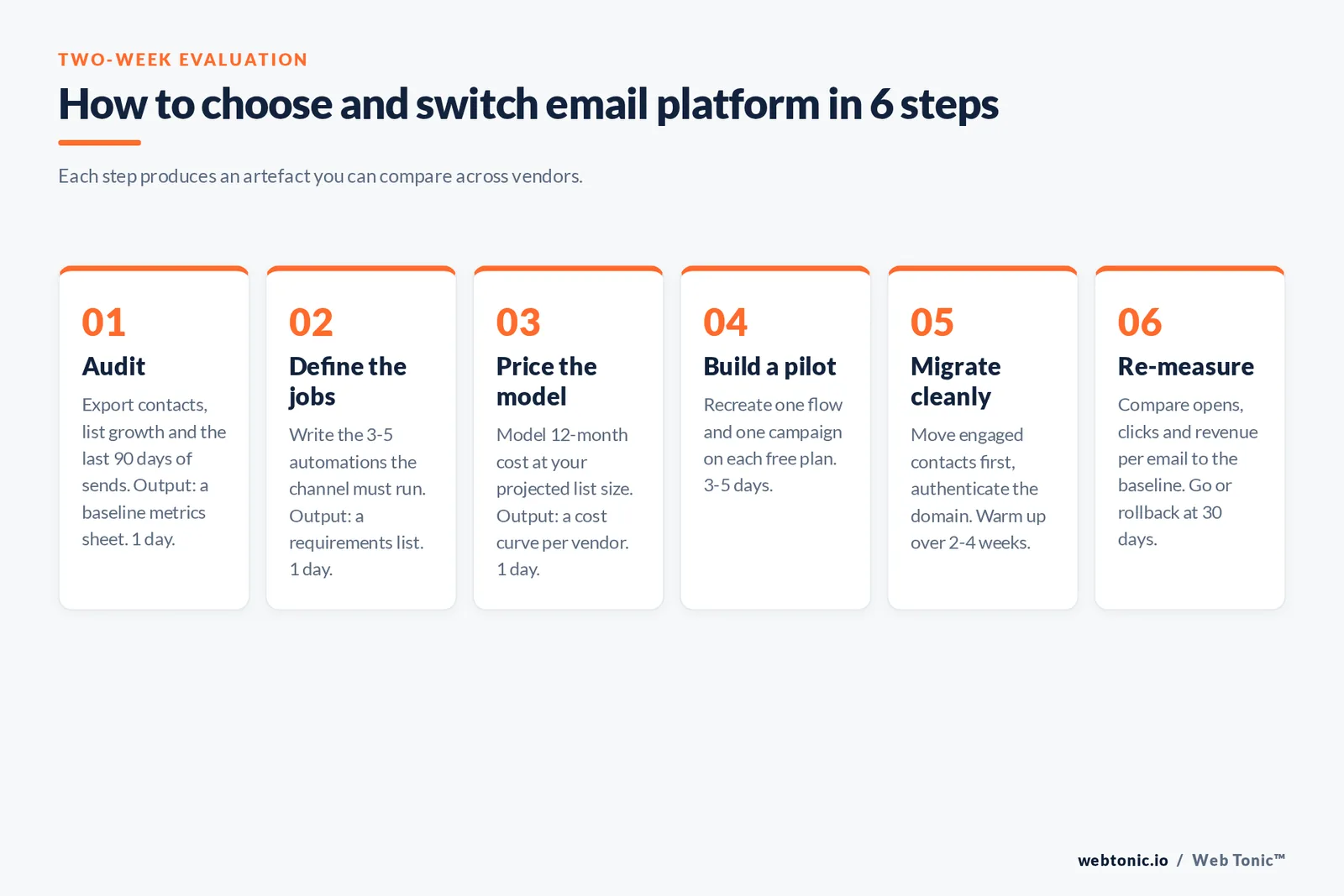
How to choose and switch in 6 steps
Run this as a two-week evaluation rather than a demo tour. Each step produces an artefact you can compare across vendors.
| Step | Action | Output | Time |
|---|---|---|---|
| Step 1 — Audit | Export contacts, list growth and last 90 days of sends | A baseline metrics sheet | 1 day |
| Step 2 — Define the jobs | Write the 3–5 automations the channel must run | A requirements list | 1 day |
| Step 3 — Price the model | Model 12-month cost at your projected list size | A cost curve per vendor | 1 day |
| Step 4 — Build a pilot | Recreate one flow and one campaign on each free plan | A hands-on comparison | 3–5 days |
| Step 5 — Migrate cleanly | Move engaged contacts first, authenticate the domain | A warmed sending setup | 2–4 weeks |
| Step 6 — Re-measure | Compare opens, clicks and revenue per email to the baseline | A go or rollback decision | 30 days |
Full review notes: what each free plan includes
Here is the review detail buyers actually want: what the free plan includes, whether there is a day free trial on paid plans, how the drag drop editor behaves and what support looks like for free users. Brevo, MailerLite and Omnisend are the three tools whose free plan includes real automation; the rest gate automation behind paid plans.
| Email marketing service | Free plan includes | Free trial on paid plans | Support for free users |
|---|---|---|---|
| Brevo | Unlimited contacts with a daily emails cap, drag drop editor, basic automation | No trial needed — free plan is permanent | Email support |
| MailerLite | Subscribers and emails month caps, drag drop email templates, forms | 30-day access to premium features | Email support, chat on paid plans |
| Omnisend | A $0/month tier with email plus a small SMS allowance | No separate trial | 24/7 chat, including free users |
| Klaviyo | 250 profiles, 500 emails month, full feature access | No separate trial | Community and docs, paid support above tiers |
| Mailchimp | A small contacts tier with limited monthly emails | 14-day free trial on paid plans | Email support for the first 30 days |
| GetResponse | Free plan for a small list with a landing page | 30-day trial of paid plans | 24/7 chat on paid plans |
| Zoho Campaigns | Low subscribers and emails month allowance | Trial on paid plans | Email support |
| Campaign Monitor | Build and preview campaigns free, pay to send | Free account, no send | Email support |
Rule 3 — read the free plan limits as a pair: a generous free plan on contacts with a tight emails-per-month cap suits a large dormant list, while the reverse suits a small list you email daily. Brevo counts daily emails, MailerLite and Mailchimp count subscribers, and Klaviyo counts active profiles.
Automation, editor and data features compared
Every platform on this list markets “marketing automation”. The difference is how many triggers a workflow can listen to, whether the drag drop editor supports saved brand blocks, and how much customer data the segment builder can reach.
| Capability | Entry-level tools (MailerLite, Moosend, Zoho) | Mid-market platforms (Brevo, GetResponse, Omnisend) | Data-led platforms (Klaviyo, ActiveCampaign) |
|---|---|---|---|
| Automation triggers | Signup, date, link click | Multiple automation triggers including ecommerce events | Product, profile, prediction and API events |
| Workflow branching | Simple splits | Conditional branches with waits | Multi-branch with in-flow split tests |
| Drag drop editor | Drag drop email templates, limited saved blocks | Drag drop editor with brand blocks | Editor plus dynamic content blocks |
| Segmentation data | List fields and tags | Behaviour plus purchase data | Full event history and predictive scores |
| SMS and channels | Rarely included | Email plus SMS, from about $0.007 per message | Email, SMS and push in one platform |
| Reporting | Opens, clicks, unsubscribes | Revenue per campaign and flow | Cohort, attribution and forecast reporting |
| API and webhooks | Basic API | Full API and webhooks | Full API, event streaming, warehouse sync |
Limit 3: automation depth is the one feature you cannot buy your way out of later. Migrating 5 flows and 20 segments between platforms is a two-to-three week project, so choose the automation ceiling you will need in 18 months, not the one you need this quarter.
Support and services: what you get at each price band
Support is where free plans and cheap paid plans differ most, and it is the most common reason companies switch email marketing platforms without changing anything else.
| Monthly spend band | Support you can expect | Services included | Who it suits |
|---|---|---|---|
| $0 (free plan) | Docs, community, email support with slow SLAs | Self-serve onboarding only | Testing and validation |
| $11–$25 | Email and often chat support | Templates and help centre | Small lists and creators |
| $50–$150 | Priority chat, onboarding call | Migration help on request | Growing ecommerce and B2B |
| $400+ | Named contact — Omnisend assigns an account expert above $400/month | Strategy reviews and deliverability checks | Scaling programmes |
| Custom contracts | Dedicated success manager — Mailchimp includes it on plans above $299/month | Managed services and SLAs | Enterprise and multi-brand |
If your programme sits in the $11–$150 bands but needs strategy, the gap is usually filled by an agency rather than by upgrading the software tier. That is the honest reason both models exist.
How contacts, subscribers and emails per month are counted
Two platforms can quote the same price for the same list and bill you differently, because the unit differs. This table decodes the units used across the best email marketing services.
| Billing unit | How it is counted | Platforms using it | Who benefits |
|---|---|---|---|
| Subscribers | Every contact on any list, active or not | MailerLite, GetResponse, Moosend | Small, clean lists |
| Active profiles | Contacts you emailed or tracked in the period | Klaviyo | Lists with heavy seasonality |
| Contacts stored | Unlimited storage, paid sending | Brevo | Large, rarely-emailed lists |
| Emails per month | Total sends across campaigns and automation | Brevo, Omnisend Standard | Occasional senders |
| Emails per 1,000 | Raw sending volume at $0.16 per 1,000 | Amazon SES, SendGrid | Developer-owned volume |
| Seats plus contacts | Users on the platform plus list size | HubSpot, enterprise suites | Large marketing teams |
Email content types that earn their send
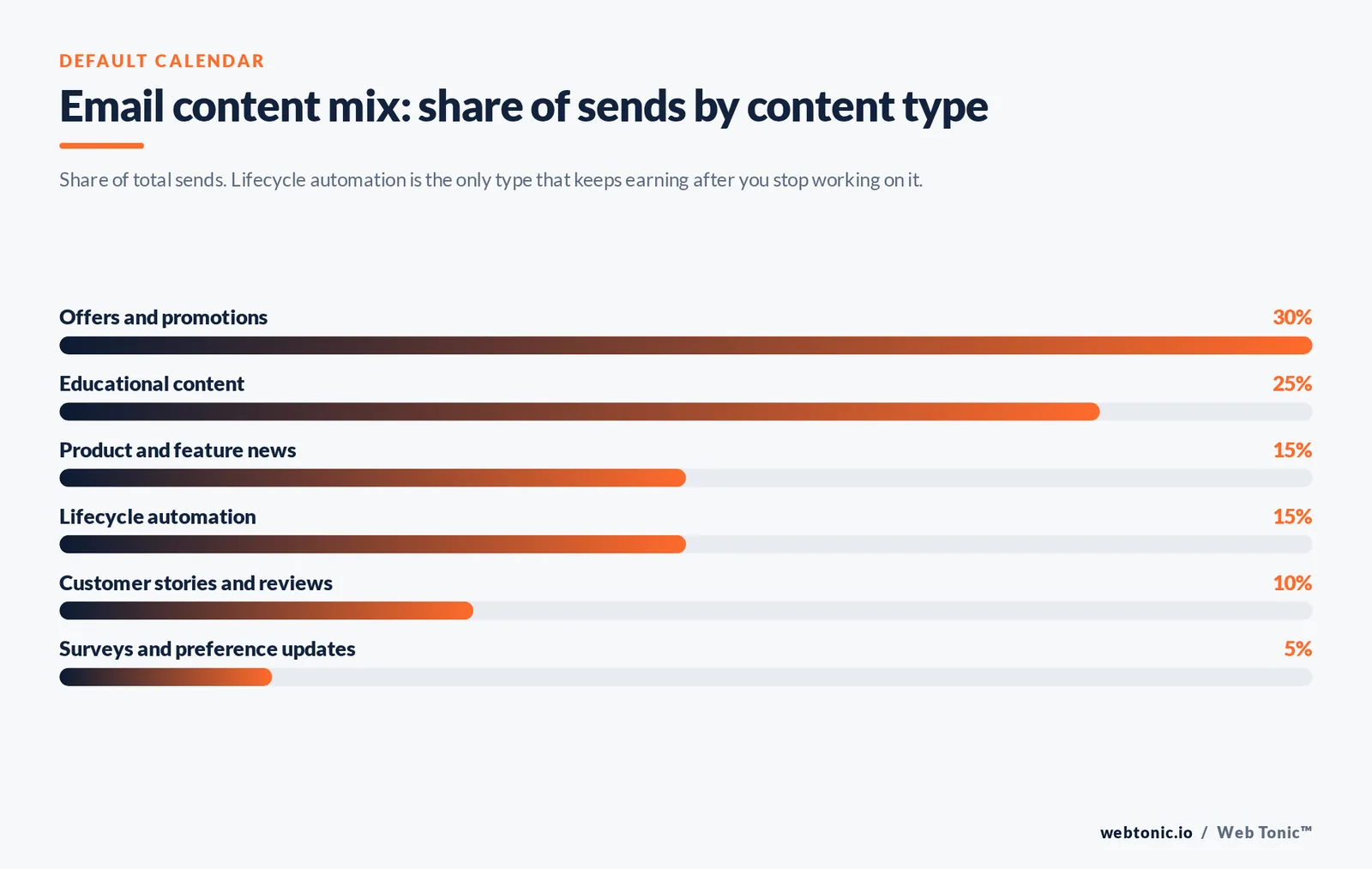
The best email marketing tools cannot rescue weak content. Businesses that review their content mix quarterly — offers, education, product news and customer stories — hold attention far longer than senders who mail offers only. Use this mix as your default calendar.
| Content type | Share of sends | What it does for customers | Design and time cost |
|---|---|---|---|
| Offers and promotions | 30% | Drives immediate sales from ready buyers | Low — reuse one template design |
| Educational content | 25% | Builds trust with users who are still researching | Medium — writing time dominates |
| Product and feature news | 15% | Reactivates lapsed customers | Low with saved blocks in the editor |
| Customer stories and reviews | 10% | Removes doubt before a purchase | Medium — needs interviews |
| Lifecycle automation | 15% | Welcome, cart and post-purchase advanced flows | One-time build, then evergreen |
| Surveys and preference updates | 5% | Improves segmentation data for every future send | Low |
Rule 4 — automate the 15% first. Lifecycle automation is the only content type that keeps producing revenue after you stop working on it, which is why ecommerce businesses see the fastest payback from platforms with advanced segmentation.
Where these tools sit in your wider digital marketing stack
Email rarely lives alone. Several of these platforms now bundle a website or landing page builder, a CRM and sales pipeline, or SMS — which changes the real cost comparison against buying separate tools.
| Platform | Extra tools bundled | Replaces | Watch out for |
|---|---|---|---|
| Brevo | CRM, SMS, chat, transactional sending | A separate CRM for small sales teams | Feature depth vs a dedicated CRM |
| GetResponse | Website and landing page builder, webinars, funnels | A basic website builder subscription | Design flexibility limits |
| HubSpot | Full CRM, sales, service and content hubs | Several standalone tools at once | Cost scales quickly with contacts and seats |
| Klaviyo | Reviews, SMS, advanced segmentation and CDP-style profiles | A separate customer data tool | Per-profile billing on large lists |
| Omnisend | SMS, push, popups and forms | A separate popup and SMS tool | Ecommerce focus only |
| Moosend | Landing pages and subscription forms | A light page builder | Smaller integration library |
| Mailchimp | Websites, stores, digital ads, appointments | Entry-level ad and site tools | Best-of-breed depth per tool |
Trap 8 — bundle maths: a bundled builder or CRM only saves money if your team actually retires the tool it replaces. Otherwise you are paying twice and reviewing two sets of customer data.
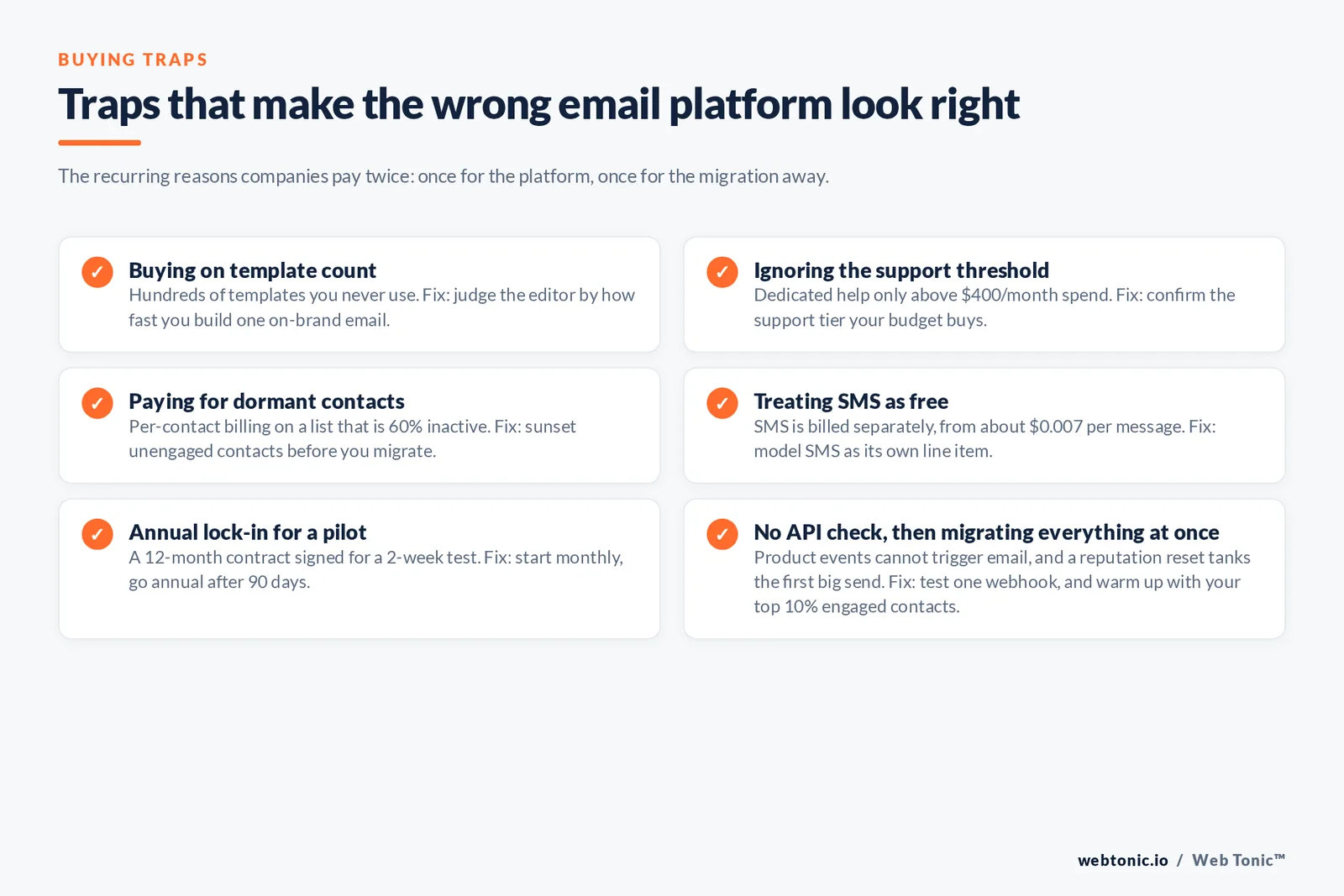
7 traps that make the wrong platform look like the right one
These are the recurring reasons companies pay twice: once for the platform, once for the migration away from it.
| Trap | How it shows up | The fix |
|---|---|---|
| Trap 1 — Buying on template count | A library of hundreds of email templates that you never use | Judge the editor by how fast you build one on-brand email |
| Trap 2 — Ignoring the support threshold | Dedicated help only above $400/month spend | Confirm the support tier your budget actually buys |
| Trap 3 — Paying for dormant contacts | Per-contact billing on a list with 60% inactives | Sunset unengaged contacts before you migrate |
| Trap 4 — Treating SMS as free | SMS billed separately, from about $0.007 per message | Model SMS volume as its own line item |
| Trap 5 — Annual lock-in for a pilot | A 12-month contract signed for a 2-week test | Start monthly, switch to annual after 90 days |
| Trap 6 — No API check | Product events cannot trigger email | Test one webhook before you commit |
| Trap 7 — Migrating everything at once | Reputation reset tanks the first big send | Warm up with your top 10% engaged contacts |
FAQ
Which is the best email marketing company overall?
There is no single winner. For ecommerce automation, Klaviyo and Omnisend lead on data and flow depth; for low-cost sending, MailerLite and Brevo win; for developer-owned volume, Amazon SES is the cheapest at $0.16 per 1,000 emails; for brand-led campaigns with the widest integrations, Mailchimp remains the default. Pick by billing model and automation need.
What is the best free email marketing service?
Brevo’s free plan is the most generous on contact storage because it bills by sends, while Klaviyo’s free tier gives full-feature access to 250 profiles and 500 email sends per month. If your list is large but rarely emailed, a send-based free plan lasts longer than a contact-based one.
How much should email marketing cost per month?
Small lists run between about $11 and $25 per month on paid entry plans. Mid-market programmes with automation and SMS typically land at $150 to $1,000 per month, and a fully managed agency programme is usually a $1,500 to $8,000 monthly retainer on top of the software fee.
Are email marketing agencies worth it over software alone?
They are when nobody owns the channel weekly. Software solves capability, not consistency. With 35% of marketing leaders reporting $10–$36 back per $1 spent, an unowned email programme is usually the highest-return gap in a marketing budget.
Does switching email platforms hurt deliverability?
Temporarily, yes. You inherit a new IP pool and your sending history does not transfer. Re-authenticate the domain with SPF, DKIM and DMARC, then warm up over two to four weeks starting with your most engaged contacts, keeping reported spam well under the 0.3% threshold.
Sources
Mailchimp — Email Marketing Benchmarks and Statistics by Industry; Mailchimp Pricing; Brevo Pricing; MailerLite Pricing; GetResponse Pricing; Omnisend Pricing; Klaviyo Pricing; Amazon SES Pricing; Litmus — Email Marketing ROI (State of Email 2025); Google Workspace Admin Help — Email sender guidelines; IETF RFC 8058 — One-Click Unsubscribe; US Federal Trade Commission — CAN-SPAM Act Compliance Guide for Business. All vendor pricing checked August 2026.