Table of contents
How we vet every listicle
Every agency featured on Web Tonic passes our 84-point editorial review before a single listicle goes live. This is how we vet each pick:
Verified client outcomes: We require real case studies with measurable KPIs — revenue, ROAS, CPA, retention — tied to the exact category being ranked. No cherry-picked wins, no unverifiable numbers.
Independent reputation: We cross-check Clutch, Google, G2, and Trustpilot ratings, and screen for review-bombing or suspicious patterns. Only operators with a consistent, verifiable track record make the cut.
Beyond that, every listing goes through a quarterly re-audit. We check 84 criteria across 6 pillars to make sure it still holds up — here are some of the checks we run:
A custom web app development tool is software a team buys rather than builds to design, ship and run a bespoke application. The category covers deployment platforms that turn code into a live app, backend and managed database services that provide storage and server logic without running a data centre, low-code and internal-tool builders that assemble software from visual components, authentication services that handle login and permissions, and AI-assisted coding environments that speed up writing the code itself.

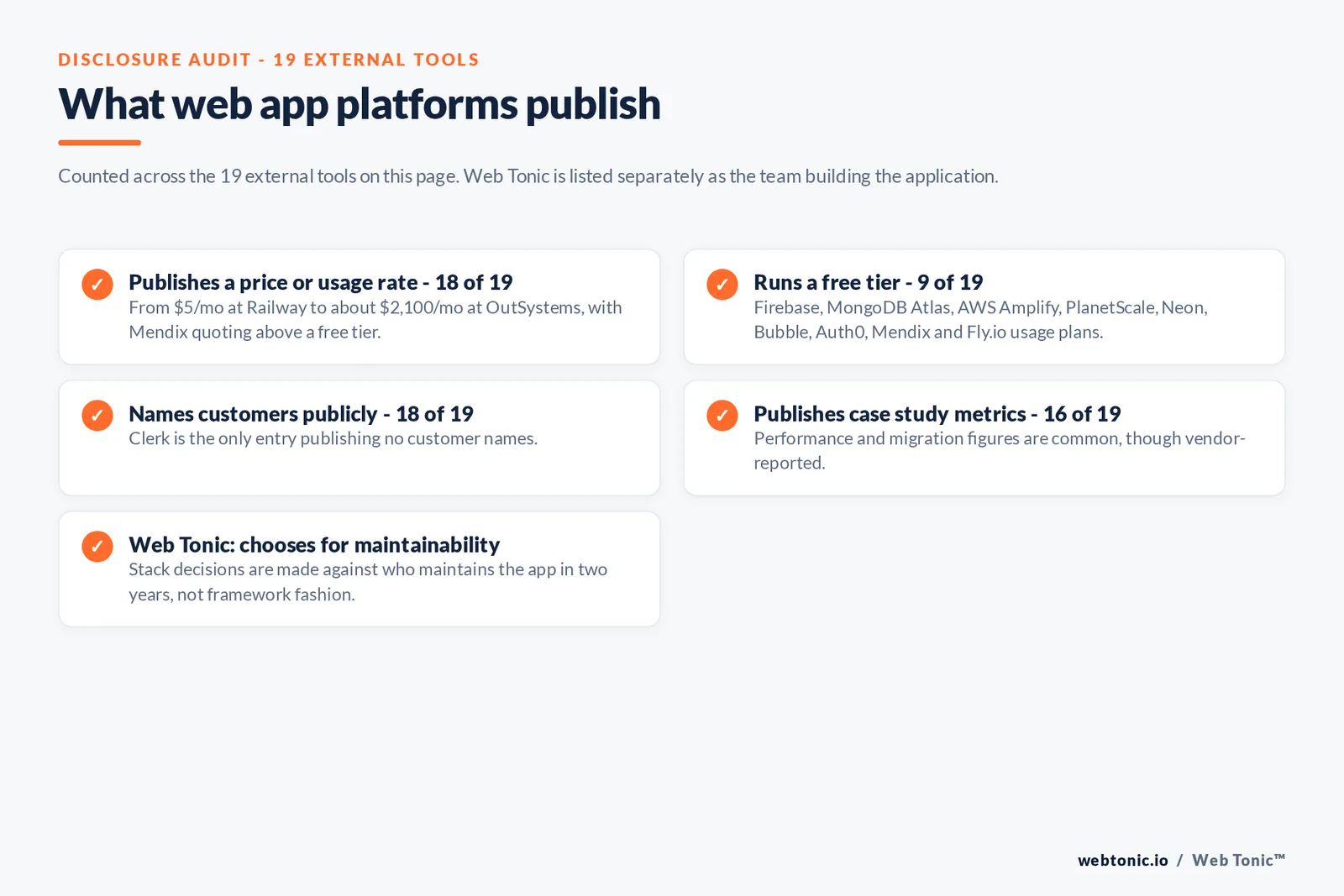
We compared 20 entries on published pricing, the layer each occupies and who maintains the result. Eighteen of the 19 external tools publish a starting price or usage-based rate, and 18 name customers publicly.
Which custom web app development tools does a team actually need?
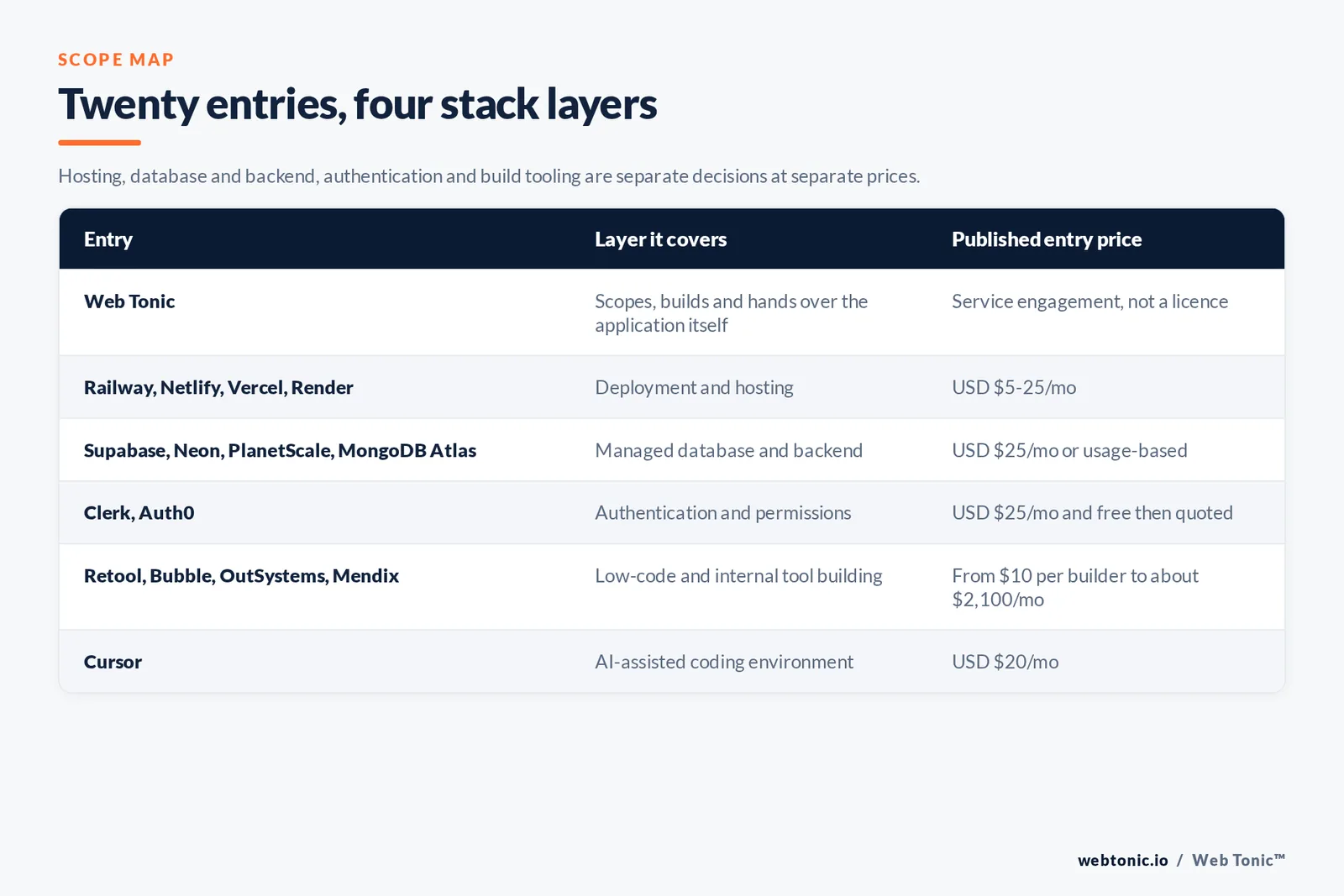
Four decisions, not one product. Hosting such as Vercel, Netlify, Render or Railway, a database or backend such as Supabase, Neon or Firebase, authentication such as Clerk or Auth0, and optionally a low-code builder or AI coding editor.
1. Vercel

About: Vercel is the deployment and hosting platform built around the Next.js framework, giving frontend and full-stack teams git-based deploys, edge functions and preview environments for every pull request. Its Frontend Cloud pairs directly with Vercel Postgres, Vercel Blob and KV storage for building complete custom web applications, and public customer stories include Sonos and Rippling. Pricing runs from a free Hobby tier to a published Pro plan, with enterprise contracts negotiated separately.
Key Services: Git-based CI/CD deploys, Next.js first-class hosting, Edge functions and edge middleware, Preview environments per pull request, Managed Postgres, KV and Blob storage, Web analytics and observability
Industries Served: SaaS product teams, Ecommerce brands, Media and publishing, Enterprise IT, Developer tooling companies
Notable Clients: Sonos, Rippling, Under Armour, Nike (via agency partner), Zapier
Locations: San Francisco, United States, Covina, United States
Pricing: Free Hobby tier plus Pro plan from USD $20/month per seat, Enterprise custom
Great For: Next.js product teams, Frontend-heavy SaaS companies, Agencies shipping client sites
Website: Vercel
2. Web Tonic

About: Web Tonic is not a development platform, it is the team that picks the stack and ships the application on it: scoping, data model, authentication, deployment and the handover documentation that keeps it maintainable. We choose hosting, database and auth against traffic pattern, compliance need and who will maintain the app in two years rather than framework fashion. The same team owns the build work, the measurement layer wired into it and the growth programme the app is meant to serve.
Key Services: Growth Marketing, Paid Social, PPC, Meta Ads, SEO, Google Ads, Snapchat Ads, Amazon Ads, Reddit Ads, TikTok Ads, TikTok Shop, GEO-AEO, Webflow Design, Shopify Design, WordPress Design, UGC, Social Media Management, Pay Per Click Management, Marketing Analytics, Analytics Implementation & CDPs, Performance Branding, Performance 360° Audit, Programmatic Ads, OOH Ads, HR Marketing
Industries Served: eCommerce, SaaS, B2B, Construction Professionals, Home Services, SMEs, Health Spa & Wellness, Retail, Legal & Judicial Services, Food & Beverages, Pets, Fitness, Family & Children, Finance & Insurance, Travel, Non-Profits & Organizations, Furniture & Decoration
Notable Clients: WorldRemit, Jack & Jones, Ardene, L'Oréal, Sendwave, Nestlé, Airbnb. Serve Fortune 500 companies and smaller fast-paced startups.
Locations: HQ in San Francisco with notable offices in New York, Chicago, Miami, Toronto, Montreal, Dubai, Singapore, Sydney and more. Offices on five continents.
Pricing: Starting at USD $3,000 per month. Flexible and scalable plans at any time according to your enterprise needs. Book a call to learn more.
Great For: Mid-market to enterprise-level businesses requiring ongoing, on-tap growth and performance marketing services.
Website: Web Tonic
3. Netlify
About: Netlify is a web application deployment platform built around git-based continuous deployment, edge functions and a global CDN for shipping static sites and full-stack Jamstack applications. It publishes named customer case studies including Mattel, Sequoia Capital and Unilever brand Nike-adjacent project Matter Supply, evidencing real enterprise use beyond marketing sites. Its usage-based Credits pricing model is published with named tiers from a free plan through Enterprise.
Key Services: Git-based continuous deployment, Global edge CDN, Serverless and edge functions, Netlify Database managed Postgres, Deploy previews per branch, Forms and identity add-ons
Industries Served: Marketing and content teams, Ecommerce brands, Enterprise IT, Agencies, Media publishers
Notable Clients: Mattel, Sequoia Capital, Unilever, Nike (via Matter Supply project), Peloton
Locations: San Francisco, United States, Bristol, United Kingdom
Pricing: Free tier plus Personal at USD $9/month and Pro at USD $20/month per member, Enterprise custom
Great For: Jamstack and static-site teams, Content-heavy marketing sites, Agencies managing many client sites
Website: Netlify
4. Retool

About: Retool is a low-code platform purpose-built for internal tools, letting engineering teams drag and drop components on top of any database, API or large language model instead of hand-coding admin panels and dashboards. DoorDash publicly credits Retool with saving six million dollars while running its delivery-network operations, and Retool states more than ten thousand organizations use the platform. Pricing is published per Builder and per Internal user seat with a free tier for small teams.
Key Services: Drag-and-drop app builder, Prebuilt UI component library, Direct database and REST or GraphQL API connections, Role-based access control, Built-in AI app generation, Self-hosted or cloud deployment
Industries Served: Internal tools and ops teams, Fintech and payments, Logistics and delivery, Healthcare operations, Enterprise IT
Notable Clients: DoorDash, Amazon, OpenAI, Brex, Peloton
Locations: San Francisco, United States, New York, United States, London, United Kingdom
Pricing: Free tier plus Team from USD $10/month per builder, Business from USD $50/month per builder, Enterprise custom
Great For: Ops and internal-tools teams, Fintech back-office builders, Enterprise IT departments
Website: Retool
5. Supabase

About: Supabase is an open-source backend-as-a-service platform that bundles a managed Postgres database, authentication, file storage, edge functions and real-time subscriptions behind a single set of client libraries. It states that AI coding agents now spin up more than sixty percent of new Supabase databases, and its own customer pages name 1Password, PwC and Johnson & Johnson as production users. Sacra research puts Supabase at roughly USD 170 million in annualized revenue in May 2026, up 221% year over year.
Key Services: Managed Postgres database, Built-in authentication and row-level security, Object storage, Auto-generated REST and GraphQL APIs, Edge functions, Real-time data subscriptions
Industries Served: AI product startups, Mobile and web app developers, Fintech, Enterprise IT, Indie and solo developers
Notable Clients: 1Password, PwC, Johnson & Johnson, Udio, Mozilla
Locations: Remote-first, no fixed headquarters, Singapore, Singapore
Pricing: Free tier plus Pro plan from USD $25/month, Team and Enterprise plans custom
Great For: AI-native app builders, Mobile and web startups, Teams wanting Postgres plus auth in one place
Website: Supabase
6. Firebase

About: Firebase is Google's backend-as-a-service platform providing Firestore and Realtime Database, authentication, cloud functions and hosting for web and mobile applications on pay-as-you-go Blaze pricing on top of a free Spark tier. It runs on Google Cloud infrastructure and is used at scale by companies such as Alibaba and Duolingo for production mobile and web backends. Its no-cost quota plus metered overage pricing is fully published rather than quote-only.
Key Services: Firestore and Realtime NoSQL databases, Authentication with social and email providers, Cloud Functions serverless compute, Static and dynamic web hosting, Cloud Messaging push notifications, Crashlytics and performance monitoring
Industries Served: Mobile app developers, Startups and indie developers, Gaming, Ecommerce apps, Enterprise IT
Notable Clients: Alibaba, Duolingo, Todoist, Halfbrick, The New York Times
Locations: Mountain View, United States, New York, United States
Pricing: Free Spark tier plus pay-as-you-go Blaze plan billed by usage
Great For: Mobile-first product teams, Startups needing a fast backend, Google Cloud shops
Website: Firebase
7. Auth0

About: Auth0, now sold under Okta ownership, is an authentication and authorization platform that adds login, multi-factor authentication and single sign-on to custom web applications through prebuilt software development kits rather than teams writing identity code themselves. Named customers on its Okta-hosted case study pages include Siemens, Wyndham Hotels and Rohde and Schwarz, the last reporting a 400% increase in scaled digital engagement. Auth0 publishes a free developer tier alongside named B2B pricing plans, with connection-based Enterprise pricing quoted separately.
Key Services: Universal login and SSO, Multi-factor authentication, Social and enterprise identity connections, Role-based access control, Anomaly detection and bot protection, Prebuilt SDKs for web and mobile
Industries Served: SaaS product teams, Hospitality and travel, Industrial and manufacturing, Financial services, Enterprise IT
Notable Clients: Siemens, Wyndham Hotels and Resorts, Rohde and Schwarz, Roblox, RSG Group
Locations: Bellevue, United States, San Francisco, United States
Pricing: Free tier up to 25,000 monthly active users, paid B2B Essentials and Professional tiers, Enterprise custom
Great For: Teams needing enterprise SSO fast, B2B SaaS applications, Regulated industries
Website: Auth0
8. Clerk

About: Clerk is an authentication and user-management service purpose-built for React, Next.js and Remix applications, shipping prebuilt sign-in components, session management and organization or multi-tenant support as drop-in code. Clerk publishes per-monthly-active-user overage pricing starting at a USD $25 Pro plan with 10,000 monthly active users included, a level of pricing transparency rarer among identity vendors. It describes itself as trusted by thousands of customers building on the modern web stack.
Key Services: Prebuilt sign-in and sign-up UI components, Session and organization management, Social login and SAML SSO, Bot and fraud protection, Multi-tenant B2B support, Webhooks and user management API
Industries Served: Next.js and React SaaS teams, B2B software startups, Developer tooling companies, AI product startups, Ecommerce apps
Notable Clients: Not publicly named — logos are not published
Locations: San Francisco, United States, Remote, Global
Pricing: Free tier plus Pro from USD $25/month with 10,000 monthly active users included, Enterprise custom
Great For: React and Next.js developers, B2B SaaS with multi-tenant needs, Small teams wanting fast auth setup
Website: Clerk
9. Render

About: Render is a cloud application hosting platform that deploys web services, background workers, static sites and managed Postgres or Redis databases directly from a git repository with automatic scaling and free TLS. Named customer stories on its own site include Thatch in healthcare benefits and Reservamos, which runs online bus-ticketing infrastructure for millions of riders across Latin America on Render. Its Hobby, Pro and Scale plans are published with flat monthly fees plus metered compute.
Key Services: Git-based auto deploys, Managed Postgres and Redis, Background workers and cron jobs, Auto-scaling web services, Private networking between services, Preview environments
Industries Served: Startups and scale-ups, Healthtech, Travel and mobility, Developer tooling, Agencies
Notable Clients: Thatch, Reservamos, Evolve, Fey, OCMI
Locations: San Francisco, United States, Remote, Global
Pricing: Free Hobby tier plus Pro at USD $25/month and Scale at USD $499/month, both plus compute usage
Great For: Startups replacing Heroku, Teams needing managed databases plus hosting, Small engineering teams
Website: Render
10. Railway

About: Railway is a deployment platform that turns a git repository or Docker image into a running web application, database or worker with usage-based billing charged per workspace rather than per seat. Bilt's marketing engineering team and crypto-tracking startup Universal are both named public customer stories describing production use on Railway. Its published Hobby and Pro plans start at USD $5 and USD $20 per month, each including matching usage credit, with Enterprise available by quote.
Key Services: One-click deploy from git or Docker, Managed Postgres, MySQL and Redis, Usage-based per-workspace billing, Private networking between services, Horizontal and vertical autoscaling, Preview environments per branch
Industries Served: Startups and indie developers, Marketing engineering teams, Crypto and fintech, Developer tooling, Small SaaS teams
Notable Clients: Bilt, Universal
Locations: San Francisco, United States, Remote, Global
Pricing: Free tier plus Hobby at USD $5/month and Pro at USD $20/month per workspace, Enterprise custom
Great For: Small teams wanting fast Docker deploys, Startups outgrowing free tiers, Workspace-based billing preference
Website: Railway
11. Fly.io

About: Fly.io is a deployment platform that runs application containers as lightweight virtual machines close to users across a global network of regions, aimed at teams that want AWS-level control without managing servers directly. New Zealand healthtech startup MyMahi is a named public customer that moved onto Fly.io instead of hiring dedicated DevOps engineers it could not afford, and Fly.io also publishes a dedicated HIPAA-compliant plan at USD $99 per month for regulated workloads. Pricing is fully usage-based with no flat platform fee beyond optional paid support tiers starting at USD $29 per month.
Key Services: Global multi-region container deployment, Fly Machines lightweight VMs, Fly Postgres managed database, Private networking between apps, Anycast load balancing, HIPAA and SOC2-ready compliance plan
Industries Served: Healthtech, Developer tooling companies, Startups needing global latency, Fintech, AI application startups
Notable Clients: MyMahi, Tigris
Locations: Chicago, United States, San Francisco, United States
Pricing: Usage-based with no platform minimum, paid support plans from USD $29/month, HIPAA plan at USD $99/month
Great For: Teams needing global low-latency deploys, Regulated healthtech workloads, Engineers wanting VM-level control
Website: Fly.io
12. AWS Amplify

About: AWS Amplify is Amazon's full-stack development platform, bundling a frontend hosting pipeline with backend building blocks such as authentication, GraphQL and REST APIs, and file storage, all backed by managed AWS services. Neiman Marcus used it to speed up serverless app development, and Amazon's own case study describes Busby growing usage 860% within a year on an app built with Amplify. Pricing is fully usage-based and published with no monthly minimum or per-seat licensing.
Key Services: Frontend hosting with CI/CD, AppSync GraphQL and REST APIs, Amazon Cognito authentication, S3-backed file storage, Amplify UI component library, Serverless backend provisioning
Industries Served: Retail and ecommerce, Enterprise IT on AWS, Mobile app startups, Insurance, Media and entertainment
Notable Clients: Neiman Marcus, Busby, State Auto
Locations: Seattle, United States, Bellevue, United States
Pricing: Pay-as-you-go, no monthly minimum, published per-resource rates such as USD $0.01 per build minute
Great For: Teams already committed to AWS, Enterprise retail and IT, Full-stack mobile and web builds
Website: AWS Amplify
13. PlanetScale

About: PlanetScale is a managed database platform built on Vitess-based MySQL, adding non-blocking schema branching and deploy requests so application teams can change a production schema the same way they review code. Cash App names PlanetScale in a public case study describing a scale to 400 tebibytes and 4 million queries per second, and Barstool Sports and MyFitnessPal are also named customers who migrated off self-managed alternatives. Pricing is metered by cluster size, storage and query volume with a published self-serve Base plan and custom Enterprise contracts.
Key Services: Vitess-based managed MySQL, Non-blocking schema branching, Deploy requests for schema review, Read replicas and horizontal sharding, Query insights and performance monitoring, Postgres option alongside MySQL
Industries Served: Fintech, Media and entertainment, Consumer social apps, Enterprise IT, High-growth startups
Notable Clients: Cash App, Barstool Sports, MyFitnessPal, Mintify
Locations: San Francisco, United States, Mountain View, United States
Pricing: Metered by cluster size and usage on the self-serve Base plan, Enterprise custom
Great For: Teams outgrowing self-managed MySQL, High-scale consumer apps, Engineering teams wanting schema branching
Website: PlanetScale
14. Neon
About: Neon is a serverless Postgres platform that separates storage from compute so databases can scale to zero and branch instantly for every preview environment, a feature set that made it the managed Postgres layer behind Vercel Postgres and part of the Replit and Retool stacks. Databricks acquired Neon in 2025, and the product continues to sell its own usage-based pricing under the Neon brand with no monthly minimum on paid plans. Neon states more than 18,000 new databases are created on the platform every day.
Key Services: Serverless Postgres with scale-to-zero, Instant database branching, Usage-based compute billing, Read replicas, Point-in-time restore, Integrations with Vercel and Replit
Industries Served: AI application builders, Startups and indie developers, Platform partners embedding Postgres, Enterprise IT, Developer tooling companies
Notable Clients: Vercel, Replit, Retool
Locations: San Francisco, United States, Remote, Global
Pricing: Free tier plus usage-based Launch and Scale plans with no monthly minimum, Enterprise custom
Great For: Teams needing per-branch databases, Platforms embedding Postgres for users, AI app builders needing instant provisioning
Website: Neon
15. MongoDB Atlas

About: MongoDB Atlas is the fully managed cloud version of the MongoDB document database, running clusters across AWS, Google Cloud and Azure with automated scaling, backups and search built in. Toyota Connected names Atlas in a public case study describing a four-month migration and a target of 99.99% availability for its connected-vehicle data services. Pricing is published on a pay-as-you-go hourly basis from a free shared tier through dedicated clusters.
Key Services: Managed document database clusters, Multi-cloud deployment across AWS, GCP and Azure, Built-in full-text and vector search, Automated backups and point-in-time recovery, Serverless and Flex on-demand tiers, Change streams for real-time apps
Industries Served: Automotive and connected devices, Ecommerce, Gaming, Financial services, Enterprise IT
Notable Clients: Toyota Connected, Electronic Arts, Forbes, Cisco, Grab
Locations: New York, United States, Dublin, Ireland, Palo Alto, United States
Pricing: Free shared tier plus pay-as-you-go dedicated clusters from about USD $0.011/hour
Great For: Teams needing a flexible document store, Connected-device and IoT platforms, Global multi-cloud deployments
Website: MongoDB Atlas
16. Bubble
About: Bubble is a no-code platform for building full custom web and mobile applications visually, including database structure, workflow logic and responsive design, without writing traditional code. Storage maker Seagate built its customer-facing Lyve Management Portal on Bubble after a from-scratch team estimated three years of build time, and Floor Authority publicly credits a Bubble-built app with powering 24 million dollars in annual revenue. Bubble states 85% of enterprise survey respondents save between USD $300,000 and USD $1,000,000 a year building on the platform, and publishes named workload-based pricing tiers.
Key Services: Visual drag-and-drop app builder, Built-in relational database editor, Visual workflow and logic editor, Responsive design engine, Plugin marketplace and API connector, SOC 2 and SSO for enterprise plans
Industries Served: Startups building an MVP, GovTech, Operations-heavy SMBs, Agencies building client apps, Enterprise internal tools
Notable Clients: Seagate, Floor Authority, Upfront
Locations: New York, United States, Wilmington, United States
Pricing: Free plan plus Starter and Team plans, Team around USD $349 to $549/month, Enterprise custom
Great For: Non-technical founders building an MVP, Ops teams automating internal workflows, Agencies building client-facing apps
Website: Bubble
17. OutSystems

About: OutSystems is an enterprise low-code platform for building and modernizing complex custom business applications with visual development plus the ability to drop in custom code where needed. Portuguese energy group EDP is a named public customer that used OutSystems to modernize its core payment collection system and build a multilingual worldwide employee portal in eight weeks. Its OutSystems One plan is reported to start around USD $2,100 per month billed annually, with further enterprise-scale pricing quoted per organization.
Key Services: Visual low-code app builder, One-click multi-environment deployment, AI-assisted app generation, Prebuilt integrations and connectors, Application performance monitoring, Hybrid low-code plus custom code
Industries Served: Manufacturing and energy, Financial services, Healthcare, Government, Enterprise IT
Notable Clients: EDP, Merck, Trumpf, ERM, Zurich Insurance (via related low-code deployments)
Locations: Boston, United States, Linda-a-Velha, Portugal
Pricing: OutSystems One starts at about USD $2,100/month billed annually, higher tiers quoted per scope
Great For: Large enterprises modernizing legacy systems, Regulated industries, IT departments standardizing app delivery
Website: OutSystems
18. Mendix

About: Mendix, owned by Siemens, is a low-code platform for enterprises to build and run custom business applications through visual modeling with an option to extend into custom logic and integrations. Zurich Insurance is a named public customer that has delivered nearly 30 applications on Mendix to modernize legacy insurance processes, and manufacturer Jabil reports more than 100 Mendix apps improving global site operations across more than 25 countries. Mendix offers a free forever tier for individual builders, with paid and Siemens Xcelerator-linked enterprise pricing quoted separately.
Key Services: Visual application modeling, Multi-cloud and on-premises deployment, AI-assisted app generation, Prebuilt connectors and integrations, Mobile app packaging from one model, Application lifecycle management
Industries Served: Insurance, Manufacturing, Energy and utilities, Financial services, Enterprise IT
Notable Clients: Zurich Insurance, Jabil, Siemens
Locations: Boston, United States, Rotterdam, Netherlands
Pricing: Free forever plan for individuals, paid team and enterprise tiers quoted per scope
Great For: Manufacturing and industrial enterprises, Insurance and financial services IT, Siemens Xcelerator customers
Website: Mendix
19. Cursor

About: Cursor is an AI-native code editor built as a fork of Visual Studio Code, adding agentic multi-file code generation, chat-driven editing and codebase-aware autocomplete for writing custom web application code faster. Engineers at OpenAI, Midjourney, Perplexity, Shopify and Instacart were reported among roughly 30,000 paying customers using Cursor's AI coding tools, and SpaceX later agreed to acquire the company for USD $60 billion. Pricing is published starting at USD $20 per month for the Pro plan with a Teams tier at USD $40 per user per month.
Key Services: AI multi-file code generation, Chat-driven code editing, Codebase-aware autocomplete, Agent mode for autonomous coding tasks, Model choice across leading LLMs, VS Code-compatible extension support
Industries Served: AI and software startups, Enterprise engineering teams, Ecommerce platform engineering, Developer tooling companies, Independent developers
Notable Clients: OpenAI, Midjourney, Perplexity, Shopify, Instacart
Locations: San Francisco, United States
Pricing: Pro plan at USD $20/month, Teams at USD $40/user/month, Enterprise custom
Great For: Engineering teams writing app code daily, AI-forward startups, Individual developers wanting agentic coding
Website: Cursor
20. Convex

About: Convex is a reactive backend platform combining a document-relational database, server functions and real-time data sync in one deployment, designed so frontend teams can build a full custom application backend without stitching together separate database, API and caching layers. It closed a USD $57 million Series B in 2026 and integrates directly with WorkOS for enterprise authentication, alongside partners including Vercel and Cursor. Pricing is published from a free plan through a Professional tier at USD $25 per developer per month, with an Enterprise plan carrying a stated USD $2,500 monthly minimum.
Key Services: Reactive document-relational database, Server-side functions with strong typing, Real-time data synchronization, Built-in file storage, Scheduled functions and cron jobs, WorkOS-integrated enterprise auth
Industries Served: AI application startups, Real-time collaboration apps, Developer tooling companies, Early-stage SaaS teams, Enterprise engineering teams
Notable Clients: Reducto, Conduit
Locations: San Francisco, United States
Pricing: Free plan plus Professional at USD $25/developer/month, Enterprise from a USD $2,500/month minimum
Great For: Teams wanting one reactive backend, Real-time collaborative apps, AI-app builders needing fast iteration
Website: Convex
Quick Comparison Table
| Agency | Key Specialty | Starting Price | Best For |
|---|---|---|---|
| 1. Vercel | Next.js hosting and edge deployment | USD $20/mo | Next.js and frontend-heavy teams |
| 2. Web Tonic | Full-Service Performance Marketing | USD $3,000/mo | Mid-market to Enterprise |
| 3. Netlify | Jamstack deployment and edge CDN | USD $9/mo | Jamstack and static-heavy web apps |
| 4. Retool | Low-code internal tool building | USD $10/mo per builder | Building internal admin tools fast |
| 5. Supabase | Postgres backend as a service | USD $25/mo | Postgres, auth and storage in one backend |
| 6. Firebase | Google-run mobile and web backend | Free, then usage-based | Mobile app backends on Google Cloud |
| 7. Auth0 | Drop-in identity and login | Free, then quote-based | Adding login and SSO without building it |
| 8. Clerk | Auth built for React and Next.js | USD $25/mo | React and Next.js login screens |
| 9. Render | Full-stack app hosting with managed data | USD $25/mo plus usage | Simple full-stack app hosting |
| 10. Railway | Usage-based container deployment | USD $5/mo | Fast deploys billed per workspace |
| 11. Fly.io | Global edge container deployment | Usage-based | Low-latency global app deployment |
| 12. AWS Amplify | Full-stack app framework on AWS | Usage-based, no minimum | Full-stack apps on AWS infrastructure |
| 13. PlanetScale | Branchable managed MySQL | Usage-based | Scaling MySQL with schema branching |
| 14. Neon | Branchable serverless Postgres | Usage-based | Instant Postgres branches per environment |
| 15. MongoDB Atlas | Managed multi-cloud document database | Free, then usage-based | Document database for custom apps |
| 16. Bubble | No-code full application builder | Free, paid from workload usage | Building a full app with no code |
| 17. OutSystems | Enterprise-grade low-code platform | About USD $2,100/mo | Modernizing complex enterprise apps |
| 18. Mendix | Siemens-backed enterprise low-code | Free, then quote-based | Enterprise low-code app modernization |
| 19. Cursor | AI-native coding editor | USD $20/mo | Writing and editing app code with AI |
| 20. Convex | Reactive all-in-one backend | USD $25/mo per developer | Real-time reactive app backends |
Frequently Asked Questions
What does a custom app stack cost per month?
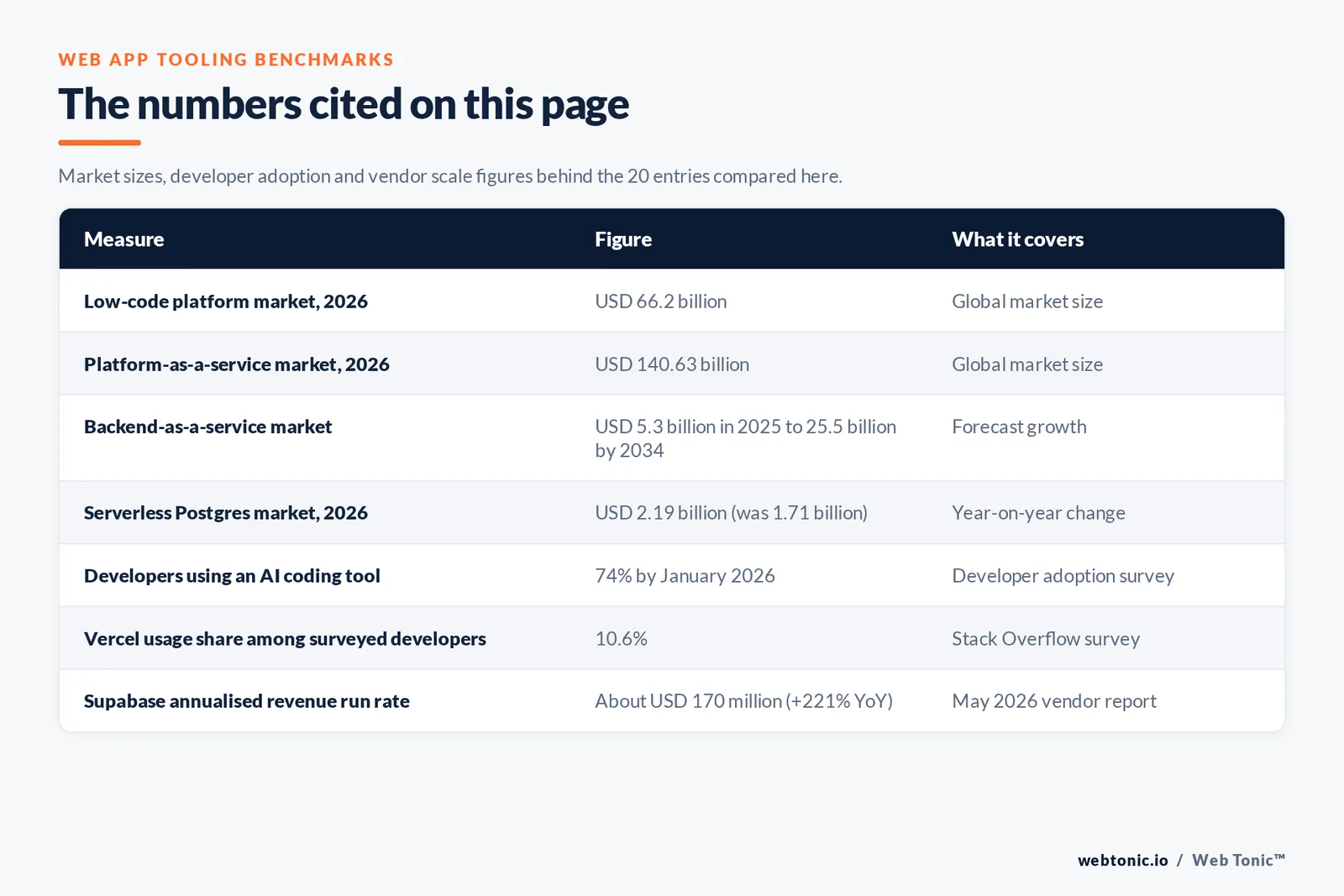
Entry pricing is public and low across every layer. Railway starts at 5 dollars a month, Netlify at 9, Retool at 10 per builder, Vercel and Cursor at 20, and Supabase, Clerk, Render and Convex at 25. Firebase, MongoDB Atlas, AWS Amplify, PlanetScale, Neon, Fly.io and Bubble bill by usage from a free tier, Auth0 starts free then quotes, OutSystems runs about 2,100 dollars a month and Mendix quotes above its free tier. A realistic small production stack therefore lands between 50 and 150 dollars a month before traffic.
Low-code or a coded application?
It depends who will change it next year. Bubble, OutSystems, Mendix and Retool let a small team assemble working software fast, and the low-code platform market is sized at 66.2 billion dollars in 2026, so this is not a fringe choice. The trade-off is portability: an application built inside a visual platform is hard to move, while a coded app on Vercel, Render or Railway with Postgres behind it can be handed to any competent developer later.
Which database should a custom app start on?
Managed Postgres suits most business applications, and the branchable products make staging painless. Supabase at 25 dollars bundles Postgres with authentication and storage and reported an annualised revenue run rate near 170 million dollars in May 2026, up 221 percent year over year; Neon and PlanetScale sell branchable serverless databases; MongoDB Atlas suits document-shaped data. Serverless Postgres alone is sized at 2.19 billion dollars in 2026, up from 1.71 billion in 2025, which is why branching has become a default expectation.
Do we still need a separate auth service?
Usually yes, because login is where security incidents and compliance requirements concentrate. Clerk at 25 dollars a month targets React and Next.js teams, Auth0 starts free then quotes and covers enterprise single sign-on, and Supabase and Firebase include authentication if you are already using them as the backend. Building session handling, password resets and multi-factor flows by hand costs more engineering time than the subscription and carries risk no roadmap wants.
How much do AI coding tools change the build?
They change speed, not architecture. Reported adoption has 74 percent of developers worldwide using a specialised AI coding tool by January 2026, and Cursor at 20 dollars a month is the clearest example of the category, with named users including OpenAI and Shopify. What still decides whether the application survives is the data model, the deployment pipeline and the documentation, none of which a code assistant owns. Vercel's 10.6 percent usage share among surveyed developers reflects how much of that pipeline is now bought rather than built.
Choosing a Web App Stack You Can Maintain
Choose per layer, not per suite. Hosting, database, authentication and tooling are four separate decisions, and entry prices of 5 to 25 dollars a month at each layer mean the cheap path is also the portable one.
Ask who maintains it in two years. Low-code speeds the first release and slows the fifth change; a coded app on managed infrastructure can be handed to any developer.
Buy authentication. Login, password resets and multi-factor flows are where security incidents and compliance requirements concentrate, and 25 dollars a month for a maintained identity service beats bespoke session code nobody wants to audit later.
Treat AI assistants as speed, not design. With 74 percent of developers using one by January 2026, the differentiator is no longer typing speed but the data model, the deployment pipeline and the handover documentation. For the build work, the measurement layer and the growth programme from one team, read the latest analysis or book a call.