Table of contents
How we vet every listicle
Every agency featured on Web Tonic passes our 84-point editorial review before a single listicle goes live. This is how we vet each pick:
Verified client outcomes: We require real case studies with measurable KPIs — revenue, ROAS, CPA, retention — tied to the exact category being ranked. No cherry-picked wins, no unverifiable numbers.
Independent reputation: We cross-check Clutch, Google, G2, and Trustpilot ratings, and screen for review-bombing or suspicious patterns. Only operators with a consistent, verifiable track record make the cut.
Beyond that, every listing goes through a quarterly re-audit. We check 84 criteria across 6 pillars to make sure it still holds up — here are some of the checks we run:
A CRM analytics and integration tool connects a customer relationship management system to the rest of the revenue stack, then turns those records into reporting anyone will trust. The category covers five distinct jobs: moving CRM data into a warehouse and pushing modelled data back out through reverse ETL, wiring apps together through integration platform connectors, importing offline conversions so ad platforms can optimize toward closed deals, deduplicating and cleaning records, and resolving one person across visits, emails and CRM entries.

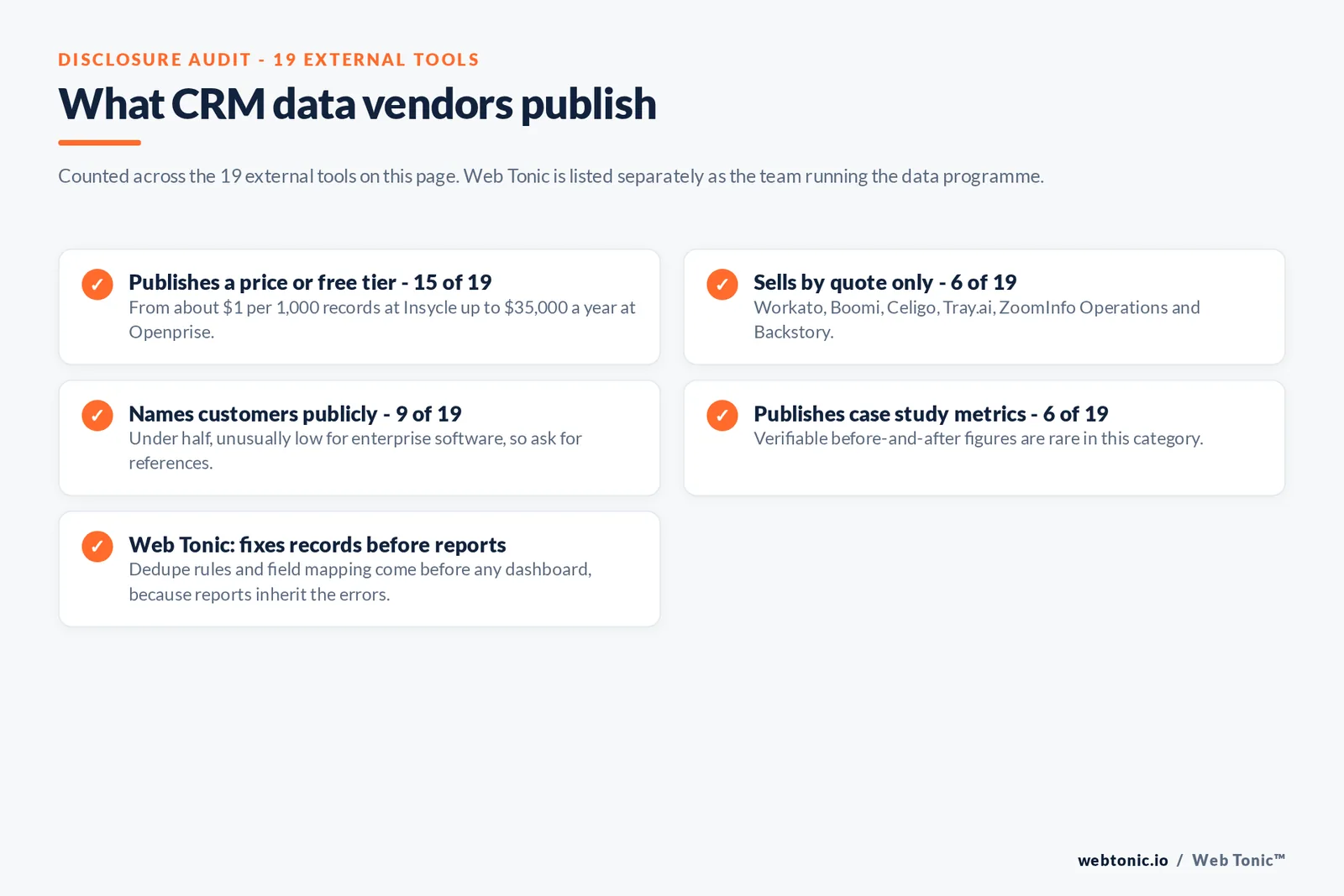
We compared 20 entries on published pricing, the job each genuinely does and the data it needs. Fifteen of the 19 external tools publish a starting price or a free tier, and nine name customers publicly.
Which CRM analytics and integration tool does which job?
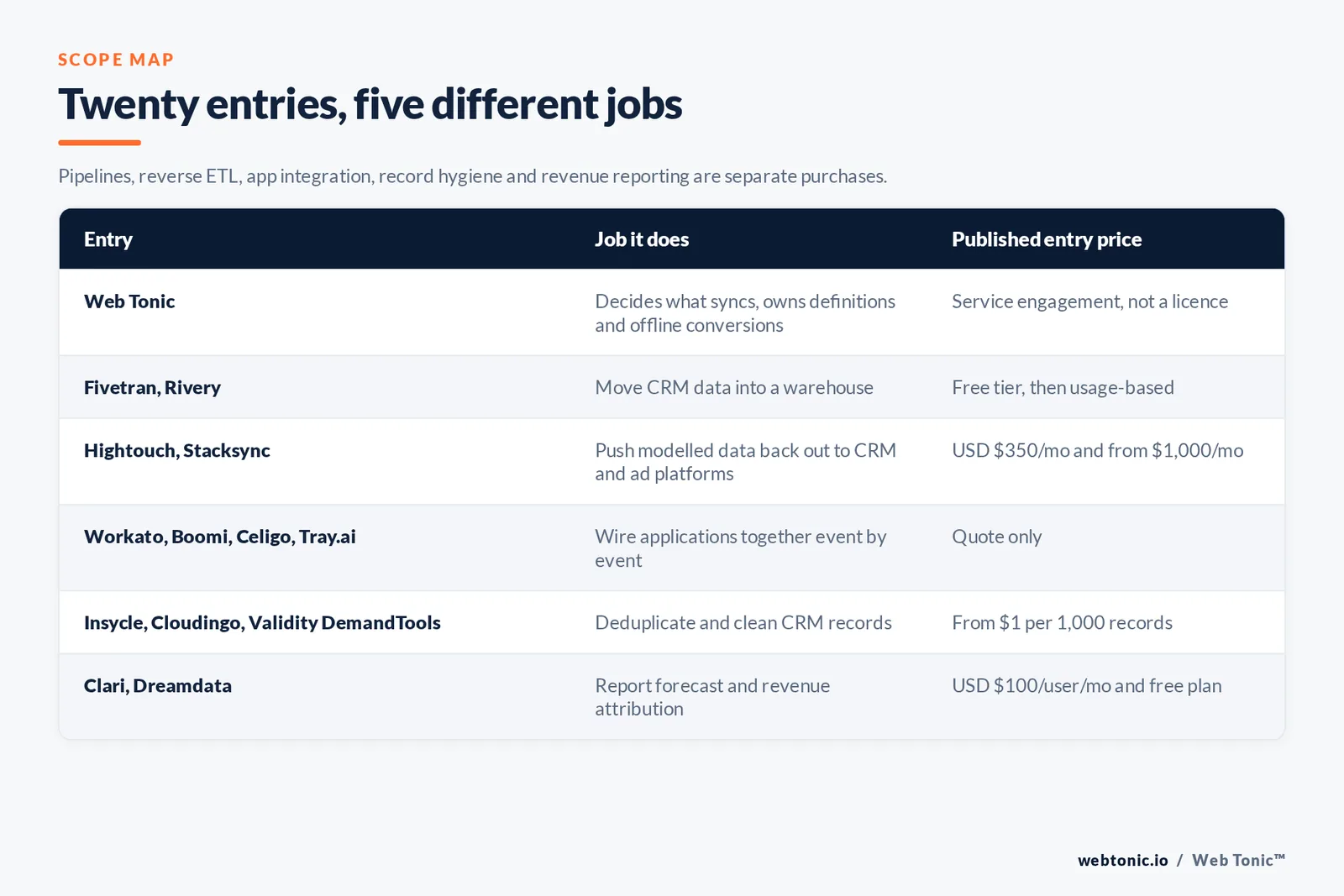
Split the job first. Fivetran or Rivery move data in, Hightouch or Stacksync push it back out, Workato, Boomi, Celigo or Tray.ai wire the apps, Insycle, Cloudingo or DemandTools clean records, and Clari or Dreamdata report revenue.
1. Fivetran

About: Fivetran is a managed data movement platform that automatically extracts and loads CRM data such as Salesforce and HubSpot objects into a customer's cloud warehouse through fully managed connectors, then keeps schemas in sync as source systems change. It expanded into CRM activation by acquiring reverse ETL leader Census in 2025, so the same platform can now sync warehouse-modeled data back into the CRM and ad platforms. Fivetran publishes usage-based pricing and counts Autodesk, DoorDash, Notion and Okta among its named customers.
Key Services: Managed CRM-to-warehouse connectors, Automatic schema drift handling, Reverse ETL activation (formerly Census), Change data capture, Pre-built transformations, Data lineage and monitoring
Industries Served: Revenue operations teams, Data engineering teams, SaaS companies, Enterprise IT, Marketing analytics teams
Notable Clients: Autodesk, DoorDash, Notion, Okta, Penguin Random House
Locations: Oakland, United States, Denver, United States, Dublin, Ireland
Pricing: Usage-based consumption pricing with a free tier for small volumes; paid tiers scale by monthly active rows
Great For: Data engineering teams, Revenue operations, Companies standardizing on a cloud warehouse
Website: Fivetran
2. Web Tonic

About: Web Tonic is not an integration platform, it is the team that decides what should sync and what should never leave the warehouse: field mapping, dedupe rules, offline conversion imports and the reporting layer sales actually trusts. We pick the pipeline, hygiene and identity tools against how your revenue is really recorded rather than a connector count, then own the definitions behind every number. The same team runs the data and measurement programme, the paid acquisition that feeds the CRM and the growth plan built on both.
Key Services: Growth Marketing, Paid Social, PPC, Meta Ads, SEO, Google Ads, Snapchat Ads, Amazon Ads, Reddit Ads, TikTok Ads, TikTok Shop, GEO-AEO, Webflow Design, Shopify Design, WordPress Design, UGC, Social Media Management, Pay Per Click Management, Marketing Analytics, Analytics Implementation & CDPs, Performance Branding, Performance 360° Audit, Programmatic Ads, OOH Ads, HR Marketing
Industries Served: eCommerce, SaaS, B2B, Construction Professionals, Home Services, SMEs, Health Spa & Wellness, Retail, Legal & Judicial Services, Food & Beverages, Pets, Fitness, Family & Children, Finance & Insurance, Travel, Non-Profits & Organizations, Furniture & Decoration
Notable Clients: WorldRemit, Jack & Jones, Ardene, L'Oréal, Sendwave, Nestlé, Airbnb. Serve Fortune 500 companies and smaller fast-paced startups.
Locations: HQ in San Francisco with notable offices in New York, Chicago, Miami, Toronto, Montreal, Dubai, Singapore, Sydney and more. Offices on five continents.
Pricing: Starting at USD $3,000 per month. Flexible and scalable plans at any time according to your enterprise needs. Book a call to learn more.
Great For: Mid-market to enterprise-level businesses requiring ongoing, on-tap growth and performance marketing services.
Website: Web Tonic
3. Hightouch

About: Hightouch is a reverse ETL and data activation platform that syncs modeled CRM and warehouse data out to more than two hundred marketing, ad and sales destinations without custom API code. It includes an identity resolution layer that matches records across CRM, email and web behavioral data using deterministic and probabilistic rules configured in the warehouse. Hightouch has raised more than $80 million and reports over 600 customers including Spotify, the NBA and Calendly.
Key Services: Reverse ETL syncs to 200+ destinations, Warehouse-native identity resolution, Audience and segment builder, Data governance and observability, AI decisioning agents, Composable customer data platform model
Industries Served: Marketing operations teams, Growth teams, Data teams, Media and entertainment, Sports and consumer brands
Notable Clients: Spotify, NBA, Calendly, Plaid, Weight Watchers
Locations: San Francisco, United States
Pricing: Free basic reverse ETL tier; paid plans from about USD $350/month scaling with destinations and usage
Great For: Growth and marketing ops teams, Companies with an existing cloud warehouse, Teams activating CRM segments into ad platforms
Website: Hightouch
4. Workato
About: Workato is an enterprise integration and automation platform that connects CRM systems such as Salesforce and HubSpot to hundreds of business applications through low-code recipes, combining iPaaS-style data sync with workflow automation. It is used by large organizations to automate cross-system processes that touch CRM records, from lead routing to order-to-cash, without custom middleware. Workato runs on a published usage-based pricing model and names Vodafone, Atlassian and Broadcom as customers.
Key Services: Low-code integration recipes, Bidirectional CRM data sync, Workflow and process automation, Enterprise API management, AI-assisted recipe building, Pre-built connectors for major CRMs
Industries Served: Enterprise IT teams, Revenue operations, Telecommunications, Software companies, Financial services
Notable Clients: Vodafone, Atlassian, Broadcom, Jollibee, Slack
Locations: Mountain View, United States, London, United Kingdom
Pricing: Usage-based pricing tracked per product capability; quoted per scope for enterprise plans
Great For: Enterprise IT and RevOps, Companies automating CRM-adjacent workflows, Multi-system integration projects
Website: Workato
5. Boomi

About: Boomi is an integration platform as a service that connects CRM applications to ERP, database and cloud systems through a visual, low-code process builder with thousands of pre-built connectors. It supports both real-time and batch synchronization of CRM objects such as leads, accounts and opportunities, which makes it a common backbone behind multi-system revenue reporting. Boomi publishes subscription and pay-as-you-go pricing tiers and lists American Express Global Business Travel and ENGIE as customers.
Key Services: Low-code visual integration builder, Pre-built CRM and ERP connectors, API management, Master data hub, Event-driven and batch sync, Data catalog and governance
Industries Served: Enterprise IT, Manufacturing, Travel and hospitality, Retail, Financial services
Notable Clients: American Express Global Business Travel, ENGIE, SunExpress Airlines, Al-Futtaim Group
Locations: Conshohocken, United States, Berkshire, United Kingdom
Pricing: Subscription editions plus a pay-as-you-go monthly option; enterprise pricing quoted per scope
Great For: Large enterprises with legacy systems, IT teams standardizing integration, Companies syncing CRM with ERP
Website: Boomi
6. Celigo

About: Celigo, through its integrator.io platform, is an integration platform as a service built around pre-packaged integration apps for common CRM combinations such as Salesforce with NetSuite or HubSpot. It prices by endpoints and flows rather than by task or data volume, which distinguishes it from consumption-billed rivals and appeals to finance-conscious revenue teams. Celigo names its pricing model publicly and serves mid-market companies running Salesforce, HubSpot or NetSuite as their CRM of record.
Key Services: Pre-built CRM integration apps, Flow-based low-code builder, Two-way Salesforce and HubSpot sync, Error management and monitoring, API management, AI-assisted flow creation
Industries Served: Mid-market companies, Ecommerce operators, NetSuite users, Salesforce and HubSpot admins, Finance and operations teams
Notable Clients: Not publicly named — logos are not published
Locations: San Mateo, United States
Pricing: Tiered pricing based on endpoints and flows, not usage or task volume; quoted per scope
Great For: Mid-market NetSuite and Salesforce users, Finance-conscious integration buyers, Ecommerce operations teams
Website: Celigo
7. Rivery

About: Rivery is a fully managed ELT and reverse ETL platform that moves CRM data into a warehouse and back out again from a single interface, using a credit-based unit system instead of per-connector fees. It includes built-in orchestration so CRM syncs, transformations and activation can run as one scheduled pipeline rather than three separate tools. Rivery offers a genuinely free professional tier and publishes its BDU credit pricing model openly.
Key Services: Managed CRM-to-warehouse ELT, Reverse ETL activation, Built-in workflow orchestration, 200+ pre-built connectors, Kit marketplace for common use cases, Data transformation layer
Industries Served: Data teams, Marketing analytics teams, Mid-market companies, Agencies managing multiple clients, Startups
Notable Clients: Not publicly named — logos are not published
Locations: New York, United States, Tel Aviv, Israel
Pricing: Free professional tier; paid plans billed per BDU credit, scaling with usage
Great For: Data teams wanting ELT and reverse ETL together, Cost-sensitive mid-market teams, Agencies running multiple CRM syncs
Website: Rivery
8. Unito

About: Unito is a two-way, no-code sync platform that keeps CRM records such as Salesforce and HubSpot deals continuously mirrored with project management and support tools such as Jira, Asana and Airtable. Unlike one-way integrations, Unito flows field-level updates in both directions in near real time, which teams use to keep sales, delivery and support in sync without manual data entry. Unito prices by number of items in sync and reports that HubSpot itself uses the product, saving an estimated $595,000 a year in manual work.
Key Services: Two-way field-level sync, CRM to project-tool mirroring, No-code flow builder, Multi-directional filtering rules, Recurring sync scheduling, 50,000+ user base across integrations
Industries Served: Sales and delivery handoff teams, Customer success operations, Agencies, Project management offices, Support teams
Notable Clients: HubSpot, B&H Photo Video, Anderson Business Advisors, Cloudwerx
Locations: Montreal, Canada
Pricing: Plans priced by number of synced items; custom enterprise pricing available
Great For: Sales-to-delivery handoff teams, Customer success operations, Teams syncing CRM with project tools
Website: Unito
9. Tray.ai

About: Tray.ai, formerly Tray.io, is an integration platform that lets technical and non-technical teams build automated workflows connecting CRM data to marketing, support and finance systems, and now layers AI agents on top of those workflows. It supports both visual low-code building and AI-assisted flow generation for CRM data cleanup, routing and sync tasks. Tray.ai names IBM, Zuora and Apollo.io as customers and states that Zuora cut customer briefing prep from 23 hours to 5 minutes using the platform.
Key Services: Visual low-code workflow builder, AI agent workflows on CRM data, Universal API connectors, Real-time and batch CRM sync, Embedded integration for software vendors, Monitoring and alerting
Industries Served: Software vendors embedding integrations, Enterprise IT, Revenue operations, Customer support teams, Finance operations
Notable Clients: IBM, NetApp, Zuora, Apollo.io, Auctane
Locations: San Francisco, United States
Pricing: Custom, sales-led pricing based on base plan, usage and add-ons; no public rate card
Great For: Enterprise IT teams, Software vendors embedding CRM integrations, AI-driven workflow automation teams
Website: Tray.ai
10. Skyvia

About: Skyvia is a cloud data integration suite offering separate but connected products for CRM data import and export, backup, querying and two-way connection, aimed at smaller teams that need Salesforce or HubSpot sync without an engineering team. Its Connect product handles ongoing bidirectional CRM sync while its Backup product protects CRM data against accidental deletion. Skyvia publishes an actual price table by records processed, including a genuine free plan.
Key Services: CRM data import and export, Two-way CRM connect sync, Automated CRM backup, SQL-based CRM querying, Scheduled integration jobs, No-code workflow builder
Industries Served: Small and mid-sized businesses, Salesforce admins, HubSpot users, IT consultants, Nonprofits
Notable Clients: Not publicly named — logos are not published
Locations: Alpharetta, United States
Pricing: Free plan for small volumes; paid plans from roughly USD $0.02-$0.06 per 1,000 records processed
Great For: Small businesses without engineering support, Salesforce and HubSpot admins, Teams needing CRM backup plus sync
Website: Skyvia
11. LeanData
About: LeanData is a Salesforce-native revenue operations platform built around lead-to-account matching, routing and territory management, so CRM records get assigned to the right rep instantly instead of sitting in a queue. Its FlowBuilder lets operations teams visually design routing logic based on CRM fields such as account owner, territory and buying group. LeanData publishes tiered per-user pricing starting near USD $39 per user per month for its Standard plan.
Key Services: Lead-to-account matching, Visual routing FlowBuilder, Round-robin and territory assignment, Buying group orchestration, Meeting scheduling (BookIt), Salesforce-native architecture
Industries Served: Salesforce-based sales teams, Revenue operations, B2B SaaS companies, Marketing operations, Enterprise sales orgs
Notable Clients: Not publicly named — logos are not published
Locations: Santa Clara, United States
Pricing: Standard plan from about USD $39/user/month; Advanced plan from about USD $49/user/month
Great For: Salesforce revenue operations teams, B2B sales orgs with complex routing, Marketing-to-sales handoff teams
Website: LeanData
12. Clari
About: Clari is a revenue intelligence platform that pulls activity, email and CRM data into a unified time-series model to power forecasting, deal scoring and pipeline dashboards for sales leaders. It captures signals CRM records alone miss, such as email and call activity, and reconciles them against CRM fields to flag deals at risk before they slip. Clari says it manages over five trillion dollars in tracked revenue and names Adobe, Cisco, Okta and Zoom as customers, with front-line seats priced from roughly USD $100 to $120 per user monthly.
Key Services: AI-driven revenue forecasting, Automated deal scoring, Pipeline and revenue dashboards, Activity capture across email and calls, Time-series revenue data model, RevAI workflow automation
Industries Served: Enterprise sales organizations, Revenue operations leaders, Sales leadership, Complex B2B sales teams, Finance teams forecasting revenue
Notable Clients: Adobe, Cisco, Okta, Zoom, HPE
Locations: Sunnyvale, United States
Pricing: Core seats from roughly USD $100-$120/user/month, rising with add-on modules
Great For: Enterprise sales leadership, Revenue operations teams forecasting pipeline, Complex multi-stage B2B sales orgs
Website: Clari
13. Backstory

About: Backstory is a revenue intelligence platform, formerly branded People.ai, that automatically captures sales activity from email, calls and calendars and syncs it into the CRM so pipeline data reflects what reps actually did rather than what they remembered to log. The company rebranded from People.ai to Backstory in 2026 while keeping the same underlying product and team, and it still sells automatic activity capture and CRM data enrichment as its core capability. Because the old peopleai domain now redirects fully to backstory.ai, this entry uses the current product name and site as instructed by the disqualification rule for rebranded successors.
Key Services: Automatic sales activity capture, CRM contact and activity auto-creation, Email and calendar sync to CRM, Revenue signal reasoning, AI-driven deal answers, Activity matching and filtering
Industries Served: Enterprise sales organizations, Revenue operations, B2B SaaS sales teams, Sales leadership, RevOps analysts
Notable Clients: Not publicly named — logos are not published
Locations: San Francisco, United States
Pricing: No public rate card; quoted per scope
Great For: Enterprise sales operations, Teams tired of manual CRM logging, Revenue leaders needing complete activity data
Website: Backstory
14. Dreamdata

About: Dreamdata is a business-to-business revenue attribution platform that stitches together CRM deal data with marketing touchpoints, ad spend and product usage to show which channels and campaigns actually produced closed revenue. It builds a unified customer journey model per account, connecting CRM stages to earlier marketing and content interactions for full-funnel reporting. Dreamdata offers a genuine free plan alongside enterprise pricing that reportedly averages around USD $35,440 per year based on verified purchase data.
Key Services: B2B multi-touch revenue attribution, CRM and marketing data unification, Account-based journey mapping, Custom attribution models, ROI and ROAS reporting, Content and channel analytics
Industries Served: B2B marketing teams, Revenue operations, Account-based marketing teams, SaaS growth teams, Marketing analytics teams
Notable Clients: Not publicly named — logos are not published
Locations: Copenhagen, Denmark
Pricing: Free plan available; enterprise pricing quoted, averaging roughly USD $35,440/year per published buyer data
Great For: B2B marketing attribution teams, Account-based marketing programs, Revenue operations connecting CRM to marketing spend
Website: Dreamdata
15. Insycle

About: Insycle is a CRM data management platform focused on bulk cleaning, deduplication, formatting and backup of records inside HubSpot, Salesforce and Pipedrive, without requiring a developer to write scripts. It runs recurring automated workflows that standardize picklist values, merge duplicate contacts and enrich sparse fields on a schedule rather than as a one-time cleanup. Insycle prices per one thousand records under management, starting at roughly USD $1 per 1,000 records on its Starter plan.
Key Services: Bulk CRM data cleaning, Automated deduplication workflows, Record formatting and standardization, Scheduled CRM backup, Custom data enrichment rules, No-code bulk edit templates
Industries Served: HubSpot administrators, Salesforce operations teams, Revenue operations, Marketing operations, Small to mid-sized B2B companies
Notable Clients: Not publicly named — logos are not published
Locations: New York, United States
Pricing: Record-based pricing from about USD $1 per 1,000 records on the Starter plan, rising by tier
Great For: HubSpot and Salesforce admins, Marketing ops cleaning legacy data, Revenue teams running recurring hygiene workflows
Website: Insycle
16. Validity DemandTools

About: DemandTools, sold by Validity, is a Salesforce-native data quality toolkit used to deduplicate, standardize, import and mass-update CRM records at scale, and is frequently cited as a category standard for Salesforce data cleansing. Validity built its reputation on email deliverability tools before extending into CRM data quality, and it now sells DemandTools as part of a broader data quality suite. Independent pricing trackers report DemandTools starting around USD $3,000 per year for small Salesforce orgs, scaling with org size and objects covered.
Key Services: Salesforce record deduplication, Bulk data import and mass update, Data standardization rules, Multi-org data comparison, Scheduled data quality jobs, Data quality suite integration
Industries Served: Salesforce administrators, Enterprise IT, Revenue operations, Sales operations teams, Nonprofits on Salesforce
Notable Clients: Not publicly named — logos are not published
Locations: Boston, United States
Pricing: No public rate card on the vendor site; third-party trackers cite roughly USD $3,000-$12,000/year depending on org size
Great For: Salesforce admins managing large orgs, Enterprise data quality teams, Sales operations cleaning legacy CRM data
Website: Validity DemandTools
17. ZoomInfo Operations

About: ZoomInfo Operations, built from the 2021 acquisition of RingLead, is a CRM data orchestration product that automates deduplication, enrichment and continuous verification of Salesforce and Marketo records against ZoomInfo's business data. It routes and matches leads to the correct account before they ever create a duplicate, then keeps existing records current through scheduled enrichment jobs. ZoomInfo sells Operations as an add-on within its broader go-to-market intelligence platform, with published buyer reports citing enterprise deals in the tens of thousands of dollars annually.
Key Services: Automated CRM deduplication, Continuous record verification, Lead-to-account routing and matching, Multi-vendor waterfall enrichment, Data normalization rules, Marketo and Salesforce native integration
Industries Served: Enterprise sales operations, Marketing operations, Revenue operations, Large B2B sales organizations, Data governance teams
Notable Clients: Not publicly named — logos are not published
Locations: Vancouver, United States
Pricing: No public rate card; sold as a bundled add-on, with published buyer reports citing five-figure annual deals
Great For: Enterprise sales operations, Companies already on ZoomInfo for enrichment, Marketing operations teams routing leads
Website: ZoomInfo Operations
18. Cloudingo
About: Cloudingo is an admin-friendly, no-code tool built specifically to find, merge and prevent duplicate records inside Salesforce, positioned as a lighter-weight alternative to enterprise data quality suites. It runs scheduled duplicate scans across leads, contacts, accounts and custom objects and lets admins configure merge rules without writing Apex code. Cloudingo publishes its licensing openly, with plans starting at USD $2,500 per year plus a record-count fee above 300,000 total records.
Key Services: Automated duplicate detection, No-code merge rule configuration, Scheduled deduplication scans, Custom object support, Data import and transformation, Salesforce-native admin console
Industries Served: Salesforce administrators, Small and mid-sized businesses, Nonprofits on Salesforce, Sales operations teams, IT consultants
Notable Clients: Not publicly named — logos are not published
Locations: Wilmington, United States
Pricing: Licenses from USD $2,500/year, with a $100 fee per additional 100,000 records above 300,000
Great For: Small and mid-market Salesforce admins, Nonprofits needing affordable dedupe, Teams without a dedicated data quality budget
Website: Cloudingo
19. Openprise

About: Openprise is a data and AI orchestration platform built for revenue operations teams that need to clean, dedupe, enrich and route CRM and marketing automation records through pre-built bots rather than custom scripts. It ships with more than four hundred pre-built connectors covering CRMs, marketing automation platforms and file sources, and lets teams chain hygiene, enrichment and routing steps into a single automated pipeline. Openprise publishes starting pricing of USD $35,000 per year for its Professional plan covering up to 250,000 records per bot run.
Key Services: CRM and marketing automation data orchestration, Pre-built hygiene and enrichment bots, Lead-to-account routing, 400+ pre-built connectors, Self-service app factory, Scheduled bot execution
Industries Served: Revenue operations teams, Enterprise marketing operations, B2B SaaS companies, Sales operations, Data governance teams
Notable Clients: Not publicly named — logos are not published
Locations: San Ramon, United States
Pricing: Professional plan from USD $35,000/year; Enterprise plan priced on request
Great For: Enterprise revenue operations, Teams orchestrating hygiene plus routing plus enrichment, Marketing operations at scale
Website: Openprise
20. Stacksync

About: Stacksync is a newer two-way sync platform purpose-built to keep a CRM and a cloud data warehouse in lockstep, with schema-aware field mapping and conflict replay so changes made on either side stay consistent without a nightly batch job. It positions itself against traditional one-way ELT tools by treating the CRM as a first-class, continuously writable endpoint rather than just a source to extract from. Stacksync publishes transparent usage-based pricing starting at USD $1,000 per month for 50,000 records in sync, with a Pro tier at USD $3,000 per month for 1 million records.
Key Services: Real-time two-way CRM-warehouse sync, Schema-aware field mapping, Conflict detection and replay, 1,000+ pre-built connectors, Row-level sync monitoring, HubSpot and Salesforce native apps
Industries Served: Data teams needing live CRM sync, Revenue operations, Mid-market companies on HubSpot or Salesforce, Analytics teams, Startups scaling data infrastructure
Notable Clients: Not publicly named — logos are not published
Locations: San Francisco, United States
Pricing: Starter USD $1,000/month for 50,000 synced records; Pro USD $3,000/month for 1 million records; Enterprise custom
Great For: Data teams needing live two-way CRM sync, Mid-market HubSpot or Salesforce users, Teams replacing batch ETL with real-time sync
Website: Stacksync
Quick Comparison Table
| Agency | Key Specialty | Starting Price | Best For |
|---|---|---|---|
| 1. Fivetran | Managed CRM-to-warehouse ELT plus activation | Free tier; paid from usage | Warehouse-centric CRM data movement |
| 2. Web Tonic | Full-Service Performance Marketing | USD $3,000/mo | Mid-market to Enterprise |
| 3. Hightouch | Reverse ETL and warehouse identity resolution | USD $350/mo | Syncing warehouse data into CRM and ads |
| 4. Workato | Enterprise iPaaS with workflow automation | Usage-based; quoted | Enterprise CRM integration and automation |
| 5. Boomi | Enterprise iPaaS and master data hub | Quote-based | Enterprise CRM-to-ERP integration |
| 6. Celigo | Endpoint-priced CRM integration apps | Quote-based | Predictable-cost CRM to ERP sync |
| 7. Rivery | Combined ELT plus reverse ETL with orchestration | Free tier | One platform for CRM sync in and out |
| 8. Unito | Two-way CRM to project-tool sync | From item-based plans | Keeping CRM and delivery tools mirrored |
| 9. Tray.ai | AI-agent-driven CRM workflow automation | Quote-based | AI-assisted CRM integration workflows |
| 10. Skyvia | Low-cost CRM sync, backup and query | Free plan | Budget CRM sync and backup |
| 11. LeanData | Salesforce lead and account routing | USD $39/user/mo | Automated CRM lead routing |
| 12. Clari | Revenue forecasting on top of CRM data | USD $100/user/mo | Pipeline and revenue dashboards |
| 13. Backstory | Automatic CRM activity capture | Quote-based | Filling CRM gaps with real activity data |
| 14. Dreamdata | B2B revenue attribution on CRM data | Free plan | Connecting marketing spend to CRM revenue |
| 15. Insycle | Automated recurring CRM data hygiene | USD $1/1,000 records | Ongoing CRM deduplication and cleanup |
| 16. Validity DemandTools | Salesforce-native deduplication and cleansing | ~USD $3,000/yr | Bulk Salesforce data cleanup |
| 17. ZoomInfo Operations | CRM dedupe and routing at enterprise scale | Quote-based | Enterprise CRM record orchestration |
| 18. Cloudingo | Affordable no-code Salesforce dedupe | USD $2,500/yr | Small-team Salesforce record cleanup |
| 19. Openprise | Bot-based CRM data orchestration | USD $35,000/yr | Automated CRM hygiene and routing at scale |
| 20. Stacksync | Real-time two-way CRM-warehouse sync | USD $1,000/mo | Live bidirectional CRM to warehouse sync |
Frequently Asked Questions
What does this tooling cost?
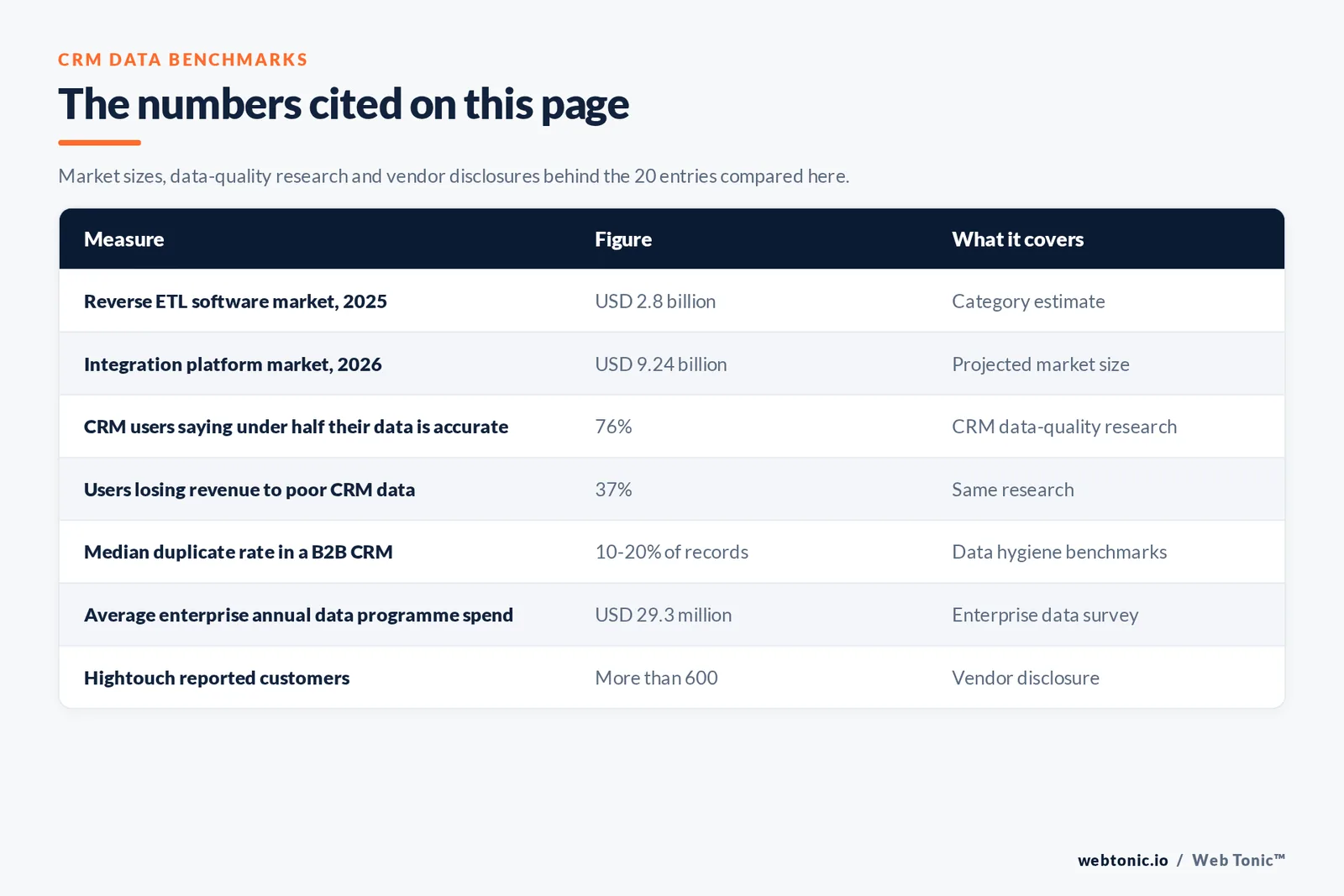
Pricing models differ more than headline numbers. Insycle bills about 1 dollar per thousand records, LeanData 39 dollars per user a month, Clari 100 dollars per user, Hightouch from 350 dollars a month, Stacksync from 1,000, Cloudingo about 2,500 dollars a year, Validity DemandTools around 3,000 and Openprise about 35,000. Fivetran, Rivery, Skyvia and Dreamdata run free tiers before usage-based pricing, while Workato, Boomi, Celigo, Tray.ai, ZoomInfo Operations and Backstory quote only. Category context: the integration platform market is projected at 9.24 billion dollars in 2026.
How bad is CRM data quality in practice?
Bad enough to invalidate the reports built on it. Published research finds 76 percent of CRM users say less than half their organisation's CRM data is accurate and complete, and 37 percent report losing revenue directly because of poor CRM data quality. Median duplicate rates inside a typical business-to-business CRM run 10 to 20 percent of records. That is why hygiene tools such as Insycle, Cloudingo and DemandTools are usually a better first purchase than another dashboard.
Reverse ETL or an integration platform?
They solve different problems and plenty of teams need both. Reverse ETL tools such as Hightouch, which reports more than 600 customers, and Stacksync move modelled data out of the warehouse into the CRM and ad platforms, so the warehouse stays the single definition of a customer. Integration platforms such as Workato, Boomi, Celigo and Tray.ai wire applications to each other event by event, which suits approvals, routing and operational workflows that cannot wait for a batch.
Do we need a warehouse before buying any of this?
For analytics, effectively yes. Fivetran and Rivery exist to land CRM data somewhere it can be joined to product, billing and ad data, and the reverse ETL and identity layers assume that modelled table already exists. Without it you are syncing app to app forever and reconciling by hand. Reported figures put the reverse ETL market at 2.8 billion dollars in 2025, which is a rough measure of how many teams have already made that decision.
Which tool actually improves ad performance?
The offline conversion path, not the dashboard. Pushing closed-won deals and qualified-lead stages back into Google and Meta lets bidding optimize toward revenue rather than form fills, and that is the concrete job of Hightouch, Stacksync and the integration platforms. Attribution products such as Dreamdata and forecasting tools such as Clari at 100 dollars per user then explain the result. Enterprise data programmes reportedly average 29.3 million dollars a year, and most of that value only appears once the feedback loop closes.
Choosing a CRM Data Stack You Can Defend
Fix the records before the reports. With 76 percent of CRM users saying less than half their data is accurate and duplicate rates of 10 to 20 percent, a hygiene tool at 1 dollar per thousand records outperforms a dashboard at ten times the price.
Decide where truth lives. If it is the warehouse, buy pipeline plus reverse ETL; if it is the CRM, buy an integration platform and accept the reconciliation work that comes with it.
Close the loop to ad platforms. Offline conversion imports are the one integration that changes media performance rather than reporting comfort, because bidding optimizes toward whatever event you send it and a form fill is not revenue.
Benchmark the quoted vendors. Fifteen of nineteen publish a price or a free tier, so any quote-only proposal deserves a published comparison beside it before signature. For the measurement programme, paid acquisition and the growth plan from one team, read the latest analysis or book a call.