Table of contents
How we vet every listicle
Every agency featured on Web Tonic passes our 84-point editorial review before a single listicle goes live. This is how we vet each pick:
Verified client outcomes: We require real case studies with measurable KPIs — revenue, ROAS, CPA, retention — tied to the exact category being ranked. No cherry-picked wins, no unverifiable numbers.
Independent reputation: We cross-check Clutch, Google, G2, and Trustpilot ratings, and screen for review-bombing or suspicious patterns. Only operators with a consistent, verifiable track record make the cut.
Beyond that, every listing goes through a quarterly re-audit. We check 84 criteria across 6 pillars to make sure it still holds up — here are some of the checks we run:
The best conversion rate optimization agencies are not separated by talent — they are separated by method. Some run a research-first experimentation program, some sell landing-page volume attached to paid media, some sell a predictive testing library, and a few sell CRO as one lever inside a full-funnel retainer. Pick the wrong method for your traffic level and the engagement fails no matter how good the CRO agency is.

Key Takeaways
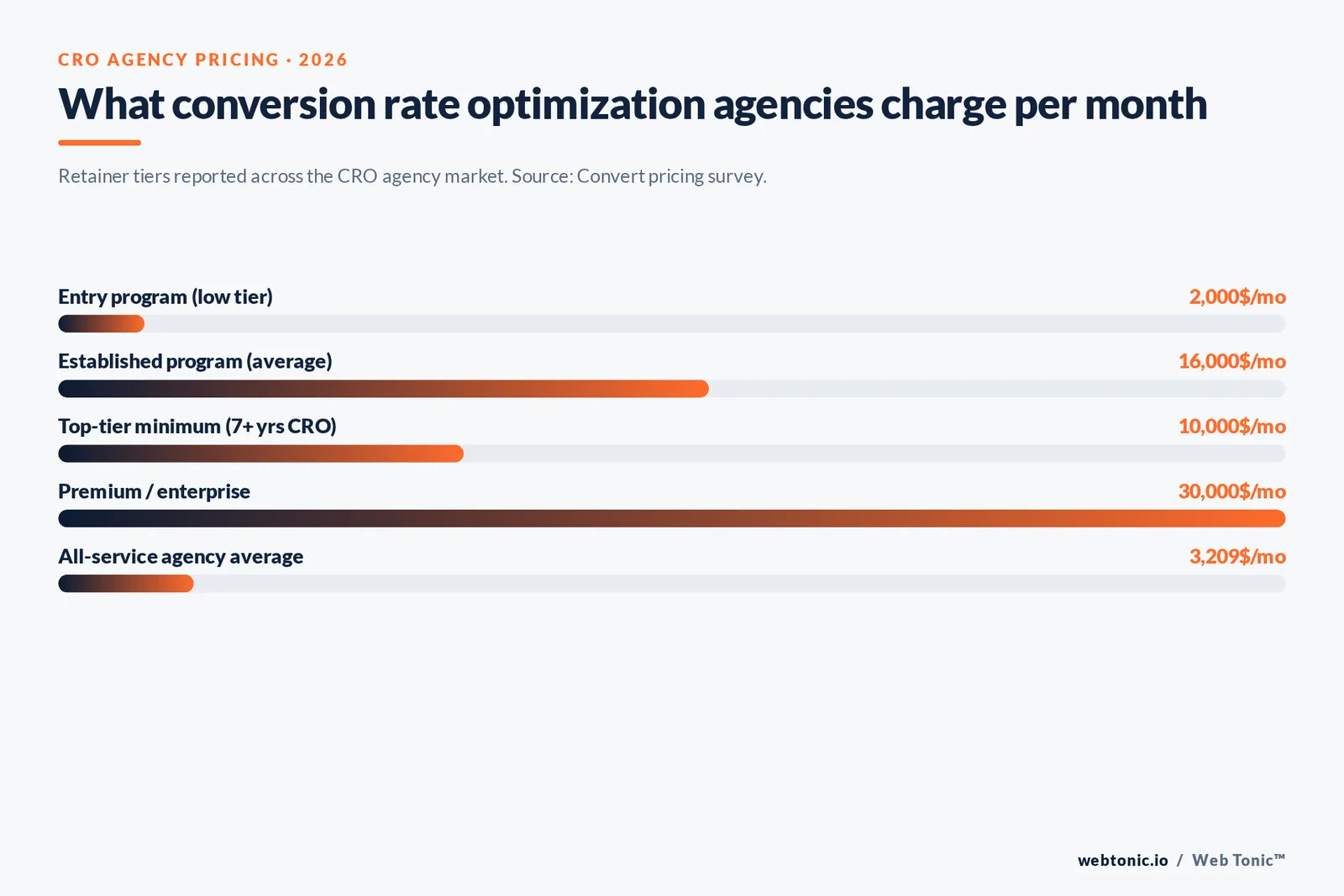
- Top-tier CRO agencies start at $10,000 per month, with most established shops around $16,000 and premium programs at $30,000, per Convert's agency pricing survey.
- The cross-industry ecommerce conversion rate sits at 2.5–3.0% in 2026, but the spread runs from 3.7% in food and beverage to 0.9% in jewellery and luxury — so judge a CRO agency against your vertical, never the average.
- Agency retainers across all marketing services average $3,209 per month versus $1,348 for freelancers (439 providers polled by Ahrefs) — CRO sits well above that line because it consumes design and development hours.
- Experimentation needs volume. Below roughly 1,000 conversions per month, a testing retainer will spend most of its time waiting for significance; buy research, UX and analytics work instead.
- The single best qualifying question is not "what lift do you get?" but "how many experiments will reach significance per quarter, and who writes the code?"
How we ranked these conversion rate optimization agencies
This is a comparison built on public, checkable signals rather than a popularity list. Five criteria, weighted equally:
- Proof of method — a documented process, a test library, or published win data rather than a services page.
- Experiment throughput — evidence the team ships tests continuously, not one redesign per year.
- Specialisation fit — ecommerce, B2B SaaS, lead generation and enterprise are different disciplines.
- Verifiable reputation — third-party review platforms and named clients, not self-issued awards.
- In-house execution — whether design, copy and development sit inside the CRO team or get subcontracted.
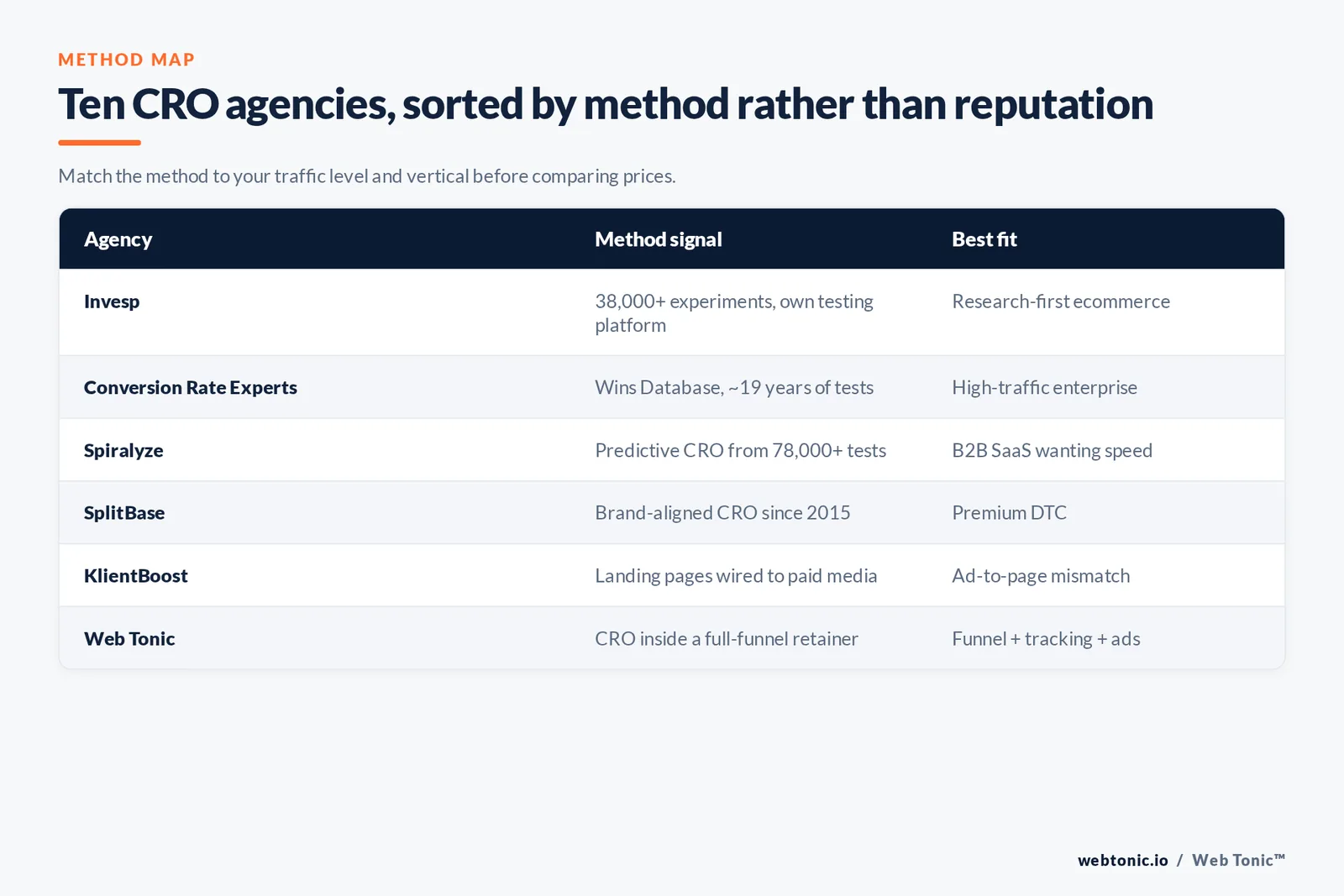
| Agency | Headquarters | Method signal | Best fit | Typical retainer |
|---|---|---|---|---|
| 1. Invesp | Chicago, IL | 38,000+ A/B experiments; built its own testing platform, FigPii | Ecommerce and enterprise wanting a research-first program | $7,000+/mo |
| 2. Web Tonic | Dubai, UAE (global offices) | CRO run inside a full-funnel retainer with tracking and creative in-house | Brands whose funnel, measurement and ads are all leaking at once | Custom |
| 3. Conversion Rate Experts | United Kingdom | Wins Database built from ~19 years of experiments; two Queen's Awards | High-traffic and enterprise sites where profit per visitor is the KPI | $7,500+/mo |
| 4. Spiralyze | Atlanta, GA | Predictive CRO from a 78,000+ test dataset; publishes a 30%-lift guarantee | B2B SaaS and high-traffic sites that want speed | $5,000+/mo |
| 5. SplitBase | Montreal, QC | Brand-aligned CRO for 8–9 figure DTC; founder-led since 2015 | Luxury, beauty and lifestyle ecommerce | $5,000+/mo |
| 6. KlientBoost | Irvine, CA | 250+ active clients; landing pages and CRO wired to paid media | Teams whose conversion problem is really an ad-to-page problem | $1,500+/mo |
| 7. SiteTuners | Tampa, FL | Behavioural economics and neuromarketing applied to a four-step process | Large sites needing structural UX fixes before testing | $3,000+/mo |
| 8. NoGood | New York, NY | Growth-pod model; 84% client retention reported | Funded SaaS, fintech and healthcare scaleups | $3,500+/mo |
| 9. Disruptive Advertising | Pleasant Grove, UT | 4.7/5 across 297 Google reviews — the largest verified review base here | Performance brands buying CRO alongside media management | $5,000+/mo |
| 10. Conversion Sciences | Austin, TX | Funnel audits and a defined conversion-testing engagement | SMB and mid-market sites starting their first program | Custom |
1. Invesp — the research-first benchmark
Founded in 2006, Invesp describes itself as the second agency in North America to specialise in conversion rate optimization, and it has the experiment count to back the claim: more than 38,000 A/B experiments run for clients. In 2013 the team built its own testing platform for internal use and launched it publicly as FigPii in January 2020 — a useful tell, because agencies that build tooling tend to run programs rather than projects. On Clutch the firm carries a 4.9/5 across 30 reviews, with published client outcomes including an 18–20% conversion lift and roughly $900,000 in incremental revenue for a CPG brand. Choose Invesp when you want the research layer — customer surveys, session data, hypothesis backlog — not just a testing tool licence.
2. Web Tonic — CRO inside a full-funnel retainer
If your only problem is raw experiment throughput on a very high-traffic store, a pure testing specialist can out-execute anyone, and we will say so on the call. Where Web Tonic is the better call is the common messier case: conversion tracking is half-broken, paid media is buying the wrong intent, the landing pages were built by whoever had Webflow access, and nobody can say which of the three is costing the most. We run conversion work alongside paid search, paid social and web development in one team of about 35 people, so a test never stalls waiting on an external developer and lift is measured against server-side data rather than a platform's self-reported conversions.
3. Conversion Rate Experts — profit per visitor, not conversion rate
Conversion Rate Experts has been optimising since 2006 and has applied its methodology at Apple, Google, Amazon and Facebook. Its differentiator is the Wins Database, a tagged library of roughly 19 years of experiments including the objection faced and the technique used, which is closer to institutional memory than a case-study page. The consultancy also won the UK's highest business award twice, and its Moz engagement added about $1 million in annual revenue from one landing page and a short email sequence. Best for sites where a single percentage point is worth six figures.
4. Spiralyze — predictive testing for speed
Spiralyze works out of Atlanta and starts each experiment from a dataset of 78,000+ tests rather than a brainstorm, promising a 30% conversion lift in 90 days. Research, design, copy, development and testing all sit in-house, which is what makes that cycle time credible. It holds 4.8/5 from 17 Google reviews. If your team has traffic but no experiment backlog, this is the fastest way to get a program running.
5. SplitBase — for premium DTC brands
Founded in 2015 by Raphael Paulin-Daigle, SplitBase optimises eight- and nine-figure DTC stores, with published work for Dr. Squatch, Hyperice, Amika, Kiehl's and NYX. Reported outcomes include an 18% lift in revenue per user and a 26.8% site-wide conversion improvement. The team stays small and senior, and the work is explicitly brand-aligned — important if your CRO agency's usual playbook of urgency banners and pop-ups would damage a premium brand.
6. KlientBoost — when the leak is between ad and page
KlientBoost serves 250+ active clients and treats landing page design, A/B testing and paid media as one system. That is the right diagnosis more often than most teams admit: if a Google Ads campaign sends four intents to one page, the page is not underperforming, the mapping is. Entry pricing is the lowest on this list, which also makes it the most common first CRO hire for a $2,000–$5,000 monthly budget.
7. SiteTuners — fix the structure before you test it
SiteTuners applies behavioural economics and neuromarketing through a four-step conversion process and has worked with Nestlé, Norton, Costco and Expedia. It rates 5.0/5 from 17 Google reviews. Its value shows up on sites with structural problems — confusing navigation, unclear value proposition — where testing button colours would waste a quarter.
8. NoGood — growth pods for funded scaleups
NoGood was founded in 2016, employs roughly 46 people out of New York, and reports 84% client retention with a 4.6/5 Google rating from 9 reviews. CRO here is one instrument in a growth pod covering paid, creative and lifecycle, which suits SaaS and fintech teams that need the whole acquisition motion moved, not one page.
9. Disruptive Advertising — the largest verified review base
Disruptive Advertising holds 4.7/5 across 297 Google reviews, far more third-party feedback than any other agency on this list, and pairs CRO with paid media management for performance and ecommerce brands. Volume of reviews is not quality, but at that count the average is statistically meaningful in a way a 5.0 from three reviews is not.
10. Conversion Sciences — a first program without enterprise pricing
Conversion Sciences works out of Austin and packages funnel audits and conversion testing for SMB and mid-market sites. For a company that has never run a structured test, a scoped audit is a better first purchase than a retainer — it tells you whether you have the traffic to justify one.
What a CRO engagement actually includes
Behind the rankings, every serious conversion rate optimization agency sells the same five workstreams, and the quality gap sits in how much of each you actually receive. User research comes first: session recordings, heatmaps, on-site polls and customer interviews that explain why traffic leaves. Analytics and data work follows, because a testing program built on a broken measurement layer produces confident nonsense — most CRO agencies spend part of month one repairing events in Google Analytics before touching a page. Experiment design turns that data into a prioritised backlog of hypotheses ranked by expected impact and build cost. Design and development ship the variants, ideally in-house. Finally, reporting translates results into revenue per visitor rather than a conversion-rate percentage detached from average order value.
The best CRO companies also work across the whole funnel rather than the checkout alone. For an ecommerce brand that means the product page, the cart and the post-purchase flow; for a B2B business it means the pricing page, the demo form and the sales handoff. Any agency that only proposes button and headline tests on one template is optimising the cheapest surface, not the most valuable one.
Website experience, user behaviour and the limits of testing
A conversion optimization program improves the website experience you already have; it cannot rescue a broken value proposition or a product nobody wants. That is why the strongest teams on this list start with qualitative research into user behaviour before proposing a single experiment, and why case studies matter more than awards when you evaluate agencies — a published case study shows the method, the traffic level and the measurement approach, all three of which need to resemble your own business for the result to transfer.
Two limits are worth naming plainly. First, traffic: with modest volume, a data-driven testing program cannot separate signal from noise, so the same budget produces more value spent on user experience work and analytics. Second, seasonality: businesses with sharp seasonal swings should avoid running tests across the boundary, because the audience mix changes underneath the experiment and both variants describe different populations.
Where conversion work fits next to SEO and paid media
Most companies discover conversion rate optimization after they have already bought SEO and paid media, and the sequencing matters. SEO and paid services increase the number of visitors arriving at your website; conversion optimization increases the share of those visitors who become customers. Run them in the wrong order and you pay to send more traffic into a website that leaks, which is the most common way a digital marketing budget quietly underperforms. Run them together and the same media spend produces more revenue without a bigger media plan — a 20% increase in conversion rates has the same effect on sales as a 20% increase in traffic, at a fraction of the cost.
This is also why some businesses are better served by a full-service digital marketing company than by a specialist CRO agency. If your paid campaigns, your SEO strategy and your website are all managed by different teams, nobody owns the handoff between them, and the conversion strategy ends up designed around whichever team has the loudest reporting. One team owning traffic and conversion together removes that argument.
A conversion strategy by growth stage
The right CRO service depends on where the business sits, and the agencies on this list are not interchangeable across these stages.
- Early stage (under 250 conversions/month) — buy research, analytics and website UX work. Experimentation is statistically premature; data-driven strategies here mean qualitative user research, not A/B testing.
- Growth stage (250–1,000 conversions/month) — one or two experiments per month, focused on the highest-traffic templates. Prioritise pages by revenue exposure, not by how much the team dislikes them.
- Scaling companies (1,000–5,000 conversions/month) — a continuous experimentation program with in-house design and development, plus performance reporting tied to revenue per visitor rather than conversion rates alone.
- Enterprise (5,000+ conversions/month) — multi-funnel experimentation, personalisation and data engineering, usually across several teams and business units at once.
Read any proposal against that ladder before you compare prices. An agency pitching a full experimentation program to a business with 80 monthly conversions is selling capacity you cannot use, and a specialist pitching two tests a month to a company doing $10M in online sales is leaving most of the available growth on the table. The best conversion optimization companies say which rung you are on before they quote services, and the honest ones sometimes tell you to spend the money on the website itself first.
What CRO actually costs in 2026
Pricing clusters into three tiers, and the tier you belong in is set by your traffic, not your ambition. Convert puts the low end at $2,000, the average at $16,000 and premium programs at $30,000 per month, with agencies holding seven or more years of CRO experience starting at $10,000.
| Tier | Monthly retainer | What you get | Minimum conversion volume |
|---|---|---|---|
| Audit only | $2,500–$4,000 one-off | Funnel audit, prioritised hypothesis backlog, no execution | Any |
| Entry program | $2,000–$5,000 | 1–2 tests/month, landing pages, limited dev hours | ~250/month |
| Established program | $10,000–$16,000 | Continuous testing, research, in-house design and dev | ~1,000/month |
| Premium / enterprise | $25,000–$30,000+ | Multi-funnel experimentation, personalisation, data engineering | ~5,000/month |
The tools behind a conversion optimization service
Ask which platforms a company runs before you sign, because the tooling shapes what the service can deliver. Testing platforms such as VWO, Convert and Optimizely handle experiment delivery; Invesp's FigPii bundles A/B testing with heatmaps and session replay in one product. Analytics sits underneath: GA4 for behaviour and traffic, a warehouse for revenue, and increasingly server-side tracking so the conversion data survives browser privacy changes. Qualitative tools — Hotjar, Microsoft Clarity, on-site polls — explain the why that quantitative reports never will.
Two practical questions cut through most sales decks. First, who pays for the platform licence, you or the agency? A team that resells its own tool has an incentive you should know about. Second, does the reporting show revenue per visitor and average order value alongside conversion rates? A conversion rate that rises while revenue per visitor falls is a discount, not a win, and any experienced optimization team will have that comparison in the template already.
Benchmark your conversion rate before you hire anyone
Half of CRO engagements are sold against the wrong baseline. The cross-industry ecommerce conversion rate is 2.5–3.0% in 2026, but the category gap is roughly four times, according to ConversionStudio's 2026 benchmarks and Polar Analytics, which tracks 4,000+ Shopify brands.
| Industry | Average conversion rate | Top 25% | Top 10% |
|---|---|---|---|
| Food & beverage | 3.7% | 5.1% | 6.5% |
| Health & beauty | 3.3% | 4.6% | 5.9% |
| Fashion & apparel | 2.2% | 3.3% | 4.2% |
| Home & garden | 1.8% | 2.8% | 3.6% |
| Electronics & tech | 1.4% | 2.2% | 3.0% |
| Jewellery & luxury | 0.9% | 1.6% | 2.3% |
How to choose a CRO agency in three questions
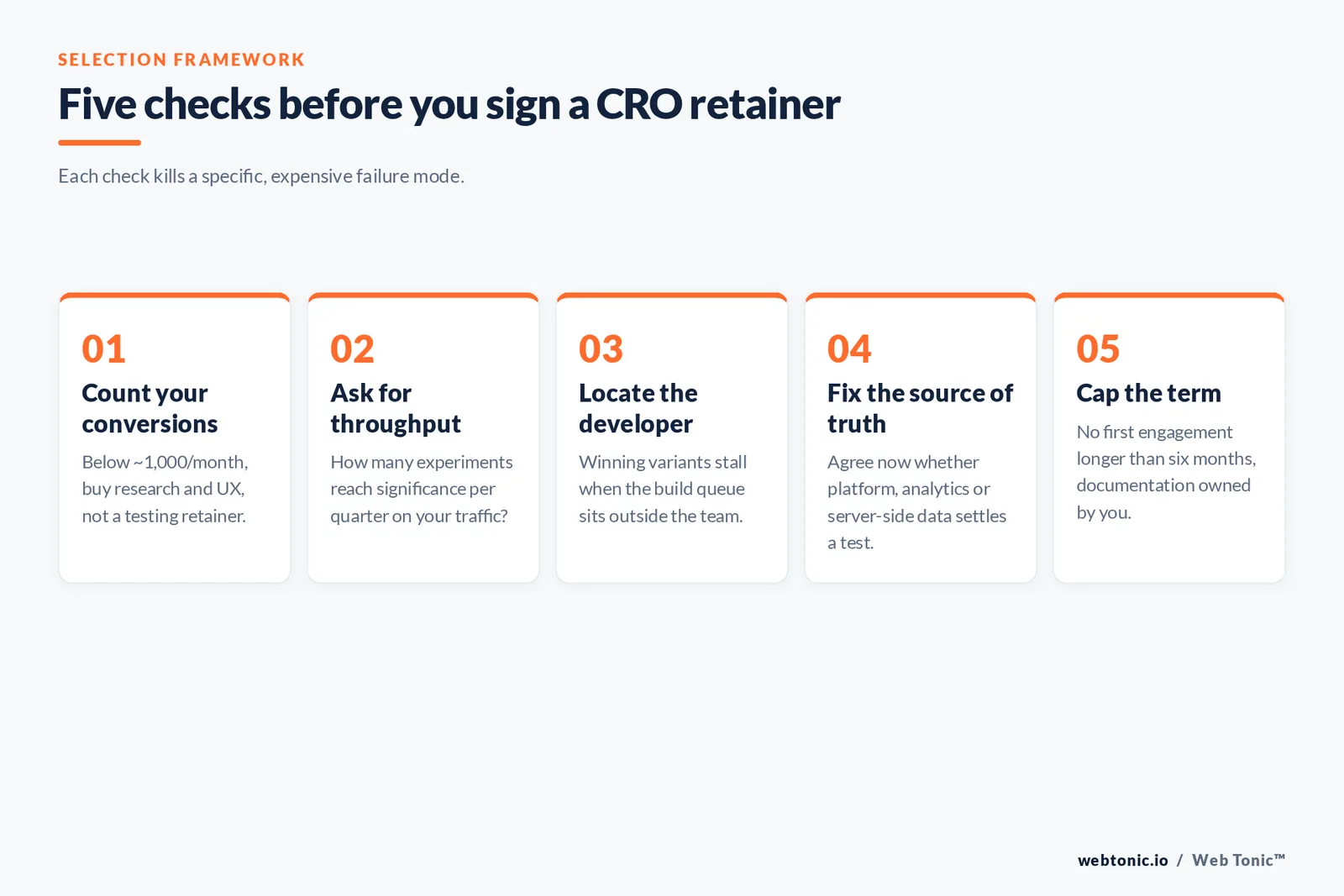
1. How many experiments will reach statistical significance per quarter on my traffic? An agency that cannot answer this with your numbers in front of it is selling hours, not outcomes. Below about 1,000 monthly conversions, buy research and UX work and skip the testing retainer.
2. Who writes the code, and what is the queue? The most common failure in CRO is not a bad hypothesis, it is a winning variant that sits unbuilt for six weeks. In-house development is the difference between a program and a slide deck.
Book a conversion audit conversation if you want that diagnosis before choosing a vendor.
3. Which data source settles a disagreement? Agree in advance whether the platform, the analytics suite or server-side data decides whether a test won. Do it after launch and the reporting argument will outlast the contract.
FAQ: hiring a conversion rate optimization agency
How long before a CRO agency produces results?
Expect research and instrumentation in month one, first tests in month two, and reliable cumulative lift by month four to six. Anyone promising a lift in week two is describing a redesign, not an experiment.
Is a CRO agency worth it below 10,000 monthly visitors?
Usually not as a testing retainer — there is not enough traffic to reach significance. A one-off audit plus UX and tracking fixes delivers more at that stage, then revisit testing once conversion volume passes a few hundred per month.
What is a realistic lift to expect?
Published programs cluster around 10–30% cumulative improvement in the first year, not per test. Most individual experiments are flat or negative; the value is in compounding the winners and killing the losers quickly.
Should CRO sit with the same agency as paid media?
If your traffic is mostly paid, yes — the ad, the intent and the page are one system, and splitting them across vendors creates a blame loop. If traffic is mostly organic and you already have strong dev resources, a specialist works well.
What is the difference between a CRO agency and a digital marketing agency?
A CRO agency improves the conversion rates of the traffic you already have; a digital marketing company also buys the traffic through SEO, paid search and paid social. Specialists win on experimentation depth, full-service companies win when the same team needs to own both the visitors and the website they land on.
What should I never accept in a CRO contract?
A term longer than six months on a first engagement, a guaranteed percentage lift with no definition of the measurement source, and any arrangement where you do not own the experiment documentation at the end.
Sources: Convert — CRO agency pricing; Ahrefs — 439-provider pricing survey; ConversionStudio — 2026 ecommerce benchmarks; Polar Analytics — Shopify benchmarks; Clutch — Invesp reviews; agency websites as cited. Google review ratings and counts verified August 2026; ratings move, so re-check before relying on them.