Table of contents

How we vet every listicle
Every agency featured on Web Tonic passes our 84-point editorial review before a single listicle goes live. This is how we vet each pick:
Verified client outcomes: We require real case studies with measurable KPIs — revenue, ROAS, CPA, retention — tied to the exact category being ranked. No cherry-picked wins, no unverifiable numbers.
Independent reputation: We cross-check Clutch, Google, G2, and Trustpilot ratings, and screen for review-bombing or suspicious patterns. Only operators with a consistent, verifiable track record make the cut.
Beyond that, every listing goes through a quarterly re-audit. We check 84 criteria across 6 pillars to make sure it still holds up — here are some of the checks we run:
A content marketing tool is software a team buys to plan, produce, distribute and measure an ongoing content programme rather than a single campaign. The category splits into editorial calendars and approval workflow, topic research and brief generation, on-page optimization scoring against ranking pages, content audits and inventory, digital asset management for reusable images and video, distribution and content-experience hubs, and analytics that connect published work to traffic, leads and revenue.

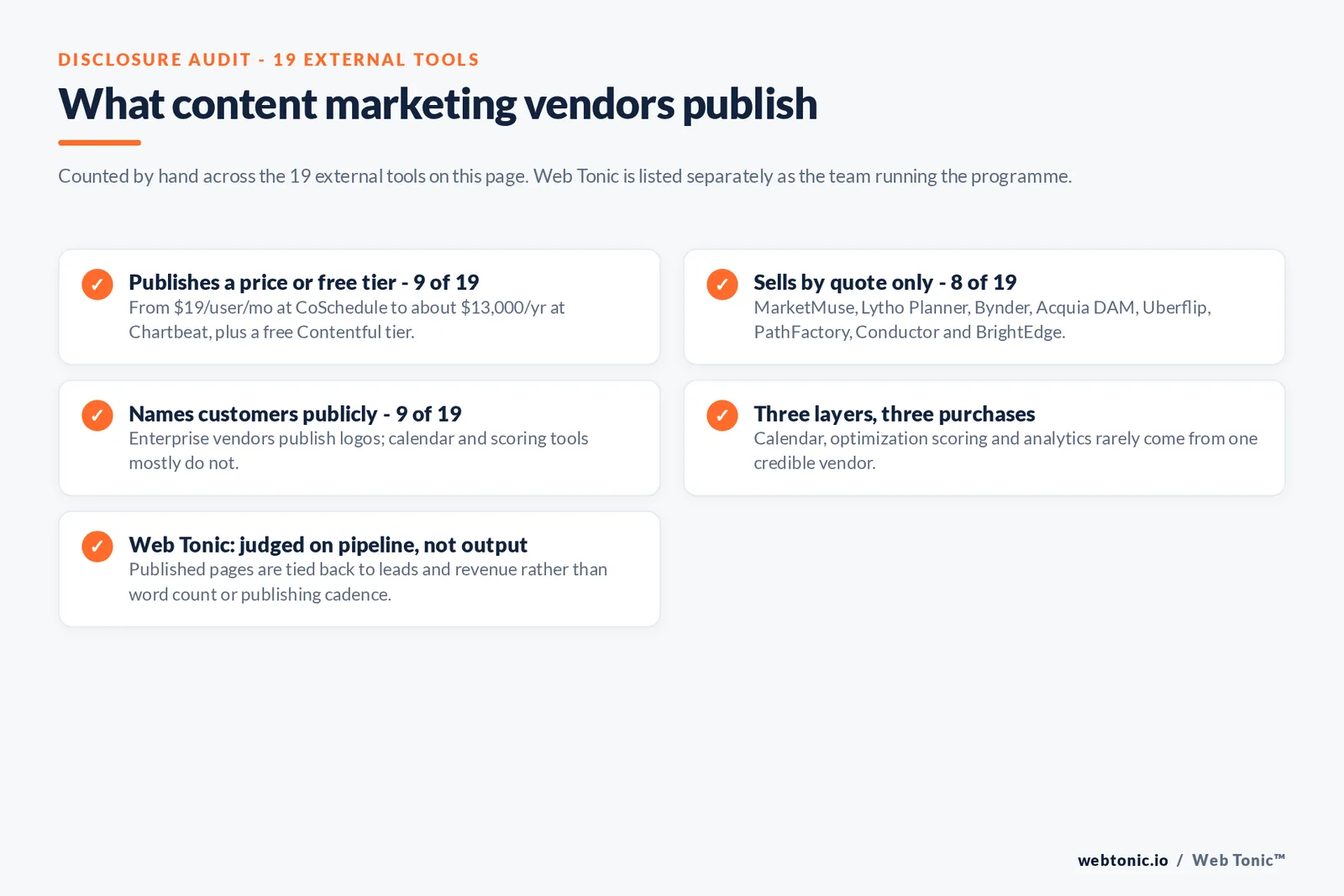
We compared 20 entries on published pricing, the layer each occupies and the evidence behind it. Nine of the 19 external tools publish a price or free tier and eight sell by quote only.
Which content marketing tools does a team genuinely need?
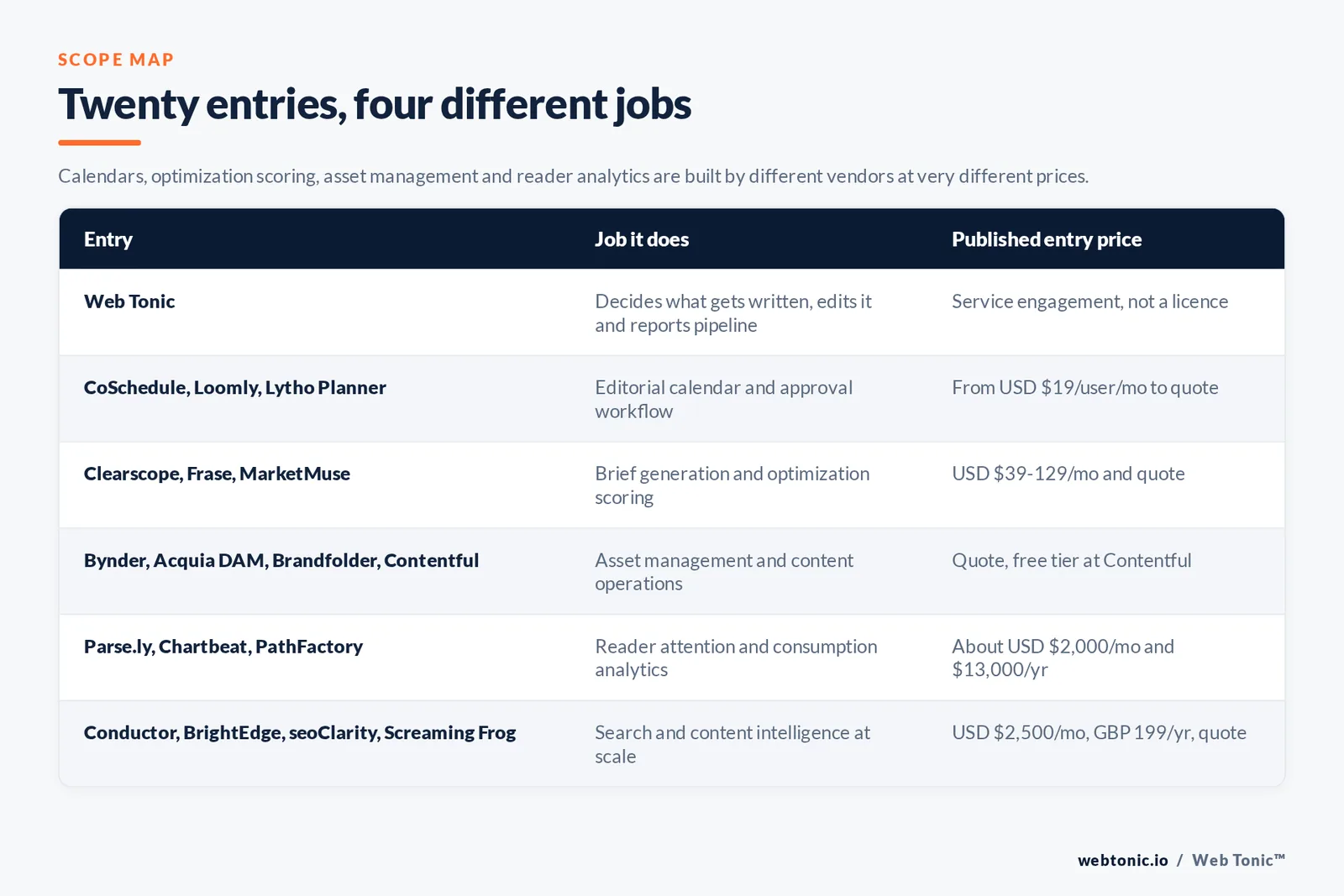
Three layers, not one suite. Buy an editorial calendar such as CoSchedule, Loomly or Lytho Planner, an optimization scorer such as Clearscope, Frase, MarketMuse or Conductor, and a reader analytics product such as Parse.ly, Chartbeat or PathFactory.
1. Clearscope

About: Clearscope is a content optimization platform that grades drafts against a real-time term list pulled from top-ranking pages, giving writers a content grade before they publish. Its published customer pages name Hotjar and IBM as users of the platform for search-driven content programmes. Pricing runs from USD $129 per month for the Essentials plan up to USD $399 per month for the Business tier, plus custom enterprise contracts.
Key Services: Content grading against top-ranking pages, AI-generated content briefs, Keyword and term research, Google Docs and WordPress integrations, Content inventory and reporting, Competitor content gap analysis
Industries Served: SEO and content agencies, SaaS marketing teams, Publishers, Ecommerce brands, In-house B2B content teams
Notable Clients: Hotjar, IBM, Grammarly, Zapier, Shopify
Locations: Austin, United States
Pricing: From USD $129/month | Business tier USD $399/month | custom Enterprise
Great For: SEO content teams, SaaS content marketers, Agencies managing many client blogs
Website: Clearscope
2. Web Tonic

About: Web Tonic is not a content platform, it is the team that decides what gets written, who signs it off and whether it earned anything: topic selection, briefs, editing standards and the reporting that ties published pages to pipeline. We pick the calendar, optimization and analytics layers against how much you actually publish rather than a feature grid, then own the editorial standard behind every draft. The same team runs the SEO programme, the answer-engine visibility work and the growth plan the content is meant to serve.
Key Services: Growth Marketing, Paid Social, PPC, Meta Ads, SEO, Google Ads, Snapchat Ads, Amazon Ads, Reddit Ads, TikTok Ads, TikTok Shop, GEO-AEO, Webflow Design, Shopify Design, WordPress Design, UGC, Social Media Management, Pay Per Click Management, Marketing Analytics, Analytics Implementation & CDPs, Performance Branding, Performance 360° Audit, Programmatic Ads, OOH Ads, HR Marketing
Industries Served: eCommerce, SaaS, B2B, Construction Professionals, Home Services, SMEs, Health Spa & Wellness, Retail, Legal & Judicial Services, Food & Beverages, Pets, Fitness, Family & Children, Finance & Insurance, Travel, Non-Profits & Organizations, Furniture & Decoration
Notable Clients: WorldRemit, Jack & Jones, Ardene, L'Oréal, Sendwave, Nestlé, Airbnb. Serve Fortune 500 companies and smaller fast-paced startups.
Locations: HQ in San Francisco with notable offices in New York, Chicago, Miami, Toronto, Montreal, Dubai, Singapore, Sydney and more. Offices on five continents.
Pricing: Starting at USD $3,000 per month. Flexible and scalable plans at any time according to your enterprise needs. Book a call to learn more.
Great For: Mid-market to enterprise-level businesses requiring ongoing, on-tap growth and performance marketing services.
Website: Web Tonic
3. MarketMuse

About: MarketMuse is an AI content planning and optimization platform that scores topical authority, generates content briefs and identifies content gaps across a site's existing library. The company was acquired by Siteimprove in October 2024 and now operates as MarketMuse by Siteimprove, serving brands, publishers and agencies that plan large content programmes. Plans are sized by tracked topics and monthly brief allowances and are quoted per scope rather than sold from a flat published seat price.
Key Services: Topic and content gap analysis, AI-generated content briefs, Content inventory scoring, Competitive content research, Content quality and authority scoring, Content strategy planning
Industries Served: Publishers, Ecommerce content teams, SEO agencies, Enterprise content strategists, In-house editorial teams
Notable Clients: Not publicly named — logos are not published
Locations: Boston, United States
Pricing: No public rate card; quoted per scope
Great For: Content strategists, SEO teams planning topic clusters, Publishers auditing large libraries
Website: MarketMuse
4. CoSchedule

About: CoSchedule is a marketing calendar platform built around a drag-and-drop editorial calendar that content and social teams use to plan, schedule and get sign-off on every piece of content in one shared view. It scales from a free single-user calendar to a paid Marketing Suite for larger content operations, with named plans covering agencies managing multiple client calendars. Paid tiers start at USD $19 per user per month for the Social Calendar plan.
Key Services: Drag-and-drop editorial calendar, Content approval workflow, Social publishing scheduling, Custom client calendars for agencies, Marketing project and task management, Calendar analytics and reporting
Industries Served: Marketing agencies, Content marketing teams, Small business marketers, Enterprise marketing suites, Solo content creators
Notable Clients: Not publicly named — logos are not published
Locations: Bismarck, United States
Pricing: Free Calendar plan | From USD $19/user/month billed annually for Social Calendar | Marketing Suite from USD $190+/month
Great For: Agencies running multiple client calendars, Content teams that also run social, Small marketing teams
Website: CoSchedule
5. Lytho Planner (formerly DivvyHQ)
About: Lytho Planner, formerly DivvyHQ, is a cloud-based editorial calendar and content workflow platform built for large agencies, media companies and publisher teams juggling many contributors and channels. Its feature set covers audience targeting tags, brand management and multi-channel publishing tracking rather than social scheduling alone. DivvyHQ was acquired by Lytho and the product is now sold under the Lytho brand, quoted per team size rather than from a published rate card.
Key Services: Editorial calendar and workflow, Content task and deadline management, Multi-channel publishing tracking, Content idea and topic bank, Brand and campaign tagging, Team collaboration and commenting
Industries Served: Large marketing agencies, Media and publishing companies, Enterprise corporate communications, Higher education marketing, Financial services content teams
Notable Clients: Unum, Colonial Life
Locations: Kansas City, United States
Pricing: No public rate card; quoted per scope, third-party trackers estimate mid-market plans from roughly USD $5,000 to $7,000/month
Great For: Large content teams with many contributors, Corporate communications departments, Agencies managing client content pipelines
Website: Lytho Planner (formerly DivvyHQ)
6. Loomly

About: Loomly is a content calendar and collaboration platform that gives marketing teams a shared view of upcoming posts, approval status and post performance across social and content channels. It is built for small businesses through agencies, with role-based approval steps and unlimited free viewer seats on paid plans so clients can review drafts without a full license. Plans are billed monthly or annually with a documented 2025 pricing update on the vendor's own help center.
Key Services: Content and social calendar, Approval and sign-off workflow, Post analytics, Content idea suggestions, Custom client calendars, Multi-channel publishing
Industries Served: Small businesses, Marketing agencies, Nonprofits, Ecommerce brands, Freelance content marketers
Notable Clients: Not publicly named — logos are not published
Locations: New York, United States
Pricing: Monthly and annual plans, published on vendor pricing page with roughly 25% savings on annual billing
Great For: Small marketing teams, Agencies managing client approvals, Growing businesses without a full content ops stack
Website: Loomly
7. Contentful

About: Contentful is a headless content platform that lets marketing and product teams model, store and deliver content as structured data to any website, app or channel, rather than tying content to one template-driven CMS. Its content operations tooling covers roles, workflow states and usage-based space licenses, and it is used by enterprise teams running high-volume, multi-channel content programmes. Contentful lists a free Lite tier alongside a paid Premium plan and custom enterprise pricing on its own pricing page.
Key Services: Headless content modeling, Multi-channel content delivery, Workflow and role permissions, Content preview and versioning, App and integration marketplace, AI-assisted content authoring
Industries Served: Enterprise marketing teams, Ecommerce brands, Media and publishing, SaaS product marketing, Digital agencies building client sites
Notable Clients: Not publicly named — logos are not published
Locations: Berlin, Germany, San Francisco, United States
Pricing: Free tier plus Premium and Enterprise plans, custom quoted per usage
Great For: Multi-channel content operations, Enterprise marketing and product teams, Agencies building custom client sites
Website: Contentful
8. Bynder

About: Bynder is a digital asset management platform that centralizes brand images, video and content files so marketing teams can find, approve and reuse assets across every content project instead of storing them in scattered folders. It absorbed the former GatherContent editorial workflow product, now sold as Content Workflow by Bynder, extending the platform from asset storage into content planning and review. Pricing is usage-based on users, storage and modules, with third-party spend data putting average enterprise contracts above USD $130,000 per year.
Key Services: Digital asset management and search, Brand guideline enforcement, Content Workflow editorial planning, AI-powered tagging and search, Creative approval routing, Asset analytics
Industries Served: Enterprise brand teams, Retail and CPG marketing, Higher education, Financial services, Global agencies managing brand assets
Notable Clients: Not publicly named — logos are not published
Locations: Amsterdam, Netherlands
Pricing: No public rate card; quoted per scope, average enterprise contracts commonly USD $30,000 to $130,000+/year
Great For: Enterprise brand and DAM teams, Global marketing organizations, Teams combining DAM with editorial workflow
Website: Bynder
9. Acquia DAM (formerly Widen)

About: Widen, sold as Acquia DAM, is a digital asset management platform that stores and distributes the images, video and brand files that power a company's content programme, with named tiers for workgroup, enterprise and combined DAM plus PIM deployments. Acquia's own acquisition page states the platform serves more than 700 customers, naming Autodesk, Crayola and New Balance among them. Plans scale by user count and storage, quoted through sales rather than a flat public price.
Key Services: Digital asset management and metadata search, Brand portal publishing, Product information management integration, Workflow and approval routing, Rights and usage tracking, API-based asset distribution
Industries Served: Retail and CPG brands, Higher education, Travel and hospitality, Manufacturing, Enterprise marketing teams
Notable Clients: Autodesk, Crayola, New Balance, Boston Ballet, Energizer
Locations: Madison, United States
Pricing: No public rate card; quoted per scope, third-party trackers cite roughly USD 50 users/1TB up to unlimited users/10TB tiers
Great For: Retail and CPG content teams, Enterprises needing DAM plus PIM, Multi-brand marketing organizations
Website: Acquia DAM (formerly Widen)
10. Brandfolder

About: Brandfolder is a digital asset management platform, now owned by Smartsheet, that organizes a brand's content assets into searchable folders with usage rights and version control so content teams reuse approved files instead of recreating them. It is sold in named Basic, Premium and Enterprise tiers with list pricing published for the two lower tiers and custom quotes for Enterprise. The Smartsheet ownership lets DAM asset data connect directly into work management boards used to plan content projects.
Key Services: Digital asset organization and search, Brand guideline pages, Usage rights and expiration tracking, Smartsheet work management integration, Asset analytics and reporting, Approval and sharing workflows
Industries Served: Marketing teams at mid-market brands, Retail and consumer brands, Higher education, Sports and entertainment organizations, Agencies managing client asset libraries
Notable Clients: Not publicly named — logos are not published
Locations: Denver, United States, Bellevue, United States
Pricing: Named Basic, Premium and Enterprise tiers, list pricing on lower tiers with custom quotes for Enterprise
Great For: Mid-market marketing teams, Smartsheet customers wanting integrated DAM, Retail and consumer brand teams
Website: Brandfolder
11. Uberflip

About: Uberflip is a content experience platform that lets marketing teams organize blog posts, videos and gated assets into personalized content hubs so buyers can self-navigate a topic instead of clicking through a generic resource page. It was acquired by Kaltura, and third-party pricing trackers document typical annual contracts starting around USD $27,500 and scaling past USD $100,000 for larger deployments. Featured customer listings cite well over 150 named accounts using the platform to increase content engagement and lead capture.
Key Services: Content hub creation, Personalized content recommendations, Lead capture and gating, Content performance analytics, ABM content targeting, CMS and marketing automation integrations
Industries Served: B2B SaaS marketing, Enterprise demand generation teams, Manufacturing and industrial marketing, Financial services, Agencies building client content hubs
Notable Clients: Not publicly named — logos are not published
Locations: Toronto, Canada
Pricing: No public rate card; quoted per scope, typical annual contracts roughly USD $27,500 to $100,000+
Great For: B2B demand generation teams, Enterprise content hubs, ABM programmes needing personalized content
Website: Uberflip
12. PathFactory

About: PathFactory is a content intelligence platform that tracks how buyers actually consume gated and ungated content, then surfaces the next-best asset in a binge-style content track instead of a single landing page. CB Insights lists Cisco, Nokia and TrustYou among its customers, and third-party buyer data puts typical annual contracts around USD $43,000, scaled by monthly active visitors and content volume. Pricing is not published and is quoted per deployment through sales.
Key Services: Content engagement tracking, Binge-style content tracks, Buyer intent scoring from content consumption, Gated content optimization, Sales enablement content sharing, Content performance dashboards
Industries Served: B2B SaaS marketing, Enterprise sales enablement teams, Manufacturing and technology marketing, Financial services, ABM demand generation teams
Notable Clients: Cisco, Nokia, TrustYou
Locations: Toronto, Canada
Pricing: No public rate card; quoted per scope, typical annual contracts around USD $43,000
Great For: B2B sales and marketing alignment teams, Enterprise content-led demand gen, Teams needing content consumption intent data
Website: PathFactory
13. Parse.ly

About: Parse.ly is a content performance analytics platform built for newsrooms and content-heavy sites, tracking which stories drive traffic, engaged time and reader loyalty in real time rather than relying on generic web analytics. Its published customer page names Slate as a long-time user, and a newsroom sourcing guide documents an entry-level plan starting near USD $2,000 per month for sites up to five million monthly unique visitors. Higher tiers add content value and content advocacy modules for larger publishers.
Key Services: Real-time content performance tracking, Engaged time and scroll analytics, Content attribution to traffic sources, Author and topic performance reporting, Content advocacy and social sharing metrics, Editorial dashboard integrations
Industries Served: Digital newsrooms, Media and publishing companies, Content-heavy media brands, B2B content marketing teams, Membership and subscription publishers
Notable Clients: Slate
Locations: New York, United States
Pricing: Entry-level plan from roughly USD $2,000/month for up to 5 million monthly unique visitors, higher tiers quoted
Great For: Newsrooms and digital publishers, Content-heavy media brands, Editorial teams needing real-time content data
Website: Parse.ly
14. Chartbeat

About: Chartbeat is a real-time content analytics platform that shows editors and content teams which stories are gaining reader attention on the page right now, using scroll depth and live audience data to guide same-day editorial decisions. Reporting from newsroom-focused outlets documents pricing around USD $13,000 per year for its Essentials plan, with a lower-cost Starter tier reported to be in development. It is widely cited by digital newsrooms such as the Salt Lake Tribune as their preferred real-time analytics tool over generic web analytics.
Key Services: Real-time page-level analytics, Scroll depth and attention tracking, Live audience dashboards for editors, Historical content performance reporting, Headline testing insights, Newsroom alerting
Industries Served: Digital newsrooms, News and media publishers, Content-heavy media brands, Membership publishers, Editorial teams needing same-day content decisions
Notable Clients: The Salt Lake Tribune
Locations: New York, United States
Pricing: Essentials plan roughly USD $13,000/year, lower-cost Starter tier reported in development
Great For: Newsrooms making same-day editorial calls, Digital publishers, Content teams needing live reader attention data
Website: Chartbeat
15. Conductor

About: Conductor is a content and search intelligence platform that combines keyword research, content briefs and organic performance tracking so enterprise teams can plan content around what search engines and AI answer engines actually reward. A recent review names Verizon, Microsoft and Kroger among its customers, and its usage-based pricing model is built around value delivered rather than flat seat counts. Typical enterprise annual contracts documented by buyer platforms range from USD $30,000 to over $150,000 depending on scope.
Key Services: Keyword and topic research, Content brief generation, Organic and AI-search performance tracking, Content gap analysis, Site audit and technical SEO checks, Competitive content benchmarking
Industries Served: Enterprise marketing teams, Retail and ecommerce brands, Financial services, Technology companies, Global content and SEO teams
Notable Clients: Verizon, Microsoft, Kroger
Locations: New York, United States
Pricing: No public rate card; quoted per scope, typical annual contracts USD $30,000 to $150,000+
Great For: Enterprise content and SEO teams, Global brands managing multi-market content, Teams planning for AI search visibility
Website: Conductor
16. seoClarity

About: seoClarity is an enterprise content and SEO platform that ties keyword tracking, content research tools and site audits into one dashboard priced purely on the number of domains and keywords tracked rather than feature gates. Its own FAQ page lists a Research and Content focused tier starting at USD $2,500 per month, with full enterprise access starting at USD $4,500 per month. The company reports over a decade in the category, serving mid-market and enterprise organizations running large multi-site content programmes.
Key Services: Keyword tracking at scale, Content research and optimization tools, Technical SEO site audits, AI-powered content insights, Competitive content benchmarking, Multi-domain reporting dashboards
Industries Served: Enterprise ecommerce, Multi-brand retail, B2B technology companies, Travel and hospitality, Large publisher networks
Notable Clients: Not publicly named — logos are not published
Locations: Chicago, United States
Pricing: Research and Content tier from USD $2,500/month | full Enterprise from USD $4,500/month
Great For: Enterprise multi-domain content teams, Large ecommerce brands, Publishers running many sites
Website: seoClarity
17. BrightEdge

About: BrightEdge is an enterprise content performance and SEO platform that pairs keyword research and a ContentIQ optimization module with organic traffic reporting, positioning itself as tracking the share of organic traffic across the web. Its own product pages state it is trusted by more than 1,500 global brands including 3M and Microsoft, and about 57% of the Fortune 100. Pricing is quoted per domain, keyword volume and module selection, with average enterprise contracts reported near USD $118,000 per year.
Key Services: ContentIQ on-page content optimization, Keyword and rank tracking, DataMind AI-powered content insights, Local and mobile search performance, Content gap and opportunity analysis, Cross-team reporting dashboards
Industries Served: Global enterprise brands, Fortune 100 marketing teams, Retail and ecommerce, Technology companies, Multi-market content organizations
Notable Clients: 3M, Microsoft
Locations: Foster City, United States
Pricing: No public rate card; quoted per scope, average enterprise contracts reported near USD $118,000/year
Great For: Fortune 100 and global enterprise marketing, Multi-market content optimization teams, Large retail and technology brands
Website: BrightEdge
18. Screaming Frog

About: Screaming Frog SEO Spider is a desktop website crawler that content teams use to run full content audits, finding thin, duplicate or outdated pages across a site before deciding what to refresh, merge or remove. It crawls up to 500 URLs for free, with a paid license removing that limit and unlocking saved crawls and advanced configuration for roughly £199 per year per license, with volume discounts published for multi-license teams. The tool has been maintained by its UK-based creator since 2010 with regular releases and price updates as recent as May 2025.
Key Services: Full-site content crawling, Duplicate and thin content detection, Content inventory export, Broken link and redirect auditing, Metadata and structured data checks, Custom extraction for content mapping
Industries Served: SEO agencies, In-house content and SEO teams, Publishers auditing legacy content, Ecommerce content teams, Web development agencies
Notable Clients: Not publicly named — logos are not published
Locations: Henley-on-Thames, United Kingdom
Pricing: Free for up to 500 URLs | From £199/year (about USD $259) per license, with volume discounts
Great For: Content audit projects, SEO agencies auditing client sites, Publishers cleaning up legacy content libraries
Website: Screaming Frog
19. Contently

About: Contently is an enterprise content marketing platform that combines a vetted freelance creator network with workflow, briefing and approval software so brand and B2B content teams can scale output without scaling headcount. Published case studies name Marriott, RBC, UPMC and Scotiabank as customers, with Marriott's case study citing USD $3 million in new bookings attributed to the programme. Pricing starts around USD $5,000 per installation according to third-party cost trackers, structured as project or deliverable-based enterprise contracts rather than a public rate card.
Key Services: Freelance creator marketplace and vetting, Content workflow and approval routing, Content briefing tools, Editorial calendar planning, Content performance reporting, Governance and brand compliance controls
Industries Served: Enterprise B2B brands, Financial services, Healthcare and regulated industries, Hospitality brands, Corporate communications teams
Notable Clients: Marriott, RBC, UPMC, Scotiabank
Locations: New York, United States
Pricing: No public rate card; quoted per scope, third-party trackers cite installations from roughly USD $5,000
Great For: Enterprise brand content teams, Regulated industries needing governance, B2B teams scaling with freelance creators
Website: Contently
20. Frase
About: Frase is a content optimization and AI content operations platform built for research, briefing, writing, and SEO/GEO scoring in one workflow. Its feature set spans SERP-based content briefs, AI-assisted drafting, topic and entity coverage scoring against top-ranking pages, content audits, and AI-visibility monitoring across search and answer engines. Frase publishes a tiered subscription model starting with a Starter plan at $39 per month billed annually, scaling through Professional and Scale tiers to a custom-priced Enterprise plan.
Key Services: SEO content briefs, AI-assisted content writing, content optimization scoring, content audits, AI-visibility/GEO monitoring, SERP and competitor research
Industries Served: content marketing, SEO agencies, in-house content teams, publishers, SaaS marketing teams
Notable Clients: Not publicly named — logos are not published
Locations: Boston, United States, Remote, United States
Pricing: From USD $39/month billed yearly, with Professional, Scale and custom Enterprise tiers
Great For: In-house content teams, SEO agencies, SaaS marketing teams
Website: Frase
Quick Comparison Table
| Agency | Key Specialty | Starting Price | Best For |
|---|---|---|---|
| 1. Clearscope | content grading and term optimization | USD $129/mo | search-driven content optimization |
| 2. Web Tonic | Full-Service Performance Marketing | USD $3,000/mo | Mid-market to Enterprise |
| 3. MarketMuse | AI topic authority scoring | Quote-based | content gap and authority planning |
| 4. CoSchedule | shared editorial and social calendar | USD $19/user/mo | editorial calendar and workflow |
| 5. Lytho Planner (formerly DivvyHQ) | enterprise editorial workflow | Quote-based | large-team content workflow |
| 6. Loomly | calendar plus client approval workflow | See vendor pricing page | small-team content calendar |
| 7. Contentful | headless content operations platform | Free tier available | structured multi-channel content delivery |
| 8. Bynder | digital asset management plus content workflow | Quote-based | brand asset management for content teams |
| 9. Acquia DAM (formerly Widen) | enterprise DAM with named customer base | Quote-based | large-scale brand asset distribution |
| 10. Brandfolder | DAM integrated with work management | See vendor pricing page | asset management tied to project workflow |
| 11. Uberflip | personalized content experience hubs | Quote-based | buyer-facing content hub personalization |
| 12. PathFactory | buyer content consumption intelligence | Quote-based | content intent tracking for pipeline |
| 13. Parse.ly | real-time editorial content analytics | USD ~$2,000/mo | publisher content performance tracking |
| 14. Chartbeat | real-time reader attention analytics | USD ~$13,000/yr | live newsroom content decisions |
| 15. Conductor | enterprise content and search intelligence | Quote-based | large-scale content and organic planning |
| 16. seoClarity | domain and keyword-priced content platform | USD $2,500/mo | multi-site enterprise content and SEO |
| 17. BrightEdge | enterprise content optimization at scale | Quote-based | global enterprise content performance |
| 18. Screaming Frog | site-wide content and technical audit crawler | Free tier, paid from £199/yr | content inventory and audit |
| 19. Contently | creator network plus content workflow | USD ~$5,000 (project-based) | enterprise content programme scaling |
| 20. Frase | AI content briefs and scoring | $39/mo | Scaling briefs and optimization |
Frequently Asked Questions
What does a content marketing stack cost?
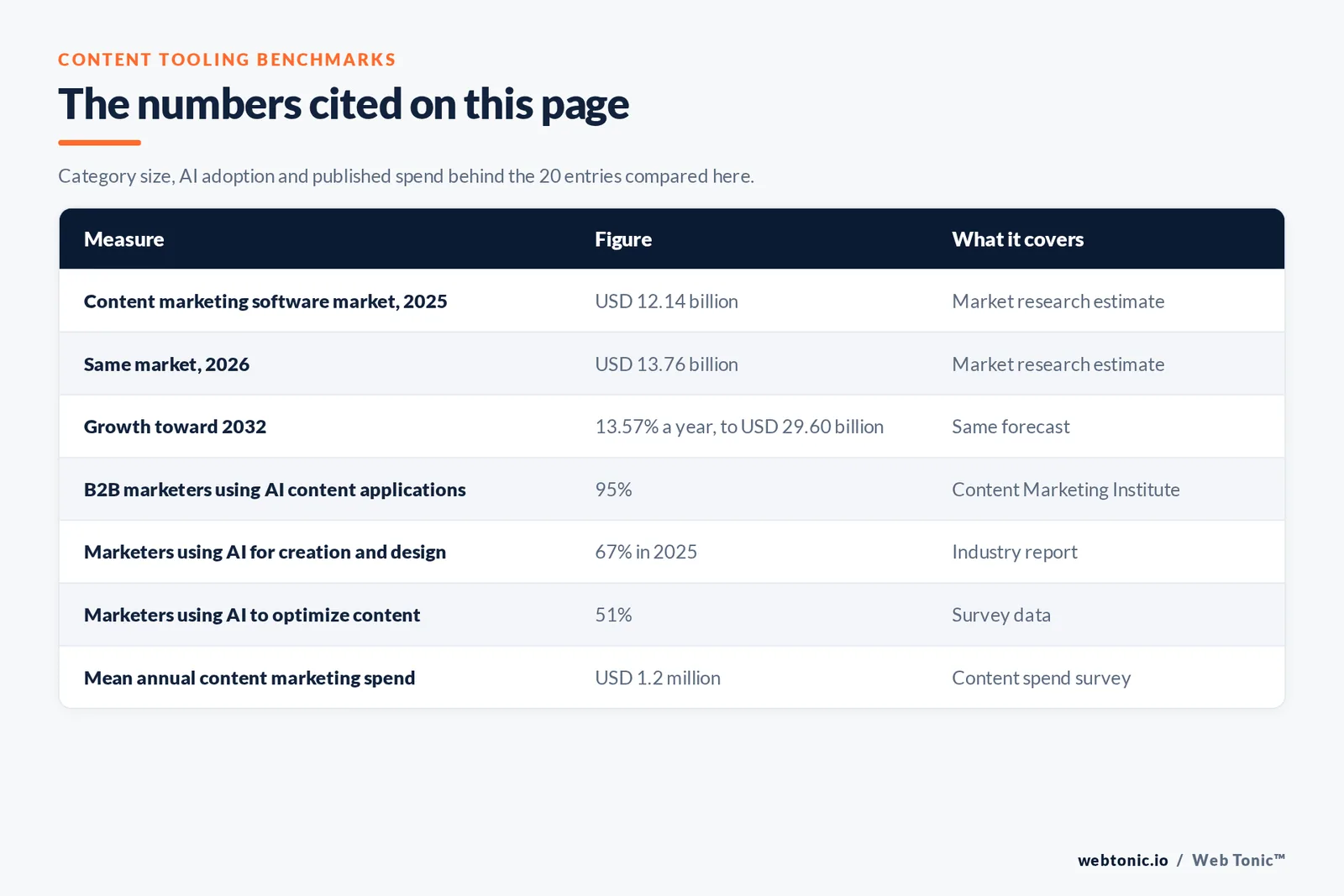
Published prices span three orders of magnitude. CoSchedule starts at 19 dollars per user a month, Frase at 39, Screaming Frog at 199 pounds a year, Clearscope at 129 dollars a month, Parse.ly near 2,000, seoClarity at 2,500, Chartbeat around 13,000 dollars a year and Contently near 5,000 dollars per project, while Contentful runs a free tier. MarketMuse, Lytho Planner, Bynder, Acquia DAM, Uberflip, PathFactory, Conductor and BrightEdge quote per scope. Survey data puts mean annual content marketing spend at about 1.2 million dollars, with 20 percent of companies between 250,000 and 499,000.
Is one all-in-one platform better than three tools?
Rarely, because the vendors are specialists. Calendar products such as CoSchedule, Loomly and Lytho Planner are built around workflow and sign-off, optimization scorers such as Clearscope, Frase and MarketMuse are built around search intent and term coverage, and editorial analytics products such as Parse.ly and Chartbeat are built around reader attention. Buying one suite usually means accepting a weak version of two of those three jobs, which is why most teams stitch a stack together instead.
How much has AI changed content tooling?
Enough that it is now an assumed feature rather than a differentiator. Content Marketing Institute research reports 95 percent of business-to-business marketers whose organisations use AI-powered content applications, 67 percent of marketers using AI for content creation and design in 2025, and 51 percent using it specifically to optimize content. Ahrefs data associates AI use with 42 percent more content published per month. Volume is the easy part; the constraint has moved to editing, fact-checking and deciding what deserves a page at all.
Do we need digital asset management?
Only once reuse becomes the bottleneck. Bynder, Acquia DAM and Brandfolder exist for teams where dozens of people need the approved logo, product shot or video cut, and where the cost of the wrong asset going live is real. A team publishing four articles a month does not have that problem and is better served by an optimization scorer and clean analytics. Acquia DAM names customers such as Autodesk, Crayola and New Balance, which is a fair signal of the scale the category assumes.
Which tool actually proves content works?
The analytics layer, and only if the definitions are agreed first. Parse.ly and Chartbeat measure reader attention and editorial performance in real time, PathFactory tracks how buyers consume content across a session, and Conductor and BrightEdge tie search visibility to page-level performance. The content marketing software market itself is projected at 13.76 billion dollars in 2026, growing about 13.6 percent a year toward 29.6 billion by 2032, so measurement scrutiny is rising with the spend.
Choosing Content Marketing Tools That Earn Their Seat
Buy by layer, not by suite. Calendar, optimization scoring and analytics are three different purchases built by three different kinds of vendor, and 19 dollars a month at each beats one compromised platform at ten times the price.
Let publishing volume set the budget. A team shipping four articles a month cannot justify a 2,500-dollar enterprise platform, while one shipping forty cannot run on a spreadsheet and goodwill.
Treat AI features as baseline. With 67 percent of marketers using AI for creation and 42 percent more content published per month, the scarce resource is editorial judgement and fact-checking, not drafting speed.
Price the quote-only vendors against the published ones. Eight of nineteen here refuse a public rate card, so any proposal deserves a published comparison beside it. For the SEO programme, the answer-engine visibility work and the growth plan from one team, read the latest analysis or book a call.