Table of contents
Webflow powers a growing slice of beauty and skincare brand websites — from DTC product catalogues to editorial skincare destinations — yet the average beauty e-commerce site still scores just 40 on mobile Lighthouse performance. Below are 85+ verified statistics covering beauty website design, Webflow adoption, page-speed benchmarks, CMS market share, conversion rates, and UX trends that beauty marketers need for 2026.
Key Takeaways
- Webflow holds 1.2 % of the global CMS market, growing at a 10 % CAGR since 2022 (Enricher.io / CMS Conf).
- Beauty e-commerce sites score a median 40 on mobile Lighthouse — last place among 9 industries tested (EcomHint).
- Beauty website conversion rates average 2–3.5 %, with top performers hitting 5–8 % and quiz funnels converting at 10–20 % (Acceleroi).
- Mobile drives 82.5 % of beauty website traffic and 59 % of digital checkouts (CuFinder / ClickPost).
- Online beauty sales grew 9× faster than in-store, with North American e-commerce up 21 % year-over-year (NIQ).
- Beauty website traffic surged 14.6 % overall in 2025, with individual brands like Il Makiage jumping 51 % (Similarweb / WWD).
- Cutting page load from 5.2 s to 1.9 s lifted conversion by 34 % and mobile sales by 42 % for one beauty retailer (1Center).
- The CMS market is valued at $30.91 billion in 2025 and projected to reach $48.17 billion by 2031 at a 7.68 % CAGR (Hashmeta).
CMS Market Share and Webflow's Position
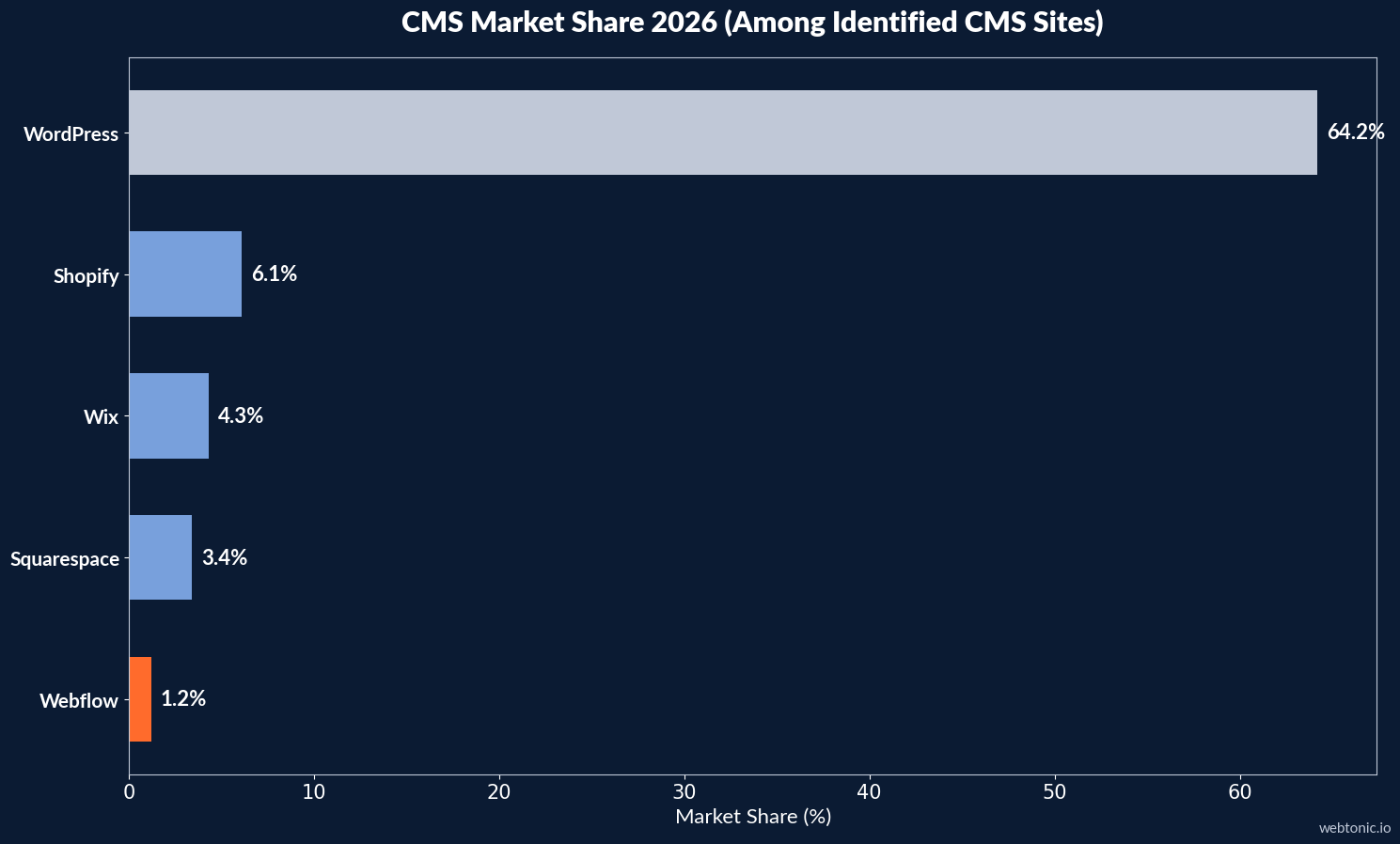
WordPress still dominates the CMS landscape, but visual-first platforms like Webflow are gaining ground — particularly among design-forward beauty brands that prioritize creative control over plugin ecosystems. The table below shows current market share figures for the major platforms beauty brands consider.
| CMS Platform | Market Share | Growth Trend | Source |
|---|---|---|---|
| WordPress | 43 % (all sites) / 64.2 % (CMS-identified) | Down from 65.2 % YoY | Visionary Marketing |
| Shopify | 6.1 % (all sites) | +0.8 pp YoY | CMS Conf / Colorlib |
| Wix | 4.3 % (all sites) | +32.6 % single-year growth | Colorlib |
| Squarespace | 3.4 % (CMS-identified) | 11× growth from 0.3 % | CMS Conf |
| Webflow | 1.2 % (CMS-identified) | 10 % CAGR (2022–2025) | Enricher.io |
| Overall CMS market | $30.91 B (2025) | → $48.17 B by 2031 (7.68 % CAGR) | Hashmeta |
Beauty Website Performance Benchmarks
Beauty sites are among the slowest-loading e-commerce verticals due to high-resolution imagery, video backgrounds, interactive shade finders, and ingredient databases. EcomHint's benchmark of 180 Shopify beauty stores found a median mobile Lighthouse score of 40 and a desktop score of 57 — both dead last among 9 industries (EcomHint). Only 33 % of beauty sites pass Core Web Vitals on mobile versus 58 % on desktop.
Speed matters directly for revenue. One beauty retailer that cut load time from 5.2 seconds to 1.9 seconds saw a 34 % conversion rate increase and 42 % mobile sales lift (1Center). Herborabeauty measured an LCP of 5.8 seconds on mobile — more than double Google's 2.5 s threshold — with 78 % of its traffic on mobile devices. Webflow's managed hosting infrastructure gives beauty brands an advantage here: its global CDN and built-in lazy loading can deliver sub-2-second LCP without custom DevOps work, making it a strong fit for growth marketing teams that need speed without engineering overhead.
Beauty E-Commerce Conversion Rate Benchmarks
Conversion rates in beauty vary dramatically based on traffic source, device, and funnel strategy. Quiz-based funnels outperform standard product pages by 3–10×, making them one of the highest-ROI investments beauty brands can make on any CMS platform, including Webflow.
| Metric | Benchmark | Top Performers | Source |
|---|---|---|---|
| E-commerce conversion rate | 2–3.5 % | 5–8 % | Acceleroi |
| Quiz-funnel conversion | 10–20 % | 20 %+ | Acceleroi |
| Cart abandonment rate | ~72 % | < 65 % | ClickPost |
| Mobile checkout share | 59 % | 65 %+ (top brands) | ClickPost |
| AOV range | $60–$164 | $164+ (prestige) | EcommerceAgencies |
| Email open rate (beauty) | 38.5 % | 42 %+ | CuFinder |
| Repeat purchase rate | 32 % CRR | 40 %+ | CuFinder |
| Blended CPA | $31.50 | < $20 (DTC leaders) | CuFinder |

Beauty Website Traffic and Growth Trends
Beauty e-commerce is accelerating faster than nearly every other consumer vertical. Online beauty sales are growing 9× faster than in-store, with North American e-commerce up 21 %, Asia Pacific up 20 %, and Europe up 10 % year-over-year (NIQ). Similarweb reported a 14.6 % increase in total beauty website visitors across 2025 (WWD / Similarweb), with individual standouts like Il Makiage surging 51 % and Elf Cosmetics jumping 40 %.
Traffic source distribution for beauty websites skews heavily mobile and social. Mobile accounts for 82.5 % of beauty traffic, with desktop at 16 % and tablet at 1.5 %. Direct traffic represents 38 %, organic search 28 %, paid search 14 %, and social (organic + paid) 16 % (CuFinder). This mobile-dominant reality makes performance creative and responsive design essential for any beauty brand building on Webflow or any other CMS.
Why Beauty Brands Choose Webflow
Webflow's appeal to beauty brands centres on three capabilities that the Webflow template marketplace already reflects: visual CMS management for ingredient-rich product pages, design flexibility for brand-forward aesthetics without developer dependency, and built-in SEO structure that auto-generates clean URLs, sitemaps, and meta-tag fields.
The Webflow template marketplace now features multiple beauty-specific templates (SkinCareX, DermaFlow, NueSkin, Skiner, Aurae, Bavia, SseraSkin) — each with CMS-powered product catalogues, blog systems, and responsive design out of the box. For beauty brands comparing platforms, Webflow fills the gap between Shopify's commerce-first approach and WordPress's plugin-dependent flexibility, offering a code-optional middle ground that design teams can manage directly. Baymard's research identified 1,200+ medium-to-severe usability issues across beauty e-commerce sites from 3,000+ hours of testing (Baymard) — Webflow's visual editor lets beauty teams fix many of these without engineering tickets.
Beauty Website Speed Benchmarks by Brand
Individual beauty brand site performance varies dramatically. The brands below illustrate the range from best-in-class to critically slow — and the business impact of each tier. Speed optimization through paid traffic landing pages is especially critical when ad costs are rising.
| Brand / Benchmark | Key Speed Metric | Impact | Source |
|---|---|---|---|
| Dermalogica (post-Shopify) | 44 % speed improvement | +119 % sales, +45 % CVR | Shopify |
| Herborabeauty | 5.8 s mobile LCP | 78 % traffic on mobile, suppressed CVR | Prateeksha |
| Generic beauty retailer | 5.2 s → 1.9 s load time | +34 % CVR, +42 % mobile sales | 1Center |
| Beauty Shopify median | Score 40 mobile / 57 desktop | Last of 9 industries | EcomHint |
| Sephora (desktop LCP) | 75.12 % passing | Top desktop performer | Raygun |
| Beauty CWV pass rate | 33 % mobile / 58 % desktop | 25 pp mobile–desktop gap | EcomHint |
Website Optimisation Best Practices for Beauty Brands
Whether building on Webflow, Shopify, or WordPress, beauty brands should prioritise these data-backed strategies to improve site performance and conversion rates.
- Target sub-2-second mobile LCP. The benchmark data shows a 34 % conversion lift from cutting load time to under 2 seconds. Compress hero images, enable lazy loading, and use WebP or AVIF formats for product photography.
- Implement quiz-based funnels. Quiz funnels convert at 10–20 % versus 2–3.5 % for standard product pages — a 5× or greater improvement that justifies the development investment on any CMS platform.
- Prioritise mobile checkout UX. With 59 % of checkouts on mobile and 72 % cart abandonment, add native payment options (Apple Pay, Shop Pay) and default to guest checkout to reduce friction.
- Leverage CMS-powered ingredient pages. Webflow's CMS collections are ideal for building ingredient-rich product detail pages that boost data intelligence through structured data and schema markup — critical for SEO in a category where informational intent drives discovery.
- Invest in shade-finder and routine-builder tools. Interactive tools drive 2.1× longer session time on product pages compared to static imagery, and beauty UX research confirms they are key differentiators for conversion.
FAQ
Beauty Website UX Trends Shaping 2026
Beauty website design is evolving rapidly as consumer expectations rise. Baymard identified 1,200+ medium-to-severe usability issues from 3,000+ hours of beauty-specific UX testing, highlighting the depth of optimisation available. Key trends include interactive shade finders and routine builders that drive 2.1× longer session times on product pages compared to static imagery. AI-powered skin analysis tools are also gaining traction, with Revieve's Beauty & Wellness Index tracking millions of AI-powered skincare interactions across 100+ global brands.
On the technical side, Google replaced First Input Delay with Interaction to Next Paint (INP) as a Core Web Vitals metric in March 2024. Skincare sites with heavy JavaScript — shade selectors, ingredient filters, reviews widgets — frequently fail INP thresholds. Webflow's lightweight rendering approach gives beauty brands an edge here, as its generated code avoids the DOM bloat typical of plugin-heavy WordPress builds. Mobile-first checkout design is another critical trend: sites that default to guest checkout with Apple Pay and Shop Pay prominently displayed see measurably lower cart abandonment rates from the current 72 % beauty average.
What is the average conversion rate for beauty e-commerce websites?
Beauty e-commerce websites typically convert at 2–3.5 %, with top-performing brands reaching 5–8 %. Quiz-based product recommendation funnels convert at 10–20 %, making them one of the highest-ROI tactics for beauty brands on any CMS platform including Webflow.
Is Webflow a good CMS for beauty and skincare brands?
Webflow is an excellent choice for beauty brands that prioritise design flexibility and visual CMS management. It offers built-in SEO tools, managed hosting with a global CDN for fast page loads, and a growing library of beauty-specific templates. The trade-off is that Webflow's native e-commerce features are less mature than Shopify's for high-volume transactional sites.
How much traffic do beauty websites get from mobile devices?
82.5 % of beauty website traffic comes from mobile devices, with desktop accounting for 16 % and tablets just 1.5 %. Mobile also drives 59 % of digital checkouts in the beauty category, making mobile-first design and sub-2-second load times critical for conversion.
What is Webflow's current market share compared to WordPress and Shopify?
Webflow holds approximately 1.2 % of the CMS market among identifiable CMS sites, compared to WordPress at 64.2 % and Shopify at 6.1 %. Webflow is growing at roughly 10 % annually and is especially popular with design-led brands in beauty, fashion, and lifestyle verticals.
How does page speed affect beauty e-commerce conversion rates?
Page speed has a direct and measurable impact on beauty conversions. One retailer saw a 34 % conversion rate increase after cutting load time from 5.2 to 1.9 seconds, along with a 42 % lift in mobile sales. Beauty sites that fail Core Web Vitals on mobile — which 67 % currently do — leave significant revenue on the table.
Sources
Enricher.io — Webflow Market Share Statistics
EcomHint — Beauty Shopify Speed Benchmark
Acceleroi — Beauty Conversion Rate Benchmarks
CuFinder — Personal Care & Beauty Benchmarks
1Center — Site Speed & Beauty Sales
NIQ — State of Beauty 2025
WWD / Similarweb — Beauty Traffic Growth
Baymard — Health & Beauty UX Research
Hashmeta — CMS Market Share
CMS Conf — CMS Market Share 2026