Table of contents
Key Takeaways
- Beauty LinkedIn ads achieve a 3.8% click-through rate — double the 1.9% LinkedIn average — making it one of the highest-engagement verticals on the platform (World Metrics).
- Median cost per lead (CPL) for beauty on LinkedIn is $89, lower than professional services ($120–$200) but higher than retail ($45–$75) (Clever Zebo).
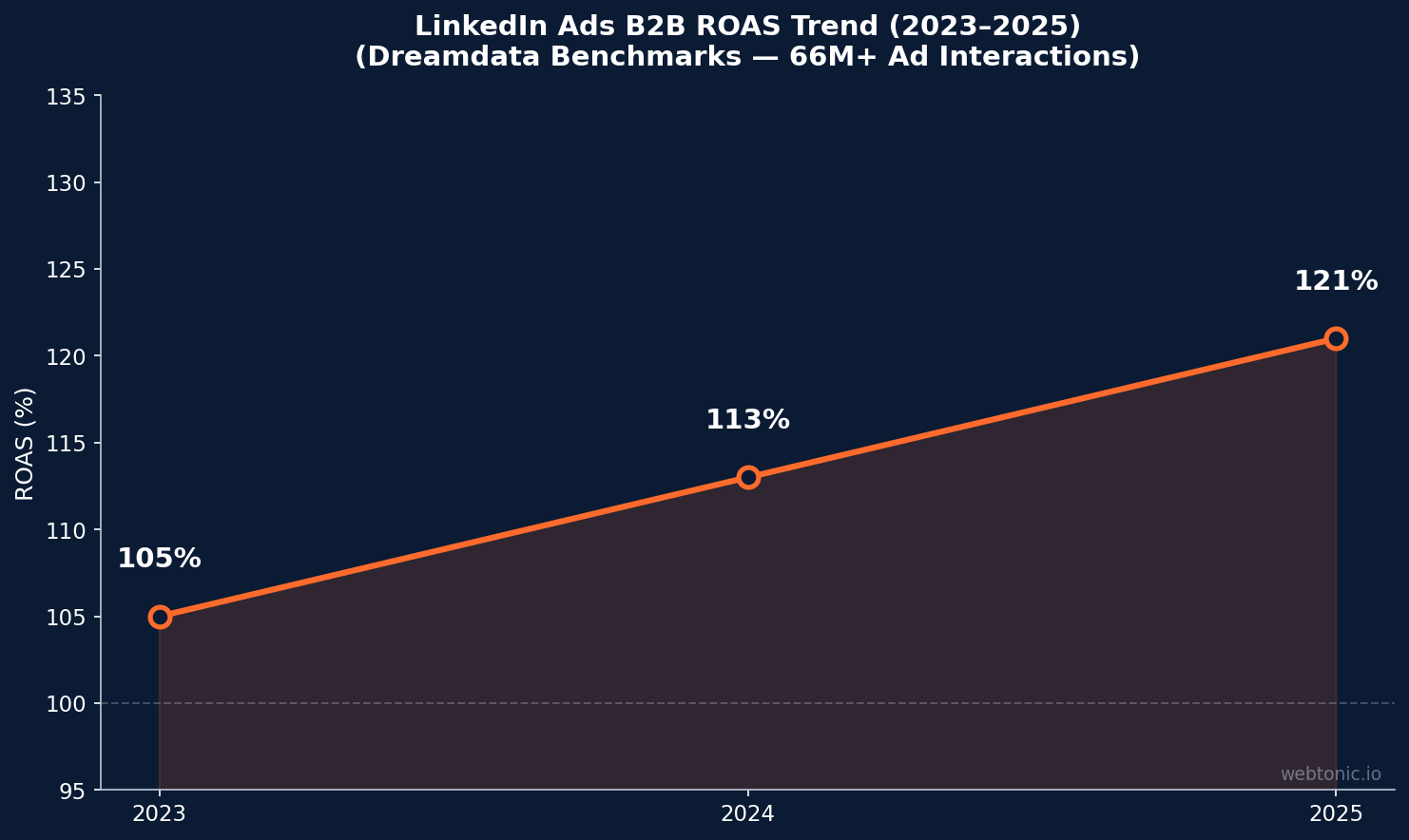
- LinkedIn Ads ROAS reached 121% in 2025 — up from 113% in 2024 — with share of B2B ad budgets continuing to grow (Dreamdata).
- LinkedIn B2B marketing for beauty ingredients grew leads by 33% for suppliers targeting formulation and procurement professionals (Gitnux).
- A Chinese DTC beauty brand achieved 3× revenue growth in 6 months on LinkedIn with a 4.2% conversion rate — 2.7× higher than other platforms (Zipdo).
- Document ads deliver the highest CTR (0.50–0.80%) among LinkedIn formats, outperforming single image (0.40–0.65%) and video (0.35–0.55%) for B2B beauty campaigns (MetadataONE).
LinkedIn Ads Cost Benchmarks for Beauty & Skincare
LinkedIn advertising is premium-priced by design — the platform sells access to professional decision-makers, not general consumers. For beauty brands, that premium can deliver outsized value when campaigns target the B2B side of the industry: ingredient suppliers, retail buyers, distributors, and salon and spa owners.
| Cost Metric | Beauty & Skincare | All-Industry Average | Delta |
|---|---|---|---|
| Cost Per Click (CPC) | $5.50–$8.00 | $5.00–$8.00 | In line |
| Cost Per Mille (CPM) | $30–$55 | $25–$45 | +20% premium |
| Cost Per Lead (CPL) | $89 (median) | $75–$200 range | Mid-range |
| Click-Through Rate (CTR) | 3.8% | 1.9% | 2× higher |
| Avg CTR (Sponsored Content) | 0.81% | 0.44–0.65% | +25–85% lift |
| Cost Per Acquisition (CPA) | $120–$250 (est.) | $150–$400 | Below avg |
The standout metric is the 3.8% CTR — double the platform average. This suggests that beauty content resonates unusually well with LinkedIn audiences, likely because beauty industry professionals are hungry for trend data, ingredient innovations, and competitive intelligence that LinkedIn content uniquely delivers. The high engagement rate also reflects beauty's visual nature — even in a professional context, product imagery and trend reports capture attention more effectively than text-heavy B2B content. Explore how LinkedIn fits into a broader paid strategy with our Meta Ads services.
LinkedIn Ad Format Performance for Beauty Campaigns
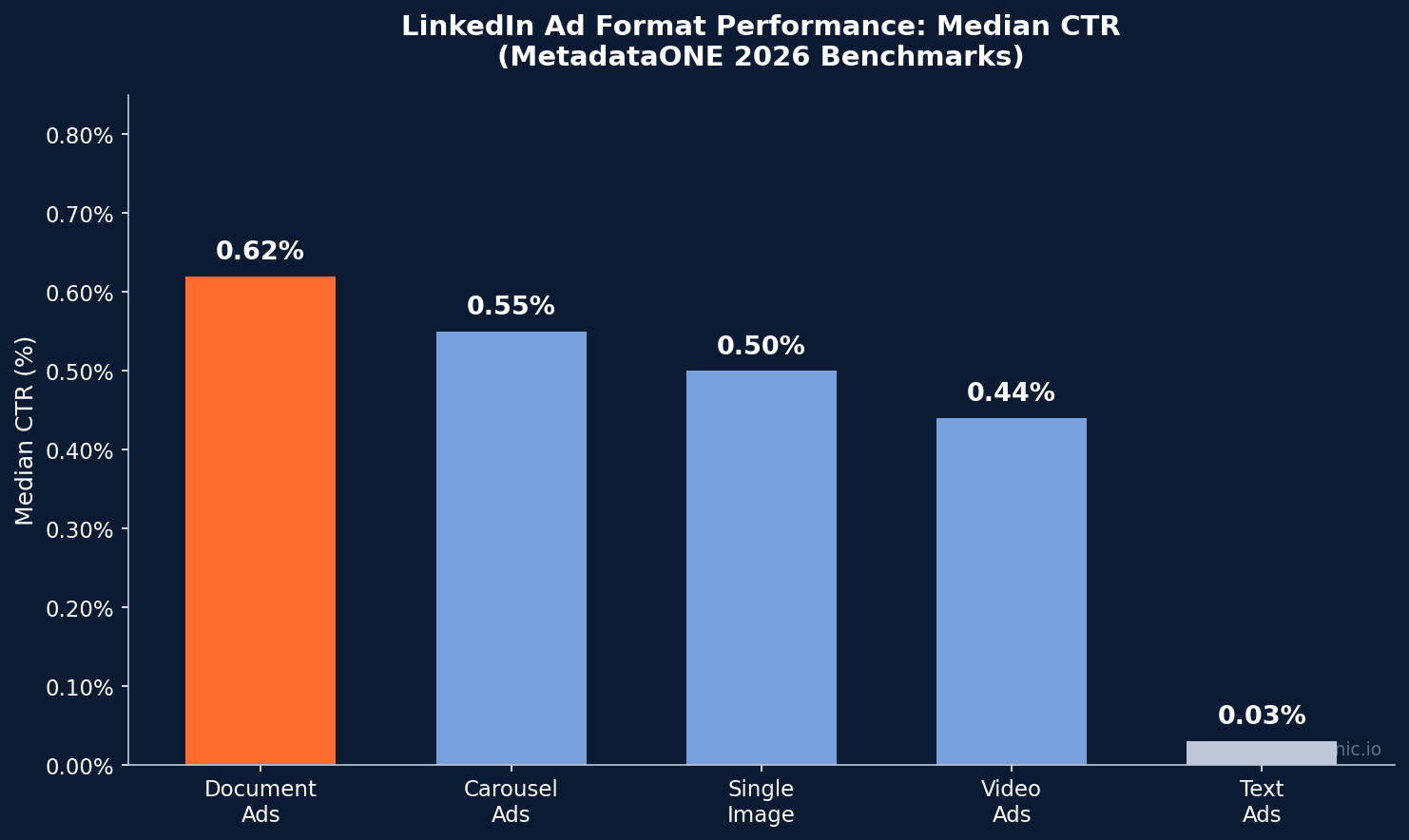
Not all LinkedIn ad formats perform equally. MetadataONE's 2026 benchmarks reveal significant CTR variation by format — and beauty brands can exploit these differences to optimize campaign architecture and allocate budget toward higher-performing placements.
| Ad Format | CTR Range | Median CTR | Best Use Case |
|---|---|---|---|
| Document Ads | 0.50–0.80% | 0.62% | Ingredient guides, trend reports |
| Carousel Ads | 0.45–0.70% | 0.55% | Product ranges, brand stories |
| Single Image | 0.40–0.65% | 0.50% | Awareness, broad reach |
| Video Ads | 0.35–0.55% | 0.44% | Brand storytelling, demos |
| Conversation Ads | N/A (open rate) | 55–65% open | High-intent lead gen |
| Text Ads | 0.02–0.05% | 0.03% | Always-on retargeting |
Document ads' 0.62% median CTR makes them the top-performing format for beauty B2B campaigns. The format works because it delivers immediate value — a downloadable report, ingredient analysis, or trend deck — within the feed. Users can consume content without leaving LinkedIn, reducing friction compared to landing-page-dependent formats. For beauty ingredient suppliers and beauty tech companies, document ads that share industry research or formulation trends consistently outperform product-focused creative.
Where LinkedIn Ads Work Best in Beauty
LinkedIn advertising for beauty is fundamentally a B2B play. While some DTC beauty brands experiment with LinkedIn for affluent consumer targeting, the highest-ROI use cases cluster around industry-to-industry relationships where deal values justify the premium CPL.
- Ingredient suppliers targeting cosmetic formulators — LinkedIn B2B marketing for beauty ingredients grew leads by 33% (Gitnux). Companies like SpecialChem use LinkedIn to connect raw material suppliers with procurement teams at beauty brands. The platform's job-title targeting lets suppliers reach R&D chemists, procurement managers, and formulation leads directly.
- Contract manufacturers reaching brand founders — the DTC beauty boom has created thousands of small brands needing manufacturing partners. LinkedIn's job title and company size targeting makes this audience uniquely reachable. Document ads showcasing manufacturing capabilities, MOQ ranges, and certifications perform particularly well for this audience.
- Beauty tech and SaaS companies — tools for ingredient sourcing, shade matching, virtual try-on, and supply chain management use LinkedIn to reach beauty brand decision-makers with consideration-stage content that demonstrates ROI through case studies and product demos.
- Salon and spa equipment/product distributors — targeting salon owners, spa directors, and aesthetic professionals by job title delivers high-quality leads for professional beauty products. This audience responds well to video ads demonstrating equipment features and before-after results.
- Professional beauty education and certifications — esthetician programs, cosmetic chemistry courses, and industry conferences find their ideal audience on LinkedIn's professional graph. Conversation Ads work particularly well for event registrations and course enrollment funnels.
LinkedIn Beauty Campaign Case Studies
Real-world campaign data shows what's achievable when beauty brands align LinkedIn targeting with the right audience and offer combination.
- A Chinese DTC beauty brand generated 3× revenue growth in 6 months targeting beauty, wellness, and healthcare professionals on LinkedIn. The campaign achieved a 4.2% conversion rate on their e-commerce site from LinkedIn traffic — 2.7× higher than their average ad performance on other platforms. The key was targeting professionals who buy beauty products for both personal use and professional recommendations.
- 78% of chemical companies (including beauty ingredient suppliers) use LinkedIn for B2B marketing, with 85% reporting increased lead generation compared to other professional channels (Zipdo). The beauty ingredient supply chain has become one of LinkedIn's most active B2B verticals.
- LinkedIn B2B marketing for beauty ingredients grew leads by 33% year-over-year for suppliers targeting formulation and procurement professionals, driven primarily by document ads sharing research data and trend reports that formulators find genuinely useful.
LinkedIn Ads ROAS and Budget Trends
LinkedIn's value proposition for B2B advertisers has been strengthening year over year. Dreamdata's 2026 benchmarks report — analyzing data from 66+ million ad interactions across 3.5 million customer journeys — shows the platform's ROAS trajectory is trending upward across all B2B categories.
| Budget Metric | 2024 | 2025 | Trend |
|---|---|---|---|
| LinkedIn Ads ROAS (B2B avg) | 113% | 121% | +8 ppt growth |
| Share of B2B ad budget | Growing | Largest B2B platform | Accelerating |
| Beauty sector LinkedIn spend | Niche but growing | Est. +15–20% YoY | Following B2B trend |
| Avg monthly budget (beauty B2B) | $3,000–$10,000 | $5,000–$15,000 | Scaling up |
| Cost efficiency trend | Baseline | Improving | +7% ROAS improvement |
LinkedIn vs. Other Platforms for Beauty Advertising
LinkedIn occupies a unique position in the beauty advertising landscape — it is not competing with Meta or TikTok for consumer attention, but rather serving the professional layer that powers the industry behind the scenes. Understanding where LinkedIn fits relative to other platforms helps beauty marketers allocate budget effectively.
| Platform | Beauty CPL | Primary Use | LinkedIn Advantage |
|---|---|---|---|
| $89 median | B2B lead gen, recruiting | Professional targeting precision | |
| Meta (Facebook/IG) | $18–$45 | DTC consumer acquisition | Scale, visual formats |
| Google Ads | $35–$80 | Intent capture, search | Purchase-intent traffic |
| TikTok | $21–$48 | Discovery, awareness | Viral reach, younger demos |
| $15–$35 | Aspirational discovery | Purchase consideration |
LinkedIn's $89 CPL looks expensive next to Meta's $18–$45, but the comparison misses the point: LinkedIn leads in beauty B2B contexts (ingredient sales, distribution deals, partnership inquiries) carry deal values 10–100× higher than a DTC skincare purchase. The cost-per-qualified-opportunity calculation almost always favors LinkedIn for B2B beauty use cases. A single ingredient supply contract or distribution deal can justify months of LinkedIn ad spend. See how Google Ads compares in our Google Ads pricing guide.
LinkedIn Ads Best Practices for Beauty Brands
- Lead with value-first document ads. Publish trend reports, ingredient analyses, or market sizing documents as LinkedIn Document Ads — they deliver the highest CTR (0.62% median) and position your brand as a thought leader. Beauty professionals engage most with content that helps them do their jobs better, not promotional material.
- Target by job function, not just industry. For beauty B2B, layer "Cosmetics" industry targeting with job functions like Procurement, R&D, Marketing Director, and Brand Manager to reach decision-makers directly. Avoid broad industry-only targeting that wastes impressions on irrelevant roles.
- Use Conversation Ads for high-intent offers. With 55–65% open rates, Conversation Ads work well for event invitations, sample requests, and demo bookings where the next step is clear and specific. The interactive format lets you qualify leads within the ad experience itself.
- Set realistic CPL expectations. Beauty B2B CPL of $89 is healthy for the category. Trying to force CPL below $50 typically degrades lead quality — focus on cost-per-opportunity rather than cost-per-form-fill. Track downstream conversion rates and deal values, not just lead volume.
- Run always-on retargeting with Text Ads. At $0.02–$0.05 CTR, Text Ads are cheap enough to maintain brand visibility with website visitors and engaged LinkedIn followers year-round without significant budget commitment.
- Align content cadence with industry events. Beauty industry calendars (Cosmoprof, IECSC, Beautyworld) create natural spikes in LinkedIn activity — time your campaigns to the 2–4 weeks surrounding major trade shows when professional engagement on the platform peaks.
For a cross-platform advertising strategy, explore our Facebook Ads cost breakdown.
FAQ
Are LinkedIn Ads worth it for beauty brands?
For B2B beauty applications — ingredient suppliers, contract manufacturers, beauty tech companies, and professional education — LinkedIn Ads are highly effective. The platform's 3.8% CTR for beauty (2× the average) and $89 median CPL deliver strong ROI when deal values justify the cost. For DTC consumer beauty, Meta and TikTok typically offer better economics. The key question is whether your target audience makes purchasing decisions in a professional capacity — if yes, LinkedIn is likely your highest-value paid channel.
What is the average CPC for beauty LinkedIn Ads?
Beauty and skincare LinkedIn Ads average $5.50–$8.00 CPC, in line with the all-industry average of $5.00–$8.00. The cost is higher than Meta ($0.50–$1.50) or Google ($1.00–$4.00 for non-brand keywords) because LinkedIn targets a higher-value professional audience with verified job titles, company data, and seniority levels that no other platform can match.
Which LinkedIn ad format works best for beauty?
Document Ads lead with a 0.62% median CTR, followed by Carousel Ads (0.55%) and Single Image (0.50%). Document Ads perform well in beauty because they deliver immediate value such as trend reports, ingredient guides, and formulation data without requiring users to leave LinkedIn. Video Ads (0.44%) work for brand storytelling but underperform for direct lead generation. Conversation Ads offer the highest engagement for high-intent conversion goals.
How do you target beauty professionals on LinkedIn?
Effective targeting combines industry filters (Cosmetics, Personal Care Products) with job function layers (Procurement, R&D, Marketing, Operations). Add company size (1–50 for indie brands, 200+ for established companies) and seniority (Director+) for B2B campaigns. LinkedIn's Matched Audiences feature lets you retarget website visitors and upload email lists for account-based marketing targeting specific brands or retailers you want to reach.
What budget do beauty brands need for LinkedIn Ads?
Most beauty B2B advertisers start with $3,000–$5,000/month and scale to $10,000–$15,000/month once initial CPL and lead quality benchmarks are established. LinkedIn's minimum daily budget is $10/campaign, but meaningful data requires at least $50–$100/day per campaign to exit the learning phase within 2 weeks. Starting with a single campaign focused on your highest-value audience segment is more effective than spreading budget across multiple campaigns.
Sources
World Metrics — Marketing in the Makeup Industry Statistics 2026
Clever Zebo — Beauty LinkedIn Ads CPL Benchmark (Jun 2026)
Dreamdata — LinkedIn Ads 2026 Benchmarks Report
Gitnux — Marketing in the Beauty Industry Statistics
MetadataONE — LinkedIn Ads Benchmarks 2026 by Industry
CreativeGrade — Beauty & Skincare LinkedIn CPC Benchmark
CreativeGrade — Beauty & Skincare LinkedIn CTR Benchmark
Calc4Marketers — LinkedIn Ads Benchmarks by Industry
Zipdo — Marketing in the Beauty Industry Research Stats