Table of contents
Meta Ads — Facebook and Instagram combined — remains the primary paid acquisition engine for DTC skincare and cosmetics labels in 2026. But the platform looks fundamentally different than it did two years ago: Advantage+ Shopping campaigns have replaced manual prospecting for most advertisers, Andromeda's signal model has compressed CPMs while widening ROAS variance, and UGC-first creative strategies now outperform studio assets across nearly every sub-vertical. This report compiles the most important Meta Ads statistics for the cosmetics and skincare sector in 2026, sourced from Pennock's DTC client data, AdLibrary's cross-vertical analysis, and FoundryCRO's benchmark datasets, so you can calibrate your campaigns against what "good" genuinely looks like.
Key Takeaways
- Skincare Meta Ads CPM benchmarks sit at $12–$28, with strong performers below $18 — running 30–40% higher than the ecommerce average of $14–$22 (Pennock).
- Advantage+ Shopping campaigns produce 1.6x–3.2x purchase ROAS for skincare advertisers, with top accounts exceeding 3x blended (Pennock).
- UGC formats outperform studio creative by 35–55% on CTR in cold traffic across every sub-vertical except luxury fragrance (AdLibrary).
- CPA for cosmetics conversion campaigns sits at $28–$95 depending on AOV and funnel stage, with DTC CAC averaging $60.45 (FoundryCRO).
- Sector social ROAS rebounded to $3.50 in Q1 2025 after dipping to $1.90 in Q4 2024, underscoring the importance of quarterly evaluation over monthly snapshots (eMarketer / Cart.com).
- "Beauty" is actually five separate businesses on Meta — skincare, haircare, personal care, tools/devices, and wellness — each with materially different CPM, CTR, and ROAS benchmarks (AdLibrary).
Meta Ads Benchmarks by Sub-Vertical at a Glance (2026)
The most important finding from the 2026 data is that single-row "beauty" benchmarks are misleading. Performance varies dramatically by sub-vertical. Here is what each segment looks like on Meta (AdLibrary):
| Sub-Vertical | CPM Range | ROAS Range | Relative Competitiveness |
|---|---|---|---|
| Skincare | $14–$22 | 1.8x–3.2x | Most expensive to reach |
| Haircare | $10–$16 | 2.4x–4.1x | Lower CPM, strong repeat economics |
| Personal care | $8–$13 | 2.8x–5.0x | Lowest CPM, highest ROAS ceiling |
| Tools & devices | $16–$28 | 1.6x–2.8x | High AOV, lower frequency |
| Wellness / supplements | $11–$18 | 1.9x–3.5x | Growing fast, moderate density |
The takeaway: benchmarking your skincare account against a generic "beauty" CPM of $12 understates what you are actually competing against. Skincare CPMs run 30–40% higher than personal care within the same vertical, which means your creative efficiency and LTV assumptions need to be calibrated to your specific sub-segment.
Core Meta Ads Performance Metrics for Skincare (2026)
For DTC skincare specifically — the largest and most competitive sub-vertical — here is the full benchmark table from Pennock's 2026 client dataset (Pennock):
| Metric | Benchmark Range | Strong Performance |
|---|---|---|
| CPM (cost per 1,000 impressions) | $12–$28 | Below $18 |
| CPC (link click) | $0.80–$2.40 | Below $1.40 |
| CTR (link click-through rate) | 1.0%–2.5% | Above 1.8% |
| CPA / CAC | $25–$80 | Below $45 |
| Conversion ROAS (Advantage+) | 1.6x–3.2x | Above 2.5x |
| Add-to-cart rate | 4%–9% | Above 7% |
| Checkout conversion (LP → order) | 1.5%–3.5% | Above 2.8% |

A healthy skincare account is hitting blended ROAS of 2.5x+ with paid driving 25% or more of new-customer acquisition. If your in-platform ROAS looks strong but your blended returns sit below 2x, the issue is almost always attribution inflation — not creative quality. This gap is especially common in accounts running broad Advantage+ audiences where Meta's modeled attribution overcounts.
Advantage+ Shopping Campaigns: The New Default
Advantage+ Shopping (ASC) has become the dominant campaign structure for DTC skincare and cosmetics advertisers on Meta. The 2026 data shows why:
- ASC campaigns produce 1.6x–3.2x conversion ROAS, with top performers consistently above 2.5x.
- Advantage+ Audience targeting now uses Andromeda's expanded signal model, which has compressed CPMs in many accounts while increasing ROAS variance — meaning the ceiling is higher but so is the floor.
- Existing-customer caps (typically set at 10–25%) are critical for preventing ASC from cannibalizing your email and organic channels.
- ASC performs best when fed 10–15 creative variants per ad set — fewer limits the algorithm's ability to optimize, and more dilutes creative-level learnings.
The practical implication: if you are still running manual prospecting campaigns with detailed interest targeting, the data suggests migrating to ASC for most of your conversion spend. Reserve manual campaigns for testing new creative concepts, launching new products, or targeting narrow audiences that ASC's broad modeling misses.
Creative Performance: UGC vs. Studio and Format Breakdowns
Creative is now the primary lever for performance differentiation on Meta. The 2026 data from AdLibrary's analysis of thousands of cosmetics ads shows consistent patterns (AdLibrary):
| Creative Format | CTR Lift vs. Static | Best Use Case |
|---|---|---|
| UGC video (creator-led) | +35–55% | Cold prospecting, top-of-funnel |
| Before/after carousel | +20–35% | Retargeting, social proof |
| Tutorial / how-to video | +15–30% | Mid-funnel education |
| Static product shot | Baseline | Remarketing, catalog |
| Founder/expert testimonial | +25–40% | Trust-building, premium positioning |
The standout finding: UGC creator-led video outperforms studio creative by 35–55% on CTR in cold traffic across every cosmetics sub-vertical except luxury fragrance, where brand-controlled aesthetics still win. The implication for media buyers is clear — your creative budget should tilt heavily toward creator partnerships and whitelisted UGC, not polished brand shoots.
Seasonal ROAS Volatility and How to Plan for It
One of the most actionable findings in the 2026 data is the magnitude of seasonal ROAS swings in the sector. Cart.com and eMarketer tracked 35+ accounts and found (eMarketer / Cart.com):
- ROAS dipped to $1.90 in Q4 2024 as CPMs spiked during holiday season competition.
- ROAS rebounded to $3.50 in Q1 2025 — an 84% recovery — as CPMs normalized and post-holiday demand remained strong for skincare (January "new year, new routine" effect).
- The Q4-to-Q1 swing is structural, not a one-off: it appears consistently across multiple years of data. The sector's replenishment-driven demand sustains Q1 volume even as other verticals pull back.
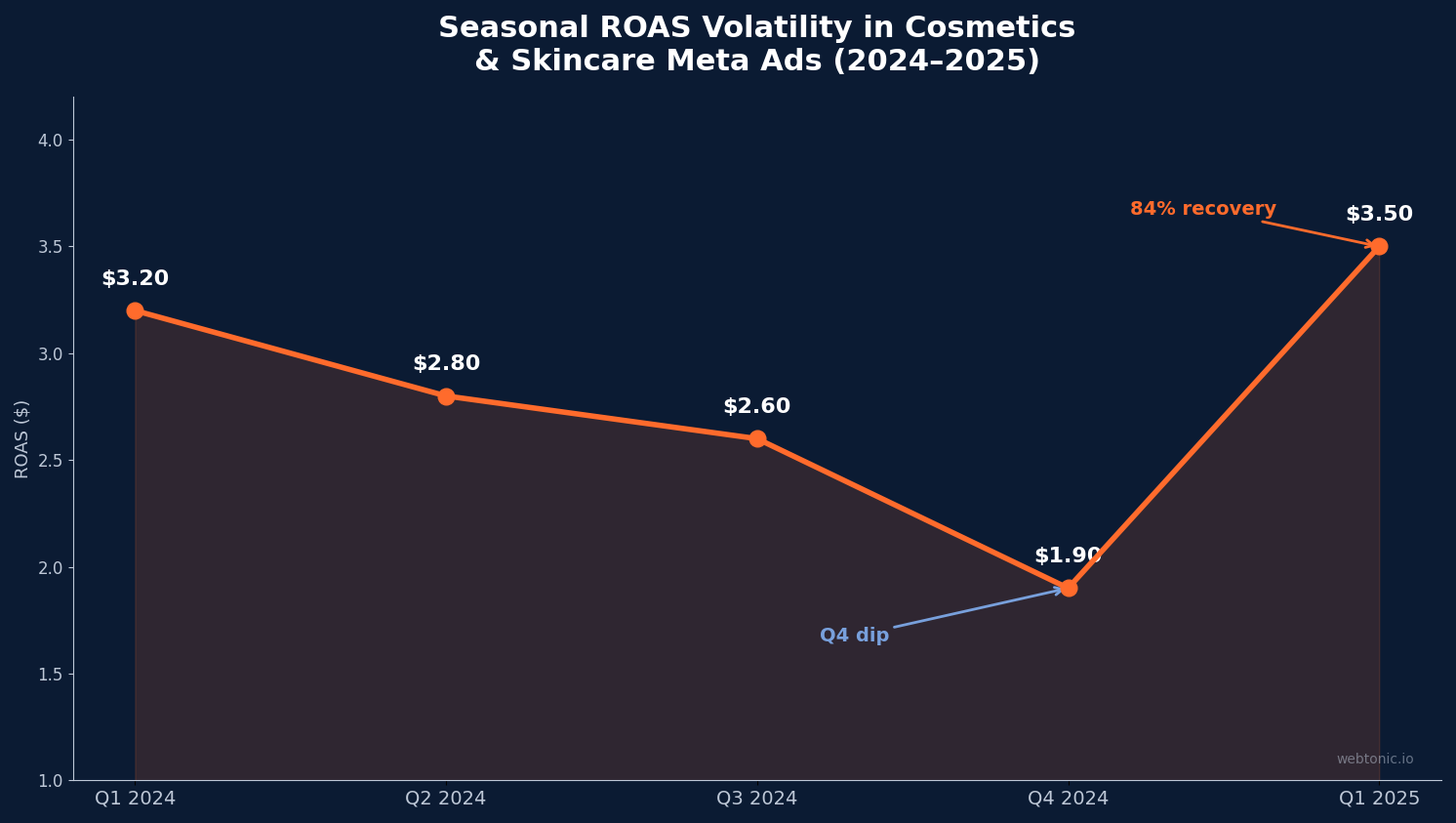
For budget planning, this means cosmetics advertisers should reduce CPA targets in Q4 by 15–25% (accepting temporarily lower efficiency) and scale aggressively in Q1 when CPMs drop and demand stays high. Operators who panic-cut budgets in November miss the cheapest inventory of the year in January.
Audience and Targeting Strategy in 2026
The targeting landscape on Meta has shifted decisively toward algorithmic audience finding. For skincare and cosmetics advertisers, the 2026 playbook looks like this:
- Broad/Advantage+ audiences now outperform lookalikes in most skincare accounts, especially at scale (>$50K/month). Meta's machine learning has enough signal from pixel data and in-app behavior to find high-intent buyers without manual audience building.
- Retargeting remains critical but has structurally changed: with iOS 14.5+ signal loss, retargeting windows have shrunk from 180-day to 7–14-day windows being most effective. CTR for skincare retargeting ranges from 1.5% to 2.1% — the highest of any funnel stage.
- First-party data (email lists, purchase history) fed through Custom Audiences remains the most reliable targeting signal, especially for exclusion (preventing wasted spend on recent buyers).
- Interest-based targeting still works for new product launches and niche sub-categories (e.g., "retinol" or "K-beauty"), but accounts spending above $30K/month typically see diminishing returns vs. broad.
The broad trend is unmistakable: creative quality has replaced targeting precision as the primary performance lever. When everyone runs broad audiences, the differentiator becomes which ad actually stops the scroll — which is why the UGC and format data above matters so much. To see how we structure full-funnel paid programs, explore our Meta Ads services at Web Tonic.
The Broader Digital Landscape: Meta vs. Other Channels for Skincare
Meta Ads do not exist in a vacuum. To evaluate whether your Facebook and Instagram investment is delivering, you need context on how consumers engage across the full digital ecosystem and where skin care brands are allocating their global advertising spend:
- The global cosmetics and personal-care market will exceed $580 billion by 2027, with digital commerce projected to account for 25–30% of total sales. Meta remains the single largest paid channel for DTC operators, but its share of total ad spend is declining as TikTok and connected TV grow rapidly.
- Content-driven engagement is now the top predictor of ad performance: ads that educate consumers about ingredient benefits or demonstrate real skin transformations outperform promotional-only creative by 25–40% on conversion rate.
- Influencers remain central to the cosmetics advertising playbook: brands that run whitelisted influencer content as paid ads see 20–35% lower CPA than brand-owned assets, according to multiple agency datasets.
- Social commerce revenue (in-app purchasing on Instagram Shops, TikTok Shop) is growing at 3x the rate of traditional ecommerce for skincare operators. Users who discover products through shoppable posts convert at higher rates because the path from discovery to checkout never leaves the platform.
- Video content accounts for 65–75% of all ad engagement on Meta across the cosmetics vertical. The shift from static to video is complete — brands still running primarily static campaigns are competing with significantly lower engagement rates.
The takeaway: Meta Ads remain the workhorse for skin care and cosmetics customer acquisition, but the real competitive advantage comes from integrating paid, organic, and influencer-driven content into a unified digital strategy. Brands that treat Meta as an isolated channel will underperform those running a coordinated multi-platform approach.
7 Data-Backed Best Practices for Cosmetics and Skincare Meta Ads in 2026
- Migrate conversion spend to Advantage+ Shopping. ASC delivers 1.6x–3.2x ROAS with less manual management. Set existing-customer caps at 10–25% to protect your owned channels.
- Lead with UGC creator video in cold traffic. It outperforms studio creative by 35–55% on CTR. Partner with 5–10 micro-creators per quarter for a fresh creative pipeline.
- Feed 10–15 creative variants per ad set. Fewer starves the algorithm; more dilutes signal. Rotate creatives every 2–3 weeks to fight fatigue.
- Benchmark by sub-vertical, not "beauty." Skincare CPMs run $14–$22; personal care runs $8–$13. Using the wrong benchmark leads to wrong decisions about what "good" looks like.
- Evaluate ROAS quarterly, not monthly. The Q4-to-Q1 swing ($1.90 → $3.50) is structural. Monthly panic-cuts cost more than the dip itself.
- Use first-party data for exclusions, not just targeting. Suppress recent buyers from prospecting campaigns to prevent wasted impressions and protect your CPA.
- Invest in landing page conversion rate, not just ad performance. Checkout conversion benchmarks of 1.5–3.5% mean your landing page is doing more or less of the work. A 1-point improvement in LP conversion rate is worth more than any ad optimization at the same budget level.
For a deeper look at structuring a full paid acquisition program, see our guide to building a paid strategy for better ROI. And for brands looking to combine Meta with other channels, our growth programs integrate paid, organic, and retention into a unified stack.
Related reading
- Inside Allergy & Immunology Meta Ads (Facebook & Instagram): Key Statistics & Insights for 2026
- Automotive Facebook Ads Statistics: 2026 Meta Benchmarks & Insights
- Meta Ads (Facebook & Instagram) Performance in Construction Materials: 50+ Stats for 2026
- Meta Ads Agency services at Web Tonic
FAQ: Skincare and Cosmetics Meta Ads Statistics
What is a good ROAS for skincare Meta Ads in 2026?
Strong skincare accounts achieve blended ROAS of 2.5x or higher. Advantage+ Shopping campaigns produce 1.6x–3.2x conversion ROAS. Haircare and personal care segments see even higher returns (2.4x–5.0x) due to lower CPMs and strong repeat rates.
How much do Meta Ads cost for cosmetics brands?
Skincare CPMs range from $14 to $22, with CPCs of $0.80–$2.40. CPA for conversion campaigns sits at $28–$95 depending on product price point. The DTC average customer acquisition cost is $60.45 across sub-categories.
Does UGC really outperform studio creative?
Yes. UGC creator-led video outperforms studio assets by 35–55% on CTR in cold prospecting traffic across all sub-verticals except luxury fragrance. Before/after carousels and founder testimonials also significantly outperform standard product shots.
Should I use Advantage+ Shopping or manual campaigns?
For most conversion spend, Advantage+ Shopping is now the better default. It automates audience finding and creative optimization, producing 1.6x–3.2x ROAS with less management overhead. Reserve manual campaigns for new product launches, creative testing, and niche audience segments where ASC's broad modeling lacks signal.
Why does ROAS drop so much in Q4?
Q4 CPMs spike as every advertiser (not just cosmetics) competes for holiday attention. The sector's ROAS dipped to $1.90 in Q4 2024 before rebounding to $3.50 in Q1 2025. This 84% recovery is structural — driven by post-holiday "new year, new routine" demand that sustains skincare volume even as other verticals pull back.
Sources
Pennock — Skincare Advertising Benchmarks 2026
AdLibrary — Meta Ad Benchmarks: Beauty Industry 2026
AdLibrary — Cosmetics Meta Ad Benchmarks 2026
FoundryCRO — DTC Beauty Marketing Benchmarks 2026
eMarketer / Cart.com — Beauty Social ROAS Benchmarks
Dash Social — 2026 Beauty Industry Benchmarks
Eightx — Beauty Influencer and UGC Spend Benchmarks 2026