Table of contents
Most B2B tech marketing teams are now putting 10% to 35% of total marketing budget behind video and creative production, and the share is rising - yet the same industry data shows video is one of the slowest-funded lines inside a broader B2B marketing budget. This page reconciles both views: how much B2B tech teams budget for video, and how that compares with what buyers say actually moves them.
Key Takeaways
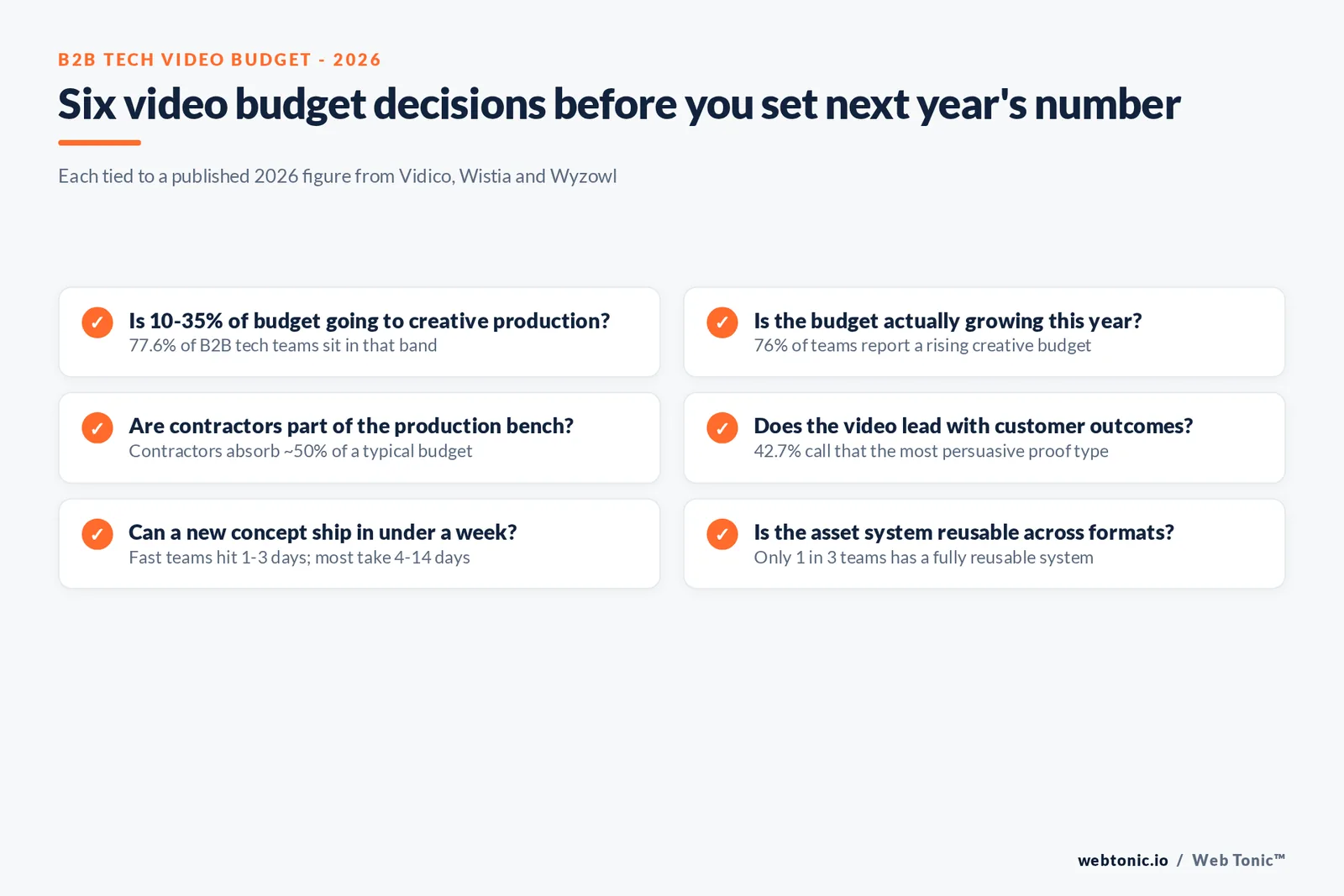
- 42.7% of B2B tech teams commit 21-35% of budget to creative production (Vidico).
- 35.9% commit 10-20% of budget to the same line.
- 76% say their creative production budget is increasing this year.
- 74% say total marketing budget is growing.
- Contractors absorb roughly 50% of a typical production budget.
- Sagefrog separately ranks video the lowest-growth B2B budget line, at 5%.
- 48% of companies plan to increase video promotion budgets in 2026 (Wistia).
- Fewer than 10% of companies are cutting video promotion budgets.
- 41% of companies spent under USD 20,000 on video promotion in 2025.
- 28% spent over USD 20,000 on the same line.
- 91% of businesses use video as a marketing tool in 2026 (Wyzowl).
- 93% of video marketers call it an important part of their strategy.
- 69% have created social media videos, the most common use case.
- Testimonial videos rank at 57% usage, ahead of product demos at 39%.
- 42.7% of B2B tech marketers say customer outcomes are the most persuasive proof type.
- Most teams need 4-14 days from concept to a live video; fast teams hit 1-3 days.
- Only about one in three teams has a fully reusable asset system.
- 81% of B2B teams share video on LinkedIn, ahead of YouTube at 76% (Wistia).
What share of budget actually goes to video
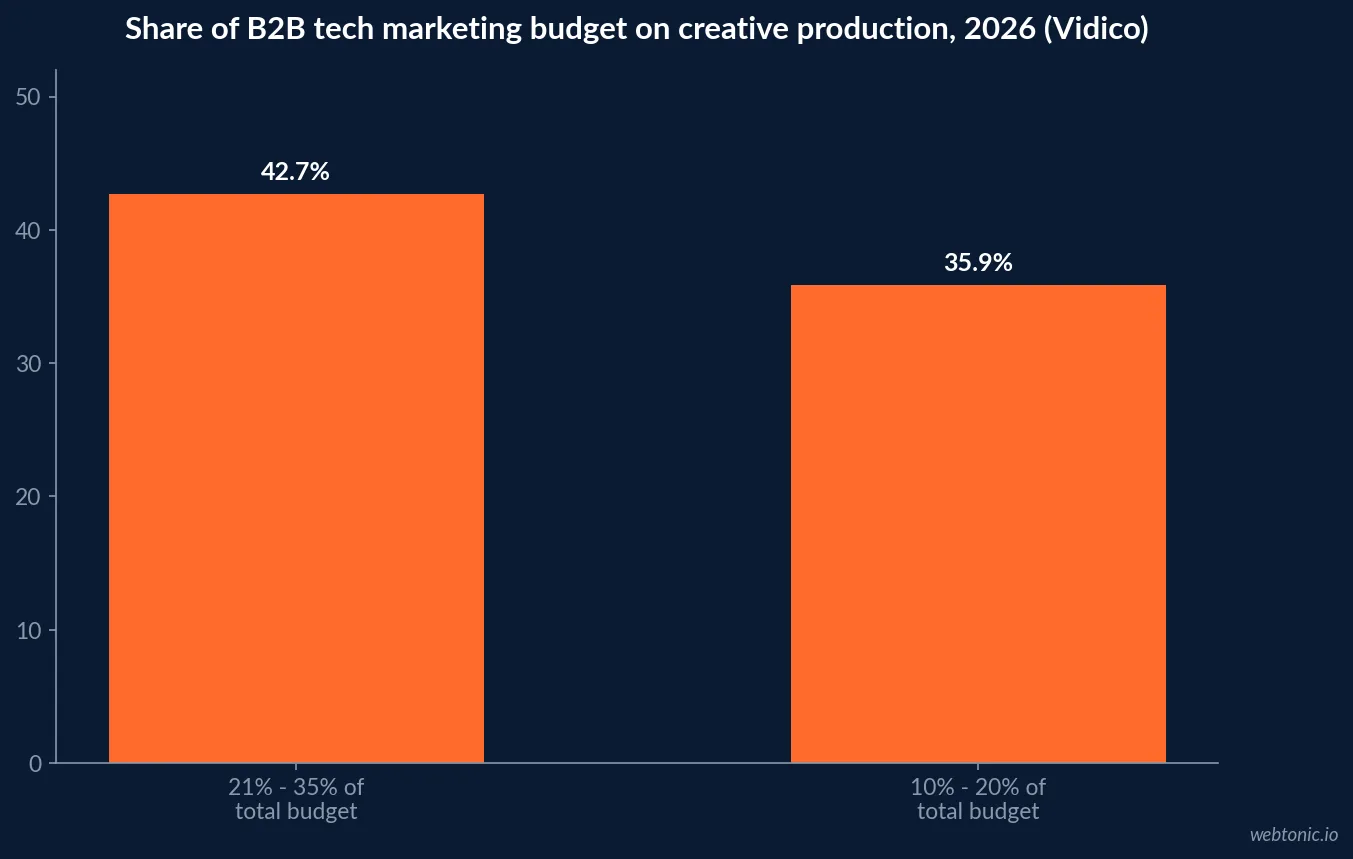
Vidico's 2026 State of Creative Marketing in Tech report, surveying 230-plus B2B tech marketing leaders, found creative production - which in a B2B tech context is overwhelmingly video - now absorbs 21% to 35% of total marketing budget for 42.7% of teams, with a further 35.9% in the 10% to 20% range. Very few teams reported single-digit allocations. That single data point is the clearest 2026 budgeting anchor available for a B2B SaaS marketing lead building next year's plan.
| Share of total marketing budget on creative production (Vidico 2026) | Share of B2B tech teams |
|---|---|
| 21% - 35% | 42.7% |
| 10% - 20% | 35.9% |
| Remainder (below 10% or above 35%) | ~21.4% combined |
Is the budget growing - and does that match what the rest of B2B marketing is doing?
Vidico found 76% of B2B tech marketing leaders say creative production budget is increasing this year, and 74% say total marketing budget is growing - investment is accelerating even as 42% say getting attention is harder because of more competition and more sameness, and 35% report accelerating creative fatigue. That tension - more spend, harder returns - is the report's central finding.
It is worth reading against Sagefrog's 2026 B2B Marketing Mix Report, a broader ~500-marketer survey not limited to video-heavy tech brands, which separately ranks video marketing and production at just 5% naming it a rising 2026 budget priority - tied for the lowest spot on that list, behind even website development. The two data sets are not contradictory: Vidico surveyed marketers who already treat video as core infrastructure, while Sagefrog's broader B2B sample shows video is still near the bottom of the priority stack for the average B2B marketer outside heavy video producers.
| Signal (2026 unless noted) | Reading it |
|---|---|
| 76% say creative production budget is rising (Vidico) | Among B2B tech teams already investing in video |
| 5% name video a rising 2026 budget priority (Sagefrog) | Across the broader B2B marketer population |
| 42% say attention is harder to win (Vidico) | Spend is up, results are not automatically |
| 35% report accelerating creative fatigue (Vidico) | Assets stop performing faster than before |
What companies actually spent on video promotion in 2025
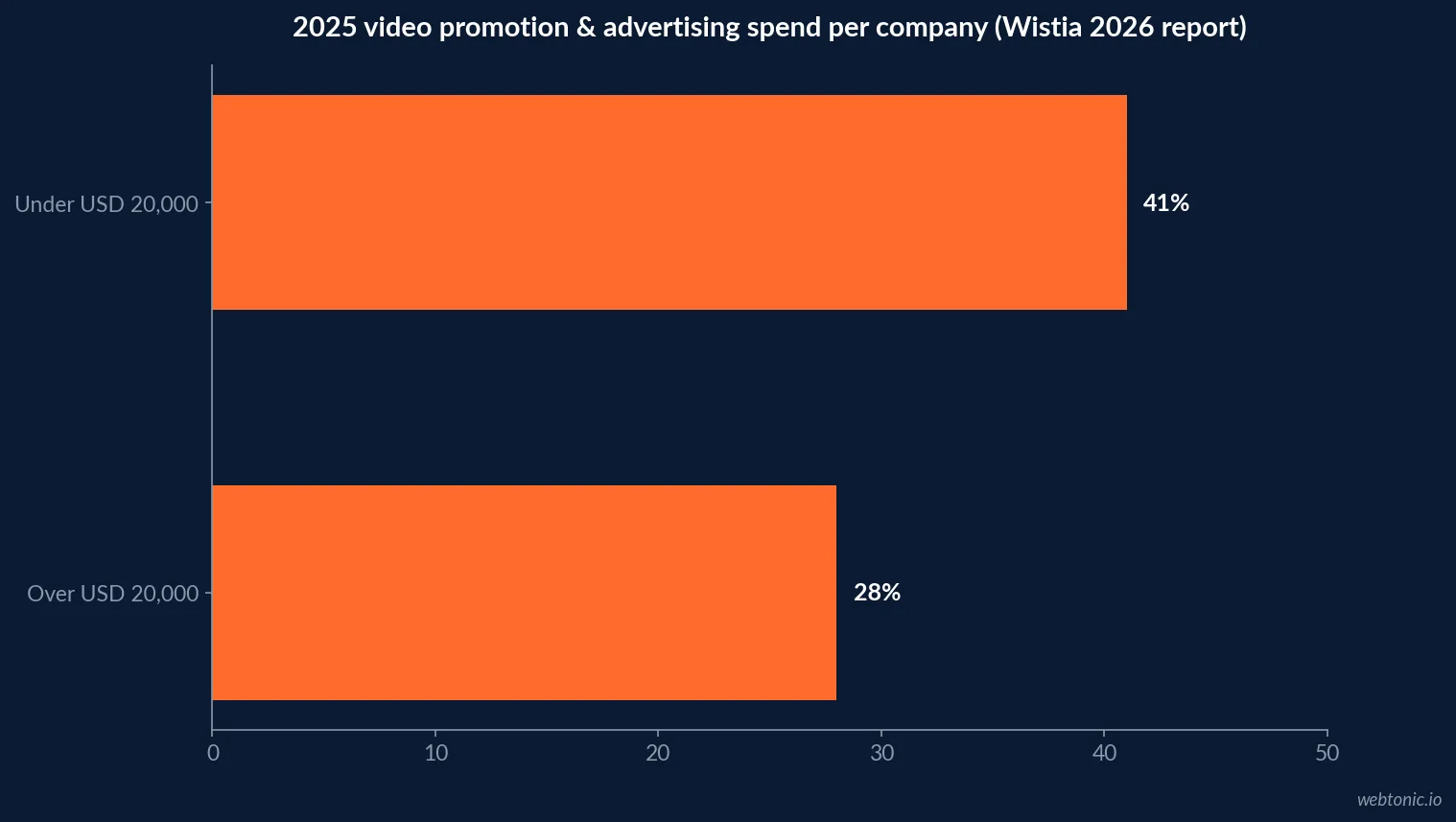
Wistia's 2026 State of Video Report, surveying 900-plus professionals across industries and analyzing 13 million-plus hosted videos, found 41% of companies spent under USD 20,000 on video promotion and advertising in 2025, against 28% that spent over USD 20,000. Looking ahead, 48% of companies plan to increase that promotion budget this year and fewer than 10% are cutting it. On the production side (making the videos, not promoting them), 40% of companies spent under USD 5,000 last year and 30% spent more than USD 5,000.
| Video promotion & advertising spend, 2025 (Wistia) | Share of companies |
|---|---|
| Under USD 20,000 | 41% |
| Over USD 20,000 | 28% |
| Planning to increase promotion budget in 2026 | 48% |
| Planning to cut promotion budget in 2026 | <10% |
Which video formats B2B tech marketers actually fund
Wyzowl's 2026 Video Marketing Statistics report found 91% of businesses use video as a marketing tool, matching the all-time high, and 93% of video marketers call it an important part of their overall strategy. Social media videos are the single most common use case at 69%, ahead of explainer videos (68%), testimonial videos (57%), presentation videos (48%), video ads (48%) and product demos (39%).
| Video format (Wyzowl 2026) | Share of video marketers using it |
|---|---|
| Social media videos | 69% |
| Explainer videos | 68% |
| Testimonial videos | 57% |
| Presentation videos | 48% |
| Video ads | 48% |
| Teaser videos | 45% |
| Product demo videos | 39% |
| Sales videos | 37% |
What buyers say actually moves them, versus what gets funded
Vidico's report is direct about the mismatch: customer outcomes and results is the most persuasive proof type in B2B tech, named by 42.7% of marketing leaders, ahead of every other category tested. Only 6.8% say they lack proof material - meaning roughly 93% already have customer evidence sitting somewhere and cannot get it in front of buyers in a usable video format. 85% have at least a partial proof system for turning that evidence into content, but only 38% have standardized it.
TrustRadius's 2026 B2B Buying Disconnect Report, based on 1,862 technology buyers and 444 technology vendors, reinforces the same finding from the buyer side: even as 63% of buyers now use AI during their purchase journey, product demos, free trials, prior experience and user reviews remain among the resources buyers say most influence a purchase decision - not polished brand video alone.
| Proof/production signal (2026) | Figure | Source |
|---|---|---|
| Most persuasive B2B tech proof type: customer outcomes | 42.7% | Vidico |
| Teams that say they lack proof material | 6.8% | Vidico |
| Teams with at least a partial proof system | 85% | Vidico |
| Teams with a fully standardized proof system | 38% | Vidico |
| Tech buyers who used AI during their purchase journey | 63% | TrustRadius |
Who makes the video: in-house, agency, or a hybrid bench
Nearly half of Vidico's respondent base runs a hybrid production model, with contractors accounting for roughly 50% of the typical creative production budget as teams shift from one-off freelance hires to a standing bench of boutique agencies and freelancers they can scale up without a fresh procurement cycle each time. Wyzowl's broader sample shows 59% of video marketers create video themselves in some capacity, while 42% of businesses rely on external creators for at least part of the work, and 63% have used AI video tools to help create or edit marketing videos, up sharply from 51% a year earlier.
How fast a B2B tech team can actually ship a new video
Speed is the operational bottleneck Vidico's data surfaces most clearly: most B2B tech teams take 4 to 14 days from concept to a live asset - too slow for fast-moving paid channels - while teams with reusable asset systems and streamlined approval chains consistently hit 1 to 3 days. Only about one in three teams has a fully reusable, modular asset system; the rest are rebuilding creative closer to scratch than their budget can really support, which is as much a process constraint as a spending one.
Building a 2026 video budget line that matches the data
Read together, the honest 2026 budgeting range for a B2B SaaS or tech marketing team is 10% to 35% of total marketing spend on video and creative production, weighted toward the proof formats - customer outcomes, testimonials, product demos - that buyer-side research keeps ranking above polished brand film. Our performance creative team builds that production cadence against a reusable asset system rather than one-off shoots, and our growth marketing practice sizes the paid distribution budget that gets the finished video in front of the right buyer once it exists. Our data and analytics team is what closes the loop on which format, from the table above, is actually moving pipeline once the video is live.
Frequently Asked Questions
What share of a B2B tech marketing budget should go to video?
Vidico's 2026 State of Creative Marketing in Tech survey, covering 230-plus B2B tech marketing leaders, found the largest group - 42.7% - now commits 21% to 35% of total marketing budget to creative production (which is mostly video in a B2B tech context), and the next largest group, 35.9%, sits in the 10% to 20% range. Very few teams report single digits. Treat 10-20% as a floor and 21-35% as where growth-stage SaaS teams are actually landing.
Is video budget increasing or flat for 2026?
Increasing for most teams, but unevenly funded relative to demand. Vidico found 76% of B2B tech marketing leaders say their creative production budget is increasing this year, and 74% say total marketing budget is growing. Wistia's 2026 State of Video Report, surveying 900-plus professionals across industries, found 48% of companies plan to increase video promotion budgets this year and fewer than 10% are cutting them - though Sagefrog's B2B-specific 2026 data separately ranks video marketing and production as the single lowest-growth budget line among B2B marketers, at just 5% naming it a rising priority.
What do B2B tech buyers actually want to see in vendor video?
Proof over production value. Vidico's same 2026 survey found customer outcomes and results is the most persuasive proof type in B2B tech, named by 42.7% of marketing leaders, ahead of every other category tested. TrustRadius's 2026 B2B Buying Disconnect Report, based on 1,862 technology buyers and 444 technology vendors, separately found that even as AI adoption in the buying journey accelerates, buyers still lean on product demos, free trials, and user reviews among their most influential resources.
How is B2B tech video actually produced - in-house, agency, or hybrid?
Mostly hybrid. Vidico's 2026 data shows nearly half of B2B tech brands run a hybrid production model, with contractors accounting for roughly 50% of the typical creative production budget as teams move from one-off freelance hires to a standing vendor bench. Wyzowl's 2026 Video Marketing Statistics report, covering marketers across sectors, found 59% of video marketers create video themselves in some capacity and 42% of businesses rely on external video creators for at least part of the work.
How fast can a B2B tech team turn around a new video concept?
Vidico's 2026 survey found most B2B tech teams take 4 to 14 days from concept to a live asset - too slow for fast-moving paid channels - while teams with reusable asset systems and streamlined approvals consistently hit 1 to 3 days. Only about one in three teams reports a fully reusable, modular asset system; the rest are still rebuilding creative from scratch more often than the budget can absorb.
Sources
Vidico, State of Creative Marketing in Tech 2026
Wistia, State of Video Report 2026
Wyzowl, Video Marketing Statistics 2026
TrustRadius, 2026 B2B Buying Disconnect Report
Sagefrog, 2026 B2B Marketing Mix Report