Table of contents
Only an estimated 8% of B2B marketers currently run TikTok ads, yet the small number of B2B SaaS accounts that published real results reported some of the largest cost swings of any paid channel - a reminder that low adoption and low performance are not the same thing. This page separates the adoption gap from the performance evidence, and states plainly where a figure is a single company's case study rather than a channel-wide benchmark.
Key Takeaways
- Only about 8% of B2B marketers currently invest in TikTok advertising.
- An estimated 80% of B2B marketers run no TikTok activity at all.
- B2B advertiser counts on TikTok grew an estimated 142% year over year.
- 15% of product discoveries now begin on TikTok, per TikTok and Nielsen data.
- TikTok reports an average return of $2 for every $1 spent across its advertiser base.
- Roughly two-thirds of decision-makers use TikTok to learn about products pre-demo.
- One B2B software case cut cost per sign-up from $185 to $7, a 96% reduction.
- That reduction came from switching to Spark Ads and platform targeting tools.
- More than 95% of B2B buyers use video during product research (industry data).
- The average B2B buying cycle lasted 10.1 months in 6sense's 2025 report.
- 95% of winning vendors were already on the buyer's Day One shortlist.
- The 25-34 age group is now TikTok's largest demographic, overtaking 18-24.
- Professional-audience TikTok CPMs run well below LinkedIn's in cross-platform data.
- 52% of users exposed to small-business content made a purchase, per a Drum-cited report.
- TikTok's US audience alone is roughly 148 million monthly unique users.
The adoption gap is the headline, not a footnote
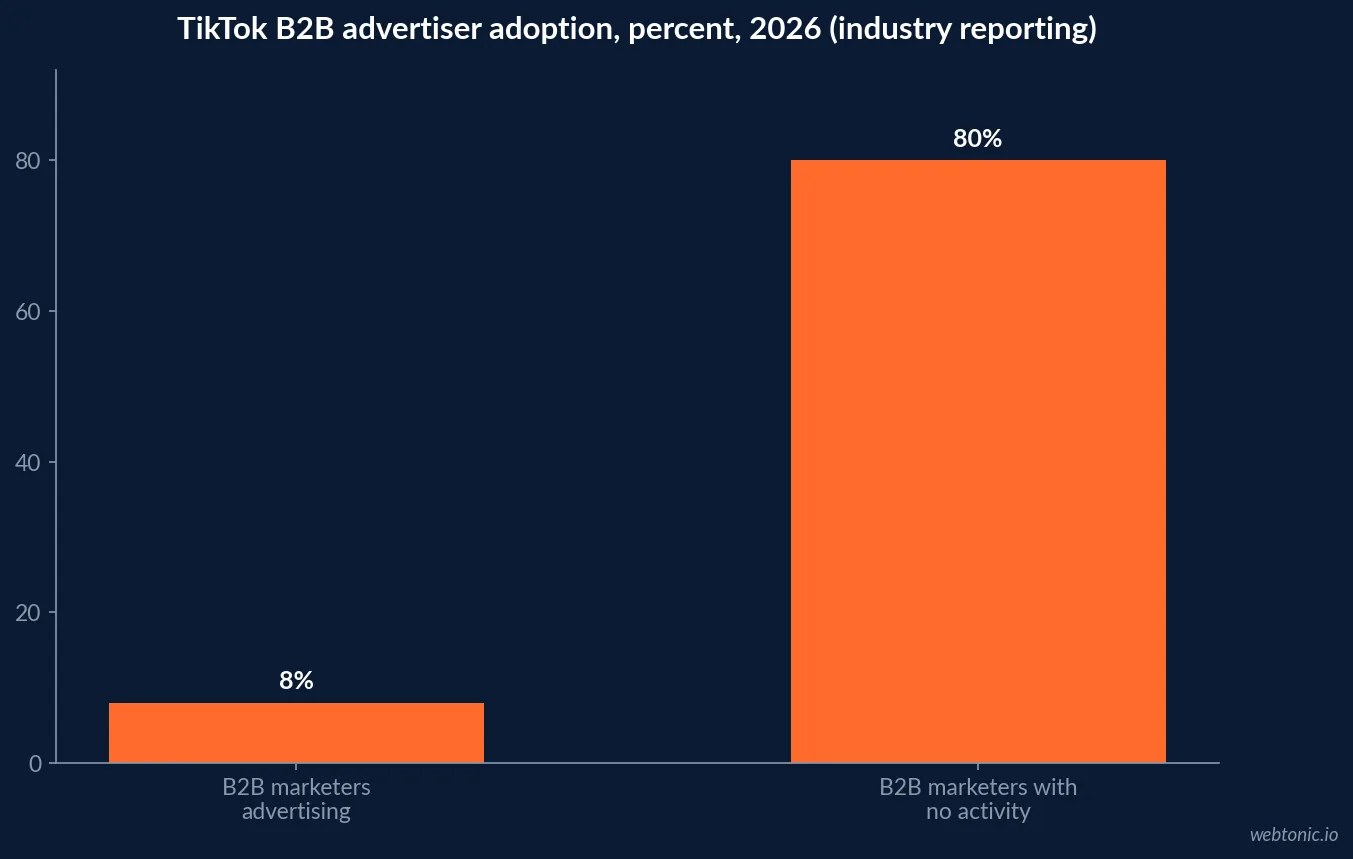
Across the 2026 B2B-on-TikTok guides reviewed for this page, the recurring figure is that roughly 8% of B2B marketers currently invest in TikTok advertising, with an estimated 80% running no TikTok activity at all. That is a thinner base than every other channel this coverage set has examined for B2B SaaS - Google, Meta and LinkedIn all show broad, if uneven, adoption. TikTok's B2B advertiser count is reported growing quickly off that low base, an estimated 142% year over year, which is consistent with a channel in the early-adopter phase rather than one with mature, comparable benchmarks.
That gap cuts two ways for a B2B tech marketer: less competition for attention in a still-cheap auction, but also far less third-party data to validate a budget request against.
| TikTok B2B adoption fact (2026) | Figure | What it implies | Source |
|---|---|---|---|
| B2B marketers currently advertising on TikTok | ~8% | A thin, early-adopter base | Industry reporting, TikTok B2B guides |
| B2B marketers with no TikTok activity | ~80% | Most competitors are not there yet | Industry reporting, TikTok B2B guides |
| YoY growth in B2B advertiser count | +142% | Fast growth off a small base | Industry reporting, TikTok B2B guides |
| Share of product discovery starting on TikTok | 15% | Fastest-growing discovery channel | TikTok/Nielsen data via martech.org |
| TikTok's own reported average return | $2 per $1 spent | Platform-reported, not third-party audited | TikTok data via martech.org |
What TikTok is actually being used for in a B2B funnel
Every credible 2026 guide reviewed here frames TikTok as a top-of-funnel discovery and familiarity layer, not a bottom-of-funnel conversion channel. One 2026 guide reports that roughly two-thirds of company decision-makers on TikTok say they use the platform to discover or learn about business products, software or services before they have visited a website or requested a demo. Directive Consulting's guide ties this directly to 6sense's 2025 B2B Buyer Experience Report, which found 95% of winning vendors were already on the buyer's Day One shortlist and the average buying cycle ran 10.1 months - meaning familiarity built months before an active evaluation starts is what actually shapes the eventual shortlist.
A separate 2026 guide reports more than 95% of B2B buyers use video as part of their product research, which is the underlying reason a short-form video platform earns a place in the B2B mix even without a direct-response track record to match LinkedIn or Google.
| Funnel stage | TikTok's evidenced role | Success metric to track | Source |
|---|---|---|---|
| Top of funnel | Brand and category awareness | Video views, watch time, saves | Directive Consulting 2026 |
| Pre-demo research | Decision-maker product discovery | Branded search lift, site traffic | TikAdTools 2026 guide |
| Mid funnel | Problem education, credibility content | Content downloads, repeat visits | Directive Consulting 2026 |
| Bottom of funnel | Only with intent-matched offers | Demo requests, trial signups | Directive Consulting 2026 |
The single case study that shows the ceiling
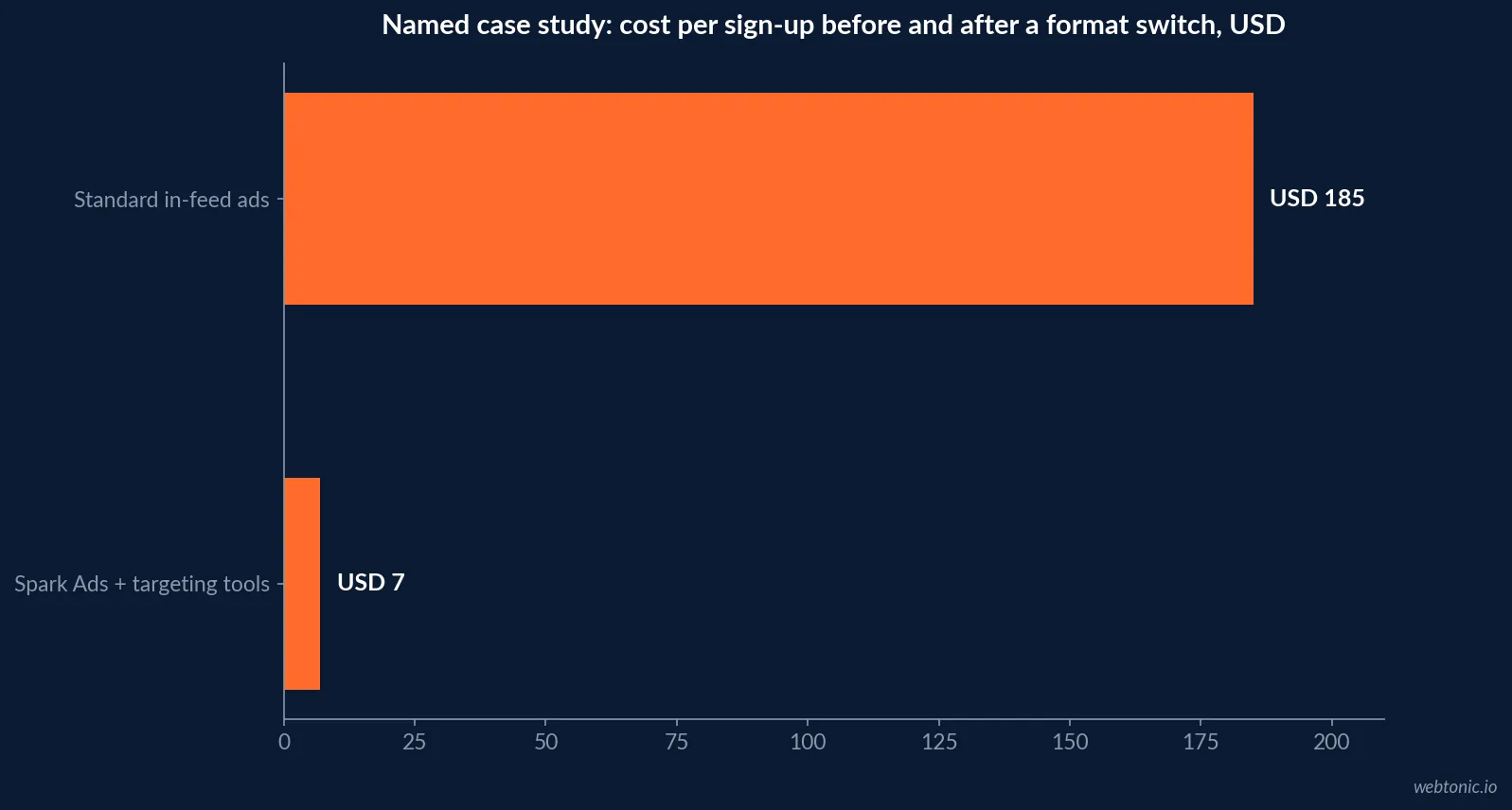
The most frequently cited B2B TikTok result across the guides reviewed here is Goodcall, described as a B2B AI software company that cut its cost per sign-up from $185 to $7 - a 96% reduction - after switching from standard in-feed placements to Spark Ads (boosted organic-style posts) combined with TikTok's audience targeting tools. This is one company's reported result, not a channel-wide benchmark, and it should be read as evidence that format choice can move B2B TikTok costs by an order of magnitude, not as a number any other account should expect to replicate directly.
The mechanism is plausible even without a larger sample: Spark Ads inherit the organic engagement signals of the underlying post, which the algorithm can use to find a more relevant audience than a cold in-feed placement with no engagement history behind it.
| Case detail (Goodcall, B2B AI software) | Before | After | Change |
|---|---|---|---|
| Ad format | Standard in-feed ads | Spark Ads + audience targeting tools | Format switch |
| Cost per sign-up | $185 | $7 | -96% |
| Result type | Single-company case study | Single-company case study | Not a benchmark |
| Named case detail vs. cross-industry reference | Goodcall (B2B AI software) | Meta cross-industry median | LinkedIn cross-industry median |
|---|---|---|---|
| Cost per acquisition-style event | $7 (after format switch) | $27.39 per lead | $202 spend-weighted / $376 median |
| Sample size behind the figure | 1 named company | ~1,800 campaigns | 138 advertisers |
| Whether a B2B-specific line exists | Yes, this is the B2B case | No published B2B line | Yes, LinkedIn is B2B by design |
Why the format switch mattered more than the platform
The mechanism behind Goodcall's 96% cost reduction is instructive for any B2B SaaS team evaluating TikTok: Spark Ads boost an existing organic post rather than launching a cold, purpose-built ad unit, which means the algorithm inherits real engagement signals (watch time, shares, comments) before it starts spending on distribution. A standard in-feed ad with no engagement history is, by comparison, asking the algorithm to find an audience with almost no signal to work from - which is consistent with the $185 starting cost per sign-up in the same case.
That mechanism generalizes better than the raw dollar figures do: any B2B SaaS team testing TikTok should expect a purpose-built, never-published ad to underperform a boosted, already-engaging organic post, independent of the specific cost numbers a single company happened to report.
| Format decision | Signal the algorithm inherits | Evidenced outcome | Recommendation |
|---|---|---|---|
| Boosted organic post (Spark Ads) | Real watch time, shares, comments | Goodcall case: $7 cost per sign-up | Start here for a first test |
| Cold in-feed ad, no history | None - algorithm guesses | Goodcall case: $185 cost per sign-up | Avoid as the first test |
| Repurposed static/display creative | Feels like an interruption on a native feed | Not evidenced in reviewed case studies | Use only after Spark Ads validate the offer |
Who is on the platform, and why the demographic argument holds up
The demographic objection to B2B TikTok spend - "it's a platform for teenagers" - is increasingly out of date. Martech.org reports TikTok's US base alone at roughly 148 million monthly unique users, with 21.7% of the US base identifying as Millennials and a 2026 TikTok B2B guide reporting that the 25-34 age group has overtaken 18-24 as the platform's single largest cohort - the same age band making a growing share of day-to-day B2B software decisions. Martech.org also cites a Drum-reported finding that 52% of users exposed to small and mid-size business content made a purchase after seeing it, evidence that commercial intent exists on the platform even outside the DTC-brand context most people associate with it.
None of that closes the evidence gap against LinkedIn's transparent, 138-advertiser cost-per-lead dataset - it argues for testing TikTok as an incremental awareness layer with a small, clearly labeled budget, not for reallocating a proven LinkedIn or Google budget toward it. Meta's own cross-industry lead cost, a median $27.39 per lead (WordStream 2026), is a closer reference point for what a mature paid-social channel actually costs once volume exists to benchmark against.
How to test TikTok without overcommitting
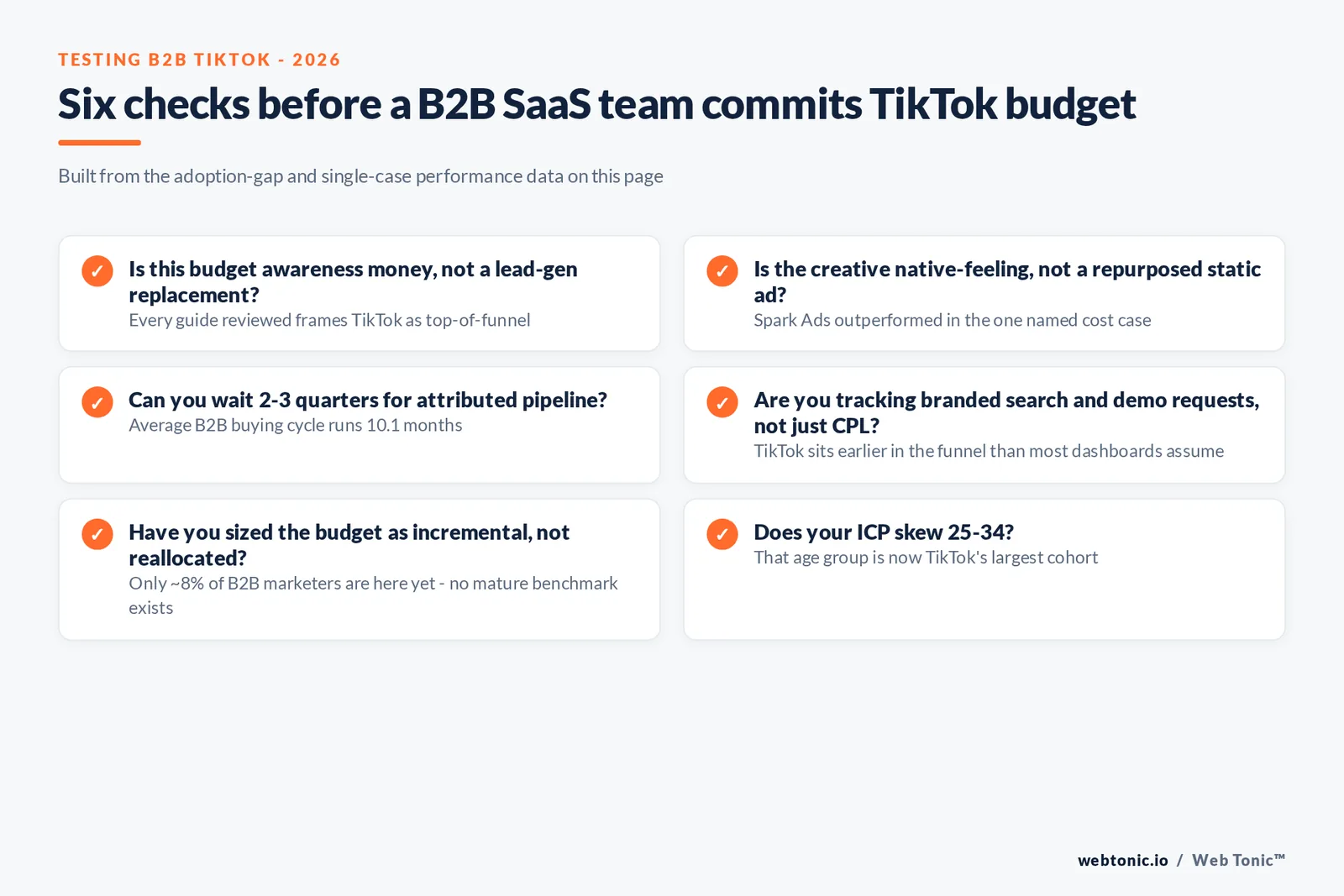
Start with Spark Ads on genuinely useful content (a product walkthrough, a customer story, a practitioner take on a category problem) rather than a repurposed static ad, since the case evidence above and the discovery-behavior data both point to native-feeling content outperforming interruption-style creative. Measure the test on branded search lift, site traffic, and demo requests attributed to the platform - not cost per lead in isolation, since every credible guide places TikTok earlier in the funnel than the conversion event most B2B dashboards track by default. Our performance creative team builds that kind of native-format test plan before recommending a platform-specific budget increase, and our team can walk through whether your buying cycle and ACV fit the awareness-first case made here; reach out before committing a test budget.
Budget small and be patient: with the average B2B buying cycle at 10.1 months and 95% of eventual winners already shortlisted on Day One of formal evaluation, a TikTok awareness campaign started this quarter is unlikely to show up as attributed pipeline for two or three quarters after that. That patience is consistent with a broader 2026 shift in how B2B buyers research at all: TrustRadius's 2026 report found analyst-report usage in purchase decisions down 63% since 2022, which means the earlier, less formal discovery channels - including short-form video - are absorbing a growing share of a buyer's first exposure to a category.
Frequently Asked Questions
How many B2B companies actually advertise on TikTok?
Roughly 8%, per industry reporting cited across multiple 2026 B2B TikTok guides, with an estimated 80% of B2B marketers running no TikTok activity at all. That gap is closing, not static: B2B advertiser counts on the platform grew an estimated 142% year over year as more software and services brands tested the channel for top-of-funnel awareness rather than direct response.
Does TikTok actually work as a discovery channel for B2B buyers?
TikTok and Nielsen data cited by martech.org found TikTok is the fastest-growing channel for product discovery, with 15% of product discoveries now starting there, and reports an average return of $2 for every $1 spent across TikTok's own advertiser data. A separate 2026 guide found roughly two-thirds of company decision-makers on TikTok say they use the platform to learn about business products or software before visiting a website or requesting a demo - which frames the channel as pre-funnel awareness, not a bottom-of-funnel conversion play.
What is a realistic B2B SaaS cost swing from switching ad formats on TikTok?
One frequently cited case (Goodcall, a B2B AI software company) cut its cost per sign-up from $185 to $7 - a 96% reduction - after switching to Spark Ads and TikTok's audience targeting tools instead of standard in-feed placements. That is a single company's result, not a channel-wide average, and should be read as evidence that format choice on TikTok can swing B2B costs by an order of magnitude, not as a number to plan a budget around directly.
How long is the B2B SaaS buying cycle TikTok ads are feeding into?
Long. 6sense's 2025 B2B Buyer Experience Report, cited in a 2026 TikTok-for-B2B-SaaS guide, found the average B2B buying cycle lasted 10.1 months, and that 95% of winning vendors were already on the buyer's shortlist on Day One of the formal buying process. That timeline argues for using TikTok to build early familiarity well before a formal evaluation starts, rather than judging the channel on last-click demo requests alone.
Should a B2B SaaS marketer expect TikTok to replace LinkedIn or Google Ads?
No single piece of 2026 research reviewed for this page suggests that. Every credible B2B TikTok guide frames it as a top-of-funnel awareness and discovery layer that feeds accounts into LinkedIn, email, or direct search later in the journey, not a like-for-like substitute for LinkedIn's lead-gen forms or Google's high-intent search traffic. Track TikTok on website visits, demo requests sourced from the platform, and branded search lift, not cost per lead in isolation.
Sources
Martech.org - B2B marketing on TikTok: what you need to know
TikAdTools - TikTok Ads B2B Strategy 2026
TikAdSuite - TikTok Ads for B2B Companies, a fact-checked playbook
Stackmatix - TikTok Advertising for SaaS Companies, 2026 Guide
Directive Consulting - TikTok Ads for B2B SaaS, a practical guide
Metadata - LinkedIn Ads Cost for B2B in 2026 (cross-channel reference)
WordStream - Facebook Ads Benchmarks (cross-channel reference)
TrustRadius - 2026 B2B Buying Disconnect Report